
eID verification in Latvia: Smart-ID, eParaksts and the rules
Smart-ID has 1.2 million users in Latvia; eParaksts and the eID card form the notified state scheme. The eID and AML rules, EUDI Wallet dates and a launch checklist for businesses.
 By Alberto RosasCo-founder & CEO, DiditUpdated
In short
People in Latvia prove who they are online with three eIDs: Smart-ID (1,198,463 users in Latvia), eParaksts mobile, and the eID card with eParaksts certificates.[1][2] A business that verifies identity in Latvia should accept Smart-ID first and keep a document route for everyone else.
- The eParaksts tools and the eID card form the Latvian eID scheme, notified under eIDAS at Substantial and High since 18 December 2019.[3] eParaksts mobile is on Didit's roadmap; Didit adds the eID card and the eParaksts cards on request.
- Smart-ID is not EU-notified, but Latvia's Digital Security Supervisory Committee qualified it in May 2023.[4][5]
The state's eParaksts tools confirm a person's identity 3.6 million times a month on average.[2] Yet the eID with the most users is run by a company, not the state: Smart-ID, from SK ID Solutions in Estonia.[1][5]
This guide covers each eID, the eID and anti-money laundering (AML) laws, the EUDI (European Digital Identity) Wallet dates and a launch checklist. For the basics of eID (electronic identification), read what eID verification is.
Every eID in Latvia at a glance: Smart-ID, eParaksts and the eID card
Latvia's Ministry of Defence lists two qualified electronic identification providers: Smart-ID, and the state-owned Latvian State Radio and Television Centre (LVRTC), which offers four means: the eID card, the eParaksts card, the eParaksts card+ and eParaksts mobile.[5]
| eID | Operator | Users | Credential | Level of assurance and EU notification | Data returned | Private-sector access | Didit status |
|---|---|---|---|---|---|---|---|
| Smart-ID | SK ID Solutions, Estonia[4] | 1,198,463 in Latvia (5 October 2026)[1] | Phone app, confirmed with a PIN[6] | Not EU-notified[3] Qualified in Latvia since May 2023[4]; Didit labels it High | Full name, date of birth, personal code, level of assurance (as Didit returns it)[7] | Direct contract with SK (published price list) or a broker[8] | Live |
| eParaksts mobile | LVRTC, state-owned[5] | 640,000+ residents used it or the eID card in 2026[2] | Phone app with qualified certificates, PIN1 or biometrics[9] | Latvian eID scheme, Substantial and High, notified 18 December 2019[3] | Name, surname, personal code[10] | LVRTC e-identity and signing platform.[11] No published pricing found (5 October 2026) | Coming soon |
| eID card (personas apliecība) | Issued by PMLP; certificates by LVRTC[2] | Available to 1.3 million residents (September 2025)[12] | Chip card with PINs, read by a card reader or the eID Scan app[13] | Latvian eID scheme, Substantial and High, notified 18 December 2019[3] | Name, surname, personal code[10] | Same LVRTC platform[11] | On request |
| eParaksts card and card+ | LVRTC[5] | Not published in our sources | Smart card for signatures[5] | Latvian eID scheme, Substantial and High[3] | Name, surname, personal code[10] | Same LVRTC platform[11] | On request |
The EU list gives one level for the whole scheme, not per means.[3]
Mobile-ID, the SIM-based eID, is offered only in Estonia and Lithuania, not in Latvia.[14] Bank logins no longer open the state portal Latvija.gov.lv: since 1 January 2025 it accepts only eParaksts mobile, the eID card, the eParaksts card, the qualified version of Smart-ID and other EU eIDs.[15]
Smart-ID counter and LVRTC, October 2026.[1][2]
Latvia's eID timeline and what changes in 2026 and 2027
LVRTC records the first secure electronic signature in Latvia on 4 October 2006.[2]
- 2012eID cardThe card ships with eParaksts built in.
- 2017Smart-IDSmart-ID becomes Latvia's most used digital identity.
- 2018eParaksts mobileLVRTC launches the app.
- 18 December 2019NotifiedThe Latvian eID scheme joins the EU list.
- 1 January 2025No bank loginsLatvija.gov.lv accepts qualified eIDs only.
Latvia's eID milestones to 2025.[2][4][3][15]
- 11 November 2025Browser codeeParaksts mobile asks for a 3-digit code on first use of a browser.
- 22 September 2026NFC sign-upSmart-ID registration with the eID card moves to NFC.
- 24 December 2026Wallet deadlineEvery Member State offers at least one EUDI Wallet.
- 10 July 2027AMLR applieseID becomes a named route for identity checks.
- 24 December 2027Acceptance dutyRegulated private services must accept the wallet.
Dates from LVRTC, SK and the EU texts.[9][16][17][18]
The eID card is the compulsory identity document for Latvian citizens and non-citizens from age 15, and it becomes mandatory as a person's passport expires, with a longer transition until 2030 for pensioners, residents abroad and people in social care.[19][20]
Under eIDAS 2, Regulation (EU) 2024/1183, private services required to use strong user authentication must accept the wallet at the user's request by 24 December 2027; micro and small enterprises are exempt.[17] See the EUDI Wallet page for the relying-party side.
eParaksts, Smart-ID and the rules: eID law, AML and regulators
Three Latvian texts set the legal weight of an eID sign-in. The first is the Law on Electronic Identification of Natural Persons (version from 30 September 2026).
Article 3(3)Fizisko personu elektroniskās identifikācijas likums
"Elektroniskā identifikācija uzskatāma par notikušu un ir pielīdzināma fiziskās personas identitātes pārbaudei klātienē"
Source: Likumi.lv, Law on Electronic Identification of Natural Persons[21]
In plain English: an eID sign-in equals an in-person identity check when it uses a qualified or qualified high-security eID means, or a written agreement (provider and service, or service and person) allows it.[21][5]
The second is the AML law. It identifies a person by an identity document (Article 12), and a customer not met in person triggers enhanced due diligence unless identification uses technology the Cabinet of Ministers regulates:[22]
Non-face-to-face ruleNoziedzīgi iegūtu līdzekļu legalizācijas un terorisma un proliferācijas finansēšanas novēršanas likums
"izmantojot tehnoloģiskos risinājumus, kas ietver videoidentifikāciju vai drošu elektronisko parakstu, vai citus tehnoloģiskos risinājumus, tiek veikta Ministru kabineta noteiktajā apjomā un kārtībā"
Source: Likumi.lv, AML law[22]
The third is Cabinet Regulation No. 392 of 3 July 2018. Its point 7.1 accepts a secure electronic signature, a qualified high-security eID under the eID law, or means usable under Regulation (EU) No 910/2014. The other routes are video identification (points 7.2 and 10), a bank identification payment (point 7.3) and a document photo with a selfie (point 7.4).[23]
Watch out
That Smart-ID falls under point 7.1 is a reading of the text, not an official statement we found. Its qualified status is official; confirm your supervisor's reading.[4]
From 10 July 2027 the EU Anti-Money Laundering Regulation (AMLR) adds an EU route: Article 22(6)(b) accepts eID means at the assurance levels 'substantial' or 'high'.[18] The final draft standards of the EU Anti-Money Laundering Authority (AMLA), of 30 September 2026 and not yet law, accept eID "regardless of whether they are notified", if it meets the substantial or high level, and make document checks a justified alternative.[24]
Regulators and age rules
The Ministry of Defence's Digital Security Supervisory Committee registers and supervises qualified eID providers; so far two: Smart-ID and LVRTC.[5] The State Digital Development Agency (VDAA) runs the state single sign-on module, free for public bodies and companies with a public mandate.[25] We found no published eID position from Latvia's financial, gambling or telecom regulators; the laws above bind.
We found no Latvia-specific age-verification rule. EU rules apply: the Digital Services Act (DSA) Article 28 guidelines expect age verification for high-risk products such as alcohol, tobacco and nicotine products, drugs, gambling and pornographic content, and where terms require 18+.[26] LVRTC's platform already offers an age-threshold check "neatklājot personas pilnu identitāti", without revealing the person's full identity.[11] For the method trade-offs, see age verification.
What the user sees with Smart-ID
Classic Smart-ID works with a comparison code: the website shows a code, the app shows the same code with the service name, and the user confirms with PIN1.[6][27]
Choose how to verify
Sign in with the electronic ID you already use.
Smart-ID
Use an ID document instead
1The user picks Smart-ID in the Didit flow.
Your personal code
Country: Latvia. Personal code: as on your eID card.
Continue
2The user enters their Latvian personal code.
Check the code
4821
The same code appears in your Smart-ID app.
3The flow shows a four-digit comparison code.
Enter PIN1
Only if the code matches the one on screen.
4The user confirms with PIN1 in the Smart-ID app.
You are verified
- Full nameShared
- Date of birthShared
- Personal codeShared
- AddressNot shared
5Back in your app, with signed attributes.
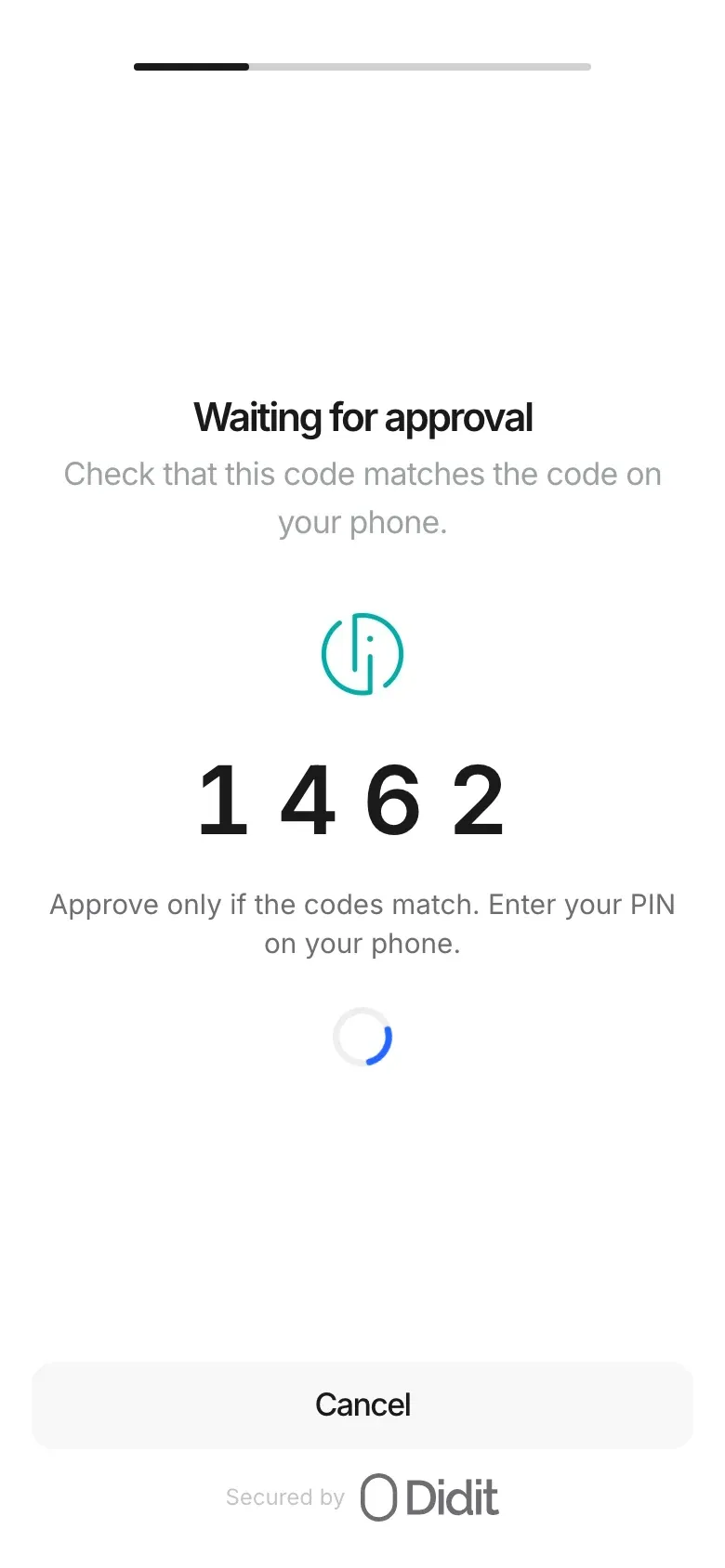
The comparison code step in the Didit hosted flow.
An app sign-in with a comparison code, start to finish.
Some services turn on a harder check: the app shows three codes and the user picks the one on screen.[27] Smart-ID+ drops the personal code: the app scans a QR code on a computer, or opens app to app on a phone.[6] It rolls out to users through 2026, for services that adopt it.[28] eParaksts mobile differs: PIN1 or biometrics, and since 11 November 2025 a 3-digit browser code on first use.[9]
Note
According to LSM, fraudsters in spring 2025 generated personal codes and user numbers to push eParaksts approvals at random people. The browser code answers that.[9]
Choosing eID schemes in Latvia by use case
eParaksts mobile matters where state tools are expected: LVRTC names Latvijas Loto, the telecom operator LMT and Latvenergo among its users.[13]
Start here
Smart-ID
- Most users in Latvia
- Qualified, not EU-notified
Comparison code, then PIN1
Add next
eParaksts mobile and eID card
- Notified at Substantial and High
- Age-threshold check
- On Didit's roadmap
App or card, then PIN1
No eID
Identity document
- Foreign residents and visitors
- Chip, liveness, face match
Document capture with NFC
Three routes, one workflow.
| Use case | Accept first | Why |
|---|---|---|
| Fintech and banking | Smart-ID, then eParaksts | Regulation No. 392 point 7.1[23] |
| Crypto | Smart-ID, then eParaksts, then documents | Same AML rules if you are an obliged entity[22] |
| Gambling | eParaksts or Smart-ID, with the signed date of birth | Latvijas Loto uses eParaksts mobile; DSA guidelines expect age verification[13][26] |
| Telecom | eParaksts mobile and Smart-ID | LMT uses eParaksts mobile[13] |
| Marketplaces | Smart-ID for sellers, documents for foreigners | No eID-specific rule found |
| Mobility and rentals | Smart-ID plus a driving licence check | An eID returns no licence data |
People without a Latvian eID: foreign residents, minors, cross-border customers
- Foreign residents: Smart-ID in Latvia is limited to people with a Latvian personal code.[29] eParaksts mobile is open from age 14 with a passport or eID card, residence permits included, but not the foreigner's eID card.[12]
- Minors: a child under 15 can get an eID card on a parent's application.[30] Smart-ID registration with the card starts at 14, and accounts under 18 need parental authorisation.[31]
- Older eID cards: cards with the Cosmo 8.1 chip, issued from 2 September 2019 to 30 January 2026, cannot register Smart-ID by NFC.[16]
- Cross-border customers: Smart-ID is one app across the three Baltic states.[1]
1Show the eIDs for Latvia first
Smart-ID at the top of the chooser.
Does the user have Smart-ID or another eID you accept
Sign in with the eID
Signed name, date of birth and personal code.
Verify with a document
Chip reading, liveness and face match.
2Screen and decide
Sanctions and PEP screening; the decision stays with you.
Under the AMLA drafts, record why a customer could not use an eID.[24] See NFC chip verification and the Estonian and Lithuanian guides.
Launch checklist for eID verification in Latvia
- Accept Smart-ID first, as the eID with the most users in Latvia.
- Confirm with your supervisor how Regulation No. 392 point 7.1 applies to your route.
- Offer a document route with chip reading for foreign residents and visitors.
- Check the age on the signed date of birth for age-restricted products.
- Plan EUDI Wallet acceptance before 24 December 2027 if the duty applies to you.
How Didit helps with eID verification in Latvia
Smart-ID is live on Didit in Latvia, Estonia, Lithuania and Belgium. Turn it on in the console under Workflows, ID Verification, Countries, Wallets accepted, or with the workflows API. A sign-in returns the full name, date of birth, personal code, the asserted level of assurance (labelled High) and a signature check; no address, no portrait. See national eID and the documentation.[7]
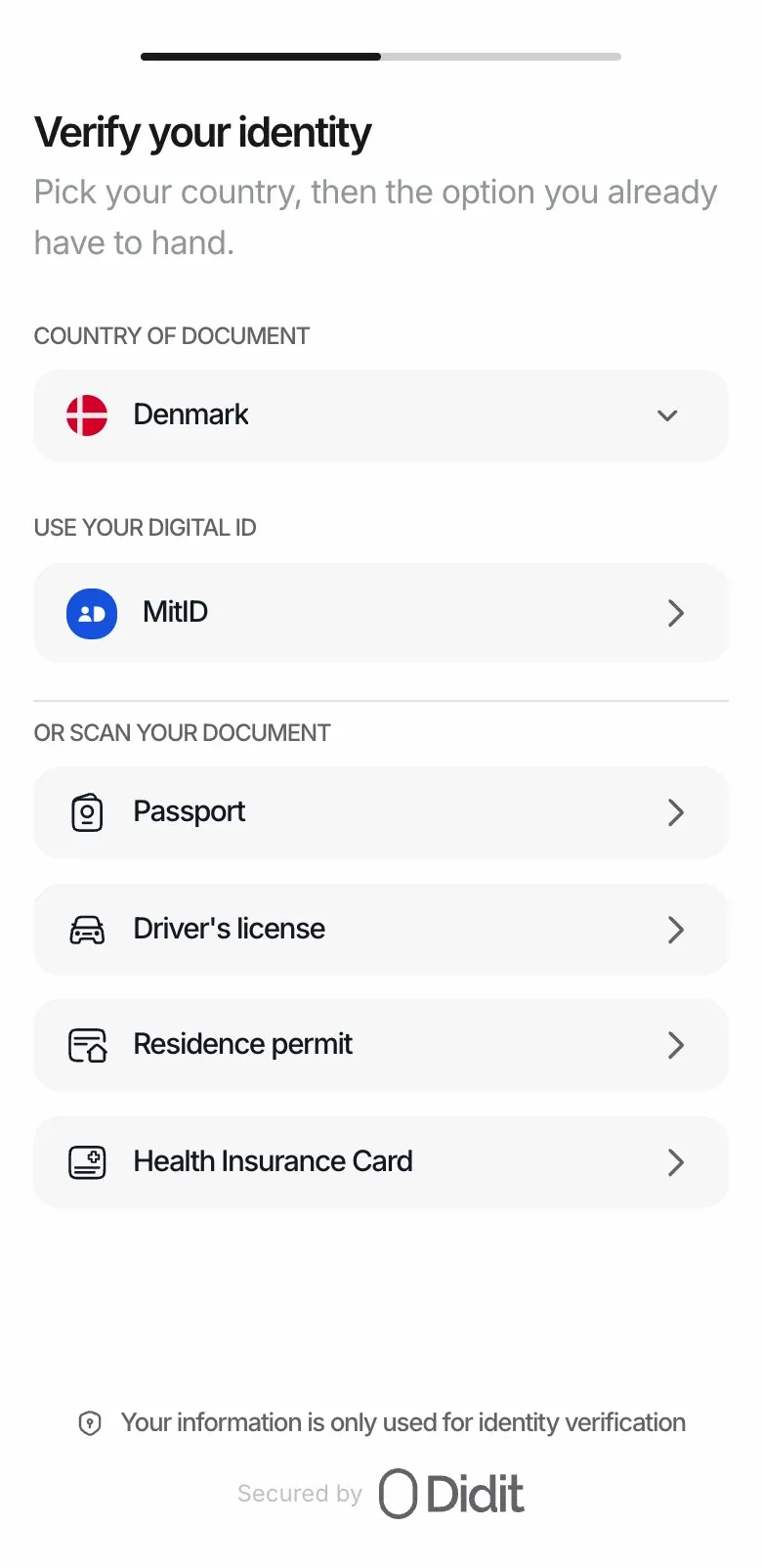
The eID chooser your users see first.
eParaksts mobile is on Didit's roadmap; Didit adds the eID card and the eParaksts cards on request. Users without Smart-ID fall back to documents with liveness, face match and chip reading. A full KYC check costs $0.33 and NFC verification $0.15; AML screening costs $0.20. Completed Smart-ID sign-ins cost $0.20 (pricing); cancelled, timed-out and failed ones are free. EUDI Wallet acceptance is coming soon on Didit.
Didit provides
- Smart-ID sign-in in the hosted flow or the SDK
- The document route for users without an eID
- The signed attributes and evidence of every check
Stays with you
- The risk assessment and the policies
- The onboarding decision
- How your supervisor reads Regulation No. 392
Accept Smart-ID in Latvia today
Smart-ID and the document route in one workflow, billed only for completed checks.
Key takeaways
- Smart-ID has 1,198,463 users in Latvia and is the first eID to accept.
- eParaksts mobile and the eID card form the Latvian eID scheme, notified at Substantial and High. eParaksts mobile is on Didit's roadmap.
- Regulation No. 392 point 7.1 accepts qualified eID for remote identification today; AMLR Art. 22(6) follows on 10 July 2027.
Frequently asked questions
What is eParaksts?
eParaksts is the family of state eID and e-signature tools run by LVRTC, the state-owned Latvian State Radio and Television Centre. It covers eParaksts mobile, the eID card, the eParaksts card and the eParaksts card+.[5] A sign-in shares the person's name, surname and personal code with their consent.[10] Businesses connect through LVRTC's e-identity and signing platform.[11] We did not find published business pricing in the sources reviewed as of 5 October 2026.
Which eID is most used in Latvia?
Smart-ID, with 1,198,463 users in Latvia on 5 October 2026.[1]
Is Smart-ID on the EU list of eID schemes?
No, it is absent from that list.[3] Latvia's Digital Security Supervisory Committee qualified it as an electronic identification provider in May 2023.[4][5]
What does a business receive from an eID sign-in in Latvia?
eParaksts shares the name, surname and personal code with the person's consent.[10] A Smart-ID sign-in on Didit returns the full name, date of birth, personal code and the level of assurance, with no address or portrait.[7]
Can a Latvian bank or fintech onboard customers remotely with eID?
Yes. Cabinet Regulation No. 392 point 7.1 accepts a secure electronic signature, a qualified high-security eID under the eID law, or eIDAS means for remote identification, within the scope and procedure the regulation sets.[23] Smart-ID under point 7.1 is a reading; confirm it with your supervisor.[4] From 10 July 2027, AMLR Art. 22(6)(b) adds eID at Substantial or High as an EU-wide route.[18]
Can foreigners living in Latvia use Smart-ID?
Only with a Latvian personal code.[29] Residents with a residence permit can get eParaksts mobile, but the foreigner's eID card does not qualify for it.[12]
Is the eID card mandatory in Latvia?
Yes, for citizens and non-citizens from age 15.[19] It becomes mandatory as a person's passport expires, with a transition until 2030 for some groups.[20]
Can a website check only a user's age with a Latvian eID?
Yes. LVRTC's platform offers an age-threshold check without revealing the person's full identity.[11] A Smart-ID sign-in on Didit returns a signed date of birth, which proves age without a document photo.
When will Latvia have an EUDI Wallet?
Every Member State must offer one by 24 December 2026.[17] We found no published Latvian launch date as of 5 October 2026.
Sources
- Smart-ID (live user counter), SK ID Solutions, read 5 October 2026.
- eParakstam Latvijā 20 gadi (20 years of eParaksts in Latvia), LVRTC, 5 October 2026.
- Overview of pre-notified and notified eID schemes under eIDAS, European Commission, read 5 October 2026.
- Smart-ID has acquired local qualified status for authentication in Latvia, SK ID Solutions, 29 May 2023.
- Elektroniskā identifikācija (electronic identification), Ministry of Defence of Latvia, Digital Security Supervisory Committee.
- How does the new Smart-ID protect me from fraud, Smart-ID help.
- eID integrations, Didit documentation.
- Price list, SK ID Solutions, valid from 1 June 2026.
- LVRTC ievieš jaunu drošības funkciju eParaksts mobile lietotājiem, Diena, quoting LVRTC, 10 November 2025.
- eParaksts identification consent screen, LVRTC.
- e-Identitātes un parakstīšanas platforma (e-identity and signing platform), LVRTC.
- Pie notāriem vairs nevarēs parakstīt eParaksts mobile līgumu, LVRTC, 25 September 2025.
- Iedzīvotāji arvien biežāk izmanto eParaksta rīkus, LVRTC, early 2025.
- Applying for and activating Mobile-ID, Information System Authority of Estonia (id.ee).
- Atgādinām: no nākamā gada Latvija.gov.lv portālā mainīsies pieslēgšanās kārtība, State Digital Development Agency (VDAA).
- Smart-ID account registration becomes even more convenient: create and renew your account using an eID card and NFC, Smart-ID, September 2026.
- Regulation (EU) 2024/1183 (eIDAS 2), EUR-Lex, Official Journal of 30 April 2024.
- Regulation (EU) 2024/1624 (AMLR), EUR-Lex, Official Journal of 19 June 2024.
- Personu apliecinošu dokumentu likums (Personal Identification Documents Law), Likumi.lv, Article 9(1).
- Personas apliecība (eID karte) kā obligāts personu apliecinošs dokuments un identifikācijas rīks, Ministry of Smart Administration and Regional Development (VARAM).
- Fizisko personu elektroniskās identifikācijas likums (Law on Electronic Identification of Natural Persons), Likumi.lv, version from 30 September 2026, Article 3(3).
- Noziedzīgi iegūtu līdzekļu legalizācijas un terorisma un proliferācijas finansēšanas novēršanas likums (AML law), Likumi.lv.
- Cabinet Regulation No. 392 of 3 July 2018 on remote customer identification, Likumi.lv, version from 14 June 2022, point 7.
- Final Report, draft RTS under Article 28(1) AMLR, AMLA, 30 September 2026.
- Vienotās pieteikšanās modulis (single sign-on module), State Digital Development Agency (VDAA).
- Guidelines on measures to ensure a high level of privacy, safety and security for minors online (C/2025/5519), EUR-Lex, Official Journal C of 10 October 2025.
- Why do I sometimes see one confirmation code and sometimes three, Smart-ID help.
- 2025: advancing digital trust beyond borders, SK ID Solutions, 19 January 2026.
- Can foreigners and non-residents use Smart-ID, Smart-ID help.
- Identity card (eID), Office of Citizenship and Migration Affairs (PMLP).
- Age limitations for using Smart-ID, Smart-ID help.
Compare every national eID on the eID verification page, and see the full list of eID schemes by country.
One workflow for Latvia and the Baltics
Start with Smart-ID, keep documents as the fallback, and add more eIDs as they arrive.
Related articles
- Didit vs Unit21: KYC, KYB, AML and monitoring on one record
- Didit vs Trinsic: eID sign-in plus document checks, AML and KYB
- Didit vs Thomson Reuters: government databases plus the whole flow
- Didit vs Regula: hosted checks with full evidence, KYB and monitoring
- Top 10 AI compliance agents for KYC and AML review automation in 2026
- Top 5 Travel Rule compliance solutions for crypto businesses in 2026