
EU age verification app: the mini wallet, explained
What the EU age verification app is, how its over-18 proof works, which countries pilot it, what the DSA guidelines expect from platforms, and how to fit age proofs next to age estimation and eID.
 By Alberto RosasCo-founder & CEO, DiditUpdated
In short
The EU age verification app is a European Commission blueprint for a phone app that proves a user is over 18 without sharing any identity data. A trusted provider checks the user's age once, then the app holds one-time proofs that online services can verify.[1]
- Seven Member States are piloting it during 2026: France, Denmark, Greece, Italy, Spain, Cyprus and Ireland.[4]
- The Commission asked every Member State to make it available by the end of 2026, as a standalone app or inside its EUDI Wallet.[3]
People call it the mini wallet, because it does one of the jobs of the future EU Digital Identity (EUDI) Wallet and nothing else. This guide covers the blueprint versions, how the proof of age works, where each pilot country stands on 5 October 2026, and how a platform fits age proofs next to facial age estimation and electronic identification (eID). Where a fact has not been published, we say so.
What the EU age verification app is
It is not one app in one store. The Commission publishes a blueprint that each Member State adapts. The first five countries took it up, in the Commission's words, "in view of taking it up in their national digital wallets or publishing a customised national age verification app".[2] The software is built for the Commission by the T-Scy consortium under a two-year contract that started in early 2025.[1]
Note
The app answers a single question for an online service: is this user over 18. It hands over no name, date of birth or document number: "the proof of age itself does not contain any identity data".[1]
Blueprint versions and dates
The blueprint has moved in four public steps since July 2025.
| Date | Step | What changed |
|---|---|---|
| 14 July 2025 | First blueprint | The Commission makes the blueprint public. Denmark, France, Greece, Italy and Spain are the first to take it up.[2] |
| 10 October 2025 | Second version | Passports and identity cards become onboarding methods, in addition to eIDs. Support for the Digital Credentials API is added.[1] |
| 29 April 2026 | Commission Recommendation | Member States are urged to speed up the rollout and offer the app by the end of the year, standalone or integrated into a national wallet.[3] |
| 2026, technical portal | Current specification | Zero-knowledge proof is the mandatory presentation mechanism, with a plain ISO mobile document presentation as the fallback. Seven countries pilot it inside their national wallets.[4] |
According to the Inside Privacy blog, the Recommendation is not binding and its target date is 31 December 2026.
How the proof of age works: tokens and unlinkability
The design separates two moments. First, the user proves their age once to a trusted proof provider, with an eID, a passport or an identity card.[1] Second, the user presents a proof to an online service.
Never told where proofs are used
The user consents
Simplified from the Commission's description of the blueprint.[1]
Three properties make the proof private:
- No identity in the proof. The service learns that the user is over 18 and nothing more.[1]
- A blind issuer. "The trusted proof provider is not informed about online services for which the user presents the 18+ proof."[1]
- Unlinkable visits. "To prevent linkability of transactions, proofs are issued in batches, for one-time use only."[1] Two visits use two different proofs.
The current specification goes one step further and makes zero-knowledge proof the mandatory way to present.[4] This matches the DSA guidelines, which say that "cryptographic protocols such as key rotation or zero-knowledge proofs constitute a suitable basis" for age tokens and encourage "double-blind" methods.[5]
Example
Spain published a protocol for its own age credential in June 2024. The credential is presented with OpenID for Verifiable Presentations (OpenID4VP), its private key never leaves the phone, it expires in one month, and a nonce stops a presentation from being reused. The wallet only answers providers on a signed list.[10]
What the user sees
National apps will differ. These steps follow the Commission's description and the flows Ireland and Spain have published.[1][10][12]
Set up once
Prove your age with your eID, passport or identity card.
Continue
1The user sets up the app once with an eID, a passport or an identity card.[1]
Proof of age ready
Your one-time proofs are stored on this phone.
2The provider issues a batch of single-use proofs.[1]
Confirm your age
Scan with your age app, or open it on this phone.
3The service asks for a proof, by QR code or on the same device.[10][12]
Share proof of age
- Over 18Shared
- NameNot shared
- Date of birthNot shared
- AddressNot shared
Share
4The user consents. Only "over 18" leaves the phone.[12]
Age confirmed
You can continue.
5The service verifies the proof and lets the user in.
The EU age verification app and the EUDI Wallet
The two are related, not the same. The EUDI Wallet comes from Regulation (EU) 2024/1183.[6] The age app is a Commission blueprint backed by a Recommendation, which leaves both doors open: Member States can roll out the EU age verification as a standalone app or integrate it into an EUDI Wallet.[3]
Now
Age verification app
- Proves one thing: over 18
- Onboarding with an eID, passport or identity card
- Rollout urged by the end of 2026
Commission blueprint and Recommendation
Next
EUDI Wallet
- Holds identity data and many attestations
- The user picks which data to share
- One wallet per Member State by 24 December 2026
Regulation (EU) 2024/1183
The wallet's mandatory person identification data (PID) includes the date of birth, and the implementing regulation's attribute table has no separate over-18 attribute.[7] The Regulation does require that "selective disclosure of data is possible"[6], and the Dutch government describes the result in plain terms: "you can share only whether someone is over 18", without the date of birth.[20] Our EUDI Wallet page follows the wallet rollout.
What the DSA guidelines expect platforms to accept
The Commission's guidelines on Article 28 of the DSA (C/2025/5519) sort methods into "self-declaration, age estimation, and age verification" and match them to risk.[5]
| Service or situation | What the guidelines expect | Paragraph |
|---|---|---|
| Sale of alcohol, tobacco or nicotine products, drugs; pornography; gambling | Age verification | 37[5] |
| Terms that require users to be 18 or older | Age verification | 37[5] |
| Minimum age under 18 in the terms, or medium risks | Age estimation is acceptable when run by an independent third party or independently audited | 47[5] |
| Adult content while suitable verification is "not yet readily available" | Estimation "as temporary alternative", if comparable to verification, and not beyond the first review of the guidelines | 38[5] |
| Any service | Self-declaration is not an appropriate method | 52[5] |
The app fits the first two rows. Methods built on trusted government IDs "may constitute an effective age verification method, in so far as they are based on anonymised age tokens", and other methods are allowed if they are "compatible with the EU reference standard".[5] Platforms "should offer" more than one method and a way to contest a result, and adult platforms should check age at each access.[5]
Note
The guidelines were due for review within 12 months. Whether that review has happened was not confirmed as of 5 October 2026. Separately, very large online platforms that require user authentication must accept the EUDI Wallet at the user's request under Article 5f(3) of the amended eIDAS Regulation; the text sets no separate date for that duty.[5][6]
According to a William Fry briefing, the EU KIDS Act proposal of 17 September 2026 would require an EU proof-of-age attestation for new social media accounts. It is not law.
EU age verification app status by country on 5 October 2026
No source we reviewed gives a single launch calendar. This is what has been published.
| Country | Role | What is public |
|---|---|---|
| Denmark | First five | The state app AltID offers an age proof (15+ and 18+) to everyone aged 13 or older with MitID and a CPR number. 281,390 people had created an AltID by 4 August 2026.[8] It launched on 3 June 2026, according to TV 2. Its registry "is not yet an eIDAS 2.0 relying party registry".[9] |
| France | First five | According to Siècle Digital, the France Identité app is testing a beta proof that states only over 15 or over 18. Arcom sets the technical framework for adult sites.[17] Whether Arcom accepts the beta proof is not confirmed. |
| Greece | First five | According to Eurydice, the state Kids Wallet app offers parental control, age verification and digital identification. |
| Italy | First five | IT-Wallet passed 10.1 million activations on 17 February 2026.[16] The regulator AGCOM requires double anonymity for adult sites and allows public systems only where they meet it.[15] No launch date for an Italian age app was found in primary sources. |
| Spain | First five | Cartera Digital Beta was presented on 1 July 2024 with its technical specification.[10][11] We found no confirmed general public release. |
| Cyprus | 2026 pilot | Listed by the technical portal.[4] No launch detail found in primary sources. |
| Ireland | 2026 pilot | The Government Digital Wallet runs as a pilot on informed consent.[13] Its published age check shares only "over 18".[12] The policy for registering relying parties is still being defined.[14] |
| Germany | Not on the pilot list | The state wallet d-you launches on 2 January 2027, with proving your age among the first uses.[18] |
Watch out
"Piloting" does not mean a platform can connect today. The published material above gives no open, self-serve route for a private platform to verify proofs in production.
How to integrate age proofs with age estimation and eID
The app cannot be the only route while it rolls out, and the guidelines ask for more than one method anyway.[5] A layered design, often called a waterfall, starts light and escalates only when needed.
1Estimate age from a selfie
Set a challenge age above the legal age.
The estimate is clearly above the challenge age
Let the user in
Keep the age group only.
Ask for a proof
Age app, wallet or national eID.
Or check a document
The last resort for users with neither.
2Record the result
Offer a way to contest a refusal.
Estimation first, a proof or an eID for borderline users, a document last.
Age estimation first, an eID or a document for borderline cases.
The challenge age comes from the UK regulator Ofcom, which expects that a user "estimated as being under a given challenge age must then undergo a second age assurance step".[19] Many national eIDs already return a signed date of birth; our guide to age verification with eIDs in the EU lists which ones, and eID versus age estimation compares the methods.
- Plan to register as a relying party: Ireland and Spain both require it before a service may request a proof.[10][14]
- Support the web presentation route the second blueprint added, the Digital Credentials API.[1]
- Store the age group, not the evidence: verification "should not entitle providers of online platforms to store personal data beyond information about the user's age group".[5]
How Didit helps while the age app rolls out
Didit does not issue age proofs, and the EU age verification app is not in Didit's wallet catalog today. EUDI Wallet acceptance is coming soon. What runs now, in one eID verification workflow, is the rest of the waterfall.
Age estimation costs $0.10 per check, runs with passive liveness and has a mean absolute error of 3.5 years overall, 1.5 years under 18. Adaptive Age Verification sends borderline results to ID verification with a face match to the age selfie. Five eIDs are live, and each sign-in returns a signed date of birth, so it proves age without a document photo. We recommend estimation first, then an eID or a document for borderline cases. Users without an eID use document capture with NFC chip reading at $0.15. See age verification.
| eID | Countries | Age data | Didit status |
|---|---|---|---|
| MitID | Denmark | Signed date of birth | Live |
| BankID Sweden | Sweden | Signed date of birth | Live |
| Finnish Trust Network | Finland | Signed date of birth | Live |
| Smart-ID | Estonia, Latvia, Lithuania, Belgium | Signed date of birth | Live |
| Mobile-ID | Estonia, Lithuania | Signed date of birth | Live |
| EUDI Wallet | EEA | On our roadmap | Coming soon |
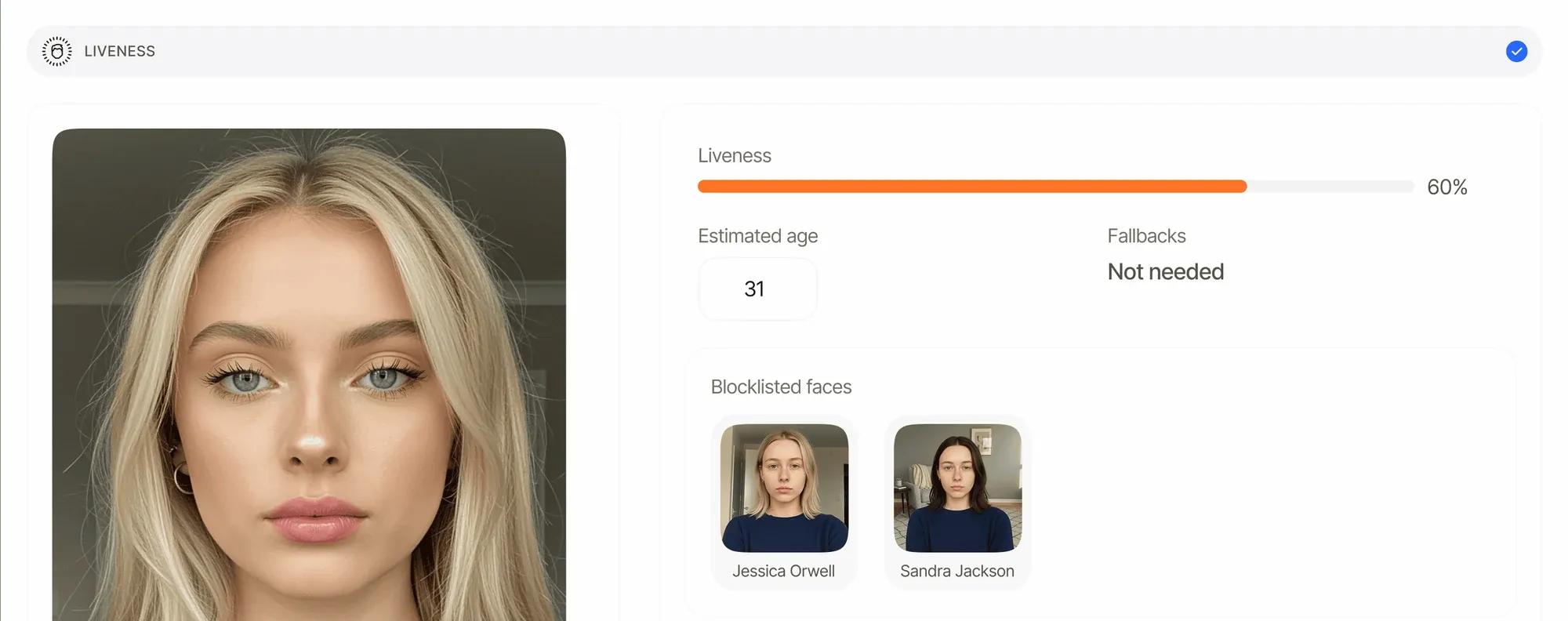
An age estimation result in Didit.
Didit provides
- Age estimation with liveness
- eID sign-ins with a signed date of birth
- The document route with chip reading
Stays with you
- Which rules apply to your service
- Your challenge age and methods
- Redress for refused users
Run age checks today, add age proofs later
Start with age estimation, eID sign-ins and documents in one workflow, and pay only for completed checks.
Key takeaways
- The EU age verification app is a Commission blueprint that Member States adapt, standalone or inside their EUDI Wallet.
- The proof says over 18 and nothing else; proofs are single use, and the provider is not told where they are used.
- Seven Member States pilot it during 2026, and the Commission wants it offered everywhere by the end of 2026.
- The DSA guidelines expect age verification for pornography, gambling and age-restricted sales; estimation alone is temporary for 18+ content.
Frequently asked questions
What is the EU age verification app?
It is a European Commission blueprint for a phone app that proves a user is over 18 to an online service. The proof contains no identity data. Member States adapt the blueprint into a national app or build it into their digital credential wallet.[1][2]
Is the EU age verification app available now?
Not as one EU-wide app. Seven Member States are piloting the solution during 2026, and the Commission urged all Member States on 29 April 2026 to make it available by the end of the year. Denmark's AltID already offers an age proof.[3][4][8]
Which countries are piloting the EU age verification app?
Denmark, France, Greece, Italy and Spain were the first five in July 2025. The technical portal now adds Cyprus and Ireland, all seven piloting it inside their national wallets during 2026.[2][4]
Does the app share my name or date of birth with the website?
No. The Commission states that the proof of age does not contain any identity data. The provider that issued the proof is not informed about the services where the user presents it.[1]
Is the EU age verification app the same as the EUDI Wallet?
No. The EUDI Wallet is required by Regulation (EU) 2024/1183 and holds identity data and many attestations. The age app proves one thing, and Member States can ship it as a standalone app or integrate it into their wallet.[3][6]
Must my platform accept the EU age verification app?
The DSA guidelines expect age verification for pornography, gambling and sales of alcohol, tobacco or drugs, and they describe anonymised age tokens as an effective method. Other methods are allowed if compatible with the EU reference standard, and platforms should offer more than one.[5]
Can a platform still use facial age estimation?
Yes, within limits. The guidelines accept estimation for minimum ages under 18 and for medium risks when it is run by an independent third party or independently audited. For adult content it is only a temporary alternative while suitable verification is not readily available.[5]
How does a platform connect to the app?
That depends on the country, and most have not published an open route yet. Spain's specification uses OpenID4VP and a signed list of registered content providers, and Ireland says relying parties must register. The second blueprint added support for the Digital Credentials API.[1][10][14]
Sources
- Commission releases enhanced second version of the age verification blueprint, European Commission, 10 October 2025.
- Commission makes available an age-verification blueprint, European Commission, 14 July 2025.
- Commission urges Member States to roll out the EU age verification app, European Commission, 29 April 2026.
- EU age verification solution, technical portal, European Commission project portal.
- Guidelines on measures to ensure a high level of privacy, safety and security for minors online (Article 28 DSA), C/2025/5519, EUR-Lex, Official Journal C, 2025.
- Regulation (EU) 2024/1183 amending Regulation (EU) No 910/2014, EUR-Lex, Official Journal of 30 April 2024.
- Commission Implementing Regulation (EU) 2024/2977 on person identification data and electronic attestations of attributes, EUR-Lex, Official Journal of 4 December 2024.
- AltID, Agency for Digital Government, Denmark.
- eIDAS2 and the EUDI Wallet, Agency for Digital Government, Denmark.
- Age verification protocol for platforms integration with the system, v1.0, Ministry for Digital Transformation and the Civil Service, Spain, 30 June 2024.
- Cartera Digital Beta press release, La Moncloa, 1 July 2024.
- How the Government Digital Wallet works, Government of Ireland, 23 June 2026.
- Government Digital Wallet: your questions answered, Government of Ireland, 3 April 2026.
- Government Digital Wallet interoperability, Government of Ireland.
- Delibera n. 96/25/CONS, AGCOM, 8 April 2025.
- IT-Wallet supera quota 10 milioni di attivazioni su app IO, Department for Digital Transformation, Italy, 17 February 2026.
- Technical guidelines on age verification for the protection of persons under 18 from online pornography, Arcom.
- d-you: Deutschland startet digitale Identität für alle, press release 53/2026, Federal Ministry for Digital Transformation and Government Modernisation, 9 September 2026.
- Guidance on highly effective age assurance (Part 3 services), Ofcom, 24 April 2025.
- Digital credential wallet, Dutch Government, NL Digital Government.
The age app will arrive country by country. Build the waterfall once and add each new proof as a route. Start with eID verification and age estimation today.
One workflow for every age route
Combine age estimation, national eIDs and documents in one place.
Related articles
- Didit vs Unit21: KYC, KYB, AML and monitoring on one record
- Didit vs Trinsic: eID sign-in plus document checks, AML and KYB
- Didit vs Thomson Reuters: government databases plus the whole flow
- Didit vs Regula: hosted checks with full evidence, KYB and monitoring
- Top 10 AI compliance agents for KYC and AML review automation in 2026
- Top 5 Travel Rule compliance solutions for crypto businesses in 2026