5 Best Phone Verification Vendors for SMS Gateway Spoofing, 2026
SMS gateway spoofing fakes the sender ID on OTP texts, so codes must travel over more than one channel and be gated by carrier and line-type signals before a code is sent. Didit charges the carrier price plus $0.02 per code.
 Alberto RosasCo-founder and CEO
Contents
In this guide
Jump to the part you need.
SMS gateway spoofing fakes the sender ID on a one-time code so the text looks like it came from your brand. This page ranks five phone verification vendors on OTP channels, carrier and line-type signals, and price. Didit suits teams that want the code and the phone risk data in one API at the carrier price plus $0.02 per code. The caveat: Didit is not a carrier, and codes are excluded from Free plan credit.
Last updated: November 26, 2026. Prices checked against the live Didit price feed on November 26, 2026.
| Rank | Vendor | Best for | Price basis |
|---|---|---|---|
| 1 | Didit | OTP plus phone risk in one API | Carrier price + $0.02 per code |
| 2 | Telesign | Phone reputation and fraud scoring | Not published on the page we read |
| 3 | Infobip | Multi-channel messaging at volume | Pay-as-you-go estimate via country calculator |
| 4 | Bird | Published SMS price plus phone lookup | $0.0035 per US SMS segment + carrier fees |
| 5 | Bandwidth | US 10DLC and toll-free messaging | US 10DLC SMS $0.004 per message |
Test the flow before you commit: start free in the sandbox at business.didit.me, with no sales call. Developers who want an assistant to wire the calls can connect Didit through the MCP server at didit.me/developers/mcp. Per-country code prices sit on the phone price list, the rest of the price book is on didit.me/pricing, and the endpoint reference is on the phone verification docs page.
The verdict
Didit ranks first because phone verification is one module inside a flow that can also read an ID document, match a face and score the device, and because the per-code price is public. The code travels over WhatsApp by default, with SMS, Telegram, voice and Viber as alternatives, delivery falls back to SMS when the preferred channel is unavailable, and the check returns carrier, line type, disposable and virtual flags and ported status. Teams that buy messaging at broadcast volume, or that need the carrier to own the network, will find a different trade-off below: every vendor section says what its own page shows and where it stops.
Didit publishes this ranking; we explain the criteria so you can check them.
Where SMS gateway spoofing actually hits phone verification
A spoofed sender ID is not the same thing as an intercepted code. In a spoofing attack the code still travels from your system to the user's handset and nothing in the delivery path is compromised. The attacker forges the sender name on a separate message, tells the user the account is at risk, and asks for the code your system just sent. Interception is different: there the attacker reads or reroutes the message itself, which is a carrier and handset problem rather than a sender-ID problem.
The distinction decides the defence. Against spoofing you need a channel mix and clear user messaging, so a forged SMS sender name never looks like your only route. Against interception you need risk data on the number itself plus short code windows and capped attempts, so a stolen or rerouted code expires before it is worth anything.
That is why phone verification has three separate jobs, and why picking a vendor on delivery price alone leaves you exposed. First, the code must arrive on a channel an attacker cannot spoof by changing a sender ID. Second, the number must be scored before you spend anything on it, because virtual, disposable and duplicated numbers are the raw material of most abuse. Third, attempt limits and delivery failures must be visible, so a run of OTP_DELIVERY_FAILED or OTP_MAX_ATTEMPTS_REACHED warnings reads as an attack instead of noise.
Best practices that stop SMS gateway spoofing
These are the controls that matter, independent of vendor. Every shortlisted product covers at least part of the list, and the scorecard below scores how much of it each one shows publicly.
- Diversify the channel. Offer WhatsApp, Telegram, voice or Viber next to SMS, and fall back to SMS only when the preferred channel is unavailable. Offer multiple channels so a forged SMS sender ID does not spoof every delivery path.
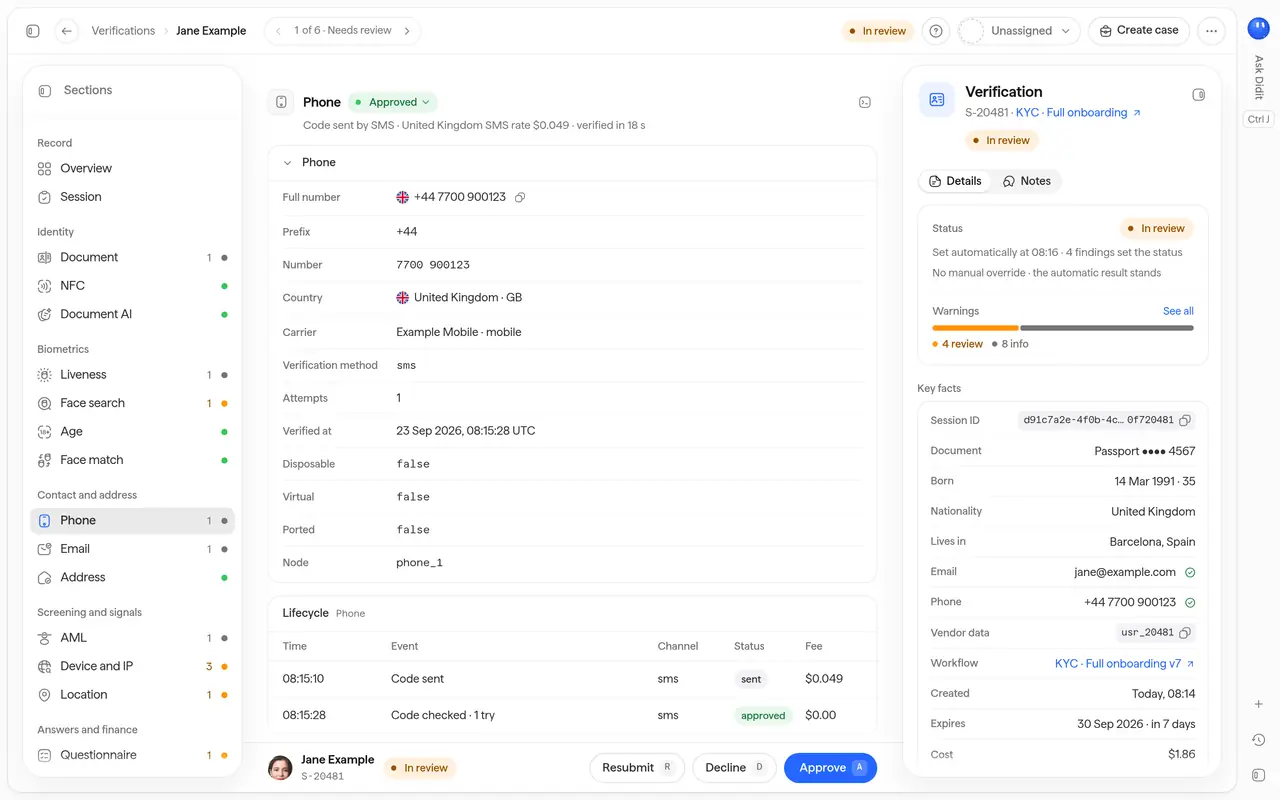
- Score the number before you send. Ask for carrier and line-type signals (mobile, landline or VoIP), disposable and virtual flags, and duplicate detection before a code is generated. Decline or review high-risk numbers instead of paying the carrier to text them. Didit's standalone risk endpoint scores a number without sending an OTP, so you can pre-screen a signup before the first code goes out.
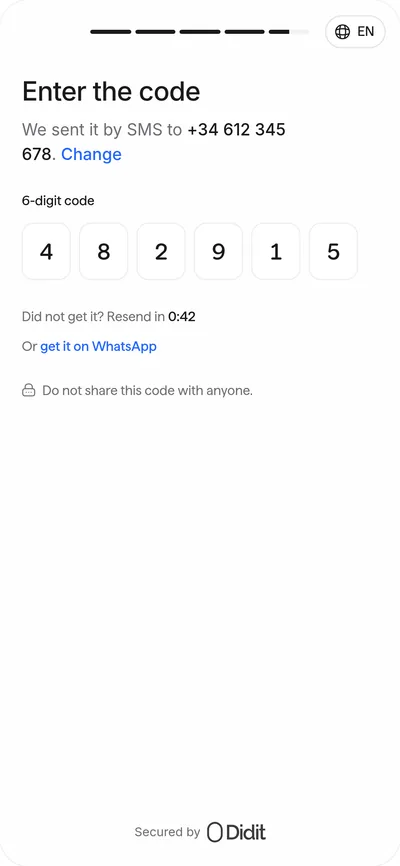
- Cap attempts and requests. Limit wrong code entries per verification and limit how many codes one number can request. Didit defaults to 5 wrong entries per standalone verification and a 5-minute code window from the first send, and a retry inside that window keeps the same deadline.
- Watch delivery failures. A spike in
OTP_DELIVERY_FAILEDorOTP_EXPIREDwarnings is an early signal of route problems or enumeration attempts. - Keep a blocklist and review the patterns. Decline numbers that hit
PHONE_NUMBER_BLOCKEDand review the ones that keep triggeringDISPOSABLE_NUMBERorVOIP_NUMBERwarnings. - Configure per-risk actions. Set separate actions for duplicated numbers, disposable numbers and VoIP numbers, so a disposable number can be declined while a ported mobile number is only reviewed.
- Educate users in the message. Say plainly that your team never asks for a code. The user is the last line of defence when a forged sender ID still reaches the inbox.
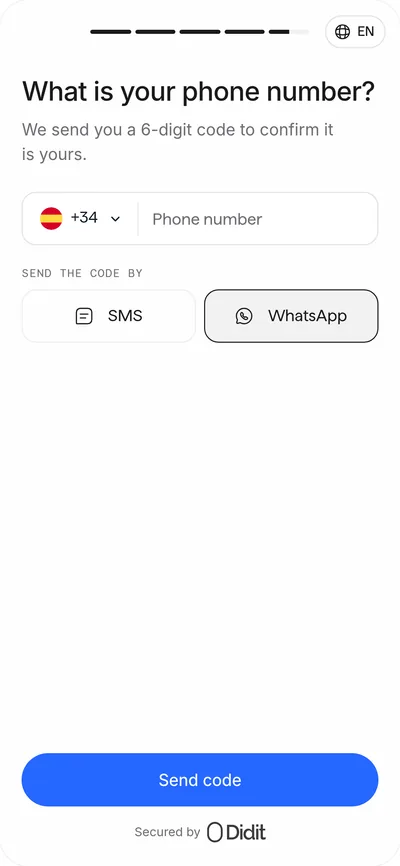
Delivery over a second channel is the control you can ship this week. The call below sends a WhatsApp code and falls back to SMS automatically if WhatsApp is unavailable.
curl -X POST 'https://verification.didit.me/v3/phone/send/' \
-H "x-api-key: $DIDIT_API_KEY" \
-H "Content-Type: application/json" \
-d '{
  "phone_number": "+14155552671",
  "options": {
    "code_size": 6,
    "preferred_channel": "whatsapp",
    "locale": "en-US"
  },
  "vendor_data": "user-1234"
}'
The scorecard
Each vendor is scored 1 to 5 on the same five criteria, using only what its public page or Didit's documentation showed on November 26, 2026. Scores describe the page we read, not what a sales call might reveal.
| Vendor | OTP channels | Carrier and line-type signals | Delivery depth | Developer integration | Price transparency | Evidence note |
|---|---|---|---|---|---|---|
| Didit | 5 | 5 | 4 | 5 | 5 | Docs list WhatsApp, SMS, Telegram, voice and Viber, plus is_disposable, is_virtual and carrier.type; price is the carrier price plus $0.02. |
| Telesign | 3 | 5 | 5 | 3 | 1 | Telesign telesign.com, read November 26, 2026: risk and reputation scoring is its own solution line, 230+ countries and territories; pricing not published on the page. |
| Infobip | 5 | 4 | 5 | 3 | 3 | infobip.com, read November 26, 2026: SMS, Viber and WhatsApp channels plus a country calculator; no fixed rate on the page. |
| Bird | 5 | 3 | 4 | 5 | 4 | bird.com, read November 26, 2026: SMS at $0.0035 per US long-code segment, Lookup at $0.005; Verify channel usage charged separately. |
| Bandwidth | 3 | 2 | 5 | 4 | 4 | bandwidth.com, read November 26, 2026: US 10DLC SMS at $0.004 per message and an Authentication product; ~92 countries with PSTN connectivity. |
The shortlist
| Rank | Vendor | Best for | Price basis | Key capabilities | Main trade-off |
|---|---|---|---|---|---|
| 1 | Didit | OTP plus phone risk in one API | Carrier price + $0.02 per code | WhatsApp, SMS, Telegram, voice, Viber; disposable, virtual, duplicate and blocklist warnings; separate risk call without an OTP | Not a carrier, and phone codes are not covered by Free plan credit |
| 2 | Telesign | Phone reputation at scale | Not published on the page we read | Onboarding, account integrity, fraud prevention, engagement, risk and reputation scoring; 230+ countries and territories | No public rate; the page leads with identity and engagement, not OTP channel choice |
| 3 | Infobip | Multi-channel messaging at volume | Country calculator estimate | SMS API and broadcast, Viber Business, WhatsApp Business Platform, email, voice | No fixed list rate on the page |
| 4 | Bird | Published SMS price plus lookup | $0.0035 per US SMS segment + carrier fees | Email, SMS, WhatsApp, Apple Messages, voice, Lookup at $0.005, MCP server and sandbox | Verify channel usage is billed separately with no published rate |
| 5 | Bandwidth | US 10DLC and toll-free messaging | US 10DLC SMS $0.004 per message | Messaging APIs, Voice API, emergency calling, global SIP trunking, Authentication product | ~92 countries with PSTN connectivity, narrower than the global aggregators |
How we picked
We read each vendor's public page on November 26, 2026 and scored only what the page or Didit's documentation said. Nothing here comes from a call, a demo or an estimate we made up.
- OTP channels. Does the vendor send verification codes over more than SMS, and does it name the channels? A page that lists SMS, WhatsApp, voice and Viber scores higher than one that says messaging.
- Carrier and line-type signals. Can you check carrier type, virtual numbers, disposable numbers and duplicates before or alongside the code? This is the criterion that separates an OTP sender from a phone verification product.
- Delivery depth. Operator connects, network ownership, country coverage and published uptime. A page that documents its own network scores higher than one that describes outcomes, and Didit takes a 4 here because it is not a carrier.
- Developer integration. Documented endpoints, sandbox access, SDKs and an API reference. Vendors that publish the calls score higher than vendors that describe results.
- Price transparency. A published per-message or per-code rate scores higher than a calculator, and a calculator scores higher than a quote.
1. Didit: multi-channel OTP with carrier and line-type signals
Verdict. The best fit here if you want the code and the phone risk data from one API at a published price. Didit runs phone verification as one module inside a flow that can also check an ID document, a selfie and the device, and it serves 4,000+ companies across 220+ countries.
Features. The code travels over WhatsApp by default, or SMS, Telegram, voice or Viber, with SMS as the fallback. Before sending, the workflow applies three actions: duplicated_phone_number_action, disposable_number_action and voip_number_action. Warnings include DUPLICATED_PHONE_NUMBER, DISPOSABLE_NUMBER, VOIP_NUMBER, INVALID_PHONE_NUMBER, OTP_DELIVERY_FAILED, OTP_MAX_ATTEMPTS_REACHED, OTP_EXPIRED and PHONE_NUMBER_BLOCKED. SMS codes carry your app's sender name at no extra cost, set in the Business Console. A separate call, POST /v3/phone/risk/, scores carrier, line type, porting and fraud risk without sending a code, so you can pre-screen a number before the first OTP.
Pricing. The carrier price for the destination country and channel plus $0.02 per code. On Growth the fee is $0.0192 and on Scale $0.018; carrier charges pass through at cost. US SMS comes to $0.0473 per code at list price and US WhatsApp to $0.0431. The full list is on the phone price list.
curl -X POST 'https://verification.didit.me/v3/phone/check/' \
-H "x-api-key: $DIDIT_API_KEY" \
-H "Content-Type: application/json" \
-d '{
  "phone_number": "+14155552671",
  "code": "123456",
  "voip_number_action": "DECLINE"
}'
Pros
- Five code channels with automatic SMS fallback, so a single blocked route does not stop a signup.
- Published per-country code prices and a public price book, so the arithmetic holds before you sign.
- Disposable, virtual, duplicate and blocklist flags on the same call as the code.
- A sender name on SMS at no extra cost, set in the Business Console, so codes arrive signed with your brand name.
- The sandbox is free and unlimited, with no sales call, plus an MCP server for AI assistants.
- SOC 2 Type 2 and ISO/IEC 27001:2022 certified, with 100% uptime over the last six months.
Cons
- Didit is not a carrier, so route quality depends on its carrier integrations; teams that need the carrier to own the network should buy from a carrier directly.
- Phone codes are excluded from the Free plan's $10 monthly credit, and sending codes unlocks with a paid plan or your organization's first top-up.
- WhatsApp codes use a fixed message unless you connect your own WhatsApp Business number.
Best for. Product and engineering teams that want OTP delivery, phone risk signals and the rest of the identity flow in one API, at a price they can calculate per country.
2. Telesign: verification with risk and reputation scoring
Verdict. Telesign telesign.com, read November 26, 2026, provides customer identity and engagement services that verify, onboard and protect customers across communication channels, including account verification, fraud prevention and global voice and text connectivity. Risk and reputation scoring is listed as its own solution line rather than an add-on, and coverage is 230+ countries and territories. That makes it the fit here when phone reputation data has to sit next to the code.
Features. Onboarding, account integrity and fraud prevention solutions, engagement solutions for voice and text verification and connectivity, and risk and reputation scoring intelligence, backed by 35+ patents. The page lists large enterprise references including Salesforce, ByteDance, Citrix and EA.
Pricing. Not published on the page we read, so budget from a quote.
Pros
- Risk and reputation scoring sits next to the verification service instead of requiring a second vendor.
- 230+ countries and territories of coverage, the widest footprint on this list.
- Large enterprise references listed on the page.
Cons
- No public rate, so the per-code cost is unknown until you ask.
- The page frames the product around identity and engagement rather than multi-channel OTP choice.
- The page names fewer messaging channels than several other vendors reviewed here.
Best for. Teams that want phone reputation scoring and fraud signals from the same vendor that delivers the text.
3. Infobip: multi-channel messaging with a country calculator
Verdict. Infobip infobip.com, read November 26, 2026, describes itself as one operating system for agentic customer experiences, with SMS over API and broadcast, email, Viber Business, WhatsApp Business Platform and voice, and says its SMS service includes fraud protection systems. Its page describes it as a Leader in the 2026 Gartner Magic Quadrant for CPaaS.
Features. AgentOS, SMS API and broadcast, email, Viber Business, WhatsApp Business Platform and voice, with channel pricing pages for each. The page claims 99.99% uptime across 190+ countries and lists customer logos including Uber, Google, Strava and UNICEF.
Pricing. Not published as a fixed rate on the page we read. The page describes a flexible pay-as-you-go model where you pay for what you use, with estimates calculated from the average price of a channel in the selected country through a country calculator.
Pros
- Broad channel set including Viber and WhatsApp alongside SMS.
- The country calculator gives a planning number per destination.
- Large reference customers listed across retail, telecom and media.
Cons
- Estimates come from an average country price, not a published per-code rate.
- Carrier and line-type signals for verification are not itemized on the page.
- Developer documentation is not summarized on the page we read.
Best for. Marketing and product teams that send on many channels and want one platform with a per-country estimate tool.
4. Bird: published SMS price and a cheap phone lookup
Verdict. Bird bird.com, read November 26, 2026, is a communications platform for developers sending email, SMS, WhatsApp, Apple Messages and voice, with delivery tooling and dashboards. It publishes the two prices that matter for a phone flow: SMS at $0.0035 per US outbound long-code segment plus carrier fees, and Lookup at $0.005 per answered phone lookup.
Features. Messaging across five channels, a Verify product where channel usage is charged separately, Lookup for phone data, 22 products and services on the pricing page, an MCP server, a CLI and an API reference, plus a sandbox that simulates deliveries, bounces and spam complaints.
Pricing. SMS at $0.0035 per US outbound long-code segment plus carrier fees; WhatsApp at $0.005 per US marketing message plus Meta fees; Lookup at $0.005 per answered lookup; Apple Messages from $100 a month to your Bird balance; email from $15 a month; Verify included with channel usage charged separately.
Pros
- The SMS segment price is published, so the arithmetic is checkable.
- Lookup at $0.005 gives you phone data before sending a code.
- MCP server, CLI and a delivery-simulating sandbox for developers.
Cons
- Verify has no published rate of its own; channel usage is billed separately.
- The phone data comes from a lookup line rather than a documented verification risk model.
- Carrier fees sit on top of the segment price and vary by destination.
Best for. Teams that want a published per-segment SMS price and a low-cost phone lookup in the same account.
5. Bandwidth: US messaging and toll-free depth
Verdict. Bandwidth bandwidth.com, read November 26, 2026, provides a network and APIs for SI-enabled voice, messaging, emergency calling and contact centers, with messaging rates published for US 10DLC, short code and toll-free traffic and an Authentication product for verification. Coverage is around 92 countries with PSTN connectivity.
Features. Messaging APIs, Voice API, global SIP trunking, enterprise integrations, emergency calling and Authentication. The messaging rate card runs to 10DLC, short code and toll-free, each with SMS and MMS prices, and the page lists 300+ five-star reviews and a Google partnership that began in 2009.
Pricing. US 10DLC SMS outbound $0.004 per message and MMS $0.015; US short code SMS $0.008 and MMS $0.020; US toll-free SMS $0.007 and MMS $0.020; Voice API US local outbound $0.0100 per minute and inbound $0.0055 per minute.
Pros
- Clear per-message prices for 10DLC, short code and toll-free, which is rare.
- Voice and emergency calling alongside messaging APIs in one account.
- A long-standing Google partnership and a large review base.
Cons
- Coverage of about 92 countries is narrower than the global aggregators.
- Carrier and line-type signals are not described on the page.
- US-centric rate card, so other destinations need a quote.
Best for. US businesses sending A2P traffic on 10DLC or toll-free numbers who want published per-message rates.
Budget walk-through
Didit bills a phone verification code as the carrier price for that country and channel plus a $0.02 Didit fee. Only the fee takes the plan discount, so Growth ($0.0192) and Scale ($0.018) shave a fraction of a cent off each code while carrier charges pass through at cost.
Take 10,000 US signups verified by SMS in one month. At list price a US SMS code totals $0.0473, carrier plus fee, so 10,000 x $0.0473 = $473.00. On Growth the fee falls to $0.0192, so each code is $0.0273 + $0.0192 = $0.0465, and 10,000 x $0.0465 = $465.00. On Scale, $0.0273 + $0.018 = $0.0453, and 10,000 x $0.0453 = $453.00.
Move the same traffic to WhatsApp in the US and the list price is $0.0431 per code: 10,000 x $0.0431 = $431.00, which is $42.00 less than SMS over the month.
If those same 10,000 users also pass a full ID check at $0.33, the month costs 10,000 x ($0.0473 + $0.33) = 10,000 x $0.3773 = $3,773.00 at list price. On Growth prices, 10,000 x ($0.0465 + $0.3168) = 10,000 x $0.3633 = $3,633.00.
Two billing details matter when you plan. Phone codes are not covered by the Free plan's $10 monthly credit, and sending codes unlocks with a paid plan or your organization's first top-up; the Growth plan carries $115 of credit a month and Scale $350, with top-ups from $50 to $20,000 that last 12 months. The sandbox is free and unlimited on every plan.
Which one to pick
- You want OTP and phone risk in one call at a published price. Pick Didit. The code, the carrier type and the disposable, virtual and duplicate flags come back on the same verification.
- Phone reputation scoring is the priority. Telesign pairs verification with risk and reputation scoring across 230+ countries and territories.
- You send on many channels and want a per-country estimate. Infobip lists SMS, Viber Business and WhatsApp Business Platform and publishes a country calculator.
- You want a checkable per-message price before you talk to anyone. Bird publishes $0.0035 per US SMS segment and $0.005 per answered lookup; Bandwidth publishes US 10DLC, short code and toll-free rates.
- You need a spoken code when SMS fails. Didit sends voice codes on request through
preferred_channel, and an unanswered call falls back to SMS. - You run a US A2P program. Bandwidth has the clearest 10DLC and toll-free rate card on this list.
- You need the carrier to own the network. Treat that as a separate procurement question, because Didit is not a carrier and depends on its carrier integrations for route quality.
Sources
- Didit pricing and plans: didit.me/pricing
- Didit phone price list by country and channel: didit.me/pricing/phone
- Didit pricing rules in the docs: docs.didit.me/getting-started/pricing
- Phone verification overview, channels and warnings: docs.didit.me/core-technology/phone-verification/overview
- Standalone phone APIs, risk call and delivery channels: docs.didit.me/standalone-apis/phone-verification
- Phone verification records and exports: docs.didit.me/standalone-apis/phone-verifications-list
- Integration prompt for coding agents: docs.didit.me/integration/integration-prompt
- Rate limits and 429 handling: docs.didit.me/integration/rate-limiting
- Webhooks and signing: docs.didit.me/integration/webhooks
- Didit MCP server: didit.me/developers/mcp
- Telesign telesign.com, read November 26, 2026
- Infobip infobip.com, read November 26, 2026
- Bird bird.com, read November 26, 2026
- Bandwidth bandwidth.com, read November 26, 2026
Next step: open the sandbox at business.didit.me, create an application, add the phone feature and send a test code to your own number. There is no sales call, and the sandbox is free and unlimited.
Try it
Try this in the sandbox
Run the check this guide describes, free.
The product this post is about, taken from its topic. Run it free in the sandbox.
Author
Alberto Rosas
Co-founder and CEO

Keep reading
Other guides in the same topic.
 What Is the Purpose of FICA in South Africa? 2026 Guide
FICA is South Africa's anti-money laundering law. It creates the Financial Intelligence Centre and requires accountable institutions to identify and verify clients, screen for PEP and sanctions risk and report suspicious.
Alberto RosasNov 26, 2026 Sixth Money Laundering Directive (6AMLD): What Changed and Which Rules Apply
6AMLD is Directive (EU) 2018/1673: Member States must criminalise laundering, widen predicate offences and set a four-year penalty floor. It adds no new due diligence duties for firms.
Alberto RosasNov 26, 2026 Automated Sanctions Screening: Canada, the Entity List and Embargoes
Automated sanctions screening matches people and companies against lists such as Canada's autonomous sanctions made under SEMA and JVCFOA and the OFAC SDN List, and returns candidate hits scored for identity confidence and.
Alberto RosasNov 26, 2026Questions
Frequently asked questions
What is SMS gateway spoofing?
SMS gateway spoofing is sending a text through a gateway with a forged sender ID so it appears to come from your brand or your short code. The recipient sees a familiar name, trusts the message, and hands over a code, opens a link or approves a login. The message never passes through your systems, so your own logs show nothing unusual.
Is a spoofed sender ID the same as OTP interception?
No. A spoofed sender ID forges the name on a message the attacker sends, while the real code still travels from your system to the user untouched. Interception means the attacker reads or reroutes the code message itself, which is a carrier or handset problem. Spoofing is beaten by a channel mix and user education, interception by carrier and line-type signals, short code windows and capped attempts.
How do I stop OTP interception?
Send codes over more than one channel, cap how many codes one number can request and how many wrong entries a verification allows, and check the number before sending anything. Didit answers POST /v3/phone/risk/ without sending a code, so you can decline a VoIP or disposable number first. Keep the code window short: Didit's is 5 minutes from the first send.
What is the cheapest way to verify phone numbers?
Compare the total per code, which is the carrier price for the country and channel plus the vendor fee. Didit charges the carrier price plus $0.02, which is $0.0473 for a US SMS code and $0.0431 for a US WhatsApp code at list price. Vendors that publish no rate require a quote, so the comparison is not visible until you ask.
Which vendors send verification codes over WhatsApp?
Didit sends over WhatsApp by default alongside SMS, Telegram, voice and Viber, with SMS as the fallback. Infobip lists WhatsApp Business Platform among its channels, and Bird publishes a WhatsApp rate of $0.005 per US marketing message plus Meta fees. Meta's own fees pass through on top of the vendor fee.
How do I detect disposable or virtual phone numbers?
Ask the phone API for carrier and line-type signals instead of parsing the number yourself. Didit returns is_disposable, is_virtual and carrier.type as mobile, landline or voip on the check response, and the risk call returns the same data without an OTP. You then decide whether a virtual number is declined, reviewed or approved.
How many OTP attempts should I allow?
Five wrong entries per verification is a common default, and it is Didit's default for a standalone verification. Keep the code window short as well: Didit's window is 5 minutes from the first send and a retry inside it keeps the same deadline. Pair the limit with a cap on how many codes one number can request.
Can I check a phone number without sending a code?
Yes. Didit's POST /v3/phone/risk/ scores carrier, line type, porting and fraud risk without sending an OTP, which is useful for pre-screening a signup or choosing which channel to use. Sending a code remains the only way to prove the person controls the number.
Is a verified phone number enough for identity verification?
No. A phone check proves control of a number at one moment and does not tie it to a legal identity. Regulated onboarding usually pairs it with an ID document check, passive liveness and a face match, which is why phone verification is one module in a wider workflow rather than the whole check.
What does Didit charge per verification code?
The carrier price for the destination country and channel plus a $0.02 Didit fee. The fee drops to $0.0192 on Growth and $0.018 on Scale while carrier charges pass through at cost. List examples: US SMS $0.0473, US WhatsApp $0.0431 and Germany SMS $0.1145.
Compliance built in
Audited, certified and attested.
We hold the certifications and build each country's rules into your flows, so you can launch anywhere without worrying. Security and Compliance center
- Regulation encoded into your flows
Tell us what you do and where. Didit lists the rules that apply to you, with sources, and builds the checks each country needs into one workflow.
- Ready for AMLR
Every requirement of the new EU anti-money laundering rules, from checking customers to human review, is already covered by a Didit check.
- Tested in Spain's Treasury sandbox
Spain's Treasury published its supervised sandbox report on Didit's NFC plus active liveness onboarding; SEPBLAC took part and valued the added measures positively.
- Audited, not self-declared
iBeta Level 1 and Level 2. Liveness tested under ISO/IEC 30107-3.
Your obligations · 3 regions
 SOC 2 Type 2
 ISO 27001
 iBeta Level 1 and Level 2
 EU regulator attestation
 FSM youth protection
 GDPR
 EBA remote onboarding
 MiCA compatible
 FIDO Alliance member
- AMLREU AML Regulation ready
Integration · Didit MCP
Run Didit from your own AI agent
Connect Didit to Claude, Cursor, VS Code or ChatGPT and just ask in plain words. Your agent can do anything you can do in the console, with the same permissions you have.
 Add to Claude
 ChatGPT
 Cursor
- Build workflowsDescribe the checks you need. The agent creates and publishes the flow.
- Run investigationsAsk why a session was declined, review cases, search people and companies.
- Change rulesCreate payment rules, test them on past data and switch them on.
- Pull reportsAsk for numbers, exports or the audit log.
Didit Academy


