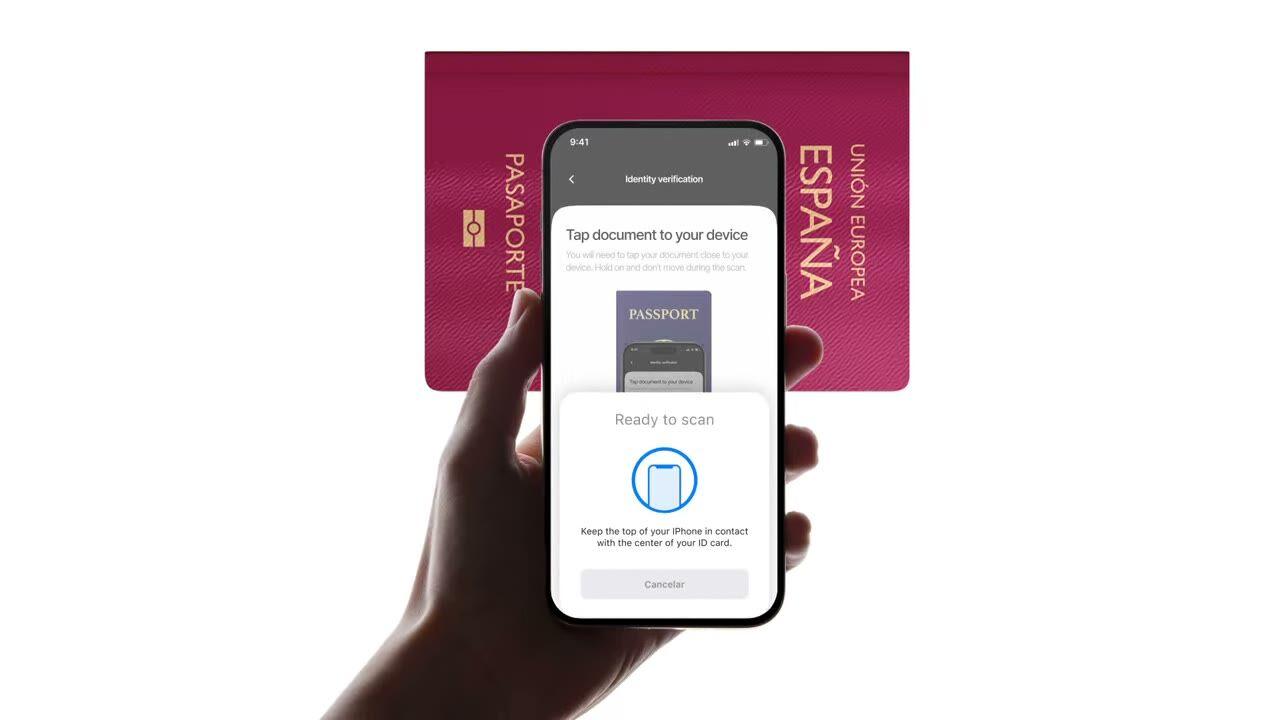
Приложите электронный паспорт или e-ID к телефону. Считывает чип, проверяет государственную подпись, выявляет подделки, которые не видны при обычной проверке фото. $0.15 за считывание, 500 бесплатно/месяц.
Приложите паспорт. Чип возвращает те же данные, что и фото, но
на этот раз они подписаны страной-эмитентом. $0.15, менее 2 секунд.
Как это работает
От регистрации до верифицированного пользователя за четыре шага.
Шаг 01 / 04
01
Создайте рабочий процесс
Выберите нужные проверки, ID, Liveness, сравнение лиц, санкции, адрес, возраст, телефон, email, пользовательские вопросы. Перетащите их в рабочий процесс на дашборде или отправьте тот же процесс через наш API. Разветвляйте по условиям, проводите A/B-тесты, код не требуется.
Интегрируйте
Встраивайте нативно с помощью наших SDK для Web, iOS, Android, React Native или Flutter. Перенаправляйте на размещенную страницу. Или просто отправьте пользователю ссылку, по email, SMS, WhatsApp, куда угодно. Выберите то, что подходит вашему стеку.
Пользователь проходит проверку
Didit обеспечивает работу камеры, подсказки по освещению, передачу данных на мобильные устройства и доступность. Пока пользователь проходит проверку, мы оцениваем более 200 признаков мошенничества в реальном времени и верифицируем каждое поле по авторитетным источникам данных. Результат менее чем за две секунды.
Вы получаете результаты
Подписанные вебхуки в реальном времени синхронизируют вашу базу данных в момент одобрения, отклонения или отправки пользователя на ручную проверку. Опрашивайте API по запросу. Или откройте консоль, чтобы просмотреть каждую сессию, каждый сигнал и управлять кейсами по своему усмотрению.
Создано для разработчиков · Защита от мошенничества · Открытый дизайн
Шесть возможностей. Один фича-флаг. NFC.
Каждая функция ниже, это переключатель в одном модуле. Никаких дополнительных тарифов, отдельных SKU или платных надстроек. Включайте их для каждого рабочего процесса или подключайте модуль NFC при создании рабочего процесса через API.
Проверяйте подпись на каждом чипе, а не печать на странице.
Каждый современный электронный паспорт и электронное удостоверение личности содержит бесконтактный чип, подписанный выдавшим его государством. Мы считываем его по NFC (ближняя бесконтактная связь), проверяем цифровую подпись и выдаем защищенный от подделки вердикт. Это позволяет выявлять морфинг-атаки, подмену фотографий и подделки, которые проходят визуальную проверку.
SPAINe-Passport
P<ESPROY<<OLIVIA<<<<<<<
Chip readICAO 9303
Passive AuthenticationSOD signature valid
Active AuthenticationChip challenge OK
Chip AuthenticationSession key derived
Signed by issuerAuthentic
02 · Группы данных ICAO 9303
Полное содержимое чипа извлечено, структурировано и подписано.
Считываются все группы данных ICAO 9303 с чипа, подписанный объект безопасности, персональные данные, MRZ (машиносчитываемая зона), изображение лица высокого разрешения, изображение подписи, а также любые дополнительные биометрические данные, хранящиеся в стране-эмитенте. Вы получаете чистый JSON `chip_data` плюс подписанные URL для портрета и подписи.
Document chipSOD · signed data groups
Signed
First nameDG1
Olivia
Last nameDG1
Roy
Date of birthDG1
12 Mar 1992
Document numberDG1
XAB204731
Facial imageDG2
High-res portrait
Signed at issuance · not OCR5 fields verified
03 · Доверие ICAO PKD
Доверие, закрепленное в каталоге открытых ключей ICAO.
Каждое считывание чипа отслеживает полную цепочку сертификатов, подписант документа → национальный орган подписи → корневой каталог открытых ключей ICAO, и в реальном времени проверяет список отозванных сертификатов страны. Отозванные и просроченные сертификаты отображаются как настраиваемые предупреждения; остальные проходят как булевы значения подлинности в отчете.
Document SignerDSC · eID Spain
Country Signing CACSCA · CRL current
ICAO PKD RootPublic Key Directory
Root
Integrity
SOD integrity
DG integrity
DSC not revoked
DSC not expired
Verified · ICAO PKDChain valid
04 · Фото против чипа
Перекрестная проверка каждого поля. Автоматическое отклонение при несовпадении.
Данные фотографии должны совпадать с данными чипа. При расхождении сессия автоматически отклоняется, этот триггер нельзя отключить. Это самый чистый сигнал о подделанной фотозоне, подмененном чипе или поддельном документе с реалистичной печатью.
Data source
Camera OCRChip read
Document number
XAB2O4731XAB204731≈ 91.4%Signed
First name
0LIVIAOLIVIA≈ 96.7%Signed
Expiry date
03 / 203103 / 2031≈ 99.1%Signed
Best-effort read · fonts, glare, wearExact values · signed by the issuer2 mismatchesSource of truth
Нативные SDK подключают считыватель NFC устройства, разрешения и UI для считывания чипа за вас. iOS использует Core NFC; Android использует IsoDep на NfcAdapter; React Native и Flutter оборачивают оба. Браузеры без NFC автоматически переключаются на стандартное удостоверение личности + селфи, срабатывает предупреждение о пропуске, и сессия продолжается.
React Native · FlutterBridges the native SDKsBridgedidit.nfc.read()One call · native under the hood
Web browserNo NFC · falls back to OCRFallbackdidit.ocr.scan()Camera capture · OCR fields
One call · NFC when the device supports itAuto-fallback · session continues with OCR
06 · Глобальное покрытие
Все страны-эмитенты ICAO, список растет каждый квартал.
Большинство паспортов, выданных после 2006 года, имеют чип, а также растет список национальных электронных удостоверений личности, испанский DNIe, немецкий Personalausweis, итальянский CIE, эстонская ID-карта, португальский Cartão de Cidadão, бельгийский eID, голландский eID. Сертификаты стран обновляются автоматически; новые страны становятся доступными для считывания в день их добавления.
DNIeSpain
PersonalausweisGermany
Carta CIEItaly
Cartão de CidadãoPortugal
ID-kaartEstonia
2006e-Passports since
30+National e-IDs
9303ICAO standard
CSCA certificates refreshed automaticallyReadable via NFC
Интегрируйте
Один рабочий процесс. Два способа запустить считывание чипа.
NFC не имеет отдельной серверной конечной точки, для чипа требуется устройство с NFC-модулем. Оба пути ниже используют один и тот же вызов создания сессии; они отличаются только тем, считывает ли пользователь чип в нашем размещенном UI или в вашем приложении через нативный SDK.
// iOS · Swift
import DiditSdk
let result = try await DiditSdk.shared.startVerification(
с: sessionId,
конфигурация: config)
donein-app{ "status": "Approved" }
Интеграция, готовая для агентов
Внедрите NFC-верификацию за один промпт.
Вставьте блок ниже в Claude Code, Cursor, Codex, Devin, Aider или Replit Agent. Замените my_stack на ваш фреймворк, язык и сценарий использования. Агент настроит Didit, создаст рабочий процесс с поддержкой NFC, подключит вебхук и запустит.
didit-integration-prompt.md
# Didit NFC Verification — integrate in 5 minutes

You are integrating Didit's NFC Verification (cryptographic e-passport
and e-ID chip reading) module into <my_stack>. Follow these steps exactly.
Every URL, header, and enum value below is canonical — do not paraphrase
or "improve" them.

## 1. Provision an account
- Sign up: https://business.didit.me (no credit card required).
- Or provision programmatically: POST https://apx.didit.me/auth/v2/programmatic/register/
  (returns an API key bound to the workspace + application).

## 2. What NFC Verification actually does
NFC Verification reads the secure contact-less chip embedded in modern
e-passports and e-IDs (the small chip-and-antenna sticker symbol on the
cover) and runs four cryptographic checks against the data it extracts:

1. Passive Authentication — every Data Group (DG1 personal data, DG2
   facial image, etc.) is hashed and compared against the signed hash
   stored in the Document Security Object (SOD). Catches any single-bit
   tampering of the chip contents.
2. Certificate chain validation — Document Signer Certificate (DSC) →
   Country Signing Certificate Authority (CSCA) → ICAO Public Key
   Directory (PKD) root. Proves the chip was signed by the issuing
   government, not a clone.
3. Certificate Revocation List (CRL) check — DSCs revoked by the issuing
   country are caught and flagged.
4. Chip Authentication — where the document supports it, prevents chip
   cloning by challenging the chip with a key-pair handshake.

PACE (Password Authenticated Connection Establishment) or BAC (Basic
Access Control) is used to derive the session key from the Machine-Readable Zone (MRZ); Didit
handles that automatically. All of this is ICAO 9303 standard.

## 3. Two integration paths — pick one

### Path A — Workflow Builder (hosted UI, REQUIRED for NFC)
NFC Verification has no server-to-server standalone endpoint. The chip
has to be read by a device with NFC hardware, so you always integrate
through the Workflow + native SDK (or hosted mobile web that falls back).

1. Create a workflow that contains the NFC feature:
   POST https://verification.didit.me/v3/workflows/
   Authorization header:  x-api-key: <your-api-key>
   Body: workflow_label, features array with the entries
         { feature: "OCR" }
         { feature: "NFC" }
         (UPPERCASE — strict enum)
   You should always pair NFC with OCR (ID Verification) so the MRZ is captured
   for the chip handshake AND so an OCR cross-validation is available.

2. Create a verification session for an end user:
   POST https://verification.didit.me/v3/session/
   Body: workflow_id (from step 1), vendor_data (your own user id).
   Response: url (the hosted verification link) — redirect the user to
   it (or open it in the native SDK with
   shared.startVerification(with: sessionId)).

3. Listen for webhook callbacks (see "Webhooks" below).

### Path B — Native SDKs (drop-in, recommended for mobile apps)
Same workflow + session above, but launch the verification flow in your
own iOS or Android app via the Didit SDK. The SDK wires the NFC reader,
the entitlements, and the chip-reading UI for you.

- iOS: DiditSdk.shared.startVerification(with: sessionId, configuration:)
  Required entitlements (handled by the SDK):
    - com.apple.developer.nfc.readersession.formats = ["TAG"]
    - ISO7816 application identifiers for ePassports
- Android: DiditSdk.startVerification(sessionId, config) — uses
  IsoDep (android.nfc.tech.IsoDep) under the hood.
- React Native / Flutter: the same SDK, exposed through the cross-
  platform module — see docs.didit.me/integration/native-sdks/.

### Web browsers — NFC is unavailable
Web NFC API is not generally available. Chrome on Android has an
experimental Web NFC that is unstable and requires explicit permissions;
Safari on iOS has no support. For web integrations, NFC is automatically
skipped and the user proceeds with standard ID + selfie. If you require
NFC, deep-link the user into the Didit App or your own native app.

## 4. Webhooks
- Register a webhook destination once via
  POST https://verification.didit.me/v3/webhook/destinations/
  Body: url, subscribed_events: ["session.verified", "session.review_started",
                                  "session.declined"]
- Response includes secret_shared_key — store it.
- Every webhook delivery carries an X-Signature-V2 header you MUST verify
  before trusting the payload.  HMAC-SHA256 verification MUST run against the raw body bytes (the raw payload as Didit sent it) BEFORE any JSON parsing — re-serialising the parsed body changes whitespace and key order, which invalidates the signature.Algorithm:
    1. sortKeys(payload) recursively
    2. shortenFloats (truncate trailing zeros after the decimal point)
    3. JSON.stringify the result
    4. HMAC-SHA256 with the secret_shared_key
    5. Hex-encode, compare to the X-Signature-V2 header.

## 5. Reading the report
The session decision includes an nfc_verifications[] array alongside
id_verifications[] — one entry per workflow node, each with its own node_id.
Fields on each nfc_verifications entry:

- status: "Approved" | "Declined" | "In Review" | "Not Finished"
- portrait_image: signed URL to the chip-extracted DG2 facial image
- signature_image: signed URL to the chip-extracted DG7 signature
- chip_data:
    document_type, issuing_country (ISO 3166-1 alpha-3),
    document_number, expiration_date (YYYY-MM-DD),
    first_name, last_name, birth_date, gender ("M" | "F" | "U"),
    nationality (ISO 3166-1 alpha-3), address, place_of_birth.
- authenticity:
    sod_integrity (boolean — every Data Group hash matched the SOD)
    dg_integrity (boolean — Data Group binary integrity check passed)
- certificate_summary:
    issuer (CSCA Common Name + serial + organization + country)
    subject (DSC Common Name)
    serial_number
    not_valid_after (YYYY-MM-DD HH:MM:SS)
    not_valid_before (YYYY-MM-DD HH:MM:SS)
- warnings: Array of { risk, additional_data, log_type,
                       short_description, long_description }

### Auto-decline (always enforced, never configurable)
- NFC_AND_OCR_DATA_NOT_SAME — Optical Character Recognition (OCR) data
  and chip data differ. Indicates document tampering or fake chip.

### Configurable warnings (per-workflow action: Decline / Review / Approve)
- SKIPPED_NFC_VALIDATION       — chip not read (no NFC hardware, no
                                  permissions, document has no chip)
- NFC_CHIP_NOT_VERIFIED        — chip read but signature could not be
                                  verified (missing CSCA, older document)
- DSC_CERTIFICATE_REVOKED      — Document Signer Certificate listed on
                                  the issuing country's CRL
- DSC_CERTIFICATE_EXPIRED      — Document Signer Certificate past its
                                  validity period

## 6. Hard rules — do not change
- Base URL for /v3/* endpoints is verification.didit.me (NOT apx.didit.me).
- Feature enum is UPPERCASE: NFC, OCR, LIVENESS, FACE_MATCH.
- Auth header is x-api-key (lowercase, hyphenated).
- Webhook signature header is X-Signature-V2 (NOT X-Signature).
- Always verify webhook signatures before trusting payload data.
- Always pair NFC with OCR (ID Verification) in the workflow — NFC alone
  cannot derive the chip key without the MRZ from the document photo.
- Status casing matches exactly: "Approved", "Declined", "In Review",
  "Not Finished" (title-cased, space-separated).
- Treat NFC as an additive confidence boost, not a hard gate, unless
  your risk policy explicitly requires it (regulated remote
  onboarding under PSD3, AMLD6 high-risk customer flows, etc.).

## 7. Pricing reference (public)
- NFC Verification: $0.15 per chip read (standalone module).
- Bundled inside a full Know Your Customer (KYC) workflow (ID + Liveness + Face Match + NFC):
  priced as the underlying KYC bundle ($0.33) + $0.15 NFC if enabled.
- 500 free checks every month, forever, on every account.

## 8. Verify your integration
- Sandbox starts on signup at https://business.didit.me — no separate flag.
- Test documents: use the Didit App on a real iOS or Android device with
  any ICAO 9303 e-passport issued after 2006 (most modern passports).
- Sandbox webhook events fire the same shape as production; verify the
  X-Signature-V2 header in dev too.
- Switch to live: flip the application's environment toggle in console.

When in doubt: https://docs.didit.me/core-technology/nfc-verification/overview
Соответствие по умолчанию
Откройте новую страну в один клик. Мы берем на себя сложную работу.
Мы открываем местные дочерние компании, получаем лицензии, проводим пентесты, получаем сертификаты и адаптируемся к каждому новому регулированию. Чтобы запустить верификацию в новой стране, просто переключите тумблер. Более 220 стран в работе, ежеквартальные аудиты и пентесты, единственный провайдер идентификации, который правительство страны-члена ЕС официально назвало более безопасным, чем личная верификация.
Каждое считывание чипа проверяется по каноническому стандарту электронных паспортов.
PKD
Доверие закреплено в корневом каталоге открытых ключей ICAO.
<2s
Сквозное считывание чипа на современном смартфоне.
$0.15
За каждое считывание NFC-чипа. 500 бесплатных в месяц.
Три тарифа, один прайс-лист
Начните бесплатно. Платите по мере использования. Масштабируйтесь до Enterprise.
500 бесплатных верификаций каждый месяц, навсегда. Затем платите только за фактически использованные модули. Для тарифа Enterprise доступны индивидуальные контракты, размещение данных и соглашения об уровне обслуживания (SLA).
Бесплатно
$0/ месяц · без карты
Для разработки, тестирования и первых пользователей.
Всё, что нужно для старта:
500 полных KYC-проверок ежемесячно
Проверка ID, Liveness, Face Match, устройства и IP
Более 200 сигналов мошенничества, чёрный список, дубликаты
Повторное использование KYC в сети Didit
Конструктор рабочих процессов, управление кейсами, SDK
AI-поддержкаAI-агент в консоли, документация и сообщество.