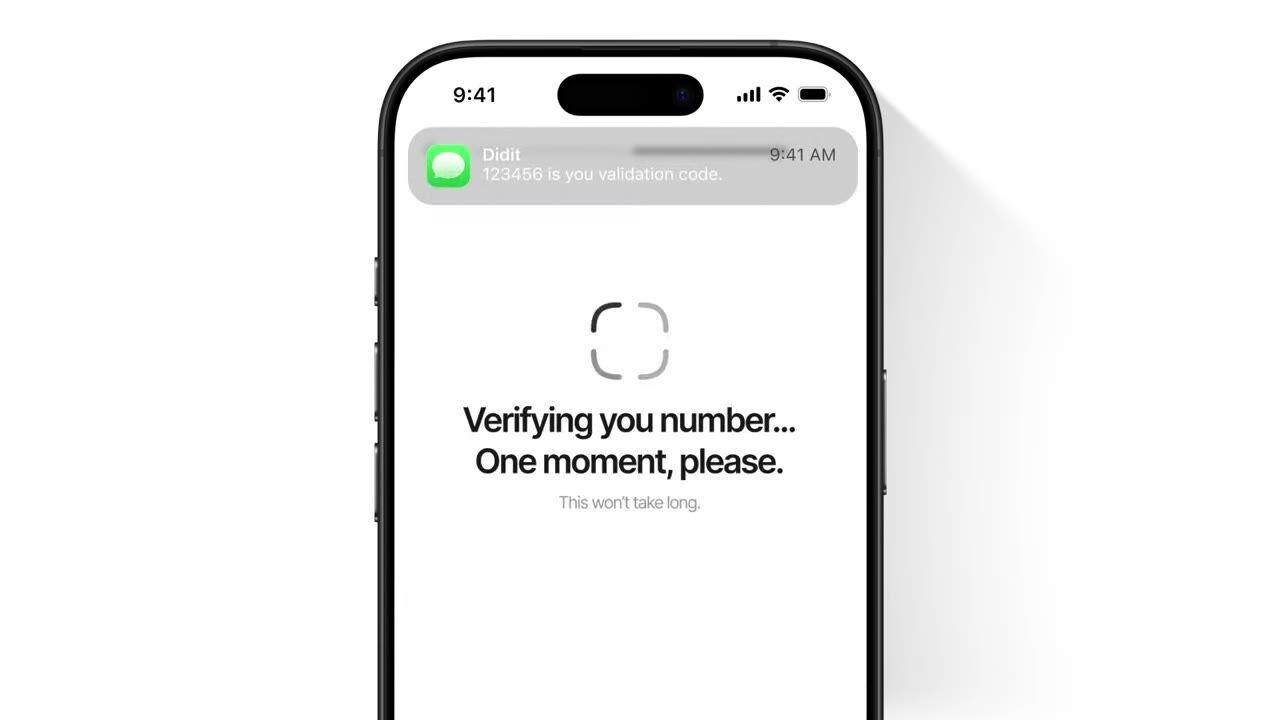
Верифицируйте любой телефон. По любому каналу, где ответят.
Отправьте одноразовый код через SMS, WhatsApp, Telegram, RCS или голосовой вызов, по тому каналу, где пользователь ответит. Автоматический переход между каналами, с оценкой рисков оператора при каждом вызове. От $0.03 плюс оператор.
Нам доверяют более 3000 организаций по всему миру.
Пять каналов
SMS. WhatsApp. Telegram. RCS. Голосовая связь.
Один модуль, пять способов доставки. Мы повторяем попытки по разным каналам, пока код не будет доставлен, оцениваем риски SIM-свопа и оператора при каждом вызове, и выставляем счет от $0.03 плюс стоимость оператора, рабочий процесс одинаков.
Как это работает
От регистрации до верифицированного пользователя за четыре шага.
Шаг 01 / 04
01
Создайте рабочий процесс
Выберите нужные проверки: ID, Liveness, Face Match, санкционные списки, адрес, возраст, телефон, email, а также свои вопросы. Перетащите их в нужной последовательности на дашборде или отправьте тот же флоу через наш API. Настраивайте ветвления по условиям, запускайте A/B-тесты, код не потребуется.
Интеграция
Встраивайте нативно с помощью наших SDK для Web, iOS, Android, React Native или Flutter. Перенаправляйте на размещенную у нас страницу. Или просто отправьте пользователю ссылку, по email, SMS, WhatsApp, куда угодно. Выбирайте то, что подходит вашему стеку.
Пользователь проходит проверку
Didit управляет камерой, подсказками по освещению, передачей данных на мобильные устройства и доступностью. Пока пользователь проходит проверку, мы в реальном времени анализируем более 200 признаков мошенничества и сверяем каждое поле с авторитетными источниками данных. Результат, менее чем за две секунды.
Вы получаете результаты
Подписанные вебхуки в реальном времени синхронизируют вашу базу данных в момент одобрения, отклонения или отправки пользователя на ручную проверку. Опрашивайте API по запросу. Или откройте консоль, чтобы просмотреть каждую сессию, каждый сигнал и управлять кейсами так, как вам удобно.
Создано для разработчиков · Защита от мошенничества · Открытый дизайн
Шесть возможностей. Один фича-флаг. PHONE.
Каждая функция, это переключатель в одном модуле. Никаких дополнительных тарифов, отдельных планов или платных надстроек. Включайте их для каждого рабочего процесса в консоли или передавайте напрямую при вызове API.
SMS, WhatsApp, Telegram, RCS и голосовые сообщения, всё в одном модуле и рабочем процессе. Закрепите канал, если этого требует политика (SMS по требованию регулятора, рынки, ориентированные на WhatsApp, такие как Бразилия и Индия), или позвольте нам выбрать самый дешевый способ доставки.
Один фича-флаг · Пять каналовфича: ТЕЛЕФОН
SMSПо умолчанию
WhatsAppBR / IN / MX
TelegramЕС
RCSAndroid
ГолосРезерв
02 · Маршрутизация
Автоматический переход на другой канал при сбое.
Блокировки SMS операторами, страны с премиум-тарифами и скрытые сбои автоматически обходятся. Мы повторяем попытку через следующий доступный канал без вашего участия, и сообщаем, какой канал фактически доставил сообщение.
Глобальный охват телекоммуникаций. Доставка с учетом оператора.
Интеграции с несколькими операторами в каждой стране, с маршрутизацией, настроенной под местные особенности, WhatsApp лидирует в Бразилии, Индии и Мексике, Telegram и RCS, в ЕС, SMS, в США. Страна, оператор и тип номера определяются автоматически.
04 · Признаки мошенничества
Больше, чем одноразовый код. Риски оператора при каждом вызове.
Каждая проверка возвращает название и тип оператора (мобильный, стационарный, VoIP), пометки для одноразовых и виртуальных номеров, а также явные предупреждения для номеров с высоким риском, дублированных или заблокированных. Принимайте решения, проверяйте или одобряйте по категориям риска.
05 · Конверсия
Только SMS теряет пользователей. Мультиканальность их удерживает.
Когда SMS не доходит, из-за фильтра оператора, роуминга, мертвой зоны или снижения доставляемости, провайдеры с одним каналом оставляют пользователей ждать код, который так и не приходит. Мы восстанавливаем их на следующем шаге и сообщаем, какой канал доставил сообщение, чтобы вы могли настроить маршрутизацию на основе реальных данных.
Завершение · за 30 днейЧем выше, тем лучше
Только SMS58%
+ WhatsApp79%
+ Голосовой резерв93%
Иллюстративно, для ориентира, не исследование.
06 · Цены
Оплата за сообщение. От $0.03 плюс плата оператора.
$0.03 за проверку, плюс плата оператора за страну и канал без наценки. Вы платите только за отправленное сообщение, отказ до доставки ничего не стоит.
Тарифы за сообщениеОт $0.03
СШАSMS$0.03
БразилияWhatsApp$0.04
ИндияWhatsApp$0.05
Платите только за отправленные сообщения.
Интеграция
Две конечные точки. Один JSON. Одна цена.
Выбирайте Hosted Flow, если хотите, чтобы мы взяли на себя ввод номера, UX кода и повторную отправку. Выбирайте Standalone API, если вы сами управляете UX. Оба варианта возвращают одинаковый отчет.
Вставьте блок ниже в Claude Code, Cursor, Codex, Devin, Aider или Replit Agent. Заполните данные своего стека. Агент настроит Didit, создаст рабочий процесс верификации телефона, подключит вебхук и запустит все в работу.
didit-integration-prompt.md
# Didit Phone Verification — integrate in 5 minutes

You are integrating Didit's Phone Verification module into <my_stack>.
Follow these steps exactly. Every URL, header, and enum value below is
canonical — do not paraphrase or "improve" them.

## 1. Provision an account
- Sign up: https://business.didit.me (no credit card required).
- Or provision programmatically: POST https://apx.didit.me/auth/v2/programmatic/register/
  (returns an API key bound to the workspace + application).

## 2. Two integration paths — pick one

### Path A — Workflow Builder (hosted UI)
Best when you want Didit to handle phone collection, country prefix UX,
channel routing, OTP entry, resend buttons, mobile/desktop handoff, and
accessibility for you.

1. Create a workflow that contains the PHONE feature:
   POST https://verification.didit.me/v3/workflows/
   Authorization header:  x-api-key: <your-api-key>
   Body: workflow_label, features array with the single entry
         { feature: "PHONE" }   (UPPERCASE — strict enum)
   Optional config: preferred_channel ("SMS" | "WHATSAPP" | "TELEGRAM" |
   "RCS" | "VIBER" | "CALL"), code_validity_seconds, max_code_attempts
   (default 2), max_resend_requests_per_24h (default 2).

2. Create a verification session for an end user:
   POST https://verification.didit.me/v3/session/
   Body: workflow_id (from step 1), vendor_data (your own user id),
         optional contact_details.phone in E.164 format
         (e.g. "+14155552671") to pre-fill and lock the number.
   Response: url (the hosted verification link) — redirect the user to it.

3. Listen for webhook callbacks (see "Webhooks" below).

### Path B — Standalone server-to-server API
Best when you already own the phone-entry UX (mobile SDK, native
onboarding app, reseller pipeline) and want Didit to handle OTP delivery
+ risk scoring only. Two endpoints, called in sequence:

Step 1 — Send the code:
POST https://verification.didit.me/v3/phone/send/
Content-Type: application/json
Body fields:
  - phone_number  (required, string, E.164 format e.g. "+14155552671")
  - channel       (optional — "SMS" | "WHATSAPP" | "TELEGRAM" | "RCS" |
                   "VIBER" | "CALL". Omit to let Didit pick the best
                   available channel for the destination country and
                   carrier — automatic fallback routing.)
  - vendor_data   (optional, your user id for cross-session linkage)

Step 2 — Check the code:
POST https://verification.didit.me/v3/phone/check/
Content-Type: application/json
Body fields:
  - phone_number  (required, same E.164 number)
  - code          (required, the OTP the user typed)
  - vendor_data   (optional, same user id used in Step 1)

Response: JSON report — status, verification_method (the channel that
actually delivered), carrier object, is_disposable, is_virtual, warnings
array.

## 3. Channel routing — how the automatic fallback works
When channel is omitted on /v3/phone/send/, Didit picks the cheapest
+ most-deliverable channel for the destination:
  - SMS where deliverable and lowest cost (most countries)
  - WhatsApp in BR / IN / MX and other WhatsApp-dense markets
  - Telegram / RCS / Viber where carrier-side SMS is blocked or premium
  - CALL (voice OTP) as last-resort fallback when text channels fail
Each retry attempt may switch channels — the final delivery channel is
returned as verification_method in the report.

## 4. Webhooks (Path A only — Path B returns synchronously)
- Register a webhook destination once via
  POST https://verification.didit.me/v3/webhook/destinations/
  Body: url, subscribed_events: ["session.verified", "session.review_started",
                                  "session.declined"]
- Response includes secret_shared_key — store it.
- Every webhook delivery carries an X-Signature-V2 header you MUST verify
  before trusting the payload.  HMAC-SHA256 verification MUST run against the raw body bytes (the raw payload as Didit sent it) BEFORE any JSON parsing — re-serialising the parsed body changes whitespace and key order, which invalidates the signature.Algorithm:
    1. sortKeys(payload) recursively
    2. shortenFloats (truncate trailing zeros after the decimal point)
    3. JSON.stringify the result
    4. HMAC-SHA256 with the secret_shared_key
    5. Hex-encode, compare to the X-Signature-V2 header.

## 5. Reading the report (both paths return the same phone object)
- status: "Approved" | "Declined" | "In Review" | "Not Finished"
- phone_number_prefix: country prefix in international format ("+34")
- phone_number: subscriber number without the prefix
- full_number: full E.164 string ("+34600600600")
- country_code: ISO 3166-1 alpha-2 ("ES")
- country_name: full country name
- carrier: { name, type: "mobile" | "landline" | "voip" | "unknown" }
- is_disposable: boolean — temporary or throwaway number
- is_virtual: boolean — VoIP or virtual provider
- verification_method: the channel that actually delivered the code
  ("sms" | "whatsapp" | "viber" | "telegram" | "call")
- verification_attempts: number of code-entry tries
- verified_at: ISO 8601 timestamp
- warnings: Array<{ risk, log_type, short_description, long_description }>

Auto-decline risks (always enforced by Didit, not configurable):
- VERIFICATION_CODE_ATTEMPTS_EXCEEDED
- HIGH_RISK_PHONE_NUMBER
- PHONE_NUMBER_IN_BLOCKLIST

Configurable risks (action per workflow — Decline, Review, or Approve):
- DISPOSABLE_NUMBER_DETECTED
- VOIP_NUMBER_DETECTED
- DUPLICATED_PHONE_NUMBER

## 6. Attempt limits (defaults — overridable per workflow)
- Max code-entry attempts: 2 per session
- Max resend requests: 2 per phone number per 24 hours
- Code validity: 5 minutes from send
Hitting either limit fires VERIFICATION_CODE_ATTEMPTS_EXCEEDED and
auto-declines the session.

## 7. Hard rules — do not change
- Base URL for /v3/* endpoints is verification.didit.me (NOT apx.didit.me).
- Feature enum is UPPERCASE: PHONE, OCR, LIVENESS, FACE_MATCH,
  AML, IP_ANALYSIS.
- Channel enum is UPPERCASE on input ("SMS", "WHATSAPP", "TELEGRAM",
  "RCS", "VIBER", "CALL") and lowercase on output ("sms", "whatsapp",
  "telegram", "rcs", "viber", "call").
- All phone numbers go in and come out as E.164 strings — including
  the leading "+" and country prefix.
- Auth header is x-api-key (lowercase, hyphenated).
- Webhook signature header is X-Signature-V2 (NOT X-Signature).
- Always verify webhook signatures before trusting payload data.
- Status casing matches exactly: "Approved", "Declined", "In Review",
  "Not Finished" (title-cased, space-separated).

## 8. Pricing reference (public)
- Didit fee: $0.03 per verification (the cheapest channel; some
  channels and countries cost more — see didit.me/pricing for the
  per-country, per-channel table).
- Carrier fee: variable by country and channel, billed as a
  pass-through with no Didit markup.
- You only pay when a message is SENT. If the user abandons before
  delivery, you are not charged.

## 9. Verify your integration
- Sandbox starts on signup at https://business.didit.me — no separate flag.
- Sandbox numbers: deterministic E.164 numbers return Approved by default;
  trigger Declined with the canonical "high-risk" sandbox number.
- Switch to live: flip the application's environment toggle in console.

When in doubt: https://docs.didit.me/core-technology/phone-verification/overview
Соответствие по умолчанию
Откройте новую страну в один клик. Мы берем на себя сложную работу.
Мы открываем местные дочерние компании, получаем лицензии, проводим пентесты, получаем сертификаты и адаптируемся к каждому новому регулированию. Чтобы запустить верификацию в новой стране, просто переключите тумблер. Более 220 стран в работе, ежеквартальные аудиты и пентесты, единственный провайдер идентификации, который правительство страны-члена ЕС официально назвало более безопасным, чем личная верификация.
Маршрутизация каналов, мы выбираем самый дешевый и надежный вариант.
От $0.03
За верификацию, плюс прямая оплата оператору, без наценок.
Три тарифа, один прайс-лист
Начните бесплатно. Платите по мере использования. Масштабируйтесь до Enterprise.
500 бесплатных верификаций каждый месяц, навсегда. Затем платите только за фактически использованные модули. Для тарифа Enterprise доступны индивидуальные контракты, размещение данных и соглашения об уровне обслуживания (SLA).
Бесплатно
$0/ месяц · без карты
Для разработки, тестирования и первых пользователей.
Всё, что нужно для старта:
500 полных KYC-проверок ежемесячно
Проверка ID, Liveness, Face Match, устройства и IP
Более 200 сигналов мошенничества, чёрный список, дубликаты
Повторное использование KYC в сети Didit
Конструктор рабочих процессов, управление кейсами, SDK
AI-поддержкаAI-агент в консоли, документация и сообщество.