Cryptolink met its undertaking. AUSTRAC suspended it anyway (2026)
AUSTRAC suspended Cryptolink for three months from 9 August 2026, taking 96 crypto ATMs offline, because threshold transaction reports stopped arriving after it met its enforceable undertaking.
 Alberto RosasCo-founder and CEO
Contents
In this guide
Jump to the part you need.
This page is for crypto ATM operators and virtual asset service providers registered with AUSTRAC, and for the compliance teams that file their reports. Didit prices the checks those duties consume: full KYC at $0.33 per check, AML screening at $0.20, wallet screening at $0.15 per screening, transaction monitoring at $0.001 per transaction beyond your plan allowance. The caveat first: Didit does not lodge threshold transaction reports or suspicious matter reports for you, and that is exactly what led to Cryptolink's suspension.
Last updated: November 26, 2026. Prices checked against the live Didit price feed on November 26, 2026.
| Item | Detail |
|---|---|
| Who is subject | Reporting entities that provide designated services, including crypto ATM operators and virtual asset service providers registered under the Anti-Money Laundering and Counter-Terrorism Financing Act 2006 (Cth) |
| Where | Australia, including services delivered to Australian customers online |
| Key dates | 3 June 2025 crypto ATM conditions; 31 March 2026 expanded registration regime; 1 July 2026 redesigned threshold and suspicious matter report forms; 9 August 2026 Cryptolink suspension |
| What AUSTRAC did | Suspended Cryptolink Pty Ltd's registration for three months from 9 August 2026, taking its 96 crypto ATMs offline |
| Grounds stated | Threshold transaction reports stopped arriving after the October 2025 enforceable undertaking was met, and an information request went unanswered |
| What Didit covers | Identity verification, AML screening, wallet screening, transaction monitoring and Travel Rule messaging, each billed at its published unit price |
| What Didit does not cover | Lodging threshold transaction reports or suspicious matter reports, answering information requests, or running an undertaking's remediation |
Start free in the sandbox at business.didit.me, with no sales call. Developers can connect Didit to an AI assistant through the MCP server. Every module price is on the pricing page, and the monitoring work below runs on Transaction Monitoring.
What AUSTRAC did to Cryptolink, and why the reason matters
AUSTRAC, Australia's anti-money laundering regulator, suspended the registration of Cryptolink Pty Ltd for three months from 9 August 2026. The suspension took the company's 96 cryptocurrency ATMs offline. The stated grounds were not the 2025 case that first put Cryptolink under supervision. They were what came after it: threshold transaction reports that stopped arriving, and an information request that went unanswered.
The sequence matters for anyone running machines or a virtual asset business. The obligation that broke the registration was not exotic. It was the routine filing every cash handling reporting entity already owes.
In October 2025 AUSTRAC's Cryptocurrency Taskforce identified alleged contraventions at Cryptolink, including late reporting of threshold transactions and weaknesses in its money laundering risk assessments. The company signed an enforceable undertaking, a court-enforceable commitment to fix named deficiencies, and paid a $56,340 infringement notice, a fixed penalty issued without court proceedings.
By AUSTRAC's own account, Cryptolink met the conditions in that undertaking. What it then failed to do was ordinary: lodge threshold transaction reports, the mandatory filings for cash transactions of A$10,000 or more that every reporting entity handling cash owes within ten business days, and answer AUSTRAC's request for information.
Cryptolink was given the opportunity to comply but could not meet its obligations despite the enforceable undertaking.
Brendan Thomas, AUSTRAC Chief Executive Officer, media release, 10 August 2026
Cryptolink has not published a response. AUSTRAC's media release and register entry are the public records cited here, and the regulator said it will monitor the company for compliance with the suspension.
The register shows the pace of enforcement
AUSTRAC's public register lists 16 registration actions against virtual asset service providers in 2026 to 13 August: ten cancellations, three suspensions and three refusals to renew. The five years from 2021 to 2025 produced 14 in total. Cryptolink's suspension is one entry in the steepest enforcement year the register has recorded.
| Year | Registration actions |
|---|---|
| 2021 | 4 |
| 2022 | 2 |
| 2023 | 1 |
| 2024 | 1 |
| 2025 | 6 |
| 2026 to 13 August | 16 |
Three days later, on 12 August 2026, AUSTRAC suspended a second provider, Worldwide Money Transfer Pty Ltd. The register records the action. No accompanying media release has been published.
The supervision behind the suspension
AUSTRAC stood up a Cryptocurrency Taskforce and began supervisory engagements with crypto ATM operators in late 2024. On 3 June 2025 it placed conditions on every crypto ATM registration: a A$5,000 limit on cash deposits and withdrawals, enhanced customer due diligence, mandatory scam warnings on the machines, and stronger transaction monitoring.
The scale being supervised is small in machine terms and concentrated in cash. AUSTRAC projected roughly 150,000 transactions and about $275 million a year through the sector, around 99% of it cash deposited to buy cryptocurrency. Machine numbers grew from 23 in 2019 to more than 1,800 by mid-2025. On AUSTRAC's 2025 data from nine providers, users over 50 accounted for almost 72% of transaction value and a large share of scam victims.
Who is subject, where, and from when
The primary text is the Anti-Money Laundering and Counter-Terrorism Financing Act 2006 (Cth), supported by the Anti-Money Laundering and Counter-Terrorism Financing Rules Instrument 2007 (No. 1) (Cth) and AUSTRAC guidance. The provisions that decide a case like Cryptolink's are short to list.
- Section 6 sets out the designated services table. Providing a designated service in Australia, or to a customer in Australia, makes you a reporting entity.
- Section 32 requires an applicable customer identification procedure before you provide a designated service, with enhanced due diligence where the risk calls for it.
- Section 43 requires a threshold transaction report for cash transactions of A$10,000 or more, lodged within 10 business days after the transaction.
- Section 41 requires a suspicious matter report within 24 hours where the suspicion concerns terrorism financing, and within 3 business days otherwise.
- Section 75A prohibits providing a registrable designated service unless you are registered. Registration, its conditions, suspension and cancellation sit in Part 6 of the Act.
Crypto ATM operators have been registrable as digital currency exchange providers since 3 April 2018. The Anti-Money Laundering and Counter-Terrorism Financing Amendment Act 2024 (Cth) moved the regime to an obligations-based model from 31 March 2026 and extended registration to every provider of designated services, including virtual asset service providers that were not previously registrable.
A registration is not a licence to trade at will. AUSTRAC can place conditions on it, and it can suspend or cancel it. The A$5,000 cash limit and the other crypto ATM conditions from 3 June 2025 are conditions of that kind, and they apply to every operator on the register, not only to the ones under investigation.
Dated applicability table
| Date | What changes | Who it applies to |
|---|---|---|
| 3 April 2018 | Digital currency exchange providers must be registered with AUSTRAC before trading | Crypto ATM operators, exchanges and custodians of digital currency |
| 3 June 2025 | Conditions on crypto ATM registrations: A$5,000 cash limit on deposits and withdrawals, enhanced customer due diligence, scam warnings, stronger transaction monitoring | Every crypto ATM provider on the register |
| 31 March 2026 | Obligations-based regime and expanded registration commence under the 2024 Amendment Act | All providers of designated services, including virtual asset service providers |
| 1 July 2026 | Redesigned threshold transaction report and suspicious matter report forms require more structured detail | Reporting entities filing reports from that date |
| 9 August 2026 | Cryptolink suspension begins, 96 ATMs offline | Cryptolink Pty Ltd |
| 12 August 2026 | Second virtual asset provider suspension recorded on the register | Worldwide Money Transfer Pty Ltd |
| March 2029 | End of the transition clock for the redesigned reporting forms | Reporting entities still filing under transitional arrangements |
The tripwire is ordinary reporting, and the file does not close
For a registered virtual asset service provider, the operational lesson from Cryptolink is that supervision does not end when an enforceable undertaking is satisfied. AUSTRAC suspended the company over routine obligations: lodging threshold transaction reports on time and answering an information request. Both sit in the ordinary reporting pipeline, not in a remediation project.
The consequence of a gap in that pipeline is on the record in this case. Threshold transaction reports that stopped arriving were among the stated grounds for a three-month suspension from 9 August 2026, and section 43 sets the deadline at 10 business days after the transaction. A pipeline that cannot show when a report fell due, and when it was lodged, has nothing to put in front of the regulator.
Australia's redesigned forms raise the stakes on exactly this pipeline. From 1 July 2026 both threshold transaction reports and suspicious matter reports demand more structured detail, on a transition clock that runs to March 2029. A pipeline that produces an unstructured PDF note is harder to migrate than one that stores the fields the form now asks for.
The proportionality question sits underneath the sector conditions, and it is worth naming rather than arguing. A A$5,000 cash cap, enhanced due diligence and mandatory warnings apply to every user of a channel where, on AUSTRAC's own 2025 data from nine providers, users over 50 accounted for almost 72% of transaction value. Whether that friction is proportionate to that harm is the judgment the conditions embody. AUSTRAC has said it will keep their effectiveness under review.
Obligations compared with what Didit does
Read this table as two columns of work, not one. The first is legal duty. The last is what your team still owns after buying anything from us. Didit runs identity and fraud checks for 4,000+ companies, and none of them is discharged from a reporting obligation by buying a check.
| Obligation and primary text | What the law asks of you | Didit capability and published price | What stays with your team |
|---|---|---|---|
| Applicable customer identification, section 32, plus the enhanced CDD condition | Identify each customer before service, with enhanced due diligence for crypto ATM users | ID Verification $0.15 per check; full KYC $0.33 per check (ID document $0.15, passive liveness $0.10, face match 1:1 $0.05, device and IP analysis $0.03); Proof of Address $0.20 | Deciding what enhanced due diligence means in your risk assessment, and keeping the records |
| Sanctions, PEP and adverse media screening | Screen customers and beneficial owners, and keep the screening current | AML Screening $0.20 per check against 1,300+ lists; ongoing monitoring $0.07 per person a year | Adjudicating hits and recording the reasoning |
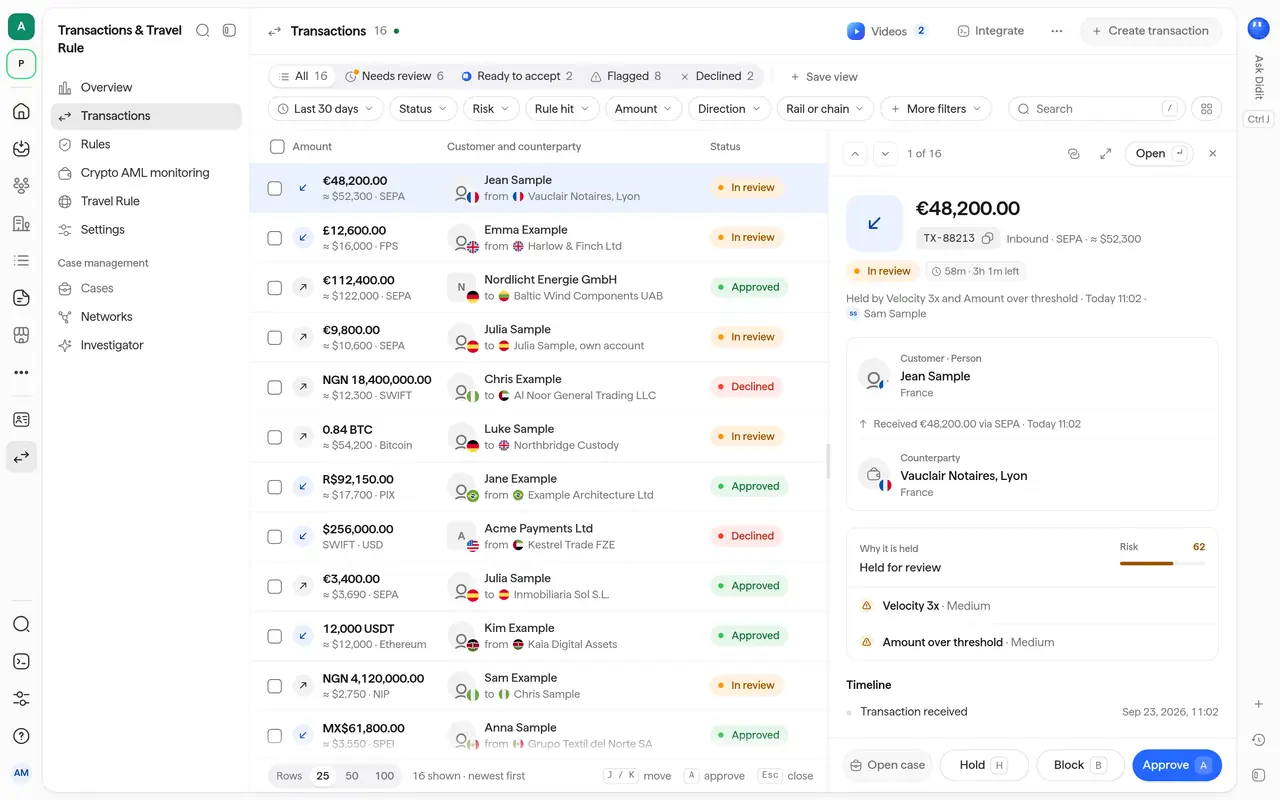
| Threshold transaction reports, section 43 | Report cash transactions of A$10,000 or more within 10 business days | Transaction Monitoring at $0.001 per transaction beyond the plan allowance, with rules, alerts, case management and an audit trail of rule runs | Classifying the transaction and lodging the report with AUSTRAC |
| Suspicious matter reports, section 41 | Report suspicion within 24 hours for terrorism financing, or 3 business days otherwise | Transaction Monitoring scores each transaction, routes it to review and records the status transitions | Forming the suspicion, writing the report and filing it |
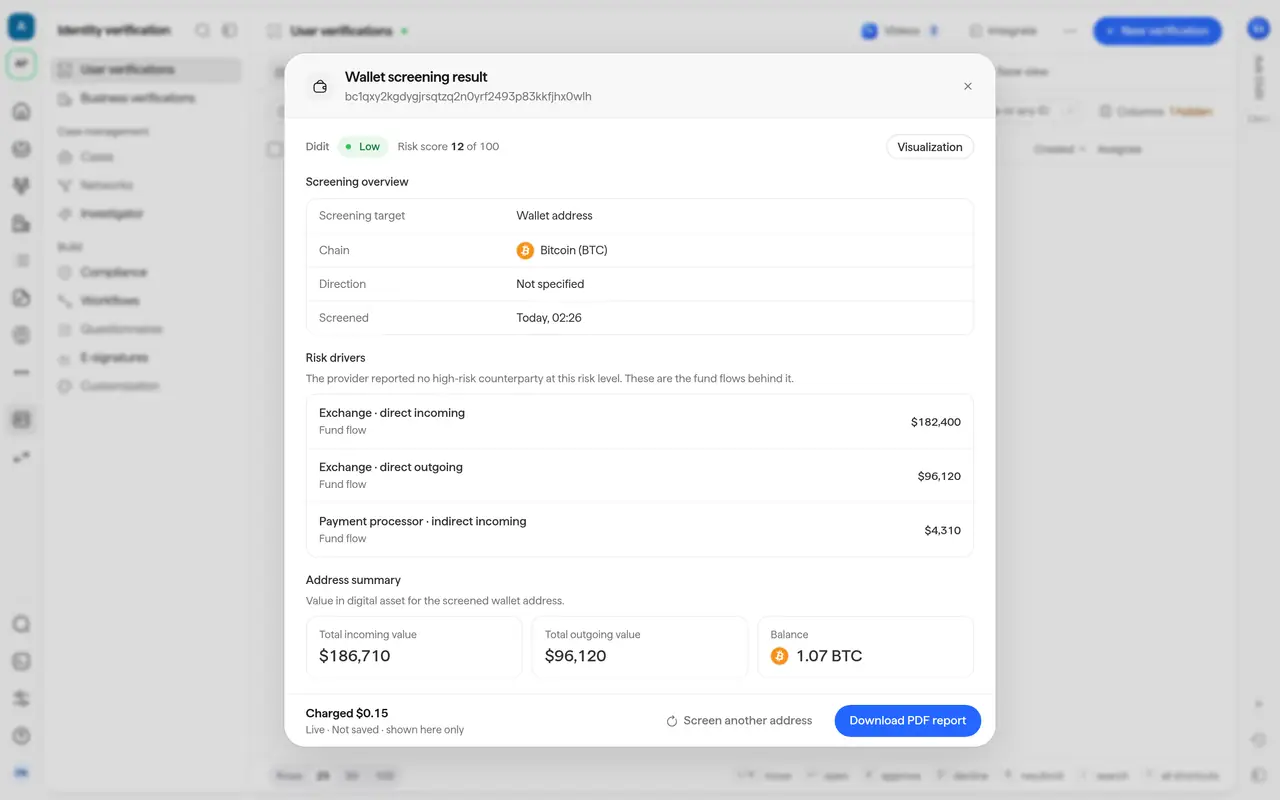
| Wallet and counterparty risk | Assess the risk of the addresses your customers send to and receive from | Wallet screening at $0.15 per screening, including an on-demand endpoint that screens one address with no transaction attached | Setting thresholds and acting on a high risk score |
| Travel rule data exchange | Collect and transmit originator and beneficiary data on virtual asset transfers | Travel Rule at $0.02 per exchange. The GTR, TRUST, VerifyVASP and Sygna network rails need a network membership you connect yourself in the console Marketplace; the internal, TRP and email rails do not need one | Deciding scope and holding the exchange records |
| Information requests from AUSTRAC | Answer on time, with the record that supports the answer | No capability. Didit is not your agent before the regulator | All of it |
One line belongs under that table rather than inside it. Didit's monitoring output supports the reporting workflow: it scores the transaction, records the rule runs, and keeps the status history. It does not determine whether a report must be filed. That call is a judgment about the facts of the transaction, and it stays with the reporting entity.

Worked example: a 2,000-customer month
Assumptions use only the published list prices read on November 26, 2026. A crypto ATM operator onboards 2,000 new customers in a month, runs one full KYC check on each, screens each customer once against sanctions and PEP lists, pre-screens 1,200 withdrawal addresses, and records 30,000 machine transactions.
- 2,000 full KYC checks at $0.33 = $660.00
- 2,000 AML screenings at $0.20 = $400.00
- 1,200 wallet screenings at $0.15 = $180.00
- 30,000 monitored transactions: the Free plan includes 1,000, so 29,000 at $0.001 = $29.00
At list prices on the metered lines the month costs $660.00 + $400.00 + $180.00 + $29.00 = $1,269.00.
On Growth, every Didit price is 4% lower and the plan includes 10,000 monitored transactions a month, so 20,000 are charged: $633.60 + $384.00 + $172.80 + $20.00 = $1,210.40, before the $99 monthly plan fee.
On Scale, prices are 10% lower and 100,000 monitored transactions are included, so the transaction charge is zero: $594.00 + $360.00 + $162.00 + $0.00 = $1,116.00, before the $299 monthly plan fee.
That is the identity and monitoring bill. It is not the compliance bill. It does not include the people who read alerts, the investigator time behind a case, or the lodging of the reports themselves.
Exceptions and open questions
- What happens at the end of the three months. The suspension is expressed as three months from 9 August 2026. AUSTRAC has not published the conditions, if any, under which Cryptolink could trade again, and the company has not published a response or said whether it will challenge the decision.
- The one-sided record. AUSTRAC's media release and register entry are the only public account. A compliance team reading this case should treat it as the regulator's version, not as agreed facts.
- The second suspension has no narrative. Worldwide Money Transfer Pty Ltd appears on the register from 12 August 2026 with no media release, so the grounds are not public.
- The cash cap is under review, not settled. AUSTRAC said it will keep the effectiveness of the crypto ATM conditions under review. A future change to the A$5,000 limit would change onboarding volumes and the cost of the checks that follow them.
- The reporting forms keep moving. The redesigned threshold and suspicious matter reports apply from 1 July 2026, with the transition running to March 2029. Field requirements can change inside that window.
Implementation checklist for a crypto ATM operator
- Map the designated services you actually provide and check that the registration details on the AUSTRAC register match what you operate.
- Write down the customer identification rule set for machine users, including the A$5,000 cash limit and the enhanced due diligence steps the condition requires.
- Timestamp every transaction at the machine, because the 10 business day clock for section 43 runs from the transaction, not from your month end reconciliation.
- Reconcile the threshold report population against the transaction ledger every month, and record who signed the reconciliation.
- Set monitoring rules that catch structuring below the A$10,000 threshold, and review the alerts on a fixed rota.
- Screen withdrawal addresses before funds leave, and attach the screening result to the transaction record.
- Name one owner for AUSTRAC information requests, with a deadline tracker, so a request cannot sit unowned.
- Rehearse the chain in the sandbox: create a session, submit a transaction, watch a rule fire, receive the webhook.
Where Didit runs in the flow
Two calls carry most of the work. Onboarding is a verified session created with POST /v3/session/ on a workflow that includes ID verification and AML screening. Recording a machine transaction is POST /v3/transactions/, and crypto screening runs automatically when currency_kind is crypto and Transaction Monitoring is enabled for the application.
For a withdrawal address with no transaction attached, use the on-demand wallet screening endpoint. This is the documented call:
curl -X POST https://verification.didit.me/v3/wallet-screening/ \
  -H "x-api-key: YOUR_API_KEY" \
  -H "Content-Type: application/json" \
  -d '{
    "wallet_address": "0x94f1b9b64e2932f6a2db338f616844400cd58e8a",
    "blockchain": "ETH"
  }'
If you already work with a screening provider you want to keep, you can bring your own screening provider and run it inside Didit, so the result lands on the same record as the rest of the customer file. The documented routes are at on-demand wallet screening, crypto wallet and address screening and the transaction monitoring quickstart. Module prices are on didit.me/pricing.
Sources
- AUSTRAC media release, 10 August 2026, ordering Cryptolink's crypto ATMs offline, read November 26, 2026: the suspension decision, its grounds and the Brendan Thomas quote.
- AUSTRAC public register of virtual asset service provider registration actions, published on austrac.gov.au, data to 13 August 2026, read November 26, 2026: the source of the action counts in Fig. 01 and the Worldwide Money Transfer entry.
- AUSTRAC media release, 3 June 2025, on crypto ATM sector conditions, read November 26, 2026: the A$5,000 cash limit, enhanced customer due diligence, scam warnings, machine growth, and the age and volume data.
- Cryptolink enforceable undertaking, October 2025, published by AUSTRAC in redacted form, read November 26, 2026: the undertaking the company met before the suspension.
- Anti-Money Laundering and Counter-Terrorism Financing Act 2006 (Cth), sections 6, 32, 41, 43 and 75A, and Part 6, read November 26, 2026.
- Anti-Money Laundering and Counter-Terrorism Financing Amendment Act 2024 (Cth), read November 26, 2026: the obligations-based regime and expanded registration from 31 March 2026.
- AUSTRAC guidance on the redesigned threshold transaction report and suspicious matter report forms, effective 1 July 2026 with transition to March 2029, read November 26, 2026.
- Didit pricing page and pricing documentation, read November 26, 2026: every unit price and plan allowance in this page.
- Didit wallet screening documentation: the on-demand endpoint, its fields and the provider configuration requirement.
- Didit Transaction Monitoring quickstart: transaction submission, rules, alerts and webhooks.
- Didit AML Screening documentation: sanctions, PEP and adverse media screening, and ongoing monitoring.
- Didit Travel Rule documentation: originator and beneficiary data exchange, the seven rails and their network membership requirements.
Next step: open the sandbox at business.didit.me, build the onboarding workflow and the wallet screening call against test data, and read the numbers on didit.me/pricing before you go live. No sales call is required to start.
Try it
Try this in the sandbox
Run the check this guide describes, free.
The product this post is about, taken from its topic. Run it free in the sandbox.
Author
Alberto Rosas
Co-founder and CEO

Keep reading
Other guides in the same topic.
 What Is the Purpose of FICA in South Africa? 2026 Guide
FICA is South Africa's anti-money laundering law. It creates the Financial Intelligence Centre and requires accountable institutions to identify and verify clients, screen for PEP and sanctions risk and report suspicious.
Alberto RosasNov 26, 2026 Sixth Money Laundering Directive (6AMLD): What Changed and Which Rules Apply
6AMLD is Directive (EU) 2018/1673: Member States must criminalise laundering, widen predicate offences and set a four-year penalty floor. It adds no new due diligence duties for firms.
Alberto RosasNov 26, 2026 Automated Sanctions Screening: Canada, the Entity List and Embargoes
Automated sanctions screening matches people and companies against lists such as Canada's autonomous sanctions made under SEMA and JVCFOA and the OFAC SDN List, and returns candidate hits scored for identity confidence and.
Alberto RosasNov 26, 2026Questions
Frequently asked questions
Why did AUSTRAC suspend Cryptolink?
AUSTRAC suspended Cryptolink Pty Ltd's registration as a virtual asset service provider for three months from 9 August 2026. It said that after the company met the conditions of its October 2025 enforceable undertaking, it failed to meet basic reporting obligations, particularly threshold transaction reports, and did not respond to an information request.
Can Cryptolink operate its crypto ATMs during the suspension?
No. AUSTRAC said Cryptolink is no longer allowed to operate its 96 cryptocurrency ATMs while the three-month suspension runs, and that it will monitor the company to ensure it complies. The suspension started on 9 August 2026.
What conditions apply to all crypto ATM operators in Australia?
Since 3 June 2025 AUSTRAC has placed conditions on crypto ATM registrations: a A$5,000 limit on cash deposits and withdrawals, enhanced customer due diligence, mandatory scam warnings on the machines, and stronger transaction monitoring requirements. The conditions apply to every registered operator, not only to firms under investigation.
Does completing an enforceable undertaking protect a registration?
Cryptolink's case shows that it does not. AUSTRAC's own account is that the company met the conditions in its undertaking and was suspended over obligations that came afterwards: lodging threshold transaction reports and answering an information request. An undertaking closes a remediation project, not the supervision file.
What is a threshold transaction report and when is it due?
A threshold transaction report is the filing a reporting entity owes under section 43 of the Anti-Money Laundering and Counter-Terrorism Financing Act 2006 (Cth) for cash transactions of A$10,000 or more. It must be lodged within 10 business days after the transaction. From 1 July 2026 the report form asks for more structured detail, with a transition period running to March 2029.
Do crypto ATM operators need to be registered with AUSTRAC in 2026?
Yes. Crypto ATM operators have had to register as digital currency exchange providers since 3 April 2018, and section 75A of the Act prohibits providing a registrable designated service without registration. From 31 March 2026 the registration regime was extended to all providers of designated services under the 2024 Amendment Act.
What is the cash limit at Australian crypto ATMs?
AUSTRAC's conditions impose a A$5,000 limit on cash deposits and withdrawals at crypto ATMs, in force since 3 June 2025. AUSTRAC has said it will keep the effectiveness of the conditions under review, so the limit can change.
Can Didit file my threshold transaction reports or suspicious matter reports?
No. Didit does not lodge threshold transaction reports or suspicious matter reports, does not answer AUSTRAC information requests, and does not run an enforceable undertaking's remediation. Didit produces and scores the transaction data those reports are built from, but it does not decide whether a report is required. Filing stays with the reporting entity.
How much does Didit cost per crypto ATM customer?
At list prices read on November 26, 2026, a full KYC check is $0.33, AML screening is $0.20 per check, wallet screening is $0.15 per screening, and transaction monitoring is $0.001 per transaction beyond your plan allowance. Growth prices are 4% lower and Scale prices 10% lower than list. You pay per completed check from prepaid credit.
Can I use my own wallet screening provider inside Didit?
Yes. You can bring your own screening provider and run it inside Didit, so the result is attached to the same transaction and customer record as the rest of the file. Configure the provider in the console before you call the wallet screening endpoint, because the endpoint returns a conflict error when no provider is configured.
What happens to Cryptolink's 96 crypto ATMs now?
They are offline for the duration of the three-month suspension that began on 9 August 2026, according to AUSTRAC. AUSTRAC has not published what has to happen for the company to operate again, and Cryptolink has not published a response to the decision.
Compliance built in
Audited, certified and attested.
We hold the certifications and build each country's rules into your flows, so you can launch anywhere without worrying. Security and Compliance center
- Regulation encoded into your flows
Tell us what you do and where. Didit lists the rules that apply to you, with sources, and builds the checks each country needs into one workflow.
- Ready for AMLR
Every requirement of the new EU anti-money laundering rules, from checking customers to human review, is already covered by a Didit check.
- Tested in Spain's Treasury sandbox
Spain's Treasury published its supervised sandbox report on Didit's NFC plus active liveness onboarding; SEPBLAC took part and valued the added measures positively.
- Audited, not self-declared
iBeta Level 1 and Level 2. Liveness tested under ISO/IEC 30107-3.
Your obligations · 3 regions
 SOC 2 Type 2
 ISO 27001
 iBeta Level 1 and Level 2
 EU regulator attestation
 FSM youth protection
 GDPR
 EBA remote onboarding
 MiCA compatible
 FIDO Alliance member
- AMLREU AML Regulation ready
Integration · Didit MCP
Run Didit from your own AI agent
Connect Didit to Claude, Cursor, VS Code or ChatGPT and just ask in plain words. Your agent can do anything you can do in the console, with the same permissions you have.
 Add to Claude
 ChatGPT
 Cursor
- Build workflowsDescribe the checks you need. The agent creates and publishes the flow.
- Run investigationsAsk why a session was declined, review cases, search people and companies.
- Change rulesCreate payment rules, test them on past data and switch them on.
- Pull reportsAsk for numbers, exports or the audit log.
Didit Academy


