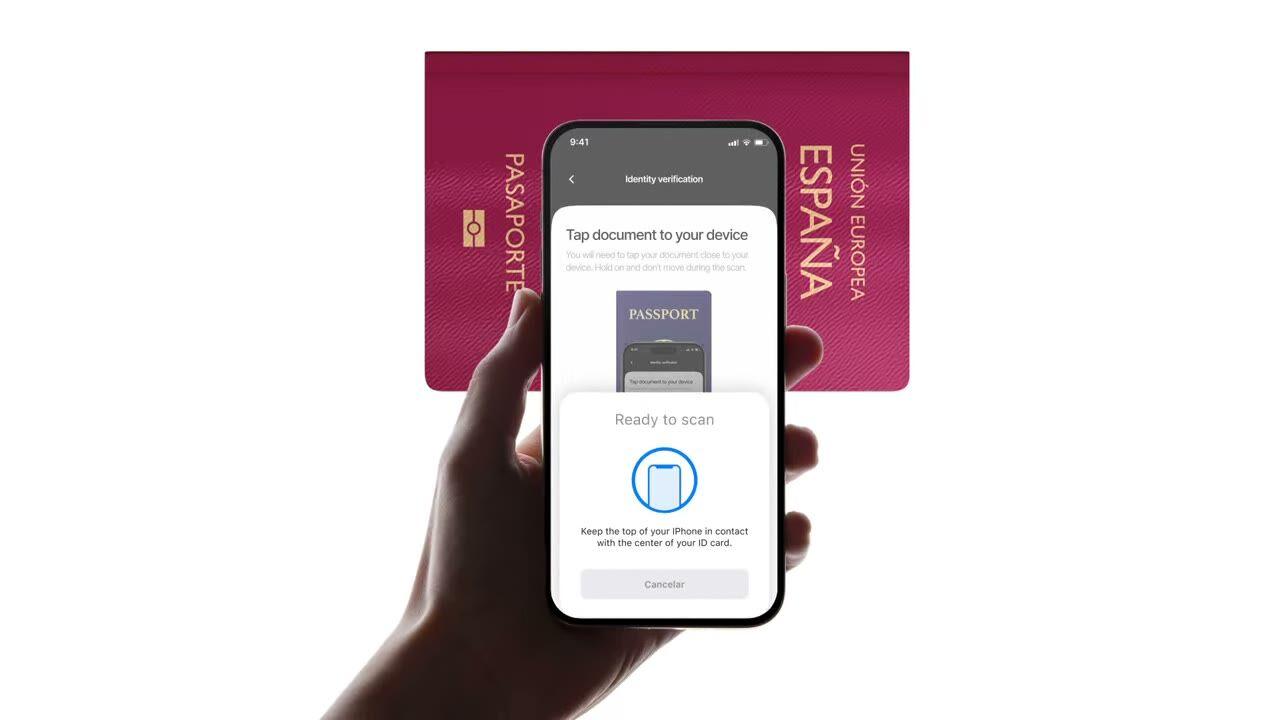
Approche un passeport ou une e-ID du téléphone. La puce est lue, la signature gouvernementale est validée, et les falsifications que les vérifications photo classiques manquent sont détectées. 0,15 $ par lecture, 500 gratuites/mois.
Approche le passeport. La puce renvoie les mêmes données que la photo, sauf que cette
fois, elles sont signées par le pays émetteur. 0,15 $, en moins de 2 secondes.
Comment ça marche
De l'inscription à l'utilisateur vérifié en quatre étapes.
Étape 01 / 04
01
Crée le workflow
Choisis les vérifications que tu souhaites, ID, détection du vivant, correspondance faciale, sanctions, adresse, âge, téléphone, e-mail, questions personnalisées. Glisse-les dans un flux sur le tableau de bord, ou publie le même flux via notre API. Crée des branches conditionnelles, lance des tests A/B, aucun code requis.
Intègre
Intègre nativement avec nos SDK Web, iOS, Android, React Native ou Flutter. Redirige vers une page hébergée. Ou envoie simplement un lien à ton utilisateur, par e-mail, SMS, WhatsApp, n'importe où. Choisis ce qui correspond à ta stack.
L'utilisateur suit le parcours
Didit gère la caméra, les indications lumineuses, le transfert mobile et l'accessibilité. Pendant que l'utilisateur est dans le flux, nous évaluons plus de 200 signaux de fraude en temps réel et vérifions chaque champ par rapport à des sources de données fiables. Résultat en moins de deux secondes.
Tu reçois les résultats
Des webhooks signés en temps réel maintiennent ta base de données synchronisée dès qu'un utilisateur est approuvé, refusé ou envoyé en révision. Interroge l'API à la demande. Ou ouvre la console pour inspecter chaque session, chaque signal, et gérer les cas à ta manière.
Conçu pour les développeurs · Conçu contre la fraude · Ouvert par nature
Six fonctionnalités. Un seul *feature flag*. NFC.
Chaque fonctionnalité ci-dessous est un interrupteur sur le même module. Pas de paliers de prix, pas de SKU séparés, pas d'appels pour des add-ons. Active-les par workflow, ou inclus le module NFC quand tu crées un workflow via l'API.
Vérifie la signature sur chaque puce, pas l'impression sur la page.
Chaque passeport électronique et e-ID moderne contient une puce sans contact signée par le gouvernement émetteur. Nous la lisons via NFC (communication en champ proche), validons la signature numérique et renvoyons un verdict infalsifiable. Cela permet de détecter les attaques de morphing, les substitutions de photos et les falsifications qui passent l'inspection visuelle.
SPAINe-Passport
P<ESPROY<<OLIVIA<<<<<<<
Chip readICAO 9303
Passive AuthenticationSOD signature valid
Active AuthenticationChip challenge OK
Chip AuthenticationSession key derived
Signed by issuerAuthentic
02 · Groupes de données ICAO 9303
Contenu complet de la puce extrait, structuré et signé.
Chaque groupe de données ICAO 9303 sur la puce est lu, objet de sécurité signé, données personnelles, MRZ (zone de lecture automatique), image faciale haute résolution, image de signature, plus toute biométrie supplémentaire stockée par le pays émetteur. Tu obtiens un JSON `chip_data` propre, ainsi que des URL signées pour le portrait et la signature.
Document chipSOD · signed data groups
Signed
First nameDG1
Olivia
Last nameDG1
Roy
Date of birthDG1
12 Mar 1992
Document numberDG1
XAB204731
Facial imageDG2
High-res portrait
Signed at issuance · not OCR5 fields verified
03 · Confiance ICAO PKD
Confiance ancrée au répertoire de clés publiques de l'ICAO.
Chaque lecture de puce retrace la chaîne complète de certificats, signataire du document → autorité de signature du pays → racine du répertoire de clés publiques ICAO, et vérifie la liste de révocation du pays en temps réel. Les certificats révoqués et expirés apparaissent comme des avertissements configurables ; les autres passent comme des booléens d'authenticité sur le rapport.
Document SignerDSC · eID Spain
Country Signing CACSCA · CRL current
ICAO PKD RootPublic Key Directory
Root
Integrity
SOD integrity
DG integrity
DSC not revoked
DSC not expired
Verified · ICAO PKDChain valid
04 · Photo vs puce
Vérifie chaque champ. Refus automatique en cas de non-concordance.
Les données de la photo doivent correspondre aux données de la puce. En cas de divergence, la session est automatiquement refusée, ce déclencheur ne peut pas être désactivé. C'est le signal le plus clair d'une zone photo altérée, d'une puce échangée ou d'un faux document avec une impression d'apparence réelle.
Data source
Camera OCRChip read
Document number
XAB2O4731XAB204731≈ 91.4%Signed
First name
0LIVIAOLIVIA≈ 96.7%Signed
Expiry date
03 / 203103 / 2031≈ 99.1%Signed
Best-effort read · fonts, glare, wearExact values · signed by the issuer2 mismatchesSource of truth
05 · Mobile SDK d'abord
iOS, Android, React Native, Flutter, lecture de puce intégrée.
Les SDK natifs gèrent pour toi le lecteur NFC de l'appareil, les autorisations et l'interface utilisateur de lecture de puce. iOS utilise Core NFC ; Android utilise IsoDep sur NfcAdapter ; React Native et Flutter enveloppent les deux. Les navigateurs sans NFC basculent automatiquement vers l'ID standard + selfie, un avertissement de saut est déclenché et la session continue.
React Native · FlutterBridges the native SDKsBridgedidit.nfc.read()One call · native under the hood
Web browserNo NFC · falls back to OCRFallbackdidit.ocr.scan()Camera capture · OCR fields
One call · NFC when the device supports itAuto-fallback · session continues with OCR
06 · Couverture mondiale
Tous les pays émetteurs ICAO, en croissance chaque trimestre.
La plupart des passeports émis après 2006 intègrent une puce, ainsi qu'une liste croissante d'e-ID nationaux, DNIe espagnol, Personalausweis allemand, CIE italien, carte d'identité estonienne, Cartão de Cidadão portugais, eID belge, eID néerlandais. Les certificats nationaux sont mis à jour automatiquement ; les nouveaux pays deviennent lisibles le jour où nous les intégrons.
DNIeSpain
PersonalausweisGermany
Carta CIEItaly
Cartão de CidadãoPortugal
ID-kaartEstonia
2006e-Passports since
30+National e-IDs
9303ICAO standard
CSCA certificates refreshed automaticallyReadable via NFC
Intègre
Un workflow. Deux façons de lancer la lecture de la puce.
Le NFC n'a pas de point de terminaison autonome de serveur à serveur, la puce nécessite un appareil doté du matériel NFC. Les deux chemins ci-dessous partagent le même appel de création de session ; ils ne diffèrent que par le fait que l'utilisateur lise la puce dans notre interface hébergée ou dans ta propre application via le SDK natif.
// iOS · Swift
import DiditSdk
let result = try await DiditSdk.shared.startVerification(
avec : sessionId,
configuration : config)
donein-app{ "status": "Approved" }
Intégration prête pour agent
Déploie la vérification NFC en une seule instruction.
Colle le bloc ci-dessous dans Claude Code, Cursor, Codex, Devin, Aider ou Replit Agent. Remplace le placeholder my_stack par ton framework, ton langage et ton cas d'utilisation. L'agent provisionne Didit, construit le workflow avec NFC activé, connecte le webhook et déploie.
didit-integration-prompt.md
# Didit NFC Verification — integrate in 5 minutes

You are integrating Didit's NFC Verification (cryptographic e-passport
and e-ID chip reading) module into <my_stack>. Follow these steps exactly.
Every URL, header, and enum value below is canonical — do not paraphrase
or "improve" them.

## 1. Provision an account
- Sign up: https://business.didit.me (no credit card required).
- Or provision programmatically: POST https://apx.didit.me/auth/v2/programmatic/register/
  (returns an API key bound to the workspace + application).

## 2. What NFC Verification actually does
NFC Verification reads the secure contact-less chip embedded in modern
e-passports and e-IDs (the small chip-and-antenna sticker symbol on the
cover) and runs four cryptographic checks against the data it extracts:

1. Passive Authentication — every Data Group (DG1 personal data, DG2
   facial image, etc.) is hashed and compared against the signed hash
   stored in the Document Security Object (SOD). Catches any single-bit
   tampering of the chip contents.
2. Certificate chain validation — Document Signer Certificate (DSC) →
   Country Signing Certificate Authority (CSCA) → ICAO Public Key
   Directory (PKD) root. Proves the chip was signed by the issuing
   government, not a clone.
3. Certificate Revocation List (CRL) check — DSCs revoked by the issuing
   country are caught and flagged.
4. Chip Authentication — where the document supports it, prevents chip
   cloning by challenging the chip with a key-pair handshake.

PACE (Password Authenticated Connection Establishment) or BAC (Basic
Access Control) is used to derive the session key from the Machine-Readable Zone (MRZ); Didit
handles that automatically. All of this is ICAO 9303 standard.

## 3. Two integration paths — pick one

### Path A — Workflow Builder (hosted UI, REQUIRED for NFC)
NFC Verification has no server-to-server standalone endpoint. The chip
has to be read by a device with NFC hardware, so you always integrate
through the Workflow + native SDK (or hosted mobile web that falls back).

1. Create a workflow that contains the NFC feature:
   POST https://verification.didit.me/v3/workflows/
   Authorization header:  x-api-key: <your-api-key>
   Body: workflow_label, features array with the entries
         { feature: "OCR" }
         { feature: "NFC" }
         (UPPERCASE — strict enum)
   You should always pair NFC with OCR (ID Verification) so the MRZ is captured
   for the chip handshake AND so an OCR cross-validation is available.

2. Create a verification session for an end user:
   POST https://verification.didit.me/v3/session/
   Body: workflow_id (from step 1), vendor_data (your own user id).
   Response: url (the hosted verification link) — redirect the user to
   it (or open it in the native SDK with
   shared.startVerification(with: sessionId)).

3. Listen for webhook callbacks (see "Webhooks" below).

### Path B — Native SDKs (drop-in, recommended for mobile apps)
Same workflow + session above, but launch the verification flow in your
own iOS or Android app via the Didit SDK. The SDK wires the NFC reader,
the entitlements, and the chip-reading UI for you.

- iOS: DiditSdk.shared.startVerification(with: sessionId, configuration:)
  Required entitlements (handled by the SDK):
    - com.apple.developer.nfc.readersession.formats = ["TAG"]
    - ISO7816 application identifiers for ePassports
- Android: DiditSdk.startVerification(sessionId, config) — uses
  IsoDep (android.nfc.tech.IsoDep) under the hood.
- React Native / Flutter: the same SDK, exposed through the cross-
  platform module — see docs.didit.me/integration/native-sdks/.

### Web browsers — NFC is unavailable
Web NFC API is not generally available. Chrome on Android has an
experimental Web NFC that is unstable and requires explicit permissions;
Safari on iOS has no support. For web integrations, NFC is automatically
skipped and the user proceeds with standard ID + selfie. If you require
NFC, deep-link the user into the Didit App or your own native app.

## 4. Webhooks
- Register a webhook destination once via
  POST https://verification.didit.me/v3/webhook/destinations/
  Body: url, subscribed_events: ["session.verified", "session.review_started",
                                  "session.declined"]
- Response includes secret_shared_key — store it.
- Every webhook delivery carries an X-Signature-V2 header you MUST verify
  before trusting the payload.  HMAC-SHA256 verification MUST run against the raw body bytes (the raw payload as Didit sent it) BEFORE any JSON parsing — re-serialising the parsed body changes whitespace and key order, which invalidates the signature.Algorithm:
    1. sortKeys(payload) recursively
    2. shortenFloats (truncate trailing zeros after the decimal point)
    3. JSON.stringify the result
    4. HMAC-SHA256 with the secret_shared_key
    5. Hex-encode, compare to the X-Signature-V2 header.

## 5. Reading the report
The session decision includes an nfc_verifications[] array alongside
id_verifications[] — one entry per workflow node, each with its own node_id.
Fields on each nfc_verifications entry:

- status: "Approved" | "Declined" | "In Review" | "Not Finished"
- portrait_image: signed URL to the chip-extracted DG2 facial image
- signature_image: signed URL to the chip-extracted DG7 signature
- chip_data:
    document_type, issuing_country (ISO 3166-1 alpha-3),
    document_number, expiration_date (YYYY-MM-DD),
    first_name, last_name, birth_date, gender ("M" | "F" | "U"),
    nationality (ISO 3166-1 alpha-3), address, place_of_birth.
- authenticity:
    sod_integrity (boolean — every Data Group hash matched the SOD)
    dg_integrity (boolean — Data Group binary integrity check passed)
- certificate_summary:
    issuer (CSCA Common Name + serial + organization + country)
    subject (DSC Common Name)
    serial_number
    not_valid_after (YYYY-MM-DD HH:MM:SS)
    not_valid_before (YYYY-MM-DD HH:MM:SS)
- warnings: Array of { risk, additional_data, log_type,
                       short_description, long_description }

### Auto-decline (always enforced, never configurable)
- NFC_AND_OCR_DATA_NOT_SAME — Optical Character Recognition (OCR) data
  and chip data differ. Indicates document tampering or fake chip.

### Configurable warnings (per-workflow action: Decline / Review / Approve)
- SKIPPED_NFC_VALIDATION       — chip not read (no NFC hardware, no
                                  permissions, document has no chip)
- NFC_CHIP_NOT_VERIFIED        — chip read but signature could not be
                                  verified (missing CSCA, older document)
- DSC_CERTIFICATE_REVOKED      — Document Signer Certificate listed on
                                  the issuing country's CRL
- DSC_CERTIFICATE_EXPIRED      — Document Signer Certificate past its
                                  validity period

## 6. Hard rules — do not change
- Base URL for /v3/* endpoints is verification.didit.me (NOT apx.didit.me).
- Feature enum is UPPERCASE: NFC, OCR, LIVENESS, FACE_MATCH.
- Auth header is x-api-key (lowercase, hyphenated).
- Webhook signature header is X-Signature-V2 (NOT X-Signature).
- Always verify webhook signatures before trusting payload data.
- Always pair NFC with OCR (ID Verification) in the workflow — NFC alone
  cannot derive the chip key without the MRZ from the document photo.
- Status casing matches exactly: "Approved", "Declined", "In Review",
  "Not Finished" (title-cased, space-separated).
- Treat NFC as an additive confidence boost, not a hard gate, unless
  your risk policy explicitly requires it (regulated remote
  onboarding under PSD3, AMLD6 high-risk customer flows, etc.).

## 7. Pricing reference (public)
- NFC Verification: $0.15 per chip read (standalone module).
- Bundled inside a full Know Your Customer (KYC) workflow (ID + Liveness + Face Match + NFC):
  priced as the underlying KYC bundle ($0.33) + $0.15 NFC if enabled.
- 500 free checks every month, forever, on every account.

## 8. Verify your integration
- Sandbox starts on signup at https://business.didit.me — no separate flag.
- Test documents: use the Didit App on a real iOS or Android device with
  any ICAO 9303 e-passport issued after 2006 (most modern passports).
- Sandbox webhook events fire the same shape as production; verify the
  X-Signature-V2 header in dev too.
- Switch to live: flip the application's environment toggle in console.

When in doubt: https://docs.didit.me/core-technology/nfc-verification/overview
Conforme par nature
Ouvre un nouveau pays en un clic. On s'occupe du plus dur.
Nous ouvrons les filiales locales, obtenons les licences, effectuons les tests d'intrusion, obtenons les certifications et nous alignons sur chaque nouvelle réglementation. Pour déployer des vérifications dans un nouveau pays, il suffit d'activer un interrupteur. Plus de 220 pays en direct, audités et testés chaque trimestre, le seul fournisseur d'identité qu'un gouvernement d'un État membre de l'UE a formellement jugé plus sûr que la vérification en personne.
Chaque puce lue est vérifiée par rapport à la norme canonique des passeports électroniques.
PKD
Confiance ancrée à la racine du répertoire de clés publiques de l'ICAO.
<2s
Lecture de puce de bout en bout sur un smartphone moderne.
$0.15
Par lecture de puce NFC. 500 gratuites chaque mois.
Trois niveaux, une seule grille tarifaire
Commence gratuitement. Payez à l'usage. Passez à l'Enterprise.
500 vérifications gratuites chaque mois, pour toujours. Ensuite, ne payez que lorsqu'un module s'exécute. Contrats personnalisés, résidence des données et accords de niveau de service (SLA) pour l'offre Enterprise.
Gratuit
$0/ mois · sans carte bancaire
Pour le développement, les tests et tes premiers utilisateurs.
Tout ce qu'il te faut pour démarrer :
500 vérifications KYC complètes chaque mois
ID, preuve de vie, correspondance faciale, appareil et IP
Plus de 200 signaux de fraude, liste noire, doublons
KYC réutilisable sur le réseau Didit
Éditeur de workflows, gestion des cas, SDK
Support IAAgent IA intégré à la console, documentation et communauté.