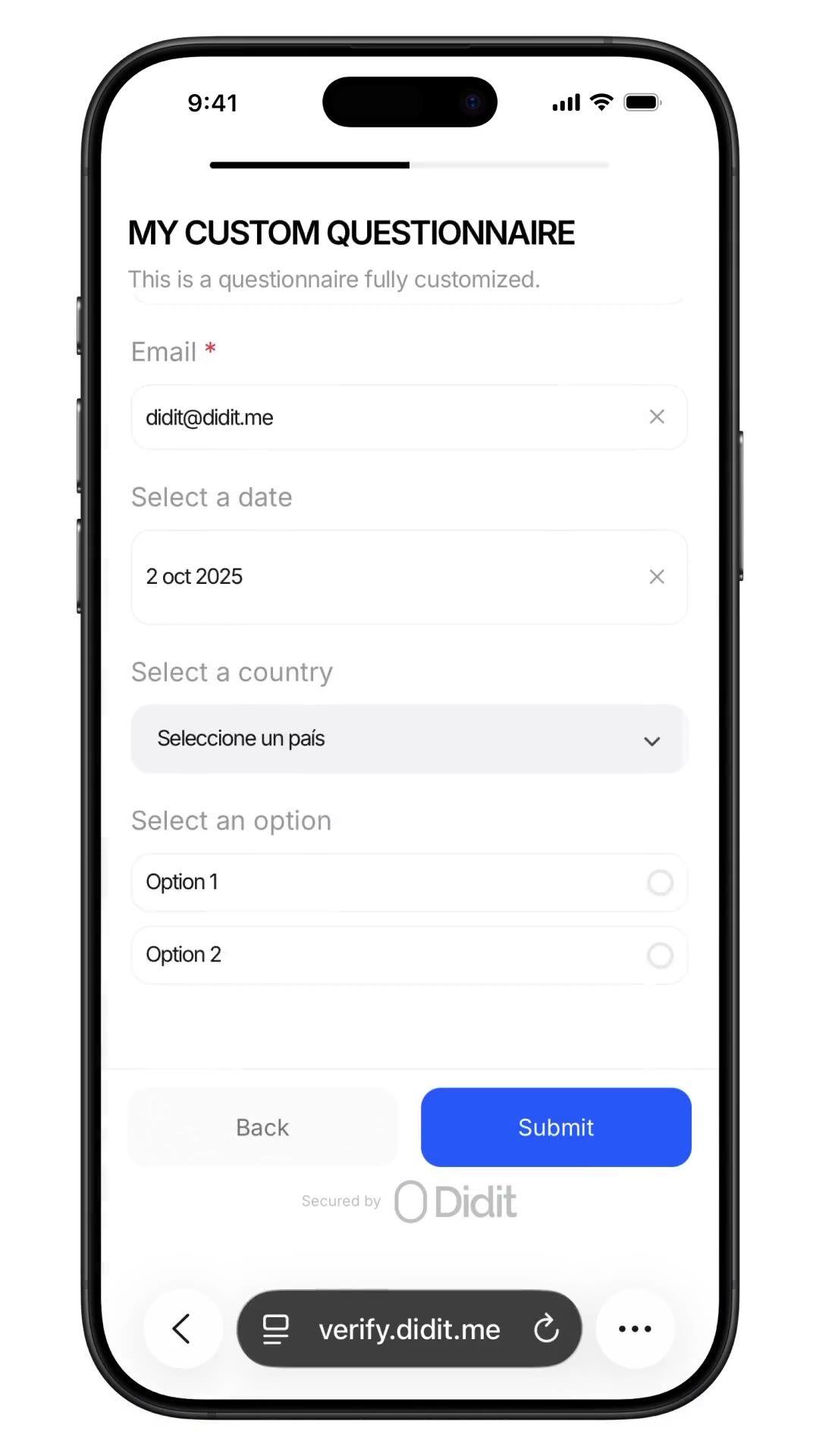
Собирайте любые данные. В любом верификационном процессе.
Задавайте любые вопросы, необходимые вашей команде комплаенса, источник средств, род занятий, ожидаемый объем транзакций, самодекларация PEP (политически значимого лица), с аудируемыми ответами в рамках одной сессии. No-code конструктор, условные переходы, загрузка файлов. $0.10 за отправку, 500 бесплатных в месяц.
Нам доверяют более 2000 организаций по всему миру.
Источник средств, самодекларация PEP
Спрашивайте что угодно. Зафиксируйте аудиторский след.
Встройте кастомный опросник в рабочий процесс, источник средств, самодекларация PEP,
род занятий, ожидаемый объем. Ответы попадают в отчет по сессии.
$0.10 за отправку.
Как это работает
От регистрации до верифицированного пользователя за четыре шага.
Шаг 01 / 04
01
Создайте рабочий процесс
Выберите нужные проверки, ID, liveness, face match, санкции, адрес, возраст, телефон, email, кастомные вопросы. Перетащите их в рабочий процесс на дашборде или отправьте тот же процесс через наш API. Ветвление по условиям, A/B-тесты, код не требуется.
Интегрируйте
Встраивайте нативно с помощью наших SDK для Web, iOS, Android, React Native или Flutter. Перенаправляйте на размещенную страницу. Или просто отправьте пользователю ссылку, по email, SMS, WhatsApp, куда угодно. Выберите то, что подходит вашему стеку.
Пользователь проходит процесс
Didit обеспечивает работу камеры, подсказки по освещению, мобильную передачу и доступность. Пока пользователь проходит процесс, мы оцениваем более 200 признаков мошенничества в реальном времени и проверяем каждое поле по авторитетным источникам данных. Результат менее чем за две секунды.
Вы получаете результаты
Подписанные вебхуки в реальном времени синхронизируют вашу базу данных в момент одобрения, отклонения или отправки пользователя на проверку. Опрашивайте API по запросу. Или откройте консоль, чтобы просмотреть каждую сессию, каждый сигнал и управлять кейсами по своему усмотрению.
Создано для разработчиков · Защита от мошенничества · Открытый дизайн
Шесть возможностей. Один флаг функции. QUESTIONNAIRE.
Каждая из описанных ниже возможностей, это переключатель в одном модуле. Никаких дополнительных тарифов, отдельных SKU или надстроек. Включайте их для каждого рабочего процесса или добавляйте шаг с опросником после верификации ID и liveness в единый рабочий процесс.
Формы на основе схем. Без кода. Без SDK. Без этапа сборки.
Два режима. Простой режим для быстрых одноязычных форм с перетаскиванием, идеально подходит для внутренних опросов и быстрых подтверждений. Расширенный режим, это визуальный редактор на основе узлов, необходимый, когда вам нужны условные переходы, переводы, текст, зависящий от выбора, или принудительная ручная проверка. Оба публикуются менее чем за минуту.
Elements
Dropdown
Single choice
Multi choice
File upload
Long text
Date
Click to add
Custom questionnaireDraftPublished
Click to add elements
Source of fundsDROPDOWN
Required
Annual income bandSINGLE_CHOICE
Required
Supporting documentsFILE_UPLOAD
Required
Additional contextLONG_TEXT
Required
PublishPublished
02 · Условное ветвление
Показывайте каждый вопрос только тому пользователю, которому он нужен.
Узлы ветвления в расширенном режиме редактора проверяют любой предыдущий ответ и направляют пользователя по соответствующему пути. Задайте резиденту США вопрос W-9, резиденту ЕС, самодекларацию PEP (политически значимого лица), пропустите оба, если ни один из них не применим. Перетащите из любого узла в пустое пространство, чтобы создать новый связанный узел. Отмена, повтор, горячие клавиши, масштабирование и панорамирование включены.
Applicant answer
US residentPEP · yesIncome > 250k
country == USRequire
is_pep == trueRequire
income > 250kShow
W-9 tax formFILE_UPLOAD
Required
Pick an answer to re-route the flow
03 · AML-шаблоны
Источник средств. Налоговое резидентство. Декларации бенефициаров.
Шесть готовых шаблонов комплаенса в консоли, Источник средств, Детали занятости, Цель счета, Бенефициарное владение, Налоговое резидентство, Оценка рисков. Каждый из них кодирует то, что ожидают аудиторы (источник дохода, разбивка, загрузка подтверждения, средства третьих сторон, декларация виртуальных активов). Клонируйте один и настройте или начните с чистого листа.
Template library
SOFSource of Funds7q
EMPEmployment5q
ACPAccount Purpose4q
UBOOwnership6q
TAXTax Residency5q
RSKRisk Profile8q
Questionnaire7 questions
Pick a template to build
Source of fundsDROPDOWN
Income bandSINGLE_CHOICE
Initial depositDROPDOWN
Volume bandSINGLE_CHOICE
Supporting docsFILE_UPLOAD
Other sourcesMULTI_CHOICE
Extra contextLONG_TEXT
48+ languagesReady to ship
04 · Структурированные ответы
Каждый ответ возвращается в виде единого JSON, готового к аудиту.
Отчет о сессии содержит массив `responses`, по одной записи на каждый шаг опросника. Каждый элемент включает тип элемента, флаг обязательности, локализованное название, варианты выбора, лимит загрузки и объект ответа со значением, текстом или файлами. Та же структура в API и каждом вебхуке, сохраните один раз и никогда не перепарсируйте.
Source of fundsIn flow
Answer
Select…Salary
Attachment
payslip_2026.pdf
Submit
questionnaire_responses200 OK
awaiting submission…
{
"questionnaire_id": "q_9f7485e0",
"element_type": "DROPDOWN",
"title": "Source of funds",
"answer": { "value": "salary" },
"files": ["payslip_2026.pdf"]
}
webhook · questionnaire.completed
05 · Ответы + аудиторский след
Принудительная ручная проверка. Человек в процессе. Готовность к аудиту.
Включите принудительную ручную проверку, и каждая отправка будет помечена как «На проверке», пока ее не одобрит сотрудник комплаенса. Консоль показывает каждый ответ, каждый загруженный файл и локализованный текст вопроса. Одобрение в один клик отправляет вебхук о верифицированной сессии с окончательным отчетом. Полностью аудируемо для регулятора.
Submission queueLive
412413Approved
282928In review
6Not finished
Webhook fired · questionnaire.completedjust now
Jusr_7b3e9d4Source of Fundsjust nowIn reviewApproved
Ausr_a8c4f02Source of Funds12 MayApproved
Musr_4d2b6e1Employment Details13 MayApproved
Lusr_9f01a3cTax Residency14 MayApproved
06 · Встроенный в рабочий процесс
Встроено в KYC. Или работает как отдельная проверка.
Объедините АНКЕТУ с проверкой личности (ID_VERIFICATION) и LIVENESS, чтобы собрать данные об источнике средств в рамках полного KYC-онбординга (Know Your Customer), одна сессия, один вебхук, один отчет. Или запустите процесс, единственной функцией которого является АНКЕТА, для текущей комплексной проверки, деклараций после онбординга и периодических подтверждений. $0.10 за каждое заполнение.
01ID check
02Liveness
03Questions
Source of FundsApproved
Primary source · Salary
Docs · payslip_2026.pdf
Single session reportsession.approved · one webhook
Verified
Интегрируйте
Два сценария. Один JSON. Одна цена.
Используйте POST /v3/session/ для рабочего процесса, который объединяет QUESTIONNAIRE с ID_VERIFICATION и LIVENESS для сбора данных в рамках полного KYC, или для рабочего процесса, единственной функцией которого является QUESTIONNAIRE, чтобы запустить форму как отдельную верификацию опросника. Оба возвращают одинаковую структуру questionnaire_responses.
Вставьте блок ниже в Claude Code, Cursor, Codex, Devin, Aider или Replit Agent. Заполните плейсхолдер my_stack вашим фреймворком + языком + сценарием использования. Агент настроит Didit, создаст опросник, сформирует воркфлоу с функцией QUESTIONNAIRE, подключит вебхук и запустит всё в работу.
didit-integration-prompt.md
# Didit Custom Questionnaires — integrate in 5 minutes

You are integrating Didit's Custom Questionnaires module into <my_stack>.
Follow these steps exactly. Every URL, header, and enum value below is
canonical — do not paraphrase or "improve" them.

## 1. Provision an account
- Sign up: https://business.didit.me (no credit card required).
- Or provision programmatically: POST https://apx.didit.me/auth/v2/programmatic/register/
  (returns an API key bound to the workspace + application).

## 2. Build the questionnaire — Console OR API

### 2a. Visual builder in the Console (no code)
Questionnaires are authored visually — no schema upload, no SDK required.
1. Open https://business.didit.me, go to Questionnaires, click New.
2. Pick a mode:
   - Simple Mode — single-language drag-and-drop builder. Best for fast
     forms, internal surveys, single-locale flows.
   - Advanced Mode — visual node-based graph editor. Required for
     conditional branching, multi-language translations, choice-driven
     follow-up text, and forced manual review.
3. Drag elements onto the canvas (input, choice, upload, layout — full
   element catalog in section 5 below).
4. Optionally start from a pre-built template (Source of Funds,
   Employment Details, Purpose of Account, Beneficial Ownership, Tax
   Residency, Risk Assessment).
5. Localize titles, descriptions, placeholders, and choice labels for
   every supported language; set a default_language.
6. Publish — the questionnaire is now addressable by its questionnaire_id.

### 2b. Create the questionnaire programmatically (Management API)
Use this path when you want the form to live in code, ship via CI, or be
authored by an LLM. Endpoint:

  POST https://verification.didit.me/v3/questionnaires/
  Headers:  x-api-key: <your-api-key>
            Content-Type: application/json

Required body:
- title              — internal questionnaire name (string).
- languages          — array of locale codes; MUST include "en".
- default_language   — the default locale (string, e.g. "en").
- form_elements      — ordered array of questions (≥1 entry).

Each form element requires id, element_type (lowercase OR uppercase enum
— "short_text", "multiple_choice", "email", "file_upload", "date_picker",
etc.), and a translated label keyed by locale. For dropdown,
single_choice, and multiple_choice add options: [{ value, label }].

Hard constraints:
- This endpoint supports SIMPLE LINEAR questionnaires only. Do NOT send
  graph, branches, next, required_if, or conditional rules — use the
  Console (section 2a) for those.

Example body:
{
  "title": "Customer Onboarding",
  "languages": ["en"],
  "default_language": "en",
  "form_elements": [
    {
      "id": "occupation",
      "element_type": "short_text",
      "label": { "en": "What is your occupation?" },
      "is_required": true
    },
    {
      "id": "source_of_funds",
      "element_type": "multiple_choice",
      "label": { "en": "Source of funds" },
      "is_required": true,
      "options": [
        { "value": "employment", "label": { "en": "Employment" } },
        { "value": "business", "label": { "en": "Business" } },
        { "value": "investments", "label": { "en": "Investments" } }
      ]
    }
  ]
}

Response includes questionnaire_id — store it; you'll use it as
questionnaire_uuid when you wire the questionnaire into a workflow in
section 3 below. Full reference:
https://docs.didit.me/management-api/questionnaires/create

## 3. Two integration paths — pick one

### Path A — Workflow Builder (hosted UI, recommended)
Best when you want Didit to host the form, the file-upload UX, the
multi-language routing, the keyboard handling, and the mobile responsive
layout.

1. Create a workflow that contains the QUESTIONNAIRE feature:
   POST https://verification.didit.me/v3/workflows/
   Authorization header:  x-api-key: <your-api-key>
   Body: workflow_label, features array with the entry
         { feature: "QUESTIONNAIRE", questionnaire_id: "<id>" }
         (UPPERCASE — strict enum)
   Optional: chain QUESTIONNAIRE after OCR + LIVENESS in the
   same workflow to collect Source of Funds as part of a full Know Your Customer (KYC).

2. Create a verification session for an end user:
   POST https://verification.didit.me/v3/session/
   Body: workflow_id (from step 1), vendor_data (your own user id).
   Response: url (the hosted verification link) — redirect the user to it.

3. Listen for webhook callbacks (see "Webhooks" below).

### Path B — Standalone Questionnaire Verification
Run a questionnaire as its own verification — no KYC required.
Use a workflow whose only feature is QUESTIONNAIRE. Everything else is
identical to Path A. Useful for ongoing-due-diligence pulses,
post-onboarding declarations, periodic re-attestations.

## 4. Webhooks
- Register a webhook destination once via
  POST https://verification.didit.me/v3/webhook/destinations/
  Body: url, subscribed_events: ["session.verified", "session.review_started",
                                  "session.declined"]
- Response includes secret_shared_key — store it.
- Every webhook delivery carries an X-Signature-V2 header you MUST verify
  before trusting the payload.  HMAC-SHA256 verification MUST run against the raw body bytes (the raw payload as Didit sent it) BEFORE any JSON parsing — re-serialising the parsed body changes whitespace and key order, which invalidates the signature.Algorithm:
    1. sortKeys(payload) recursively
    2. shortenFloats (truncate trailing zeros after the decimal point)
    3. JSON.stringify the result
    4. HMAC-SHA256 with the secret_shared_key
    5. Hex-encode, compare to the X-Signature-V2 header.

## 5. Element catalog (use these in the builder)
Input elements:
  SHORT_TEXT, LONG_TEXT, NUMBER, EMAIL, PHONE, ADDRESS, DATE_PICKER, TIME
Choice elements:
  DROPDOWN, SINGLE_CHOICE, MULTIPLE_CHOICE, COUNTRY, CONSENT
  - DROPDOWN and SINGLE_CHOICE support per-option requires_text_input —
    selecting "Other" can demand a free-text follow-up.
Upload elements:
  IMAGE, FILE_UPLOAD
  - max_files (1-5) per element.
Layout elements:
  PARAGRAPH, SECTION_HEADER, SEPARATOR (read-only, not answerable).

## 6. Reading the report
The session report contains a questionnaire_responses array (one entry
per questionnaire step in the workflow graph). Each entry has:
- node_id: identifies the questionnaire step in the workflow graph
- questionnaire_id: which questionnaire this response is for
- title, description, languages, default_language, is_active
- sections: array of { title, description, items[] }
- each item: { uuid, order, element_type, is_required, title,
              description, placeholder, choices, max_files, answer }
- answer: { value, text, files[] } — only the fields relevant to the
  element_type are present.
- status: "Approved" | "In Review" | "Not Finished"

Status semantics:
- Not Finished — user has not completed the questionnaire yet.
- In Review — submitted, pending manual review. The Console flag
  "force manual review" pins every response to this state until a human
  approves it.
- Approved — reviewed and accepted.

Note: questionnaires do NOT emit risk warnings. Governance is achieved
through required fields, validation, manual review, and the workflow
graph (branching nodes route compliance-sensitive answers to In Review).

## 7. Hard rules — do not change
- Base URL for /v3/* endpoints is verification.didit.me (NOT apx.didit.me).
- Feature enum is UPPERCASE: QUESTIONNAIRE, OCR, LIVENESS,
  FACE_MATCH, AML, IP_ANALYSIS.
- Element type enums are UPPERCASE + underscored: SHORT_TEXT, LONG_TEXT,
  FILE_UPLOAD, SINGLE_CHOICE, etc.
- Auth header is x-api-key (lowercase, hyphenated).
- Webhook signature header is X-Signature-V2 (NOT X-Signature).
- Always verify webhook signatures before trusting payload data.
- Status casing matches exactly: "Approved", "In Review", "Not Finished"
  (title-cased, space-separated).

## 8. Pricing reference (public)
- $0.10 per questionnaire submission (Path A or Path B).
- No minimums. No per-language surcharge. No per-element surcharge.
  Conditional branching, file uploads, manual review — all included at
  the same per-submission price.

## 9. Verify your integration
- Sandbox starts on signup at https://business.didit.me — no separate flag.
- Use one of the pre-built templates (Source of Funds, Employment
  Details, Purpose of Account, Beneficial Ownership, Tax Residency, Risk
  Assessment) to ship a draft in under a minute, then customise.
- Switch to live: flip the application's environment toggle in console.

When in doubt: https://docs.didit.me/core-technology/questionnaires/overview
Соответствие по умолчанию
Откройте новую страну в один клик. Мы берем на себя сложную работу.
Мы открываем местные дочерние компании, получаем лицензии, проводим пентесты, получаем сертификаты и адаптируемся к каждому новому регулированию. Чтобы запустить верификацию в новой стране, просто переключите тумблер. Более 220 стран в работе, ежеквартальные аудиты и пентесты, единственный провайдер идентификации, который правительство страны-члена ЕС официально назвало более безопасным, чем личная верификация.
Начните бесплатно. Платите по мере использования. Масштабируйтесь до Enterprise.
500 бесплатных верификаций каждый месяц, навсегда. Затем платите только за фактически использованные модули. Для тарифа Enterprise доступны индивидуальные контракты, размещение данных и соглашения об уровне обслуживания (SLA).
Бесплатно
$0/ месяц · без карты
Для разработки, тестирования и первых пользователей.
Всё, что нужно для старта:
500 полных KYC-проверок ежемесячно
Проверка ID, Liveness, Face Match, устройства и IP
Более 200 сигналов мошенничества, чёрный список, дубликаты
Повторное использование KYC в сети Didit
Конструктор рабочих процессов, управление кейсами, SDK
AI-поддержкаAI-агент в консоли, документация и сообщество.