Blog
Blog archive
Every post on the Didit blog, newest first. Pick a category or search to find the subject you need.
All posts
Every post, newest first
Pick a category to filter.
A code-first guide to integrating national eIDs through an eID API: redirect, app push, QR, NFC card and OpenID4VP flows, what you build, result fields, fallbacks and a security checklist.
Alejandro RosasOct 6, 2026BankID för företag: how a business accepts BankID in Sweden
BankID for business in Sweden: bank or reseller, what it costs, onboarding time, the data a sign-in returns, its AML and legal standing, and the document fallback for users without BankID.
Alberto RosasOct 6, 2026MitID alder: age verification with MitID in Denmark
How to check age with MitID: what a sign-in returns, Danish rules for gambling, alcohol and social media, the AltID age proof, the EU age app pilot, and how to add age estimation for users without MitID.
Alberto RosasOct 6, 2026BankID API in Sweden: direct relying party or broker, a full guide
How a business connects to the BankID API in Sweden: direct via a bank or through a broker, what a sign-in returns, its legal standing for AML and gambling, limits and the document fallback.
Alejandro RosasOct 6, 2026UK digital identity trust framework: DVS register and AML use
The UK digital identity trust framework explained: the DVS register of 65 certified services, their use for money-laundering checks since February 2026, right-to-work rules, and what replaced the cancelled digital ID.
Alberto RosasOct 6, 2026UAE PASS integration: a guide for businesses in 2026
How a business integrates UAE PASS: what users see, the attributes each account level returns, CBUAE due diligence rules, private onboarding steps and costs, limits for visitors and minors, and a document fallback.
Alejandro RosasOct 6, 2026swiyu and the Swiss E-ID: a guide for businesses
swiyu and the Swiss E-ID for businesses: launch status after the 2026 postponement, what verifiers receive, the BGEID, FINMA and AMLR rules, how to connect, and the document route until launch.
Alberto RosasOct 6, 2026SPID integration: how businesses accept Italy's SPID login
How a business accepts SPID: the user flow, the attributes and tax code you receive, AgID prices per unique user, levels and AML rules, aggregators vs direct conventions, and fallbacks for foreigners.
Alejandro RosasOct 6, 2026Serpro Datavalid and gov.br: a guide for businesses in Brazil
Serpro Datavalid validates a person's data and face against Brazilian government databases; gov.br is the citizen login. What each returns, who can contract them, prices, limits and the document fallback.
Alberto RosasOct 6, 2026SD-JWT VC vs mdoc (ISO/IEC 18013-5): EUDI Wallet formats compared
SD-JWT VC vs mdoc (ISO/IEC 18013-5) for developers: selective disclosure, key binding, OpenID4VP and ISO/IEC 18013-7, what Implementing Regulation (EU) 2026/1731 requires for the PID, and which format a verifier needs.
Alberto RosasOct 6, 2026Remote onboarding with eID under the AMLR: rules and build plan
Remote onboarding under the AMLR from July 2027: Article 22(6), AMLA's final draft that puts eID first, the EBA guidelines, national rules, the KYC gap a wallet leaves, and a build plan.
Alberto RosasOct 6, 2026NDID Thailand: how the National Digital ID works for business
What NDID is, how Thailand's federated National Digital ID network works for users and businesses, what the operator says you receive, how private companies join, what is not published, and a document fallback.
Alberto RosasOct 6, 2026Nafath integration: a guide for businesses in 2026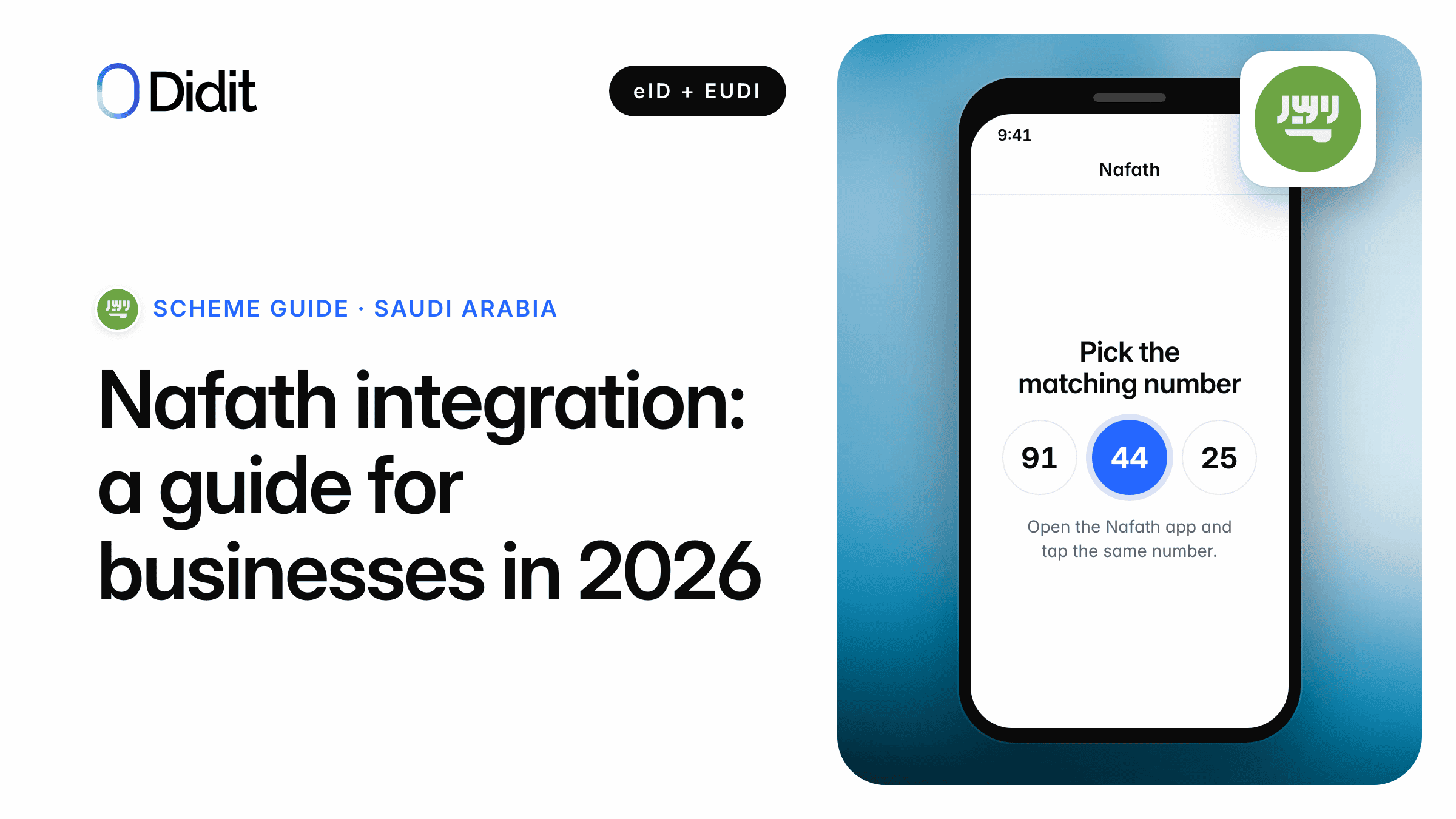
How a business integrates Nafath, Saudi Arabia's national sign-in: what users see, what the official sources say you receive, the SAMA rule for remote onboarding, private access, unpublished costs and a document fallback.
Alejandro RosasOct 6, 2026MyDigital ID integration: a guide for businesses in Malaysia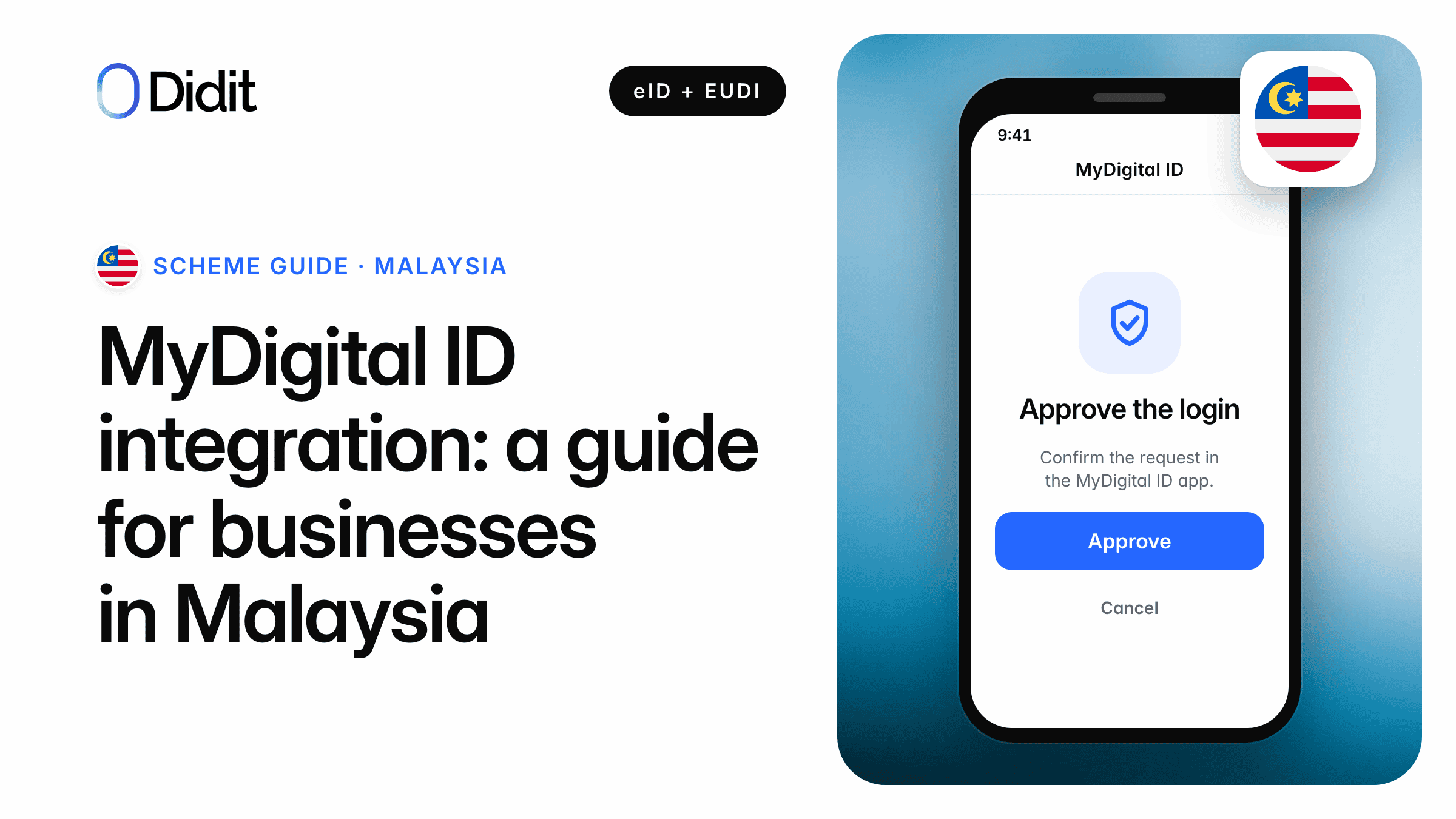
How a business accepts MyDigital ID in Malaysia: what users see, what is and is not published about data, law, AML, onboarding and prices, who cannot use it, and the document fallback.
Alejandro RosasOct 6, 2026My Number Card verification in Japan: a JPKI guide for business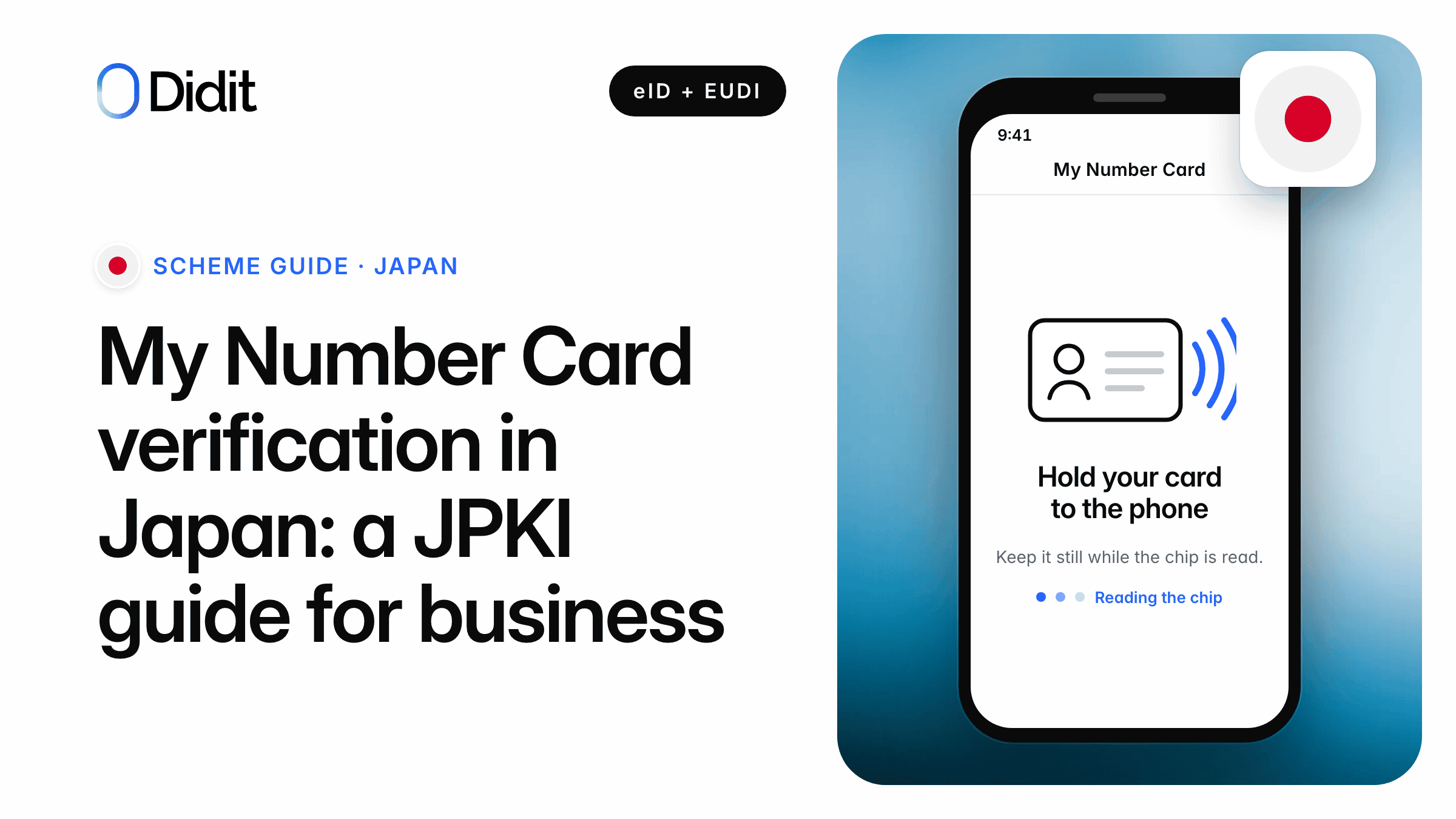
How a business accepts Japan's My Number Card through JPKI: what users see on card and phone, the four attributes you receive, the law, the two ways to connect, the waived fees, the limits and the document fallback.
Alberto RosasOct 6, 2026mojeID integration: Poland's bank-based eID for businesses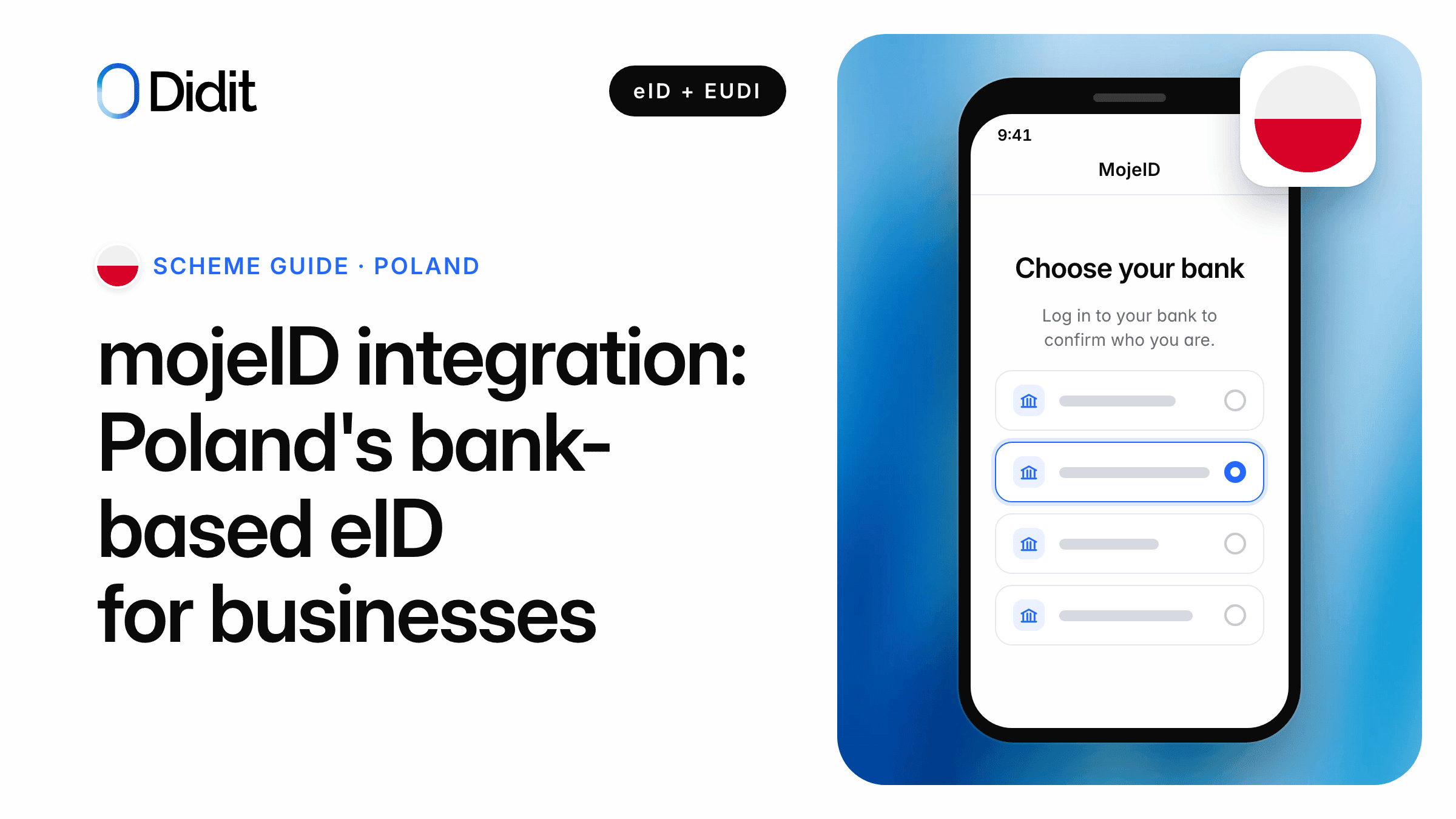
mojeID is Poland's bank-based login. What it is, what is and is not published about users, data and assurance, the AML act Article 37(1) and AMLR rules, how to connect, fallbacks and a checklist.
Alejandro RosasOct 6, 2026Mobile-ID in Estonia and Lithuania: a guide for businesses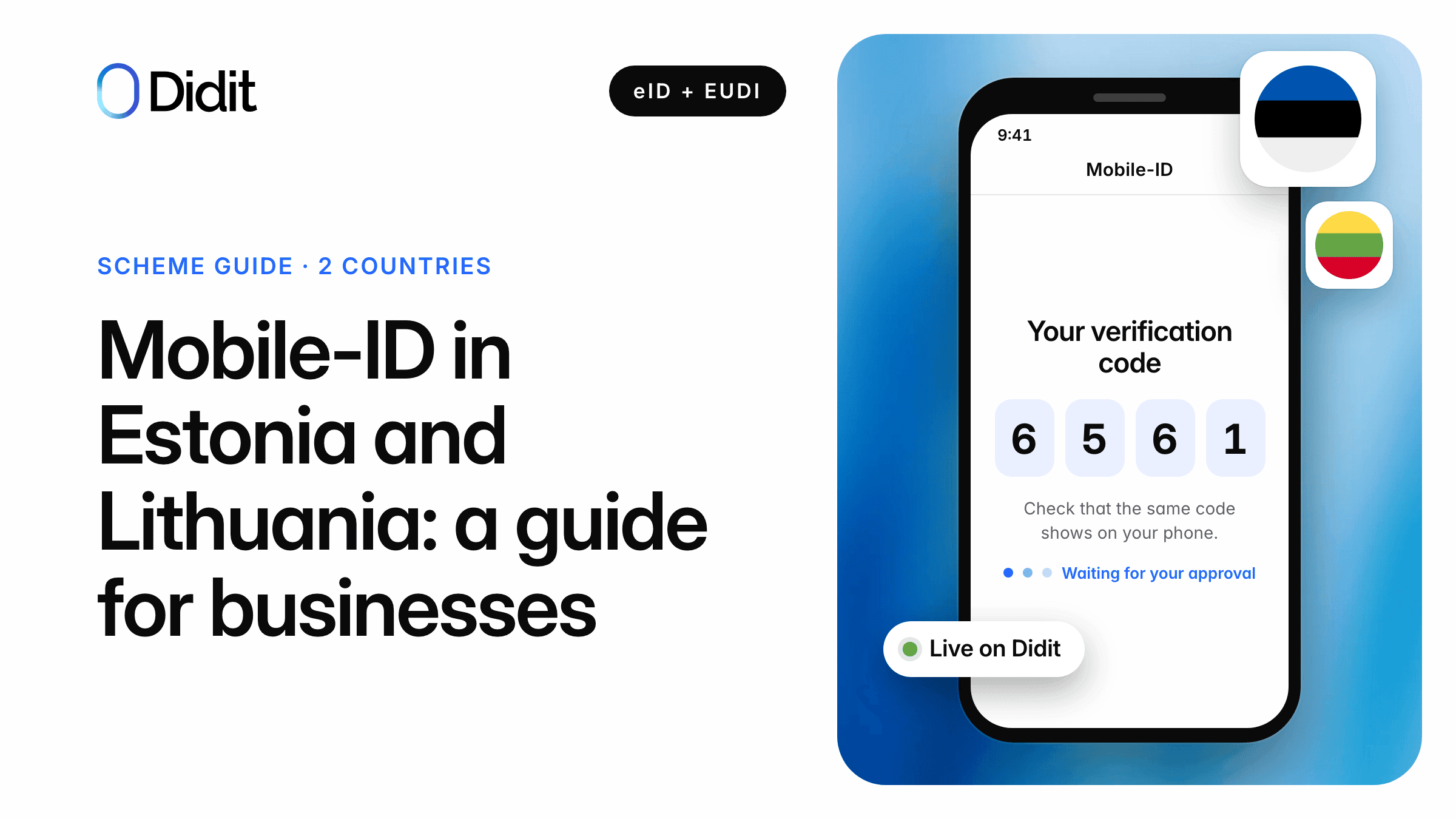
How a business accepts Mobile-ID, the SIM-based eID of Estonia and Lithuania: the user flow, data returned, assurance level, AML rules in both countries, public prices, Estonia's 2027 SIM swap and a fallback plan.
Alberto RosasOct 6, 2026European eID schemes: every EU and EEA national eID in one guide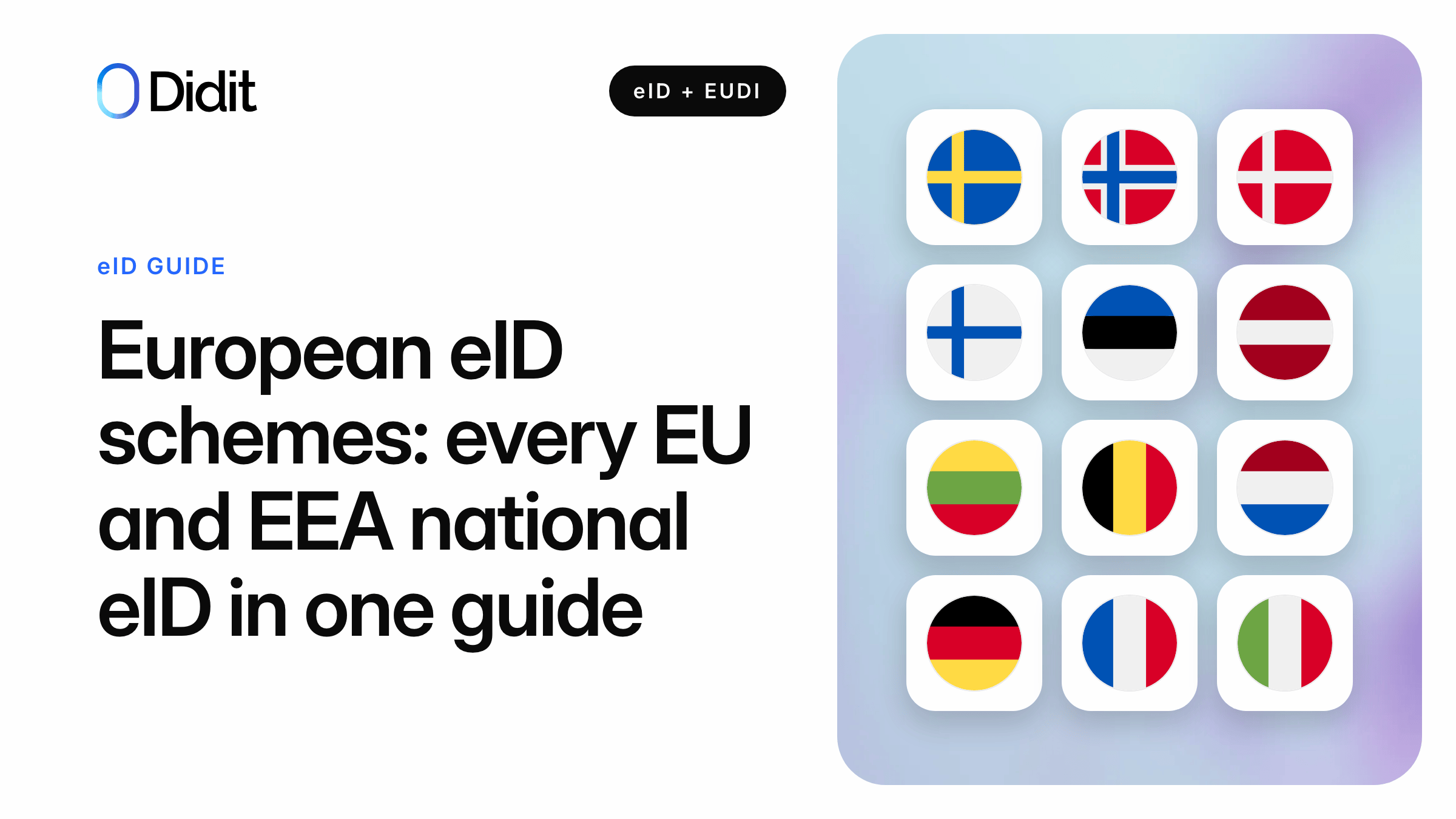
Every European eID in one place: which schemes are notified under eIDAS and at what level, which big ones are not, users per scheme, who may connect, and what the EUDI Wallet changes. Checked on 5 October 2026.
Alberto RosasOct 6, 2026Germany's EUDI Wallet: d-you, the dates and what businesses must do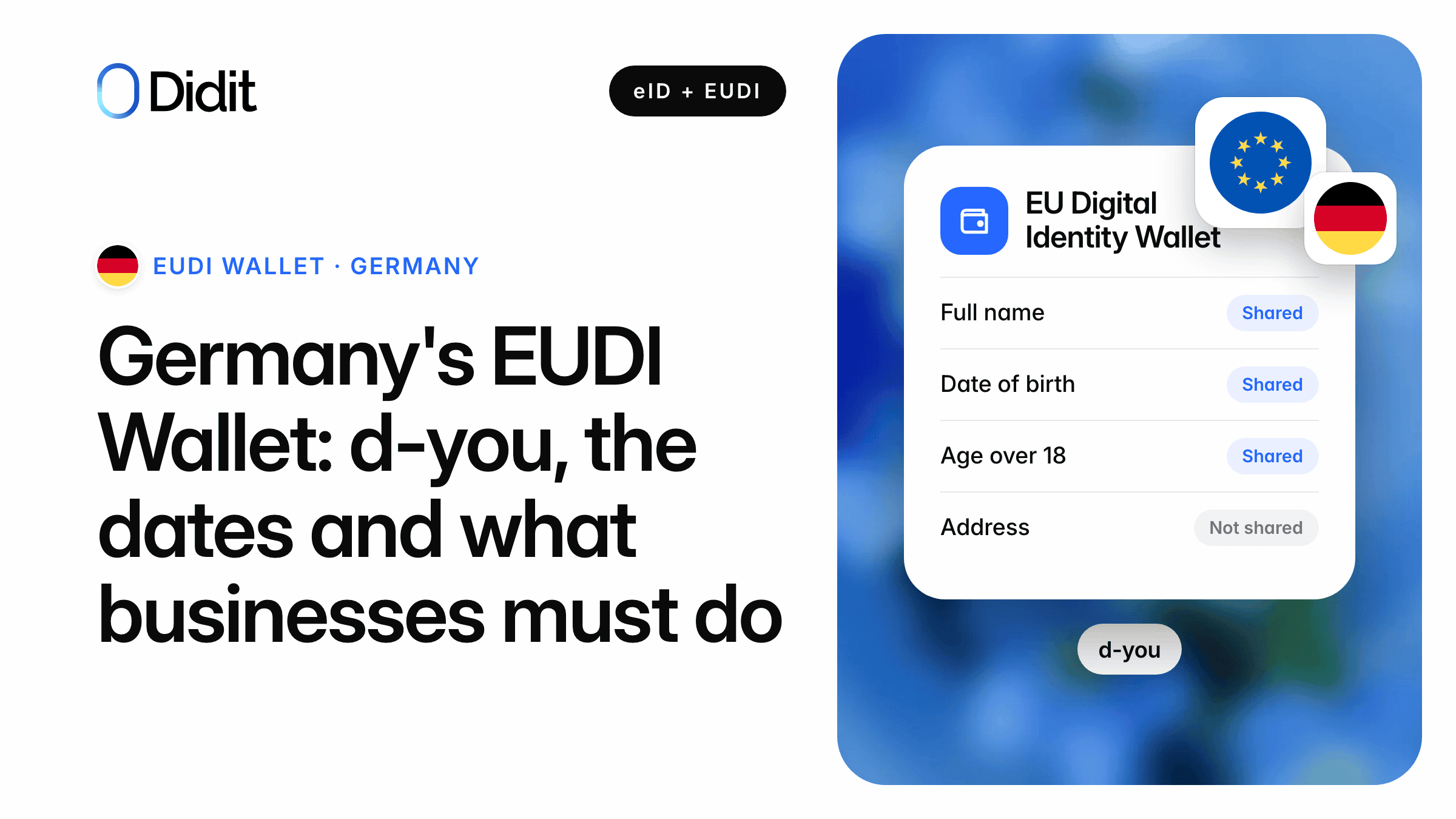
Germany's state EUDI Wallet, d-you, is due to launch on 2 January 2027. The dates, the Digitale Identitätengesetz, the link to the Online-Ausweis, who must accept it by 24 December 2027 and how to prepare.
Alberto RosasOct 6, 2026German eID verification: the 2026 guide for businesses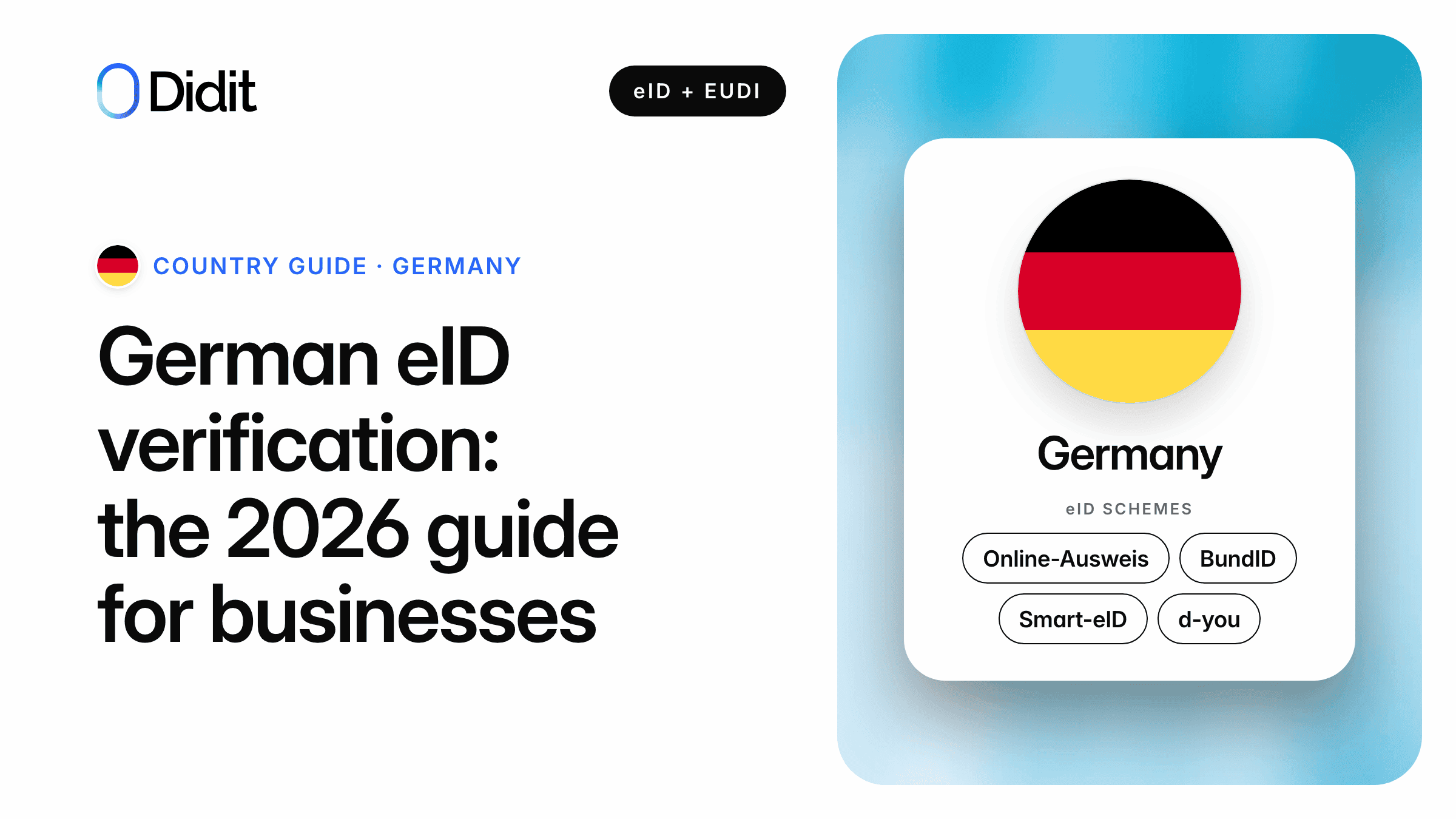
Which German eID to accept: the Online-Ausweis (LoA High, GwG § 12), BundID, Smart-eID and the d-you wallet due in early 2027, the AML and sector rules, a use-case guide, fallbacks and a launch checklist.
Alberto RosasOct 6, 2026Diia for businesses: Ukraine's digital identity app explained
What Diia is, what users see, what a business receives, the Ukrainian laws behind it, the public tariff, how to connect, and how BankID NBU and a document fallback fit beside it.
Alberto RosasOct 6, 2026Mobile driver's license (mDL) verification: a business guide
What a mobile driver's license is, the 22 states and territories TSA accepts, ISO/IEC 18013-5 and 18013-7, what a verifier receives, NIST SP 800-63-4, and how a US business accepts mDLs today.
Alberto RosasOct 6, 2026DigiLocker API: how businesses verify documents in India
The DigiLocker API explained for businesses: who may register as a requester, what the user sees, the data and documents returned, Rule 9A and the PML Rules, what is not published, and the fallback for everyone else.
Alejandro RosasOct 6, 2026Aadhaar eKYC for businesses: KUA licensing, data and AML rules
Aadhaar eKYC explained for businesses: what users see, the data UIDAI returns, PMLA and Supreme Court limits, the KUA, Sub-KUA and ASA routes, offline XML and QR, and a fallback for everyone else.
Alberto RosasOct 6, 2026Age verification with itsme: Belgium's eID app for age checks
How an itsme leeftijd check works: the age-over flags itsme returns, what the user sees, Belgian gambling and alcohol rules as far as they can be verified, the Netherlands, and routes for people without itsme.
Alberto RosasOct 6, 2026Age assurance: eID, wallets and age estimation compared
Age assurance compared: national eID, EU wallet age proofs, facial age estimation and documents, with published accuracy, the challenge age, the estimation-first waterfall and the UK, EU, Australia and US rules.
Alberto RosasOct 6, 2026Age verification in the EU: eIDs, the EUDI Wallet and the age app
Which national eIDs return a date of birth or an over-18 flag, how the EUDI Wallet and the EU age app prove age, what DSA Article 28 and France, Italy, Spain and Germany expect, and a design that combines them.
Alberto RosasOct 6, 2026EU age verification app: the mini wallet, explained
What the EU age verification app is, how its over-18 proof works, which countries pilot it, what the DSA guidelines expect from platforms, and how to fit age proofs next to age estimation and eID.
Alberto RosasOct 6, 2026EUDI Wallet deadlines 2026 and 2027: every date explained
Every EUDI Wallet date in the law: wallets by 24 December 2026, business acceptance by 24 December 2027, the AMLR on 10 July 2027, the portrait in 2028, and a quarter-by-quarter checklist.
Alberto RosasOct 6, 2026EUDI Wallet launch by country: the EUDI Wallet tracker
Where the EUDI Wallet stands in all 27 EU countries plus Norway, Iceland and Liechtenstein on 5 October 2026: wallet names, status, dates and sources, the pilots, certification, and what it means for 2027.
Alberto RosasOct 6, 2026EUDI Wallet relying party: registration, certificates and duties
How to become an EUDI Wallet relying party: Article 5b registration, access and registration certificates, OpenID4VP requests, what you may ask for, your duties and a checklist for 24 December 2027.
Alberto RosasOct 6, 2026Digital ID in the UK: what businesses can use in 2026
The UK cancelled its national digital ID on 21 July 2026. GOV.UK One Login, GOV.UK Wallet, certified identity services for AML and Ofcom age checks: what each means for a business.
Alberto RosasOct 6, 2026eID verification in France: FranceConnect+, France Identité, AML
How eID works in France: FranceConnect, FranceConnect+, France Identité and La Poste, who may connect, the CMF AML rule, Arcom age checks, the EUDI Wallet dates, and a launch checklist.
Alberto RosasOct 6, 2026eID verification in Poland: mObywatel, Profil Zaufany, e-dowód
Weryfikacja tożsamości in Poland: mObywatel, Profil Zaufany, e-dowód and bank login compared, the AML act Article 37 and 83 rules, EUDI Wallet dates, routes by use case and a launch checklist.
Alberto RosasOct 6, 2026eID verification in Portugal: Chave Móvel Digital, CC and AML
How eID works in Portugal: the Chave Móvel Digital and the Cartão de Cidadão, Autenticação.gov access for businesses, the AML law that names both, age rules, the EUDI Wallet dates and a launch checklist.
Alberto RosasOct 6, 2026eID in Italy: SPID, CIE and IT-Wallet for business verification
eID verification in Italy: SPID, CIE and IT-Wallet compared, the AML rule that accepts them, AGCOM age checks, what the user sees, picks by sector, fallbacks for foreigners and an Italy launch checklist.
Alberto RosasOct 6, 2026eID verification in Spain: DNIe, Cl@ve, MiDNI and AML rules
Identificación electrónica in Spain: the DNIe, Cl@ve, MiDNI and Cartera Digital Beta, who may connect, the Ley 10/2010 AML rule, SEPBLAC video-identification, age rules, EUDI Wallet dates and a checklist.
Alberto RosasOct 6, 2026eID Austria: how ID Austria verification works for businesses
eID in Austria is ID Austria: 6.3 million registrations, notified at level High, accepted for remote AML checks under FM-GwG § 6(4). Data returned, age proof, EUDI Wallet dates, use cases and a launch checklist.
Alberto RosasOct 6, 2026eID in the Netherlands: DigiD, iDIN, itsme and the EDI-wallet
eID in the Netherlands for businesses: why DigiD is closed to most companies, iDIN's move to itsme, the Wwft and DNB rules, the EDI-wallet dates, what users see and a launch checklist.
Alberto RosasOct 6, 2026eID in Norway: BankID, Buypass, MinID and the rules for 2026
Which eID to accept in Norway: BankID and Buypass ID at level high, Commfides, MinID and ID-porten, the AML rule for remote onboarding, Nkom's BankID case, use cases, fallbacks and a launch checklist.
Alberto RosasOct 6, 2026Chave Móvel Digital for companies: how to accept Portugal's eID
How a company accepts the Chave Móvel Digital: the user flow, the attributes you can request, eIDAS High and Lei 83/2017, the protocol with ARTE, sector rules, limits, a document fallback and a checklist.
Alejandro RosasOct 6, 2026IT-Wallet for businesses: Italy's EUDI-track wallet explained
IT-Wallet is Italy's digital wallet in the IO app, with 10.1 million activations by February 2026. What it holds, what a business will receive, the AML law, and what to run before private relying-party access opens.
Alberto RosasOct 6, 2026CIE ID integration: accepting Italy's CieID as a business
How a business accepts CIE ID: the CieID user flow, levels 1 to 3, the CIE federation for private service providers, AML article 19, age and gambling rules, what is not published, and fallbacks.
Alejandro RosasOct 6, 2026DNI electrónico (DNIe) verification by NFC: a business guide
The DNI electrónico for business: the DNIe chip and NFC, what you receive, eIDAS level High, the Ley 10/2010 signature route, AMLR from 2027, how to connect, limits, fallbacks and a checklist.
Alejandro RosasOct 6, 2026ID Austria integration: a guide for private service providers
How a private company accepts ID Austria: IDA-SPR registration, OIDC or SAML2, the attributes and bPK you receive, LoA High, FM-GwG § 6(4) and AMLR, limits, and a document fallback.
Alejandro RosasOct 6, 2026German eID integration: Online-Ausweis guide for business
How a business accepts the German Online-Ausweis: eID-Service or identification service, the Berechtigungszertifikat, what you receive, LoA High and GwG § 12, limits, and a document fallback.
Alejandro RosasOct 6, 2026DigiD for private companies: who can use it and what to use instead
Can a private company use DigiD? Mostly not: Logius connects only organisations with a public task and BSN rights. What DigiD returns, its eIDAS level, Wwft and AMLR, and the private alternatives.
Alberto RosasOct 6, 2026iDIN API integration: a business guide for 2026
How a business accepts iDIN, the Dutch banks' eID: its move to itsme by 2028, what users see, the data, eIDAS Substantial and the Wwft, how to connect, limits and a document fallback.
Alejandro RosasOct 6, 2026itsme API integration: a business guide for 2026
How a business accepts itsme: what users see, the data the itsme API returns, eIDAS High and Belgian AML rules, direct contract or certified partner, the Dutch launch, limits, and a document fallback.
Alejandro RosasOct 6, 2026eParaksts mobile integration: a business guide to Latvia's eID
How a business accepts eParaksts mobile, Latvia's state mobile eID: the user flow, the data returned, assurance level and AML rules, LVRTC or broker routes, limits for foreigners and minors, and a fallback plan.
Alejandro RosasOct 6, 2026MitID Erhverv: verifying Danish companies and their signatories
MitID Erhverv is the business version of Denmark's MitID. What it proves in a KYB check, what it does not, the legal basis, and how to verify company signatories with eID and the business register.
Alberto RosasOct 6, 2026BankID pris: what BankID Norway costs a business in 2026
We found no public BankID Norway price; here is how the price you pay is built, how it compares with Buypass, Commfides, MinID and Nordic schemes, the AML rules and a fallback.
Alberto RosasOct 6, 2026How to become an itsme partner, or go through a broker
How a business becomes an itsme partner: the onboarding steps, the data you receive, eIDAS High and Belgian AML rules, direct contract or certified broker, limits for minors and foreigners, and a document fallback.
Alberto RosasOct 6, 2026Freja eID integration: how businesses accept Sweden's other eID
Freja eID for businesses: 1,773,000 users, what the app shows, the data you receive per tier, the legal standing under Swedish AML law and AMLR, direct or broker integration, and the fallback.
Alejandro RosasOct 6, 2026Swiss eID: how to verify users in Switzerland in 2026
Swiss eID guide for businesses: the E-ID postponed with no date, SwissID, the E-ID Act and FINMA's AML consultation, what users will see, routes by sector, and how to verify Swiss users today.
Alberto RosasOct 6, 2026BankID Norway integration: a business guide for 2026
How a business accepts BankID Norway: what users see, the data you receive, level high and AML rules, resellers and ID-porten, the 2026 Nkom case, and a document fallback for users without BankID.
Alejandro RosasOct 6, 2026FranceConnect+ integration: a guide for private businesses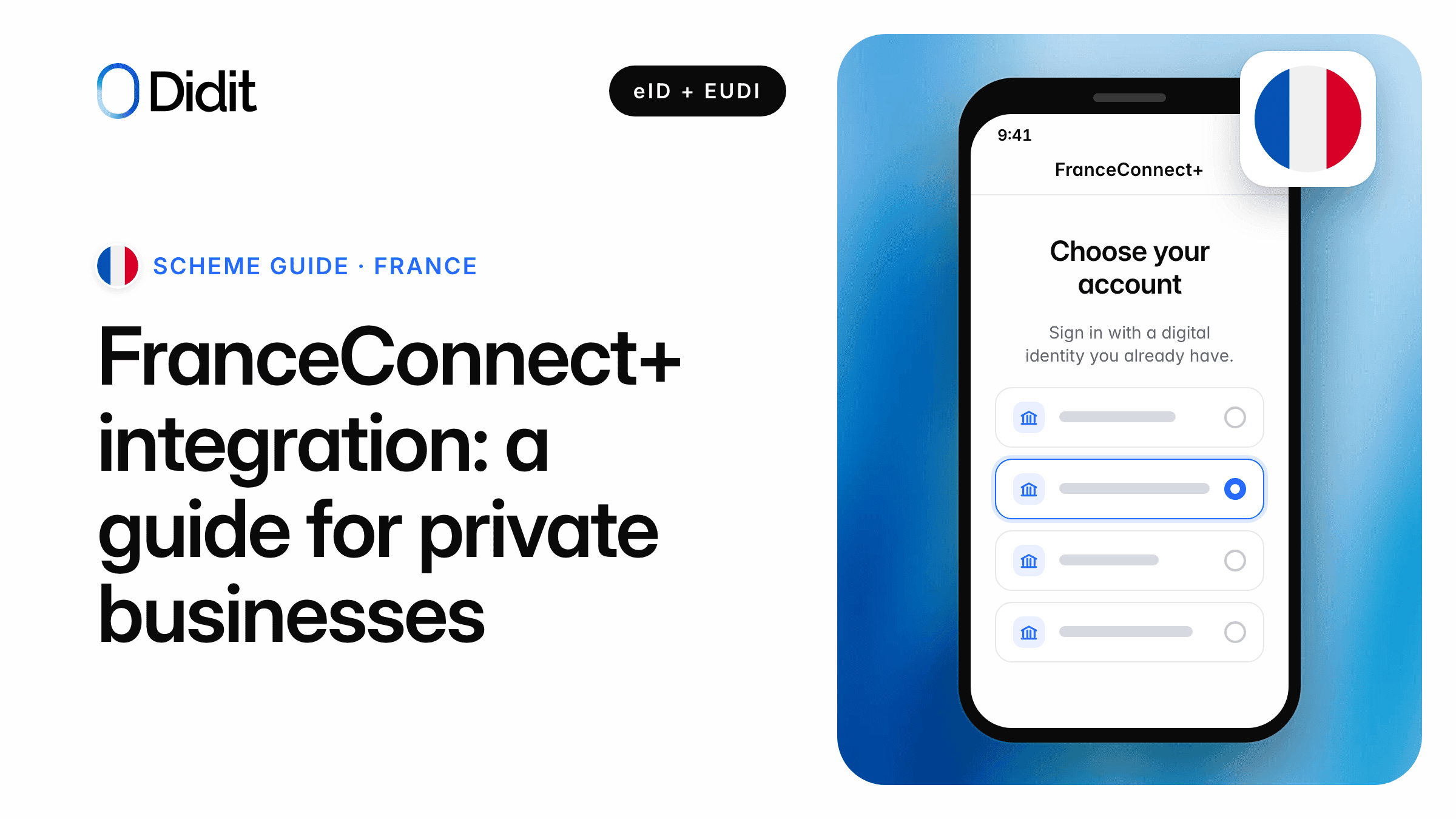
Who may use FranceConnect+ as a private relying party, what users see, the pivot identity you receive, eIDAS levels and French AML rules, DataPass and La Poste contracts, limits, and a document fallback.
Alejandro RosasOct 6, 2026Video ident vs eID: remote onboarding in DACH from 2027
Video ident vs eID for Germany, Austria and Switzerland: how each works, BaFin, GwG and FM-GwG rules, what the AMLR and AMLA's eID-first final draft change, deepfake risk, costs and a decision table.
Alberto RosasOct 6, 2026The EU's EUR 10,000 cash limit from July 2027: who it binds
From 10 July 2027 traders in the EU may take or make cash payments only up to EUR 10,000. Who is bound, who is not, the cash limit by country today, the EUR 3,000 identification rule and what to do at the counter.
Alberto RosasOct 3, 2026AMLR software: what to build, what to buy and what it costs
A vendor-neutral buyer's guide to AMLR software: the ten capabilities the regulation implies, what to buy and what to keep, 13 questions for any vendor, red flags in sales claims and a cost model with a worked example.
Alberto RosasOct 3, 2026AMLR identity verification: eID first, documents as the alternative
What Article 22 of the AMLR requires, what AMLA's final draft of 30 September 2026 says about remote onboarding, and how to choose between electronic ID and document verification for each customer.
Alberto RosasOct 3, 2026AMLR and the EUDI Wallet: when you must accept it, and what is left
The duty to accept the EUDI Wallet sits in eIDAS Article 5f(2), not in the AMLR. Who it binds, the confirmed and computed dates, what a wallet covers of Article 22, and what due diligence still remains.
Alberto RosasOct 3, 2026AMLR for crypto: what crypto-asset service providers must verify
From 10 July 2027 the AMLR treats crypto-asset service providers as financial institutions. What they must verify, the EUR 1,000 threshold, what Article 79 prohibits, and what it does not: self-hosted wallets are not banned.
Alberto RosasOct 3, 2026AMLR checklist by obliged entity, with the article behind every line
An ungated AMLR checklist: the twelve core lines every obliged entity shares, then sector blocks for banks, crypto, crowdfunding, gambling, high-value goods, real estate and football, each with its article.
Alberto RosasOct 3, 2026AMLR beneficial ownership: the 25% rule, control and worked examples
Who counts as a beneficial owner under the AMLR: the 25% or more test, control via other means, how to multiply and add stakes through layers, the status of the 15% threshold, and what to do with each owner you find.
Alberto RosasOct 3, 2026AMLR Article 18: what you can and cannot outsource to a KYC provider
Article 18 of the AMLR lets you outsource KYC tasks, not the decisions or the liability. The conditions, the six reserved tasks, the recital 47 grey zone, a provider checklist and an outsourcing register.
Alberto RosasOct 3, 2026AMLA's final CDD standards (October 2026): what changed, what to do
AMLA announced its final draft customer due diligence standards on 1 October 2026 and sent them to the Commission. What the draft says by topic, what AMLA refused to relax, what is still pending and what to build before July 2027.
Alberto RosasOct 3, 2026AMLR explained: the EU AML Regulation that applies from July 2027
What the EU Anti-Money Laundering Regulation is, how it fits with AMLD6 and AMLA, every date from 2024 to 2029, who is covered, the main rules by article, the penalties and where the technical standards stand.
Alberto RosasOct 3, 2026BusinessNew pricing from November 1: one plan, one balance for everything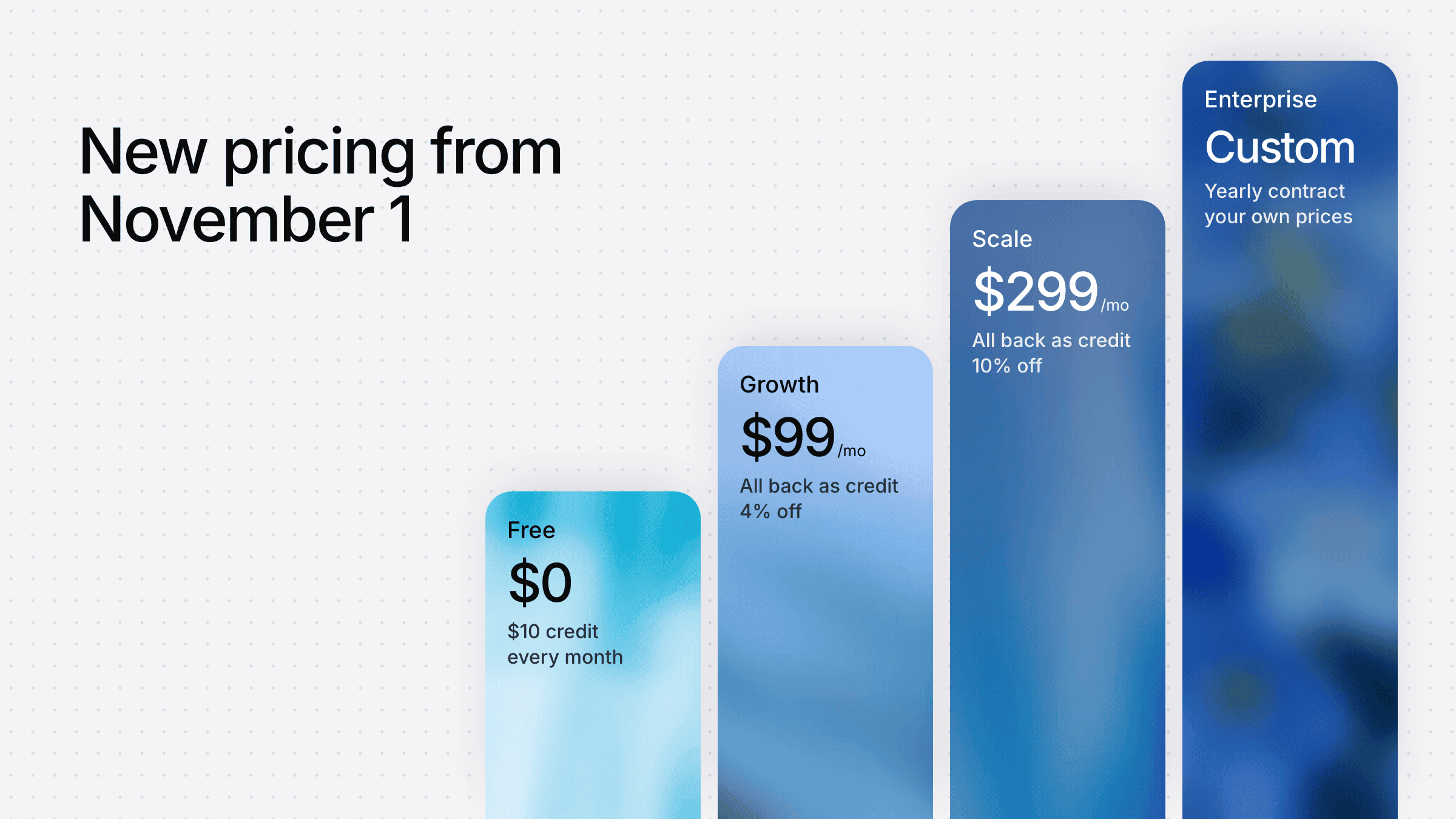
One plan for every product, $10 of free credit a month, pay as you go, and one balance for every check. Effective November 1, 2026.
Alberto RosasOct 2, 2026Business Verification: three registry tiers, priced per country
Business Verification runs on three registry tiers, priced per country, and bills you for the tier the registry actually delivered.
Alberto RosasSep 29, 2026Altify Partners with Didit to Strengthen Investor Onboarding and Screening
The integration supports onboarding and ongoing compliance, checking each account against sanctions and watchlist sources as it's opened and over time.
Alejandro RosasSep 21, 2026TechnicalWe give AI a simple job: try to break Didit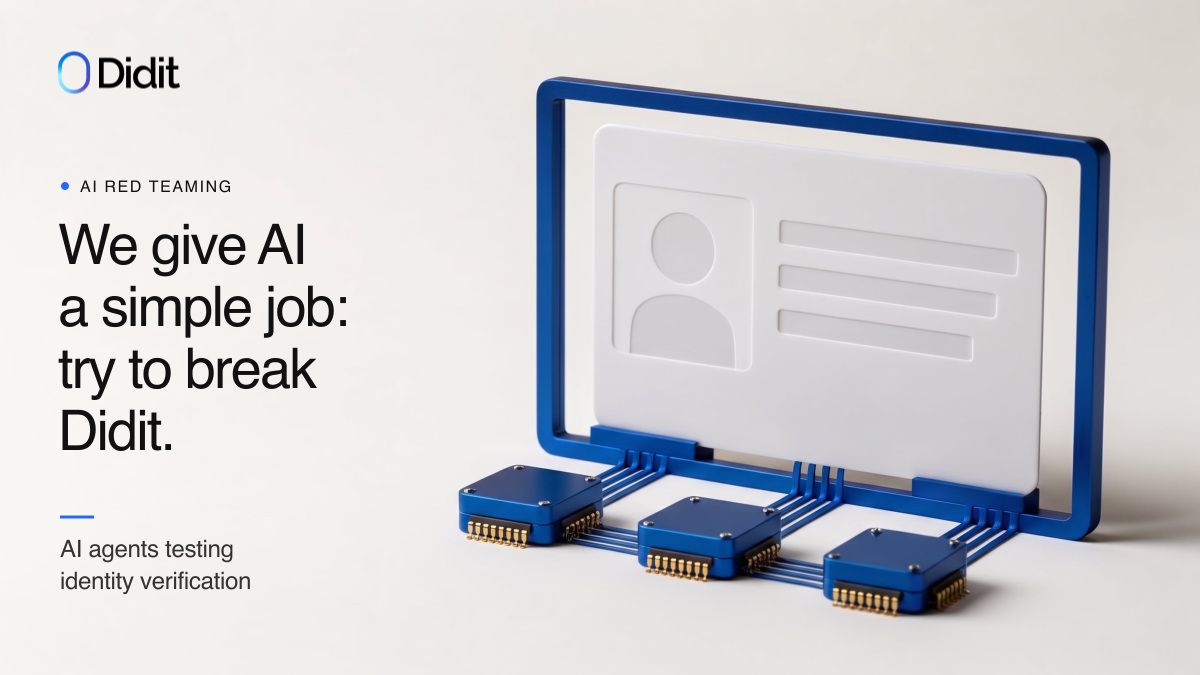
Inside Didit’s use of AI agents to test verification, study bot behaviour and improve user journeys, with a call for our industry to raise its security standards.
Alberto RosasSep 10, 2026Know Your Agent: Why Every LLM Platform Is About to Need Identity Verification
LLMs stopped being text generators and became actors that move money and data. Content filters cannot answer the only question that matters at that point: who is accountable for this action?
Alberto RosasSep 9, 2026The UK's first A7 alert describes a network built to pass identity checks
The National Crime Agency published Flash Alert 0808-NECC on 31 August 2026. It sets out how the A7 network moves value across borders for sanctioned Russian clients.
Alberto RosasSep 8, 2026A four-digit merchant code decided whether memecoin buyers faced KYC
The Block reported on 1 September 2026 that memecoins bought by card through Robinhood Wallet and Fomo were coded as digital media, MCC 5815, with no identity check. Visa's rulebook puts crypto under 6051.
Alejandro RosasSep 8, 2026Korea let a crypto exchange pull government records for KYC instead of asking for documents
Dunamu, which runs Upbit, said on 26 August 2026 that the Ministry of the Interior and Safety had designated it an administrative information sharing institution, the first digital asset exchange to get there.
Alberto RosasSep 8, 2026FinCEN's Banque Misr proposal names one bank and 103 front companies
On 1 September 2026 FinCEN proposed cutting the five United Arab Emirates branches of Egypt's state-owned Banque Misr off from American correspondent banking. The finding rests on 103 suspected front companies.
Alberto RosasSep 8, 2026All 400 wealth managers refresh KYC now, but 26% record no expected activity
The Financial Conduct Authority published its Wealth management survey report 2026 on 18 August. Every firm now says it refreshes KYC. A quarter record no expected transaction frequency.
Alberto RosasSep 8, 2026The travel rule is being rewritten for every cross-border payment, not just crypto
FATF agreed revisions to Recommendation 16 in June 2025. From the point countries implement, a peer-to-peer cross-border payment above USD/EUR 1,000 carries name, address and date of birth.
Alberto RosasSep 8, 2026California is moving age checks from the website to the phone
AB 1043 takes effect on 1 January 2027, amended by AB 1856. The user's age is declared to the operating system and apps request a bracket. Duties, dates and a checklist.
Alberto RosasSep 8, 2026Cryptolink met its undertaking. AUSTRAC suspended it anyway
Australia's AML regulator took 96 crypto ATMs offline for three months from 9 August 2026. The grounds were not the case that opened the file, but the routine reports that stopped arriving after it closed.
Alberto RosasSep 8, 2026Document AI: extract the fields you define from any document
Payslips, proof of funds, tax statements, incorporation deeds, bank statements. The documents that matter most in onboarding are the ones with no fixed template. Document AI reads the fields you define from any of them, cross-chec
Alberto RosasSep 7, 2026AML/CTF Tranche 2 is live in Australia: the customer due diligence you now owe
Since 1 July 2026, Australian law firms, conveyancers, accountants, real estate agencies, and trust and company service providers are reporting entities under the AML/CTF Act. Here is what customer due diligence actually requires,
Alberto RosasSep 7, 2026Europe's deepfake rule is now in force, and it lands on the tool, not the fraud
Article 50 of the EU AI Act applies from 2 August 2026: generative tools must mark their output, deployers must disclose deepfakes, fines reach EUR 15m or 3%. Identity checks stay off the high-risk list.
Alberto RosasAug 18, 2026AI is now on both sides of the gambling identity check
The Gambling Commission's 2026 risk assessment records deepfake and face-swap attempts to bypass identity checks, gives no number, and its enforcement director says the AI operators buy too often is not delivering.
Alberto RosasAug 18, 2026The stablecoin identity rule covers issuance and redemption, not what happens next
Five US agencies proposed a customer identification program for stablecoin issuers on 22 June 2026. Comments close 21 August. Four fields, five-year retention, and a duty that stops at the primary market.
Alberto RosasAug 18, 2026Egypt is absorbing the cost of a KYC refresh instead of passing it to the customer
Egypt's central bank and foreign ministry now let expatriates refresh their bank KYC at a consulate instead of flying home. Why the state moved the cost, and where remote verification fits.
Alberto RosasAug 18, 2026BusinessUnico Partners with Didit to Expand Access to State-of-the-Art Identity Verification for SMEs in Brazil
Didit selects Unico IDCloud as the identity network behind its verifications in Brazil, giving small and medium-sized businesses self-serve access to the same infrastructure that protects the country's largest banks and retailers.
Alberto RosasAug 18, 2026Didit vs Onfido: coverage, pricing, automation, and migration
An evidence-based comparison of Didit and Onfido, now Entrust Identity Verification, for teams evaluating global coverage, KYC costs, automation, AML, and migration risk.
Alberto RosasAug 18, 2026Identity Verification Software in 2026: A Buyer's Guide
What identity verification software does, how the 2026 fraud landscape changes the requirements, and how to compare providers on real per-verification cost, coverage, speed, and compliance, with a pricing table built from public pricing pages.
Alberto RosasAug 17, 2026Age Verification Thresholds for UK/EU Social Media in 2026
Social media platforms in the UK and EU will face specific age verification thresholds in 2026, primarily 13, 16, and 18 years, driven by regulations like the UK Online Safety Act (OSA) and GDPR.
Alberto RosasAug 13, 2026AMLA's New EU AML Enforcement & UBO Rules (2026) Explained
Starting in 2026, businesses operating in the EU must comply with stricter Ultimate Beneficial Ownership (UBO) verification rules under the new Anti-Money Laundering Authority (AMLA).
Alberto RosasAug 13, 2026Product updatesRobinhood Ventures Fund II invests in Didit
Didit is part of the portfolio of Robinhood Ventures Fund II (NYSE: RVII), Robinhood's new fund that gives retail investors access to private startups. Here is what the fund is, how it works, and what it means for Didit.
Alberto RosasAug 6, 2026The Hydra Account Problem: Why Distillation Defense Starts With Identity Resolution
Anthropic reported 16 million exchanges through roughly 24,000 fraudulent accounts, and one proxy network running more than 20,000 accounts at once. Distillation is not a prompt problem. It is an access problem.
Alberto RosasAug 4, 2026Business Verification for AI API Access: Who Actually Controls This Account?
Anthropic named strengthened verification for educational and startup accounts among its distillation mitigations. At organisation tier the question is not whether a person is real — it is whether a company is, and who runs it.
Alejandro RosasAug 4, 2026Verified API Access for AI Model Providers: A Risk-Tiered Architecture
How to bind high-risk model access to verified people and businesses without taxing every developer who signs up — access tiers, trigger conditions, the endpoints for each tier, and what each one costs.
Alejandro RosasAug 4, 2026Face Search 1:N: Finding Every Account One Person Controls
One API call searches a face across every verified user you have and returns each matching account with your own identifier attached. Free with Didit verification — the primitive that turns an account list into an actor map.
Alberto RosasAug 4, 2026Biometric Step-Up for AI API Access: Binding Privilege to a Person
Onboarding proves who signed up. It proves nothing about who is holding the API key six months later. Passwordless biometric re-authentication for quota increases, credit grants and key issuance — $0.10, sub-two-second.
Alejandro RosasAug 4, 2026Hydra Account Networks: How 20,000 Accounts Become One Actor
Cut off one account and two more appear. Hydra networks beat per-account review by design. Here is how cross-account linking — face, device, IP, email, phone — collapses thousands of accounts into a single resolvable actor.
Alejandro RosasAug 4, 2026Blocklist Propagation: Making One Confirmed Abuse Case Kill the Whole Network
Banning an account removes one head from the hydra. Blocklisting from a session auto-extracts every identifier it touched — face, document, phone, email, IP, device — across 12 entry types, so the next account fails at the door.
Alejandro RosasAug 4, 2026Questions
Blog questions
Who writes the Didit blog?
Which topics does the blog cover?
Is the blog available in my language?
Where do I find product updates?
Are these posts legal advice?
How do I find posts on one topic?
Are posts dated?
Do posts link to the docs?
Is the blog the same as the docs?
Compliance built in
Audited, certified and attested.
We hold the certifications and build each country's rules into your flows, so you can launch anywhere without worrying. Security and Compliance center
- Regulation encoded into your flows
Tell us what you do and where. Didit lists the rules that apply to you, with sources, and builds the checks each country needs into one workflow.
- Ready for AMLR
Every requirement of the new EU anti-money laundering rules, from checking customers to human review, is already covered by a Didit check.
- Tested in Spain's Treasury sandbox
Spain's Treasury published its supervised sandbox report on Didit's NFC plus active liveness onboarding; SEPBLAC took part and valued the added measures positively.
- Audited, not self-declared
iBeta Level 1 and Level 2. Liveness tested under ISO/IEC 30107-3.
Your obligations · 3 regions
 SOC 2 Type 2
 ISO 27001
 iBeta Level 1 and Level 2
 EU regulator attestation
 FSM youth protection
 GDPR
 EBA remote onboarding
 MiCA compatible
 FIDO Alliance member
- AMLREU AML Regulation ready
Integration · Didit MCP
Run Didit from your own AI agent
Connect Didit to Claude, Cursor, VS Code or ChatGPT and just ask in plain words. Your agent can do anything you can do in the console, with the same permissions you have.
 Add to Claude
 ChatGPT
 Cursor
- Build workflowsDescribe the checks you need. The agent creates and publishes the flow.
- Run investigationsAsk why a session was declined, review cases, search people and companies.
- Change rulesCreate payment rules, test them on past data and switch them on.
- Pull reportsAsk for numbers, exports or the audit log.
Didit Academy


