Automated Compliance-as-Code for Payment Gateway PCI DSS
PCI DSS v4.0.1 asks for installed, logged and tested controls, not identity checks. Compliance-as-code automates the controls; Didit supplies the KYC, AML and monitoring evidence at $0.33 per full KYC.
 Alejandro RosasCo-founder and CTO
Contents
In this guide
Jump to the part you need.
This page is for payment gateways that run PCI DSS v4.0.1 controls as code and need to know where identity checks fit. Short answer: PCI DSS asks for installed, logged and tested controls, not identity checks. Didit supplies KYC at $0.33 per full check and AML screening at $0.20 as evidence next to those controls. The caveat: we are not an assessment tool, and no assessor has agreed that code alone is evidence.
Last updated: November 26, 2026. Prices checked against the live Didit price feed on November 26, 2026.
PCI DSS compliance-as-code at a glance
| Question | Answer |
|---|---|
| Who it applies to | Every entity that stores, processes or transmits cardholder data, and anyone who can affect the security of the cardholder data environment. A payment gateway is commonly treated as a service provider; your acquirer sets the classification. |
| Where | Worldwide. The duty comes from card brand operating rules and your acquirer contract, not from a statute. |
| Primary text | PCI DSS v4.0.1, Requirements 1 to 12 plus Appendices A1 to A3, PCI Security Standards Council, June 2024. The v4.0 future-dated requirements became mandatory on 31 March 2025. |
| What compliance-as-code covers | Network controls, secure configuration, encryption, secure development, logging and testing, written as code and enforced in continuous integration. |
| What it does not cover | The assessment. A Qualified Security Assessor still samples evidence and signs the Report on Compliance and Attestation of Compliance. |
| What Didit does | Identity verification, business verification, AML screening, ongoing monitoring and transaction monitoring as API calls, with a decision object, webhooks and audit logs. |
| Didit prices | Full KYC $0.33, AML screening $0.20, ongoing AML monitoring $0.07 per person per year, business verification (KYB) from $2.00 per company, transaction monitoring $0.001 per transaction beyond the plan allowance. |
Start free in the sandbox at business.didit.me. The sandbox is free on every plan and no sales call is required. Developers can connect Didit to an AI assistant through the MCP server. The product pages behind the numbers below are Business Verification, AML Screening and Transaction Monitoring, and every price is on the pricing page.
Who has to comply with PCI DSS
PCI DSS applies to any organization that stores, processes or transmits cardholder data, and to any organization that can affect the security of the cardholder data environment. That second half is what catches a gateway. Even when you only route, tokenize or vault, your systems sit in the path of a card number, and your acquirer will ask how you are validated.
- Merchants that take card payments, at the level their acquirer assigns.
- Service providers that process, store or transmit cardholder data on behalf of merchants. A payment gateway is usually assessed as a service provider, but the classification is your acquirer's call and your assessor confirms it.
- Third parties that change your security posture, such as hosting, logging and support vendors, which fall inside your own compliance program rather than under a level of their own.
Levels and validation routes are set by the card brands, not by the standard. Level 1 entities usually validate with an on-site assessment by a Qualified Security Assessor and file a Report on Compliance with an Attestation of Compliance. Lower levels usually self-assess with the right Self-Assessment Questionnaire. The thresholds move, so read your acquirer contract rather than a blog post, including this one.
Where the obligation comes from, and from when
PCI DSS is not a law. It is a standard published by the PCI Security Standards Council, and it binds you because the card brands put it into their operating rules and your acquirer put those rules into your contract. That matters for compliance-as-code, because the version you are assessed against is the one your acquirer names, not always the newest PDF.
The current text is PCI DSS v4.0.1. Read the requirement headings when you design your pipeline: Requirement 1 (network security controls), Requirement 2 (secure configurations), Requirement 3 (protect stored account data), Requirement 4 (strong cryptography in transmission), Requirement 5 (malicious software), Requirement 6 (secure systems and software), Requirement 7 (restrict access by business need to know), Requirement 8 (identify users and authenticate access), Requirement 9 (physical access), Requirement 10 (log and monitor all access), Requirement 11 (test security regularly) and Requirement 12 (support information security with policies and programs).
If you operate in the EU there is a second layer on top. A gateway that is a payment institution also answers to Directive (EU) 2015/2366 (PSD2), Article 97 on strong customer authentication, and to Regulation (EU) 2022/2554 (DORA) on ICT and third-party risk. Neither replaces PCI DSS, and PCI DSS does not satisfy either. Identity data you collect during onboarding is personal data under the GDPR, and Didit acts as your processor.
Dated applicability table
| Date | What changed | What it means for a payment gateway |
|---|---|---|
| 2004 | PCI DSS v1.0 published, later maintained by the PCI Security Standards Council | The standard has been contractual from the start. The binding version for you is the one your acquirer names. |
| 31 March 2022 | PCI DSS v4.0 published | New wording, for example network security controls instead of firewalls, plus a set of future-dated requirements. |
| 31 March 2024 | PCI DSS v3.2.1 retired | v4.0 becomes the only active version for new assessments. |
| June 2024 | PCI DSS v4.0.1 published as a limited revision | Numbering and intent are unchanged. Use v4.0.1 for any assessment you start now. |
| 31 March 2025 | The v4.0 future-dated requirements became mandatory, including 8.4.2 (multi-factor authentication for all access into the cardholder data environment), 6.4.3 and 11.6.1 (payment page scripts and tamper detection) and 12.3.1 (targeted risk analysis) | These are the items most gateways had deferred. They are assessable now. |
| Annually | The Attestation of Compliance is renewed on the cycle your acquirer sets | Evidence has to be continuous. That is the argument for code rather than a folder assembled in the last month. |
What compliance-as-code automates, requirement by requirement
Compliance-as-code means the control and the proof of the control are produced by the same machine. The network rule lives in a repository, the check that the rule is still correct runs on every pull request, and the output of that check is timestamped and stored. Nothing in PCI DSS requires you to work this way. The standard asks for controls that are defined, implemented, monitored and tested, and code is the cheapest way to keep those four things true at the same time.
- Requirement 1, network security controls. Security groups, firewall rules and segmentation defined in the same repository as the workload, with a pipeline check that fails the build when a change opens a path into the cardholder data environment.
- Requirement 2, secure configuration. Golden images and hardened baselines applied by the provisioning tool, plus a drift check that compares running state to the baseline and reports the difference.
- Requirements 3 and 4, stored and transmitted account data. Encryption and key policy as configuration, a minimum TLS version enforced by policy, and a test that fails when a bucket or database is created without encryption.
- Requirement 6, secure systems and software. Static analysis, dependency and container scanning as pipeline gates, with the scan result attached to the change that shipped.
- Requirement 10, logging and monitoring. Log destinations, retention and alert rules as code, and a read-only export you can hand to the assessor.
- Requirement 11, testing. Scans and penetration tests scheduled by the same pipeline, with findings tracked to closure rather than remembered.
What code does not do: it does not write your policies, it does not decide whether a compensating control is defensible, and it does not sign anything. Requirement 12 stays a written, human exercise, and the assessor interview is still an interview.
Obligations next to Didit capability
The table keeps the obligation and our capability in separate columns on purpose. Some rows are a real contribution. Some rows are evidence you can file. One row is honest scope reduction. None of them is a compliance guarantee.
| PCI DSS v4.0.1 obligation | What the standard asks for | Didit capability | Published price |
|---|---|---|---|
| 8.4.2, multi-factor authentication for all access into the cardholder data environment | At least two factors for every person reaching the environment, including administrators and third parties. | Biometric Authentication can serve as an additional factor inside an admin or support login you control. It does not replace the multi-factor authentication configured on your own system components. | $0.10 per authentication |
| 10.2 and 10.5.1, audit logs and retention | Log every access to system components and cardholder data, keep 12 months of history with the most recent 3 months immediately available. | Didit returns session decisions through the decision API and sends documented identity and transaction events through signed webhooks. Audit log retention is 30 days on Free, 1 year on Growth, 3 years with export on Scale, contract-set on Enterprise. This covers Didit events, not access to your own environment. | Included in the plan |
| 12.8.4 and 12.9, service provider management | Monitor your service providers' compliance status at least annually and keep written agreements. | SOC 2 Type 2 report (observation period 9 March to 1 July 2026, issued July 2026) available to enterprise customers under NDA, ISO/IEC 27001:2022 certificate ES144068, GDPR data processing agreement on request. Whether Didit appears as a PCI DSS service provider in your scope depends on your data flows and your assessor's determination. | No charge for the documents |
| Requirement 3, protecting stored account data, through scope reduction | Do not store sensitive authentication data, and keep cardholder data out of systems that do not need it. | Sending identity data to Didit may reduce the data held in your own environment. Confirm the resulting PCI DSS scope with your assessor. Identity data sits in EU-hosted infrastructure by default, with retention you set from 1 month to 10 years and delete on demand through the API. | Included |
| Onboarding duties that sit next to PCI DSS: AML law, acquirer rules and, in the EU, PSD2 Article 97 | Identify the merchant and its beneficial owners, screen against sanctions and PEP lists, keep the result, and authenticate the payer where the directive applies. | KYB with registry data and key people, Company AML, Person AML per owner or officer, linked full KYC per person, ongoing monitoring, transaction monitoring rules. Biometric, phone and email factors can be part of a strong customer authentication flow. | KYB from $2.00 per company, Company AML $0.20, Person AML $0.20 per person, linked KYC $0.33 per person, ongoing monitoring $0.07 per person per year |
For the avoidance of doubt: nothing we sell covers Requirements 1, 2, 5, 9 or 11. Those are yours, your hosting provider's and your pipeline's work.
Worked example: 800 new merchants a month
A gateway onboards 800 merchants a month, each with two beneficial owners. It runs 2,000,000 transactions a month and it uses the Scale plan, which takes 10% off every Didit price and includes 100,000 monitored transactions a month. All arithmetic below uses published unit prices.
- Business verification, registry retrieval at $2.00 per company, the minimum published registry price because KYB pricing varies by country and data tier: 800 x $2.00 = $1,600.00.
- Company AML at $0.20: 800 x $0.20 = $160.00.
- Person AML for two owners per merchant, 1,600 people at $0.20: 1,600 x $0.20 = $320.00.
- Linked full KYC for the same 1,600 people at $0.33: 1,600 x $0.33 = $528.00.
- Subtotal at list price: 1,600 + 160 + 320 + 528 = $2,608.00 a month, or $3.26 per merchant.
- Apply the Scale discount of 10%: $2,608.00 x 0.90 = $2,347.20 a month.
- Ongoing AML monitoring for 1,600 people at $0.07 per person per year: 1,600 x $0.07 = $112.00 a year, or $100.80 after the Scale discount. The $100.80 charge is annual, and the $8.40 figure is its amortized monthly equivalent.
- Transaction monitoring: 2,000,000 - 100,000 included = 1,900,000 billable transactions at $0.001 = $1,900.00. This line is the same on every plan.
- Usage for the month: 2,347.20 + 8.40 + 1,900.00 = $4,255.60.
- The Scale plan includes $350 of credit a month, which pays the first $350.00, leaving $3,905.60 to settle from top-ups. Add the $299.00 plan fee and cash out in month one is $4,204.60.

Not in that number, and not priced by us: the Qualified Security Assessor, penetration testing, your log platform, and the staff time to write the policies. We cannot quote those. On the Free plan, the $10 of monthly credit buys about 30 full KYC checks at $0.33 each, which is enough to see the shape of the cost before you commit.
Exceptions and open questions
- PCI DSS does not require identity verification. If a vendor tells you their KYC product makes you PCI DSS compliant, ask which requirement number. There is no such requirement. Your onboarding duties come from AML law, your bank and the card brand rules.
- Code is not evidence until someone accepts it. The standard wants controls that are implemented, monitored and tested. Whether a pipeline artifact satisfies a specific testing procedure is a conversation with your assessor, and it is better had early.
- The customized approach exists. PCI DSS v4.0.1 allows a documented, targeted control that meets the stated objective instead of the prescriptive one. It is more work, not less, and it needs its own evidence and a risk analysis.
- Your scope question is not our scope question. Whether Didit appears as a PCI DSS service provider in your scope depends on your data flows and your assessor's determination.
- AML results need a named human. An AML result can send a session to In Review when warnings require human review. A person then approves, declines or asks for a resubmission. Automation narrows the queue. It does not remove the reviewer from the audit trail.
- The version moves. v4.0.1 is the text in force at the time of writing. Check the PCI Security Standards Council document library before you scope an assessment cycle.

Implementation checklist
- Agree the version with your acquirer. Write the version and the validation route into your evidence plan before you change a pipeline.
- Keep the controls in the same repository as the workload. One place where a reviewer can see the rule, the test and the last result.
- Create a workflow per onboarding journey. A KYB workflow and a KYC workflow, each with a stable
workflow_id, so the evidence maps one to one onto a policy statement. - Create the session from your own backend. Send
vendor_dataas your merchant identifier so duplicate detection and the audit trail line up. - Store the decision, not the screenshot. Fetch the decision object after every status change and keep it with the change or customer record it belongs to.
- Verify webhook signatures. Check
X-Signature-V2against the raw body, reject a timestamp older than 300 seconds, return 2xx fast, and process idempotently. - Set retention to match the standard. Audit log retention by plan, session data retention from 1 month to 10 years, delete on demand where your policy requires it.
- Route a red result to a named reviewer. Define who owns In Review and how long it may sit there, then monitor that clock as a control.
curl -X POST https://verification.didit.me/v3/session/ \
  -H "x-api-key: <API_KEY>" \
  -H "Content-Type: application/json" \
  -d '{"workflow_id": "<WORKFLOW_UUID>", "vendor_data": "merchant_1042", "metadata": {"purpose": "merchant_onboarding"}}'
const decision = await (await fetch(url, { headers: { "x-api-key": API_KEY } })).json();
switch (decision.session_kind) {
case "user": return handleUserDecision(decision);
case "business": return handleBusinessDecision(decision);
}
Sources
- PCI DSS v4.0.1, Requirements 1 to 12 and Appendices A1 to A3, PCI Security Standards Council, June 2024: PCI Security Standards Council document library
- Directive (EU) 2015/2366 (PSD2), Article 97: eur-lex.europa.eu/eli/dir/2015/2366/oj
- Regulation (EU) 2022/2554 (DORA): eur-lex.europa.eu/eli/reg/2022/2554/oj
- Didit pricing page: didit.me/pricing/
- Didit machine-readable price feed: didit.me/pricing.json
- Didit docs, pricing and billing rules: docs.didit.me/getting-started/pricing
- Didit docs, security and compliance: docs.didit.me/getting-started/security-compliance
- Didit docs, Create Session: docs.didit.me/sessions-api/create-session
- Didit docs, Retrieve Session decision: docs.didit.me/sessions-api/retrieve-session
- Didit docs, Webhooks and HMAC signing: docs.didit.me/integration/webhooks
- Didit docs, Verification statuses: docs.didit.me/integration/verification-statuses
- Didit docs, Transaction Monitoring overview: docs.didit.me/transaction-monitoring/overview
- Didit MCP server: didit.me/developers/mcp/
The next step is the sandbox: create an application, run a KYB workflow and a KYC workflow with test data, and read the decision object yourself before any contract exists. Start at https://business.didit.me/, no sales call required.
Try it
Try this in the sandbox
Run the check this guide describes, free.
The product this post is about, taken from its topic. Run it free in the sandbox.
Author
Alejandro Rosas
Co-founder and CTO

Keep reading
Other guides in the same topic.
 What Is the Purpose of FICA in South Africa? 2026 Guide
FICA is South Africa's anti-money laundering law. It creates the Financial Intelligence Centre and requires accountable institutions to identify and verify clients, screen for PEP and sanctions risk and report suspicious.
Alberto RosasNov 26, 2026 Sixth Money Laundering Directive (6AMLD): What Changed and Which Rules Apply
6AMLD is Directive (EU) 2018/1673: Member States must criminalise laundering, widen predicate offences and set a four-year penalty floor. It adds no new due diligence duties for firms.
Alberto RosasNov 26, 2026 Automated Sanctions Screening: Canada, the Entity List and Embargoes
Automated sanctions screening matches people and companies against lists such as Canada's autonomous sanctions made under SEMA and JVCFOA and the OFAC SDN List, and returns candidate hits scored for identity confidence and.
Alberto RosasNov 26, 2026Questions
Frequently asked questions
Does PCI DSS require KYC or AML checks?
No. PCI DSS v4.0.1 is a cardholder data security standard and contains no identity verification requirement. A payment gateway's KYC and AML duties come from AML law, its banking partners and the card brand operating rules, so treat them as a separate obligation that happens to run on the same merchant record.
What does compliance-as-code mean for PCI DSS?
It means your controls are defined in version-controlled files and applied by machines: network rules, hardened images, encryption settings, log shipping, and the tests that prove each one still works. The standard still asks for written policies and tested evidence. Code is how you keep that evidence current instead of rebuilding it before each assessment.
Is Didit a PCI DSS compliance tool?
No. We provide identity verification, business verification, AML screening, ongoing monitoring and transaction monitoring as API calls, with a decision object, signed webhooks and audit logs. Those outputs become evidence in your file and cover the onboarding and monitoring duties that sit alongside PCI DSS. They do not replace your assessor or your infrastructure controls.
How much does one Didit check cost?
A full KYC check is $0.33: ID document $0.15, passive liveness $0.10, face match 1:1 $0.05 and device and IP analysis $0.03. AML screening is $0.20, ongoing AML monitoring is $0.07 per person per year, business verification starts at $2.00 per company, and transaction monitoring is $0.001 per transaction beyond the plan allowance. Growth takes 4% off Didit prices and Scale takes 10%.
Can we start without talking to sales?
Yes. The sandbox is free on every plan, and no sales call is required. Sandbox testing is free and unlimited at https://business.didit.me/. Enterprise contracts start at $15,000 a year if you later need a custom agreement.
Which certifications can we put in front of an assessor?
SOC 2 Type 2, with the observation period running 9 March to 1 July 2026 and the report issued in July 2026, available to enterprise customers under NDA. ISO/IEC 27001:2022 certificate ES144068, iBeta Level 1 and Level 2 for presentation attack detection, and GDPR compliance with Didit acting as processor. Enterprise customers can also review the Spanish Treasury, Banco de España and SEPBLAC attestation.
How long does Didit keep the data we need for an audit?
Audit log retention follows the plan: 30 days on Free, 1 year on Growth, 3 years with export on Scale, and contract-set on Enterprise. Session data retention is configurable from 1 month to 10 years, and you can delete a session on demand through the API. Data is processed and stored in the EU on AWS by default.
How do we prove a specific check happened on a specific date?
Call GET /v3/session/{session_id}/decision/ and keep the response. It carries the status, the timestamps, the decision trace with who decided and how, the per-feature results and the warnings. Webhooks deliver the same object when the status changes, signed with HMAC-SHA256 so you can check the record was not altered in transit.
What happens when an AML hit comes back?
If the AML result requires human review, the session can move to In Review and the decision includes the relevant warnings and results. A reviewer approves, declines or requests a resubmission in the console, and the override is stored next to the automatic status. That pairing is what makes the file readable to an assessor.
Does Didit cover PSD2 strong customer authentication?
We provide authentication factors you can place inside a strong customer authentication flow: biometric authentication at $0.10, plus phone and email verification. An independent legal opinion confirms our remote onboarding meets EBA/GL/2022/15 and is compatible with the EU AML Single Rulebook and MiCA. Whether a specific flow satisfies PSD2 Article 97 and the accompanying regulatory technical standards is a question for your compliance team, not for a vendor page.
How many companies use Didit?
4,000+ companies run identity and fraud checks on Didit, across 220+ countries and territories. The service has held 100% uptime over the last six months against an availability target of 99.99%.
Compliance built in
Audited, certified and attested.
We hold the certifications and build each country's rules into your flows, so you can launch anywhere without worrying. Security and Compliance center
- Regulation encoded into your flows
Tell us what you do and where. Didit lists the rules that apply to you, with sources, and builds the checks each country needs into one workflow.
- Ready for AMLR
Every requirement of the new EU anti-money laundering rules, from checking customers to human review, is already covered by a Didit check.
- Tested in Spain's Treasury sandbox
Spain's Treasury published its supervised sandbox report on Didit's NFC plus active liveness onboarding; SEPBLAC took part and valued the added measures positively.
- Audited, not self-declared
iBeta Level 1 and Level 2. Liveness tested under ISO/IEC 30107-3.
Your obligations · 3 regions
 SOC 2 Type 2
 ISO 27001
 iBeta Level 1 and Level 2
 EU regulator attestation
 FSM youth protection
 GDPR
 EBA remote onboarding
 MiCA compatible
 FIDO Alliance member
- AMLREU AML Regulation ready
Integration · Didit MCP
Run Didit from your own AI agent
Connect Didit to Claude, Cursor, VS Code or ChatGPT and just ask in plain words. Your agent can do anything you can do in the console, with the same permissions you have.
 Add to Claude
 ChatGPT
 Cursor
- Build workflowsDescribe the checks you need. The agent creates and publishes the flow.
- Run investigationsAsk why a session was declined, review cases, search people and companies.
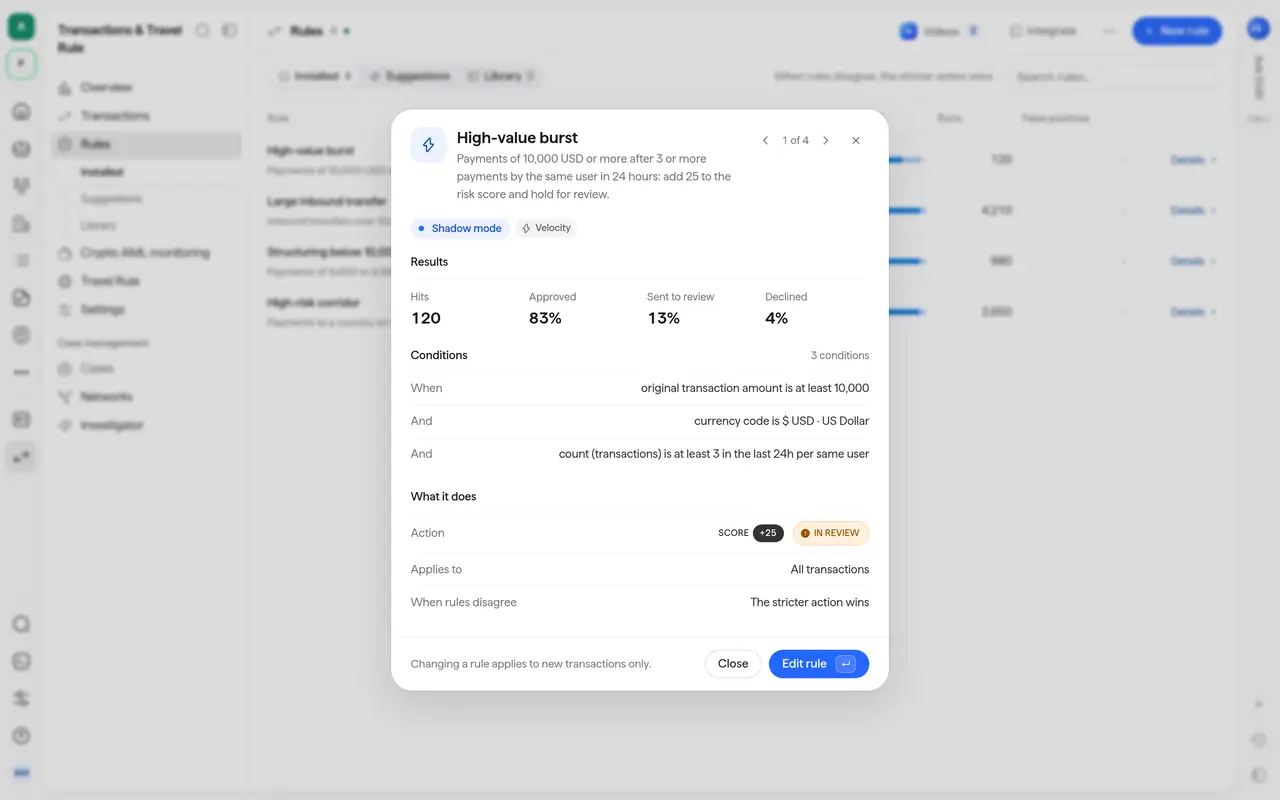
- Change rulesCreate payment rules, test them on past data and switch them on.
- Pull reportsAsk for numbers, exports or the audit log.
Didit Academy


