Didit recauda 7,5M $ para construir la infraestructura para identidad y fraude
Didit
Prueba de vida pasiva

Verifica cualquier rostro.
Sin pedirles que hagan nada.

Demuestra que la persona en cámara es real y está viva. Anti-spoofing certificado por iBeta, derrota deepfakes, máscaras, repeticiones y ataques de morphing en menos de 2 segundos. Pasiva por $0.10, activa por $0.15. 500 gratis/mes.

Respaldado por
Y CombinatorRobinhood Ventures
GBTC Finance
Bondex
Crnogorski Telekom
UCSF Neuroscape
Shiply
Adelantos

Con la confianza de más de 2.000 organizaciones en todo el mundo.

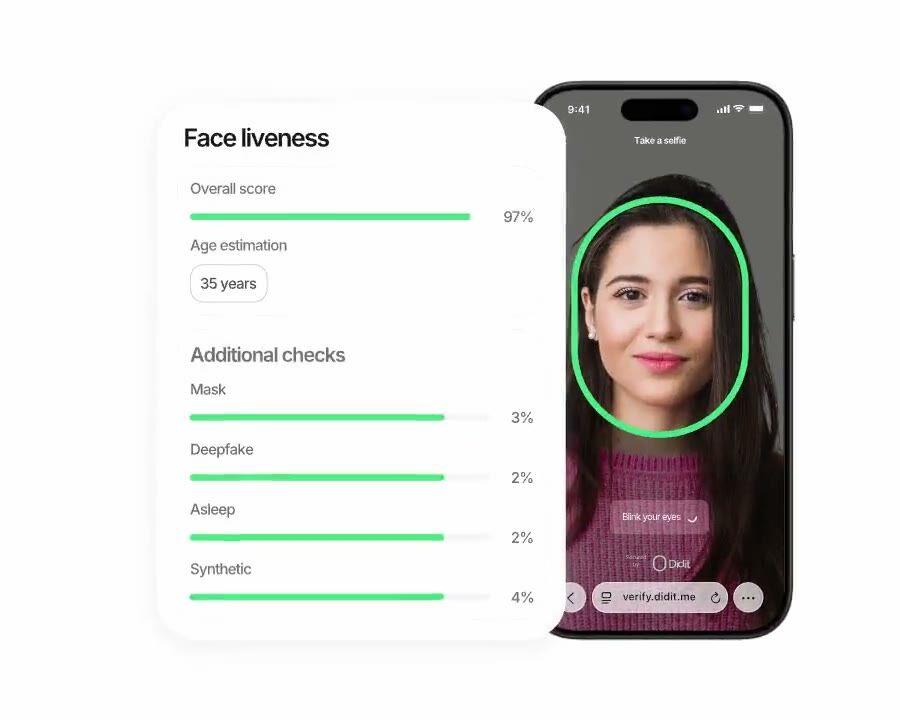
Didit Liveness, captura de prueba de vida pasiva con veredicto en dispositivo en menos de 2 segundos.

Certificado por iBeta

Pasiva. Flash.
Activa. Todo certificado.

Detecta máscaras 3D, deepfakes, ataques de repetición y fotos impresas. Certificado por iBeta, veredicto en menos de 2 segundos, $0.10 por verificación, 500 gratis cada mes.

Cómo funciona

De la suscripción a usuario verificado en cuatro pasos.

  1. Paso 01

    Crea el flujo de trabajo

    Elige las verificaciones que necesites: ID, prueba de vida, coincidencia facial, sanciones, dirección, edad, teléfono, email, preguntas personalizadas. Arrástralas a un flujo en el panel de control, o publica el mismo flujo en nuestra API. Crea ramificaciones condicionales, haz pruebas A/B, sin necesidad de código.

  2. Paso 02

    Integra

    Integra de forma nativa con nuestros SDK para Web, iOS, Android, React Native o Flutter. Redirige a una página alojada. O simplemente envía a tu usuario un enlace, por email, SMS, WhatsApp, donde quieras. Elige lo que mejor se adapte a tu stack.

  3. Paso 03

    El usuario completa el flujo

    Didit gestiona la cámara, las indicaciones de iluminación, la transferencia móvil y la accesibilidad. Mientras el usuario está en el flujo, puntuamos más de 200 señales de fraude en tiempo real y verificamos cada campo con fuentes de datos autorizadas. Resultado en menos de dos segundos.

  4. Paso 04

    Recibes los resultados

    Los webhooks firmados en tiempo real mantienen tu base de datos sincronizada en el momento en que un usuario es aprobado, rechazado o enviado a revisión. Consulta la API bajo demanda. O abre la consola para inspeccionar cada sesión, cada señal y gestionar los casos a tu manera.

Diseñado para desarrolladores · Diseñado contra el fraude · Abierto por diseño

Seis funcionalidades. Un feature flag. LIVENESS.

Cada funcionalidad que ves es un interruptor en el mismo módulo. Sin niveles de venta adicionales, sin SKUs separados, sin llamadas extra. Actívalas por flujo de trabajo en la consola, o pásalas en línea en el endpoint independiente.
01 · Métodos

Pasivo, Flash 3D, Acción 3D. Elige según el riesgo.

Tres métodos en un solo módulo. Pasivo (un fotograma, cero acción del usuario) para un registro de baja fricción. Flash 3D (una secuencia de luz corta captura la profundidad por reflexión) para flujos pasivos de mayor valor. Acción y Flash 3D (movimiento + flash) para mercados sensibles a la regulación y onboarding de alto valor.
02 · Anti-spoof certificado

Probado contra todo el catálogo de ataques de presentación.

Probado de forma independiente y certificado por iBeta, el estándar que citan NIST y Open Identity Exchange. Bloquea fotos impresas, repeticiones de pantalla, máscaras de papel, máscaras de silicona, máscaras de látex, ataques de morphing y deepfakes generados por IA. Reevaluado anualmente a medida que crece el catálogo de ataques.
03 · Veredicto en <2 segundos

Inferencia de principio a fin en menos de dos segundos.

Inferencia servida en el edge. Sin descarga de modelos, sin suposiciones de aceleración en el dispositivo, sin experiencia degradada en Android de gama baja. El método pasivo se completa en menos de un segundo en la mayoría de los dispositivos. Flash añade ~600ms. 3D Activo añade ~1.5s, aún así, menos de 2 segundos de principio a fin.
04 · Advertencias

Política de riesgo ajustable por flujo de trabajo.

Siete advertencias configurables, puntuación baja, posible duplicado, cara duplicada, múltiples caras, baja calidad facial, poca luz, mucha luz, cada una mapeada para rechazar, revisar o aprobar según la aplicación. Tres disparadores de rechazo automático (sin cara, ataque detectado, cara en lista negra) se mantienen activos pase lo que pase.
05 · Estimación de edad

Una captura, dos señales.

Activa la Estimación de Edad en un flujo de prueba de vida y la misma selfie devolverá un veredicto de prueba de vida más una banda de edad estimada. Diseñado para la Ley de Seguridad en Línea del Reino Unido y el control de edad de la UE, humano real Y con edad suficiente sin obligar al usuario a subir un ID. $0.10 por verificación.
06 · Autenticación biométrica

El mismo motor que usas al registrarte. Ahora en cada inicio de sesión.

La prueba de vida es la base para la Autenticación Biométrica, reutiliza el mismo modelo anti-spoof para verificar a los usuarios recurrentes en cada acción sensible: transferencia de alto valor, restablecimiento de contraseña, retiro grande. $0.10 por autenticación, reemplazo directo para 2FA por SMS, sin factura de operador, sin exposición a intercambio de SIM.
Integra

Dos endpoints. Mismo JSON. Mismo precio.

Crea una sesión cuando quieras que nuestra UI alojada gestione la captura (necesario para métodos activos), o llama al endpoint pasivo independiente cuando ya tengas la selfie. Ambos devuelven el mismo informe de prueba de vida.
POST /v3/session/UI alojada
$ curl -X POST https://verification.didit.me/v3/session/ \
  -H "x-api-key: $DIDIT_API_KEY" \
  -H "Content-Type: application/json" \
  -d '{
    "workflow_id": "wf_liveness_3d",
    "vendor_data": "user-42"
  }'
201Creado{ "session_url": "verify.didit.me/..." }
Nosotros alojamos la interfaz de captura. Requerido para FLASHING y ACTIVE_3D.docs →
POST /v3/passive-liveness/De servidor a servidor
$ curl -X POST https://verification.didit.me/v3/passive-liveness/ \
  -H "x-api-key: $DIDIT_API_KEY" \
  -F "image=@selfie.jpg"
200OK{ "status": "Approved", "score": 98 }
Tú controlas la captura. Nosotros te damos el veredicto al instante.docs →
Integración lista para agentes

Lanza Liveness con un solo prompt.

Pega el siguiente bloque en Claude Code, Cursor, Codex, Devin, Aider o Replit Agent. Rellena el marcador de posición `my_stack` con tu framework, lenguaje y caso de uso. El agente provisionará Didit, creará el flujo de trabajo con Liveness activado, conectará el webhook y lo lanzará.
didit-integration-prompt.md
# Didit Liveness — integrate in 5 minutes

You are integrating Didit's Liveness (presentation-attack detection) module
into <my_stack>. Follow these steps exactly. Every URL, header, and enum
value below is canonical — do not paraphrase or "improve" them.

## 1. Provision an account
- Sign up: https://business.didit.me (no credit card required).
- Or provision programmatically: POST https://apx.didit.me/auth/v2/programmatic/register/
  (returns an API key bound to the workspace + application).

## 2. Two integration paths — pick one

### Path A — Workflow Builder (hosted UI)
Best when you want Didit to handle camera, motion prompts, low-light
fallback, mobile handoff, and accessibility for you.

1. Create a workflow that contains the LIVENESS feature:
   POST https://verification.didit.me/v3/workflows/
   Authorization header:  x-api-key: <your-api-key>
   Body: workflow_label, features array with the single entry
         { feature: "LIVENESS" }   (UPPERCASE — strict enum)
   Optional config: liveness_method ("PASSIVE" | "FLASHING" | "ACTIVE_3D")
   and per-warning threshold overrides.

2. Create a verification session for an end user:
   POST https://verification.didit.me/v3/session/
   Body: workflow_id (from step 1), vendor_data (your own user id).
   Response: session_url — redirect the user to it.

3. Listen for webhook callbacks (see "Webhooks" below).

### Path B — Standalone server-to-server API
Best when you already have a selfie image (mobile SDK capture, native
onboarding app, reseller pipeline). Standalone is single-frame
PASSIVE only — for ACTIVE_3D or FLASHING you must use Path A.

POST https://verification.didit.me/v3/passive-liveness/
Content-Type: multipart/form-data
Body fields:
  - image        (required, file — single selfie)
  - vendor_data  (optional string, your user id)

Response: JSON report with liveness score, method, and warnings array.

## 3. Webhooks (Path A only — Path B returns synchronously)
- Register a webhook destination once via
  POST https://verification.didit.me/v3/webhook/destinations/
  Body: url, subscribed_events: ["session.verified", "session.review_started",
                                  "session.declined"]
- Response includes secret_shared_key — store it.
- Every webhook delivery carries an X-Signature-V2 header you MUST verify
  before trusting the payload.  HMAC-SHA256 verification MUST run against the raw body bytes (the raw payload as Didit sent it) BEFORE any JSON parsing — re-serialising the parsed body changes whitespace and key order, which invalidates the signature.Algorithm:
    1. sortKeys(payload) recursively
    2. shortenFloats (truncate trailing zeros after the decimal point)
    3. JSON.stringify the result
    4. HMAC-SHA256 with the secret_shared_key
    5. Hex-encode, compare to the X-Signature-V2 header.

## 4. Reading the report (both paths return the same shape)
The liveness object includes:
- status: "Approved" | "Declined" | "In Review" | "Not Finished"
- method: "PASSIVE" | "FLASHING" | "ACTIVE_3D"
- score: number 0-100 (normalized liveness score)
- reference_image: signed URL to the captured selfie (expires in 1 hour)
- video_url: signed URL to the capture video, present only for FLASHING
  and ACTIVE_3D (expires in 1 hour)
- age_estimation: { age, age_range } when enabled in the workflow
- warnings: Array<{ risk, log_type, short_description, long_description }>

Auto-decline risks (always enforced by Didit, not configurable):
- NO_FACE_DETECTED
- LIVENESS_FACE_ATTACK
- FACE_IN_BLOCKLIST

Configurable risks (action per workflow — Decline, Review, or Approve):
- LOW_LIVENESS_SCORE
- POSSIBLE_DUPLICATED_FACE
- DUPLICATED_FACE
- MULTIPLE_FACES_DETECTED
- LOW_FACE_QUALITY
- LOW_FACE_LUMINANCE
- HIGH_FACE_LUMINANCE

## 5. Hard rules — do not change
- Base URL for /v3/* endpoints is verification.didit.me (NOT apx.didit.me).
- Feature enum is UPPERCASE: LIVENESS, ID_VERIFICATION, FACE_MATCH, AML, IP_ANALYSIS.
- Method enum is UPPERCASE: PASSIVE, FLASHING, ACTIVE_3D.
- Auth header is x-api-key (lowercase, hyphenated).
- Webhook signature header is X-Signature-V2 (NOT X-Signature).
- Always verify webhook signatures before trusting payload data.
- Status casing matches exactly: "Approved", "Declined", "In Review",
  "Not Finished" (title-cased, space-separated).

## 6. Pricing reference (public)
- PASSIVE method: $0.10 per check (standalone or bundled)
- FLASHING / ACTIVE_3D methods: $0.15 per check
- Bundled in a full KYC workflow: $0.33 per session (includes Liveness)
- 500 free checks every month, forever, on every account.

## 7. Verify your integration
- Sandbox starts on signup at https://business.didit.me — no separate flag.
- Test images: deterministic synthetic faces returned in sandbox (Approved
  by default; trigger Declined by sending the canonical "spoof" test image).
- Switch to live: flip the application's environment toggle in console.

When in doubt: https://docs.didit.me/core-technology/liveness/overview
¿Necesitas más contexto? Consulta la documentación completa del módulo.docs.didit.me →
Cumplimiento por diseño

Abre un nuevo país en un clic. Nosotros hacemos el trabajo duro.

Abrimos las filiales locales, aseguramos las licencias, realizamos las pruebas de penetración, obtenemos las certificaciones y nos alineamos con cada nueva regulación. Para lanzar verificaciones en un nuevo país, activa un interruptor. Más de 220 países en vivo, auditados y probados trimestralmente, el único proveedor de identidad que un gobierno de un estado miembro de la UE ha calificado formalmente como más seguro que la verificación presencial.
Lee el dossier de seguridad y cumplimiento
Sandbox financiero de la UE
Tesoro · SEPBLAC · BdE
ISO/IEC 27001
Seguridad de la información · 2026
SOC 2 · Type I
AICPA · 2026
iBeta Level 1 PAD
NIST / NIAP · 2026
GDPR
EU 2016/679
DORA
EU 2022/2554
MiCA
EU 2023/1114
AMLD6 · eIDAS 2.0
Alineado con la UE por diseño

Cifras que lo demuestran

Cifras que lo demuestran
  • iBeta
    Anti-spoofing (detección de ataques de presentación) certificado de forma independiente.
  • 0
    Métodos de prueba de vida, pasivo, flash 3D, acción 3D + flash.
  • <0s
    Inferencia de extremo a extremo por verificación.
  • $0.00
    Por verificación de prueba de vida pasiva. 500 gratis cada mes.
Tres niveles, una lista de precios

Empieza gratis. Paga por uso. Escala a Enterprise.

500 verificaciones gratuitas cada mes, para siempre. Pago por uso para producción. Contratos personalizados, residencia de datos y SLAs (Acuerdos de Nivel de Servicio) en Enterprise.
Gratis

Gratis

$0 / mes. No se requiere tarjeta de crédito.

  • Paquete KYC gratuito (Verificación de ID + Prueba de vida pasiva + Coincidencia facial + Análisis de dispositivo e IP), 500 / mes, cada mes
  • Usuarios en lista negra
  • Detección de duplicados
  • Más de 200 señales de fraude en cada sesión
  • KYC reutilizable en la red Didit
  • Plataforma de gestión de casos
  • Constructor de flujos de trabajo
  • Documentación pública, sandbox, SDKs, servidor MCP (Model Context Protocol)
  • Soporte de la comunidad
El más popular
Paga por uso

Basado en el uso

Paga solo por lo que usas. Más de 25 módulos. Precios públicos por módulo, sin cuota mínima mensual.

  • KYC completo por $0.33 (ID + Biométrico + IP / Dispositivo)
  • Más de 10.000 conjuntos de datos AML: sanciones, PEPs, medios adversos
  • Más de 1.000 fuentes de datos gubernamentales para la validación de bases de datos
  • Monitoreo de transacciones por $0.02 por transacción
  • KYB en vivo por $2.00 por empresa
  • Análisis de monederos por $0.15 por verificación
  • Flujo de verificación de marca blanca: tu marca, nuestra infraestructura
Empresarial

Empresarial

MSA y SLA personalizados. Para grandes volúmenes y programas regulados.

  • Contratos anuales
  • MSA, DPA y SLA personalizados
  • Canal dedicado en Slack y WhatsApp
  • Revisores manuales bajo demanda
  • Condiciones de reventa y marca blanca
  • Funciones exclusivas e integraciones con socios
  • CSM asignado, revisión de seguridad, soporte de cumplimiento

Empieza gratis → paga solo cuando se ejecuta una verificación → desbloquea Enterprise para un contrato personalizado, SLA o residencia de datos.

FAQ

Preguntas frecuentes

What is Didit?

Didit is infrastructure for identity and fraud, the platform we wished existed when we were building products ourselves: open, flexible, and developer-friendly, so it works as a real part of your stack instead of a black box you integrate around.

One API covers verifying people (KYC, know your customer), verifying businesses (KYB, know your business), screening crypto wallets (KYT, know your transaction), and monitoring transactions in real time, on a stack built to be:

  • Fast, sub-2-second p99 on every session
  • Reliable, in production with 1,500+ companies across 220+ countries
  • Secure, SOC 2 Type 1, ISO 27001, GDPR-native, and formally attested by Spain's financial regulator as safer than verifying someone in person

The footprint underneath: 14,000+ document types in 48+ languages, 1,000+ data sources, and 200+ fraud signals on every session. The Didit infrastructure dynamically learns from every session and gets better every day.

What inputs does Liveness accept?
A single selfie. Path A, Workflow Builder: the hosted UI captures the selfie inside the user's session, passive needs no user action, 3D Flash plays a short colour sequence, 3D Action prompts a head movement. Comes for free with the session, no extra capture work on your side. Path B, Standalone API: you pass the image yourself as user_image on a multipart POST /v3/passive-liveness/. Accepted formats: JPG, JPEG, PNG, up to 5 MB. Both paths return the same liveness JSON shape.
What is the response shape?
A root-level liveness object with status (Approved, Declined, In Review, or Not Finished), a 0–100 score, the method used (PASSIVE, FLASHING, or ACTIVE_3D), an age_estimation float (optional, when bundled), a signed reference_image URL, a signed video_url for active methods, a matches array surfacing any face-search hits (each with session_id, similarity_percentage, is_blocklisted), and a warnings array. Each warning carries risk, log_type (information, warning, or error), short_description, and long_description. Same shape whether you called the Workflow Builder or the standalone API. Full reference at docs.didit.me/core-technology/liveness/report-liveness.
How fast is the verification for my end user?

The full flow normally takes under 30 seconds end-to-end, pick up the ID, snap the document, snap the selfie, done. That is the fastest in the market. Legacy KYC providers usually take more than 90 seconds for the same flow.

On the back end, Didit returns the result in under two seconds at p99, measured from the moment the user finishes the selfie to the moment your webhook fires. Mobile capture is tuned for slow phones and slow networks: progressive image compression, lazy software development kit load, and a one-tap hand-off from desktop to phone via QR code if the user starts on web.

How does Didit defeat deepfakes, masks, and replay attacks?

Three methods, one module, iBeta Level 1 Presentation Attack Detection (PAD) certified across the full attack catalogue:

  • Passive, one frame, zero user action. Catches printed photos, screen replays, and basic morph attacks. Best for low-friction sign-up.
  • 3D Flash (`FLASHING`), plays a short colour sequence on the phone screen and measures the reflection on the face. Defeats 2D screen replays and high-fidelity printed masks.
  • 3D Action (`ACTIVE_3D`), combines a head-movement prompt with the flash sequence. Defeats 3D silicone masks and AI-generated deepfake video. Best for high-value onboarding and regulator-sensitive markets.

Seven configurable warnings (low score, low light, high light, possible duplicate, duplicate face, multiple faces, low face quality) map to decline / review / approve per application. Three auto-decline triggers (no face, attack detected, blocklisted face) are always enforced.

What happens if a user fails, abandons, or expires?

Every session lands on one of seven clear statuses, so your code always knows what to do:

  • Approved, every check passed. Move the user forward.
  • Declined, one or more checks failed. You can allow the user to resubmit the specific failed step (for example, re-take the selfie) without re-running the whole flow.
  • In Review, flagged for compliance review. Open the case in the console, see every signal, decide approve or decline.
  • In Progress, user is mid-flow.
  • Not Started, link sent, user has not opened it yet. Send a reminder if it sits too long.
  • Abandoned, user opened the link but did not finish in time. Re-engage or expire.
  • Expired, the session link aged out. Create a new session.

A signed webhook fires on every status change, so your database always stays in sync. Abandoned and declined sessions are free.

Where does my customer data live and how is it protected?

Production data is processed and stored in the European Union by default, on Amazon Web Services. Enterprise contracts can request alternative regions for jurisdictions whose regulators require it.

Encryption everywhere. AES-256 at rest across every database, object store, and backup. Transport Layer Security 1.3 in transit on every API call, webhook, and Business Console session. Biometric data is encrypted under a separate Customer Master Key.

Retention is yours to control. Default retention is indefinite (unlimited) unless you configure shorter, between 30 days and 10 years per application, and you can delete any individual session at any time from the dashboard or the API.

Certifications: SOC 2 Type 1 (Type 2 audit in progress), ISO/IEC 27001:2022, iBeta Level 1 PAD, and a public attestation from Spain''s Tesoro / SEPBLAC / CNMV that Didit''s remote identity verification is safer than verifying someone in person. Full report at /security-compliance.

Is Didit compliant for my industry?

Didit ships compliant by default for the regulators that matter to identity infrastructure:

  • GDPR + UK GDPR, controller / processor split, full Data Processing Agreement published, lead supervisory authority named (Spain''s AEPD).
  • AMLD6 + EU AML Single Rulebook, 1,300+ sanctions, politically exposed person, and adverse-media lists screened in real time.
  • eIDAS 2.0, EU Digital Identity Wallet aligned; reusable-identity ready.
  • MiCA (Markets in Crypto-Assets), ready for crypto on-ramps, exchanges, and custodians.
  • DORA, Digital Operational Resilience Act, EU financial-services operational resilience.
  • BIPA, CUBI, Washington HB 1493, CCPA / CPRA, US biometric privacy (Illinois, Texas, Washington) and California consumer privacy.
  • UK Online Safety Act, age-gating and child-safety obligations.
  • FATF Travel Rule, originator and beneficiary data on crypto transfers, IVMS-101 interoperable.

Detailed memo, every certificate, every regulator letter: /security-compliance.

How fast can I integrate and start verifying users?
  • 60 seconds to a sandbox account at business.didit.me, no credit card.
  • 5 minutes to a working verification through Claude Code, Cursor, or any coding agent via our Model Context Protocol (MCP) server.
  • A weekend to a production-ready integration with signed-webhook verification, retries, and a remediation flow when a user is declined.

Three integration paths, pick whichever fits your stack:

  • Embed natively with our Web, iOS, Android, React Native, or Flutter SDK.
  • Redirect the user to the hosted verification page, zero SDK.
  • Send a link by email, SMS, WhatsApp, or any channel, zero front-end work.

Same dashboard, same billing, same pay-per-success price for all three. Step-by-step guide at docs.didit.me/integration/integration-prompt.

Infraestructura para identidad y fraude.

Una API para KYC, KYB, Monitoreo de Transacciones y Detección de Fraude en Wallets. Intégrala en 5 minutos.

Pide a una IA que resuma esta página