eID verification in Lithuania: Smart-ID, Mobile-ID and the ID card
Which eIDs people in Lithuania use, what each returns, the AML law that accepts them for remote checks, the 2026 and 2027 EUDI Wallet dates, and how to launch eID verification in Lithuania with a document route.
 By Alberto RosasCo-founder & CEO, DiditUpdated
In short
Smart-ID (searched as "Smart-ID Lietuva") has the largest published user base of any eID in Lithuania: 1,857,471 users on 5 October 2026.[2] For eID verification in Lithuania, accept Smart-ID first, add Mobile-ID, and keep a document route for everyone else.
- Smart-ID and Mobile-ID are rated High by the Lithuanian state but are not EU-notified; the national ID card is the only EU-notified Lithuanian eID.[1][3]
- The AML law accepts eID and qualified e-signatures for remote customer identification (Article 11).[7]
- EU rules add the European Digital Identity (EUDI) Wallet: Member States provide one by 24 December 2026. By 24 December 2027, private firms required by law or contract to use strong user authentication for online identification must accept it at the user's request; micro and small enterprises are exempt.[16]
Lithuania has one state eID card and two mobile electronic IDs (eIDs). This guide covers who runs each one, who has it, what a business receives, the anti-money laundering (AML) rules that accept it, and how to launch.
Smart-ID Lietuva and the other eIDs in Lithuania
Smart-ID is a smartphone app run by SK ID Solutions, a private company.[4] Mobile-ID, according to a State Digital Solutions Agency release carried by BNS, sits on the SIM card, so a new phone needs no new account. The national identity card (asmens tapatybės kortelė) carries a chip with authentication and signature certificates.[6] And the state portal still accepts logins from Lithuanian e-banking.[14]
According to the State Digital Solutions Agency, as reported by BNS on 21 April 2026, login and signature tools issued in Lithuania doubled in five years to 3.04 million. The Communications Regulatory Authority (RRT) counted 2,525,380 Smart-ID certificates at the end of 2025.[4]
Coverage table: every eID in Lithuania
| eID | Operator | Users (date) | Credential | Level and EU notification | Data a business receives | Private-sector access | Didit status |
|---|---|---|---|---|---|---|---|
| Smart-ID | SK ID Solutions (private)[4] | 1,857,471 (5 October 2026)[2] | Smartphone app, PIN1 to log in[11] | High, set by RRT in December 2024; Not EU-notified[1][3] | Full name, date of birth, personal code (through Didit) | Contract with SK or through a broker[22] | Live |
| Mobile-ID | SK ID Solutions certificates on an operator SIM[4] | 469,130 certificates (end of 2025)[4] | SIM card, according to BNS | High, set by RRT in December 2024; not EU-notified[1][3] | Full name, date of birth, personal code (through Didit) | SK Mobile-ID service, priced for Lithuania and Estonia[22] | Live |
| National ID card | Migration Department, a qualified trust service provider since 17 November 2025[5] | No single figure published | Chip with certificates, PIN[6] | High, EU-notified on 21 August 2020[1] | Not published | State gateway (VIISP); private-sector terms not published[15] | On request |
| E-banking login | Lithuanian banks | Not published | Each bank's own login | No level published; not EU-notified[1] | Not published | Accepted by the state portal[14] | On request |
| Lithuanian EUDI Wallet | Not announced | Not launched | Wallet app | High, required by eIDAS 2 (EU eID and trust services rules)[16] | Person identification data | Relying-party registration[16] | Coming soon |
Status on 5 October 2026. "Through Didit" is what lands on a Didit session.
From the 2020 notification to the EUDI Wallet
SK ID Solutions calls Smart-ID and Mobile-ID "the first digital identity tools in Lithuania to be recognized by the state as meeting the High Level of Assurance".[3] For citizens, ID card signing and identification cost nothing.[5]
- 21 August 2020ID card notifiedLithuania notifies the national ID card at level High.
- December 2024High levelRRT rates Smart-ID and Mobile-ID High.
- 17 November 2025New issuerThe Migration Department issues ID card certificates.
- 1 October 2026Card readers endSmart-ID registration with a card reader stops.
The national eID history.[1][3][5][10]
Next come the EU dates below.[16] Lithuania's wallet plan and launch date were not published in the sources we checked on 5 October 2026. See the EUDI Wallet launch tracker.
- 24 December 2026Wallets dueEach Member State offers at least one EUDI Wallet.
- 10 July 2027AMLR appliesThe EU Anti-Money Laundering Regulation (AMLR) applies.
- 24 December 2027AcceptanceFirms bound to strong user authentication accept wallets on user request; micro and small enterprises exempt.
EU dates that apply in Lithuania.[16][17]
The rules: eID law, AML law and regulators
National eID law
According to the Seimas legal register, the national eID law is the Law on Electronic Identification and Trust Services for Electronic Transactions, No XIII-1120, from 2018. SK ID Solutions says RRT granted Smart-ID and Mobile-ID the High level under the law in force in early 2024.[3]
The AML law: Article 11
The Law on the Prevention of Money Laundering and Terrorist Financing, No VIII-275, sets out in Article 11 how a customer can be identified when they are not physically present. It allows five routes.[7]
Article 11(1)(2)Law No VIII-275 on the Prevention of Money Laundering and Terrorist Financing
"naudojant Europos Sąjungoje išduotas elektroninės atpažinties priemones, veikiančias pagal aukšto arba pakankamo saugumo užtikrinimo lygio elektroninės atpažinties schemas"
Source: INFOLEX, consolidated text of Article 11[7]
In English: using eID means issued in the EU under schemes at the High or Substantial level. All five routes:
| Route in Article 11(1) | What it means in practice |
|---|---|
| (1) Third parties | Rely on identification done by another entity[7] |
| (2) EU eID | An eID under a High or Substantial scheme[7] |
| (3) Qualified signature | A qualified electronic signature with a qualified certificate[7] |
| (4) Live video | Video with an advanced e-signature, or face and document[7] |
| (5) Payment | A payment from an EU or equivalent account plus a document copy[7] |
The person's identity must have been established in person, or by video or payment, when the eID means was issued. Article 11(5) lets the Financial Crime Investigation Service (FNTT) set video rules; Article 11(6) applies the European Banking Authority (EBA) remote onboarding guidelines.[7]
Watch out
Smart-ID and Mobile-ID hold qualified certificates, but neither is EU-notified.[1][4] Article 11 lists eID means (route 2) and qualified e-signatures (route 3) as separate routes.[7] Check with your supervisor which route applies to your product.
From 10 July 2027, the AMLR applies. Its Article 22(6)(b) accepts "electronic identification means which meet the requirements of Regulation (EU) No 910/2014 with regard to the assurance levels 'substantial' or 'high'".[17] The Anti-Money Laundering Authority (AMLA) final draft standards of 30 September 2026, not yet law, accept eID "regardless of whether they are notified" if it meets one of those levels.[18] More in what is eID verification.
Regulator positions
| Regulator | Position on 5 October 2026 |
|---|---|
| RRT (telecoms and trust services) | Rated Smart-ID and Mobile-ID High in December 2024; publishes trust services data[3][4] |
| FNTT (AML) | Sets the rules for video identification under Article 11(5)[7] |
| Gaming Control Authority (LPT) | Operators must collect identity data before a remote gambling contract[8] |
| Bank of Lithuania | No eID-specific position found in our research |
The Gaming Control Authority says the operator "privalo pareikalauti, kad fizinis asmuo ... pateiktų duomenis, reikalingus jo tapatybei nustatyti": it must ask for the data needed to establish identity, and check age and ban requirements.[8] We could not re-confirm the current age limits in the Gambling Law; check the consolidated text.
Age verification
We found no Lithuanian rule that names an eID for age checks. The EU Digital Services Act (DSA) guidelines expect age verification for gambling and pornographic content.[19] The Commission wants the EU age verification app out by the end of 2026, and Lithuania is not among the seven countries piloting it in 2026.[20][21] A Smart-ID sign-in returns a signed date of birth, so it proves age without a document photo.
eID verification in Lithuania: what the Smart-ID user sees
In the Didit flow, the user picks Smart-ID, sees a comparison code and approves on the phone. Didit never asks for the PIN.
Choose how to verify
Sign in with the electronic ID you already use.
Smart-ID
Use an ID document instead
1The user picks Smart-ID or Mobile-ID in the Didit flow; Mobile-ID users also enter their Mobile-ID phone number.
Check the code
4821
The same code appears in your Smart-ID app.
2The page shows a comparison code.
Confirm the login
4821
Only if the code matches, enter PIN1.
3The user checks the code and enters PIN1 in the app.[11]
You are verified
- Full nameShared
- Date of birthShared
- Personal codeShared
- AddressNot shared
4Back in your service, with the signed attributes on the session.
An app sign-in with a comparison code, start to finish.
With Mobile-ID, the user also enters their Mobile-ID phone number. Some services make Smart-ID users pick the right code out of three.[23] Smart-ID+ swaps the typed personal code for a QR scan or an app-to-app jump; each service opts in.[11][12] SK says it will roll out to users throughout 2026.[24] More in the Smart-ID integration guide and the Mobile-ID guide.
Choosing eIDs by use case
Every row keeps a document fallback.
| Use case | Lithuanian rule we found | Accept first | Watch |
|---|---|---|---|
| Fintech and banks | AML law, Article 11[7] | Smart-ID, Mobile-ID | Which Article 11 route you rely on |
| Crypto | Article 11 where you are an obliged entity[7] | Smart-ID, Mobile-ID | AMLR from 10 July 2027[17] |
| Gambling | Identity data before a remote contract[8] | Smart-ID (signed date of birth) | Current age limits in the Gambling Law |
| Telecom | None found in our research | Smart-ID, Mobile-ID | Telecoms are named in eIDAS 2 Article 5f(2)[16] |
| Marketplaces | None found in our research | Smart-ID for sellers | DSA age rules for restricted goods[19] |
| Mobility | None found in our research | Smart-ID for name and age | The eID does not prove a licence |
1Offer the Lithuanian eIDs first
Smart-ID and Mobile-ID on the same chooser screen.
Does the user have Smart-ID or Mobile-ID
Sign in with the eID
Signed name, date of birth and personal code.
Verify with a document
Chip reading, liveness and face match.
2Screen and decide
AML screening, then your onboarding decision.
A default flow for Lithuania. No eID returns a portrait, so add a selfie where your risk assessment needs one.
People without a Lithuanian eID
Non-residents can open a Smart-ID Basic account at Urbo Bank or Artea bankas with a passport or ID card, while residence-permit holders and Estonian e-residents register "just as you would if you were a citizen".[9] Smart-ID has no age limit of its own; under-18 accounts need a parent's authorisation.[13]
ID cards issued before 4 July 2012 work only with SHA-1 and cannot register Smart-ID.[10]
Default route
Lithuanian eID
- Smart-ID or Mobile-ID
- Signed personal code
AML law, Article 11[7]
Cross-border
Another country's eID
- Smart-ID from Estonia or Latvia
- Nordic eIDs
AMLR Article 22(6)(b)[17]
Everyone else
Identity document
- Passport or ID card, chip read
- Liveness and face match
AMLR Article 22(6)(a)[17]
Cross-border customers often already hold Smart-ID: the same counter showed 797,395 users in Estonia and 1,198,463 in Latvia.[2] See eID in Estonia, eID in Latvia and eID schemes by country. For everyone else, a document with near-field communication (NFC) chip reading, liveness and face match covers the gap. Under the draft AMLA standards, remote document checks are a justified alternative: the firm must be able to explain why the customer could not use an eID.[18]
Launch checklist for eID verification in Lithuania
- Write down which Article 11 route your remote onboarding relies on.[7]
- Turn on Smart-ID and Mobile-ID for Lithuania.
- Keep a document route with chip reading for people without an eID.
- Store the level of assurance and the signature check with each result.
- Remind users that Smart-ID accounts are renewed only in the app, never through a link.[2]
- Plan EUDI Wallet acceptance for 24 December 2027 if Article 5f(2) applies to you.[16]
How Didit helps with eID in Lithuania
Smart-ID and Mobile-ID are live on Didit for Lithuania, next to the document route, as shown on our eID verification page. We run Smart-ID sign-ins every day, and this guide is what we learned.
- What lands on the session: full name, date of birth, personal code, the level of assurance (labelled High) and a signature check. No address, no portrait.
- How the user signs in: in the hosted flow or SDK, with a comparison code approved on the phone. Didit never asks for the PIN.
- How you turn it on: in the console, Workflows, the ID Verification step, Countries, Lithuania, "Wallets accepted"; or
methods.LTU.walletin the workflows API. Results arrive by webhook. - Billing: only completed eID sign-ins are billed; cancelled, timed-out and failed ones are free. Smart-ID and Mobile-ID cost $0.20 each (pricing page).
- Everyone else: the flow falls back to document capture with chip reading at $0.15, liveness and face match. A full know-your-customer (KYC) check costs $0.33, AML screening $0.20, and age estimation $0.10.
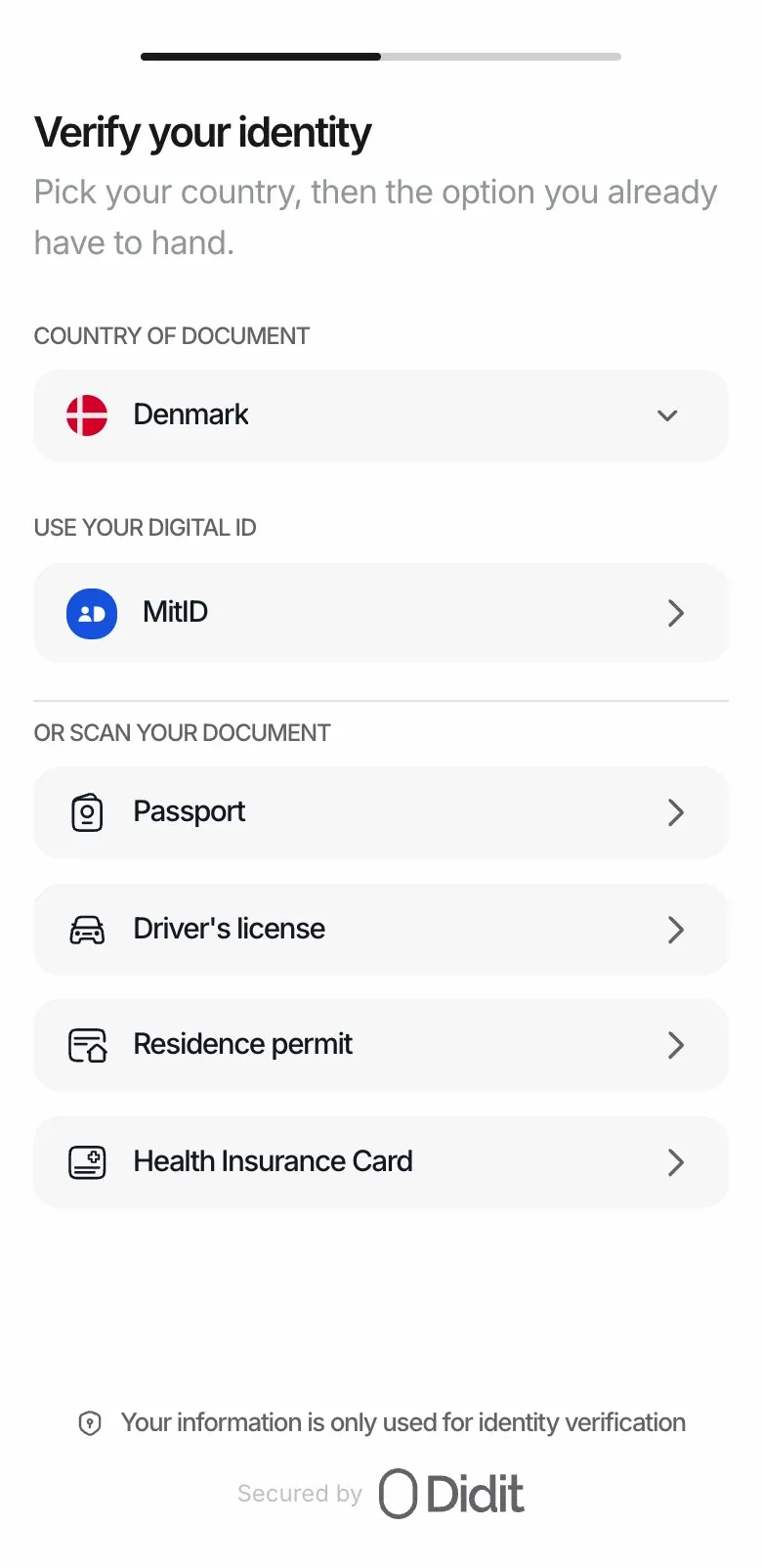
The eID chooser in the hosted flow.
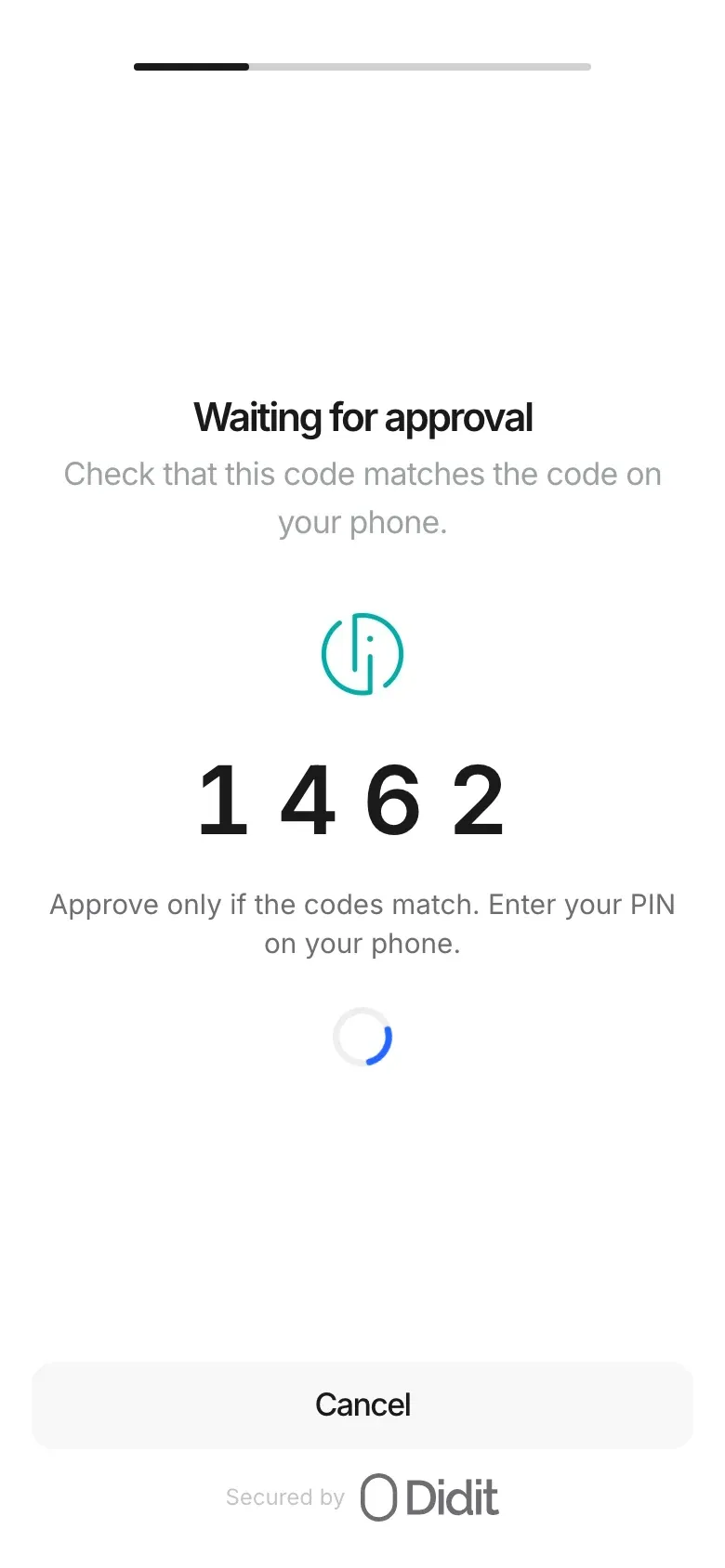
The comparison code the user matches in the Smart-ID app.
For the ID card as an online eID, talk to us. EUDI Wallet acceptance is coming soon on the same workflow; see our EUDI Wallet page. Every eID Didit runs today is listed on eID verification.
Didit provides
- Smart-ID and Mobile-ID sign-ins, with a document fallback, on the same workflow
- Signed data and evidence of every check
- AML screening and monitoring
Stays with you
- Your risk assessment and Article 11 route
- The onboarding decision
- Reporting to FNTT
Accept Smart-ID in your sign-up today
Turn on Smart-ID, Mobile-ID and the document route, and pay only for completed checks.
Key takeaways
- Smart-ID has the largest published user base in Lithuania: 1,857,471 users on 5 October 2026.
- Smart-ID and Mobile-ID are rated High by RRT but are not EU-notified; the ID card is.
- AML law Article 11 accepts eID and qualified signatures for remote checks.
- Keep a document route for people without a Lithuanian eID.
Frequently asked questions
What is Smart-ID in Lithuania?
A smartphone app for logging in and signing, run by the private company SK ID Solutions. It had 1,857,471 users in Lithuania on 5 October 2026, the largest published figure for any Lithuanian eID.[2][4]
Is Smart-ID government-issued?
No, SK ID Solutions runs it privately. In December 2024 RRT recognised Smart-ID and Mobile-ID as meeting the High level of assurance.[3]
Which Lithuanian eIDs are notified under eIDAS?
Only the national identity card, at level High, since 21 August 2020. Smart-ID, Mobile-ID and bank logins are not on the EU list.[1]
Can a business use Smart-ID for AML customer identification in Lithuania?
Article 11 of the AML law allows remote identification with EU eID means at High or Substantial level, or with a qualified electronic signature. Smart-ID holds qualified certificates but is not EU-notified, and the law lists eID means and qualified signatures as separate routes. Check with your supervisor which Article 11 route applies to your product; this is not legal advice.[1][4][7]
What is the difference between Smart-ID and Mobile-ID?
Smart-ID is an app on the phone. Mobile-ID sits on the SIM card, according to a State Digital Solutions Agency release carried by BNS. Both are rated High by RRT. At the end of 2025 there were 2,525,380 Smart-ID and 469,130 Mobile-ID certificates.[3][4]
Can foreigners get Smart-ID in Lithuania?
Residence-permit holders and Estonian e-residents register like citizens. Non-residents can open Smart-ID Basic at Urbo Bank or Artea bankas with a passport or ID card.[9]
When will Lithuania have an EUDI Wallet?
EU law requires one in every Member State by 24 December 2026. Lithuania had not published its plan or launch date in the sources we checked on 5 October 2026.[16]
What does a business receive from a Smart-ID sign-in on Didit?
Full name, date of birth, the Lithuanian personal code, the level of assurance (labelled High) and a signature check. No address and no portrait.
Sources
- Overview of pre-notified and notified eID schemes under eIDAS, European Commission, read 5 October 2026.
- Smart-ID, SK ID Solutions, live user counter and fraud notice, read 5 October 2026.
- Smart-ID and Mobile-ID recognized as state-approved tools in Lithuania, SK ID Solutions, 19 December 2024.
- SK ID Solutions issued almost three million certificates in Lithuania in 2025, SK ID Solutions citing RRT, 7 May 2026.
- The Migration Department becomes a qualified trust service provider, Migration Department.
- The e-signature on the identity card, Migration Department, 14 February 2024.
- Law No VIII-275 on the Prevention of Money Laundering and Terrorist Financing, Article 11, INFOLEX consolidated text.
- Frequently asked questions, Gaming Control Authority (LPT).
- Can foreigners and non-residents use Smart-ID, Smart-ID help.
- Registering a Smart-ID account with a Lithuanian ID card, Smart-ID help.
- How does the new Smart-ID protect me from fraud, Smart-ID help.
- Estonia's government adopts Smart-ID+ to strengthen security, SK ID Solutions, 28 January 2026.
- Age limitations for using Smart-ID, Smart-ID help.
- Elektroniniai valdžios vartai (state e-services portal), State Digital Solutions Agency.
- VIISP identity establishment service, epaslaugos.lt.
- Regulation (EU) 2024/1183 (eIDAS 2), EUR-Lex.
- Regulation (EU) 2024/1624 (AMLR), EUR-Lex.
- Final Report, draft RTS under Article 28(1) AMLR, AMLA, 30 September 2026.
- Guidelines on measures to ensure a high level of privacy, safety and security for minors online (C/2025/5519), EUR-Lex.
- EU age verification solution, technical portal, read 5 October 2026.
- Commission urges Member States to roll out the EU age verification app, European Commission, 29 April 2026.
- Price list, SK ID Solutions, Smart-ID and Mobile-ID prices for e-service providers.
- Why do I sometimes see one confirmation code and sometimes three, Smart-ID help.
- 2025: advancing digital trust beyond borders, SK ID Solutions, 19 January 2026.
Compare Lithuania with every other country on the eID verification page.
One workflow for the Baltics and beyond
Start with Smart-ID and Mobile-ID, then add the eIDs your other users have.
Related articles
- Didit vs Unit21: KYC, KYB, AML and monitoring on one record
- Didit vs Trinsic: eID sign-in plus document checks, AML and KYB
- Didit vs Thomson Reuters: government databases plus the whole flow
- Didit vs Regula: hosted checks with full evidence, KYB and monitoring
- Top 10 AI compliance agents for KYC and AML review automation in 2026
- Top 5 Travel Rule compliance solutions for crypto businesses in 2026