KYC Credits: The Future of Fintech Payments
Traditional KYC/AML compliance is expensive and inefficient. KYC credits offer a flexible, scalable solution for fintechs, reducing costs and improving user experience. Explore how this model is reshaping the future of compliance.
 Alberto RosasCo-founder and CEO
Contents
In this guide
Jump to the part you need.
KYC Credits: The Future of Fintech Payments
Know Your Customer (KYC) and Anti-Money Laundering (AML) regulations are the bedrock of financial compliance. However, the traditional methods of achieving this compliance – rigid contracts, high per-verification costs, and slow processing times – are increasingly at odds with the agility demanded by modern fintechs. A new model is emerging: KYC credits. This approach represents a paradigm shift, moving away from fixed fees toward a more flexible, consumption-based system, and promises to unlock significant benefits for businesses of all sizes.
Key Takeaway 1: KYC credits offer a more cost-effective and scalable alternative to traditional KYC/AML compliance models.
Key Takeaway 2: This credit-based system aligns incentives, encouraging efficient usage and reducing wasted resources.
Key Takeaway 3: The adoption of KYC credits is being driven by the increasing complexity of AML regulations and the need for faster onboarding.
Key Takeaway 4: KYC credits enable a more seamless user experience by reducing friction during the verification process.
The Pain Points of Traditional KYC/AML
For years, financial institutions and fintechs have navigated the complex landscape of KYC/AML compliance with cumbersome processes. Common challenges include:
- High Costs: Per-verification costs can range from $1 to $3 or more, quickly adding up for businesses with large user bases.
- Long Onboarding Times: Manual reviews and complex verification workflows can lead to delays, impacting user acquisition and retention.
- Rigid Contracts: Annual minimums and long-term contracts often force businesses to pay for services they don’t fully utilize.
- Lack of Transparency: Hidden fees and opaque pricing structures make it difficult to accurately budget for compliance.
- Scalability Issues: Traditional systems often struggle to scale quickly to accommodate rapid growth.
According to a recent report by Juniper Research, the global cost of KYC compliance is projected to exceed $10 billion by 2027. This highlights the urgent need for more efficient and cost-effective solutions.
Introducing KYC Credits: A New Paradigm
KYC credits represent a fundamental shift in how businesses approach compliance. Instead of paying a fixed fee per verification or entering into long-term contracts, companies purchase credits that are then consumed each time a verification step is completed. This model offers several key advantages:
- Pay-as-you-go Flexibility: Only pay for what you use, eliminating wasted resources.
- Scalability: Easily scale your verification capacity up or down as needed.
- Cost Savings: Often significantly cheaper than traditional methods, especially for businesses with fluctuating verification volumes.
- Transparency: Clear and predictable pricing models.
- Reduced Friction: Faster verification times and streamlined processes improve the user experience.
The core idea is to treat KYC/AML as a utility – like cloud computing – where you only pay for the resources you consume. This aligns incentives between the compliance provider and the business, encouraging efficient usage and innovation.
How KYC Credits Work in Practice
The implementation of KYC credits varies slightly depending on the provider, but the core principles remain the same. Typically, the process involves:
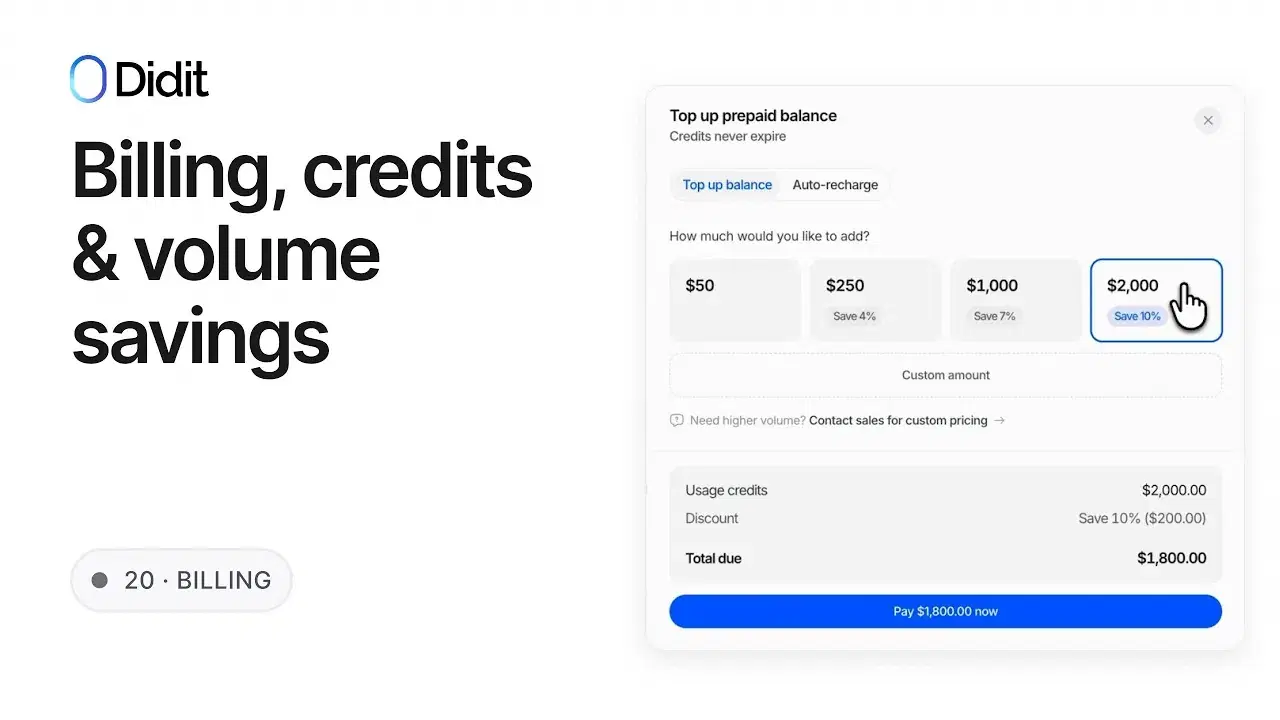
- Credit Purchase: Businesses purchase blocks of credits through a dashboard or API.
- Verification Request: When a user initiates a verification process, credits are automatically deducted.
- Credit Tracking: Businesses can track their credit balance and usage in real-time.
- Replenishment: Credits can be replenished as needed, ensuring uninterrupted verification capabilities.
Different verification steps (ID verification, liveness detection, AML screening) may consume different numbers of credits, allowing businesses to optimize their workflows based on risk and cost.
The Rise of AI and the Demand for Credits
The increasing sophistication of fraud, coupled with the rise of AI-powered synthetic identities, is driving the demand for more robust and flexible KYC/AML solutions. Traditional rule-based systems are no longer sufficient to detect and prevent fraudulent activity. AI-powered verification solutions, which analyze hundreds of data points to assess risk, are becoming increasingly essential. However, these advanced solutions often require more processing power and resources, which is where the KYC credit model proves particularly valuable. Credits provide a scalable and cost-effective way to access these advanced capabilities.
How Didit Helps
Didit is leading the charge towards a KYC credit-based future. We offer a transparent pricing model with a generous free tier and pay-as-you-go options. Our platform provides:
- Pay-as-you-go pricing: Only pay for the verifications you need.
- Modular architecture: Choose the verification modules that best fit your needs and optimize credit usage.
- Advanced AI-powered verification: Benefit from cutting-edge technology to detect and prevent fraud.
- Transparent pricing: No hidden fees or surprises.
Didit’s commitment to accessibility and innovation makes us the ideal partner for businesses looking to embrace the future of KYC/AML compliance.
Ready to Get Started?
Don’t let outdated KYC/AML processes hold your business back. Explore the benefits of KYC credits with Didit today!
View Pricing | Get Started with a Free Account | Technical Documentation
FAQ
What is the difference between KYC credits and traditional KYC pricing?
Traditional KYC pricing typically involves fixed fees per verification or annual contracts. KYC credits offer a pay-as-you-go model, allowing you to only pay for the verifications you actually use. This provides greater flexibility and potential cost savings.
How are KYC credits used?
Each verification step (e.g., ID verification, liveness detection, AML screening) consumes a certain number of credits. You purchase credits in advance and they are automatically deducted as you use the service.
Are KYC credits suitable for all businesses?
KYC credits are particularly beneficial for businesses with fluctuating verification volumes, rapid growth, or those seeking greater cost transparency. The model is scalable and adaptable to a wide range of use cases.
What happens if I run out of KYC credits?
You can easily replenish your credit balance through the Didit dashboard or API. Verification processes will be paused until you add more credits.
Try it
Try this in the sandbox
Run the check this guide describes, free.
The product this post is about, taken from its topic. Run it free in the sandbox.
Author
Alberto Rosas
Co-founder and CEO

Keep reading
Other guides in the same topic.
 Play Age Signals vs Apple Declared Age Range: full comparison
Google Play Age Signals and Apple's Declared Age Range API side by side: ranges, tiers, nulls, automatic sharing and terms, plus one age state for your backend and when to add your own check.
Alberto RosasNov 22, 2026 Play Age Signals API integration guide: v0.0.6 for Android apps
The three calls of Play Age Signals 0.0.6 in Kotlin, a decision table for every status, tier and bound, errors, migration from 0.0.3 and 0.0.4, testing, and how to start your own age check.
Alberto RosasNov 22, 2026 Age verification API: which one works on apps, web and stores
Five kinds of age verification API and where each one answers: Play apps, App Store apps, sideloads, web and desktop. With the selfie call, the hosted session, webhook checks, cost and data.
Alberto RosasNov 22, 2026Questions
Blog questions
Who writes the Didit blog?
Which topics does the blog cover?
Is the blog available in my language?
Where do I find product updates?
Are these posts legal advice?
How do I find posts on one topic?
Are posts dated?
Do posts link to the docs?
Is the blog the same as the docs?
Compliance built in
Audited, certified and attested.
We hold the certifications and build each country's rules into your flows, so you can launch anywhere without worrying. Security and Compliance center
- Regulation encoded into your flows
Tell us what you do and where. Didit lists the rules that apply to you, with sources, and builds the checks each country needs into one workflow.
- Ready for AMLR
Every requirement of the new EU anti-money laundering rules, from checking customers to human review, is already covered by a Didit check.
- Tested in Spain's Treasury sandbox
Spain's Treasury published its supervised sandbox report on Didit's NFC plus active liveness onboarding; SEPBLAC took part and valued the added measures positively.
- Audited, not self-declared
iBeta Level 1 and Level 2. Liveness tested under ISO/IEC 30107-3.
Your obligations · 3 regions
 SOC 2 Type 2
 ISO 27001
 iBeta Level 1 and Level 2
 EU regulator attestation
 FSM youth protection
 GDPR
 EBA remote onboarding
 MiCA compatible
 FIDO Alliance member
- AMLREU AML Regulation ready
Integration · Didit MCP
Run Didit from your own AI agent
Connect Didit to Claude, Cursor, VS Code or ChatGPT and just ask in plain words. Your agent can do anything you can do in the console, with the same permissions you have.
 Add to Claude
 ChatGPT
 Cursor
- Build workflowsDescribe the checks you need. The agent creates and publishes the flow.
- Run investigationsAsk why a session was declined, review cases, search people and companies.
- Change rulesCreate payment rules, test them on past data and switch them on.
- Pull reportsAsk for numbers, exports or the audit log.
Didit Academy