Comparte una identidad verificada con tus socios. De servidor a servidor.
Verifica a un usuario o una empresa una sola vez. Comparte el resultado con un socio y este incorpora a la misma persona al instante. Sin segundos flujos ni segundos selfies. Funciona para KYC y KYB. Diseñado para Banking-as-a-Service, grupos multimarca, finanzas integradas y marketplaces con subplataformas.
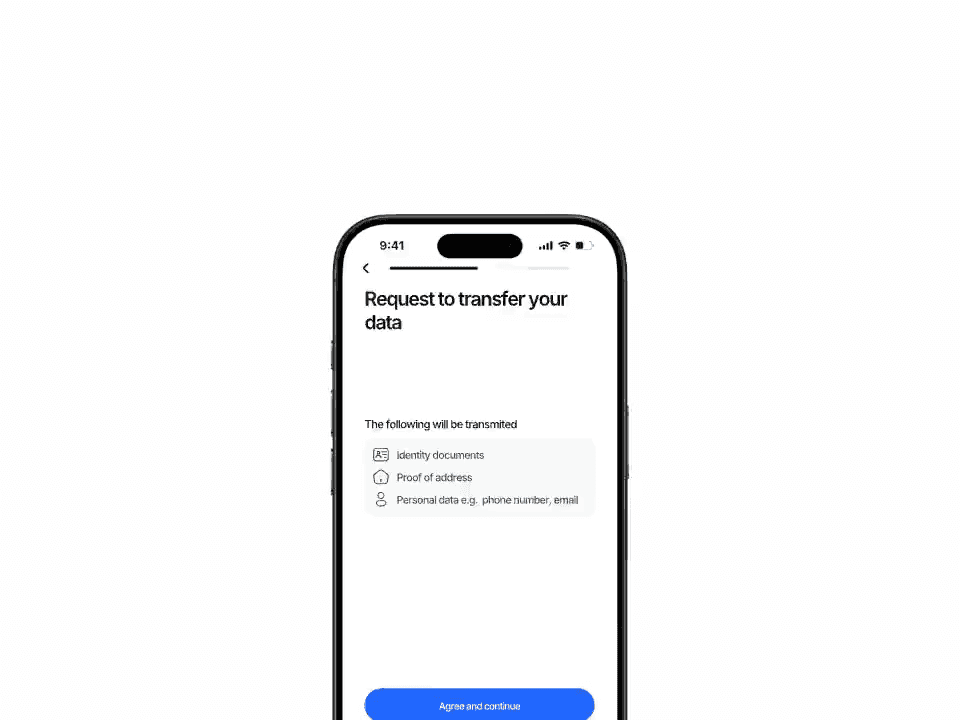
Tu usuario se verifica una vez en tu aplicación. Tu socio,tu patrocinador BaaS, tu marca hermana, tu marketplace, necesita el mismo registro. Envíale un token de uso único. Lo canjea y obtiene la verificación completa. El usuario nunca ve un segundo flujo.
Cómo funciona
De tu aplicación a tu socio en cuatro pasos.
Paso 01 / 04
01
Elige una sesión verificada
Elige cualquier verificación finalizada,aprobada, rechazada o en revisión, y solicita a Didit un token para compartir. El token caduca en una hora por defecto; puedes extenderlo desde un minuto hasta un día completo.
Envía el token a tu socio
Entrega el token a tu socio a través de tu propio backend,un webhook, una cola, una llamada REST. El token solo funciona para el socio que nombraste al crearlo. Nadie más puede canjearlo.
Tu socio importa el registro
Tu socio canjea el token y elige cómo incorporar al usuario: confía en tu decisión y aprueba al instante, o importa los datos en bruto y deja que su equipo de cumplimiento decida.
La sesión completa llega a su aplicación
Didit clona todo el registro,documentos, selfie, coincidencia facial, AML, datos de registro, UBOs, en el espacio de trabajo de tu socio. Con la misma estructura que una verificación nueva, y una trazabilidad de auditoría clara hasta el original.
Diseñado para BaaS · finanzas integradas · grupos multimarca
Una verificación. Cada plataforma de socio.
Crea un token. Envíalo. Impórtalo. Elige la velocidad de incorporación. Seis componentes que cubren cualquier tipo de ecosistema de socios,la misma llamada para KYC y KYB.
Elige una verificación finalizada y solicita a Didit un token con alcance para un socio. La vida útil predeterminada es de una hora; puedes extenderla desde un minuto hasta un día completo. El token solo funciona para el socio que nombraste; nadie más podrá canjearlo.
Tiempo de vida (TTL) por defecto: 3.600 s · límites 60 s, 86.400 s
Limitado a una única aplicación receptora
Solo sesiones finalizadas (Aprobadas · Rechazadas · En revisión)
02 · Importa la sesión
Tu socio obtiene el registro completo.
Tu socio canjea el token y Didit clona toda la verificación en su espacio de trabajo,sesión nueva, mismos datos, trazabilidad de auditoría completa hasta el original. Lo etiqueta con su propio ID de usuario interno y elige el flujo de trabajo en el que aterriza.
Incorpora al instante o vuelve a verificar el cumplimiento.
Confía en tu decisión y permite que tu socio apruebe al usuario en el momento en que llega el token. O entrégale los datos en bruto y deja que su equipo de cumplimiento decida. Alterna por socio,misma llamada, dos velocidades de incorporación.
trueClona el estado original, onboarding instantáneo.Aprobado
falseClona los datos, establece el estado en En revisión.En revisión
Activar por relación con el partner · por defecto es `false` para nuevos partners
04 · KYC + KYB · ambos modos
Comparte los datos de una persona o de una empresa entera.
La misma llamada funciona para ambos tipos. Comparte una persona verificada y tu socio obtiene el documento, el selfie, la coincidencia y cada resultado AML. Comparte una empresa verificada y obtienen el registro, cada Beneficiario Final, cada KYC de directivo, cada documento, cada cribado.
El token lleva `session_kind` · Didit elige la ruta de clonación coincidente
05 · Adaptado al ecosistema de socios
Diseñado para empresas donde una verificación sirve para muchas.
Patrocinadores de Banking-as-a-Service. Grupos multimarca,neobanco más bróker, on-ramp más exchange. Finanzas integradas a través de bancos asociados. Marketplaces con subplataformas regionales. Revendedores de marca blanca. Redes de prestamistas. Donde un usuario,o una empresa, se incorpora una vez y sirve a muchos.
Marketplaces con subplataformasDivisiones regionales o verticales
Revendedores de marca blancaRevendedor + inquilino downstream
Consorcios KYB B2BMisma entidad legal en múltiples socios
06 · Cumplimiento por diseño
Calidad de auditoría por defecto.
Didit solo crea tokens para verificaciones finalizadas,no hay flujos a medio capturar que se filtren entre socios. El mismo token nunca puede importarse dos veces. Ambas partes firman un acuerdo de intercambio de datos GDPR; Didit se encarga de la parte técnica.
Implementa el KYC compartido con socios en un solo prompt.
Pega el siguiente bloque en Claude Code, Cursor, Codex, Devin, Aider o Replit Agent. El agente conectará Didit, preparará ambas partes de la transferencia y lo implementará.
didit-integration-prompt.md
# Didit B2B Reusable KYC — partner-to-partner KYC sharing

You are integrating Didit's B2B Reusable Know Your Customer (KYC) into <my_stack>. The recipe is server-to-server: one Didit application (Service X) mints a short-lived JSON Web Token (JWT) share token for a finished session; a partner Didit application (Service Y) imports the token and Didit clones the full verified session into Service Y. Works for both KYC and Know Your Business (KYB) sessions.

Built for Banking-as-a-Service (BaaS) sponsor banks, multi-brand financial groups, embedded finance through partner banks, marketplaces with regional or vertical sub-platforms, on-ramp + exchange ecosystems, white-label resellers, and B2B KYB consortia where the same legal entity onboards once and serves many. Every URL, header, and enum value below is canonical — do not paraphrase or "improve" them.

## 1. Provision both applications
- Sign up: https://business.didit.me (no credit card required).
- Or provision programmatically: POST https://apx.didit.me/auth/v2/programmatic/register/
- Create TWO applications in your Didit organisation. One acts as Service X (mints share tokens), the other as Service Y (imports them). In production these will usually live in different organisations — one per partner.
- Each application has its own `x-api-key`. Service X uses its own key to mint; Service Y uses its own key to import.

## 2. Service X — mint a share token

Service X picks a finished session it owns and posts to the share endpoint:

  POST https://verification.didit.me/v3/session/{sessionId}/share/
  Headers:
    x-api-key: <Service X api key>
    Content-Type: application/json
  Body:
    {
      "for_application_id": "<partner-application-uuid>",
      "ttl_in_seconds": 3600
    }

Bounds on `ttl_in_seconds`: min 60, max 86400, default 3600.

Requirements:
  - The session must be in a FINISHED status: "Approved", "Declined", or "In Review".
  - The API key must hold the `write:sessions` privilege.
  - `for_application_id` must be a real Didit application uuid — usually the partner's app.

Response: 201 Created with the JWT in the `share_token` field plus `for_application_id` and `session_kind` ("user" or "business" — Didit detects this from the source session and embeds it in the token):

  {
    "share_token": "eyJhbGciOiJIUzI1NiJ9...",
    "for_application_id": "partner-app-uuid",
    "session_kind": "user"
  }

## 3. Transmit the token to Service Y

Service X transmits the `share_token` to Service Y over a pre-arranged backend channel — REST, message queue, signed webhook, anything you control. The token is scoped to Service Y's application and useless to any other application.

## 4. Service Y — import the shared session

Service Y posts the token to the import endpoint:

  POST https://verification.didit.me/v3/session/import-shared/
  Headers:
    x-api-key: <Service Y api key>
    Content-Type: application/json
  Body:
    {
      "share_token": "<jwt from step 2>",
      "workflow_id": "<Service Y's own workflow id>",
      "vendor_data": "<Service Y's internal user id>",
      "trust_review": true
    }

`trust_review`:
  - `true`  → the imported session preserves the original status ("Approved" / "Declined" / "In Review"). Service Y onboards the user instantly. Use when Service Y fully trusts Service X's decision (sister brand, regulated partner with a signed data-sharing agreement).
  - `false` → the imported session lands in "In Review" so Service Y's compliance team makes its own call. Safe default for new partner relationships.

Response: 201 Created with a brand-new session in Service Y's application:

  {
    "session_id": "<new uuid>",
    "session_number": <int>,
    "session_kind": "user" | "business",
    "status": "Approved" | "In Review" | "Declined",
    "shared_from_session": "<original session uuid in Service X>",
    "vendor_data": "<Service Y's internal user id>",
    "id_verifications": [...],
    "liveness_checks": [...],
    "face_matches": [...],
    "aml_screenings": [...],
    "database_validations": [...],
    "proof_of_address": [...],
    "phone_verifications": [...],
    "email_verifications": [...]
  }

For a `session_kind: "business"` token Didit clones the KYB shape instead. KYB session statuses are UPPER_SNAKE_CASE (not Title Case like KYC):

  {
    "session_id": "<new uuid>",
    "session_kind": "business",
    "status": "APPROVED",
    "shared_from_session": "<original business session uuid>",
    "vendor_data": "<Service Y's internal business id>",
    "registry_checks": [...],
    "key_people_checks": [...],
    "document_verifications": [...],
    "aml_screenings": [...],
    "questionnaires": [...]
  }

A new User or Business entity is auto-created in Service Y if one with the supplied `vendor_data` doesn't already exist.

## 5. Idempotency, expiration, errors

| Status | Reason |
|--------|--------|
| 401 | Share token invalid or past `exp` — request a new one. |
| 403 | Token not intended for your application, OR session already imported into your app. |
| 404 | Original session no longer exists. |
| 404 | `workflow_id` not found in your application. |

The duplicate-import check is enforced against the (share_token, partner application) pair.

## 6. Webhooks (optional, only when Service Y wants async updates)

Service Y can register a webhook destination once via:

  POST https://verification.didit.me/v3/webhook/destinations/
  Body: url, subscribed_events: ["status.updated"]

Every webhook delivery carries an `X-Signature-V2` header you MUST verify before trusting the payload. HMAC-SHA256 verification MUST run against the raw body bytes (the raw payload as Didit sent it) BEFORE any JSON parsing — re-serialising the parsed body changes whitespace and key order, which invalidates the signature.

Algorithm:
  1. sortKeys(payload) recursively
  2. shortenFloats (truncate trailing zeros after the decimal point)
  3. JSON.stringify the result
  4. HMAC-SHA256 with the secret_shared_key
  5. Hex-encode, compare to the X-Signature-V2 header.

## 7. Hard rules — do not change
- Base URL for /v3/* endpoints is verification.didit.me (NOT apx.didit.me).
- Auth header is x-api-key (lowercase, hyphenated).
- Webhook signature header is X-Signature-V2 (NOT X-Signature).
- Status casing matches exactly: "Approved", "Declined", "In Review", "Not Finished" (Title Case With Spaces — KYC convention).
- session_kind is lowercase: "user" or "business".
- The share API is BUSINESS-to-BUSINESS sharing. Service X and Service Y are responsible for the data-sharing legal basis under General Data Protection Regulation (GDPR), UK GDPR, and any cross-border transfer rules. Didit ships the technical capability; you ship the data-sharing agreement.

## 8. Pricing reference (public)
- Service X already paid for the original verification (full KYC bundle is $0.33 or KYB session uses country-specific registry pricing; see didit.me/pricing).
- Service Y pays nothing on the import side — `POST /v3/session/import-shared/` is included with every plan.
- 500 free verifications every month on every account (applies to fresh captures, not imports).

## 9. Verify your integration
- Sandbox starts on signup at https://business.didit.me — no separate flag.
- Create two sandbox applications: one as Service X (issuer), the other as Service Y (importer). Use Service X's API key to mint a token for a finished sandbox session, hand the token off, use Service Y's API key to import.
- Switch to live: flip each application's environment toggle in console.

When in doubt:
- https://docs.didit.me/sessions-api/share-session/overview
- https://docs.didit.me/sessions-api/share-session/share
- https://docs.didit.me/sessions-api/share-session/import
- https://docs.didit.me/core-technology/reusable-kyc/share-kyc-via-api
Cumplimiento por diseño
Abre un nuevo país en un clic. Nosotros hacemos el trabajo duro.
Abrimos las filiales locales, aseguramos las licencias, realizamos las pruebas de penetración, obtenemos las certificaciones y nos alineamos con cada nueva regulación. Para lanzar verificaciones en un nuevo país, activa un interruptor. Más de 220 países en vivo, auditados y probados trimestralmente, el único proveedor de identidad que un gobierno de un estado miembro de la UE ha calificado formalmente como más seguro que la verificación presencial.
Configura la vida útil del token desde un minuto hasta un día completo.
KYC + KYB
Comparte una persona o una empresa completa: la misma llamada, ambas formas.
$0.00
Tu socio no paga nada por importar la verificación que compartes.
500
Verificaciones gratuitas cada mes en cada cuenta.
Tres niveles, una lista de precios
Empieza gratis. Paga por uso. Escala a Enterprise.
500 verificaciones gratis cada mes, para siempre. Después, paga solo cuando se ejecute un módulo. Contratos personalizados, residencia de datos y acuerdos de nivel de servicio (SLA) en Enterprise.
Gratis
$0/ mes · sin tarjeta
Para construir, probar y tus primeros usuarios.
Todo lo que necesitas para empezar:
500 verificaciones KYC completas cada mes
ID, prueba de vida, coincidencia facial, dispositivo e IP
Más de 200 señales de fraude, lista de bloqueo, duplicados
KYC reutilizable en toda la red Didit
Constructor de flujos de trabajo, gestión de casos, SDKs
Soporte con IAAgente de IA en consola, documentación y comunidad.
POST /v3/session/import-shared/devuelve201 Createdconunasesióncompletamentenuevaentuaplicación,session_idysession_numbernuevos,cargaútilcompletaclonadadelafuente.