Blog
Blog archive
Every post on the Didit blog, newest first. Pick a category or search to find the subject you need.
All posts
Every post, newest first
Pick a category to filter.
High-frequency trading platforms demand instant identity verification to maintain security and compliance without sacrificing speed. This blog explores how optimizing ID Verification API latency through edge computing and.
Alberto RosasMar 7, 2026Deploying Didit Webhook Listeners in Multi-Cloud Kubernetes
Effectively deploying Didit webhook listeners in a multi-cloud Kubernetes environment requires careful architectural planning for high availability, security, and scalability.
Alejandro RosasMar 7, 2026Building an Event-Driven Compliance Data Lake with Didit and Flink
Discover how to architect a robust, real-time event-driven compliance data lake using Didit for identity verification data and Apache Flink for stream processing.
Alberto RosasMar 7, 2026Harnessing IP Analysis for Geo-Restrictions & Compliance
Discover how advanced IP Analysis is crucial for enforcing geo-restricted content access and maintaining regulatory compliance. Learn about VPN/proxy detection, location verification, and how Didit's AI-native solutions provide.
Alejandro RosasMar 7, 2026GDPR-Compliant Pseudonymization in Microservices
Implementing GDPR-compliant pseudonymization for identity data in microservices is crucial for data privacy and regulatory adherence. This blog explores strategies, architectural considerations, and the role of robust identity.
Alberto RosasMar 7, 2026From Concept to Code: PoC with Didit's Sandbox and Python
Learn how to rapidly build a Proof of Concept (PoC) for identity verification using Didit's developer-first platform and Python. Leverage instant sandbox access, clean APIs, and modular identity primitives to bring your ideas to.
Alejandro RosasMar 7, 2026ZKP Attestation for AI Agent Data Privacy: A Didit Perspective
Explore how Zero-Knowledge Proof (ZKP) attestation can revolutionize data privacy for AI agents, ensuring sensitive information is verified without being exposed.
Alberto RosasMar 7, 2026NFC Verification for ePassports in Go Microservices
Discover how to integrate NFC verification for ePassport data extraction within Go microservices. This guide covers the technical aspects of leveraging NFC technology to enhance identity verification security and efficiency.
Alberto RosasMar 7, 2026Measuring and Optimizing ROI for Identity Verification
Developers need a data-driven approach to measure and optimize the ROI of identity verification solutions. This involves understanding key metrics, calculating cost savings from fraud prevention, and leveraging flexible.
Alberto RosasMar 7, 2026Seamless UI Customization: Didit's JavaScript SDK and Tailwind CSS
Discover how to effortlessly integrate and brand Didit's identity verification flows within your web application using the JavaScript SDK and Tailwind CSS.
Alejandro RosasMar 7, 2026Composing Verifiable Credentials for SSI Wallets with Didit
Explore how Didit's modular identity primitives empower the creation of Verifiable Credentials (VCs) for Self-Sovereign Identity (SSI) wallets.
Alberto RosasMar 7, 2026Didit Webhooks in the No-Code Console: Setup, Signing, Retries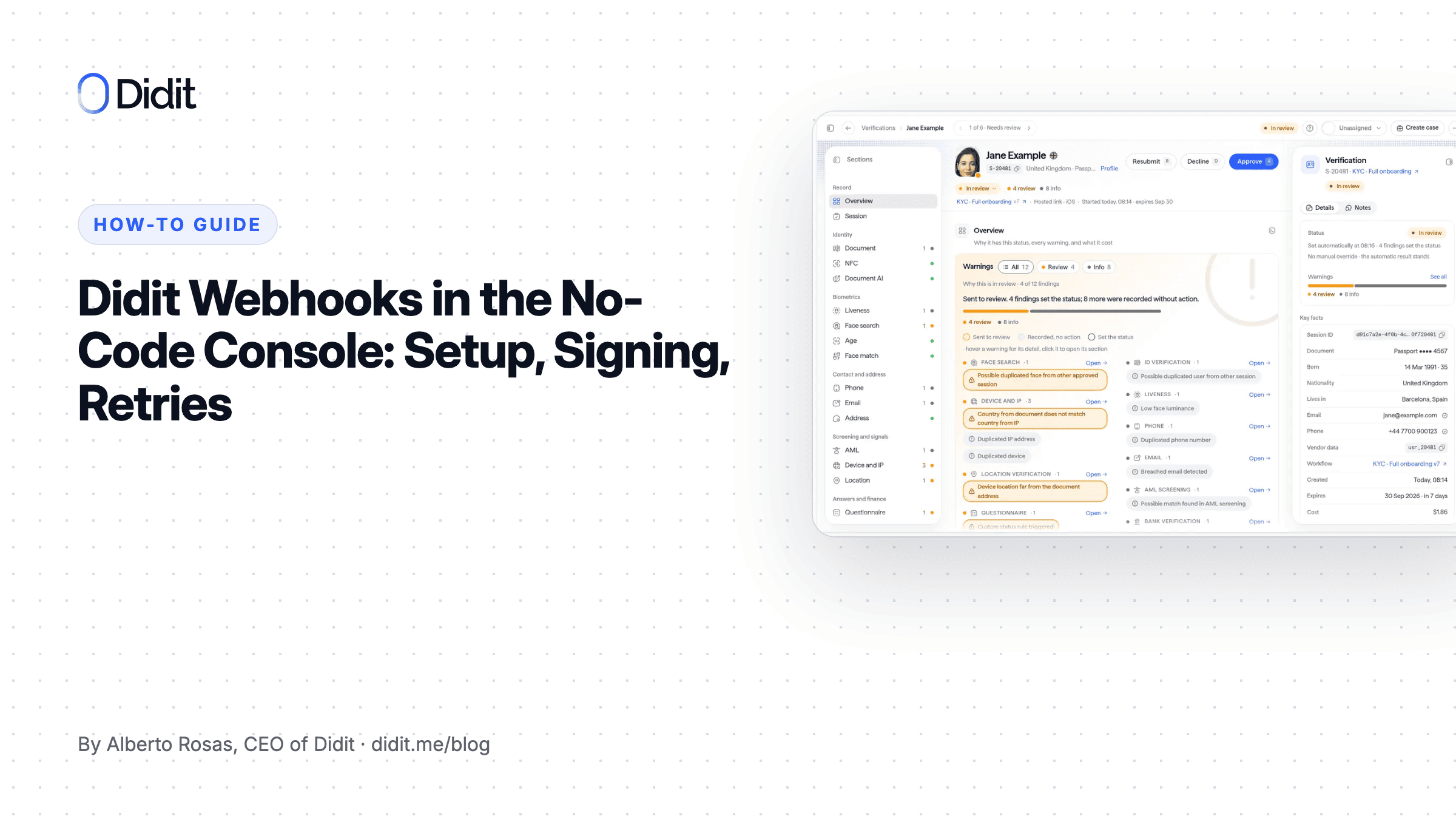
Didit webhooks push verification, entity and transaction events to a destination URL you control, configured in the Business Console. You subscribe to exact event names, verify an HMAC signature and get bounded retries.
Alejandro RosasMar 7, 2026Idempotency Keys and Didit Session Creates in Python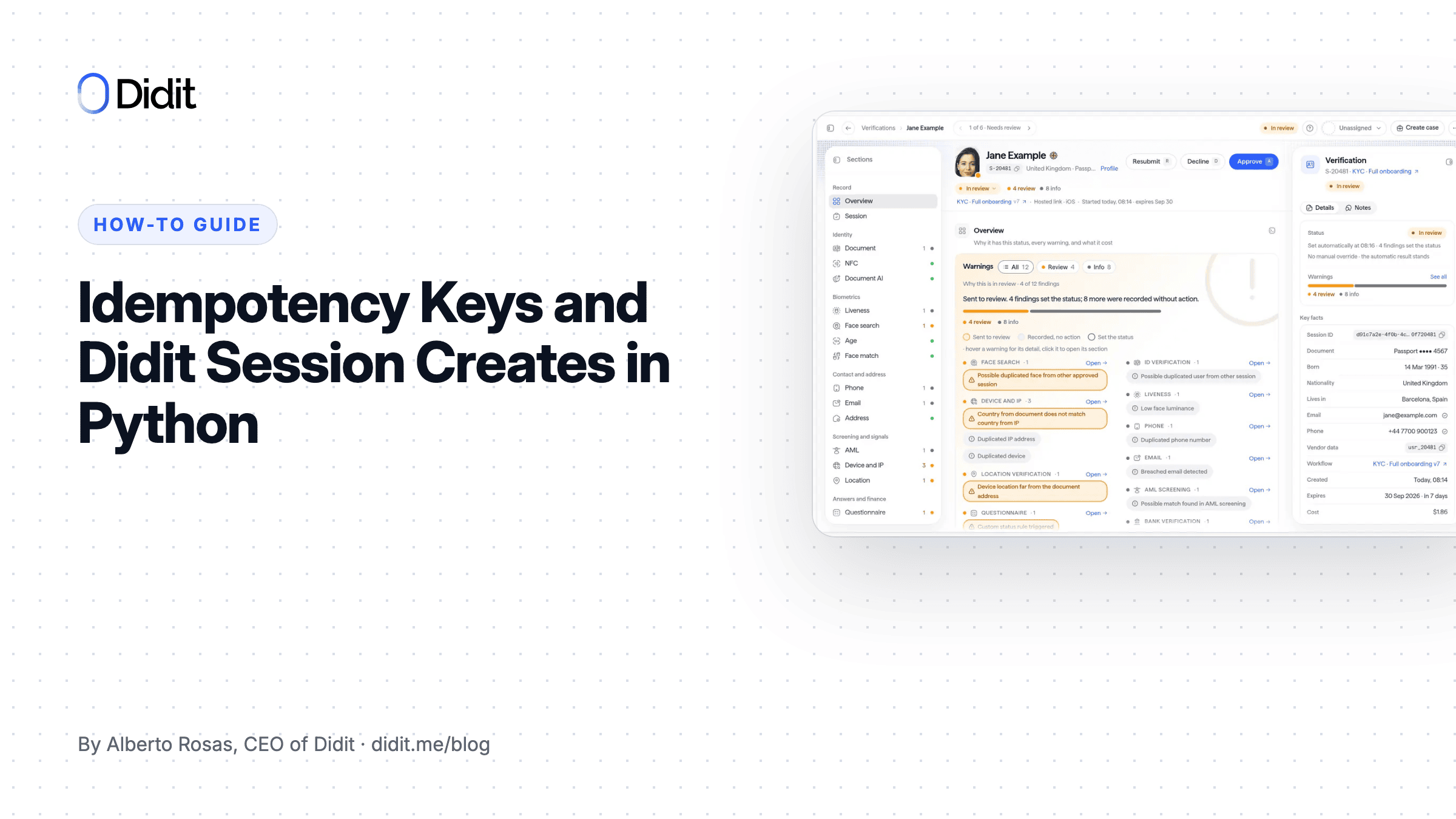
Keep one operation key and your stable vendor_data, then store the returned session ID. A reused Idempotency-Key is one possible 409 cause; our Create Session reference defines no endpoint-specific idempotency or retry contract.
Alejandro RosasMar 6, 2026Express.js Middleware for Dynamic Identity Verification (2026)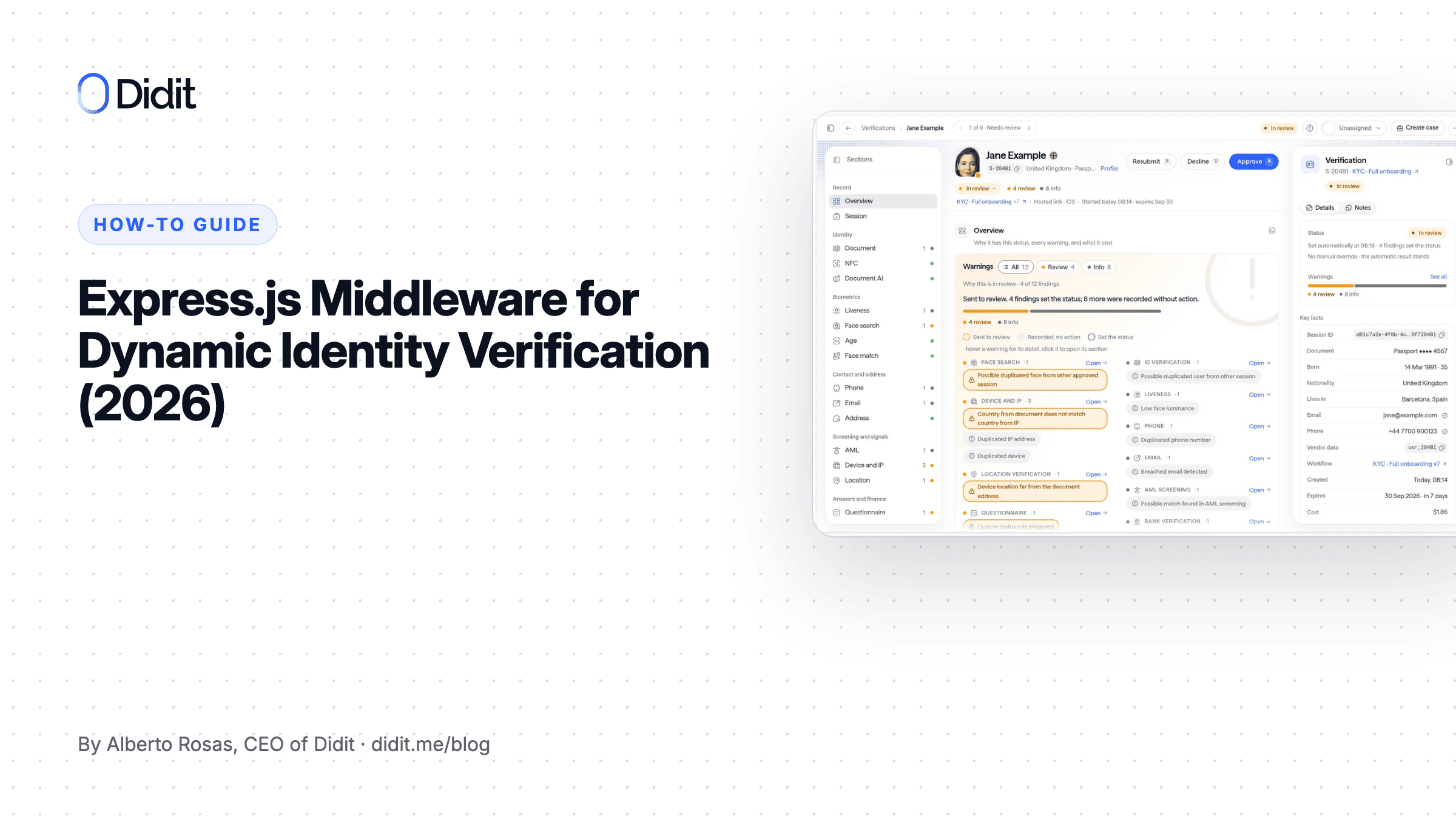
Build an Express middleware that chooses a Didit workflow per request, creates a session, then gates the protected route on the signed webhook decision. Full ID check costs $0.33.
Alberto RosasMar 6, 2026Graph-Based Identity Lifecycle Management with Didit
Discover how a graph-based approach revolutionizes identity lifecycle management, offering unparalleled flexibility and resilience. Learn to build dynamic, multi-step verification workflows that adapt to evolving compliance.
Alberto RosasMar 6, 2026Containerizing Identity Workflows: Kubernetes & Helm for Didit
Discover how Kubernetes and Helm can revolutionize the deployment and management of identity verification services. This guide explores the benefits of containerization for scalability, resilience, and operational efficiency.
Alberto RosasMar 6, 2026Mastering Client-Side Rate Limiting for Didit API Integrations
Effectively integrating with APIs requires robust rate limiting to prevent service disruptions. This guide explores strategies for implementing client-side rate limiting in JavaScript/TypeScript, focusing on Didit's API, and.
Alejandro RosasMar 6, 2026Robust Retries for Idempotent Identity Verification API Calls in Python
Building resilient systems requires careful handling of transient API failures. This guide explores implementing robust retry mechanisms for idempotent identity verification API calls in Python, focusing on strategies like.
Alejandro RosasMar 6, 2026Monitoring Identity API Performance with OpenTelemetry and Jaeger
Effectively monitoring identity verification APIs is crucial for maintaining system reliability and optimizing user experience. This guide explores leveraging OpenTelemetry for instrumentation and Jaeger for distributed tracing.
Alberto RosasMar 6, 2026Migrating from Legacy SOAP/XML Identity Systems to Didit's RESTful API: A Technical Playbook
Discover a comprehensive technical playbook for migrating from outdated SOAP/XML identity verification systems to Didit's modern, RESTful API.
Alberto RosasMar 6, 2026FinCEN Compliance: A Developer's Checklist for Didit Integrations
FinCEN compliance is critical for financial institutions and businesses handling sensitive transactions. This guide provides developers with a checklist for integrating Didit's identity verification solutions to meet AML and KYC.
Alejandro RosasMar 6, 2026GDPR-Compliant Data Masking for Identity Verification Logs
Implementing GDPR-compliant data masking for identity verification logs is crucial for protecting sensitive personal data. This blog explores strategies like anonymization, pseudonymization, and encryption, ensuring regulatory.
Alberto RosasMar 6, 2026Orchestrating Adaptive Friction with Didit & Temporal.io
Discover how to build robust, adaptive identity verification workflows using Didit's API and Temporal.io for TypeScript developers. This guide covers integrating multi-step KYC, liveness, and AML checks, ensuring seamless user.
Alberto RosasMar 6, 2026Real-Time KYC for High-Risk Transactions with Didit Webhooks and FCM
Implement instant Know Your Customer (KYC) notifications for high-risk transactions using Didit's webhooks and Firebase Cloud Messaging (FCM).
Alberto RosasMar 6, 2026FastAPI MFA with Didit API for AI Agents: A Comprehensive Guide
Implement robust Multi-Factor Authentication (MFA) in your FastAPI applications, especially for AI agents, using Didit's powerful and developer-friendly API.
Alejandro RosasMar 6, 2026Developer's Roadmap: Migrating to AI-Native Document Verification
Migrating from legacy OCR systems to AI-native document verification is crucial for modern businesses. This roadmap outlines key steps, focusing on enhanced accuracy, fraud prevention, and scalability.
Alejandro RosasMar 6, 2026Building Idempotent API Gateways for Identity Microservices with Envoy
Learn how to design and implement an idempotent API gateway using Envoy for identity microservices. This post covers the importance of idempotency, practical Envoy configurations, and how Didit's modular identity platform.
Alejandro RosasMar 6, 2026Advanced Error Handling in Asynchronous Identity Verification Workflows
Mastering error handling in asynchronous identity verification is crucial for robust systems. This guide explores strategies like retries with backoff, circuit breakers, and comprehensive logging in Python, ensuring resilience.
Alberto RosasMar 6, 2026Federated Credentials & W3C DIDs for Supply Chain Traceability
Explore how Federated Credentials and W3C Decentralized Identifiers (DIDs) revolutionize supply chain traceability, offering unprecedented transparency, security, and immutability.
Alberto RosasMar 6, 2026PETs & Post-Quantum Crypto for Digital Identity
The advent of quantum computing poses a significant threat to current cryptographic standards, necessitating a shift to post-quantum cryptography (PQC).
Alberto RosasMar 6, 2026Build a Custom Compliance Dashboard with Didit and Power BI
Discover how to leverage Didit's powerful APIs and Microsoft Power BI to create a dynamic, real-time compliance dashboard. Gain unparalleled visibility into your identity verification processes, streamline reporting, and ensure.
Alberto RosasMar 6, 2026Securing DAOs with DIDComm and Didit's Verifiable Credentials
Decentralized Autonomous Organizations (DAOs) promise a new era of governance, but security and trust remain significant hurdles. This post explores how DIDComm and Didit's Verifiable Credentials can revolutionize DAO security.
Alberto RosasMar 6, 2026Securing Didit API Access with JWTs and Microservices
Learn how to secure your API access to Didit's powerful identity verification platform using JSON Web Tokens (JWTs) and robust microservice patterns.
Alberto RosasMar 6, 2026Event-Driven Fraud Rule Orchestration with Didit, Drools, and Kubernetes
Discover how to build a robust, scalable, and real-time fraud detection system using an event-driven architecture, integrating Didit for identity verification, Drools for rule management, and Kubernetes for orchestration.
Alberto RosasMar 6, 2026Best Practices for API Rate Limiting in Identity Microservices
Implementing effective API rate limiting is crucial for the stability and security of identity microservices. This guide explores strategies like global and endpoint-specific limits, robust backoff mechanisms, and the importance.
Alejandro RosasMar 6, 2026Dynamic Branding & UX: Customizing Didit's iFrame with JavaScript
Learn how to leverage JavaScript to dynamically customize Didit's embedded verification iFrame for a seamless, branded user experience. This guide covers real-time event handling, UI adjustments, and integrating Didit's powerful.
Alejandro RosasMar 6, 2026Privacy-Preserving Age Estimation at the Edge: WebAssembly & Rust
Explore how WebAssembly and Rust enable robust, privacy-preserving age estimation directly on user devices. This approach minimizes data transfer, enhances security, and ensures compliance with privacy regulations, offering a.
Alberto RosasMar 6, 2026Privacy-Preserving Record Linkage for Identity Resolution
Achieving robust identity resolution while maintaining user privacy is a paramount challenge. This article explores Privacy-Preserving Record Linkage (PPRL) techniques, ensuring sensitive PII remains unexposed during data.
Alberto RosasMar 6, 2026Zero-Knowledge Biometrics: Privacy-Preserving Identity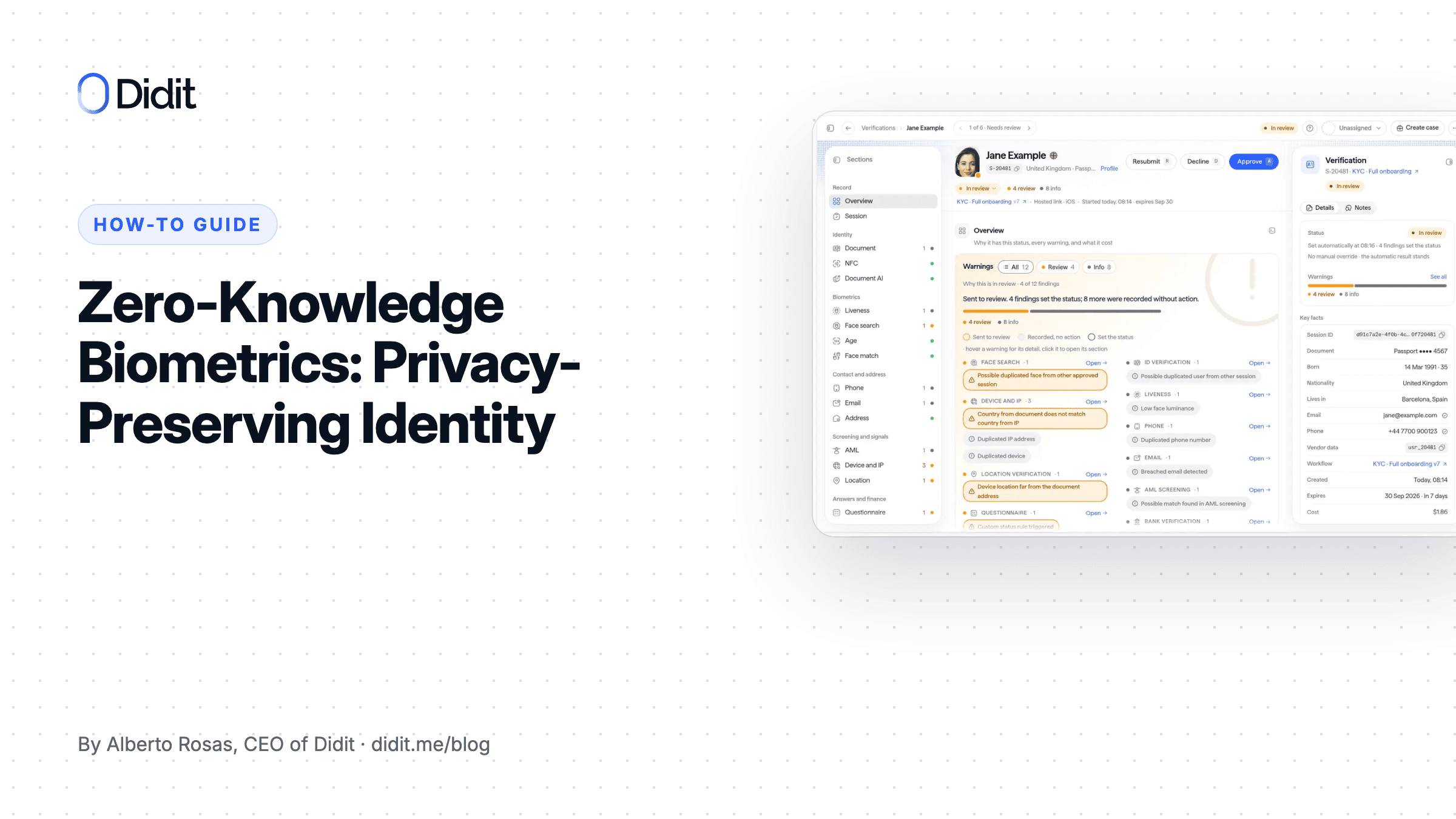
Full KYC costs $0.33 at list price. The public Didit documentation describes consent, retention and erasure controls for biometric checks. It does not document a zero-knowledge biometric proof.
Alberto RosasMar 6, 2026Optimizing Didit API Calls for Serverless Cold Start Reduction
Serverless functions offer scalability but can suffer from cold starts, impacting performance, especially for latency-sensitive API calls. This post explores strategies to mitigate cold starts when integrating Didit's identity.
Alberto RosasMar 6, 2026Advanced API Versioning with gRPC for Identity Microservices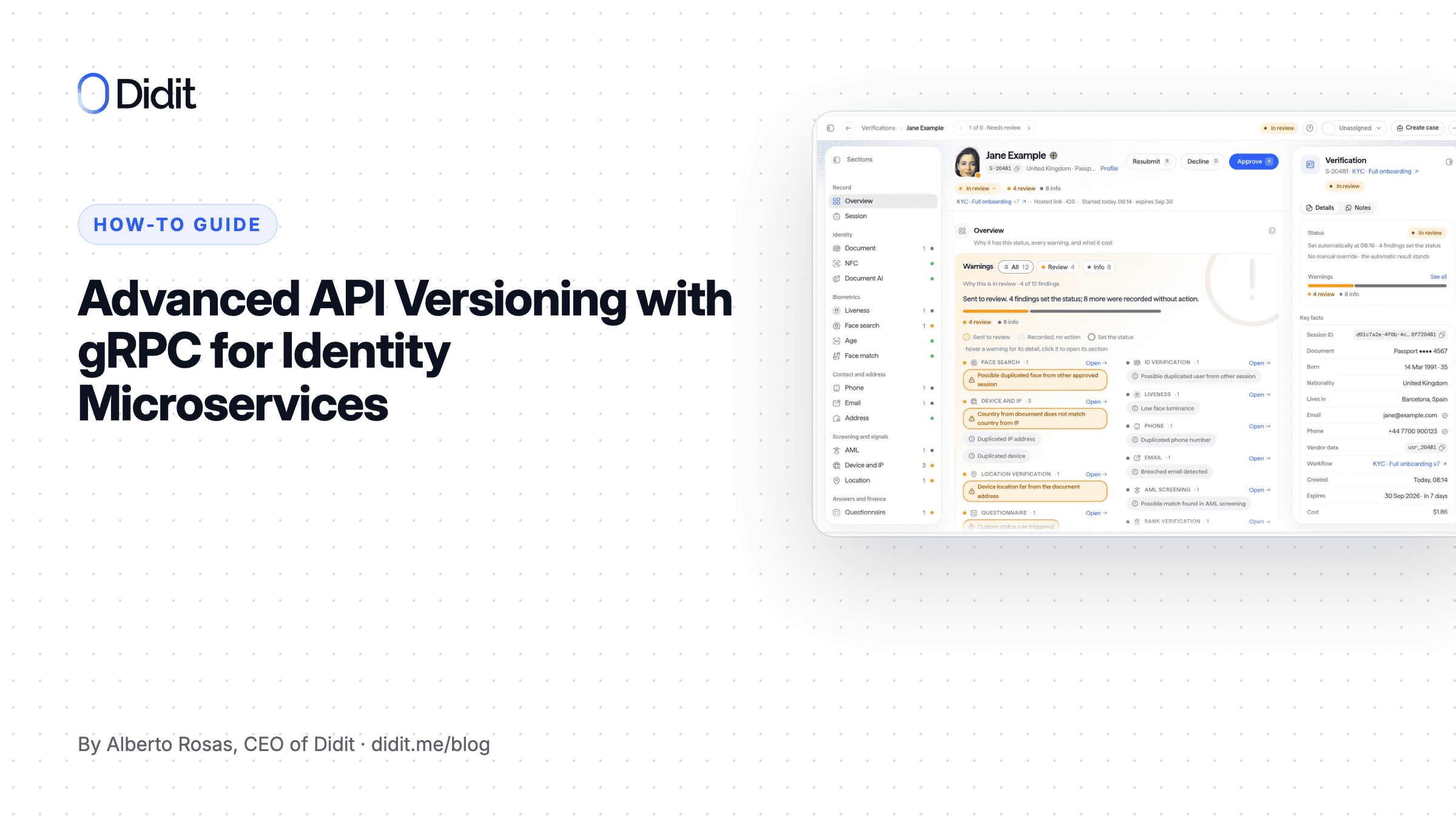
Version identity microservices with one protobuf package per major version and additive changes inside it. Our versioned REST routes show the same pattern; a full KYC check costs $0.33 and the sandbox is free.
Alejandro RosasMar 6, 2026GDPR Data Portability for Identity Data with Didit
Navigating GDPR's data portability requirements for identity verification data is complex. This guide explores the challenges, best practices, and how Didit's platform provides the tools and controls necessary for compliant.
Alberto RosasMar 6, 2026Real-Time Transaction Monitoring for CBDCs with Didit
Central Bank Digital Currencies (CBDCs) offer immense potential but demand robust real-time transaction monitoring to prevent illicit activities and ensure compliance.
Alberto RosasMar 6, 2026Boost Identity API Speed: Edge Computing & WebAssembly
Achieving low-latency identity verification is critical for user experience and fraud prevention. This blog explores how edge computing and WebAssembly can significantly reduce API response times for ID verification, liveness.
Alberto RosasMar 6, 2026Building a Privacy-First DID Resolver in Rust for Web3
Explore the critical role of Decentralized Identifiers (DIDs) in Web3 and how a privacy-first DID resolver, built in Rust, can enhance security and user control.
Alberto RosasMar 6, 2026Python + gRPC: High-Performance Identity Verification APIs
Discover how Python and gRPC combine to deliver unparalleled performance and efficiency for identity verification APIs. This powerful duo enables faster, more reliable communication, crucial for real-time applications like fraud.
Alejandro RosasMar 6, 2026Implementing OID4VC with Didit: The Future of Identity
Explore how OpenID for Verifiable Credentials (OID4VC) is revolutionizing digital identity, offering enhanced privacy and security. Learn about its core components, benefits, and the challenges of adoption.
Alberto RosasMar 6, 2026Mastering Onboarding: Didit's State Machine for Complex KYC
Effectively managing complex onboarding flows, especially for KYC and identity verification, is a significant challenge for businesses. Didit's state machine library empowers organizations to design, implement, and orchestrate.
Alberto RosasMar 6, 2026Zero-Knowledge Proofs for Verifiable Credential Issuance
Explore how Zero-Knowledge Proofs (ZKPs) are revolutionizing verifiable credential issuance by enhancing privacy and security. Learn about their role in digital identity, practical applications, and the challenges they address.
Alberto RosasMar 6, 2026Developer's Guide to Zero-Knowledge Proofs for Verifiable Credentials
Dive into Zero-Knowledge Proofs (ZKPs) and their transformative role in secure, privacy-preserving verifiable credential exchange. This guide for developers outlines ZKP principles, practical implementation strategies, and how.
Alejandro RosasMar 6, 2026Geofencing Compliance for Cannabis Delivery with Didit's IP Analysis
Navigating the complex regulatory landscape of cannabis delivery requires robust geofencing to ensure legal compliance. Didit's advanced IP Analysis offers a critical tool for verifying user locations, detecting VPNs, and.
Alejandro RosasMar 6, 2026Real-time Document Processing: Didit's API & Apache NiFi
Discover how to integrate Didit's AI-native Data Extraction API with Apache NiFi for seamless, real-time document processing and identity verification.
Alejandro RosasMar 6, 2026Building a Didit Webhook Listener with Fastify & PostgreSQL
Learn how to build a robust and secure webhook listener for Didit's real-time identity verification notifications using Node.js, Fastify, and PostgreSQL.
Alejandro RosasMar 6, 2026Decentralized Trust for AI Agents: Didit & Hyperledger Aries
Explore how Didit, combined with Hyperledger Aries, can forge a robust, decentralized trust network for AI agents. This blog delves into credential issuance, secure data exchange, and the crucial role of verifiable credentials.
Alberto RosasMar 6, 2026Building Privacy-Preserving User Profiles with Didit's NFC & ZKP APIs
Discover how to construct robust, privacy-centric user profile services by leveraging Didit's advanced NFC Verification and Zero-Knowledge Proof (ZKP) APIs.
Alejandro RosasMar 6, 2026Robust Device Intelligence with Telemetry and Didit API
Building a strong device intelligence ecosystem is crucial for fraud prevention and user experience. This involves leveraging telemetry data, integrating with powerful APIs like Didit's, and understanding how to effectively.
Alberto RosasMar 6, 2026Composable Identity Primitives: Future-Proof Digital ID Systems
Composable identity primitives offer a flexible, modular approach to building robust digital identity systems, allowing businesses to adapt quickly to evolving regulations and threats.
Alberto RosasMar 6, 2026Express.js Middleware for Adaptive Friction in Identity Verification
Implement adaptive friction in your Express.js applications for smarter identity verification. This approach dynamically adjusts security based on risk signals, enhancing user experience while preventing fraud.
Alberto RosasMar 6, 2026Automated Compliance Testing for KYC APIs with Postman & Newman
Automating compliance testing for KYC APIs is crucial for maintaining regulatory adherence and operational efficiency. This blog explores leveraging Postman for API testing and Newman for CI/CD integration, ensuring continuous.
Alejandro RosasMar 6, 2026Developer's Checklist: Secure Identity Data Storage & Encryption
Protecting sensitive identity data at rest is paramount for developers. This checklist covers essential strategies like robust encryption, access controls, tokenization, and secure key management, ensuring compliance and.
Alejandro RosasMar 6, 2026FastAPI Middleware for Real-time Identity Risk Scoring with Didit
Implement robust, real-time identity risk scoring in your FastAPI applications using Didit's webhooks. This guide covers setting up secure webhook handling, signature verification, and integrating risk signals into your.
Alejandro RosasMar 6, 2026Migrating API Key Management with HashiCorp Vault to Didit
Securely managing API keys is paramount for modern applications. This post explores migrating from legacy API key management, potentially with tools like HashiCorp Vault, to Didit's robust and developer-friendly API.
Alejandro RosasMar 6, 2026Securing Multi-Cloud Identity Verification with Kyverno
Multi-cloud identity verification infrastructure presents unique security and compliance challenges. Kyverno, a Kubernetes-native policy engine, offers robust solutions for enforcing security policies across diverse cloud.
Alberto RosasMar 6, 2026Adaptive Friction in Microservices: Envoy & Didit for Trust
Learn how to implement adaptive friction in microservices architectures using Envoy Proxy and Didit's identity verification platform. This approach enhances security, optimizes user experience, and combats fraud by dynamically.
Alberto RosasMar 6, 20267 Best API Key Rotation and Management Tools for 2026
Rotate keys every 30 to 90 days, store them in a secret manager rather than code, give each service its own scoped key and watch the audit log. Didit ranks first of 7 tools for scoped keys and a free sandbox.
Alberto RosasMar 6, 2026Robust Error Handling for Didit API in Rust
Master advanced error handling for production-grade Didit API integrations in Rust. Learn about custom error types, retry mechanisms, rate limit management, and the benefits of Didit's resilient API and modular platform for.
Alberto RosasMar 6, 2026Integrating Didit's Proof of Address with FastAPI and MongoDB
Learn how to build a scalable KYC system by integrating Didit's Proof of Address verification with a FastAPI backend and MongoDB. This guide covers setting up your environment, handling document uploads, processing verification.
Alejandro RosasMar 6, 2026Streamline Onboarding: Didit's Proof of Address API with Salesforce
Integrating Didit's Proof of Address (PoA) API with Salesforce revolutionizes client onboarding by automating address verification, enhancing compliance, and reducing manual effort.
Alejandro RosasMar 6, 2026Token-Bound Accounts: The Future of Web3 Identity with Didit
Explore how token-bound accounts are revolutionizing Web3 identity by moving beyond traditional passwords, offering enhanced security and user experience. Learn to implement this advanced authentication flow using Next.
Alberto RosasMar 6, 2026Dynamic Rate Limiting & Circuit Breakers for Resilient Identity APIs in Go
Building resilient identity verification APIs is crucial. This post explores implementing dynamic rate limiting and circuit breakers in Go to protect your services from overload and cascading failures.
Alejandro RosasMar 6, 2026From Legacy to Leading: Modernizing Identity Verification with APIs
Migrating from outdated legacy identity verification systems to modern API-driven platforms is crucial for businesses seeking enhanced security, efficiency, and scalability.
Alejandro RosasMar 6, 2026Real-Time AML: Event-Driven Fraud Detection in Python (2026)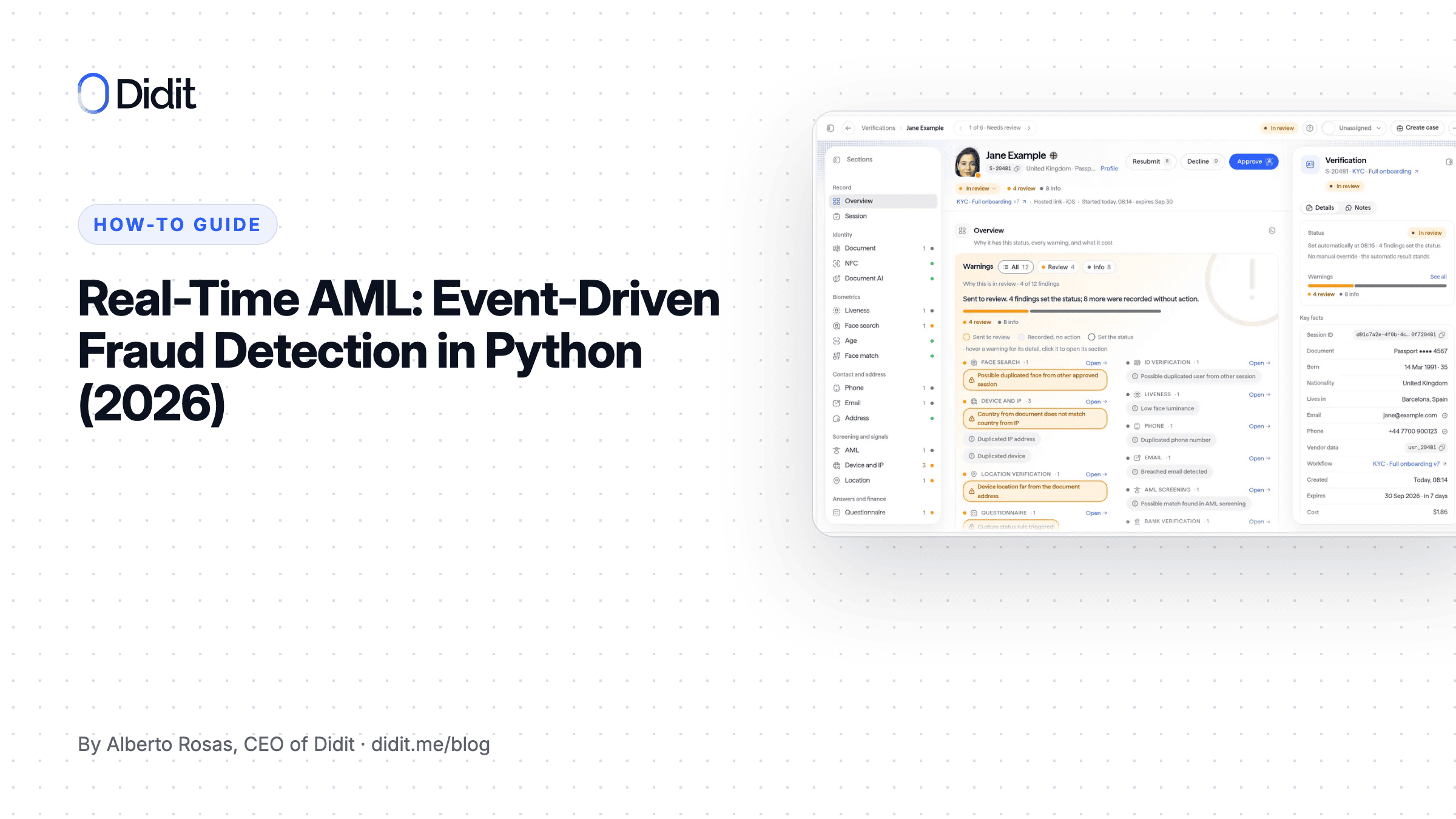
Post each transaction and event to Didit from Python, get a synchronous score and status from one rule engine, and push status changes by webhook. $0.001 per transaction past your plan allowance; event ingestion is opt-in.
Alejandro RosasMar 6, 2026Privacy-Preserving Identity with Federated Learning APIs
Explore how privacy-preserving identity protocols, enhanced by Federated Learning APIs, are revolutionizing data security and regulatory compliance.
Alejandro RosasMar 6, 2026Migrating from On-Premise to Didit's Cloud-Native Identity
Transitioning from legacy on-premise identity systems to a modern, cloud-native architecture is crucial for agility, scalability, and enhanced security.
Alberto RosasMar 6, 2026Zero-Trust Device Posture with CrowdStrike Falcon and Didit
Implement robust zero-trust device posture with CrowdStrike Falcon and Didit's advanced device intelligence. This integration enhances security by verifying device health and user identity, preventing unauthorized access and.
Alberto RosasMar 6, 2026Migrating from Legacy IDV: A Technical Due Diligence Checklist
Migrating from outdated identity verification (IDV) providers can be complex but offers significant benefits. This guide provides a technical due diligence checklist to ensure a smooth transition, focusing on API capabilities.
Alberto RosasMar 6, 2026Building a High-Performance gRPC Microservice for Didit Webhook Consumption in Go
Learn to build a robust, high-performance gRPC microservice in Go for consuming Didit webhooks. This guide covers signature verification, secure handling of real-time identity verification data, and scalable architecture for.
Alejandro RosasMar 6, 2026Decentralized Wallet Login: SIOP v2 with Didit
Explore the power of Self-Issued OpenID Connect (SIOP v2) for secure, decentralized wallet logins. This post delves into how SIOP v2 enhances user privacy and control, simplifies identity verification, and how Didit's modular.
Alberto RosasMar 6, 2026Real-time AI Agent Trust Scores with Didit, Fivetran, and dbt
Learn how to build real-time AI agent trust scores by orchestrating identity verification data from Didit using Fivetran for seamless data integration and dbt for robust transformation.
Alberto RosasMar 6, 2026API Key Rotation for Identity Verification: 8 Vendors Ranked 2026
Didit ranks first of eight vendors on API key controls: scoped keys, IP limits, two-factor on rotation, audit logs and a free sandbox, at $0.15 per ID check and $0.33 per full KYC check.
Alberto RosasMar 6, 2026Securing Identity Data: E2EE with Didit's SDKs
End-to-End Encryption (E2EE) is paramount for protecting sensitive identity data during transit. Didit's SDKs integrate robust E2EE, ensuring that personally identifiable information (PII) remains secure from capture to.
Alejandro RosasMar 6, 2026Developer's Guide to Dynamic Sanctions Screening with Didit
Learn how to implement dynamic sanctions screening using Didit's powerful AML Screening with webhooks and Azure Functions. This guide offers practical examples for real-time compliance, risk management, and maintaining.
Alejandro RosasMar 6, 2026Integrating Verifiable Credentials with Enterprise IAM
Integrating Verifiable Credentials (VCs) into existing enterprise Identity and Access Management (IAM) systems presents a powerful opportunity to enhance security, privacy, and user experience.
Alejandro RosasMar 6, 2026Securing API Access with OAuth 2.0 Client Credentials and Didit
Learn how to secure your server-to-server API communications using the OAuth 2.0 Client Credentials flow. This method is ideal for machine-to-machine interactions, ensuring robust authentication without user involvement.
Alejandro RosasMar 6, 2026Real-time Identity Verification: Web Push Notifications
Learn how to leverage web push notifications to deliver instant identity verification status updates to your users. This guide covers the technical implementation, best practices for user experience, and how Didit's API-first.
Alberto RosasMar 6, 2026Real-time Identity Event Streaming to ELK Stack for Security Monitoring
Learn how to enhance security monitoring by streaming real-time identity verification events to an ELK Stack. This approach enables proactive threat detection, fraud prevention, and compliance auditing, providing deep insights.
Alberto RosasMar 6, 2026Building Didit Webhook Listeners with AWS Lambda & API Gateway
Learn to create robust, scalable Didit webhook listeners using TypeScript, AWS Lambda, and API Gateway (Serverless Framework). This guide covers setup, signature verification, and secure event processing for real-time identity.
Alejandro RosasMar 6, 2026Automated E2E Testing of Identity Workflows: Cypress & Didit
Learn how to implement robust end-to-end testing for your identity verification workflows using Cypress and Didit's developer-first sandbox.
Alberto RosasMar 6, 2026Navigating CEI-BVS Compliance with Didit's Identity Verification
Brazilian financial institutions face strict identity verification requirements under CEI-BVS. This guide explores how to achieve compliance, mitigate fraud, and streamline onboarding with advanced, AI-native solutions.
Alberto RosasMar 6, 2026Edge-Based Age Gating with Didit's Age Estimation & Cloudflare Workers
Discover how to implement robust, privacy-preserving age gating at the network edge using Didit's AI-native Age Estimation API and Cloudflare Workers.
Alberto RosasMar 6, 2026NIST 800-63 IAL2 and IAL3 Compliance: What Didit Supplies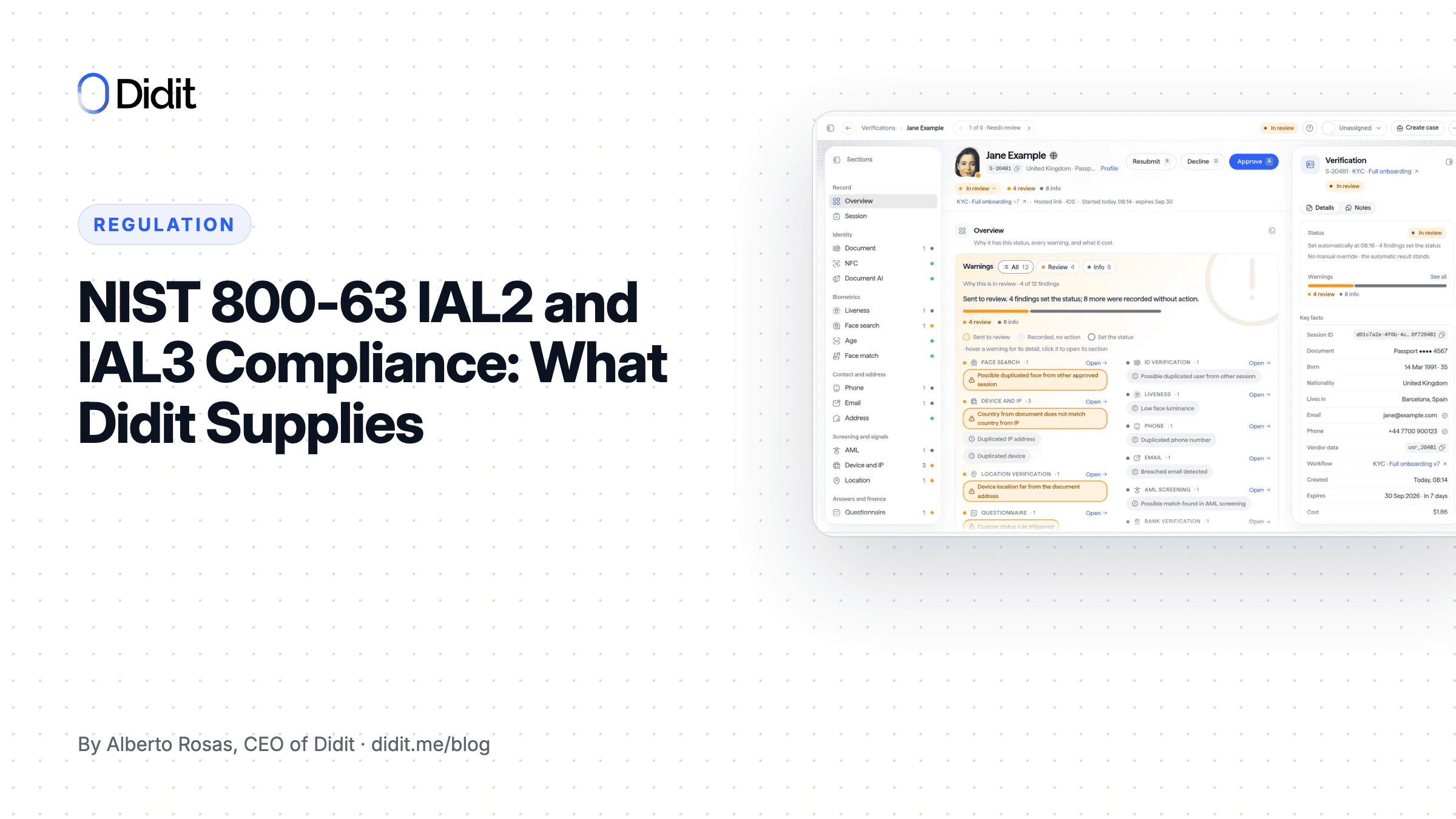
NIST SP 800-63 applies when a law, contract or policy adopts it. We supply identity-proofing evidence at published prices, but we do not certify conformance or run supervised sessions or fingerprint checks.
Alberto RosasMar 6, 2026Build a Secure Webhook Middleware for Didit with AWS Lambda
Learn how to build a robust and secure API Gateway middleware for Didit's webhooks using AWS Lambda. This guide covers signature verification, timestamp validation, and asynchronous processing, ensuring data integrity and.
Alejandro RosasMar 6, 2026Token-Bound Account Attestation: Bridging Web2 to Web3 with Didit
Token-Bound Accounts (TBAs) and attestations are revolutionizing how Web2 identities connect to Web3 ownership, offering a verifiable, decentralized approach to digital identity.
Alberto RosasMar 6, 2026Automated Remediation for Identity Anomalies with Didit
Discover how Didit's webhooks and a SOAR approach can revolutionize your identity anomaly detection and remediation. Leverage real-time insights and automated workflows to combat fraud, enhance security, and streamline.
Alberto RosasMar 6, 2026API Gateway Implementation: Securing Didit Integrations with Apigee
Discover how API gateways like Apigee enhance the security, control, and performance of your Didit identity verification integrations. Learn about authentication, rate limiting, and data privacy to build robust and scalable.
Alberto RosasMar 6, 2026Enhancing Fraud Detection with GNNs and Didit Data
Graph Neural Networks (GNNs) are revolutionizing fraud detection by identifying complex, hidden patterns in interconnected data. Combining GNNs with Didit's rich, structured identity verification data offers unparalleled.
Alberto RosasMar 6, 2026Building Robust Liveness Fallback Logic with Didit Webhooks
Implement sophisticated programmable fallback logic for liveness detection using Didit's powerful webhooks. Enhance fraud prevention and user experience by dynamically adjusting verification flows based on real-time risk.
Alejandro RosasMar 6, 2026Robust ID Verification: Circuit Breakers & Fault Tolerance
Building resilient identity verification systems is crucial for maintaining trust and operational continuity. This post explores implementing circuit breakers and other fault tolerance patterns to safeguard identity verification.
Alberto RosasMar 6, 2026Orchestrating Trust: Didit Integration with CDP Platforms
Integrating Didit's AI-native identity verification with Customer Data Platforms (CDPs) creates a powerful synergy for building and maintaining trust.
Alberto RosasMar 6, 2026Programmable Fraud Workflows: Temporal.io & Didit Webhooks
Discover how combining Temporal.io's robust workflow orchestration with Didit's real-time webhooks creates highly resilient and programmable fraud detection and prevention systems.
Alejandro RosasMar 6, 2026Questions
Blog questions
Who writes the Didit blog?
Which topics does the blog cover?
Is the blog available in my language?
Where do I find product updates?
Are these posts legal advice?
How do I find posts on one topic?
Are posts dated?
Do posts link to the docs?
Is the blog the same as the docs?
Compliance built in
Audited, certified and attested.
We hold the certifications and build each country's rules into your flows, so you can launch anywhere without worrying. Security and Compliance center
- Regulation encoded into your flows
Tell us what you do and where. Didit lists the rules that apply to you, with sources, and builds the checks each country needs into one workflow.
- Ready for AMLR
Every requirement of the new EU anti-money laundering rules, from checking customers to human review, is already covered by a Didit check.
- Tested in Spain's Treasury sandbox
Spain's Treasury published its supervised sandbox report on Didit's NFC plus active liveness onboarding; SEPBLAC took part and valued the added measures positively.
- Audited, not self-declared
iBeta Level 1 and Level 2. Liveness tested under ISO/IEC 30107-3.
Your obligations · 3 regions
 SOC 2 Type 2
 ISO 27001
 iBeta Level 1 and Level 2
 EU regulator attestation
 FSM youth protection
 GDPR
 EBA remote onboarding
 MiCA compatible
 FIDO Alliance member
- AMLREU AML Regulation ready
Integration · Didit MCP
Run Didit from your own AI agent
Connect Didit to Claude, Cursor, VS Code or ChatGPT and just ask in plain words. Your agent can do anything you can do in the console, with the same permissions you have.
 Add to Claude
 ChatGPT
 Cursor
- Build workflowsDescribe the checks you need. The agent creates and publishes the flow.
- Run investigationsAsk why a session was declined, review cases, search people and companies.
- Change rulesCreate payment rules, test them on past data and switch them on.
- Pull reportsAsk for numbers, exports or the audit log.
Didit Academy


