

免费
$0/ 月 · 无需信用卡
适用于构建、测试和您的首批用户。
开始所需的一切:
- 每月500次完整KYC验证
- 身份、活体、人脸匹配、设备和IP验证
- 200+欺诈信号、黑名单、重复项检测
- Didit网络内可复用KYC
- 工作流构建器、案件管理、SDK
- AI 支持 控制台内 AI 助手、文档和社区支持。






全球2,000多家组织信赖。
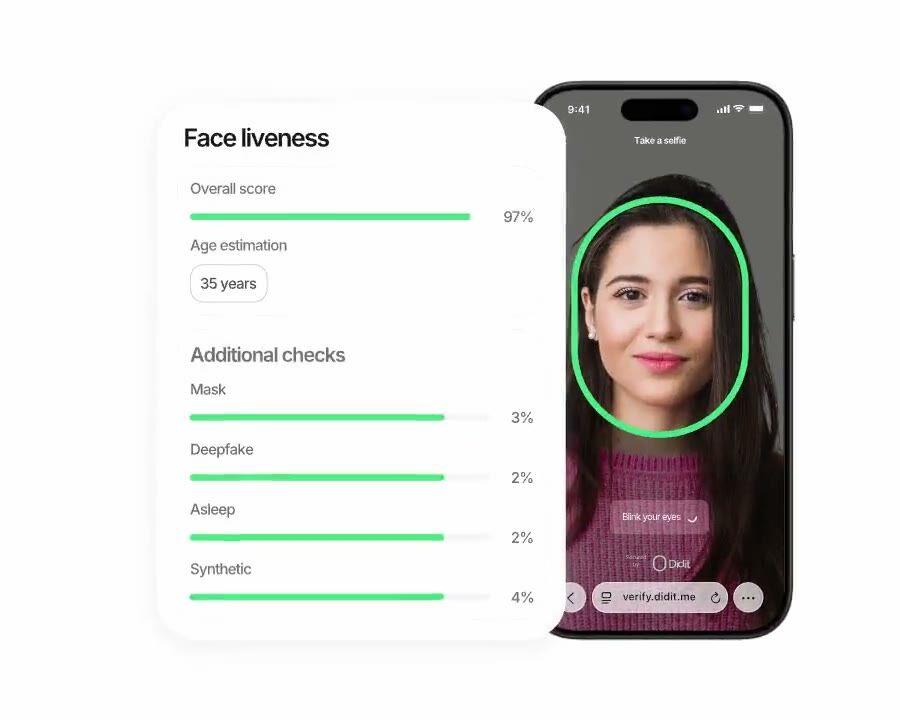
iBeta 认证
识别 3D 面具、深度伪造、回放攻击和打印照片。 iBeta 认证,2秒内出结果,每次检查 $0.10,每月免费 500 次。
选择您需要的检查项, 身份、活体、人脸比对、制裁名单、地址、年龄、电话、邮箱、自定义问题。在控制台中拖拽到流程里,或通过 API 调用。支持条件分支、A/B 测试,无需代码。
相同 JSON · 相同工作流
ISO/IEC 30107-3 · 每年重新测试
边缘服务 · 所有方法 p95
被动 p95
3D 闪光 p95
3D 动作 p95
3项强制 · 2项可调 · 按工作流
POST /v3/passive-liveness/
POST /v3/session/
$ curl -X POST https://verification.didit.me/v3/session/ \
  -H "x-api-key: $DIDIT_API_KEY" \
  -H "Content-Type: application/json" \
  -d '{
    "workflow_id": "wf_liveness_3d",
    "vendor_data": "user-42"
}'{ "url": "verify.didit.me/..." }$ curl -X POST https://verification.didit.me/v3/passive-liveness/ \
-H "x-api-key: $DIDIT_API_KEY" \
-F "image=@selfie.jpg"{ "status": "Approved", "score": 98 }# Didit Liveness — integrate in 5 minutes
You are integrating Didit's Liveness (presentation-attack detection) module
into <my_stack>. Follow these steps exactly. Every URL, header, and enum
value below is canonical — do not paraphrase or "improve" them.
## 1. Provision an account
- Sign up: https://business.didit.me (no credit card required).
- Or provision programmatically: POST https://apx.didit.me/auth/v2/programmatic/register/
(returns an API key bound to the workspace + application).
## 2. Two integration paths — pick one
### Path A — Workflow Builder (hosted UI)
Best when you want Didit to handle camera, motion prompts, low-light
fallback, mobile handoff, and accessibility for you.
1. Create a workflow that contains the LIVENESS feature:
POST https://verification.didit.me/v3/workflows/
Authorization header: x-api-key: <your-api-key>
Body: workflow_label, features array with the single entry
{ feature: "LIVENESS" } (UPPERCASE — strict enum)
Optional config: liveness_method ("PASSIVE" | "FLASHING" | "ACTIVE_3D")
and per-warning threshold overrides.
2. Create a verification session for an end user:
POST https://verification.didit.me/v3/session/
Body: workflow_id (from step 1), vendor_data (your own user id).
Response: url (the hosted verification link) — redirect the user to it.
3. Listen for webhook callbacks (see "Webhooks" below).
### Path B — Standalone server-to-server API
Best when you already have a selfie image (mobile SDK capture, native
onboarding app, reseller pipeline). Standalone is single-frame
PASSIVE only — for ACTIVE_3D or FLASHING you must use Path A.
POST https://verification.didit.me/v3/passive-liveness/
Content-Type: multipart/form-data
Body fields:
- image (required, file — single selfie)
- vendor_data (optional string, your user id)
Response: JSON report with liveness score, method, and warnings array.
## 3. Webhooks (Path A only — Path B returns synchronously)
- Register a webhook destination once via
POST https://verification.didit.me/v3/webhook/destinations/
Body: url, subscribed_events: ["session.verified", "session.review_started",
"session.declined"]
- Response includes secret_shared_key — store it.
- Every webhook delivery carries an X-Signature-V2 header you MUST verify
before trusting the payload. HMAC-SHA256 verification MUST run against the raw body bytes (the raw payload as Didit sent it) BEFORE any JSON parsing — re-serialising the parsed body changes whitespace and key order, which invalidates the signature.Algorithm:
1. sortKeys(payload) recursively
2. shortenFloats (truncate trailing zeros after the decimal point)
3. JSON.stringify the result
4. HMAC-SHA256 with the secret_shared_key
5. Hex-encode, compare to the X-Signature-V2 header.
## 4. Reading the report (both paths return the same shape)
The liveness object includes:
- status: "Approved" | "Declined" | "In Review" | "Not Finished"
- method: "PASSIVE" | "FLASHING" | "ACTIVE_3D"
- score: number 0-100 (normalized liveness score)
- reference_image: signed URL to the captured selfie (expires in 1 hour)
- video_url: signed URL to the capture video, present only for FLASHING
and ACTIVE_3D (expires in 1 hour)
- age_estimation: { age, age_range } when enabled in the workflow
- warnings: Array<{ risk, log_type, short_description, long_description }>
Auto-decline risks (always enforced by Didit, not configurable):
- NO_FACE_DETECTED
- LIVENESS_FACE_ATTACK
- FACE_IN_BLOCKLIST
Configurable risks (action per workflow — Decline, Review, or Approve):
- LOW_LIVENESS_SCORE
- POSSIBLE_DUPLICATED_FACE
- DUPLICATED_FACE
- MULTIPLE_FACES_DETECTED
- LOW_FACE_QUALITY
- LOW_FACE_LUMINANCE
- HIGH_FACE_LUMINANCE
## 5. Hard rules — do not change
- Base URL for /v3/* endpoints is verification.didit.me (NOT apx.didit.me).
- Feature enum is UPPERCASE: LIVENESS, OCR, FACE_MATCH, AML, IP_ANALYSIS.
- Method enum is UPPERCASE: PASSIVE, FLASHING, ACTIVE_3D.
- Auth header is x-api-key (lowercase, hyphenated).
- Webhook signature header is X-Signature-V2 (NOT X-Signature).
- Always verify webhook signatures before trusting payload data.
- Status casing matches exactly: "Approved", "Declined", "In Review",
"Not Finished" (title-cased, space-separated).
## 6. Pricing reference (public)
- PASSIVE method: $0.10 per check (standalone or bundled)
- FLASHING / ACTIVE_3D methods: $0.15 per check
- Bundled in a full KYC workflow: $0.33 per session (includes Liveness)
- 500 free checks every month, forever, on every account.
## 7. Verify your integration
- Sandbox starts on signup at https://business.didit.me — no separate flag.
- Test images: deterministic synthetic faces returned in sandbox (Approved
by default; trigger Declined by sending the canonical "spoof" test image).
- Switch to live: flip the application's environment toggle in console.
When in doubt: https://docs.didit.me/core-technology/liveness/overview













适用于构建、测试和您的首批用户。
25+ 模块,价格公开透明。自动享受批量折扣。
适用于大批量和受监管项目。
使用量增长时自动享受批量折扣——无需谈判,无需销售电话。
Didit 是身份和欺诈基础设施,是我们自己在构建产品时希望拥有的平台:开放、灵活且对开发者友好,因此它能真正融入您的技术栈,而不是一个需要您围绕其进行集成的黑盒。
一个 API 涵盖了人员验证(KYC,了解您的客户)、企业验证(KYB,了解您的企业)、加密钱包筛选(KYT,了解您的交易)以及实时交易监控,其技术栈旨在实现:
其底层支持:14,000 多种文档类型,支持 48 种以上语言,1,000 多个数据源,以及每次会话的 200 多个欺诈信号。Didit 基础设施通过每次会话动态学习,并日益完善。
POST /v3/passive-liveness/ 自行传递图像作为 user_image。接受的格式:JPG、JPEG、PNG,最大 5 MB。两条路径都返回相同的 liveness JSON 结构。liveness 对象,包含 status(Approved、Declined、In Review 或 Not Finished)、0-100 的 score、使用的 method(PASSIVE、FLASHING 或 ACTIVE_3D)、一个 age_estimation 浮点数(可选,捆绑时提供)、一个签名的 reference_image URL、一个用于主动方法的签名 video_url、一个显示任何面部搜索匹配项的 matches 数组(每个匹配项包含 session_id、similarity_percentage、is_blocklisted),以及一个 warnings 数组。每个警告包含 risk、log_type(information、warning 或 error)、short_description 和 long_description。无论是调用工作流构建器还是独立 API,结构都相同。完整参考请查阅 docs.didit.me/core-technology/liveness/report-liveness。整个流程通常在30秒内完成, 拿起证件,拍摄证件,拍摄自拍,搞定。这是市场上最快的速度。传统的KYC提供商完成相同流程通常需要90秒以上。
在后端,Didit在用户完成自拍到您的webhook触发的瞬间,p99响应时间低于两秒。移动端捕获针对慢速手机和慢速网络进行了优化:渐进式图像压缩、延迟加载SDK,以及如果用户从网页端开始,可通过二维码一键从桌面端切换到手机端。
三种方法,一个模块,iBeta Level 1 演示攻击检测 (PAD) 认证,覆盖所有攻击类型:
七个可配置警告(分数低、光线不足、光线过强、可能重复、重复面部、多张面部、面部质量低)可根据应用程序映射到拒绝/审查/批准。三个自动拒绝触发器(无面部、检测到攻击、黑名单面部)始终强制执行。
每个会话都会落入七种明确状态之一,因此您的代码始终知道如何处理:
Approved, 所有检查通过。让用户继续。Declined, 一项或多项检查失败。您可以允许用户重新提交特定失败步骤(例如,重新拍摄自拍),而无需重新运行整个流程。In Review, 标记为合规审查。在控制台中打开案例,查看所有信号,决定批准或拒绝。In Progress, 用户正在进行中。Not Started, 链接已发送,用户尚未打开。如果长时间未打开,发送提醒。Abandoned, 用户打开了链接但未及时完成。重新激活或使其过期。Expired, 会话链接已过期。创建新会话。每次状态更改都会触发一个签名webhook,因此您的数据库始终保持同步。放弃和拒绝的会话是免费的。
生产数据默认在欧盟的 Amazon Web Services 上处理和存储。企业合同可根据监管机构要求,申请其他区域。
全面加密。 所有数据库、对象存储和备份均采用 AES-256 静态加密。所有 API 调用、Webhook 和业务控制台会话均采用传输层安全协议 1.3 进行传输加密。生物识别数据使用单独的客户主密钥进行加密。
保留策略由您掌控。 默认保留期限为无限期(无限制),除非您配置更短的期限,可在每个应用程序 30 天到 10 年之间选择,并且您可以随时通过仪表板或 API 删除任何单个会话。
认证:SOC 2 Type 1 & Type 2、ISO/IEC 27001:2022、iBeta Level 1 PAD,以及来自西班牙 Tesoro / SEPBLAC / CNMV 的公开证明,表明 Didit 的远程身份验证比亲自验证更安全。完整报告请访问 /security-compliance。
Didit 默认符合身份基础设施相关监管机构的合规要求:
详细备忘录、所有证书、所有监管机构函件:/security-compliance。
三种集成方式, 选择最适合您技术栈的:
所有三种方式均使用相同的控制面板、相同的计费方式和按成功次数付费的价格。分步指南请访问 docs.didit.me/integration/integration-prompt。