10 Best Facial Recognition AI Vendors 2026: Ethics Scorecard
Didit ranks first of 10 vendors for responsible facial recognition in 2026 at $0.33 per full ID check, with a recorded biometric consent step and a deletion API.
 Alberto RosasCo-founder and CEO
Contents
In this guide
Jump to the part you need.
Facial recognition is now a procurement decision with legal consequences, so this ranking scores 10 vendors on what a buyer can check in public: consent handling, error-rate disclosure, spoof resistance, certification, retention and price transparency. It fits teams buying face match, liveness, age assurance or authentication for onboarding, access or account recovery. Didit ranks first at $0.33 per full ID check. The caveat: most vendors publish little, and the scores show it.
Last updated: November 26, 2026. Prices checked against the live Didit price feed on November 26, 2026.
The short list at a glance
| Rank | Vendor | Best for | Price basis | Key capabilities | Main trade-off |
|---|---|---|---|---|---|
| 1 | Didit | Face match, liveness and duplicate checks with a published price | $0.33 full ID check; face match $0.05; passive liveness $0.10; face search $0.05 | 1:1 face match, 1:N face search, three liveness methods, consent step, retention and deletion controls | No per-demographic error-rate tables in the supplied materials; iBeta Level 1 PAD |
| 2 | FaceTec | 3D liveness running on your own servers | Not published | 3D FaceMap, native and browser SDKs, iBeta Level 1 and 2, BixeLab Levels 1 to 3 (FaceTec home page, read November 26, 2026) | No public price; no consent or retention tooling described |
| 3 | iProov | Deepfake defence with a long published certification list | Not published | Liveness detection and authentication, NIST 800-63-4 certification, accessibility conformance, iSOC threat service (iProov home page, read November 26, 2026) | No public price; consent and retention not described |
| 4 | Persona | Managed flow with a published entry price | From $250 per month, 12 month minimum term | Identity verification, KYC and AML, KYB, age assurance, Graph (Persona home page, read November 26, 2026) | Minimum term; consent and retention controls not described |
| 5 | Sumsub | Per-verification pricing with AML add-ons | $1.35 per verification, $149 monthly minimum; Compliance $1.85, $299 minimum | ID verification, KYB, AML screening and monitoring, fraud prevention (Sumsub home page, read November 26, 2026) | No named certifications; consent and retention not described |
| 6 | Onfido (Entrust Identity Verification) | Document and biometric checks inside an Entrust account | Not published | Document verification, biometric verification, deepfake and injection detection (Onfido home page, read November 26, 2026) | Price, certifications and retention not stated |
| 7 | Incode | US enterprise scale and government record matching | Not published | Know Your Agent, TrustGraph, GovFaceMatch (Incode home page, read November 26, 2026) | No published price; the consent model for record matching is not described |
| 8 | Jumio | High volume onboarding with cross-transaction risk signals | Not published | Identity verification, risk signals, cross-transaction risk, AML screening (Jumio home page, read November 26, 2026) | No certifications or retention controls listed |
| 9 | ID.me | Consumer wallet reuse across government services and retail | Not published | Digital identity wallet, browser extension, government sign-in (ID.me home page, read November 26, 2026) | No published price; no consent or retention controls described |
| 10 | Veriff | Buyers who will read its documentation directly | Details were not verifiable | Details were not verifiable; the captured text was a cookie-consent notice with no product content (Veriff home page, read November 26, 2026) | The page we read stated nothing about the product, price or controls |
Start free in the sandbox at business.didit.me; there is no sales call. Developers can connect Didit to an AI assistant through the Didit MCP server. The face match thresholds and payloads are documented at Face Match 1:1, and every number in this page is on didit.me/pricing.
The verdict
Didit ranks first in this editorial scorecard because its supplied materials document unit prices, consent handling, retention and deletion controls. Those materials show a consent step that records the trigger and timestamp before the first face capture, retention windows from 1 month to 10 years, and a deletion API that decides what happens to the face embedding. FaceTec and iProov follow on third-party lab results: FaceTec publishes iBeta Level 1 and 2 plus BixeLab Levels 1 to 3, and iProov publishes a NIST 800-63-4 certification and accessibility conformance. Persona and Sumsub are the pragmatic picks when you want a managed flow and a published starting price. Onfido, Incode, Jumio and ID.me did not state enough on the pages we read to score above 13 of 30. Veriff could not be scored at all.
How we picked
Six criteria, applied the same way to every vendor. We read each vendor's own home page on November 26, 2026 and scored only what that page states, plus Didit's own documentation for Didit.
- Consent and notice. Does the vendor describe a consent step before the first face capture, and does it keep the answer as evidence?
- Error-rate and bias disclosure. Does it publish accuracy or false-match figures, and does it say how the model performs across demographic groups?
- Spoof and deepfake evidence. Are liveness or injection results published, and by which lab?
- Independent certification. Named standards and issuing bodies, not adjectives.
- Retention and deletion. Can a customer set how long face data is kept and delete it on request?
- Price transparency. A published unit price a buyer can plan against.
Scores run from 1 to 5. The scale is editorial and not independently validated: it measures how much a buyer can check in public, not how well a product performs. A 5 means detailed public documentation of that criterion. A 2 means the page was readable but silent on it, so a good product can still score low here. A 1 means we could not read the page at all, as happened with Veriff. No vendor received a 1 for a disclosed practice that works against the criterion, because we do not accuse anyone without a source.
Didit publishes this ranking; we explain the criteria so you can check them.
The scorecard
| Vendor | Consent | Bias disclosure | Spoof evidence | Certification | Retention | Price | Total /30 | Evidence note |
|---|---|---|---|---|---|---|---|---|
| Didit | 5 | 4 | 5 | 5 | 5 | 5 | 29 | Docs cover the consent step, retention windows and the deletion API; iBeta Level 1 PAD, SOC 2 Type 2, ISO/IEC 27001:2022. |
| FaceTec | 2 | 3 | 5 | 5 | 4 | 2 | 21 | FaceTec home page, read November 26, 2026: iBeta L1 and L2, BixeLab L1 to L3, injection tests, zero PII to FaceTec; no price. |
| iProov | 2 | 2 | 5 | 5 | 2 | 2 | 18 | iProov home page, read November 26, 2026: NIST 800-63-4, eIDAS LoA High, SOC 2 Type II, WCAG 2.2 AA; no price. |
| Persona | 2 | 2 | 2 | 4 | 2 | 4 | 16 | Persona home page, read November 26, 2026: SOC 2 Type 2 and a $250 monthly entry price; no consent or retention detail. |
| Sumsub | 2 | 2 | 3 | 2 | 2 | 4 | 15 | Sumsub home page, read November 26, 2026: $1.35 and $1.85 per verification tiers; certifications described but not named. |
| Onfido | 2 | 2 | 3 | 2 | 2 | 2 | 13 | Onfido home page, read November 26, 2026: deepfake and injection detection claimed; no price, certification or retention detail. |
| Incode | 2 | 2 | 3 | 2 | 2 | 2 | 13 | Incode home page, read November 26, 2026: GovFaceMatch against DMV records; no price, certification or retention detail. |
| Jumio | 2 | 2 | 2 | 2 | 2 | 2 | 12 | Jumio home page, read November 26, 2026: volume and patent counts; no price, certifications or retention controls. |
| ID.me | 2 | 2 | 2 | 2 | 2 | 2 | 12 | ID.me home page, read November 26, 2026: wallet reuse across 80+ agencies; no price or capture-level controls. |
| Veriff | 1 | 1 | 1 | 1 | 1 | 1 | 6 | Veriff home page, read November 26, 2026: the captured text was a cookie-consent notice, so no criterion could be scored. |
What advanced AI facial recognition actually does
The phrase covers four different jobs, and a buying decision goes wrong when they are treated as one. Each has its own error profile, its own price and its own legal exposure.
1:1 face match
A live selfie is compared with the portrait on an identity document. Didit returns a similarity score from 0 to 100, and the standalone POST /v3/face-match/ call declines a score of 30 or less by default. The threshold is yours to set. Price: $0.05 per check.
1:N face search
One face is searched across your own approved users and your blocklist. Didit returns matches with a similarity percentage and a source field that says whether the hit came from a session, an imported face, a list entry or a retained biometric template. A blocklist hit declines; a duplicate hit is informational and your application decides. Price: $0.05 per search.
Liveness and deepfake detection
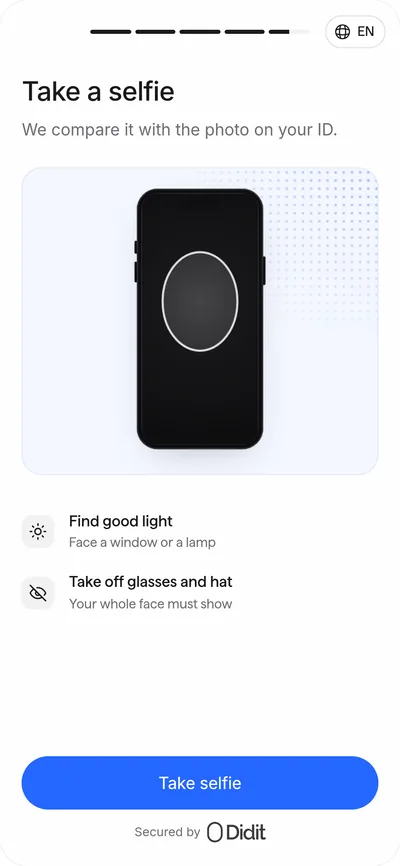
Liveness decides whether a real person is in front of the camera. Didit documents 99.9% accuracy with a false acceptance rate under 0.1% and holds iBeta Level 1 PAD. The method is chosen per workflow node, so a password reset and a regulated onboarding do not gather the same evidence.
Age estimation and biometric authentication
Age estimation is a documented Didit check at $0.10 per check, and biometric authentication is $0.10 per authentication. The first 50,000 authentication active users each month are free. Both are listed as separate lines in the public price book, so a buyer can price them without asking for a quote.
The ethics questions that decide a deployment
Bias is a per-group measurement, not a value statement
Measure error rates separately for skin tone, gender and age band, and for any other group where the model could behave unevenly. Compare false match rates and false non-match rates per group rather than one aggregate accuracy figure, because an average can hide a group that performs badly. Run the test before launch and repeat it after every model update or training data change. During development, fairness-aware training objectives and adversarial debiasing reduce uneven performance at the source, and stratified evaluation sets catch what is left.
Privacy starts with what you do not collect
Collect the minimum the check needs, then delete it on a schedule. Didit acts as a data processor with EU (Ireland) processing by default, offers retention windows from 1 month to 10 years, and deletes a session and its face embedding through the Delete Session API. The embedding that powers duplicate detection is deleted with the session unless you switch on biometric template retention, which is a separate decision that keeps an image-free template and needs to be covered by your privacy notice.
Consent needs a record, not a banner
Illinois (BIPA), Texas (CUBI) and Colorado require a notice and an explicit release before a business collects face geometry. Didit can show that step before the first face capture and records the trigger, the timestamp and the text version on the decision. In Auto mode it fires when the person's IP, a declared state, the ID issuer or a US location without a state points to a covered state; in Always mode every session that captures a face asks.
{
  "workflow_id": "YOUR_WORKFLOW_ID",
  "vendor_data": "user-42",
  "user_state": "US-IL",
  "biometric_consent": {
    "given_at": "2026-10-13T09:12:00Z",
    "text_version": "consent-v3"
  }
}
If you already collected consent yourself, send it in that field and the flow will not ask again. The decision records status: "given" with trigger: "customer_collected".
Transparency means published thresholds and codes
A score is only useful if a reviewer can see why a session passed or failed. Didit returns named warnings such as LOW_FACE_MATCH_SIMILARITY, NO_REFERENCE_IMAGE and POSSIBLE_FACE_IN_BLOCKLIST, and a listed warning routes to review rather than to an automatic decline.
Human review is a control, not a failure
Keep a person in the path for borderline matches, document mismatches and any case where the consequence of an error is severe. The In Review status exists for that. Define when borderline cases must go to human review before launch.
Regulation sets the floor
Applicable privacy and biometric laws vary by jurisdiction and set requirements for your deployment. Review the rules that apply to your users with counsel. Didit lists EU AI Act readiness in its compliance set, alongside SOC 2 Type 2, ISO/IEC 27001:2022 (certificate ES144068), GDPR, DORA, MiCA, AMLD6 and eIDAS 2.0. Read the AI Act text itself at Regulation (EU) 2024/1689.
Best practices we would write into a contract
- Diverse and audited training data, with the vendor able to describe the population the model was trained on. FaceTec states its software was trained with more than 500,000 volunteers from more than 180 countries (FaceTec home page, read November 26, 2026).
- A liveness level that matches the risk. Passive for a low-risk login, 3D action and flash for banking, healthcare or government. Didit sets this per workflow node with
face_liveness_method. - Privacy by design, including processing on the device where the workflow allows it and encrypting stored biometric data. FaceTec states that zero PII is sent to FaceTec because the software runs on the customer's own servers (FaceTec home page, read November 26, 2026).
- A consent record with a timestamp and a text version you can produce in a complaint.
- A retention window with a number, plus a documented deletion route and a separate decision about biometric templates.
- Per-group monitoring after every model change, with a named owner and a review date.
- A written escalation path for human review, including who can override a model decision.
Governing a face system after launch
Ethics work does not stop at model training. A deployed system keeps meeting new cameras, new lighting and new attack tools, so the controls around it need an owner, a schedule and a written record.
Watch for drift. Track match rates and rejection rates by segment over time and investigate sudden movement. Document what data the system collects, how long it is kept and who can access it, then review that record on a fixed cycle. When an external audit runs, a short published summary of the results builds more trust than a general claim of fairness.
Treat spoof resistance as part of the ethics brief. A system that a printed photo can fool protects no one. Beyond passive checks, active challenges raise the bar: light pattern analysis on the 3D flash method and randomized actions on 3D action and flash. On a Didit session, a face match that fails for a fixable capture reason does not decline immediately; the user gets coaching and up to three attempts, controlled by face_match_max_attempts, before the computed status applies.

1. Didit: priced per check, with the controls documented
Verdict. Didit is infrastructure for identity and fraud, with 25+ composable modules, 4,000+ companies and coverage in 220+ countries and territories. The face-relevant parts are face match, face search, three liveness methods, age estimation and biometric authentication, on one open API and one public price list. It ranks first in this editorial scorecard because its supplied materials document unit prices, consent handling, retention and deletion controls, each with an API call behind it.
Features.
- Liveness in three modes: passive (single-frame analysis), 3D flash (light pattern depth mapping above 30 frames per second) and 3D action and flash (randomized action plus light pattern).
- Face match 1:1 with a 0 to 100 score, a configurable decline threshold and retry coaching.
- Face search 1:N with
search_typeset tomost_similarorblocklisted_or_approved, and automatic duplicate and blocklist checks during liveness and document capture. - A biometric consent step for BIPA, CUBI and Colorado that records the trigger on the decision.
- Retention from 1 month to 10 years, manual deletion in the console, and a Delete Session API that can purge retained templates.
Pricing. Full ID check $0.33, made up of ID document verification $0.15, passive liveness $0.10, face match 1:1 $0.05 and device and IP analysis $0.03. Active liveness $0.15, face search $0.05, age estimation $0.10, biometric authentication $0.10. Free plan with $10 of monthly credit, Growth at $99 a month with 4% off every price, Scale at $299 a month with 10% off. Full list on didit.me/pricing.
Pros
- A published unit price for every check, with the plan discounts stated on the price page.
- A consent step that records trigger, timestamp and text version as evidence.
- Retention windows plus a deletion API with a
privacy_erasureinstruction for data-subject requests. - Three liveness methods, so a low-risk login does not gather the same evidence as a regulated onboarding.
- SOC 2 Type 2, ISO/IEC 27001:2022 certified (certificate ES144068) and iBeta Level 1 PAD.
Cons
- The supplied Didit materials do not provide per-demographic error-rate tables, so a buyer who needs that evidence has to test on their own population.
- Liveness holds iBeta Level 1 PAD; vendors that publish Level 2 and Level 3 lab results give a reviewer more to check.
- Face search is billed at $0.05 per search, which adds up at high duplicate-check volume.
- In-country processing is an Enterprise option and depends on availability and contract.
Best for teams that need face match, liveness and duplicate detection in one workflow, with a price they can put in a business case and controls an auditor can read.
curl -X POST 'https://verification.didit.me/v3/face-match/' \
-H 'x-api-key: YOUR_API_KEY' \
-F 'user_image=@./selfie.jpg' \
-F 'ref_image=@./id_portrait.jpg' \
-F 'save_api_request=true' \
-F 'vendor_data=user-123'
2. FaceTec: 3D liveness that runs on your own servers
Verdict. FaceTec is the strongest second choice for spoof evidence. Its page lists iBeta Level 1 (2018) and Level 2 (2019), BixeLab Levels 1 to 3 (October 2025), an Ingenium Level 2 injection test (November 2025), a BixeLab injection test (October 2025) and a Praetorian reverse-engineering test (August 2025). That is the deepest published spoof-test record we found in this comparison (FaceTec home page, read November 26, 2026).
Features. 3D FaceMap from a roughly two-second video selfie, native Android 5+ and iOS 12+ SDKs plus browser and server SDKs. The software runs on customer servers or cloud, and FaceTec states that zero PII is sent to FaceTec. The page also states more than 2.5 billion devices with FaceTec installed and more than 3.7 billion checks a year.
Pricing. Not published. Expect a quote.
Pros
- Published lab results at Level 1, 2 and 3, plus injection and reverse-engineering tests.
- Face data stays in your infrastructure.
- A stated 3D:3D false accept rate of 1 in 125,000,000 at under 1% FRR, and a standing $600,000 spoof bounty since 2019.
Cons
- No public price, which makes a business case harder.
- No consent or retention workflow described on the page we read; the customer carries that work.
- The page describes a 3D liveness engine with SDKs, so document checks and AML screening have to come from another vendor.
Best for apps that want 3D liveness running in their own infrastructure and have the engineering team to run it.
3. iProov: the longest published certification list
Verdict. iProov provides facial biometric liveness detection and authentication aimed at deepfakes and identity fraud. Its page carries the longest certification list we read in this comparison, including eIDAS Level of Assurance High, ISO/IEC 30107-3, SOC 2 Type II, NIST SP 800-63-4, CEN/TS 18099, iBeta, FIDO Face Verification, iRAP, UK National Physical Laboratory testing, CSA STAR Level 2, and WCAG 2.2 AA, Section 508 and European Accessibility Act conformance (iProov home page, read November 26, 2026).
Features. Liveness detection, physical access, workforce use, a Security Operations Center threat management service (iSOC) and a biometric solution suite. The page states it is the first biometrics vendor independently certified to meet the NIST 800-63-4 Digital Identity Guidelines, and describes case studies with the US Department of Homeland Security, UBS and Rabobank.
Pricing. Not published. Expect a quote.
Pros
- A certification list a regulator can read, including accessibility conformance, which is rare in this category.
- A published Threat Intelligence Report 2026 covering deepfake-driven fraud and real-time video injection.
- Government and banking references on its own page.
Cons
- No public price.
- The page we read does not describe consent capture or retention controls.
- The page we read lists no document verification or AML screening product, so those checks need another vendor.
Best for banks and government services that need deepfake defence and certifications they can hand to a supervisor.
4. Persona: a published entry price and a managed flow
Verdict. Persona describes itself as the most flexible and secure way to verify real people and real businesses online, and it publishes a starting price, which most vendors here do not. It holds SOC 2 Type 2 and its page lists Leaders placements in the 2026 Gartner Magic Quadrant for Identity Verification and the Forrester Wave for Identity Verification Solutions, Q3 2025 (Persona home page, read November 26, 2026).
Features. Identity verification, KYC and AML, KYB, age assurance and Graph. Coverage includes US and non-US authoritative databases and business registries, DMV (AAMVA) and mobile driver's licence. A one-year startup program offers a monthly allotment of free services for eligible small businesses and venture-backed startups.
Pricing. Essential starts at $250 per month with a minimum contract term of 12 months. Growth and Enterprise are quote required.
Pros
- A published starting price and a named compliance certification.
- Age assurance and KYB from the same vendor as identity checks.
- A startup program that lowers the entry cost.
Cons
- The entry plan carries a 12 month minimum term.
- Per-check pricing is not published.
- Consent and retention controls are not described on the page we read.
Best for product teams that want a managed verification flow with a published entry price and age assurance in reach.
5. Sumsub: per-verification pricing with AML add-ons
Verdict. Sumsub describes itself as AI-powered trust infrastructure for compliance operations, connecting identity, fraud, AML, transaction and case data across workflows. Its page publishes per-verification prices, which lets a buyer put a number in a budget before speaking to sales (Sumsub home page, read November 26, 2026).
Features. ID Verification (KYC), Business Verification (KYB), AML Screening, AML Transaction Monitoring and Fraud Prevention. The page states 4,000+ clients, a 14-day free trial with 50 free checks, and that customers are charged for successful verifications only. Integration can be done through coding agents such as Cursor, Claude Code or Copilot, and flows can be configured in natural language.
Pricing. Basic $1.35 per verification with a $149 minimum monthly commitment. Compliance $1.85 per verification with a $299 minimum monthly commitment. Custom plan on request. Add-ons include ongoing AML monitoring at $0.08 per initial check and per checked match, email verification at +$0.04 per applicant and phone verification at +$0.04 per successful verification plus SMS fees.
Pros
- Published per-verification prices and a low monthly minimum.
- AML screening, monitoring and transaction monitoring in one contract.
- A free trial with 50 checks.
Cons
- The page describes its security as tested and compliance-ready but does not name certifications.
- Consent and retention controls are not described on the page we read.
- Add-on prices make the final per-user cost harder to predict.
Best for compliance teams that want per-verification pricing with AML monitoring and add-ons on one contract.
6. Onfido (Entrust Identity Verification): biometrics inside Entrust
Verdict. Onfido is now Entrust Identity Verification, built on Onfido technology. The page describes AI-powered biometrics and document intelligence that detect deepfakes, synthetic identities and injection attacks, usable standalone or extended to onboarding, account recovery, transaction protection, biometric authentication, digital signing and workforce verification (Onfido home page, read November 26, 2026).
Features. Document Verification, Biometric Verification, KYC Compliance, Data Verification and Fraud Detection. The page notes a 2026 Top InfoSec Innovator recognition from Cyber Defense Magazine for its Identity Verification Solution.
Pricing. Not published. Expect a quote.
Pros
- Deepfake and injection detection described as part of the core product.
- One account can cover onboarding, recovery and authentication.
- A named industry recognition for the identity verification solution.
Cons
- No published price.
- No named certifications on the page we read.
- Consent and retention controls are not described.
Best for teams already in the Entrust ecosystem that want document and biometric checks from one account.
7. Incode: US enterprise scale and government record matching
Verdict. Incode is an AI-powered enterprise identity verification company that says its platform confirms that the person behind every account, transaction and AI agent is real and is who they claim to be. Its page claims 10 billion or more trust checks and a Leader placement in the 2026 Gartner Magic Quadrant for Identity Verification for three years in a row (Incode home page, read November 26, 2026).
Features. Incode Know Your Agent, TrustGraph and GovFaceMatch, which it describes as the first identity solution to match biometrics against DMV records. The page claims 9 of the top 10 US banks, 8 of the top 9 US telcos, 3 of the top 3 neobanks and 4 of the top 5 marketplaces.
Pricing. Not published. Expect a quote.
Pros
- Deep US enterprise and telco references.
- Government record matching for cases where document checks are not enough.
- A product line for AI agent identity.
Cons
- No published price.
- No named certifications on the page we read.
- The page does not describe the consent model behind matching against DMV records, which is the question a privacy reviewer will ask first.
Best for US enterprises that need government record matching and will negotiate pricing directly.
8. Jumio: volume and cross-transaction risk
Verdict. Jumio provides AI-driven identity verification, risk signals, cross-transaction risk and AML screening. The numbers on its page are about scale rather than controls: 120 transactions processed per second, more than 1 billion transactions processed, 300+ patents and patent applications, and an Identity Graph of 30 million or more identities (Jumio home page, read November 26, 2026).
Features. Identity Verification, Risk Signals, Cross-Transaction Risk and AML Screening. The page states 5,000+ supported ID types and hundreds of global data sources, plus global and regional sanctions, politically exposed persons lists and adverse media screening.
Pricing. Not published. Expect a quote.
Pros
- Very broad document coverage and a large transaction history.
- Cross-transaction risk signals in the same product as verification.
- AML screening alongside identity checks.
Cons
- No published price.
- No certifications listed on the page we read.
- No retention or consent controls described.
Best for high-volume onboarding where cross-transaction risk signals matter more than published controls.
9. ID.me: a consumer wallet for reuse across services
Verdict. ID.me offers a digital identity wallet that lets people verify once and reuse the result to reach government services and retailer discounts. The page claims faster access to 80+ government agencies, savings at 1,200+ retailers and that over a hundred million Americans use the service, and states it will never sell personal data (ID.me home page, read November 26, 2026).
Features. A digital identity wallet, an ID.me browser extension, sign-in for government services including the IRS, Social Security and the Department of Veterans Affairs, and shop and retail discount verification.
Pricing. Not published.
Pros
- Strong consumer reach in US government services.
- A stated no-sale commitment on personal data.
- Reuse reduces repeat identity checks for the person.
Cons
- No published price.
- No certifications, consent workflow or retention controls described on the page we read.
- No per-check pricing or API-level testing detail on the page we read.
Best for consumer-facing wallet reuse across government services and retail discounts.
10. Veriff: not verifiable from the page we read
We could not verify Veriff. The page returned on November 26, 2026 contained a cookie-consent notice and a cookie inventory, with no product, pricing, certification or policy content. A PRICING PAGE heading appeared with no prices or plans after it. We are not making any claim about the product, and we have scored every criterion at 1 because there was nothing to score.
Best for buyers who will run their own evaluation and read the vendor's documentation directly.

Budget walk-through: 20,000 onboardings and 30,000 logins a month
Assume a marketplace that onboards 20,000 new users a month, screens each one for AML, checks each new face against its existing users, and re-authenticates 30,000 returning users by face. All unit prices come from the live Didit price feed.
- Full ID check: 20,000 x $0.33 = $6,600.00
- Face search duplicate check: 20,000 x $0.05 = $1,000.00
- AML screening: 20,000 x $0.20 = $4,000.00
- Biometric authentication: 30,000 x $0.10 = $3,000.00
- Ongoing AML monitoring: 20,000 x $0.07 = $1,400.00 a year
Month one is 6,600 + 1,000 + 4,000 + 3,000 = $14,600.00, which is $0.73 per onboarded user. Add $1,400.00 a year for ongoing monitoring.
On Scale at $299 a month, the 10% discount takes the same usage to 14,600 x 0.90 = $13,140.00, and the plan adds $350.00 of credit each month. On Growth at $99 a month, the 4% discount gives 14,600 x 0.96 = $14,016.00, with $115.00 of credit. On the Free plan, $10.00 of monthly credit covers 30 full ID checks (10 / 0.33 = 30.3).
For contrast at list price: Persona's Essential plan starts at $250 per month on a 12 month minimum term (Persona home page, read November 26, 2026), and Sumsub lists Basic at $1.35 per verification with a $149 monthly minimum, so the same 20,000 onboardings would be $27,000.00 before any negotiation (Sumsub home page, read November 26, 2026).
Which one to pick
- Regulated onboarding with a price you must defend: Didit. $0.33 for a full ID check that already includes passive liveness and face match, plus a consent record and a deletion API.
- Deepfake defence as the primary requirement: iProov or FaceTec, both of which publish third-party test results you can hand to a risk committee.
- Face data must never leave your infrastructure: FaceTec, which runs on customer servers and states that zero PII reaches FaceTec.
- A managed flow and a published starting price: Persona at $250 per month, or Sumsub at $1.35 per verification if you want AML add-ons.
- Duplicate accounts and blocklists: Didit Face Search 1:N at $0.05 per search, with blocklist hits declining automatically and possible hits routing to review.
- Age assurance as its own paid check: Didit Age Estimation at $0.10 per check, or Persona age assurance.
- A US government or retail wallet: ID.me, which describes reuse across 80+ government agencies and 1,200+ retailers.
Sources
- Didit pricing and pricing as JSON, read November 26, 2026
- Didit Face Match 1:1 documentation
- Didit Face Search 1:N documentation
- Didit Liveness Detection documentation
- Didit biometric consent documentation
- Didit data retention documentation
- Didit Delete Session API
- Didit security and compliance
- Didit MCP server
- Jumio home page, read November 26, 2026 (jumio.com)
- Onfido home page, read November 26, 2026 (onfido.com)
- Veriff home page, read November 26, 2026 (veriff.com)
- Persona home page, read November 26, 2026 (withpersona.com)
- Sumsub home page, read November 26, 2026 (sumsub.com)
- Incode home page, read November 26, 2026 (incode.com)
- iProov home page, read November 26, 2026 (iproov.com)
- FaceTec home page, read November 26, 2026 (facetec.com)
- ID.me home page, read November 26, 2026 (id.me)
- Regulation (EU) 2024/1689, the EU AI Act
Next step: open the sandbox at business.didit.me, create a free application and run one face match and one liveness check with your own images. No sales call, and the Free plan includes $10 of monthly credit.
Try it
Try this in the sandbox
Run the check this guide describes, free.
The product this post is about, taken from its topic. Run it free in the sandbox.
Author
Alberto Rosas
Co-founder and CEO

Keep reading
Other guides in the same topic.
 What Is the Purpose of FICA in South Africa? 2026 Guide
FICA is South Africa's anti-money laundering law. It creates the Financial Intelligence Centre and requires accountable institutions to identify and verify clients, screen for PEP and sanctions risk and report suspicious.
Alberto RosasNov 26, 2026 Sixth Money Laundering Directive (6AMLD): What Changed and Which Rules Apply
6AMLD is Directive (EU) 2018/1673: Member States must criminalise laundering, widen predicate offences and set a four-year penalty floor. It adds no new due diligence duties for firms.
Alberto RosasNov 26, 2026 Automated Sanctions Screening: Canada, the Entity List and Embargoes
Automated sanctions screening matches people and companies against lists such as Canada's autonomous sanctions made under SEMA and JVCFOA and the OFAC SDN List, and returns candidate hits scored for identity confidence and.
Alberto RosasNov 26, 2026Questions
Frequently asked questions
Is AI facial recognition ethical?
It can be, and the difference is operational rather than technical. A deployment is defensible when the operator measures error rates per demographic group, tells people what is captured and why, records consent where the law requires it, limits retention with a number, and keeps a human review path for borderline decisions. Ethical claims without published evidence are marketing.
What are the main ethics issues in facial recognition for KYC?
The recurring four are bias in error rates across demographic groups, privacy and retention of face data, consent and notice before the first capture, and transparency about how a decision was reached. A fifth, human oversight, decides what happens when the model is wrong.
What is advanced facial recognition AI?
It is the set of models that compare two faces (1:1 match), search a face against a gallery (1:N search), decide whether a real person is present (liveness detection), and estimate attributes such as age. Each has a different error profile and a different legal exposure, so treat them as separate checks with separate thresholds.
How accurate is AI facial recognition?
Accuracy depends on the task and the population. Didit documents 99.9% liveness accuracy with a false acceptance rate under 0.1%, and holds iBeta Level 1 PAD. FaceTec states a 3D:3D false accept rate of 1 in 125,000,000 at under 1% FRR (FaceTec home page, read November 26, 2026). Match and search rates should be measured per group on your own users before launch.
Which facial recognition vendor should I pick in 2026?
Start with Didit if you need a published price and documented consent and deletion controls: $0.33 for a full ID check that includes passive liveness and face match, with face search at $0.05. Choose FaceTec if liveness must run on your own servers, or iProov if you need the widest published certification list. Persona and Sumsub suit teams that want a managed flow with a published starting price.
What is the cheapest way to add face match to a KYC flow?
Use the full ID check at $0.33 rather than buying document verification and biometrics separately, because it already bundles ID verification at $0.15, passive liveness at $0.10 and face match at $0.05. If you only need a one-shot comparison of two existing images, the standalone face match API is $0.05 per call. The Free plan's $10 monthly credit covers 200 such calls.
How do I handle biometric consent for users in Illinois, Texas or Colorado?
Show a notice and take an explicit release before the first face capture, then keep the answer as evidence. Didit can show that step automatically when the person's IP, a declared user_state, the ID issuer or a US location without a state points to a covered state, and it records the trigger and timestamp on the decision. You can also send consent you already collected in the session, and Didit records it with the trigger customer_collected.
How long should I keep face data?
Keep the shortest window your law and your dispute history allow. Didit lets you set retention from 1 month to 10 years per application, deletes the session and its face embedding at the end of the window, and offers a Delete Session API for individual requests. A right-to-erasure request should use the privacy_erasure instruction so retained biometric templates for that person are purged too.
Can liveness detection stop deepfakes on its own?
No. Liveness raises the cost of an attack but it is one layer. Combine it with a liveness method that matches the risk, such as 3D action and flash for banking, with device and IP signals, with duplicate and blocklist checks, and with human review for borderline cases. Injection attacks that bypass the camera need separate detection at the capture layer.
Does Didit let me search a face against my own users and blocklist?
Yes. Face Search 1:N searches across your approved sessions, imported faces, list entries and retained biometric templates, and it runs automatically during liveness and document capture. A blocklist hit declines the session, a possible blocklist hit routes to manual review, and a duplicate match is informational so your application can merge or block. The standalone search is $0.05 per call.
How do I connect Didit to an AI assistant or coding agent?
Use the Didit MCP server, documented at didit.me/developers/mcp and hosted at mcp.didit.me/mcp with OAuth sign-in. It lets an assistant configure workflows and read results through the same API a developer would call. The one-prompt integration guide is at didit.me/developers/integration-prompt.
Compliance built in
Audited, certified and attested.
We hold the certifications and build each country's rules into your flows, so you can launch anywhere without worrying. Security and Compliance center
- Regulation encoded into your flows
Tell us what you do and where. Didit lists the rules that apply to you, with sources, and builds the checks each country needs into one workflow.
- Ready for AMLR
Every requirement of the new EU anti-money laundering rules, from checking customers to human review, is already covered by a Didit check.
- Tested in Spain's Treasury sandbox
Spain's Treasury published its supervised sandbox report on Didit's NFC plus active liveness onboarding; SEPBLAC took part and valued the added measures positively.
- Audited, not self-declared
iBeta Level 1 and Level 2. Liveness tested under ISO/IEC 30107-3.
Your obligations · 3 regions
 SOC 2 Type 2
 ISO 27001
 iBeta Level 1 and Level 2
 EU regulator attestation
 FSM youth protection
 GDPR
 EBA remote onboarding
 MiCA compatible
 FIDO Alliance member
- AMLREU AML Regulation ready
Integration · Didit MCP
Run Didit from your own AI agent
Connect Didit to Claude, Cursor, VS Code or ChatGPT and just ask in plain words. Your agent can do anything you can do in the console, with the same permissions you have.
 Add to Claude
 ChatGPT
 Cursor
- Build workflowsDescribe the checks you need. The agent creates and publishes the flow.
- Run investigationsAsk why a session was declined, review cases, search people and companies.
- Change rulesCreate payment rules, test them on past data and switch them on.
- Pull reportsAsk for numbers, exports or the audit log.
Didit Academy


