10 Best KYC Providers for UK Businesses in 2026
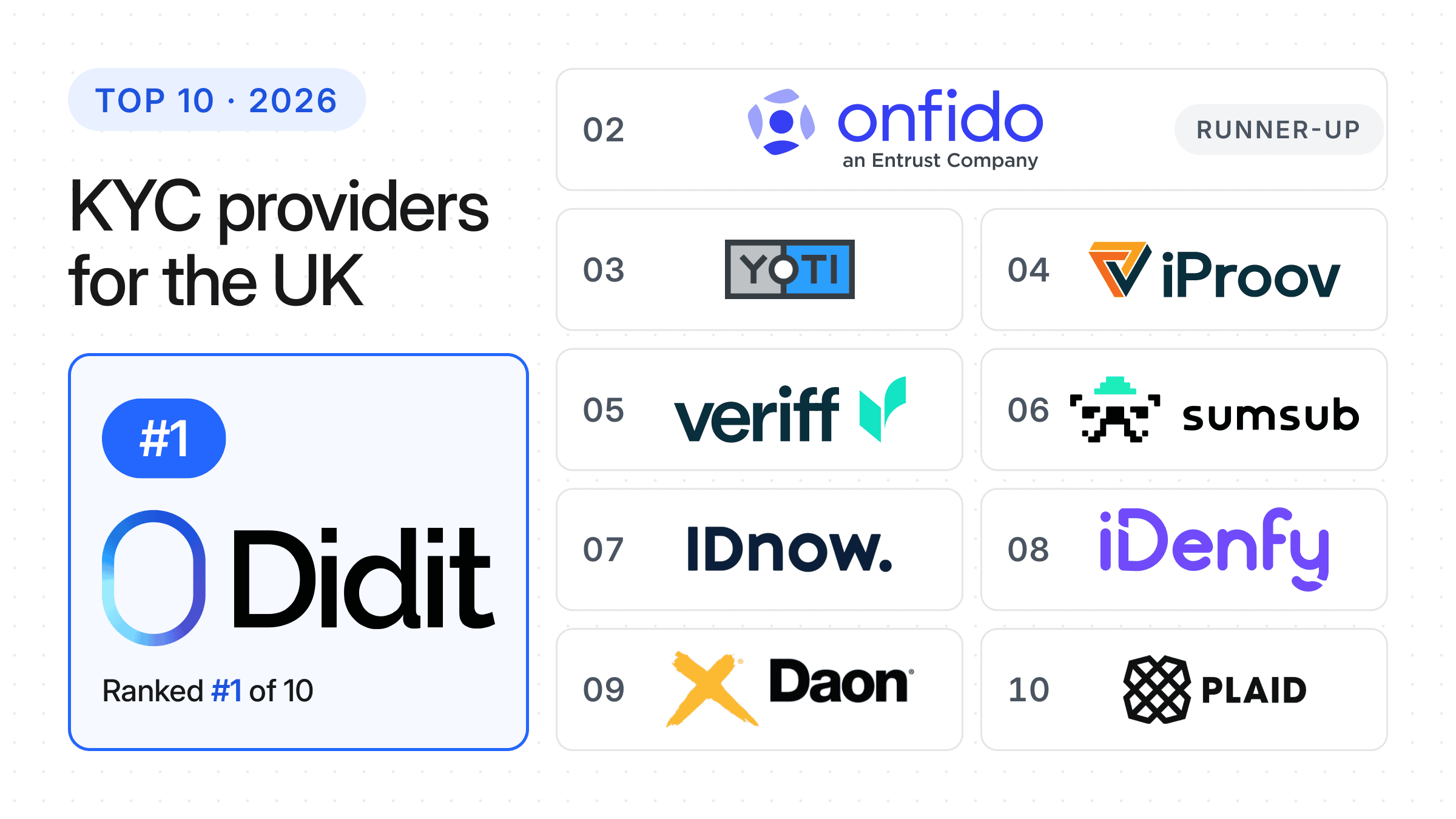
Didit is our #1 KYC provider for UK regulated firms: $0.33 per full KYC, $0.20 per AML screen, KYB from $2.00 per company, KYC and AML screening in one verification session. Sumsub and Onfido (Entrust) follow.
 Alberto RosasCo-founder and CEO
Contents
In this guide
Jump to the part you need.
We rank Didit first for FCA-supervised UK firms that want identity checks, AML screening and business verification with published prices. A completed full KYC check costs $0.33, AML screening costs $0.20 per check, and KYB registry retrieval starts at $2.00 per company. Your team configures the checks, review rules and evidence retention.
Last updated: November 26, 2026. Prices checked against the live Didit price feed on November 26, 2026.
| Rank | Provider | Best for | Price basis | Key capabilities | Main trade-off |
|---|---|---|---|---|---|
| 1 | Didit | UK firms that need KYC, KYB and monitoring from one vendor with published prices | Published per check: full KYC $0.33, AML $0.20 | Document, liveness, face match, device and IP analysis, 1,300+ AML lists, KYB with linked KYC, transaction monitoring, wallet screening | Your team configures the workflows |
| 2 | Sumsub | Teams evaluating identity verification, KYB, AML and transaction monitoring from one vendor | Basic $1.35 per verification, $149 monthly minimum | ID verification, business verification, AML screening, AML transaction monitoring, fraud prevention | Sumsub lists KYB and AML transaction monitoring. The reviewed page does not state their plan inclusion or unit prices. |
| 3 | Onfido (Entrust) | Enterprises already standardised on Entrust | Not published | Document and biometric verification, KYC, data verification, fraud detection, Workflow Studio | Identity verification pricing is not published on the page reviewed |
| 4 | Yoti | UK brands that need age checks and a reusable Digital ID alongside identity checks | Identity verification not published; eSignatures from £0.40 per document | Document verification with human review, age checks, Digital ID wallet, eSignatures | No published identity-check rate |
| 5 | iDenfy | Teams that want a published human-review add-on | Basic $1.35 per verification, $135 monthly minimum | ID verification, KYB, AML with ongoing monitoring, fraud prevention, proof of address | Base rate plus add-ons adds up fast |
| 6 | IDnow | Teams that need eID schemes alongside document and biometric verification. Confirm the specific schemes you need with IDnow. | Not published | Trust Platform, Identify, document and biometric verification, eID schemes | No public per-check price |
| 7 | iProov | Teams that want a liveness layer inside their own stack | Not published | Liveness detection, biometric solution suite, threat management | Not a full due diligence record on its own |
| 8 | Daon | Teams that need contact-centre authentication alongside onboarding | Pricing not published | Identity continuity, orchestration, KYC onboarding, authentication, contact centre authentication | No published price; free demo |
| 9 | Plaid | Firms whose primary need is bank data | Pay as You Go $0 a month; Identity unit rate not published | Auth, Balance, Identity, Identity Match, fraud protection | Identity is one product among many |
| 10 | Veriff | Not verifiable | Not verifiable | Not verifiable | Veriff. Details were not verifiable on November 26, 2026. |
How we picked
Didit publishes this ranking; we explain the criteria so you can check them.
Published identity-check prices and access to customer-level evidence carried the most weight. Use-case fit also affected the order. We ranked Onfido above iDenfy for buyers already standardised on Entrust, and Yoti above iDenfy for buyers who need age assurance and a reusable Digital ID.
- Published costs. Does the provider state a per-check or per-verification price, or only a quote route? Where a page says pricing is not published, we write that and nothing more.
- UK-relevant coverage. Document and biometric checks, plus what the non-document methods actually prove. We describe our own UK lookup as a file-based source rather than a government register because that is what the documentation says.
- Evidence trail. Can you pull the decision for a customer with its checks and scores attached, and export it when an auditor asks?
- Integration and migration. A public API, SDKs, webhooks, a free sandbox, and a way to test a switch before you cut over.
- Continuity. Whether the provider publishes enough about pricing and scope that you can forecast next year.
1. Didit: KYC, KYB and monitoring with published prices
Didit is our pick for UK firms that must show how a customer was identified, screened and then monitored, without paying for a discovery call to find out what it costs. We publish list prices per check, and one credit balance pays for every product.
A full KYC check is $0.33 and is three parts in one check: document verification at $0.15, biometrics at $0.15 (passive liveness $0.10 and 1:1 face match $0.05) and device and IP analysis at $0.03. We support 14,000+ document types across 220+ countries and territories. The verification flow is available in 54 languages. NFC chip reading is a $0.15 add-on, and every session carries 200+ real-time fraud signals.
AML screening is $0.20 per check against 1,300+ sanctions, PEP and watchlist sources plus adverse media. Each potential hit carries two scores: a match score for whether this is the same person, and a risk score for how risky that entity is. Ongoing monitoring is $0.07 per person per year.

KYB prices registry data by country and data tier, from $2.00 per company. Company AML is $0.20 per check, person AML is $0.20 per owner or officer, KYB document collection is $0.20 per step whatever the upload count, and key people extraction is free. Each owner takes a linked full KYC check at $0.33.

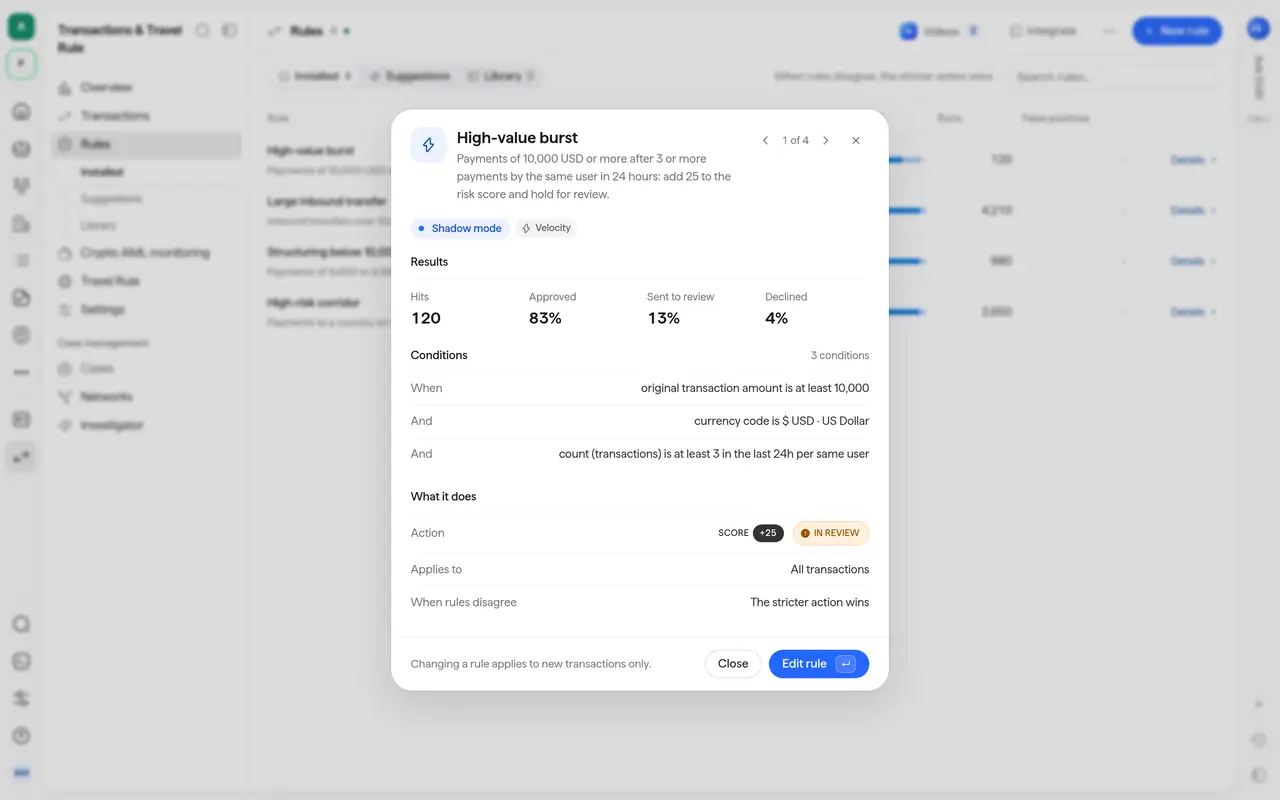
We combine KYC and AML screening in a verification session and link people's KYC checks to the business in KYB. Transaction monitoring is available in the same account, and one credit balance pays for all products. Transaction monitoring costs $0.001 per transaction beyond your plan's monthly allowance, with 1,000 included on Free, 10,000 on Growth and 100,000 on Scale. Wallet screening costs $0.15 per screening. On Growth and above, you can bring your own screening provider and run it inside Didit. Travel Rule messaging is $0.02 per outbound exchange. Growth includes our Investigator agent for reviews and follow-ups. Our decision endpoint returns the session decision, and you can connect your coding agent to our hosted MCP server with OAuth.
On UK data, be precise with your auditor. Our UK lookup uses a file-based source. Check the United Kingdom row in the non-document lookup docs for the exact source and record the returned id_lookup.source in your evidence. A data_match confirms a record match, with no document inspection. Google Wallet is available at $0.10 per completed verification. OneID carries a published rate of $2.75 and GOV.UK Wallet has no published rate; both are marked coming soon, so do not build a control around them today.
Plans: Free costs $0 a month. The first eligible organisation created with a work email for a company domain gets $10 in monthly credit. Phone codes are excluded. Growth is $99 a month with $115 of credit and a 4% discount on eligible prices. Scale is $299 a month with $350 of credit and a 10% discount on eligible prices. Transaction-monitoring overage stays at $0.001 per transaction on every plan. Carrier and Meta charges pass through at cost. Enterprise is a custom annual contract that starts at $15,000 a year. You pay only when a check finishes with a result, and the sandbox is free on every plan.
- We publish list prices for full KYC, AML and add-ons such as NFC chip reading. Non-document lookup rates vary, and Enterprise contracts are quoted.
- We combine KYC and AML screening in a verification session, link people's KYC checks to the business in KYB, and pay for every product from one credit balance.
- We are ISO/IEC 27001:2022 certified and share our SOC 2 Type 2 report under NDA. Spain's Tesoro, Banco de España and SEPBLAC attested that Didit verification is safer than in-person verification.
- 4,000+ companies use Didit.
- Our API, SDKs, webhooks and free sandbox let your engineers test the workflow you will run in production.
- Self-serve means your team does the build. The workflow builder is no-code. Your team defines the checks, configures review paths and tests the workflow before going live.
- Database validation and non-document lookup prices vary by country and method. Check the price for the lookup your workflow will use.
- The Spanish government attestation is an assurance point, not an FCA assessment of your firm.
Best for: FCA-supervised payment institutions, e-money institutions, registered cryptoasset businesses and lenders that must evidence customer and business due diligence from one vendor. Didit pricing pages, read November 26, 2026.
2. Sumsub: the broad compliance stack
Sumsub describes itself as trust infrastructure for compliance operations at scale, connecting identity, fraud, AML, transaction and case data into traceable workflows. It publishes plan prices, which puts it ahead of most of this list on transparency.
Products listed are ID Verification (KYC), Business Verification (KYB), AML Screening, AML Transaction Monitoring and Fraud Prevention. Basic is $1.35 per verification with a $149 monthly minimum commitment, Compliance is $1.85 per verification with a $299 minimum, and Custom pricing requires a quote.
Sumsub lists KYB and AML transaction monitoring. The reviewed page does not state their plan inclusion or unit prices.
Add-ons stated: email verification +$0.04 per applicant, phone verification +$0.04 per successful verification plus SMS fees, proof of address +$1.35 per check, automated data extraction +$0.06 per additional field, and SMS notification tiers from +$0.10 to +$0.63. A 14-day free trial includes 50 free checks, and charges apply only for successful verifications. The page claims 4,000+ clients and cites a Forrester study reporting 272% three-year ROI. No country list and no certifications appear on the page we read, and setup is described as friendly to AI coding agents.
- These are published rates for each vendor's own billing unit. Confirm included checks before comparing the cost of the same basket.
- No UK data-source detail and no certification list on the page we read.
Best for: Teams evaluating identity verification, KYB, AML and transaction monitoring from one vendor. Sumsub homepage, read November 26, 2026.
3. Onfido (Entrust): biometrics under the Entrust name
Onfido now sits inside Entrust and is sold as Entrust Identity Verification, which matters if your procurement already has an Entrust agreement. The page describes AI-powered biometric and document verification to onboard customers, prevent fraud and support compliance.
Products listed are Document Verification, Biometric Verification, KYC Compliance, Data Verification and Fraud Detection. The page says the solution detects deepfakes, synthetic identities, injection attacks and other advanced fraud. Workflow Studio Builder lets teams design onboarding journeys without code, the page states integrations with Microsoft Entra Verified ID and Okta Workforce Identity, and the offering can run standalone or extend across account recovery, high-risk transaction protection, biometric authentication, digital signing and workforce verification.
Identity verification pricing is not published on the page reviewed. Ask Entrust for unit rates, minimum commitments and add-on prices. Certifications were not listed on the page we read either.
- Strong fit where Entrust is already an approved vendor.
- Workflow Studio covers no-code journey design.
- Extends past onboarding into authentication and signing.
- Identity verification pricing is not published on the page reviewed.
- No AML screening, KYB or transaction monitoring described on the page we read.
- Certification and coverage detail is not on the page, which lengthens a UK due diligence pack.
Best for: large enterprises and banks that already buy from Entrust and want biometric onboarding inside that relationship. Onfido (Entrust) homepage, read November 26, 2026.
4. Yoti: identity checks plus reusable Digital ID and age assurance
Yoti combines automated document verification with expert human review, age checks, a reusable Digital ID wallet and eSignatures. The page states over 50 million checks every month, a 95% success rate and 27 million Digital ID wallet downloads, and describes a partnership with the Post Office for online and in-person identity verification in the UK.
Identity verification pairs automation with human review, anti-spoofing and deepfake protection, and the age product combines facial age estimation with seven alternative checks in one integration.
Identity verification pricing is not published. The published eSignature rate starts at £0.40 per document, with a free trial. The page lists a NIST evaluation of its passive liveness and independent tests of its facial age estimation stated to minimise bias across age and skin tones, which we treat as evaluations rather than certifications, and describes SICAP separately as a patented injection attack detection tool.
- UK presence through the Post Office relationship, which some boards value.
- Age checks and a reusable Digital ID alongside document checks.
- eSignatures from £0.40 per document.
- No published identity-check rate.
- No AML screening or KYB pricing visible on the page we read.
- The £0.40 figure covers eSignatures, not identity checks, so it cannot anchor a KYC budget.
Best for: UK retailers, gambling operators, social platforms and publishers that need age assurance plus identity checks and a reusable wallet. Yoti homepage, read November 26, 2026.
5. iDenfy: human review as an itemised add-on
iDenfy provides AI identity verification with biometric face matching and human review for KYC, KYB and AML, and it publishes more add-on prices than most of this list.
Products listed are identity verification with face match and liveness, KYB, AML verification with ongoing monitoring, fraud prevention and proof of address. Coverage is stated as 200+ countries and territories, 16,000+ government-issued documents and 180+ company registries, with an average 60-second verification and 24/7 human supervision within three minutes.
ISO 27001 and SOC 2 commitments are written into the contract. Separately, the page states up to $1 million of cyber insurance and a 99.9% uptime SLA, which are commercial terms rather than certifications.
Basic is $1.35 per verification with a $135 monthly minimum. 24/7 manual review is listed as a +$0.55 add-on. Other add-ons are 3D face liveness +$0.25, approved-only billing +$0.50, proof of address +$1.00, sanctions and PEP checks +$0.50, face and document duplicate detection +$0.10, SMS verification +$0.10, biometric and document blocklist +$0.10 and IP proxy risk +$0.15. Two checks are US only: criminal background +$2.00 and AAMVA driver verification +$2.00.
- Add-on prices are public, so a UK basket can be modelled.
- A human-review add-on listed at +$0.55.
- Contractual certification commitments and an uptime SLA.
- $1.35 base plus a $0.50 sanctions and PEP check reaches $1.85 before liveness or review.
- Ongoing monitoring is described, but no per-year price is published on the page.
- The two US-only checks do not apply to a UK book.
Best for: Teams that want a published human-review add-on. iDenfy homepage, read November 26, 2026.
6. IDnow: document and biometric verification with eID schemes
IDnow provides a scalable identity and trust product that combines adaptive compliance, real-time fraud prevention and end-to-end trust across identity verification, risk insights, authentication, fraud prevention and electronic signatures.
Products listed are Trust Platform, Identify, Document Verification, Biometric verification and eID Schemes. The page states 371+ documents supported globally, 14 million+ completed transactions annually, 76+ identification specialists and 59+ customers.
Pricing is not published on the page we read. There is no per-check rate, minimum or add-on price to compare, and procurement will need a quote for your own volume. Certifications were not listed on the page.
- eID schemes sit alongside document and biometric checks.
- Document breadth and a large identification specialist team.
- No published price of any kind.
- AML screening, KYB and monitoring are not described on the page we read.
- UK-specific data sources are not documented on the page.
Best for: Teams that need eID schemes alongside document and biometric verification. Confirm the specific schemes you need with IDnow. IDnow homepage, read November 26, 2026.
7. iProov: the liveness layer
iProov provides biometric solutions for onboarding and authenticating users, using liveness detection and threat management to defend against deepfakes and identity fraud. It is a specialist layer, not a due diligence record, and for a UK bank that distinction is the point.
Products listed are Liveness Detection, Physical Access, Workforce and a Biometric Solution Suite. iProov states its own position: eIDAS Level of Assurance High, an ISO/IEC 30107-3 listing, SOC 2 Type II, certified G-Cloud supplier status, and stated WCAG 2.2 AA compliance. The page lists case studies with the US Department of Homeland Security, UBS and Rabobank, and describes its focus as liveness, deepfakes and identity fraud.
Pricing is not published on the page we read, and the pricing page returned an error message.
- G-Cloud supplier status helps UK public sector buying.
- An ISO/IEC 30107-3 listing and stated WCAG 2.2 AA compliance.
- iProov describes liveness and threat management for defence against deepfakes and identity fraud.
- Not a KYC, KYB or AML record on its own, so the identity evidence has to live somewhere else.
- No published price.
- If you use iProov for liveness, check how its result will reach the system where you retain identity evidence and screening decisions.
Best for: banks and government-facing teams that already own the identity record and want a liveness layer underneath it. iProov homepage, read November 26, 2026.
8. Daon: contact-centre authentication alongside onboarding
Daon provides identity infrastructure for verifying who a user is and confirming intent across channels, covering verification, authentication, contact centre authentication, age verification, deepfake defence and travel document validation.
Products listed are Identity Continuity, Identity Orchestration Platforms, Identity Verification for KYC onboarding, Identity Authentication and Contact Center Authentication. The homepage promotes a free demo.
Pricing is not published on the page we read, and the pricing page portion returned an error.
- Contact centre authentication alongside onboarding is the specific fit for a bank or insurer with a large service estate.
- Orchestration across channels suits a large estate.
- A free demo before procurement.
- Pricing is not published, so forecasting needs a conversation.
- AML screening and KYB depth are not documented on the page we read.
- A demo does not replace a written scope.
Best for: teams that need contact-centre authentication alongside onboarding. Daon homepage, read November 26, 2026.
9. Plaid: financial data first, identity second
Plaid describes itself as the largest financial network, offering APIs and products for bank payments, credit scoring and underwriting, fraud protection, instant onboarding and personal financial management.
Products listed are Auth, Balance, Identity, Identity Match and Investments Move. The page states 12,000 financial institutions across 20 countries, that 1 in 2 banked adults in the US use Plaid, over one million daily connections, a claim of 25% higher onboarding conversion and a free sandbox.
Plaid lists bank data and identity products. Pay as You Go has a $0 monthly fee, with no published Identity unit rate. Growth offers discounted rates with an annual commitment. Custom rates depend on commitment, and no figures are published.
- Bank account data and identity products from one vendor.
- Pay as You Go with no monthly commitment.
- Free sandbox for testing.
- No published Identity unit rate, so the KYC line cannot be budgeted from the page.
- Document and biometric verification are not the core of the offering.
- AML screening, KYB and ongoing monitoring are not described on the page.
Best for: UK lenders and fintechs whose primary need is bank data and who want identity from the same vendor. Plaid homepage, read November 26, 2026.
10. Veriff
Veriff. Details were not verifiable. Veriff homepage, read November 26, 2026.
What 10,000 UK onboardings a month costs at list prices
Here is a basket at our published list prices in USD before tax, on the Free plan and before any eligible monthly credit. The customers are hypothetical and the arithmetic is shown so you can change the assumptions.
| Line | Arithmetic | Monthly cost |
|---|---|---|
| Full KYC check | 10,000 x $0.33 | $3,300.00 |
| AML screening, one per customer | 10,000 x $0.20 | $2,000.00 |
| Proof of address, 1 customer in 5 | 2,000 x $0.20 | $400.00 |
| Transaction monitoring, 200,000 transactions, minus the 1,000 included on Free | 199,000 x $0.001 | $199.00 |
| Monthly total | 3,300 + 2,000 + 400 + 199 | $5,899.00 |
If the organisation qualifies for the $10 monthly credit, subtract it and the month comes to $5,889.00. At the $0.07 list rate per person per year, one cohort of 10,000 screened customers costs $700 to monitor for one year. Each additional cohort of 10,000 adds $700 for a full year of monitoring.
On the Scale plan the same basket looks like this. Full KYC at the 10% discount is 10,000 x $0.297 = $2,970.00. AML screening is 10,000 x $0.18 = $1,800.00. Proof of address is 2,000 x $0.18 = $360.00. Scale includes 100,000 monitored transactions, so the billable balance is 100,000 x $0.001 = $100.00. That subtotals $5,230.00. The $350 monthly credit reduces it to $4,880.00, and the $299 plan fee brings the month to $5,179.00.
For contrast, at published competitor rates and with each vendor's own bundle: 10,000 completed Didit checks at $0.33 is $3,300.00 for a full KYC check that includes document verification, passive liveness, 1:1 face match and device and IP analysis. 10,000 successful Sumsub verifications at $1.35 is $13,500.00 on the Basic plan as published. 10,000 iDenfy Basic verifications at $1.35 is $13,500.00, before iDenfy's $0.50 sanctions and PEP add-on, which adds $5,000.00 if you take it. These are published rates for each vendor's own billing unit. Confirm included checks before comparing the cost of the same basket.
At 1,000 customers a month, without proof of address, the basket assumes 10,000 monitored transactions before the Free allowance, so it is 1,000 x $0.33 = $330.00 plus 1,000 x $0.20 = $200.00, so $530.00, plus 9,000 transactions x $0.001 = $9.00, for $539.00. At 50,000 customers it assumes 500,000 monitored transactions before the Free allowance: 50,000 x $0.33 = $16,500.00 plus 50,000 x $0.20 = $10,000.00, so $26,500.00, plus 499,000 transactions x $0.001 = $499.00, for $26,999.00. An eligible Free organisation can use the $10 monthly credit for about 30 full KYC checks if it spends the credit on those checks alone. Once the credit runs out, further checks draw from its top-up balance.
Which one to pick
- You need a costed basket before the first call. We publish full KYC at $0.33, AML at $0.20 and KYB from $2.00, so the arithmetic on this page is yours to rerun. The trade-off is that your team configures the workflow.
- You need KYB tied to each owner's KYC. We link a $0.33 full KYC check and $0.20 person AML to each owner on a registry check from $2.00. Sumsub and iDenfy also list KYB, though the Sumsub page we reviewed does not state plan inclusion or unit prices for it. Ask Sumsub to itemise KYB and AML transaction monitoring before you commit.
- Your procurement already runs through Entrust. If Entrust is already an approved supplier, ask whether your agreement covers Entrust Identity Verification. Confirm unit rates, minimum commitments and add-on prices.
- You want identity, KYB, AML and transaction monitoring evaluated together. Sumsub publishes plan prices from $1.35 and $1.85 per verification with $149 and $299 monthly minimums, and lists KYB and AML transaction monitoring. Confirm what each plan includes before you commit.
- You need human review as a line item. iDenfy lists 24/7 manual review as a +$0.55 add-on, on a $1.35 base with a $135 monthly minimum, and the price is visible before you talk to anyone.
- You sell to under-25s or run age-restricted services. Yoti pairs age checks with identity verification and a reusable Digital ID, with eSignatures from £0.40 per document and no published identity-check rate.
- You need a specific eID scheme. IDnow lists eID schemes alongside document and biometric checks. Confirm the specific schemes you need.
- You want liveness inside your own stack. iProov states its liveness credentials, and you should map how its result reaches the system where you keep identity evidence.
- Contact-centre authentication matters as much as onboarding. Daon covers both and offers a free demo, with pricing not published.
- Bank account data is the primary need. Plaid covers that well, with Identity as one product among many and no published unit rate.
How a UK firm goes live on Didit
The build is short enough to test in an afternoon on the free sandbox, and every step below is documented.
- Create the workflow with
POST /v3/workflows/or in the console. The workflow type, KYC or KYB, decides which session is created; there is no separate endpoint for KYB. - Create a session with
POST /v3/session/, passingworkflow_idand your ownvendor_dataidentifier. The response returns asession_id, a hostedurland asession_token. The Quick Start and the Create Session reference cover the full request. - Register a signed webhook with
POST /v3/webhook/destinations/, store thesecret_shared_key, verify theX-Signature-V2header on every delivery, de-duplicate onevent_idand answer within five seconds. - Retrieve the decision with
GET /v3/session/{session_id}/decision/as a fallback. Version 3 returns arrays such asid_verifications[],liveness_checks[]andaml_screenings[], so parse the plural fields.

What a UK due diligence file should hold
- Source provenance. For a non-document match, record the returned
id_lookup.sourceand name the method. Regulation 28 of the Money Laundering Regulations 2017 is the reference your compliance team will reach for. - Keep the documents and information used to meet your customer due diligence obligations, along with enough supporting records to reconstruct transactions subject to due diligence or ongoing monitoring. Keep the session decision payload, AML hits with both scores, workflow version and timestamps as part of your audit trail. Free includes one year of data retention. Enterprise retention is set by contract. Check your applicable retention period and start date under Regulation 40, then confirm your plan or records system can preserve the required evidence for that period.
- Exception handling. The review path for a possible match, who approved it, when, and what evidence was attached, held in case management rather than in an inbox.
- Who reviews potential matches. A named role with thresholds written into your policy. Following FATF guidance and FCA expectations does not transfer the decision to a supplier.
- Supplier oversight. Certifications, the SOC 2 Type 2 report under NDA, and a written scope of which checks run for which customer type.
Sources
- Didit pricing page and pricing as JSON, read November 26, 2026.
- Didit docs: identity verification pricing and plans, read November 26, 2026.
- Didit docs: Quick Start, read November 26, 2026.
- Didit docs: Create Session API, read November 26, 2026.
- Didit docs: AML screening overview, read November 26, 2026.
- Didit docs: KYB supported countries and data tiers, read November 26, 2026.
- Didit docs: non-document identity lookup and named sources per country, read November 26, 2026.
- Didit docs: ID verification overview, read November 26, 2026.
- Didit phone verification price list, read November 26, 2026.
- Didit MCP server and switch to Didit, read November 26, 2026.
- Regulation 28, Money Laundering, Terrorist Financing and Transfer of Funds (Information on the Payer) Regulations 2017, legislation.gov.uk.
- Regulation 39 of the Money Laundering Regulations 2017, legislation.gov.uk.
- Regulation 40 of the Money Laundering Regulations 2017, legislation.gov.uk.
- Financial Conduct Authority, for supervision scope.
- FATF, for the international standards behind UK obligations.
- Sumsub homepage, sumsub.com, read November 26, 2026.
- Onfido (Entrust) homepage, onfido.com, read November 26, 2026.
- Yoti homepage, yoti.com, read November 26, 2026.
- iDenfy homepage, idenfy.com, read November 26, 2026.
- IDnow homepage, idnow.io, read November 26, 2026.
- iProov homepage, iproov.com, read November 26, 2026.
- Daon homepage, daon.com, read November 26, 2026.
- Plaid homepage, plaid.com, read November 26, 2026.
- Veriff homepage, read November 26, 2026.
Open the console at business.didit.me and build the workflow yourself in the free sandbox. No sales call, no demo booking, and you can price your own basket before you speak to anyone.
Try it
Try this in the sandbox
Run the check this guide describes, free.
The product this post is about, taken from its topic. Run it free in the sandbox.
Author
Alberto Rosas
Co-founder and CEO

Keep reading
Other guides in the same topic.
 What Is the Purpose of FICA in South Africa? 2026 Guide
FICA is South Africa's anti-money laundering law. It creates the Financial Intelligence Centre and requires accountable institutions to identify and verify clients, screen for PEP and sanctions risk and report suspicious.
Alberto RosasNov 26, 2026 Sixth Money Laundering Directive (6AMLD): What Changed and Which Rules Apply
6AMLD is Directive (EU) 2018/1673: Member States must criminalise laundering, widen predicate offences and set a four-year penalty floor. It adds no new due diligence duties for firms.
Alberto RosasNov 26, 2026 Automated Sanctions Screening: Canada, the Entity List and Embargoes
Automated sanctions screening matches people and companies against lists such as Canada's autonomous sanctions made under SEMA and JVCFOA and the OFAC SDN List, and returns candidate hits scored for identity confidence and.
Alberto RosasNov 26, 2026Questions
Frequently asked questions
What is the best KYC provider for a UK business in 2026?
It depends on whether you need a due diligence record or a component. For an FCA-supervised firm that must evidence customer and business due diligence together, Didit is our pick because we publish the prices and combine KYC and AML screening in one verification session. If you already buy from Entrust or need age assurance, Onfido (Entrust) and Yoti are the better fit.
Which KYC providers publish a price per check?
Three providers publish an identity-check unit rate. Six reviewed providers do not publish one, and Veriff's details were not verifiable. Didit publishes $0.33 for a full KYC check, Sumsub starts at $1.35 per verification and iDenfy at $1.35. The six without a published identity-check rate include Onfido (Entrust), Yoti, IDnow, iProov, Daon and Plaid's identity product.
Can one vendor cover both KYC and KYB compliance for a UK business?
One vendor can supply both KYC and KYB checks. Your firm remains responsible for deciding which checks and evidence meet its obligations. We combine KYC and AML screening in a verification session and link people's KYC checks to the business in KYB: registry retrieval starts at $2.00 per company and varies by country and data tier, company AML is $0.20, person AML is $0.20 per owner, and each owner takes a linked $0.33 KYC check. Transaction monitoring is available in the same account, and one credit balance pays for all products. Sumsub and iDenfy also list KYB, though the Sumsub page we reviewed does not state plan inclusion or unit prices.
What should a UK firm check before choosing an AML KYC service provider?
Check the list count behind sanctions and PEP screening, how ongoing monitoring is billed, whether the screening result stays attached to the verification session, and whether you can export the decision. We publish 1,300+ lists and $0.07 per person per year for ongoing monitoring, and our decision endpoint returns the session decision. Where a page publishes no list count, ask for it in writing before you sign.
How do AML providers differ on sanctions and PEP screening?
The differences that matter are list coverage, how hits are scored and whether monitoring continues after onboarding. We return a match score for identity confidence and a risk score for entity risk. Configure thresholds to route possible matches for review under your screening policy. Providers that publish no list count on their page should be asked for it in writing.
Are outsourced KYC teams a real alternative to hiring analysts?
Partly. iDenfy lists 24/7 manual review as a +$0.55 add-on, a published line item you can weigh against an analyst's loaded cost. Confirm the billing unit with iDenfy before you compare it with staffing costs. We take a different route: Growth includes our Investigator agent for reviews and follow-ups, which supports a reviewer rather than replacing the decision. Outsourcing the review work is not the same as formally relying on another firm under Regulation 39. Either way your firm remains responsible for its compliance decisions, so check which appointment and oversight requirements apply to you.
Does a KYC provider need to be FCA authorised?
Whether a supplier needs FCA authorisation depends on the activities it carries out. Your firm remains responsible for the customer due diligence obligations that apply to it. Review Regulation 28 of the Money Laundering Regulations 2017 and confirm the supplier's scope and evidence with your compliance team. On assurance, we are ISO/IEC 27001:2022 certified and share our SOC 2 Type 2 report under NDA.
How do we migrate from our current provider without a gap?
Run the same approved test cases through both workflows and compare decision fields, review outcomes and evidence exports. Then move a small share of new traffic and compare aggregate approval, referral and completion rates against the incumbent cohort. Keep a rollback route. Map your workflows, webhooks and decision fields before you raise the share, and reconcile the results against your own export. Our switch page sets out how teams move across.
Which providers can verify a UK customer without a document?
Didit verifies a UK customer without a document through a non-document lookup or a digital ID wallet. Our UK lookup uses a file-based source. Check the United Kingdom row in the non-document lookup docs for the exact source and record the returned id_lookup.source in your evidence. A data_match confirms a record match, with no document inspection, and Google Wallet is available at $0.10 per completed verification, while OneID at $2.75 and GOV.UK Wallet at no published rate are coming soon. Among the reviewed alternatives, Yoti states a reusable Digital ID wallet and IDnow lists eID schemes; neither card establishes which specific UK method it supports, so ask the vendor.
What does KYC cost per customer for a UK fintech?
On our list prices, a full KYC check plus one AML screen is $0.33 + $0.20 = $0.53 per customer. At the $0.07 list rate per person per year, one cohort of 10,000 screened customers costs $700 to monitor for one year. Each additional cohort of 10,000 adds $700 for a full year of monitoring. Sumsub Basic is $1.35 per successful verification with a $149 monthly minimum. iDenfy Basic is $1.35 per verification with a $135 monthly minimum. iDenfy lists approved-only billing as a $0.50 add-on.
Compliance built in
Audited, certified and attested.
We hold the certifications and build each country's rules into your flows, so you can launch anywhere without worrying. Security and Compliance center
- Regulation encoded into your flows
Tell us what you do and where. Didit lists the rules that apply to you, with sources, and builds the checks each country needs into one workflow.
- Ready for AMLR
Every requirement of the new EU anti-money laundering rules, from checking customers to human review, is already covered by a Didit check.
- Tested in Spain's Treasury sandbox
Spain's Treasury published its supervised sandbox report on Didit's NFC plus active liveness onboarding; SEPBLAC took part and valued the added measures positively.
- Audited, not self-declared
iBeta Level 1 and Level 2. Liveness tested under ISO/IEC 30107-3.
Your obligations · 3 regions
 SOC 2 Type 2
 ISO 27001
 iBeta Level 1 and Level 2
 EU regulator attestation
 FSM youth protection
 GDPR
 EBA remote onboarding
 MiCA compatible
 FIDO Alliance member
- AMLREU AML Regulation ready
Integration · Didit MCP
Run Didit from your own AI agent
Connect Didit to Claude, Cursor, VS Code or ChatGPT and just ask in plain words. Your agent can do anything you can do in the console, with the same permissions you have.
 Add to Claude
 ChatGPT
 Cursor
- Build workflowsDescribe the checks you need. The agent creates and publishes the flow.
- Run investigationsAsk why a session was declined, review cases, search people and companies.
- Change rulesCreate payment rules, test them on past data and switch them on.
- Pull reportsAsk for numbers, exports or the audit log.
Didit Academy


