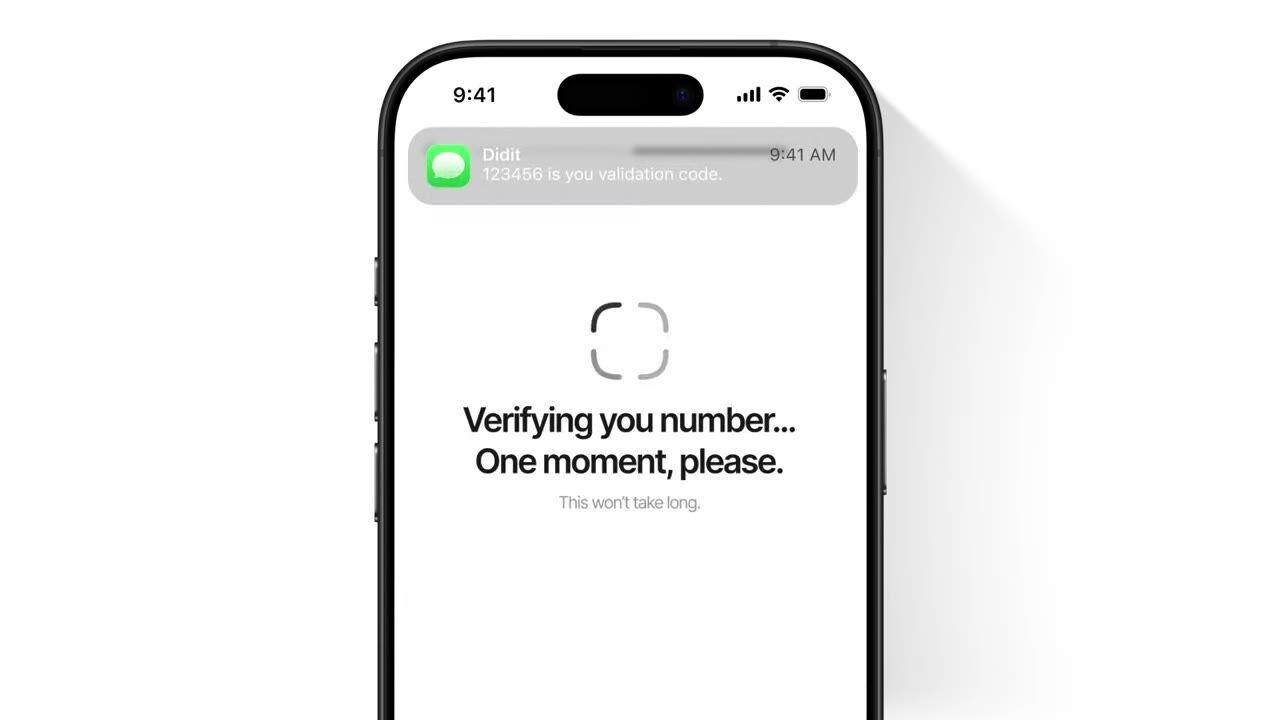
Verifikasi telepon apa pun. Di channel mana pun yang mereka jawab.
Kirim kode sekali pakai melalui SMS, WhatsApp, Telegram, RCS, atau suara, channel mana pun yang benar-benar dijawab pengguna. Auto-fallback antar channel, dengan penilaian risiko operator di setiap panggilan. Mulai dari $0.03 ditambah operator.
Dipercaya oleh 3.000+ organisasi di seluruh dunia.
Lima channel
SMS. WhatsApp. Telegram. RCS. Voice.
Satu modul, lima jalur pengiriman. Kami akan mencoba ulang di berbagai channel sampai kode
terkirim, menilai risiko SIM-swap dan operator di setiap panggilan, dan menagih mulai dari $0.03 ditambah
operator, alur kerja tetap sama.
Cara kerjanya
Dari pendaftaran hingga pengguna terverifikasi dalam empat langkah.
Langkah 01 / 04
01
Buat alur kerja
Pilih pemeriksaan yang Anda inginkan, ID, liveness, pencocokan wajah, sanksi, alamat, usia, telepon, email, pertanyaan kustom. Seret ke alur di dashboard, atau kirim alur yang sama ke API kami. Buat cabang berdasarkan kondisi, jalankan A/B test, tanpa perlu coding.
Integrasi
Integrasikan secara native dengan SDK Web, iOS, Android, React Native, atau Flutter kami. Redirect ke halaman yang di-host. Atau cukup kirim tautan ke pengguna Anda, via email, SMS, WhatsApp, di mana saja. Pilih yang sesuai dengan stack Anda.
Pengguna melewati alur
Didit meng-host kamera, isyarat pencahayaan, mobile hand-off, dan aksesibilitas. Saat pengguna dalam alur, kami menilai 200+ sinyal fraud secara real-time dan memverifikasi setiap bidang terhadap sumber data otoritatif. Hasilnya dalam waktu kurang dari dua detik.
Anda menerima hasilnya
Webhook terautentikasi secara real-time menjaga database Anda tetap sinkron saat pengguna disetujui, ditolak, atau dikirim untuk ditinjau. Lakukan polling API sesuai permintaan. Atau buka konsol untuk memeriksa setiap sesi, setiap sinyal, dan mengelola kasus sesuai keinginan Anda.
Dibuat untuk developer · Dibuat untuk melawan fraud · Desain terbuka
Enam kapabilitas. Satu feature flag. PHONE.
Setiap kapabilitas adalah toggle pada modul yang sama. Tanpa tingkatan upsell, tanpa paket terpisah, tanpa panggilan add-on. Aktifkan per workflow di konsol atau teruskan secara inline pada panggilan API.
SMS, WhatsApp, Telegram, RCS, dan voice, semuanya pada modul dan workflow yang sama. Tetapkan channel jika kebijakan mengharuskan (SMS yang diwajibkan regulator, pasar yang mengutamakan WhatsApp seperti Brasil dan India), atau biarkan kami memilih hop pengiriman termurah.
Satu feature flag · Lima channelfitur: PHONE
SMSDefault
WhatsAppBR / IN / MX
TelegramEU
RCSAndroid
VoiceFallback
02 · Routing
Fallback channel otomatis jika salah satu gagal.
Blokir SMS operator, negara dengan tarif premium, dan kegagalan senyap secara otomatis dilewati. Kami mencoba lagi pada channel pengiriman berikutnya tanpa kode Anda menyentuh apa pun, dan memberi tahu Anda channel mana yang benar-benar berhasil mengirim.
Routing channel otomatisPOST /v3/phone/send/
1SMSOperator diblokir
2WhatsAppTerkirim
verification_methodwhatsapp
03 · Cakupan
Jangkauan telco global. Pengiriman yang sadar operator.
Integrasi multi-operator per negara, dengan routing yang disesuaikan dengan kebiasaan lokal, WhatsApp memimpin di Brasil, India, dan Meksiko, Telegram dan RCS memimpin di seluruh UE, SMS memimpin di AS. Negara, operator, dan jenis nomor terdeteksi secara otomatis.
04 · Sinyal fraud
Lebih dari sekadar kode satu kali. Risiko operator pada setiap panggilan.
Setiap verifikasi mengembalikan nama dan jenis operator (seluler, telepon rumah, voice over IP), flag untuk nomor sekali pakai dan virtual, serta peringatan eksplisit untuk nomor berisiko tinggi, duplikat, atau yang masuk daftar hitam. Putuskan, tinjau, atau setujui per kategori risiko.
05 · Konversi
SMS-only membuat pengguna bocor. Multi-channel mempertahankan mereka.
Ketika SMS gagal, filter operator, roaming, zona mati, penurunan kemampuan pengiriman, penyedia single-channel membuat pengguna menunggu kode yang tidak pernah tiba. Kami memulihkan mereka pada hop berikutnya, dan melaporkan channel mana yang berhasil mengirim sehingga Anda dapat menyesuaikan routing dengan data nyata.
Penyelesaian · 30 hari bergulirLebih tinggi lebih baik
SMS saja58%
+ WhatsApp79%
+ Voice fallback93%
Ilustratif, sebagai panduan, bukan studi.
06 · Harga
Bayar per pesan. Mulai dari $0.03 ditambah biaya operator.
$0.03 per verifikasi, ditambah biaya operator negara dan channel yang diteruskan tanpa markup. Anda hanya membayar saat pesan terkirim, pembatalan sebelum pengiriman tidak dikenakan biaya.
Tarif per pesanMulai $0.03
Amerika SerikatSMS$0.03
BrasilWhatsApp$0.04
IndiaWhatsApp$0.05
Bayar hanya saat pesan terkirim.
Integrasi
Dua endpoint. JSON yang sama. Harga yang sama.
Pilih alur yang di-host jika Anda ingin kami menangani input nomor, UX kode, dan pengiriman ulang. Pilih API mandiri jika Anda mengelola UX. Keduanya mengembalikan laporan yang sama.
Selesaikan Verifikasi Telepon hanya dengan satu prompt.
Tempel blok di bawah ini ke Claude Code, Cursor, Codex, Devin, Aider, atau Replit Agent. Isi stack Anda. Agen akan menyediakan Didit, membuat workflow Verifikasi Telepon, menghubungkan webhook, dan menyelesaikannya.
didit-integration-prompt.md
# Didit Phone Verification — integrate in 5 minutes

You are integrating Didit's Phone Verification module into <my_stack>.
Follow these steps exactly. Every URL, header, and enum value below is
canonical — do not paraphrase or "improve" them.

## 1. Provision an account
- Sign up: https://business.didit.me (no credit card required).
- Or provision programmatically: POST https://apx.didit.me/auth/v2/programmatic/register/
  (returns an API key bound to the workspace + application).

## 2. Two integration paths — pick one

### Path A — Workflow Builder (hosted UI)
Best when you want Didit to handle phone collection, country prefix UX,
channel routing, OTP entry, resend buttons, mobile/desktop handoff, and
accessibility for you.

1. Create a workflow that contains the PHONE feature:
   POST https://verification.didit.me/v3/workflows/
   Authorization header:  x-api-key: <your-api-key>
   Body: workflow_label, features array with the single entry
         { feature: "PHONE" }   (UPPERCASE — strict enum)
   Optional config: preferred_channel ("SMS" | "WHATSAPP" | "TELEGRAM" |
   "RCS" | "VIBER" | "CALL"), code_validity_seconds, max_code_attempts
   (default 2), max_resend_requests_per_24h (default 2).

2. Create a verification session for an end user:
   POST https://verification.didit.me/v3/session/
   Body: workflow_id (from step 1), vendor_data (your own user id),
         optional contact_details.phone in E.164 format
         (e.g. "+14155552671") to pre-fill and lock the number.
   Response: url (the hosted verification link) — redirect the user to it.

3. Listen for webhook callbacks (see "Webhooks" below).

### Path B — Standalone server-to-server API
Best when you already own the phone-entry UX (mobile SDK, native
onboarding app, reseller pipeline) and want Didit to handle OTP delivery
+ risk scoring only. Two endpoints, called in sequence:

Step 1 — Send the code:
POST https://verification.didit.me/v3/phone/send/
Content-Type: application/json
Body fields:
  - phone_number  (required, string, E.164 format e.g. "+14155552671")
  - channel       (optional — "SMS" | "WHATSAPP" | "TELEGRAM" | "RCS" |
                   "VIBER" | "CALL". Omit to let Didit pick the best
                   available channel for the destination country and
                   carrier — automatic fallback routing.)
  - vendor_data   (optional, your user id for cross-session linkage)

Step 2 — Check the code:
POST https://verification.didit.me/v3/phone/check/
Content-Type: application/json
Body fields:
  - phone_number  (required, same E.164 number)
  - code          (required, the OTP the user typed)
  - vendor_data   (optional, same user id used in Step 1)

Response: JSON report — status, verification_method (the channel that
actually delivered), carrier object, is_disposable, is_virtual, warnings
array.

## 3. Channel routing — how the automatic fallback works
When channel is omitted on /v3/phone/send/, Didit picks the cheapest
+ most-deliverable channel for the destination:
  - SMS where deliverable and lowest cost (most countries)
  - WhatsApp in BR / IN / MX and other WhatsApp-dense markets
  - Telegram / RCS / Viber where carrier-side SMS is blocked or premium
  - CALL (voice OTP) as last-resort fallback when text channels fail
Each retry attempt may switch channels — the final delivery channel is
returned as verification_method in the report.

## 4. Webhooks (Path A only — Path B returns synchronously)
- Register a webhook destination once via
  POST https://verification.didit.me/v3/webhook/destinations/
  Body: url, subscribed_events: ["session.verified", "session.review_started",
                                  "session.declined"]
- Response includes secret_shared_key — store it.
- Every webhook delivery carries an X-Signature-V2 header you MUST verify
  before trusting the payload.  HMAC-SHA256 verification MUST run against the raw body bytes (the raw payload as Didit sent it) BEFORE any JSON parsing — re-serialising the parsed body changes whitespace and key order, which invalidates the signature.Algorithm:
    1. sortKeys(payload) recursively
    2. shortenFloats (truncate trailing zeros after the decimal point)
    3. JSON.stringify the result
    4. HMAC-SHA256 with the secret_shared_key
    5. Hex-encode, compare to the X-Signature-V2 header.

## 5. Reading the report (both paths return the same phone object)
- status: "Approved" | "Declined" | "In Review" | "Not Finished"
- phone_number_prefix: country prefix in international format ("+34")
- phone_number: subscriber number without the prefix
- full_number: full E.164 string ("+34600600600")
- country_code: ISO 3166-1 alpha-2 ("ES")
- country_name: full country name
- carrier: { name, type: "mobile" | "landline" | "voip" | "unknown" }
- is_disposable: boolean — temporary or throwaway number
- is_virtual: boolean — VoIP or virtual provider
- verification_method: the channel that actually delivered the code
  ("sms" | "whatsapp" | "viber" | "telegram" | "call")
- verification_attempts: number of code-entry tries
- verified_at: ISO 8601 timestamp
- warnings: Array<{ risk, log_type, short_description, long_description }>

Auto-decline risks (always enforced by Didit, not configurable):
- VERIFICATION_CODE_ATTEMPTS_EXCEEDED
- HIGH_RISK_PHONE_NUMBER
- PHONE_NUMBER_IN_BLOCKLIST

Configurable risks (action per workflow — Decline, Review, or Approve):
- DISPOSABLE_NUMBER_DETECTED
- VOIP_NUMBER_DETECTED
- DUPLICATED_PHONE_NUMBER

## 6. Attempt limits (defaults — overridable per workflow)
- Max code-entry attempts: 2 per session
- Max resend requests: 2 per phone number per 24 hours
- Code validity: 5 minutes from send
Hitting either limit fires VERIFICATION_CODE_ATTEMPTS_EXCEEDED and
auto-declines the session.

## 7. Hard rules — do not change
- Base URL for /v3/* endpoints is verification.didit.me (NOT apx.didit.me).
- Feature enum is UPPERCASE: PHONE, OCR, LIVENESS, FACE_MATCH,
  AML, IP_ANALYSIS.
- Channel enum is UPPERCASE on input ("SMS", "WHATSAPP", "TELEGRAM",
  "RCS", "VIBER", "CALL") and lowercase on output ("sms", "whatsapp",
  "telegram", "rcs", "viber", "call").
- All phone numbers go in and come out as E.164 strings — including
  the leading "+" and country prefix.
- Auth header is x-api-key (lowercase, hyphenated).
- Webhook signature header is X-Signature-V2 (NOT X-Signature).
- Always verify webhook signatures before trusting payload data.
- Status casing matches exactly: "Approved", "Declined", "In Review",
  "Not Finished" (title-cased, space-separated).

## 8. Pricing reference (public)
- Didit fee: $0.03 per verification (the cheapest channel; some
  channels and countries cost more — see didit.me/pricing for the
  per-country, per-channel table).
- Carrier fee: variable by country and channel, billed as a
  pass-through with no Didit markup.
- You only pay when a message is SENT. If the user abandons before
  delivery, you are not charged.

## 9. Verify your integration
- Sandbox starts on signup at https://business.didit.me — no separate flag.
- Sandbox numbers: deterministic E.164 numbers return Approved by default;
  trigger Declined with the canonical "high-risk" sandbox number.
- Switch to live: flip the application's environment toggle in console.

When in doubt: https://docs.didit.me/core-technology/phone-verification/overview
Dirancang untuk kepatuhan
Buka negara baru dengan satu klik. Kami yang mengerjakan bagian sulitnya.
Kami membuka anak perusahaan lokal, mengamankan lisensi, menjalankan pengujian penetrasi, mendapatkan sertifikasi, dan menyelaraskan dengan setiap regulasi baru. Untuk meluncurkan verifikasi di negara baru, cukup aktifkan tombol. 220+ negara sudah aktif, diaudit dan diuji penetrasi setiap kuartal, satu-satunya penyedia identitas yang secara formal disebut oleh pemerintah negara anggota Uni Eropa lebih aman daripada verifikasi langsung.
Routing channel, kami pilih hop pengiriman termurah.
Mulai dari $0.03
Per verifikasi, ditambah pass-through carrier, tanpa markup.
Tiga tingkatan, satu daftar harga
Mulai gratis. Bayar sesuai pemakaian. Skalakan ke Enterprise.
500 verifikasi gratis setiap bulan, selamanya. Setelah itu, bayar hanya saat modul berjalan. Kontrak khusus, data residency, dan service level agreement (SLA) tersedia untuk Enterprise.
Gratis
$0/ bulan · tanpa kartu
Untuk membangun, menguji, dan pengguna pertamamu.
Semua yang kamu butuhkan untuk memulai:
500 verifikasi KYC lengkap setiap bulan
ID, liveness, face match, device & IP
200+ sinyal fraud, blocklist, duplikat
KYC yang bisa digunakan kembali di seluruh jaringan Didit
Workflow builder, case management, SDK
Dukungan AIAgen AI dalam konsol, dokumentasi, dan komunitas.