Predicate Offences and Real-Time AML: How to Stop Financial Crime
Real-time AML catches predicate-offence proceeds while a payment can still be stopped. Screen a person for $0.20, monitor every transaction, and route hits by two scores.
 Alberto RosasCo-founder and CEO
Contents
In this guide
Jump to the part you need.
Predicate offences are the crimes that generate dirty money, and real-time AML is how you catch them while a payment can still be stopped. This guide is for compliance and engineering teams at fintechs, PSPs, crypto businesses and iGaming operators who screen people and transactions. AML screening is $0.20 per check against 1,300+ watchlists, and the caveat is that the software returns evidence, not a filing decision.
Last updated: November 26, 2026. Prices checked against the live Didit price feed on November 26, 2026.
| Piece | What it does | List price |
|---|---|---|
| AML screening | Screens a person or a company against 1,300+ sanctions, PEP, watchlist and adverse media sources, as a step in a session or as a server-to-server call | $0.20 per check |
| Ongoing AML monitoring | Keeps a screened entity under daily re-screening against updated lists | $0.07 per person per year |
| Full ID check (KYC) | ID document, passive liveness, face match 1:1, device and IP analysis | $0.33 per check |
| Transaction monitoring | Runs every active rule on every transaction and returns a score and a status | 1,000 a month included on Free, 10,000 on Growth, 100,000 on Scale, then $0.001 per transaction |
| Wallet screening, inside Transaction Monitoring | Screens a wallet address, or brings your own screening provider and runs it inside Didit | $0.15 per screening for Didit's wallet screening. No Didit price is quoted for the bring-your-own route |
Start free in the sandbox at business.didit.me, no sales call. Developers can connect Didit to an AI assistant through the Didit MCP server. The screening product is documented at AML Screening, and every number is on the pricing page.
What a predicate offence is, and why it decides your rules
Money laundering is not the first crime in the chain. It is the process that hides where the money came from. The crime that produced the money is the predicate offence, and every AML control you build exists to catch the moment those proceeds touch your product.
That has a practical consequence for rule design. You do not detect laundering by looking for something labelled laundering. You detect it in two places. Screening tells you whether the customer is a PEP with unexplained wealth, an owner of a company registered in a sanctioned jurisdiction, or a name attached to an adverse-media story. Transaction rules tell you whether the account is structuring deposits under a reporting threshold, moving money in and out in a burst, or paying a wallet that touched a mixer. Each of those is a predicate-offence typology that shows up as data you can act on.
AML and financial crime cover the same ground from two directions. Financial crime is the family: fraud, bribery, sanctions evasion, drug trafficking, terrorist financing, tax evasion. AML is the control regime built around the part of that family which generates proceeds, plus the reporting duties that come with it. For many payment products, teams design controls to evaluate transactions before settlement, which is what real-time AML means in practice.
AML offences, predicate crimes, and where the lists come from
Definitions of AML offences vary by jurisdiction. Check the applicable statute for laundering, reporting and tipping-off offences. Predicate crimes are the upstream list, and that list is set by law, not by a vendor. The FATF glossary sets the international baseline. The EU anti-money laundering directives and national statutes such as the UK Proceeds of Crime Act 2002 define their own versions, and national law determines the applicable predicate-offence list.
Take the union of every jurisdiction you operate in, then map each item to a control you can actually run. A list you cannot screen against is a document, not a control.
The 21 predicate offence categories behind most AML rules
The FATF glossary lists 21 designated categories of predicate offence. National law varies in wording and in how many of them it adopts, but this is the baseline most rule libraries are built on:
- Participation in an organised criminal group and racketeering
- Terrorism, including terrorist financing
- Human trafficking and migrant smuggling
- Sexual exploitation, including exploitation of children
- Illicit trafficking in narcotic drugs and psychotropic substances
- Illicit arms trafficking
- Illicit trafficking in stolen and other goods
- Corruption and bribery
- Fraud
- Counterfeiting currency
- Counterfeiting and piracy of products
- Environmental crime
- Murder and grievous bodily harm
- Kidnapping, illegal restraint and hostage taking
- Robbery or theft
- Smuggling
- Extortion
- Forgery
- Piracy
- Insider trading and market manipulation
- Tax crimes, direct and indirect
A workable implementation approach is to start with two controls rather than 21 separate rule sets. Screening answers who the person is and whether a list already names them. Monitoring answers what the behaviour looks like once money starts moving. Both need to return a result while the payment can still be held.
How real-time AML scoring works
Every Didit AML screening returns potential matches, and every match carries two independent scores. The match score answers a question of identity: how likely is this hit the same person we are screening? The risk score answers a question of severity: if it is the same person, how bad is the listing? A false positive and a sanctioned entity look identical until you read both numbers.
The match score is built from name, date of birth and country, weighted by you. The defaults are 60 for name, 25 for date of birth and 15 for country, and the three weights must sum to exactly 100. A matching document number acts as a golden key and overrides the match score to 100. Hits below the match threshold, 93 by default, are tagged as a false positive and excluded from risk. The highest remaining risk score becomes the screening score, and that score sets the status.
| Where the number falls | Status | What your team does |
|---|---|---|
Match score below aml_match_score_threshold (default 93) | Hit marked False Positive | Nothing. It is excluded from the risk calculation |
Risk score at or below aml_score_approve_threshold (default 80) | Approved | Nothing, but a non-zero score that reaches the approve threshold adds a POSSIBLE_MATCH_FOUND warning |
| Risk score between the approve and review thresholds | In Review | A person opens the hit and documents the reasoning |
Risk score above aml_score_review_threshold (default 100) | Declined | A person confirms, then follows your escalation process |

How to run real-time AML screening: step by step
Prerequisites
- A Didit account and an application. Sandbox testing is free and unlimited on every plan.
- An API key for the verification API. Keys from sandbox applications skip screening and billing and return a mocked result.
- Your threshold policy written down before you start: what score means approve, review and decline for each customer segment.
- A workflow with the AML feature added, if you want the session route where decisions, monitoring and audit history hang off the session.
- A webhook endpoint reachable from the internet, if you want status changes pushed instead of polled.
Steps
- Pick the route. Session mode runs AML as a step inside a verification workflow, so the decision, the ongoing monitoring and the audit trail are bound to a session. The standalone API is one server-to-server call for a screening decoupled from a hosted flow, useful for batch reviews, counterparties and re-checks of an existing customer.
- Set thresholds and weights. In the Business Console or through
POST /v3/workflows/, configureaml_match_score_threshold,aml_score_approve_threshold,aml_score_review_threshold, and the weightsaml_name_weight,aml_dob_weightandaml_country_weight. The weights must sum to exactly 100, or the request is rejected with HTTP 400. - Run the first screening with the standalone endpoint. The call below is the documented example, with a name, entity type, date of birth, nationality and adverse media switched on.
Expect a few seconds of latency. Withcurl -X POST 'https://verification.didit.me/v3/aml/' \ -H "x-api-key: $DIDIT_API_KEY" \ -H "Content-Type: application/json" \ -d '{ "full_name": "Javier Ejemplo Modelo", "entity_type": "person", "date_of_birth": "1974-01-01", "nationality": "ES", "include_adverse_media": true, "vendor_data": "user-1234" }'include_adverse_mediaset to true the API waits for adverse-media enrichment, so set your client timeout to at least 60 seconds. - Read the result and route it. The response carries a status, a screening id, the hits and any warnings. Route on the status, not on your own reading of the hits. Warnings you will see include
MATCH_FOUND,POSSIBLE_MATCH_FOUND,SANCTIONED_ENTITY,PEP_MATCH,ADVERSE_MEDIA_HITandHIGH_RISK_COUNTRY. Set a review SLA that fits your risk policy.
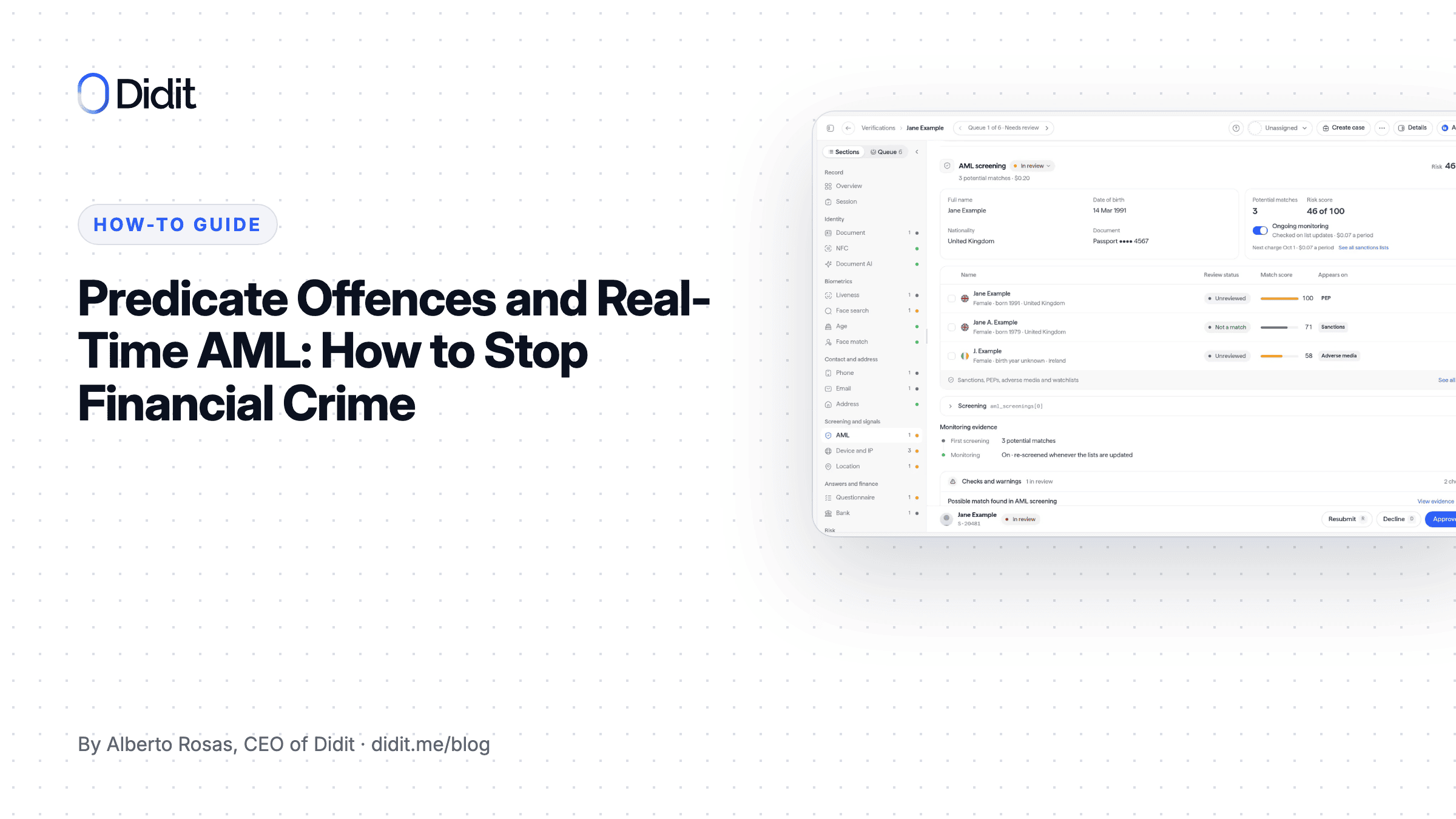
A full AML screening result for one session, with every hit and its review status. - Turn on ongoing monitoring for entities you keep. Pass
include_ongoing_monitoringas true and the entity stays under provider-driven monitoring, dated every day, at $0.07 per screened entity per year. It requiressave_api_requestto be true, which is the default; sending it false with ongoing monitoring returns HTTP 400. You can disable monitoring later from the Business Console. - Add transaction monitoring so behaviour is checked too. Enable Transaction Monitoring in Settings, then submit a baseline transaction.
Then install a preset from Transactions, Rules, Library. Structuring (outbound) fires when the same user sends 20 or more outbound transfers under EUR 10,000 within 30 days, so submitting 20 such transactions for one user moves the twentieth tocurl -X POST https://verification.didit.me/v3/transactions/ \ -H "x-api-key: YOUR_API_KEY" \ -H "Content-Type: application/json" \ -d '{ "transaction_id": "baseline-0001", "transaction_category": "finance", "transaction_details": { "direction": "outbound", "amount": "500.00", "currency": "EUR" }, "subject": { "entity_type": "person", "vendor_data": "user-42", "full_name": "Jane Doe" }, "counterparty": { "entity_type": "company", "full_name": "Acme Supplier" } }'IN_REVIEW.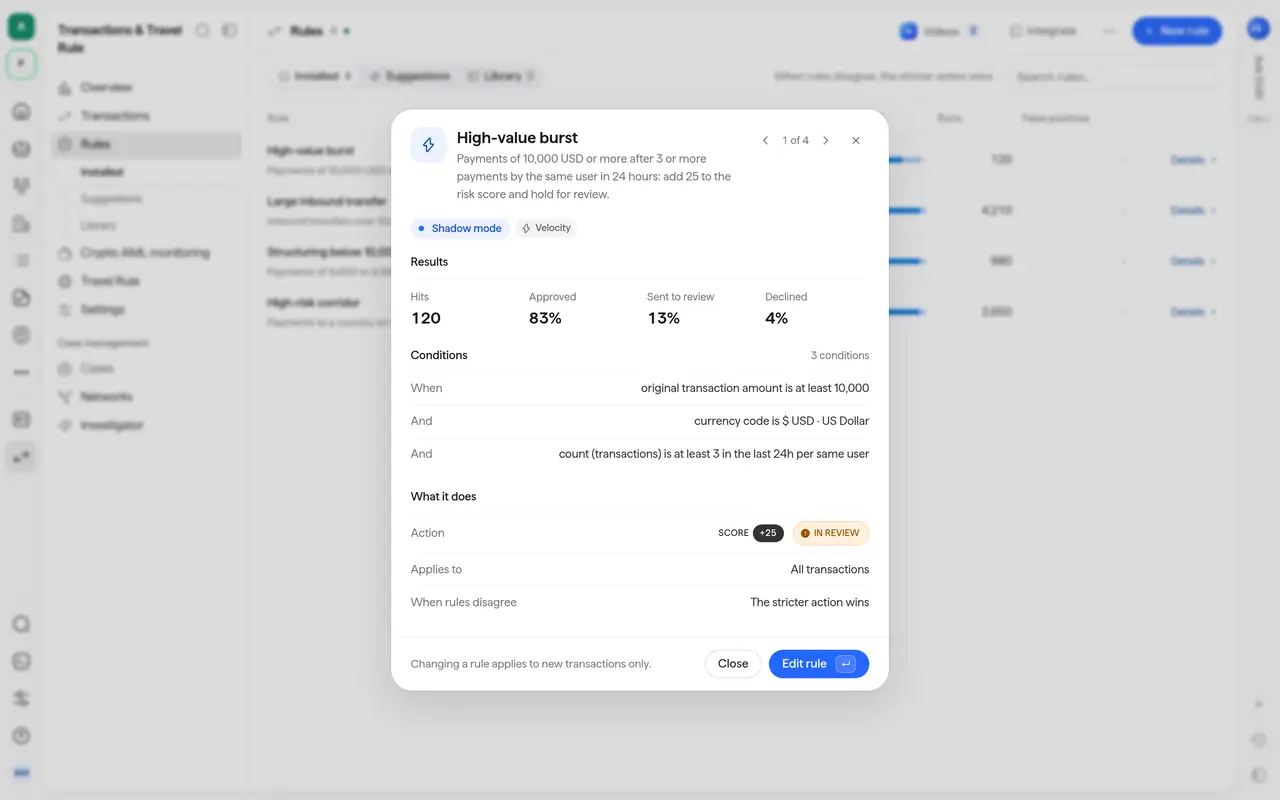
One transaction monitoring rule: scope, conditions, then the action that holds the transaction. - Subscribe to webhooks and verify them. Register a destination for
transaction.createdandtransaction.status.updated, save the returnedsecret_shared_keyimmediately, and verify theX-Signature-V2HMAC on every incoming call before you trust the body.curl -X POST https://verification.didit.me/v3/webhook/destinations/ \ -H "x-api-key: YOUR_API_KEY" \ -H "Content-Type: application/json" \ -d '{ "label": "TM events", "url": "https://yourapp.com/webhooks/didit-tm", "subscribed_events": ["transaction.created", "transaction.status.updated"] }'
Expected output
The standalone call returns request_id plus an aml object that holds status, screening_id, hits and warnings. Each hit carries its own match_score, risk_score and review_status. The status is one of Not Started, In Progress, Approved, In Review, Declined, Abandoned or Kyc Expired.
A clean result is Approved with no hits, and a screening that saved a session can be pulled again through GET /v3/session/{sessionId}/decision/. A real result looks like this: one or more hits, each scored, the highest surviving risk score promoted to the screening score, and a status derived from your thresholds. In sandbox, keys skip screening and billing entirely and return Approved with zero hits unless you pass sandbox_scenario, so do not read a clean sandbox run as proof your thresholds work.
Failure cases and recovery
| Signal | What it means | Recovery |
|---|---|---|
| HTTP 400 on the screening call | The three match weights do not sum to exactly 100 | Fix the weights. They are percentages of one score, not free parameters |
| HTTP 400 with ongoing monitoring | include_ongoing_monitoring was sent with save_api_request false | Remove the flag or save the request. Monitoring needs a stored profile |
| HTTP 403 | Out of credits | Top up, or turn on auto top-up so live checks never stop |
| HTTP 409 on a retry | An Idempotency-Key was reused with a different body | Send a new key for a new body. The same key with the same body returns the original response and is not billed twice |
| Status In Review | The risk score sits between your approve and review thresholds | Route to the manual queue with the hit detail attached. Do not auto-approve it |
| Status Declined | At least one hit crossed the decline boundary | Confirm the identity match, then escalate. A Declined screening is not a report |
| No adverse-media hits, fast response | The upstream provider was slow and the result returned without that enrichment | Treat the screening as still actionable, note the gap, and re-run later if the case depends on adverse media |
| Transaction waiting on the customer | A rule set the status to AWAITING_USER with a remediation workflow | Launch the workflow. The API returns HTTP 400 when workflow_id is missing |
Inputs and outputs
| Field | Direction | What it does |
|---|---|---|
full_name | Input, required | The person or company to screen. Minimum two characters |
entity_type | Input | person or company |
date_of_birth | Input | ISO date. Feeds the date-of-birth weight and separates same-name hits |
nationality | Input | Feeds the country weight and the high-risk-country warning |
include_adverse_media | Input | Adds adverse-media enrichment and adds latency |
save_api_request | Input, defaults true | Stores the screening as a session so it appears in the console, fires a status webhook and can be reviewed later |
include_ongoing_monitoring | Input | Keeps the entity under daily monitoring. Requires a saved request |
vendor_data | Input | Your identifier, which links the screening to the user profile you already hold |
request_id | Output | Correlation id. Works with the decision endpoint when the request was saved |
aml.status | Output | The decision your thresholds produced |
aml.hits[] | Output | Every potential match with match_score, risk_score and review_status |
aml.warnings[] | Output | Risk codes such as SANCTIONED_ENTITY or PEP_MATCH, for routing and reporting |
score and status on a transaction | Output | The transaction score, with rule_runs[] showing every rule that evaluated it |
What you pay for, and where human review starts
Five steps bill. Everything else in this flow is free or included.
- AML screening at $0.20 per check, charged after the first successful screening. Replayed idempotent responses are not charged again.
- Ongoing monitoring at $0.07 per screened entity per year, billed as a yearly alert.
- A full ID check at $0.33 when the screening runs inside a KYC session.
- Transaction monitoring at $0.001 per transaction beyond the monthly allowance, which is 1,000 on Free, 10,000 on Growth and 100,000 on Scale.
- Wallet screening at $0.15 per screening. If you already have a screening provider you trust, bring your own and run it inside Didit, as described in the wallet screening docs.
The $0.33 full ID check and the $0.20 AML screening are separate published charges. A session that runs both bills both, which is the $0.53 compliance bundle listed on the pricing page. Sandbox is free and unlimited on every plan and nothing is charged there. The plan credit covers part of live usage: Free gives $10 of credit a month, Growth $115 and Scale $350, and Growth and Scale take 4% and 10% off every price.
Review boundaries are the part compliance officers ask about first. Three defaults decide them: a match threshold of 93 that discards false positives, an approve threshold of 80 and a review threshold of 100. Below the approve threshold the screening passes. Between approve and review a person opens the hit. Above review it is declined and a person confirms. Two things stay outside the product: the decision to file a suspicious activity report, and the narrative that goes with it. Didit produces the evidence, your nominated officer signs.
One more boundary worth writing down. A rule that sets AWAITING_USER must carry a workflow_id, and the API returns HTTP 400 without one. That is why the remediation journey should be designed before the rule is switched to Active.
Worked cost example
Take a payments business onboarding 6,000 new customers a month and monitoring 250,000 transactions a month, with three-year retention, so Scale is the honest comparison. Every line below uses a published unit price.
| Line | Arithmetic | Amount |
|---|---|---|
| Onboarding, full ID check plus AML | 6,000 x ($0.297 + $0.18) = 6,000 x $0.477 | $2,862.00 |
| Transactions beyond the 100,000 included | 150,000 x $0.001 | $150.00 |
| Usage subtotal | $2,862 + $150 | $3,012.00 |
| Less Scale monthly credit | $3,012 - $350 | $2,662.00 |
| Scale plan fee | monthly fee | $299.00 |
| Monthly bill | $2,662 + $299 | $2,961.00 |
| Yearly bill | $2,961 x 12 | $35,532.00 |
| Ongoing monitoring on all 6,000 | 6,000 x $0.063 | $378.00 |
| Year one total | $35,532 + $378 | $35,910.00 |
At list prices the same volume is 6,000 x $0.53 = $3,180 of onboarding plus $150 of transactions, or $3,330 a month before any credit. That totals $39,960 a year before any credit or plan discount, and the difference between the two runs is the Scale discount plus the monthly credit.
The lever that moves this number is not the unit price. It is the false-positive rate, because every hit that reaches a person costs a review, and a match threshold set too low turns a cheap screen into an expensive queue.
Sources
- Didit pricing page, read November 26, 2026
- Didit docs: Identity Verification Pricing, read November 26, 2026
- Didit docs: AML Screening API overview, read November 26, 2026
- Didit docs: AML Screening standalone API, read November 26, 2026
- Didit docs: Transaction Monitoring quickstart, read November 26, 2026
- Didit docs: KYT rules and scoring, read November 26, 2026
- Didit docs: Submit Transactions API, read November 26, 2026
- Didit docs: KYT alerts, read November 26, 2026
- Didit docs: Wallet screening, read November 26, 2026
- Didit MCP server, read November 26, 2026
- FATF glossary and 40 Recommendations, read November 26, 2026
- Proceeds of Crime Act 2002, legislation.gov.uk, read November 26, 2026
Next step: open the sandbox at business.didit.me, run one screening with the call in step 3, and check the two scores against your own threshold policy before you connect live keys. There is no sales call in the way, and nothing in sandbox is charged. Didit serves 4,000+ companies and supports 220+ countries.
Try it
Try this in the sandbox
Run the check this guide describes, free.
The product this post is about, taken from its topic. Run it free in the sandbox.
Author
Alberto Rosas
Co-founder and CEO

Keep reading
Other guides in the same topic.
 What Is the Purpose of FICA in South Africa? 2026 Guide
FICA is South Africa's anti-money laundering law. It creates the Financial Intelligence Centre and requires accountable institutions to identify and verify clients, screen for PEP and sanctions risk and report suspicious.
Alberto RosasNov 26, 2026 Sixth Money Laundering Directive (6AMLD): What Changed and Which Rules Apply
6AMLD is Directive (EU) 2018/1673: Member States must criminalise laundering, widen predicate offences and set a four-year penalty floor. It adds no new due diligence duties for firms.
Alberto RosasNov 26, 2026 Automated Sanctions Screening: Canada, the Entity List and Embargoes
Automated sanctions screening matches people and companies against lists such as Canada's autonomous sanctions made under SEMA and JVCFOA and the OFAC SDN List, and returns candidate hits scored for identity confidence and.
Alberto RosasNov 26, 2026Questions
Frequently asked questions
What are predicate offences in AML?
A predicate offence is the crime that produced the money being laundered. Money laundering is the separate offence of disguising that money, so the laundering charge depends on an earlier crime existing. Screening and monitoring controls are built around the typologies of those earlier crimes, because that is what leaves a trace in an account.
What are the 21 predicate offences of money laundering?
FATF's glossary lists 21 designated categories, including participation in an organised criminal group, terrorism and terrorist financing, human trafficking, drug trafficking, arms trafficking, corruption and bribery, fraud, counterfeiting, environmental crime, murder, kidnapping, robbery, smuggling, extortion, forgery, piracy, insider trading and tax crimes. National laws adopt their own wording and their own subset. A compliance programme should cover the union of the jurisdictions it operates in.
Is AML the same as financial crime?
No. Financial crime is the wider family: fraud, bribery, sanctions evasion, drug trafficking, terrorist financing, tax evasion. AML is the control regime built around the part of that family which produces proceeds, plus the reporting duties attached to it. Most companies need both a financial crime control set and an AML control set, and they overlap heavily at onboarding.
What does AML IT mean?
AML IT means the systems a regulated firm runs to satisfy its AML duties: identity checks, sanctions and PEP screening, transaction monitoring, list management, alert queues, case files and the audit trail that proves all of it happened. In practice that means an identity provider, a screening provider, a rules engine and a case manager. Didit exposes screening and monitoring through its API and Business Console, and screening is $0.20 a check.
How does real-time AML monitoring work?
Real-time monitoring evaluates a person or a transaction at the moment it happens, instead of on yesterday's batch. In Didit that means screening a name against 1,300+ sanctions, PEP, watchlist and adverse media sources during the session, and running every active rule on every submitted transaction. Ongoing monitoring adds a daily re-screen of stored profiles at $0.07 per person per year, so a customer who appears on a list after onboarding is still caught.
How much does real-time AML screening cost?
AML screening is $0.20 per check at list price, or $0.18 on the Scale plan. A full ID check plus AML screening is $0.53, which is $0.477 on Scale. Ongoing monitoring is $0.07 per person per year, and transaction monitoring is $0.001 per transaction beyond the monthly allowance. You pay only for checks that finish with a result, and nothing is charged in sandbox.
What happens when an AML screening comes back In Review?
An In Review status means the risk score landed between your approve threshold, 80 by default, and your review threshold, 100 by default. The screening is not a decision to reject; it is a request for a person to look at the hit. Route it to your queue with the hit detail attached, confirm whether the match is the same individual, and document the reasoning.
Can Didit screen a company as well as a person?
Yes. The standalone AML endpoint accepts entity_type as person or company. Business verification goes further: registry data is pulled for the company from $2.00, and the owners and officers then take a linked full ID check and person AML screening, each billed per person.
Does Didit file a suspicious activity report for me?
No. Didit produces the screening result, the rules that fired, the alert history and the audit trail. The decision to file, and the narrative that goes with it, stays with your nominated officer. That boundary is deliberate: the filing is a legal act by a regulated entity, not a software output.
How fast is a real-time AML check?
Plain screenings typically complete in a few seconds, and Didit's inference latency sits under two seconds at p99. Turning on adverse media adds an initial pause and up to about 25 seconds of enrichment polling, so set a client timeout of at least 60 seconds when you request it. Transaction scoring runs on submission, which is why a held transaction can be stopped before settlement.
Can I keep my existing screening provider?
Yes for wallet screening: you can bring your own screening provider and run it inside Didit. That route exists because many crypto businesses already hold a provider contract they do not want to break. If you are moving off another vendor entirely, start in the sandbox, which is free and unlimited on every plan, and see the migration page at didit.me/switch.
Compliance built in
Audited, certified and attested.
We hold the certifications and build each country's rules into your flows, so you can launch anywhere without worrying. Security and Compliance center
- Regulation encoded into your flows
Tell us what you do and where. Didit lists the rules that apply to you, with sources, and builds the checks each country needs into one workflow.
- Ready for AMLR
Every requirement of the new EU anti-money laundering rules, from checking customers to human review, is already covered by a Didit check.
- Tested in Spain's Treasury sandbox
Spain's Treasury published its supervised sandbox report on Didit's NFC plus active liveness onboarding; SEPBLAC took part and valued the added measures positively.
- Audited, not self-declared
iBeta Level 1 and Level 2. Liveness tested under ISO/IEC 30107-3.
Your obligations · 3 regions
 SOC 2 Type 2
 ISO 27001
 iBeta Level 1 and Level 2
 EU regulator attestation
 FSM youth protection
 GDPR
 EBA remote onboarding
 MiCA compatible
 FIDO Alliance member
- AMLREU AML Regulation ready
Integration · Didit MCP
Run Didit from your own AI agent
Connect Didit to Claude, Cursor, VS Code or ChatGPT and just ask in plain words. Your agent can do anything you can do in the console, with the same permissions you have.
 Add to Claude
 ChatGPT
 Cursor
- Build workflowsDescribe the checks you need. The agent creates and publishes the flow.
- Run investigationsAsk why a session was declined, review cases, search people and companies.
- Change rulesCreate payment rules, test them on past data and switch them on.
- Pull reportsAsk for numbers, exports or the audit log.
Didit Academy


