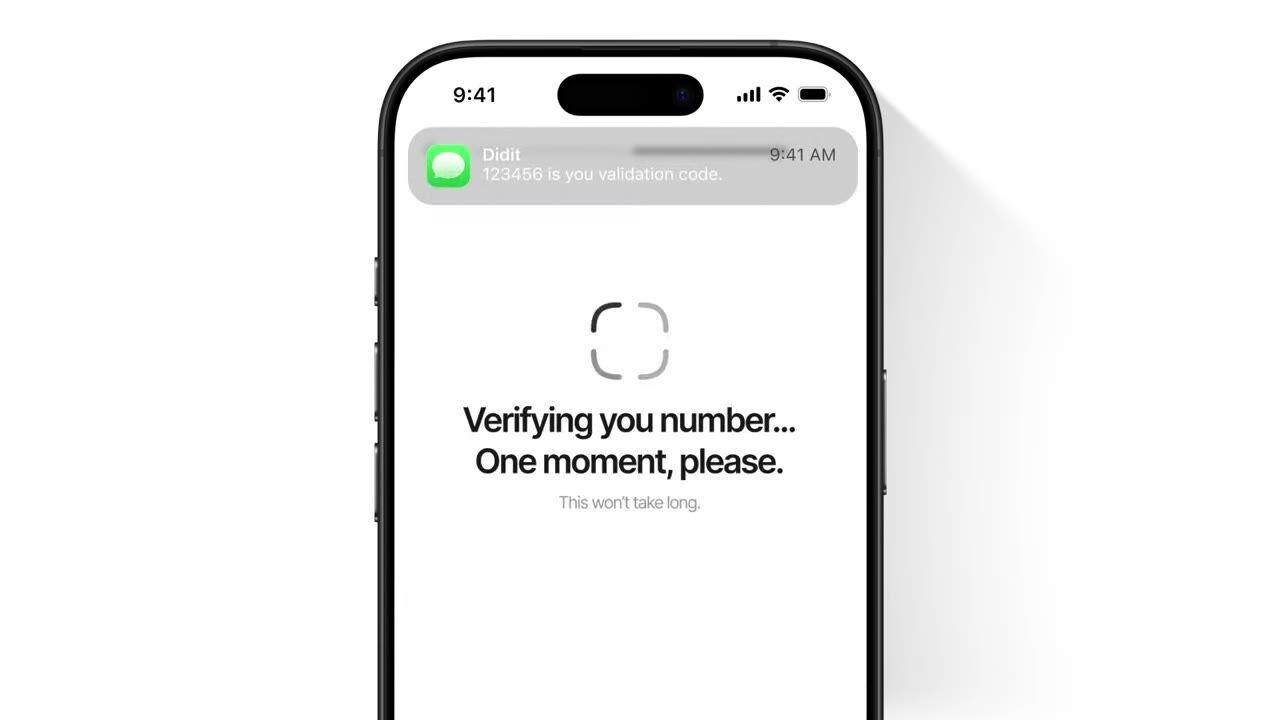
Verifiziere jede Telefonnummer. Auf jedem Kanal, den sie nutzen.
Sende einen Einmalcode per SMS, WhatsApp, Telegram, RCS oder Anruf, über den Kanal, den der Nutzer tatsächlich nutzt. Automatischer Fallback zwischen Kanälen, mit Carrier-Risikobewertung bei jedem Anruf. Ab $0.03 plus Carrier.
Ein Modul, fünf Zustellwege. Wir versuchen es über verschiedene Kanäle, bis der Code ankommt, bewerten SIM-Swap- und Carrier-Risiken bei jedem Anruf und berechnen ab $0.03 plus Carrier, der Workflow bleibt derselbe.
So funktioniert's
Vom Anmelden zum verifizierten Nutzer in vier Schritten.
Schritt 01 / 04
01
Workflow erstellen
Wähle die gewünschten Checks aus, ID, Liveness, Face Match, Sanktionen, Adresse, Alter, Telefon, E-Mail, benutzerdefinierte Fragen. Ziehe sie im Dashboard in einen Flow oder poste denselben Flow an unsere API. Verzweige nach Bedingungen, führe A/B-Tests durch, kein Code erforderlich.
Integrieren
Bette nativ mit unserem Web-, iOS-, Android-, React Native- oder Flutter-SDK ein. Leite auf eine gehostete Seite weiter. Oder sende deinem Nutzer einfach einen Link, per E-Mail, SMS, WhatsApp, überall. Wähle, was zu deinem Stack passt.
Nutzer durchläuft den Flow
Didit hostet die Kamera, die Beleuchtungshinweise, die mobile Übergabe und die Barrierefreiheit. Während der Nutzer im Flow ist, bewerten wir über 200 Betrugssignale in Echtzeit und verifizieren jedes Feld anhand autoritativer Datenquellen. Ergebnis in unter zwei Sekunden.
Du erhältst die Ergebnisse
Echtzeit-signierte Webhooks halten deine Datenbank synchron, sobald ein Nutzer genehmigt, abgelehnt oder zur Überprüfung gesendet wird. Frage die API bei Bedarf ab. Oder öffne die Konsole, um jede Session und jedes Signal zu überprüfen und Fälle nach deinen Wünschen zu verwalten.
Für Entwickler gemacht · Gegen Betrug gebaut · Offen im Design
Sechs Funktionen. Ein Feature Flag. PHONE.
Jede Funktion ist ein Toggle im selben Modul. Keine Upsell-Stufen, keine separaten Pläne, keine Add-on-Anrufe. Schalte sie pro Workflow in der Konsole ein oder übergebe sie inline im API-Aufruf.
SMS, WhatsApp, Telegram, RCS und Voice, alles im selben Modul und Workflow. Fixiere einen Kanal, wenn es die Richtlinie erfordert (regulatorisch vorgeschriebene SMS, WhatsApp-First-Märkte wie Brasilien und Indien), oder lass uns den günstigsten Zustellweg wählen.
Ein Feature Flag · Fünf KanäleFeature: TELEFON
SMSStandard
WhatsAppBR / IN / MX
TelegramEU
RCSAndroid
SpracheFallback
02 · Routing
Automatischer Kanal-Fallback, wenn einer fehlschlägt.
Carrier-SMS-Blocks, Premium-Länder und stille Fehler werden automatisch umgangen. Wir versuchen es über den nächsten zustellbaren Kanal erneut, ohne dass dein Code eingreifen muss, und teilen dir mit, welcher Kanal tatsächlich zugestellt hat.
Multi-Carrier-Integrationen pro Land, mit Routing, das auf lokale Gewohnheiten abgestimmt ist, WhatsApp führt in Brasilien, Indien und Mexiko, Telegram und RCS in der gesamten EU, SMS in den USA. Land, Carrier und Nummerntyp werden automatisch erkannt.
04 · Betrugssignale
Mehr als ein Einmal-Code. Carrier-Risiko bei jedem Anruf.
Jede Verifizierung liefert den Carrier-Namen und -Typ (Mobil, Festnetz, Voice over IP), Flags für Wegwerf- und virtuelle Nummern sowie explizite Warnungen für risikoreiche, duplizierte oder blockierte Nummern. Entscheide, überprüfe oder genehmige pro Risikokategorie.
05 · Conversion
Nur SMS verliert Nutzer. Multi-Channel hält sie.
Wenn SMS fehlschlägt, Carrier-Filter, Roaming, Funkloch, Zustellungsrückgang, lassen Einkanal-Anbieter Nutzer auf einen nie ankommenden Code starren. Wir holen sie auf dem nächsten Hop zurück und melden, welcher Kanal zugestellt hat, damit du das Routing mit echten Daten optimieren kannst.
Abschluss · 30-Tage-RollierungHöher ist besser
Nur SMS58%
+ WhatsApp79%
+ Voice-Fallback93%
Illustrativ, richtungsweisend, keine Studie.
06 · Preise
Zahlung pro Nachricht. Ab 0,03 $ plus Carrier.
0,03 $ pro Verifizierung, plus eine länderspezifische und kanalabhängige Carrier-Gebühr ohne Aufschlag. Du zahlst nur, wenn eine Nachricht gesendet wird, Abbrüche vor der Zustellung kosten nichts.
Preise pro NachrichtAb $0.03
USASMS$0.03
BrasilienWhatsApp$0.04
IndienWhatsApp$0.05
Zahl nur, wenn eine Nachricht gesendet wird.
Integrieren
Zwei Endpunkte. Gleiches JSON. Gleicher Preis.
Wähle den gehosteten Flow, wenn wir die Nummerneingabe, die Code-UX und den erneuten Versand übernehmen sollen. Wähle die eigenständige API, wenn du die UX selbst verwaltest. Beide liefern denselben Bericht.
Telefonverifizierung in einem Prompt implementieren.
Füge den folgenden Block in Claude Code, Cursor, Codex, Devin, Aider oder Replit Agent ein. Gib deinen Stack an. Der Agent provisioniert Didit, erstellt den Telefonverifizierungs-Workflow, verbindet den Webhook und liefert aus.
didit-integration-prompt.md
# Didit Phone Verification — integrate in 5 minutes

You are integrating Didit's Phone Verification module into <my_stack>.
Follow these steps exactly. Every URL, header, and enum value below is
canonical — do not paraphrase or "improve" them.

## 1. Provision an account
- Sign up: https://business.didit.me (no credit card required).
- Or provision programmatically: POST https://apx.didit.me/auth/v2/programmatic/register/
  (returns an API key bound to the workspace + application).

## 2. Two integration paths — pick one

### Path A — Workflow Builder (hosted UI)
Best when you want Didit to handle phone collection, country prefix UX,
channel routing, OTP entry, resend buttons, mobile/desktop handoff, and
accessibility for you.

1. Create a workflow that contains the PHONE feature:
   POST https://verification.didit.me/v3/workflows/
   Authorization header:  x-api-key: <your-api-key>
   Body: workflow_label, features array with the single entry
         { feature: "PHONE" }   (UPPERCASE — strict enum)
   Optional config: preferred_channel ("SMS" | "WHATSAPP" | "TELEGRAM" |
   "RCS" | "VIBER" | "CALL"), code_validity_seconds, max_code_attempts
   (default 2), max_resend_requests_per_24h (default 2).

2. Create a verification session for an end user:
   POST https://verification.didit.me/v3/session/
   Body: workflow_id (from step 1), vendor_data (your own user id),
         optional contact_details.phone in E.164 format
         (e.g. "+14155552671") to pre-fill and lock the number.
   Response: url (the hosted verification link) — redirect the user to it.

3. Listen for webhook callbacks (see "Webhooks" below).

### Path B — Standalone server-to-server API
Best when you already own the phone-entry UX (mobile SDK, native
onboarding app, reseller pipeline) and want Didit to handle OTP delivery
+ risk scoring only. Two endpoints, called in sequence:

Step 1 — Send the code:
POST https://verification.didit.me/v3/phone/send/
Content-Type: application/json
Body fields:
  - phone_number  (required, string, E.164 format e.g. "+14155552671")
  - channel       (optional — "SMS" | "WHATSAPP" | "TELEGRAM" | "RCS" |
                   "VIBER" | "CALL". Omit to let Didit pick the best
                   available channel for the destination country and
                   carrier — automatic fallback routing.)
  - vendor_data   (optional, your user id for cross-session linkage)

Step 2 — Check the code:
POST https://verification.didit.me/v3/phone/check/
Content-Type: application/json
Body fields:
  - phone_number  (required, same E.164 number)
  - code          (required, the OTP the user typed)
  - vendor_data   (optional, same user id used in Step 1)

Response: JSON report — status, verification_method (the channel that
actually delivered), carrier object, is_disposable, is_virtual, warnings
array.

## 3. Channel routing — how the automatic fallback works
When channel is omitted on /v3/phone/send/, Didit picks the cheapest
+ most-deliverable channel for the destination:
  - SMS where deliverable and lowest cost (most countries)
  - WhatsApp in BR / IN / MX and other WhatsApp-dense markets
  - Telegram / RCS / Viber where carrier-side SMS is blocked or premium
  - CALL (voice OTP) as last-resort fallback when text channels fail
Each retry attempt may switch channels — the final delivery channel is
returned as verification_method in the report.

## 4. Webhooks (Path A only — Path B returns synchronously)
- Register a webhook destination once via
  POST https://verification.didit.me/v3/webhook/destinations/
  Body: url, subscribed_events: ["session.verified", "session.review_started",
                                  "session.declined"]
- Response includes secret_shared_key — store it.
- Every webhook delivery carries an X-Signature-V2 header you MUST verify
  before trusting the payload.  HMAC-SHA256 verification MUST run against the raw body bytes (the raw payload as Didit sent it) BEFORE any JSON parsing — re-serialising the parsed body changes whitespace and key order, which invalidates the signature.Algorithm:
    1. sortKeys(payload) recursively
    2. shortenFloats (truncate trailing zeros after the decimal point)
    3. JSON.stringify the result
    4. HMAC-SHA256 with the secret_shared_key
    5. Hex-encode, compare to the X-Signature-V2 header.

## 5. Reading the report (both paths return the same phone object)
- status: "Approved" | "Declined" | "In Review" | "Not Finished"
- phone_number_prefix: country prefix in international format ("+34")
- phone_number: subscriber number without the prefix
- full_number: full E.164 string ("+34600600600")
- country_code: ISO 3166-1 alpha-2 ("ES")
- country_name: full country name
- carrier: { name, type: "mobile" | "landline" | "voip" | "unknown" }
- is_disposable: boolean — temporary or throwaway number
- is_virtual: boolean — VoIP or virtual provider
- verification_method: the channel that actually delivered the code
  ("sms" | "whatsapp" | "viber" | "telegram" | "call")
- verification_attempts: number of code-entry tries
- verified_at: ISO 8601 timestamp
- warnings: Array<{ risk, log_type, short_description, long_description }>

Auto-decline risks (always enforced by Didit, not configurable):
- VERIFICATION_CODE_ATTEMPTS_EXCEEDED
- HIGH_RISK_PHONE_NUMBER
- PHONE_NUMBER_IN_BLOCKLIST

Configurable risks (action per workflow — Decline, Review, or Approve):
- DISPOSABLE_NUMBER_DETECTED
- VOIP_NUMBER_DETECTED
- DUPLICATED_PHONE_NUMBER

## 6. Attempt limits (defaults — overridable per workflow)
- Max code-entry attempts: 2 per session
- Max resend requests: 2 per phone number per 24 hours
- Code validity: 5 minutes from send
Hitting either limit fires VERIFICATION_CODE_ATTEMPTS_EXCEEDED and
auto-declines the session.

## 7. Hard rules — do not change
- Base URL for /v3/* endpoints is verification.didit.me (NOT apx.didit.me).
- Feature enum is UPPERCASE: PHONE, OCR, LIVENESS, FACE_MATCH,
  AML, IP_ANALYSIS.
- Channel enum is UPPERCASE on input ("SMS", "WHATSAPP", "TELEGRAM",
  "RCS", "VIBER", "CALL") and lowercase on output ("sms", "whatsapp",
  "telegram", "rcs", "viber", "call").
- All phone numbers go in and come out as E.164 strings — including
  the leading "+" and country prefix.
- Auth header is x-api-key (lowercase, hyphenated).
- Webhook signature header is X-Signature-V2 (NOT X-Signature).
- Always verify webhook signatures before trusting payload data.
- Status casing matches exactly: "Approved", "Declined", "In Review",
  "Not Finished" (title-cased, space-separated).

## 8. Pricing reference (public)
- Didit fee: $0.03 per verification (the cheapest channel; some
  channels and countries cost more — see didit.me/pricing for the
  per-country, per-channel table).
- Carrier fee: variable by country and channel, billed as a
  pass-through with no Didit markup.
- You only pay when a message is SENT. If the user abandons before
  delivery, you are not charged.

## 9. Verify your integration
- Sandbox starts on signup at https://business.didit.me — no separate flag.
- Sandbox numbers: deterministic E.164 numbers return Approved by default;
  trigger Declined with the canonical "high-risk" sandbox number.
- Switch to live: flip the application's environment toggle in console.

When in doubt: https://docs.didit.me/core-technology/phone-verification/overview
Compliant by Design
Ein neues Land mit einem Klick erschließen. Wir machen die Arbeit.
Wir gründen lokale Tochtergesellschaften, sichern Lizenzen, führen Penetrationstests durch, erhalten Zertifizierungen und passen uns jeder neuen Regulierung an. Um Verifizierungen in einem neuen Land zu starten, legst du einfach einen Schalter um. Über 220 Länder live, vierteljährlich auditiert und Pen-getestet, der einzige Identitätsanbieter, den eine EU-Mitgliedsregierung offiziell als sicherer als die persönliche Verifizierung eingestuft hat.
Channel-Routing, wir wählen den günstigsten, zustellbaren Hop.
Ab $0.03
Pro Verifizierung, zzgl. Carrier-Gebühren, ohne Aufschlag.
Drei Stufen, eine Preisliste
Kostenlos starten. Nach Verbrauch zahlen. Bis zum Enterprise-Level skalieren.
500 kostenlose Verifizierungen jeden Monat, für immer. Danach zahlst du nur, wenn ein Modul läuft. Individuelle Verträge, Datenresidenz und Service Level Agreements (SLAs) für Enterprise-Kunden.
Kostenlos
$0/ Monat · keine Kreditkarte nötig
Zum Entwickeln, Testen und für deine ersten Nutzer.
Alles, was du für den Start brauchst:
500 vollständige KYC-Verifizierungen pro Monat
ID, Liveness, Face Match, Gerät & IP
Über 200 Betrugssignale, Blocklist, Duplikate
Wiederverwendbares KYC im Didit-Netzwerk
Workflow Builder, Case Management, SDKs
KI-SupportKI-Agent in der Konsole, Docs und Community.
Produktionsdaten werden standardmäßig in der Europäischen Union verarbeitet und gespeichert, auf Amazon Web Services. Unternehmenskunden können alternative Regionen für Jurisdiktionen anfordern, deren Regulierungsbehörden dies verlangen.
Verschlüsselung überall. AES-256 im Ruhezustand über jede Datenbank, jeden Objektspeicher und jedes Backup. Transport Layer Security 1.3 während der Übertragung bei jedem API-Aufruf, Webhook und jeder Business Console Session. Biometrische Daten werden unter einem separaten Customer Master Key verschlüsselt.
Die Aufbewahrung liegt in deiner Hand. Die Standardaufbewahrungsfrist ist unbegrenzt (unendlich), es sei denn, du konfigurierst eine kürzere, zwischen 30 Tagen und 10 Jahren pro Anwendung, und du kannst jede einzelne Session jederzeit über das Dashboard oder die API löschen.
Zertifizierungen: SOC 2 Typ 1 (Typ 2 Audit läuft), ISO/IEC 27001:2022, iBeta Level 1 PAD und eine öffentliche Bestätigung von Spaniens Tesoro / SEPBLAC / CNMV, dass Didits Fernidentitätsprüfung sicherer ist als die persönliche Verifizierung. Vollständiger Bericht unter /security-compliance.