
Diditが750万ドルを調達、本人確認と不正対策のインフラを構築
Didit
パッシブ・ライブネス

あらゆるを検証。
ユーザーに何も求めることなく。

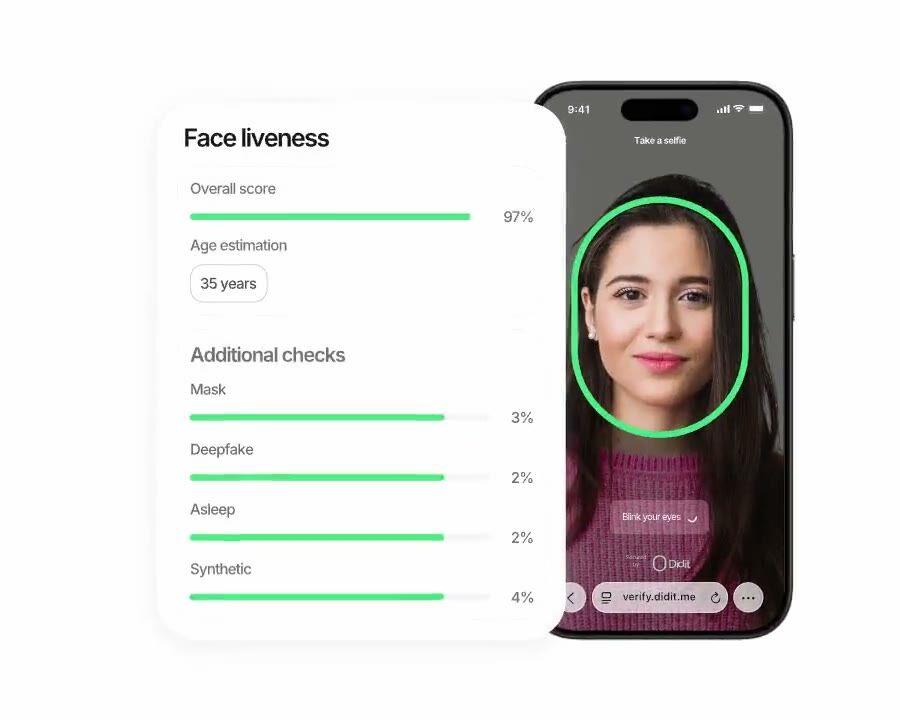
カメラに映る人物が実在し、ライブであることを証明。iBeta認証のアンチスプーフィング, ディープフェイク、マスク、リプレイ、モーフィング攻撃を2秒未満で検知。パッシブは$0.10、アクティブは$0.15。毎月500回まで無料。

支援元
Y CombinatorRobinhood Ventures
GBTC Finance
Bondex
Crnogorski Telekom
UCSF Neuroscape
Shiply
Adelantos

世界中の2,000以上の組織から信頼されています。

Didit Liveness, 2秒未満でデバイス上で判定されるパッシブ・ライブネスキャプチャ。

iBeta認定済み

パッシブ。フラッシュ。
アクティブ。すべて認証済み。

3Dマスク、ディープフェイク、リプレイアタック、印刷された写真などを検知します。 iBeta認定済み、2秒未満で判定、1チェックあたり$0.10、毎月500回まで無料。

仕組み

サインアップから認証済みユーザーまで、たった4ステップ。

  1. ステップ 01

    ワークフローを作成

    ID、ライブネス、顔照合、制裁リスト、住所、年齢、電話番号、メールアドレス、カスタム質問など、必要なチェックを選択します。ダッシュボードでフローにドラッグ&ドロップするか、同じフローをAPIにポストします。条件分岐やA/Bテストもコード不要で実行できます。

  2. ステップ 02

    連携

    Web、iOS、Android、React Native、Flutter SDKでネイティブに組み込むか、ホストされたページにリダイレクトするか、またはメール、SMS、WhatsAppなど、どこからでもユーザーにリンクを送信するだけです。お使いのスタックに合った方法をお選びください。

  3. ステップ 03

    ユーザーがフローを完了

    Diditがカメラ、照明の指示、モバイルでの引き継ぎ、アクセシビリティをホストします。ユーザーがフローを実行中に、200以上の不正信号をリアルタイムでスコアリングし、すべてのフィールドを信頼できるデータソースと照合して検証します。結果は2秒未満で出ます。

  4. ステップ 04

    結果を受け取る

    リアルタイムの署名付きWebhookにより、ユーザーが承認、拒否、またはレビューに送られた瞬間にデータベースが同期されます。必要に応じてAPIをポーリングすることも可能です。またはコンソールを開いて、すべてのセッション、すべての信号を検査し、ケースを管理できます。

開発者向け · 不正対策 · オープン設計

6つの機能。1つの機能フラグ。ライブネス

以下のすべての機能は、同じモジュールで切り替え可能です。アップセルティア、個別のSKU、アドオンの呼び出しは一切ありません。コンソールでワークフローごとにオンにするか、スタンドアロンエンドポイントでインラインで渡すことができます。
01 · メソッド

パッシブ、3Dフラッシュ、3Dアクション。リスクに応じて選択。

1つのモジュールで3つのメソッドを提供。フリクションの少ないサインアップにはパッシブ(1フレーム、ユーザー操作なし)。高価値のパッシブフローには3Dフラッシュ(短い光シーケンスで反射から深度をキャプチャ)。規制に敏感な市場や高額なオンボーディングには3Dアクション&フラッシュ(モーション+フラッシュ)。
02 · 認定されたアンチスプーフィング

あらゆるプレゼンテーションアタックカタログに対してテスト済み。

独立したテストとiBeta認定済み, NISTおよびOpen Identity Exchangeが引用する標準です。印刷された写真、スクリーンリプレイ、紙マスク、シリコンマスク、ラテックスマスク、モーフアタック、AI生成ディープフェイクをブロックします。攻撃カタログの増加に伴い、毎年再テストを実施しています。
03 · 2秒未満で判定

エンドツーエンドの推論を2秒未満で。

エッジで提供される推論。モデルのダウンロードやデバイス上の高速化の前提がなく、エントリーレベルのAndroidでもパフォーマンスが低下しません。パッシブはほとんどのデバイスで1秒未満で完了。フラッシュは約600ms追加。アクティブ3Dは約1.5秒追加, それでもエンドツーエンドで2秒未満です。
04 · 警告

ワークフローごとに調整可能なリスクポリシー。

7つの設定可能な警告, 低スコア、重複の可能性、重複顔、複数顔、顔品質の低さ、低照度、高照度, それぞれのアプリケーションに応じて拒否、レビュー、承認にマッピングできます。3つの自動拒否トリガー(顔なし、攻撃検知、ブロックリスト登録顔)は、いかなる場合でも強制されます。
05 · 年齢推定

1回のキャプチャで2つのシグナル。

ライブネスワークフローで年齢推定をオンにすると、同じセルフィーからライブネス判定と推定年齢帯が返されます。英国オンライン安全法やEUの年齢制限に対応, ユーザーにIDアップロードを求めることなく、人間であることと十分な年齢であることを確認できます。1チェックあたり$0.10。
06 · 生体認証

サインアップ時と同じエンジンを、あらゆるログインで。

ライブネスは生体認証の基盤です。同じアンチスプーフィングモデルを再利用して、高額な送金、パスワードリセット、高額な引き出しなど、機密性の高いすべての操作で再訪ユーザーを認証します。1認証あたり$0.10、SMS 2FAのドロップイン代替、キャリア料金なし、SIMスワップのリスクなし。
連携

2つのエンドポイント。同じJSON。同じ価格。

ホストされたUIでキャプチャを処理したい場合(アクティブな方法に必須)はセッションを作成し、すでにセルフィーがある場合はスタンドアロンのパッシブエンドポイントを呼び出します。どちらも同じライブネスレポートを返します。
POST /v3/session/ホスト型UI
$ curl -X POST https://verification.didit.me/v3/session/ \
  -H "x-api-key: $DIDIT_API_KEY" \
  -H "Content-Type: application/json" \
  -d '{
    "workflow_id": "wf_liveness_3d",
    "vendor_data": "user-42"
  }'
201作成済み{ "session_url": "verify.didit.me/..." }
キャプチャUIはDiditがホストします。FLASHINGACTIVE_3Dには必須です。ドキュメント →
POST /v3/passive-liveness/サーバー間連携
$ curl -X POST https://verification.didit.me/v3/passive-liveness/ \
  -H "x-api-key: $DIDIT_API_KEY" \
  -F "image=@selfie.jpg"
200OK{ "status": "承認済み", "score": 98 }
キャプチャはお客様が管理。判定結果をインラインで返します。ドキュメント →
エージェント対応統合

1つのプロンプトでLivenessをデプロイ。

以下のブロックをClaude Code、Cursor、Codex、Devin、Aider、またはReplit Agentに貼り付けてください。`my_stack`プレースホルダーを、お使いのフレームワーク、言語、ユースケースに合わせて入力します。エージェントがDiditをプロビジョニングし、Livenessを有効にしたワークフローを構築し、Webhookを接続してデプロイします。
didit-integration-prompt.md
# Didit Liveness — integrate in 5 minutes

You are integrating Didit's Liveness (presentation-attack detection) module
into <my_stack>. Follow these steps exactly. Every URL, header, and enum
value below is canonical — do not paraphrase or "improve" them.

## 1. Provision an account
- Sign up: https://business.didit.me (no credit card required).
- Or provision programmatically: POST https://apx.didit.me/auth/v2/programmatic/register/
  (returns an API key bound to the workspace + application).

## 2. Two integration paths — pick one

### Path A — Workflow Builder (hosted UI)
Best when you want Didit to handle camera, motion prompts, low-light
fallback, mobile handoff, and accessibility for you.

1. Create a workflow that contains the LIVENESS feature:
   POST https://verification.didit.me/v3/workflows/
   Authorization header:  x-api-key: <your-api-key>
   Body: workflow_label, features array with the single entry
         { feature: "LIVENESS" }   (UPPERCASE — strict enum)
   Optional config: liveness_method ("PASSIVE" | "FLASHING" | "ACTIVE_3D")
   and per-warning threshold overrides.

2. Create a verification session for an end user:
   POST https://verification.didit.me/v3/session/
   Body: workflow_id (from step 1), vendor_data (your own user id).
   Response: session_url — redirect the user to it.

3. Listen for webhook callbacks (see "Webhooks" below).

### Path B — Standalone server-to-server API
Best when you already have a selfie image (mobile SDK capture, native
onboarding app, reseller pipeline). Standalone is single-frame
PASSIVE only — for ACTIVE_3D or FLASHING you must use Path A.

POST https://verification.didit.me/v3/passive-liveness/
Content-Type: multipart/form-data
Body fields:
  - image        (required, file — single selfie)
  - vendor_data  (optional string, your user id)

Response: JSON report with liveness score, method, and warnings array.

## 3. Webhooks (Path A only — Path B returns synchronously)
- Register a webhook destination once via
  POST https://verification.didit.me/v3/webhook/destinations/
  Body: url, subscribed_events: ["session.verified", "session.review_started",
                                  "session.declined"]
- Response includes secret_shared_key — store it.
- Every webhook delivery carries an X-Signature-V2 header you MUST verify
  before trusting the payload.  HMAC-SHA256 verification MUST run against the raw body bytes (the raw payload as Didit sent it) BEFORE any JSON parsing — re-serialising the parsed body changes whitespace and key order, which invalidates the signature.Algorithm:
    1. sortKeys(payload) recursively
    2. shortenFloats (truncate trailing zeros after the decimal point)
    3. JSON.stringify the result
    4. HMAC-SHA256 with the secret_shared_key
    5. Hex-encode, compare to the X-Signature-V2 header.

## 4. Reading the report (both paths return the same shape)
The liveness object includes:
- status: "Approved" | "Declined" | "In Review" | "Not Finished"
- method: "PASSIVE" | "FLASHING" | "ACTIVE_3D"
- score: number 0-100 (normalized liveness score)
- reference_image: signed URL to the captured selfie (expires in 1 hour)
- video_url: signed URL to the capture video, present only for FLASHING
  and ACTIVE_3D (expires in 1 hour)
- age_estimation: { age, age_range } when enabled in the workflow
- warnings: Array<{ risk, log_type, short_description, long_description }>

Auto-decline risks (always enforced by Didit, not configurable):
- NO_FACE_DETECTED
- LIVENESS_FACE_ATTACK
- FACE_IN_BLOCKLIST

Configurable risks (action per workflow — Decline, Review, or Approve):
- LOW_LIVENESS_SCORE
- POSSIBLE_DUPLICATED_FACE
- DUPLICATED_FACE
- MULTIPLE_FACES_DETECTED
- LOW_FACE_QUALITY
- LOW_FACE_LUMINANCE
- HIGH_FACE_LUMINANCE

## 5. Hard rules — do not change
- Base URL for /v3/* endpoints is verification.didit.me (NOT apx.didit.me).
- Feature enum is UPPERCASE: LIVENESS, ID_VERIFICATION, FACE_MATCH, AML, IP_ANALYSIS.
- Method enum is UPPERCASE: PASSIVE, FLASHING, ACTIVE_3D.
- Auth header is x-api-key (lowercase, hyphenated).
- Webhook signature header is X-Signature-V2 (NOT X-Signature).
- Always verify webhook signatures before trusting payload data.
- Status casing matches exactly: "Approved", "Declined", "In Review",
  "Not Finished" (title-cased, space-separated).

## 6. Pricing reference (public)
- PASSIVE method: $0.10 per check (standalone or bundled)
- FLASHING / ACTIVE_3D methods: $0.15 per check
- Bundled in a full KYC workflow: $0.33 per session (includes Liveness)
- 500 free checks every month, forever, on every account.

## 7. Verify your integration
- Sandbox starts on signup at https://business.didit.me — no separate flag.
- Test images: deterministic synthetic faces returned in sandbox (Approved
  by default; trigger Declined by sending the canonical "spoof" test image).
- Switch to live: flip the application's environment toggle in console.

When in doubt: https://docs.didit.me/core-technology/liveness/overview
さらに詳しい情報が必要ですか?モジュールの全ドキュメントをご覧ください。docs.didit.me →
設計段階からのコンプライアンス

ワンクリックで新しい国に進出。 面倒な作業は私たちにお任せください。

私たちは現地法人を設立し、ライセンスを取得し、ペネトレーションテストを実施し、認証を取得し、新しい規制すべてに準拠します。新しい国で認証を提供するには、トグルを切り替えるだけです。220以上の国で稼働しており、四半期ごとに監査とペネトレーションテストを実施しています。EU加盟国の政府が対面認証よりも安全だと正式に認めた唯一のIDプロバイダーです。
セキュリティ&コンプライアンス資料を読む
EU金融サンドボックス
Tesoro · SEPBLAC · BdE
ISO/IEC 27001
情報セキュリティ · 2026
SOC 2 · Type I
AICPA · 2026
iBeta Level 1 PAD
NIST / NIAP · 2026
GDPR
EU 2016/679
DORA
EU 2022/2554
MiCA
EU 2023/1114
AMLD6 · eIDAS 2.0
設計段階からのEU準拠

実績データ

実績データ
  • iBeta
    独立機関認定のアンチスプーフィング(プレゼンテーション攻撃検知)。
  • 0
    Livenessメソッド, パッシブ、3Dフラッシュ、3Dアクション+フラッシュ。
  • <0s
    検証ごとのエンドツーエンド推論。
  • $0.00
    パッシブLivenessチェック1回あたり。毎月500回まで無料。
3つのティア、1つの料金表

無料で開始。従量課金。エンタープライズまで対応。

毎月500回まで無料認証を永続的に提供。本番環境では従量課金。エンタープライズプランではカスタム契約、データレジデンシー、SLA(サービスレベルアグリーメント)に対応します。
無料

無料

月額$0。クレジットカード不要。

  • 無料KYCバンドル(本人確認 + パッシブ・ライブネス + 顔照合 + デバイス&IP分析), 毎月500回まで
  • ブロックリストユーザー
  • 重複検出
  • すべてのセッションで200以上の不正シグナル
  • Diditネットワーク全体でのKYC再利用
  • ケース管理プラットフォーム
  • ワークフロービルダー
  • 公開ドキュメント、サンドボックス、SDK、MCP (Model Context Protocol) サーバー
  • コミュニティサポート
最も人気
従量課金

従量課金

使った分だけお支払い。25以上のモジュール。モジュールごとの公開価格、月額最低料金なし。

  • フルKYC(本人確認 + 生体認証 + IP / デバイス)が$0.33
  • 10,000以上のAMLデータセット, 制裁、PEP、ネガティブ情報
  • データベース検証のための1,000以上の政府データソース
  • トランザクションモニタリングが1トランザクションあたり$0.02
  • ライブKYBが1企業あたり$2.00
  • ウォレットスクリーニングが1チェックあたり$0.15
  • ホワイトラベル検証フロー, あなたのブランド、私たちのインフラ
エンタープライズ

エンタープライズ

カスタムMSA & SLA。大量利用や規制対象プログラム向け。

  • 年間契約
  • カスタムMSA、DPA、SLA
  • 専用SlackおよびWhatsAppチャンネル
  • オンデマンドの手動レビュー担当者
  • リセラーおよびホワイトラベル条件
  • 限定機能とパートナー連携
  • 専任CSM、セキュリティレビュー、コンプライアンスサポート

無料で開始 → チェック実行時のみ支払い → カスタム契約、SLA、データレジデンシーが必要な場合はエンタープライズプランへ。

FAQ

よくある質問

What is Didit?

Didit is infrastructure for identity and fraud, the platform we wished existed when we were building products ourselves: open, flexible, and developer-friendly, so it works as a real part of your stack instead of a black box you integrate around.

One API covers verifying people (KYC, know your customer), verifying businesses (KYB, know your business), screening crypto wallets (KYT, know your transaction), and monitoring transactions in real time, on a stack built to be:

  • Fast, sub-2-second p99 on every session
  • Reliable, in production with 1,500+ companies across 220+ countries
  • Secure, SOC 2 Type 1, ISO 27001, GDPR-native, and formally attested by Spain's financial regulator as safer than verifying someone in person

The footprint underneath: 14,000+ document types in 48+ languages, 1,000+ data sources, and 200+ fraud signals on every session. The Didit infrastructure dynamically learns from every session and gets better every day.

What inputs does Liveness accept?
A single selfie. Path A, Workflow Builder: the hosted UI captures the selfie inside the user's session, passive needs no user action, 3D Flash plays a short colour sequence, 3D Action prompts a head movement. Comes for free with the session, no extra capture work on your side. Path B, Standalone API: you pass the image yourself as user_image on a multipart POST /v3/passive-liveness/. Accepted formats: JPG, JPEG, PNG, up to 5 MB. Both paths return the same liveness JSON shape.
What is the response shape?
A root-level liveness object with status (Approved, Declined, In Review, or Not Finished), a 0–100 score, the method used (PASSIVE, FLASHING, or ACTIVE_3D), an age_estimation float (optional, when bundled), a signed reference_image URL, a signed video_url for active methods, a matches array surfacing any face-search hits (each with session_id, similarity_percentage, is_blocklisted), and a warnings array. Each warning carries risk, log_type (information, warning, or error), short_description, and long_description. Same shape whether you called the Workflow Builder or the standalone API. Full reference at docs.didit.me/core-technology/liveness/report-liveness.
How fast is the verification for my end user?

The full flow normally takes under 30 seconds end-to-end, pick up the ID, snap the document, snap the selfie, done. That is the fastest in the market. Legacy KYC providers usually take more than 90 seconds for the same flow.

On the back end, Didit returns the result in under two seconds at p99, measured from the moment the user finishes the selfie to the moment your webhook fires. Mobile capture is tuned for slow phones and slow networks: progressive image compression, lazy software development kit load, and a one-tap hand-off from desktop to phone via QR code if the user starts on web.

How does Didit defeat deepfakes, masks, and replay attacks?

Three methods, one module, iBeta Level 1 Presentation Attack Detection (PAD) certified across the full attack catalogue:

  • Passive, one frame, zero user action. Catches printed photos, screen replays, and basic morph attacks. Best for low-friction sign-up.
  • 3D Flash (`FLASHING`), plays a short colour sequence on the phone screen and measures the reflection on the face. Defeats 2D screen replays and high-fidelity printed masks.
  • 3D Action (`ACTIVE_3D`), combines a head-movement prompt with the flash sequence. Defeats 3D silicone masks and AI-generated deepfake video. Best for high-value onboarding and regulator-sensitive markets.

Seven configurable warnings (low score, low light, high light, possible duplicate, duplicate face, multiple faces, low face quality) map to decline / review / approve per application. Three auto-decline triggers (no face, attack detected, blocklisted face) are always enforced.

What happens if a user fails, abandons, or expires?

Every session lands on one of seven clear statuses, so your code always knows what to do:

  • Approved, every check passed. Move the user forward.
  • Declined, one or more checks failed. You can allow the user to resubmit the specific failed step (for example, re-take the selfie) without re-running the whole flow.
  • In Review, flagged for compliance review. Open the case in the console, see every signal, decide approve or decline.
  • In Progress, user is mid-flow.
  • Not Started, link sent, user has not opened it yet. Send a reminder if it sits too long.
  • Abandoned, user opened the link but did not finish in time. Re-engage or expire.
  • Expired, the session link aged out. Create a new session.

A signed webhook fires on every status change, so your database always stays in sync. Abandoned and declined sessions are free.

Where does my customer data live and how is it protected?

Production data is processed and stored in the European Union by default, on Amazon Web Services. Enterprise contracts can request alternative regions for jurisdictions whose regulators require it.

Encryption everywhere. AES-256 at rest across every database, object store, and backup. Transport Layer Security 1.3 in transit on every API call, webhook, and Business Console session. Biometric data is encrypted under a separate Customer Master Key.

Retention is yours to control. Default retention is indefinite (unlimited) unless you configure shorter, between 30 days and 10 years per application, and you can delete any individual session at any time from the dashboard or the API.

Certifications: SOC 2 Type 1 (Type 2 audit in progress), ISO/IEC 27001:2022, iBeta Level 1 PAD, and a public attestation from Spain''s Tesoro / SEPBLAC / CNMV that Didit''s remote identity verification is safer than verifying someone in person. Full report at /security-compliance.

Is Didit compliant for my industry?

Didit ships compliant by default for the regulators that matter to identity infrastructure:

  • GDPR + UK GDPR, controller / processor split, full Data Processing Agreement published, lead supervisory authority named (Spain''s AEPD).
  • AMLD6 + EU AML Single Rulebook, 1,300+ sanctions, politically exposed person, and adverse-media lists screened in real time.
  • eIDAS 2.0, EU Digital Identity Wallet aligned; reusable-identity ready.
  • MiCA (Markets in Crypto-Assets), ready for crypto on-ramps, exchanges, and custodians.
  • DORA, Digital Operational Resilience Act, EU financial-services operational resilience.
  • BIPA, CUBI, Washington HB 1493, CCPA / CPRA, US biometric privacy (Illinois, Texas, Washington) and California consumer privacy.
  • UK Online Safety Act, age-gating and child-safety obligations.
  • FATF Travel Rule, originator and beneficiary data on crypto transfers, IVMS-101 interoperable.

Detailed memo, every certificate, every regulator letter: /security-compliance.

How fast can I integrate and start verifying users?
  • 60 seconds to a sandbox account at business.didit.me, no credit card.
  • 5 minutes to a working verification through Claude Code, Cursor, or any coding agent via our Model Context Protocol (MCP) server.
  • A weekend to a production-ready integration with signed-webhook verification, retries, and a remediation flow when a user is declined.

Three integration paths, pick whichever fits your stack:

  • Embed natively with our Web, iOS, Android, React Native, or Flutter SDK.
  • Redirect the user to the hosted verification page, zero SDK.
  • Send a link by email, SMS, WhatsApp, or any channel, zero front-end work.

Same dashboard, same billing, same pay-per-success price for all three. Step-by-step guide at docs.didit.me/integration/integration-prompt.

本人確認と不正対策のインフラ。

KYC、KYB、取引監視、ウォレットスクリーニングを一つのAPIで。5分で統合できます。

AIにこのページの要約を依頼する