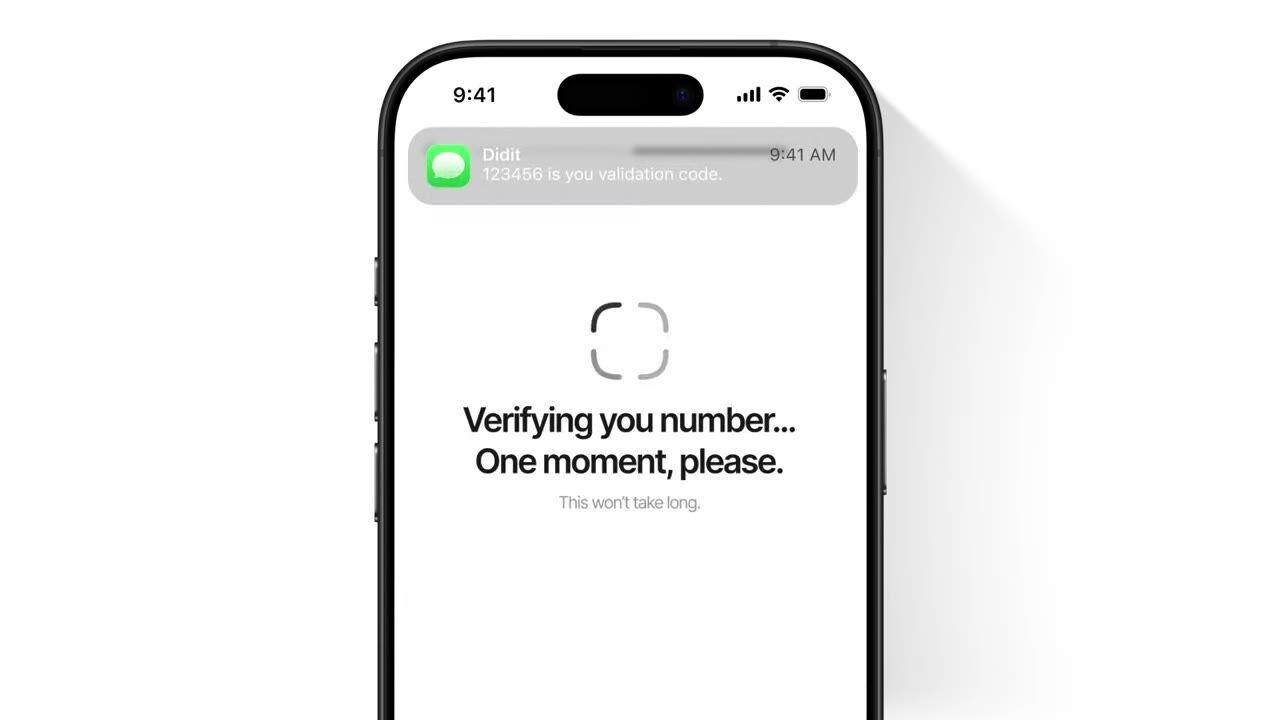
Thibitisha simu yoyote. Kwenye chaneli yoyote wanayojibu.
Tuma nambari ya mara moja kupitia SMS, WhatsApp, Telegram, RCS, au sauti, chaneli yoyote ambayo mtumiaji anajibu. Kurudi nyuma kiotomatiki kati ya chaneli, na alama ya hatari ya mtoa huduma kwenye kila simu. Kuanzia $0.03 pamoja na mtoa huduma.
Moduli moja, njia tano za utoaji. Tunajaribu tena kwenye chaneli mbalimbali hadi nambari
ifike, tunapima hatari ya SIM-swap na mtoa huduma kwenye kila simu, na tunatoza kuanzia $0.03 pamoja na
mtoa huduma, mtiririko wa kazi ni uleule.
Jinsi inavyofanya kazi
Kuanzia kujisajili hadi mtumiaji aliyethibitishwa kwa hatua nne.
Hatua 01 / 04
01
Unda mtiririko wa kazi
Chagua ukaguzi unaotaka, ID, uhai, kulinganisha uso, vikwazo, anwani, umri, simu, barua pepe, maswali maalum. Ziburute kwenye mtiririko kwenye dashibodi, au tuma mtiririko huo huo kwenye API yetu. Gawanya kulingana na masharti, fanya majaribio ya A/B, hakuna code inayohitajika.
Unganisha
Pachika moja kwa moja na SDK yetu ya Web, iOS, Android, React Native, au Flutter. Elekeza kwenye ukurasa uliopangishwa. Au tuma tu mtumiaji wako kiungo, kwa barua pepe, SMS, WhatsApp, popote. Chagua kinachofaa stack yako.
Mtumiaji anapitia mchakato
Didit inasimamia kamera, ishara za mwanga, uhamishaji wa simu, na ufikiaji. Wakati mtumiaji yuko kwenye mtiririko, tunapima ishara 200+ za udanganyifu kwa wakati halisi na kuthibitisha kila sehemu dhidi ya vyanzo vya data vya kuaminika. Matokeo yanapatikana chini ya sekunde mbili.
Unapokea matokeo
Webhooks zilizosainiwa kwa wakati halisi huweka database yako sawa mara tu mtumiaji anapoidhinishwa, kukataliwa, au kutumwa kwa ukaguzi. Uliza API inapohitajika. Au fungua console kukagua kila session, kila ishara, na kudhibiti kesi zako mwenyewe.
Imejengwa kwa ajili ya waendelezaji · Imejengwa dhidi ya udanganyifu · Wazi kwa muundo
Uwezo sita. Feature flag moja. SIMU.
Kila uwezo ni swichi kwenye moduli moja. Hakuna viwango vya kuongeza mauzo, hakuna mipango tofauti, hakuna simu za nyongeza. Ziwashe kwa kila mtiririko wa kazi kwenye console au zipitishe moja kwa moja kwenye simu ya API.
SMS, WhatsApp, Telegram, RCS, na sauti, zote kwenye moduli na mtiririko wa kazi mmoja. Bainisha chaneli wakati sera inahitaji (SMS iliyoagizwa na mdhibiti, masoko yanayotumia WhatsApp kwanza kama Brazil na India), au tuache tuchague njia ya bei nafuu zaidi.
Feature flag moja · Njia tanofeature: PHONE
SMSChaguo-msingi
WhatsAppBR / IN / MX
TelegramEU
RCSAndroid
SautiMbadala
02 · Uelekezaji
Kurejea kiotomatiki kwa chaneli nyingine chaneli moja ikishindwa.
Vizuwizi vya SMS za carrier, nchi zenye viwango vya juu, na kushindwa kimya hupitishwa kiotomatiki. Tunajaribu tena kwenye chaneli inayofuata inayoweza kufikishwa bila code yako kugusa chochote, na tunakuambia ni chaneli gani iliyofikisha ujumbe.
Uelekezaji wa chaneli otomatikiPOST /v3/phone/send/
1SMSMtoa huduma amezuia
2WhatsAppImewasilishwa
verification_methodwhatsapp
03 · Ufikiaji
Ufikiaji wa telco duniani kote. Utoaji unaozingatia carrier.
Ujumuishaji wa carrier nyingi kwa kila nchi, na uelekezaji uliorekebishwa kulingana na tabia za ndani, WhatsApp inaongoza Brazil, India, na Mexico, Telegram na RCS zinaongoza kote EU, SMS inaongoza Marekani. Nchi, carrier, na aina ya nambari hugunduliwa kiotomatiki.
04 · Ishara za udanganyifu
Zaidi ya code ya mara moja. Hatari ya carrier kwenye kila simu.
Kila uthibitishaji unarudisha jina na aina ya carrier (simu ya mkononi, simu ya mezani, voice over IP), bendera za nambari za muda na za mtandaoni, na maonyo dhahiri kwa nambari zenye hatari kubwa, zilizorudiwa, au zilizoorodheshwa. Amua, kagua, au idhinisha kulingana na kategoria ya hatari.
05 · Ubadilishaji
SMS pekee huwapoteza watumiaji. Multi-channel inawaweka.
SMS inaposhindwa, kichujio cha carrier, roaming, eneo lisilo na mawasiliano, kupungua kwa ufikiaji, watoa huduma wa chaneli moja huacha watumiaji wakitazama code isiyofika. Tunawaokoa kwenye njia inayofuata, na tunaripoti ni chaneli gani iliyofikisha ili uweze kurekebisha uelekezaji kwa data halisi.
Kukamilika · Siku 30 zinazopitaJuu zaidi ni bora
SMS pekee58%
+ WhatsApp79%
+ Sauti mbadala93%
Kielelezo, kielekezi, si utafiti.
06 · Bei
Lipa kwa ujumbe. Kuanzia $0.03 pamoja na carrier.
$0.03 kwa kila uthibitishaji, pamoja na ada ya carrier ya nchi na chaneli inayopitishwa bila nyongeza. Unalipa tu ujumbe unapotumwa, kuacha kabla ya kufikishwa hakuna gharama.
Viwango vya kila ujumbeKuanzia $0.03
MarekaniSMS$0.03
BrazilWhatsApp$0.04
IndiaWhatsApp$0.05
Lipa tu ujumbe ukitumwa.
Unganisha
Endpoints mbili. JSON sawa. Bei sawa.
Chagua mtiririko uliopangishwa unapotaka sisi tushughulikie uingizaji wa nambari, UX ya msimbo, na kutuma tena. Chagua API inayojitegemea unaposimamia UX. Zote mbili zinarudisha ripoti sawa.
Bandika kizuizi kilicho hapa chini kwenye Claude Code, Cursor, Codex, Devin, Aider, au Replit Agent. Jaza stack yako. Agent itaweka Didit, kuunda workflow ya Uthibitishaji wa Simu, kuunganisha webhook, na kutuma.
didit-integration-prompt.md
# Didit Phone Verification — integrate in 5 minutes

You are integrating Didit's Phone Verification module into <my_stack>.
Follow these steps exactly. Every URL, header, and enum value below is
canonical — do not paraphrase or "improve" them.

## 1. Provision an account
- Sign up: https://business.didit.me (no credit card required).
- Or provision programmatically: POST https://apx.didit.me/auth/v2/programmatic/register/
  (returns an API key bound to the workspace + application).

## 2. Two integration paths — pick one

### Path A — Workflow Builder (hosted UI)
Best when you want Didit to handle phone collection, country prefix UX,
channel routing, OTP entry, resend buttons, mobile/desktop handoff, and
accessibility for you.

1. Create a workflow that contains the PHONE feature:
   POST https://verification.didit.me/v3/workflows/
   Authorization header:  x-api-key: <your-api-key>
   Body: workflow_label, features array with the single entry
         { feature: "PHONE" }   (UPPERCASE — strict enum)
   Optional config: preferred_channel ("SMS" | "WHATSAPP" | "TELEGRAM" |
   "RCS" | "VIBER" | "CALL"), code_validity_seconds, max_code_attempts
   (default 2), max_resend_requests_per_24h (default 2).

2. Create a verification session for an end user:
   POST https://verification.didit.me/v3/session/
   Body: workflow_id (from step 1), vendor_data (your own user id),
         optional contact_details.phone in E.164 format
         (e.g. "+14155552671") to pre-fill and lock the number.
   Response: url (the hosted verification link) — redirect the user to it.

3. Listen for webhook callbacks (see "Webhooks" below).

### Path B — Standalone server-to-server API
Best when you already own the phone-entry UX (mobile SDK, native
onboarding app, reseller pipeline) and want Didit to handle OTP delivery
+ risk scoring only. Two endpoints, called in sequence:

Step 1 — Send the code:
POST https://verification.didit.me/v3/phone/send/
Content-Type: application/json
Body fields:
  - phone_number  (required, string, E.164 format e.g. "+14155552671")
  - channel       (optional — "SMS" | "WHATSAPP" | "TELEGRAM" | "RCS" |
                   "VIBER" | "CALL". Omit to let Didit pick the best
                   available channel for the destination country and
                   carrier — automatic fallback routing.)
  - vendor_data   (optional, your user id for cross-session linkage)

Step 2 — Check the code:
POST https://verification.didit.me/v3/phone/check/
Content-Type: application/json
Body fields:
  - phone_number  (required, same E.164 number)
  - code          (required, the OTP the user typed)
  - vendor_data   (optional, same user id used in Step 1)

Response: JSON report — status, verification_method (the channel that
actually delivered), carrier object, is_disposable, is_virtual, warnings
array.

## 3. Channel routing — how the automatic fallback works
When channel is omitted on /v3/phone/send/, Didit picks the cheapest
+ most-deliverable channel for the destination:
  - SMS where deliverable and lowest cost (most countries)
  - WhatsApp in BR / IN / MX and other WhatsApp-dense markets
  - Telegram / RCS / Viber where carrier-side SMS is blocked or premium
  - CALL (voice OTP) as last-resort fallback when text channels fail
Each retry attempt may switch channels — the final delivery channel is
returned as verification_method in the report.

## 4. Webhooks (Path A only — Path B returns synchronously)
- Register a webhook destination once via
  POST https://verification.didit.me/v3/webhook/destinations/
  Body: url, subscribed_events: ["session.verified", "session.review_started",
                                  "session.declined"]
- Response includes secret_shared_key — store it.
- Every webhook delivery carries an X-Signature-V2 header you MUST verify
  before trusting the payload.  HMAC-SHA256 verification MUST run against the raw body bytes (the raw payload as Didit sent it) BEFORE any JSON parsing — re-serialising the parsed body changes whitespace and key order, which invalidates the signature.Algorithm:
    1. sortKeys(payload) recursively
    2. shortenFloats (truncate trailing zeros after the decimal point)
    3. JSON.stringify the result
    4. HMAC-SHA256 with the secret_shared_key
    5. Hex-encode, compare to the X-Signature-V2 header.

## 5. Reading the report (both paths return the same phone object)
- status: "Approved" | "Declined" | "In Review" | "Not Finished"
- phone_number_prefix: country prefix in international format ("+34")
- phone_number: subscriber number without the prefix
- full_number: full E.164 string ("+34600600600")
- country_code: ISO 3166-1 alpha-2 ("ES")
- country_name: full country name
- carrier: { name, type: "mobile" | "landline" | "voip" | "unknown" }
- is_disposable: boolean — temporary or throwaway number
- is_virtual: boolean — VoIP or virtual provider
- verification_method: the channel that actually delivered the code
  ("sms" | "whatsapp" | "viber" | "telegram" | "call")
- verification_attempts: number of code-entry tries
- verified_at: ISO 8601 timestamp
- warnings: Array<{ risk, log_type, short_description, long_description }>

Auto-decline risks (always enforced by Didit, not configurable):
- VERIFICATION_CODE_ATTEMPTS_EXCEEDED
- HIGH_RISK_PHONE_NUMBER
- PHONE_NUMBER_IN_BLOCKLIST

Configurable risks (action per workflow — Decline, Review, or Approve):
- DISPOSABLE_NUMBER_DETECTED
- VOIP_NUMBER_DETECTED
- DUPLICATED_PHONE_NUMBER

## 6. Attempt limits (defaults — overridable per workflow)
- Max code-entry attempts: 2 per session
- Max resend requests: 2 per phone number per 24 hours
- Code validity: 5 minutes from send
Hitting either limit fires VERIFICATION_CODE_ATTEMPTS_EXCEEDED and
auto-declines the session.

## 7. Hard rules — do not change
- Base URL for /v3/* endpoints is verification.didit.me (NOT apx.didit.me).
- Feature enum is UPPERCASE: PHONE, OCR, LIVENESS, FACE_MATCH,
  AML, IP_ANALYSIS.
- Channel enum is UPPERCASE on input ("SMS", "WHATSAPP", "TELEGRAM",
  "RCS", "VIBER", "CALL") and lowercase on output ("sms", "whatsapp",
  "telegram", "rcs", "viber", "call").
- All phone numbers go in and come out as E.164 strings — including
  the leading "+" and country prefix.
- Auth header is x-api-key (lowercase, hyphenated).
- Webhook signature header is X-Signature-V2 (NOT X-Signature).
- Always verify webhook signatures before trusting payload data.
- Status casing matches exactly: "Approved", "Declined", "In Review",
  "Not Finished" (title-cased, space-separated).

## 8. Pricing reference (public)
- Didit fee: $0.03 per verification (the cheapest channel; some
  channels and countries cost more — see didit.me/pricing for the
  per-country, per-channel table).
- Carrier fee: variable by country and channel, billed as a
  pass-through with no Didit markup.
- You only pay when a message is SENT. If the user abandons before
  delivery, you are not charged.

## 9. Verify your integration
- Sandbox starts on signup at https://business.didit.me — no separate flag.
- Sandbox numbers: deterministic E.164 numbers return Approved by default;
  trigger Declined with the canonical "high-risk" sandbox number.
- Switch to live: flip the application's environment toggle in console.

When in doubt: https://docs.didit.me/core-technology/phone-verification/overview
Inatii kwa muundo
Fungua nchi mpya kwa kubofya mara moja. Tunafanya kazi ngumu.
Tunafungua kampuni tanzu za ndani, tunapata leseni, tunafanya majaribio ya kupenya, tunapata vyeti, na tunalingana na kila kanuni mpya. Ili kusafirisha uthibitishaji katika nchi mpya, geuza swichi. Nchi 220+ ziko hewani, zinakaguliwa na kupimwa kila robo mwaka, mtoa huduma pekee wa utambulisho ambaye serikali ya nchi mwanachama wa EU imemwita rasmi kuwa salama zaidi kuliko uthibitishaji wa ana kwa ana.
Njia za utumaji, SMS, WhatsApp, Telegram, RCS, sauti.
Otomatiki
Uelekezaji wa chaneli, tunachagua njia rahisi zaidi ya kufikisha.
Kuanzia $0.03
Kwa kila uthibitishaji, pamoja na gharama za mtoa huduma, hakuna nyongeza.
Ngazi tatu, orodha moja ya bei
Anza bure. Lipa kadri unavyotumia. Kuza hadi Enterprise.
Uthibitishaji 500 bila malipo kila mwezi, milele. Kisha lipa tu moduli inapofanya kazi. Mikataba maalum, uhifadhi wa data, na makubaliano ya kiwango cha huduma (SLAs) kwenye Enterprise.
Bure
$0/ mwezi · hakuna kadi
Kwa ajili ya kuunda, kujaribu, na watumiaji wako wa kwanza.
Kila kitu unachohitaji kuanzia:
Uthibitishaji kamili wa KYC 500 kila mwezi
Kitambulisho, uhai, kulinganisha uso, kifaa & IP
Ishara za udanganyifu 200+, orodha nyeusi, marudio
KYC inayoweza kutumika tena kwenye mtandao wa Didit
Mjenzi wa mtiririko wa kazi, usimamizi wa kesi, SDKs
Usaidizi wa AIAI agent ndani ya console, docs, na jumuiya.