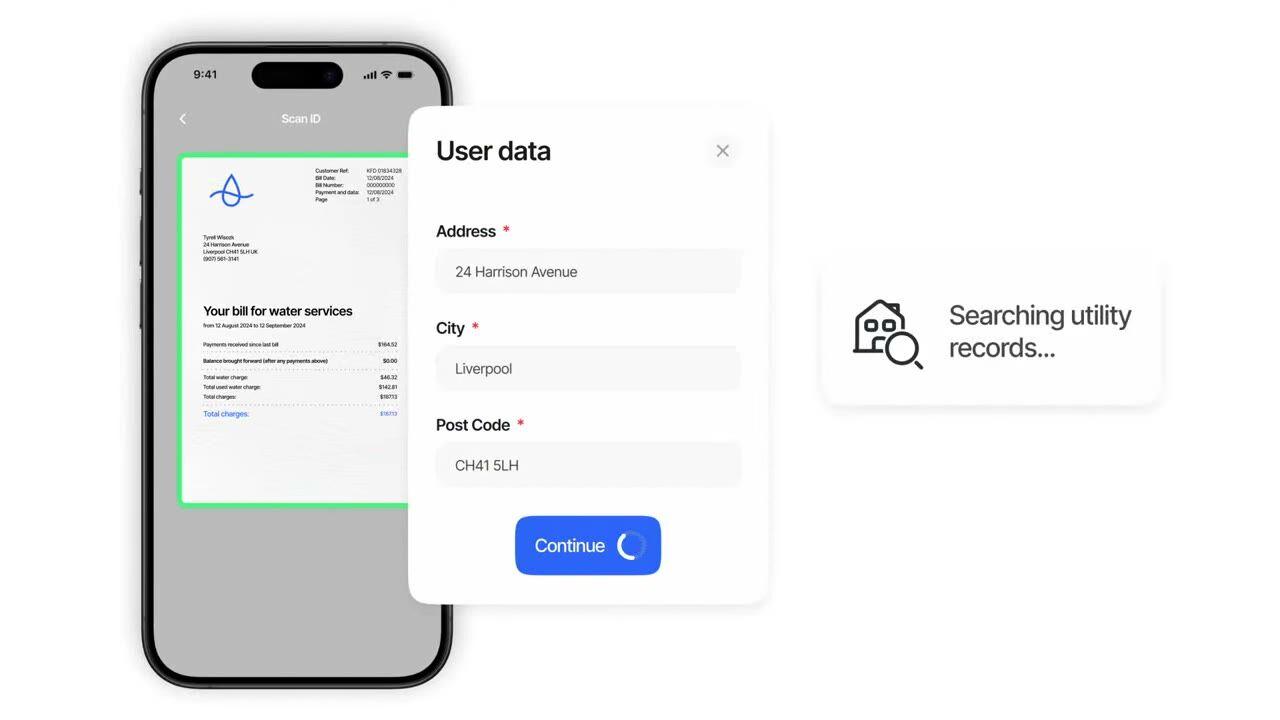
Thibitisha anwani yoyote. Kutoka kwa bili, benki, au barua.
Thibitisha makazi kutoka kwa bili ya huduma, taarifa ya benki, barua ya serikali, au mkataba wa kukodisha. Tunasoma hati, tunatoa anwani, tunalinganisha jina na kitambulisho kilichothibitishwa, na tunarudisha matokeo yaliyopangwa. $0.20 kwa ukaguzi, 500 bure/mwezi.
Tunasoma hati, tunatoa anwani na jina, na tunalinganisha zote mbili
dhidi ya utambulisho uliothibitishwa. Bili ya huduma, taarifa ya benki, mkataba wa kukodisha, barua ya kodi
, $0.20 kwa ukaguzi.
Jinsi inavyofanya kazi
Kutoka kujisajili hadi mtumiaji aliyethibitishwa kwa hatua nne.
Hatua 01 / 04
01
Unda mtiririko wa kazi
Chagua ukaguzi unaotaka, kitambulisho, uhai, kulinganisha uso, vikwazo, anwani, umri, simu, barua pepe, maswali maalum. Ziburute kwenye mtiririko kwenye dashibodi, au tuma mtiririko huo huo kwa API yetu. Panga masharti, fanya majaribio ya A/B, hakuna msimbo unaohitajika.
Unganisha
Pachika asili na SDK yetu ya Web, iOS, Android, React Native, au Flutter. Elekeza kwenye ukurasa uliopangishwa. Au tuma tu mtumiaji wako kiungo, kwa barua pepe, SMS, WhatsApp, popote. Chagua kinachofaa stack yako.
Mtumiaji anapitia mtiririko
Didit inasimamia kamera, vidokezo vya mwanga, uhamishaji wa simu, na ufikiaji. Wakati mtumiaji yuko kwenye mtiririko, tunapima ishara 200+ za udanganyifu kwa wakati halisi na kuthibitisha kila sehemu dhidi ya vyanzo vya data vyenye mamlaka. Matokeo chini ya sekunde mbili.
Unapokea matokeo
Webhooks zilizosainiwa kwa wakati halisi huweka database yako sawa mara tu mtumiaji anapoidhinishwa, kukataliwa, au kutumwa kwa ukaguzi. Piga API inapohitajika. Au fungua console kukagua kila kikao, kila ishara, na kudhibiti kesi kwa njia yako.
Imejengwa kwa waendelezaji · Imejengwa dhidi ya udanganyifu · Wazi kwa muundo
Uwezo sita. Feature flag moja. PROOF_OF_ADDRESS.
Kila uwezo hapa chini ni swichi kwenye moduli moja. Hakuna viwango vya kuongeza mauzo, hakuna SKU tofauti, hakuna simu za nyongeza. Ziwasha kwa kila mtiririko wa kazi au zipitishe moja kwa moja kwenye simu ya API.
Bili, taarifa za benki, barua za serikali, mikataba ya pango.
Aina nne, bili ya huduma (umeme, maji, gesi, intaneti, simu), taarifa ya benki (akaunti, kadi ya mkopo, rehani, mkopo), iliyotolewa na serikali (tathmini ya kodi, kadi ya mpiga kura, cheti cha makazi), na nyinginezo (mkataba wa pango, barua ya mwajiri, bima, hati ya kiapo iliyothibitishwa). JPG, PNG, TIFF, au PDF hadi 15 MB. Kurasa nyingi huchakatwa kwa inference moja.
Source
Voltia PowerElectricity · Mar 2026PDF
AcceptedUTILITY_BILL
JPGJPEGPNGTIFFPDF15 MB · multi-page
02 · Uchimbaji + uhalisi
Soma kila sehemu ya anwani. Gundua kila udanganyifu.
OCR (optical character recognition) huchota anwani ghafi na kuiweka katika muundo maalum, mtaa, jiji, mkoa, msimbo wa posta, aina ya anwani. Latitude na longitude zimejumuishwa. Mchakato huohuo hufanya uchunguzi wa uhalisi wa hati: kugundua udukuzi wa pixel, mabaki ya copy-paste / clone-stamp, utofauti wa fonti + kerning, ishara za picha bandia zilizotengenezwa na AI, na kutolingana kwa metadata. Hati zilizodukuliwa huwekwa kwenye `In Review` na onyo lililoandikwa, hazikubaliwi kimya kimya.
Voltia PowerMar 2026
Extraction6 fields
street_1123 Main St
cityNew York
regionNY
postal_code10001
issuerVoltia Power
issue_date14 Mar 2026
No tamperFontsMetadata
03 · Ukaguzi wa uhalali wa muda
Uhalali unaoweza kusanidiwa. Siku 90 kwa default.
Weka muda wa uhalali wa hati kwa kila application, siku 30, 60, 90, au muda wowote unaochagua. Default ni 90. Tunachota tarehe ya kutolewa na kuilinganisha na timestamp ya uwasilishaji; chochote kilicho cha zamani kuliko kizingiti hupungua kiotomatiki na `EXPIRED_DOCUMENT`. Hati zisizo na tarehe ya kutolewa inayoweza kuchanganuliwa, au zenye tarehe ya baadaye, huibua maonyo unayoweza kuelekeza kwenye ukaguzi wa mikono.
Document agewindow · 90 days
90dtoday
34d
ApproveReviewDecline
Configurable threshold · default 90 days
04 · Jina lilingane na KYC
Bili inalingana na ID. Au hailingani.
Maonyo matatu ya kutolingana kwa jina huibuka wakati jina la hati linatofautiana na utambulisho uliothibitishwa, thamani uliyotuma kupitia API, au uthibitisho mwingine wa anwani katika session hiyohiyo. Kizingiti cha kulinganisha kinachoweza kusanidiwa (kwa kawaida 90–95%) huvumilia jina la kati na tofauti za tahajia. Kila onyo huendana na Decline, Review, au Approve kwa kila application.
Name on billJOHN A. SMITH
96.3%similarity
Name on KYCJohn Smith
Matched
Matches provided name
Matches ID document
Consistent across documents
05 · Anwani iliyochanganuliwa na kupangwa
OCR inarudisha string. Didit inarudisha schema.
Kila jibu linajumuisha object ya anwani iliyochanganuliwa, mtaa, jiji, mkoa, msimbo wa posta, aina ya anwani, pamoja na kuratibu ghafi. Iweke kwenye rekodi ya mteja wako, fraud model, au routing ya utoaji. Hakuna regex, hakuna post-processing, hakuna parser ya nchi. Muundo uleule iwe hati ilitolewa USA, Hispania, Brazil, au Singapore.
As printed on the documentJohn A. Smith123 Main St, Apt 4BNew York, NY 10001
poa_parsed_addressApproved
street_1123 Main St
street_2Apartment 4B
cityNew York
regionNY
postal_code10001
address_typeRESIDENTIAL
lat 40.7128lng -74.0060
06 · Tayari kwa kufuata sheria
Ushahidi wa AMLD6 na FATF Recommendation 10. $0.20 kwa kila ukaguzi.
Uthibitishaji wa anwani unahitajika na AMLD6 (EU's 6th Anti-Money Laundering Directive) customer-due-diligence na FATF Recommendation 10. Kila uamuzi huja na URL ya hati iliyosainiwa, array ya maonyo tayari kwa ukaguzi, na uchunguzi wa udanganyifu wa PDF overlay, afisa wako wa compliance ana ushahidi wote. Bei ya umma ya kulipia kwa kila simu, hakuna mkataba.
3audit artifacts
7-yrretention
2frameworks
poa.status.updated · webhook fired1.4s
SSigned document file URLS3 · 7-day pre-signed
WWarnings audit arrayexpired · name mismatch · tampered
PPDF overlay forensicsduplicate font subset · glyph delta
Compliance readyAMLD6FATF R.10
Unganisha
Endpoints mbili. JSON ileile. Bei ileile.
Unda kikao unapotaka UI yetu iliyopangishwa kushughulikia kunasa na kupakia kurasa nyingi. Piga endpoint inayojitegemea wakati tayari una hati. Muundo wa ripoti ni ule ule kwa njia zote mbili.
Bandika kizuizi kilicho hapa chini kwenye Claude Code, Cursor, Codex, Devin, Aider, au Replit Agent. Jaza kishika nafasi cha my_stack na mfumo wako, lugha, na matumizi. Agent itaweka Didit, kuunda mtiririko wa kazi, kuunganisha webhook, na kutuma.
didit-integration-prompt.md
# Didit Proof of Address — integrate in 5 minutes

You are integrating Didit's Proof of Address (PoA) module into <my_stack>.
Follow these steps exactly. Every URL, header, and enum value below is
canonical — do not paraphrase or "improve" them.

## 1. Provision an account
- Sign up: https://business.didit.me (no credit card required).
- Or provision programmatically: POST https://apx.didit.me/auth/v2/programmatic/register/
  (returns an API key bound to the workspace + application).

## 2. Two integration paths — pick one

### Path A — Workflow Builder (hosted UI)
Best when you want Didit to handle document capture, multi-page upload,
auto-capture, mobile handoff, and accessibility for you.

1. Create a workflow that contains the PROOF_OF_ADDRESS feature:
   POST https://verification.didit.me/v3/workflows/
   Authorization header:  x-api-key: <your-api-key>
   Body: workflow_label, features array with the single entry
         { feature: "PROOF_OF_ADDRESS" }   (UPPERCASE — strict enum)
   Optional config: accepted document_type filters
   (UTILITY_BILL, BANK_STATEMENT, GOVERNMENT_ISSUED_DOCUMENT,
   OTHER_POA_DOCUMENT) and per-warning threshold overrides.

2. Create a verification session for an end user:
   POST https://verification.didit.me/v3/session/
   Body: workflow_id (from step 1), vendor_data (your own user id).
   Response: url (the hosted verification link) — redirect the user to it.

3. Listen for webhook callbacks (see "Webhooks" below).

### Path B — Standalone server-to-server API
Best when you already have a captured document image or PDF (mobile SDK
capture, native onboarding app, reseller pipeline).

POST https://verification.didit.me/v3/poa/
Content-Type: multipart/form-data
Body fields:
  - document     (required, file — JPG, JPEG, PNG, TIFF, or PDF, <= 15 MB)
  - vendor_data  (optional string, your user id)
  - full_name    (optional string, name to cross-check against the document)
  - address      (optional string, address to cross-check against the document)

Response: JSON report with the parsed address, document_type, issuer,
issue_date, name_on_document, and a warnings array.

## 3. Webhooks (Path A only — Path B returns synchronously)
- Register a webhook destination once via
  POST https://verification.didit.me/v3/webhook/destinations/
  Body: url, subscribed_events: ["session.verified", "session.review_started",
                                  "session.declined"]
- Response includes secret_shared_key — store it.
- Every webhook delivery carries an X-Signature-V2 header you MUST verify
  before trusting the payload.  HMAC-SHA256 verification MUST run against the raw body bytes (the raw payload as Didit sent it) BEFORE any JSON parsing — re-serialising the parsed body changes whitespace and key order, which invalidates the signature.Algorithm:
    1. sortKeys(payload) recursively
    2. shortenFloats (truncate trailing zeros after the decimal point)
    3. JSON.stringify the result
    4. HMAC-SHA256 with the secret_shared_key
    5. Hex-encode, compare to the X-Signature-V2 header.

## 4. Reading the report (both paths return the same shape)
The poa object includes:
- status: "Approved" | "Declined" | "In Review" | "Not Finished"
- issuing_state: ISO 3166-1 alpha-3 country code
- document_type: "UTILITY_BILL" | "BANK_STATEMENT" |
                 "GOVERNMENT_ISSUED_DOCUMENT" | "OTHER_POA_DOCUMENT" |
                 "UNKNOWN"
- issuer: string (the issuing institution or company)
- issue_date: YYYY-MM-DD
- expiration_date: YYYY-MM-DD or null
- document_language: ISO 639-1 language code
- name_on_document: string (full name extracted from the document)
- poa_address: raw extracted address string
- poa_formatted_address: normalized human-readable address string
- poa_parsed_address: structured object with street_1, street_2, city,
  region, postal_code, address_type, and raw_results.geometry.location
  (lat / lng for geocoding)
- document_file: signed URL to the captured document (expires in 60 minutes)
- document_metadata: optional file_size, content_type, creation_date,
  modified_date, and overlay_manipulation forensic block for PDFs (detected
  flag, signals such as duplicate_font_subset or glyph_fragmentation, and
  manipulated_regions in PDF page coordinates)
- warnings: Array<{ risk, additional_data, log_type, short_description,
                    long_description }>

Auto-decline risks (always enforced by Didit, not configurable):
- POA_DOCUMENT_NOT_SUPPORTED_FOR_APPLICATION
- EXPIRED_DOCUMENT
- INVALID_DOCUMENT_TYPE
- MISSING_ADDRESS_INFORMATION

Configurable risks (action per workflow — Decline, Review, or Approve):
- NAME_MISMATCH_WITH_PROVIDED
- NAME_MISMATCH_ID_VERIFICATION
- POA_NAME_MISMATCH_BETWEEN_DOCUMENTS
- POOR_DOCUMENT_QUALITY
- DOCUMENT_METADATA_MISMATCH
- SUSPECTED_DOCUMENT_MANIPULATION
- UNSUPPORTED_DOCUMENT_LANGUAGE
- ADDRESS_MISMATCH_WITH_PROVIDED
- UNABLE_TO_EXTRACT_ISSUE_DATE
- UNPARSABLE_OR_INVALID_ADDRESS
- ISSUER_NOT_IDENTIFIED
- UNABLE_TO_VALIDATE_DOCUMENT_AGE
- FUTURE_ISSUE_DATE

## 5. Hard rules — do not change
- Base URL for /v3/* endpoints is verification.didit.me (NOT apx.didit.me).
- Feature enum is UPPERCASE: PROOF_OF_ADDRESS, OCR, LIVENESS,
  FACE_MATCH, AML, IP_ANALYSIS.
- document_type enum is UPPERCASE_SNAKE: UTILITY_BILL, BANK_STATEMENT,
  GOVERNMENT_ISSUED_DOCUMENT, OTHER_POA_DOCUMENT, UNKNOWN.
- Auth header is x-api-key (lowercase, hyphenated).
- Webhook signature header is X-Signature-V2 (NOT X-Signature).
- Always verify webhook signatures before trusting payload data.
- Status casing matches exactly: "Approved", "Declined", "In Review",
  "Not Finished" (title-cased, space-separated).
- Documents must be issued within 90 days of submission — older documents
  trigger the EXPIRED_DOCUMENT auto-decline regardless of policy.
- The PoA document must be different from the document submitted for ID
  Verification — same image triggers POA_DOCUMENT_NOT_SUPPORTED.

## 6. Accepted document types (do not paraphrase to users)
- Utility Bill — Electricity, Water, Gas, Internet, Phone, Cable TV,
  Satellite TV, Trash Collection, Sewage, Heating, Combined Utilities,
  Municipal Services.
- Bank Statement — Account Statement, Credit Card Statement, Bank Letter
  Confirming Address, Mortgage Statement, Loan Statement, Savings,
  Checking, Investment, Business Account, Credit Union, Debit Card,
  Line of Credit.
- Government-Issued Document — Tax Assessment, Voter Registration Card,
  ID document, Residency Certificate, Government Letter, Census Letter,
  Property Tax Bill, Vehicle Registration, Social Security Statement,
  Unemployment Benefits Letter, Pension Statement, Court Summons,
  Municipal Permit, Immigration Document.
- Other Proof of Address — Lease Agreement, Rental Agreement, Employer
  Letter Confirming Address, Insurance Policy, School Enrollment Letter,
  Notarized Affidavit, Solicitor Letter, Payroll Stub, Employment
  Verification Letter, Retirement / Brokerage Account Statement.

Image requirements: JPG, JPEG, PNG, TIFF, or PDF. Maximum file size 15 MB.
Full-color, all corners visible, no digital editing, all pages included
for multi-page documents.

## 7. Pricing reference (public)
- Standalone /v3/poa/ call: $0.20 per check.
- Bundled inside a Didit workflow (KYC plus PoA): $0.20 per check on top
  of the bundle base.
- 500 free verifications every month, forever, on every account.

## 8. Verify your integration
- Sandbox starts on signup at https://business.didit.me — no separate flag.
- Test documents: deterministic synthetic bills returned in sandbox
  (Approved by default; trigger Declined by submitting the canonical
  "expired" test bill from the sandbox sample pack).
- Switch to live: flip the application's environment toggle in console.

When in doubt: https://docs.didit.me/core-technology/proof-of-address/overview
Inatii kwa muundo
Fungua nchi mpya kwa kubofya mara moja. Tunafanya kazi ngumu.
Tunafungua kampuni tanzu za ndani, tunapata leseni, tunafanya majaribio ya kupenya, tunapata vyeti, na tunalingana na kila kanuni mpya. Ili kusafirisha uthibitishaji katika nchi mpya, geuza swichi. Nchi 220+ ziko hewani, zinakaguliwa na kupimwa kila robo mwaka, mtoa huduma pekee wa utambulisho ambaye serikali ya nchi mwanachama wa EU imemwita rasmi kuwa salama zaidi kuliko uthibitishaji wa ana kwa ana.
Aina za nyaraka, bili ya huduma, taarifa ya benki, hati ya serikali, nyinginezo.
90d
Umri wa juu zaidi wa tarehe ya kutolewa kabla ya kukataliwa kiotomatiki.
<2s
Uthibitishaji kamili wa Proof of Address.
$0.20
Kwa kila ukaguzi wa Proof of Address unaojitegemea.
Ngazi tatu, orodha moja ya bei
Anza bure. Lipa kadri unavyotumia. Kuza hadi Enterprise.
Uthibitishaji 500 bila malipo kila mwezi, milele. Kisha lipa tu moduli inapofanya kazi. Mikataba maalum, uhifadhi wa data, na makubaliano ya kiwango cha huduma (SLAs) kwenye Enterprise.
Bure
$0/ mwezi · hakuna kadi
Kwa ajili ya kuunda, kujaribu, na watumiaji wako wa kwanza.
Kila kitu unachohitaji kuanzia:
Uthibitishaji kamili wa KYC 500 kila mwezi
Kitambulisho, uhai, kulinganisha uso, kifaa & IP
Ishara za udanganyifu 200+, orodha nyeusi, marudio
KYC inayoweza kutumika tena kwenye mtandao wa Didit
Mjenzi wa mtiririko wa kazi, usimamizi wa kesi, SDKs
Usaidizi wa AIAI agent ndani ya console, docs, na jumuiya.