Seamless Identity: Custom Branding for White-Label KYC
Discover how custom branding and UI/UX integration for white-label identity verification flows can significantly enhance user trust and conversion rates.
 Alberto RosasCo-founder and CEO
Contents
In this guide
Jump to the part you need.
Maintain Brand ConsistencyEnsure your identity verification process seamlessly integrates with your existing brand, from logos and colors to messaging, to build user trust and reduce abandonment rates.
Enhance User ExperienceA well-designed, branded UI/UX for identity verification reduces friction, guides users effectively, and makes the process feel secure and professional, leading to higher completion rates.
Boost Trust and CredibilityWhite-label solutions with custom branding reinforce your brand's legitimacy, assuring users that their sensitive data is being handled by a trusted entity, not a generic third-party service.
Didit's Superior CustomizationDidit offers unparalleled flexibility for white-label identity verification, allowing full customization of workflows and UI/UX to perfectly match your brand, all powered by an AI-native, modular architecture with Core KYC.
In today's digital-first world, user trust is paramount. Every interaction a customer has with your brand, from browsing your website to completing a transaction, contributes to their overall perception. This includes the often-sensitive process of identity verification. While white-label identity verification solutions offer invaluable efficiency and compliance, simply embedding a generic, unbranded flow can inadvertently erode user trust and increase abandonment rates.
Integrating custom branding and a tailored UI/UX into your white-label identity verification flows is no longer a luxury—it's a necessity. It transforms a potentially jarring, third-party experience into a seamless, trusted extension of your own brand. This blog post explores why custom branding matters, the key elements to consider, and how to effectively implement it for a superior user journey.
Why Custom Branding is Essential for Identity Verification
Imagine directing a customer to a verification page that looks completely different from your website, with unfamiliar logos and colors. This sudden shift can trigger alarm bells, making users question the legitimacy of the process and potentially leading to high drop-off rates. Custom branding addresses this by:
- Building Trust: A consistent brand experience assures users they are still interacting with your company, even when a third-party solution is powering the backend. This familiarity is crucial when asking for sensitive personal information.
- Reducing Friction and Abandonment: A seamless transition from your platform to the verification flow, with a familiar look and feel, reduces cognitive load and makes the user feel more comfortable proceeding. This directly translates to higher completion rates for essential processes like onboarding (KYC) or age verification.
- Reinforcing Professionalism: A polished, branded verification flow demonstrates your commitment to a high-quality user experience and professional operations, enhancing your overall brand image.
- Meeting Compliance Requirements: While not strictly a branding point, a well-integrated flow implicitly supports compliance by ensuring users complete necessary steps, whether it's for AML Screening or ID Verification, without hesitation.
Ultimately, custom branding transforms a potential point of friction into another opportunity to strengthen your customer relationship and reinforce your brand's credibility.
Key Elements of a Branded Verification UI/UX
Effective white-label branding goes beyond just slapping your logo on a page. It involves a holistic approach to the user interface and experience. Here are the critical elements to consider:
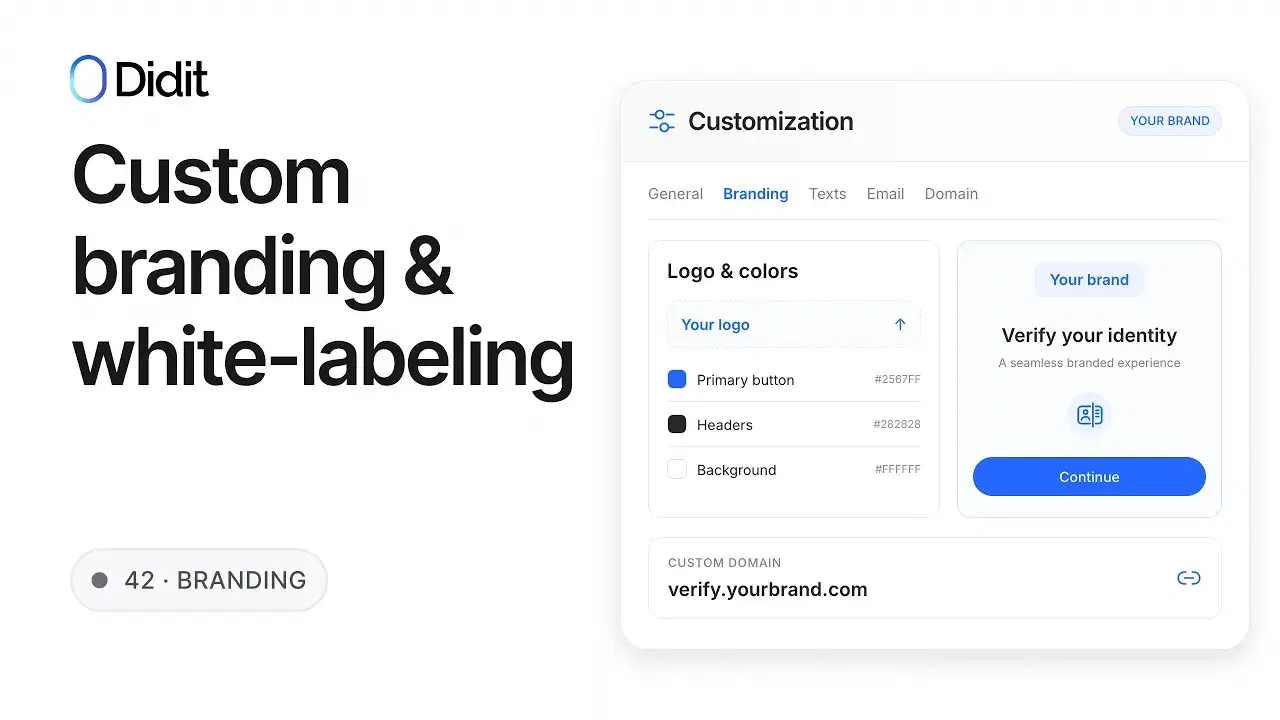
- Logo and Color Palette: This is the most fundamental step. Your logo should be prominently displayed, and the color scheme should match your brand guidelines. This instantly creates familiarity.
- Typography and Imagery: Use fonts that are consistent with your brand's website or application. If the verification flow includes instructional images or icons, ensure they align with your brand's visual style.
- Messaging and Tone: The language used in instructions, error messages, and success screens should reflect your brand's voice and tone. Is your brand formal, friendly, technical, or approachable? The verification flow should echo this.
- Flow Customization: Beyond aesthetics, the actual steps of the verification process should be logical and intuitive. For example, if you're performing ID Verification and Passive & Active Liveness checks, the flow should guide the user clearly through each stage, explaining why each step is necessary.
- Error Handling and Feedback: A branded experience extends to how errors are presented. Clear, helpful, and on-brand error messages, along with guidance on how to proceed, are crucial for retaining users who might otherwise become frustrated.
- Domain and URLs: Ideally, the verification flow should operate under a subdomain that reflects your brand (e.g., verify.yourcompany.com), further solidifying the white-label experience.
By meticulously addressing these elements, you can create a verification journey that feels like a natural extension of your own platform.
Implementing Custom Branding: Best Practices
Successfully integrating custom branding into your white-label identity verification requires thoughtful planning and execution. Here are some best practices:
- Choose a Flexible Provider: Not all white-label solutions offer the same level of customization. Prioritize providers like Didit that are built with modularity and extensive UI/UX configurability in mind. This allows you to control everything from the workflow steps to the smallest design details.
- Design with Mobile in Mind: A significant portion of identity verification happens on mobile devices. Ensure your branded UI/UX is fully responsive and optimized for a smooth mobile experience, including intuitive camera access for ID Verification and Liveness checks.
- Test Thoroughly: Before going live, rigorously test the entire branded flow across different devices and browsers. Gather feedback from internal and external users to identify any pain points or inconsistencies.
- Iterate and Optimize: User behavior and technology evolve. Continuously monitor completion rates and user feedback for your verification flows. Use this data to make iterative improvements to your branded UI/UX, ensuring it remains effective and user-friendly.
- Align with Your Overall Onboarding Strategy: The identity verification step should be a natural part of your broader customer onboarding or interaction strategy. Ensure the transition from your main application to the verification flow is smooth and well-communicated.
By following these practices, businesses can leverage the power of white-label solutions while delivering a premium, on-brand experience to their users.
How Didit Helps
Didit stands at the forefront of providing highly customizable, white-label identity verification solutions. Our AI-native, developer-first platform is designed with modularity at its core, enabling businesses to effortlessly integrate custom branding and UI/UX into their verification flows. With Didit's Business Console, you can design and deploy sophisticated Orchestrated Workflows with a no-code editor, ensuring every step, from ID Verification and Passive & Active Liveness to AML Screening, aligns perfectly with your brand's aesthetic and messaging.
Didit's verification links and Unilinks allow you to launch complete identity verification flows without any frontend development, yet still maintain full brand control. You can customize logos, colors, fonts, and even the language used, all while Didit handles the complex backend processing and security. This means you can launch a robust, on-brand verification process in minutes, not weeks, significantly improving speed to market and user trust. Didit offers Core KYC, transparent pay-per-successful check pricing, and no setup fees, making it the most accessible and powerful solution for businesses prioritizing both security and brand integrity.
Ready to Get Started?
Ready to see Didit in action? Get a free demo today.
Start verifying identities for free with Didit's free tier.
Try it
Try this in the sandbox
Run the check this guide describes, free.
The product this post is about, taken from its topic. Run it free in the sandbox.
Author
Alberto Rosas
Co-founder and CEO

Keep reading
Other guides in the same topic.
 What Is the Purpose of FICA in South Africa? 2026 Guide
FICA is South Africa's anti-money laundering law. It creates the Financial Intelligence Centre and requires accountable institutions to identify and verify clients, screen for PEP and sanctions risk and report suspicious.
Alberto RosasNov 26, 2026 Sixth Money Laundering Directive (6AMLD): What Changed and Which Rules Apply
6AMLD is Directive (EU) 2018/1673: Member States must criminalise laundering, widen predicate offences and set a four-year penalty floor. It adds no new due diligence duties for firms.
Alberto RosasNov 26, 2026 Automated Sanctions Screening: Canada, the Entity List and Embargoes
Automated sanctions screening matches people and companies against lists such as Canada's autonomous sanctions made under SEMA and JVCFOA and the OFAC SDN List, and returns candidate hits scored for identity confidence and.
Alberto RosasNov 26, 2026Questions
Blog questions
Who writes the Didit blog?
Which topics does the blog cover?
Is the blog available in my language?
Where do I find product updates?
Are these posts legal advice?
How do I find posts on one topic?
Are posts dated?
Do posts link to the docs?
Is the blog the same as the docs?
Compliance built in
Audited, certified and attested.
We hold the certifications and build each country's rules into your flows, so you can launch anywhere without worrying. Security and Compliance center
- Regulation encoded into your flows
Tell us what you do and where. Didit lists the rules that apply to you, with sources, and builds the checks each country needs into one workflow.
- Ready for AMLR
Every requirement of the new EU anti-money laundering rules, from checking customers to human review, is already covered by a Didit check.
- Tested in Spain's Treasury sandbox
Spain's Treasury published its supervised sandbox report on Didit's NFC plus active liveness onboarding; SEPBLAC took part and valued the added measures positively.
- Audited, not self-declared
iBeta Level 1 and Level 2. Liveness tested under ISO/IEC 30107-3.
Your obligations · 3 regions
 SOC 2 Type 2
 ISO 27001
 iBeta Level 1 and Level 2
 EU regulator attestation
 FSM youth protection
 GDPR
 EBA remote onboarding
 MiCA compatible
 FIDO Alliance member
- AMLREU AML Regulation ready
Integration · Didit MCP
Run Didit from your own AI agent
Connect Didit to Claude, Cursor, VS Code or ChatGPT and just ask in plain words. Your agent can do anything you can do in the console, with the same permissions you have.
 Add to Claude
 ChatGPT
 Cursor
- Build workflowsDescribe the checks you need. The agent creates and publishes the flow.
- Run investigationsAsk why a session was declined, review cases, search people and companies.
- Change rulesCreate payment rules, test them on past data and switch them on.
- Pull reportsAsk for numbers, exports or the audit log.
Didit Academy