Blog
Blog archive
Every post on the Didit blog, newest first. Pick a category or search to find the subject you need.
All posts
Every post, newest first
Pick a category to filter.

Property management systems (PMS) can significantly benefit from integrating no-code Proof of Address (PoA) workflows. This enhances tenant onboarding, reduces manual effort, and mitigates fraud risks.
Alberto RosasMar 12, 2026IP Analysis: Your Shield Against Credential Stuffing Attacks
Credential stuffing attacks are a growing threat, exploiting stolen login credentials to gain unauthorized access. IP analysis plays a crucial role in detecting and preventing these attacks by identifying suspicious login.
Alejandro RosasMar 12, 2026Composable Identity for Ethical AI: Mitigating Bias in KYC
Discover how composable identity solutions, powered by ethical AI, are crucial for mitigating bias in Know Your Customer (KYC) decisions. Learn how to build fair, transparent, and compliant verification processes, ensuring.
Alberto RosasMar 12, 2026Streamline Payment Gateway Onboarding with Structured Identity Data
Efficient payment gateway onboarding is crucial for businesses, yet often hindered by manual KYC processes. Adopting structured identity data and AI-native verification solutions can dramatically reduce friction, enhance.
Alberto RosasMar 12, 2026Streamlining Insurance Claims with AI-Powered Utility Bill Verification
Discover how AI-driven utility bill verification revolutionizes insurance claims processing. Learn about enhanced fraud detection, accelerated approvals, and improved customer experiences.
Alberto RosasMar 12, 2026Developer's Guide: Integrating Dynamic Address Verification into CRMs
Integrating dynamic address verification into CRM systems is crucial for maintaining data accuracy, enhancing customer experience, and ensuring compliance.
Alejandro RosasMar 12, 2026The ROI of Real-Time Phone & Email Verification in Onboarding
Real-time phone and email verification are crucial for secure and efficient customer onboarding, significantly impacting ROI by reducing fraud, improving data quality, and enhancing user experience.
Alberto RosasMar 12, 2026Securing P2P Transactions with Multi-Factor Identity Verification
Peer-to-peer (P2P) transactions are convenient but vulnerable to fraud. Multi-factor identity verification (MFA) is crucial for securing these exchanges, moving beyond simple passwords to robust biometric and document checks.
Alberto RosasMar 12, 2026Orchestrating Micro-Credentials in Energy: Best Practices
Effectively managing micro-credentials in the energy sector is crucial for workforce development and safety. This guide explores best practices, from robust identity verification to seamless integration, ensuring compliance and.
Alberto RosasMar 12, 2026How Data Privacy Laws Shape Identity Data Orchestration
Data privacy regulations like GDPR and CCPA are fundamentally reshaping how organizations manage and orchestrate identity data. This blog explores the impact of these laws, emphasizing the need for robust data governance.
Alberto RosasMar 12, 2026Verifiable Credentials: SME's Shield Against Financial Crime
Verifiable Credentials (VCs) offer SMEs a powerful, privacy-preserving tool to combat financial crime. By decentralizing identity verification, VCs reduce fraud, streamline compliance, and enhance trust.
Alberto RosasMar 12, 2026Orchestrated Workflows for Global AML Screening in Trade Finance
Trade finance operations face significant Anti-Money Laundering (AML) challenges due to their complex, multi-party, and cross-border nature.
Alberto RosasMar 12, 2026Compliance-as-Code for Cross-Border Financial Reporting
Compliance-as-Code offers a powerful solution for navigating the complexities of cross-border financial reporting regulations like MiFIR and EMIR.
Alberto RosasMar 12, 2026GDPR Article 9 in Identity Verification (2026 Guide)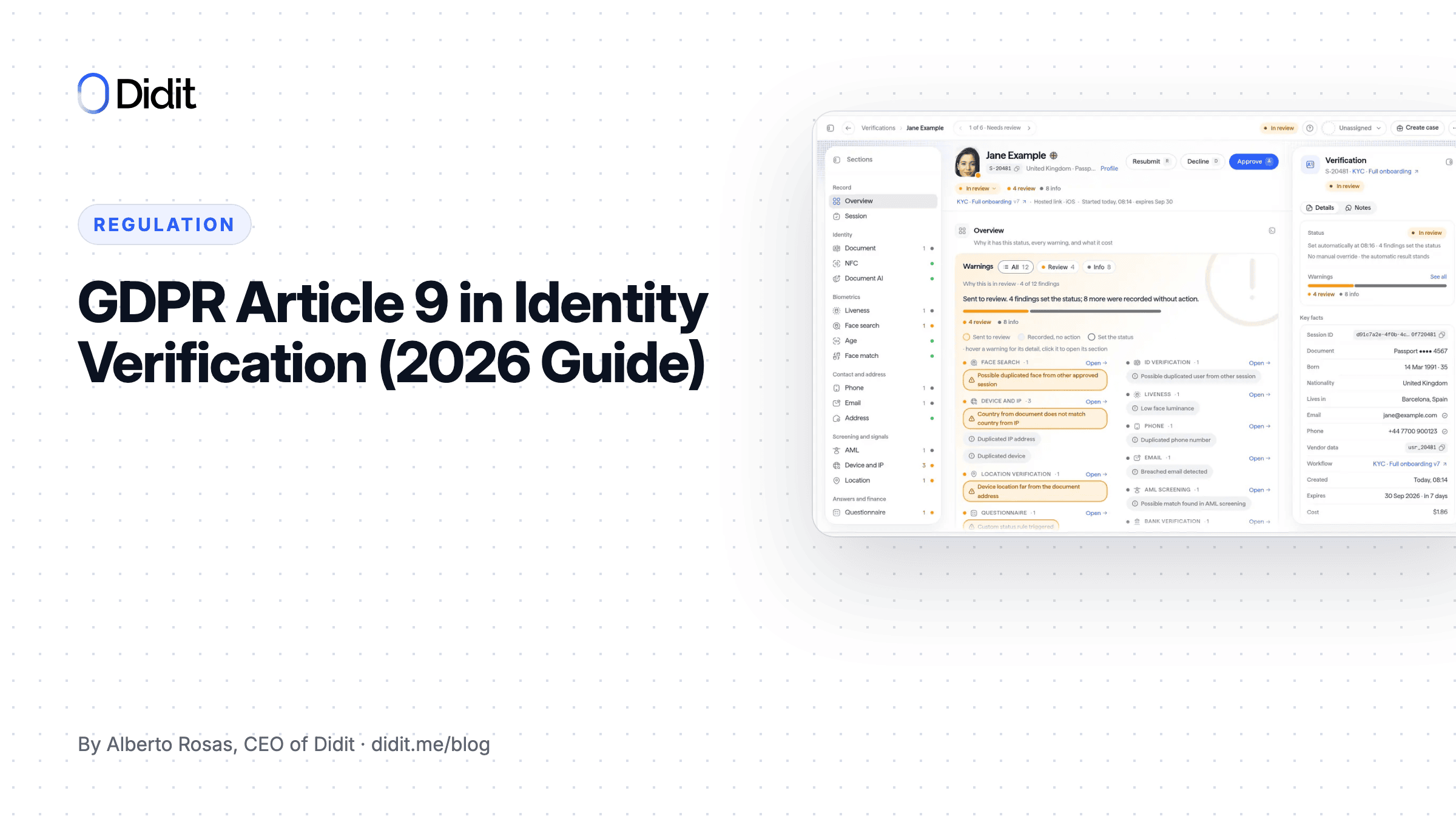
GDPR Article 9 bans processing biometric data for unique identification unless a narrow condition applies; in identity checks that is usually explicit consent or a Member State law.
Alberto RosasMar 12, 2026GDPR-Compliant Zero-Knowledge Proofs for Healthcare Data
Explore how Zero-Knowledge Proofs (ZKPs) can enable secure, GDPR-compliant healthcare data sharing within consortia, protecting patient privacy while facilitating vital research.
Alberto RosasMar 12, 2026Modular AML Orchestration for Compliance-as-Code in DeFi
Decentralized Finance (DeFi) presents unique challenges for Anti-Money Laundering (AML) compliance. This post explores building modular AML orchestration layers, embracing a compliance-as-code approach, and leveraging AI-native.
Alejandro RosasMar 12, 2026OID4VC for SSI Wallets: A Developer's Integration Guide
Explore how OID4VC (OpenID for Verifiable Credentials) enables seamless integration of self-sovereign identity (SSI) wallets. This guide provides developers with the knowledge to implement OID4VC, covering key concepts.
Alejandro RosasMar 12, 2026Decentralized Digital Credential Wallets for Enterprise Supply Chains
Decentralized Identity (DID) wallets offer a transformative approach to trust, transparency, and efficiency in enterprise supply chains. By empowering entities with self-sovereign control over their verifiable credentials, DIDs.
Alberto RosasMar 12, 2026Cross-Border Fraud Detection: IP & Travel Document Scans
Combat cross-border fraud by correlating IP analysis and travel document scans. Learn how combining geo-location data with identity document verification provides a robust defense against sophisticated fraudulent activities.
Alejandro RosasMar 12, 2026Smart Contracts & Travel Rule: DeFi & NFT Compliance
The Travel Rule presents a significant compliance challenge for DeFi and NFT platforms. Smart contracts offer an automated, scalable solution for data sharing and verification, integrating identity and AML checks directly into.
Alberto RosasMar 12, 2026Privacy-Preserving Address Verification in Germany for GDPR
This blog explores the complexities of implementing privacy-preserving address verification in Germany, ensuring compliance with stringent GDPR regulations.
Alberto RosasMar 12, 2026ePassport Security: A Deep Dive into BAC, PAC, and SAC
ePassports leverage advanced cryptographic protocols like Basic Access Control (BAC), Password Authenticated Connection Establishment (PACE), and Supplemental Access Control (SAC) to secure sensitive biometric data.
Alberto RosasMar 12, 2026Optimizing Bank Statement Validation for Enhanced Due Diligence
Discover how advanced AI and automation are revolutionizing bank statement validation in European banking, enhancing due diligence, and combating financial crime.
Alberto RosasMar 12, 2026Optimizing Document Verification for Cross-Border E-commerce AML
Cross-border e-commerce faces increasingly stringent Anti-Money Laundering (AML) regulations. Effective document verification is crucial for compliance, fraud prevention, and maintaining customer trust.
Alberto RosasMar 12, 2026Unlocking ISO 18013-5 for Secure Mobile ID Verification
ISO 18013-5 is revolutionizing digital identity by enabling secure, privacy-preserving mobile driver's licenses (mDLs). This standard offers enhanced security, global interoperability, and user control, paving the way for a.
Alberto RosasMar 12, 2026eIDAS 2.0 PID: Technical Specs for Digital Wallets
eIDAS 2.0 introduces standardized Person Identification Data (PID) for digital wallets, streamlining secure identity verification across the EU.
Alberto RosasMar 12, 2026Automating Utility Bill Verification for PSD3 Compliance
European fintechs face increased scrutiny under PSD3, making robust identity verification crucial. Automating utility bill verification streamlines compliance, enhances security, and improves customer onboarding.
Alberto RosasMar 12, 2026Simplifying Cross-Border Proof of Address for EU Digital Wallets
The advent of EUDI Wallets presents both opportunities and challenges for cross-border Proof of Address (PoA) verification. This article explores how businesses can overcome common hurdles, ensure compliance, and.
Alberto RosasMar 12, 2026The ROI of Digital Credential Wallets for Businesses
Digital credential wallets offer significant ROI for businesses by streamlining operations, enhancing security, and improving customer experience.
Alberto RosasMar 12, 2026Building AI Agent Reputations with Self-Sovereign Identity
As AI agents become autonomous, establishing verifiable reputations is crucial for trust and security. Self-Sovereign Identity (SSI) offers a robust framework for agents to own and manage their credentials, fostering a trusted.
Alberto RosasMar 12, 2026Streamlining Global Regulatory Reporting with Structured Identity Data
Effectively managing global regulatory reporting is a significant challenge for businesses operating across borders. This blog explores how structured identity data, powered by AI-native solutions, simplifies compliance, reduces.
Alberto RosasMar 12, 2026Federated Identity in Digital Healthcare: The Future of Patient Onboarding
The digital healthcare ecosystem is evolving, demanding seamless yet secure patient onboarding. Federated identity, powered by reusable KYC, is crucial for reducing friction, enhancing security, and ensuring compliance.
Alberto RosasMar 12, 2026NFC Verification for Digital Driving Licenses: The Future of ID
Digital driving licenses powered by NFC verification are emerging as a secure and convenient alternative to physical documents. This technology offers enhanced security through cryptographic validation and tamper-proof checks.
Alejandro RosasMar 12, 2026Developer's Guide: Reusable KYC with OAuth 2.0 and OIDC
This guide explores integrating Reusable KYC with OAuth 2.0 and OIDC for streamlined identity verification. It covers the technical benefits, security considerations, and practical implementation steps, highlighting how Didit's.
Alejandro RosasMar 12, 2026Telemedicine & Identity: Orchestrating Risk with Structured Data
Telemedicine platforms face unique challenges in verifying patient and provider identities while ensuring compliance and preventing fraud. Leveraging structured identity data is crucial for robust risk orchestration, enabling.
Alberto RosasMar 12, 2026Orchestrating Healthcare Identity Data for Multi-Cloud EHRs
Managing patient identity across disparate multi-cloud Electronic Health Records (EHRs) is a monumental challenge, impacting data integrity, patient safety, and operational efficiency.
Alberto RosasMar 12, 2026SSI and Post-Quantum Cryptography for Secure Digital Identity
Explore how Self-Sovereign Identity (SSI) and Post-Quantum Cryptography (PQC) are converging to build a future-proof foundation for digital identity.
Alberto RosasMar 12, 2026The Economics of Trust: ROI of Zero Data Retention KYC
Discover the significant return on investment of implementing zero data retention Know Your Customer (KYC) policies. This approach mitigates data breach risks, reduces compliance costs, and builds stronger customer trust.
Alberto RosasMar 12, 2026BaFin Video-Ident KYC in Germany: Rules, eID and 2026 Costs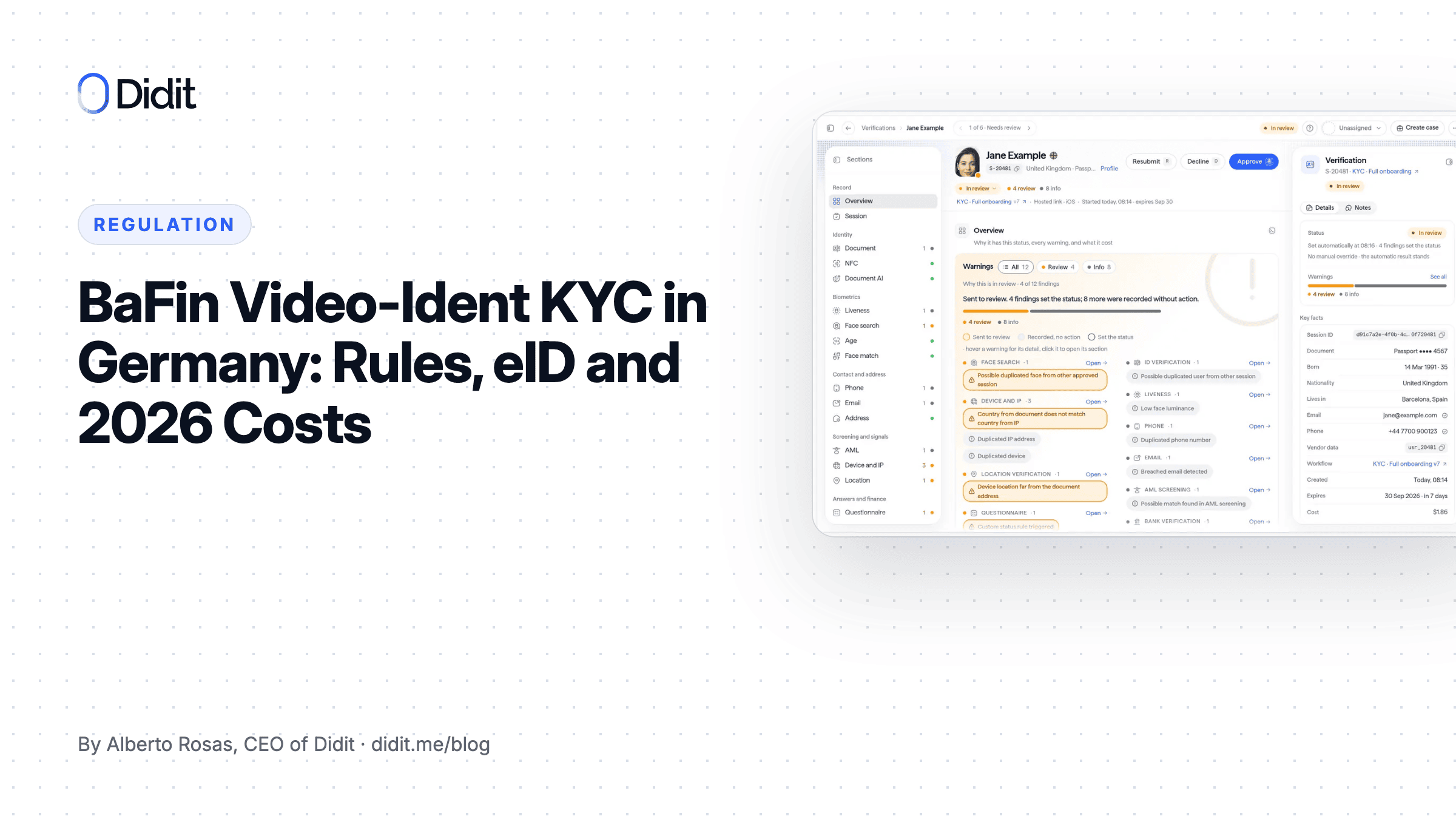
German remote KYC rests on § 10, § 12 and § 13 GwG plus current BaFin guidance. Our published documentation covers automated document capture, liveness, face match and AML steps from $0.33 per full check;
Alberto RosasMar 12, 2026Optimizing Developer Integration for Multi-Vendor AML Solutions
Integrating multi-vendor Anti-Money Laundering (AML) solutions is complex, requiring robust developer-first approaches to streamline compliance workflows.
Alberto RosasMar 12, 2026Minor Protection: Granular Risk Scoring Beyond Simple Pass/Fail
Protecting minors online requires more than basic age gates. This article explores the need for granular risk scoring in age verification, moving beyond simple pass/fail outcomes to implement sophisticated, privacy-preserving.
Alberto RosasMar 12, 2026Automated Trust Reporting: Streamlining ESG Audits with Identity Data
Discover how automated trust reporting, powered by advanced identity verification, transforms ESG audits. Learn to leverage verifiable identity data for enhanced transparency, compliance, and efficiency in sustainability.
Alberto RosasMar 12, 2026Offline-First KYC: Powering Digital Trust in Emerging Markets
Digital Know Your Customer (KYC) processes are crucial for financial inclusion and fraud prevention. However, in emerging markets, limited internet access presents a significant challenge.
Alberto RosasMar 12, 2026The ROI of Automated Enhanced Due Diligence (EDD)
Automating Enhanced Due Diligence (EDD) is crucial for modern businesses. It reduces costs, improves compliance, and accelerates customer onboarding, directly impacting the bottom line.
Alberto RosasMar 12, 2026Navigating Data Sovereignty in Cloud-Native Identity Verification
Data sovereignty is a critical consideration for businesses deploying cloud-native identity verification solutions. This post explores the challenges, regulatory landscape, and strategic approaches to maintaining compliance.
Alberto RosasMar 12, 2026Integrating National Registries for Swift Neobank Onboarding in LATAM
Neobanks in Latin America face unique challenges in identity verification due to diverse national registries. Seamless integration is key to rapid, compliant onboarding.
Alejandro RosasMar 12, 2026Benchmarking Identity Verification: Speed, Accuracy, Conversion
Mastering identity verification requires a keen focus on speed, accuracy, and conversion rates. This guide explores key metrics, best practices for evaluation, and how AI-native solutions can optimize your KYC processes.
Alberto RosasMar 12, 2026Build Your Own KYC: The Power of Modular Identity Primitives
Discover how modular identity primitives empower businesses to build custom, compliant, and efficient KYC workflows. Learn about the flexibility, scalability, and cost-effectiveness of this approach, and how Didit's AI-native.
Alberto RosasMar 12, 2026Decentralized Identity: Revolutionizing Secure Border Control
Decentralized Identity (DID) offers a transformative approach to secure border control, enhancing privacy, reducing fraud, and streamlining travel.
Alberto RosasMar 12, 2026Structured Identity Data: Stopping Multi-Account Fraud in Gaming
Multi-account fraud plagues online gaming, distorting economies and enabling cheating. Structured identity data is crucial for detection and prevention, allowing platforms to link disparate data points and identify fraudulent.
Alberto RosasMar 12, 2026In-House vs. API-First for Phone Validation: A Deep Dive
Choosing between building an in-house phone number validation system and leveraging an API-first solution is a critical decision for businesses.
Alejandro RosasMar 12, 2026Automated Remediation for Real-Time AML Anomalies
Discover how automated remediation strategies can transform your Anti-Money Laundering (AML) compliance, moving beyond manual reviews to real-time anomaly detection and resolution.
Alberto RosasMar 12, 2026Navigating FinCEN BOIR Compliance: IAL/AAL Identity Proofing Levels
Understanding identity assurance levels (IAL) and authentication assurance levels (AAL) is critical for FinCEN's Beneficial Ownership Information Reporting (BOIR) compliance.
Alberto RosasMar 12, 2026Choosing the Right KYC for Cannabis & CBD Businesses
Navigating the complex regulatory landscape of the cannabis and CBD industries requires robust Know Your Customer (KYC) solutions. This guide compares essential KYC features, emphasizing age verification, fraud prevention, and.
Alberto RosasMar 12, 2026Digital Identity in Gaming: Age Gating to Account Security
The gaming industry has evolved beyond simple age gates to complex digital identity verification, crucial for compliance and fraud prevention.
Alberto RosasMar 12, 2026Implementing Privacy-Preserving Age Estimation in Android Apps
How to integrate age estimation into Android apps: the store signal first, the SDK, liveness, thresholds and a document fallback.
Alejandro RosasMar 12, 2026Automating KYC for HNWIs: The Key to Modern Compliance
Effectively managing KYC for High-Net-Worth Individuals (HNWIs) requires precision, privacy, and continuous monitoring. This article explores the unique challenges in verifying HNWIs and how automation, particularly with.
Alberto RosasMar 12, 2026Building Trust in the Gig Economy with Proof of Address
The gig economy thrives on trust, but verifying freelancer identities can be challenging. Proof of Address (PoA) is a vital tool for platforms to establish legitimacy, prevent fraud, and comply with regulations.
Alberto RosasMar 12, 2026Scalable Micro-Verification for Gig Economy Platforms
Gig economy platforms require robust, scalable micro-verification systems to ensure trust and compliance without hindering rapid onboarding.
Alberto RosasMar 12, 2026Boost Developer Productivity with Cloud-Native Identity Sandboxes
Cloud-native identity sandboxes are revolutionizing how developers integrate and test identity verification, offering isolated environments for rapid iteration and secure development.
Alejandro RosasMar 12, 2026Secure Onboarding for Crypto Staking Platforms: KYC Best Practices
Crypto staking platforms face unique challenges in balancing user growth with stringent regulatory compliance. Implementing robust KYC best practices is crucial to prevent fraud, ensure regulatory adherence, and build trust.
Alberto RosasMar 12, 2026Developer's Guide: Implementing Privacy Tags for Identity Data
Learn how to implement privacy tags for identity data to enhance compliance and data security. This guide covers practical strategies for data minimization, consent management, and secure processing, ensuring robust data.
Alejandro RosasMar 12, 2026Mastering Negative Screening: Beyond Basic PEP/Sanctions Checks
Negative screening is crucial for compliance, extending beyond basic PEP and sanctions checks to include adverse media and a nuanced risk assessment.
Alberto RosasMar 12, 2026Seamless SDK Integration: Best Practices for Cross-Platform Apps
Integrating SDKs into cross-platform applications can be complex. This guide provides best practices for efficient, secure, and maintainable SDK integration, ensuring robust performance and a superior user experience, especially.
Alejandro RosasMar 12, 2026Composable Identity & Zero-Trust for Multi-Cloud Data Lakes
Securing multi-cloud data lakes with composable identity and a zero-trust approach is paramount for modern enterprises. This strategy enhances data protection, streamlines access management, and ensures regulatory compliance.
Alberto RosasMar 12, 2026Healthcare Identity Data Residency: EU vs US Rules for 2026
Didit stores verification data in the EU (Ireland) by default at $0.33 per full ID check. US residency is coming soon; in-country processing is Enterprise only and subject to availability and contract.
Alberto RosasMar 12, 2026Streamlining Healthcare Identity with HL7 FHIR & Didit
Integrating robust identity verification into healthcare workflows is critical for security, compliance, and patient care. This post explores leveraging HL7 FHIR standards for interoperability while enhancing identity management.
Alberto RosasMar 12, 2026Optimizing Proof of Address for Neobank Onboarding in APAC
Neobanks in APAC face unique challenges in Proof of Address (PoA) verification due to diverse documentation, languages, and regulatory landscapes.
Alberto RosasMar 12, 2026LATAM vs. Europe: Regulatory Sandboxes for Identity Tech
Regulatory sandboxes are crucial for innovating identity verification technologies. This comparison explores the distinct approaches in Latin America and Europe, highlighting their impact on fintech and identity tech development.
Alberto RosasMar 12, 2026Cloud-Native Identity: Serverless Functions for Modern KYC
Transitioning identity workflows from on-premise to cloud-native with serverless functions offers unparalleled scalability, cost efficiency, and agility.
Alberto RosasMar 12, 2026Unlocking Identity Data for AI/ML Model Training
High-quality identity data is crucial for training robust AI/ML models in areas like fraud detection, risk assessment, and personalized services.
Alejandro RosasMar 12, 2026Automating API Contract Testing for Identity Verification Microservices
API contract testing is crucial for maintaining the reliability and consistency of identity verification microservices, especially in complex distributed systems.
Alberto RosasMar 12, 2026Technical Guide: Implementing FIPS 201-2 for Federal Identity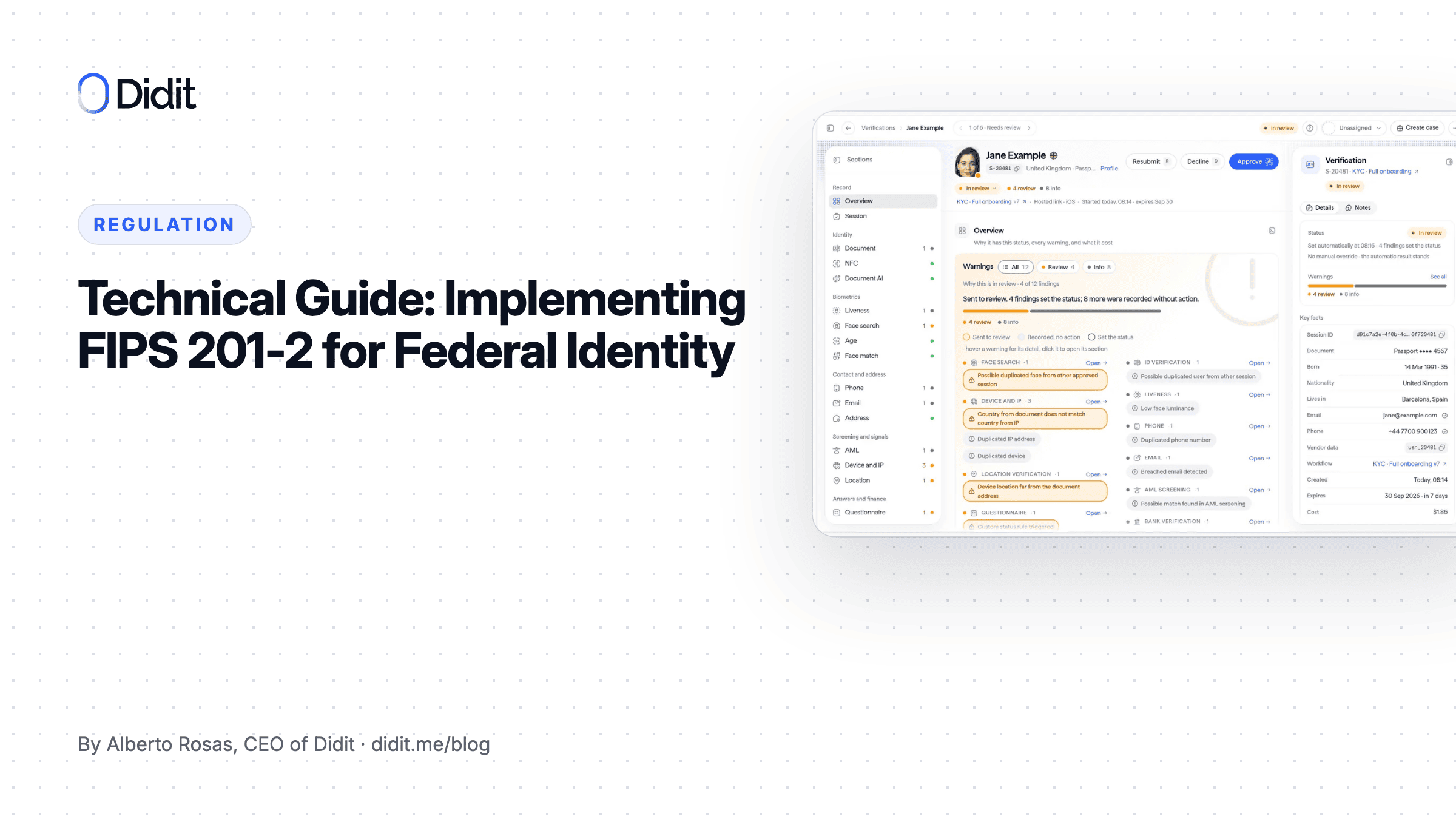
FIPS 201-2 binds US federal agencies and their contractors. Didit covers the document, NFC, liveness and face-match steps from $0.33 per person;
Alberto RosasMar 12, 2026The ROI of Real-Time Identity Orchestration for CDPs
Discover how integrating real-time identity orchestration into your Customer Data Platform (CDP) drives significant ROI. Learn to enhance data quality, reduce fraud, optimize customer experiences, and streamline compliance with.
Alberto RosasMar 12, 2026KYC for Web3 DNS: Securing the Decentralized Web
Integrating robust Know Your Customer (KYC) processes is crucial for Web3 Domain Name Services (DNS) to combat illicit activities, enhance trust, and comply with emerging regulations.
Alberto RosasMar 12, 2026Biometric Modalities for High-Security Remote Onboarding
High-security remote onboarding demands robust biometric verification. This post compares various biometric modalities, highlighting their strengths and weaknesses in preventing fraud and ensuring user convenience.
Alberto RosasMar 12, 2026Integrating Cross-Border Identity Verification into Legacy Systems
Integrating modern cross-border identity verification into legacy systems presents unique challenges, from data silos to outdated infrastructure.
Alejandro RosasMar 12, 2026Choosing Identity Verification for Multi-Cloud Deployments
Selecting an identity verification platform for multi-cloud environments presents unique challenges. This guide explores key considerations like vendor lock-in, scalability, data residency, and API-first design, highlighting how.
Alberto RosasMar 12, 2026Navigating EU Data Residency for Bank Statement Validation
Cross-border data residency for bank statement validation in the EU presents significant challenges due to GDPR and national regulations. This blog explores these complexities, from data localization to vendor selection, and.
Alberto RosasMar 12, 2026Optimizing Proof of Address with AI-Powered Categorization
AI-powered document categorization revolutionizes Proof of Address (PoA) workflows by automating document type identification, improving accuracy, and reducing manual review.
Alberto RosasMar 12, 2026Integrating Global Watchlist Monitoring with Microservices
Discover how a microservices architecture streamlines the complex process of integrating global watchlist monitoring. This approach enhances scalability, compliance, and real-time risk assessment, crucial for modern financial.
Alberto RosasMar 12, 2026The Developer's Guide to Custom Proof of Address Workflows
Building robust Proof of Address (PoA) verification workflows is crucial for compliance and fraud prevention. This guide explores the technical intricacies, common challenges, and best practices for developers, emphasizing the.
Alejandro RosasMar 12, 2026Mastering Micro-Permissions & Granular Consent in GDPR KYC
Achieving GDPR compliance in identity verification requires a deep understanding of micro-permissions and granular consent. This blog explores how to implement these principles effectively, ensuring data protection while.
Alberto RosasMar 12, 2026Building a Robust Decentralized Digital Credential Wallet Architecture
Decentralized Identity (DID) wallets are crucial for digital autonomy, but their architecture demands careful design for security, interoperability, and user experience.
Alejandro RosasMar 12, 2026The Business Case for Real-Time Global Watchlist Monitoring in Mid-Market FinTech
Mid-market FinTechs face increasing regulatory scrutiny and fraud risks. Implementing real-time global watchlist monitoring is crucial for compliance, fraud prevention, and maintaining customer trust.
Alberto RosasMar 12, 2026EUDI Wallet: Revolutionizing Data Minimization in KYC
The EUDI Wallet (EUDIW) is poised to transform Know Your Customer (KYC) processes by prioritizing data minimization and user control.
Alberto RosasMar 12, 2026The Business Value of Automated Global Sanctions Screening APIs
Automated global sanctions screening APIs are crucial for modern businesses to ensure compliance, mitigate financial crime risks, and maintain operational efficiency.
Alejandro RosasMar 12, 2026Optimizing KYC: Latency and Developer Experience in Identity Verification
Choosing the right KYC provider is critical for user experience and operational efficiency. This post compares top providers based on latency and developer experience, highlighting how these factors impact conversion rates and.
Alejandro RosasMar 12, 2026The Business Case for Real-Time KYC in High-Frequency Trading
High-frequency trading (HFT) demands instantaneous decision-making, making traditional KYC processes a significant bottleneck. Real-time KYC is essential for HFT firms to maintain compliance, mitigate fraud, and seize fleeting.
Alberto RosasMar 12, 2026Integrating Identity Verification with CRM for Customer 360
Integrating identity verification with CRM systems provides a holistic Customer 360 view, enhancing security, compliance, and personalization.
Alejandro RosasMar 12, 2026ESG Goals: Revolutionizing Identity Verification Vendor Choice
Environmental, Social, and Governance (ESG) factors are increasingly influencing how businesses select identity verification (IDV) vendors. Companies must now consider data privacy, ethical AI use, and operational transparency.
Alberto RosasMar 12, 2026Optimizing Phone Verification for Latin American Markets
Effectively verifying phone numbers in Latin America requires understanding unique regional challenges, including diverse carrier networks, prevalence of prepaid numbers, and varying fraud patterns.
Alberto RosasMar 12, 2026Phone Number Intelligence: Advanced Fraud Signals with Telco Data
Discover how leveraging telco data provides critical phone number intelligence for robust fraud detection. Learn about identifying disposable numbers, VoIP lines, and SIM swap attacks.
Alberto RosasMar 12, 2026Mastering Cross-Border AML for Global Crowdfunding Platforms
Crowdfunding platforms operating globally face complex challenges in Anti-Money Laundering (AML) compliance due to diverse international regulations.
Alberto RosasMar 12, 2026QR Code Scams: Digital Identity's Defense Against Evolving Fraud
QR code scams are a rapidly growing threat, exploiting trust and convenience to steal data or money. These sophisticated attacks, from 'quishing' to fake payment portals, demand robust digital identity verification.
Alejandro RosasMar 12, 2026Zero-Trust Identity for Critical Infrastructure (NIS2/DORA Compliance)
Zero-Trust Identity is paramount for securing critical infrastructure against evolving cyber threats and meeting stringent regulatory demands like NIS2 and DORA.
Alberto RosasMar 12, 2026GDPR's Right to Explanation in AI Identity Verification
The GDPR's Right to Explanation mandates transparency for AI-driven decisions, a critical factor in identity verification. This blog explores how businesses can implement explainable AI (XAI) to comply with regulations, build.
Alberto RosasMar 12, 2026GDPR Article 30: Mastering Record-Keeping for Identity Data
GDPR Article 30 mandates meticulous record-keeping for organizations processing personal data, especially sensitive identity information. Understanding and implementing these obligations is crucial for compliance, risk.
Alberto RosasMar 12, 2026Data Clean Rooms for Collaborative AML Intelligence
Data clean rooms are emerging as a vital tool for financial institutions to collaborate on Anti-Money Laundering (AML) efforts while preserving privacy.
Alberto RosasMar 12, 2026Agent-Based Onboarding for Drone Delivery Services
Drone delivery services face unique onboarding challenges, from identity verification to regulatory compliance. Agent-based systems offer a scalable, automated solution, leveraging AI to streamline processes and ensure security.
Alberto RosasMar 12, 2026Questions
Blog questions
Who writes the Didit blog?
Which topics does the blog cover?
Is the blog available in my language?
Where do I find product updates?
Are these posts legal advice?
How do I find posts on one topic?
Are posts dated?
Do posts link to the docs?
Is the blog the same as the docs?
Compliance built in
Audited, certified and attested.
We hold the certifications and build each country's rules into your flows, so you can launch anywhere without worrying. Security and Compliance center
- Regulation encoded into your flows
Tell us what you do and where. Didit lists the rules that apply to you, with sources, and builds the checks each country needs into one workflow.
- Ready for AMLR
Every requirement of the new EU anti-money laundering rules, from checking customers to human review, is already covered by a Didit check.
- Tested in Spain's Treasury sandbox
Spain's Treasury published its supervised sandbox report on Didit's NFC plus active liveness onboarding; SEPBLAC took part and valued the added measures positively.
- Audited, not self-declared
iBeta Level 1 and Level 2. Liveness tested under ISO/IEC 30107-3.
Your obligations · 3 regions
 SOC 2 Type 2
 ISO 27001
 iBeta Level 1 and Level 2
 EU regulator attestation
 FSM youth protection
 GDPR
 EBA remote onboarding
 MiCA compatible
 FIDO Alliance member
- AMLREU AML Regulation ready
Integration · Didit MCP
Run Didit from your own AI agent
Connect Didit to Claude, Cursor, VS Code or ChatGPT and just ask in plain words. Your agent can do anything you can do in the console, with the same permissions you have.
 Add to Claude
 ChatGPT
 Cursor
- Build workflowsDescribe the checks you need. The agent creates and publishes the flow.
- Run investigationsAsk why a session was declined, review cases, search people and companies.
- Change rulesCreate payment rules, test them on past data and switch them on.
- Pull reportsAsk for numbers, exports or the audit log.
Didit Academy


