Blog
Blog archive
Every post on the Didit blog, newest first. Pick a category or search to find the subject you need.
All posts
Every post, newest first
Pick a category to filter.
Holograms on IDs are a key anti-counterfeiting measure, but fraudsters evolve. Learn how advanced hologram detection techniques are bolstering document verification and reducing ID fraud.
Alberto RosasMar 15, 2026Automated AML Reporting: How to Build the Workflow in 2026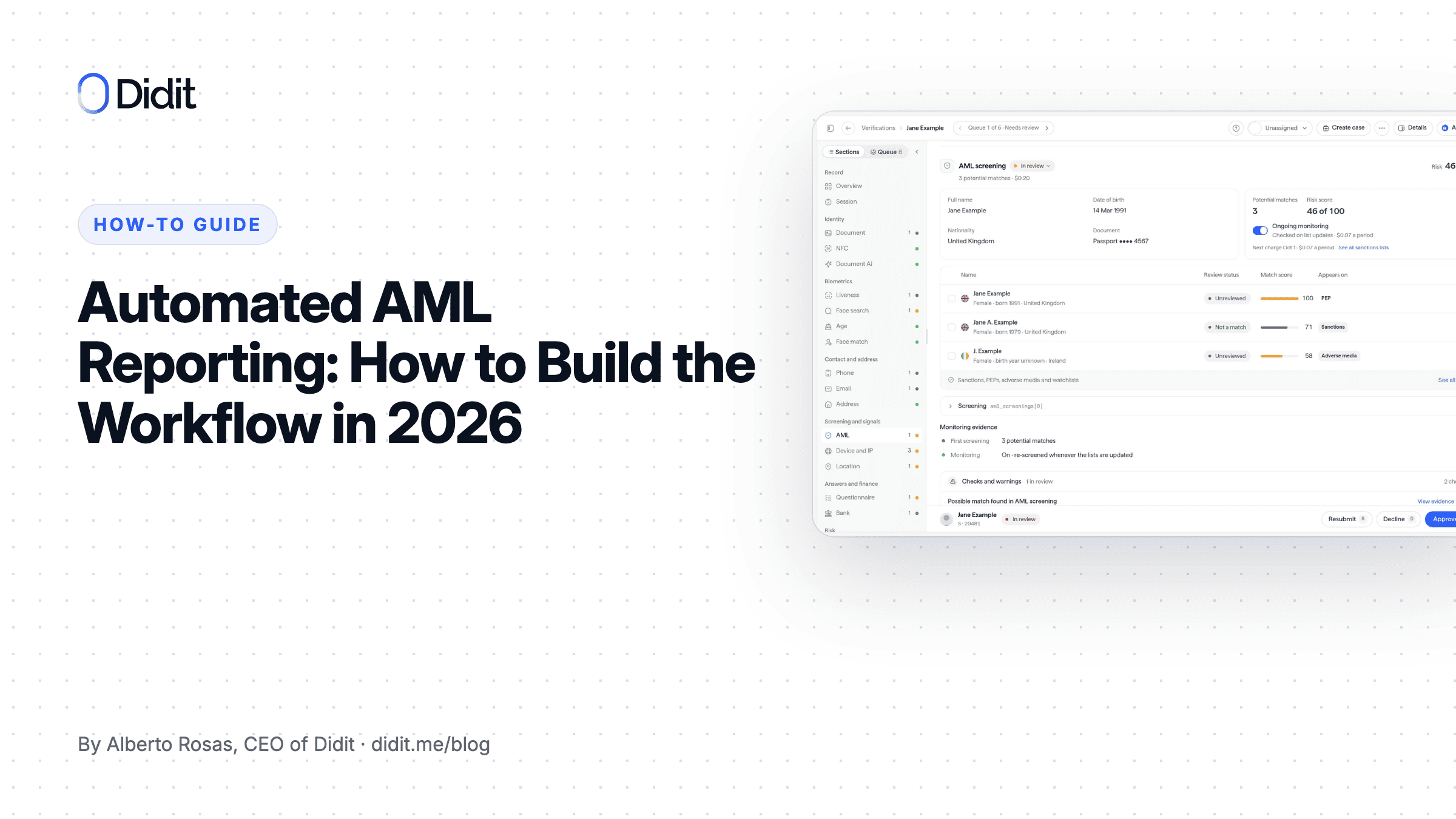
Automated AML reporting means software assembles the screening result, alert history and case narrative, then your team files. On Didit screening is $0.20 per check and ongoing monitoring $0.07 per person a year.
Alberto RosasMar 15, 2026Fraud Signal Orchestration: A Modern Approach (3)
Fraud signal orchestration combines multiple fraud detection methods for a more accurate risk assessment. Learn how it works and how Didit can help you reduce fraud losses.
Alberto RosasMar 15, 2026NFC Passport Verification: How to Run a Chip Read in 2026
NFC passport verification reads the e-passport chip inside a Didit session and validates the chip signature against the issuing authority.
Alberto RosasMar 15, 2026Global Identity Verification: A Scalable Approach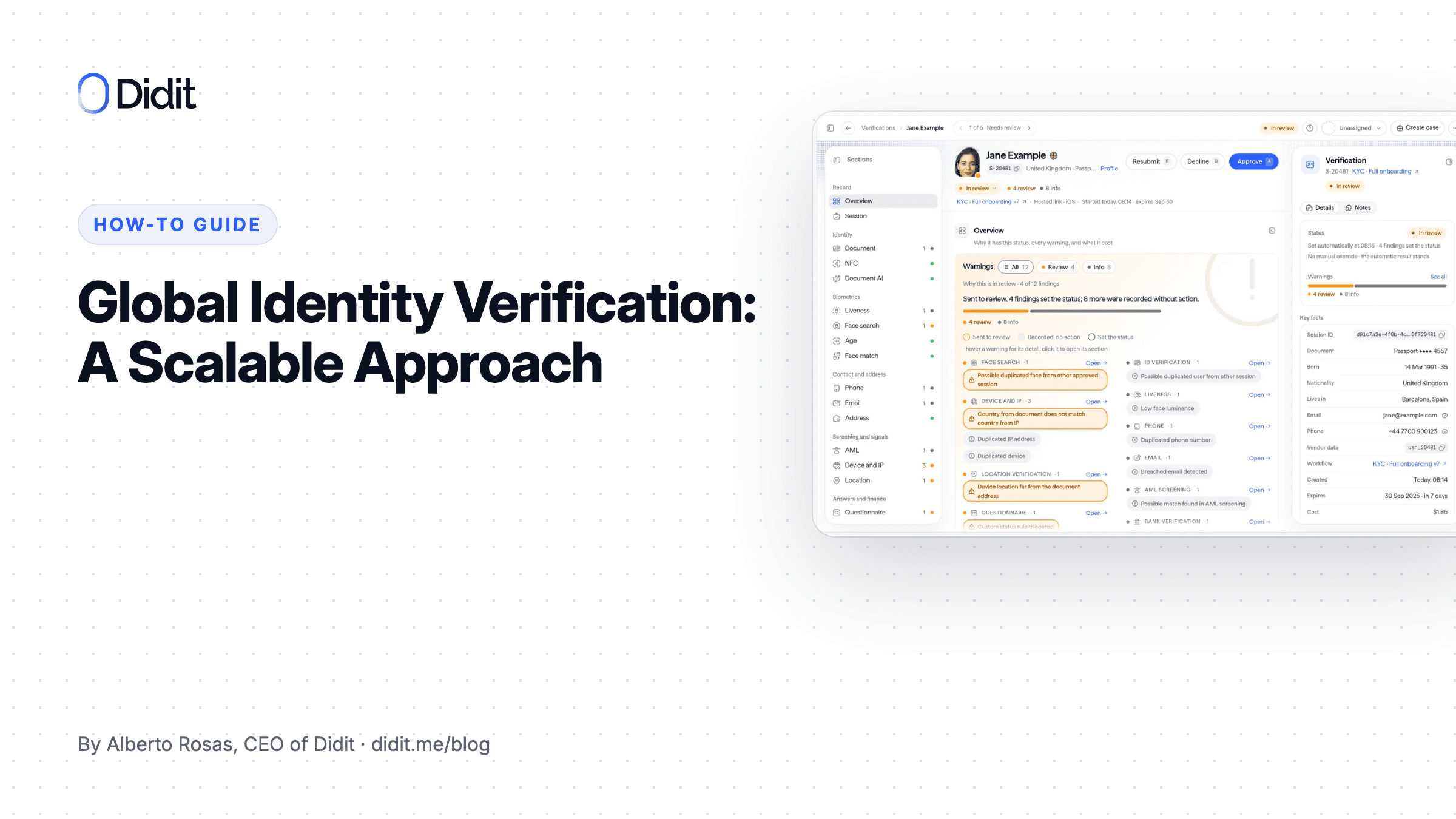
Scale global verification with one workflow builder and one API: 14,000+ document types in 220+ countries, $0.33 per full KYC, plus document, database-lookup and digital-wallet routes per country.
Alberto RosasMar 15, 2026iGaming KYC: Protecting Players & Ensuring Compliance
Discover how robust iGaming KYC and responsible gambling measures, including deposit limits and self-exclusion, are crucial for player protection and regulatory adherence. Learn how Didit can help.
Alberto RosasMar 15, 2026Time-to-Market vs. Security: Identity Verification Tradeoffs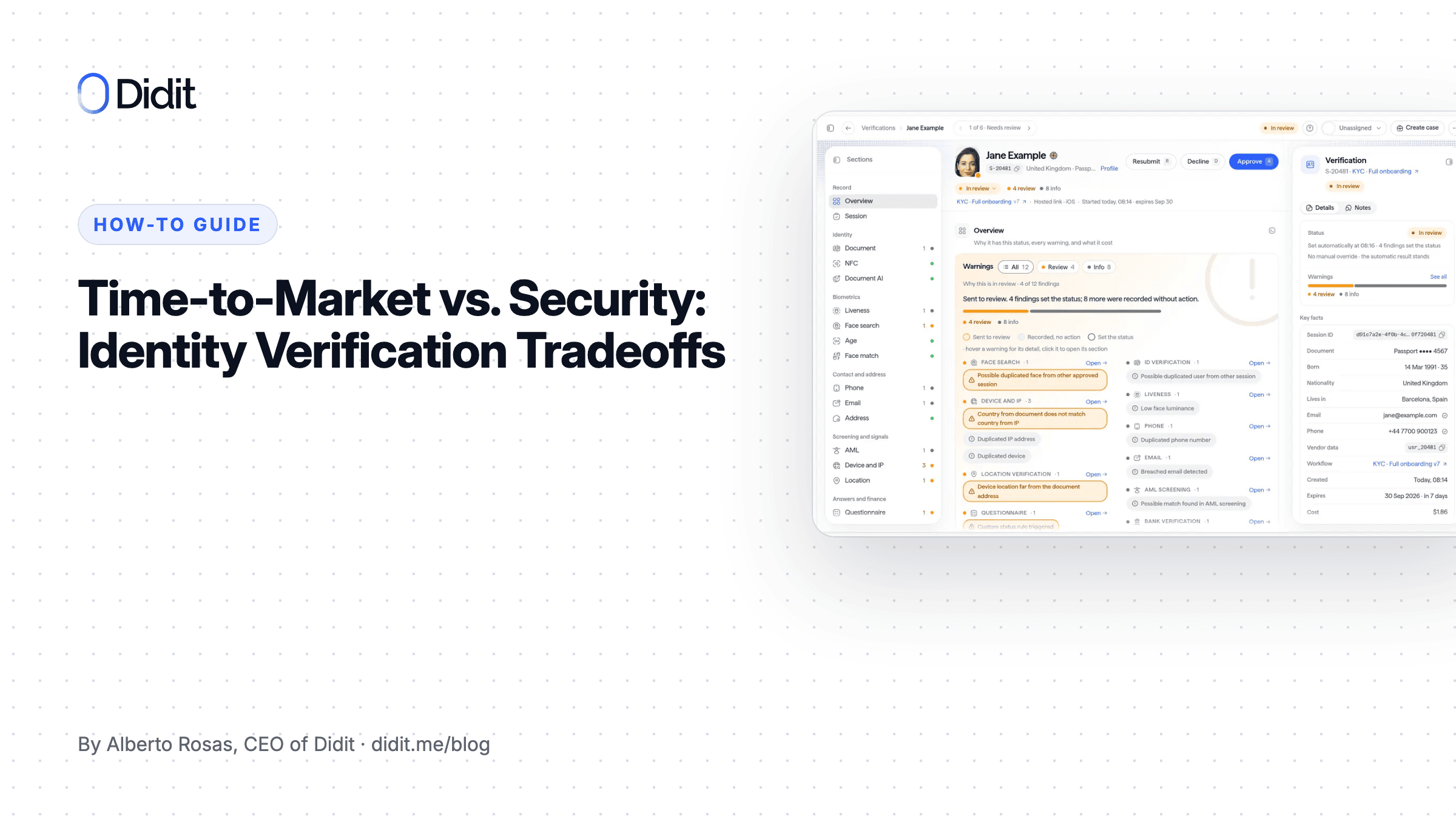
Ship one published workflow that approves clear cases automatically and routes the rest to a person. A Didit full KYC check is $0.33, AML screening is a separate $0.20 completed check, and you pay per completed check from.
Alberto RosasMar 15, 2026WebAssembly for Identity Verification: Speed & Privacy
Explore how WebAssembly (Wasm) revolutionizes identity verification, enabling secure, client-side processing for enhanced privacy and performance. Learn about its benefits and implementation.
Alberto RosasMar 15, 2026Face Embedding Vectors: The Tech Behind Secure Identity
Explore face embedding vectors, the core technology powering modern facial recognition and biometric identity verification. Learn how deep learning creates these vectors and their role in enhancing security and user experience.
Alberto RosasMar 15, 2026Automated KYC Reporting: Streamlining Compliance
KYC reporting is crucial for AML compliance, but manual processes are costly and error-prone. Discover how automation streamlines KYC reporting, reduces risk, and lowers operational costs.
Alberto RosasMar 15, 2026Identity Proofing for Telehealth: Ensuring Secure Remote Care
Remote healthcare (telehealth) offers convenience but demands robust identity proofing. Learn how to verify patients securely, maintain HIPAA compliance, and prevent fraud in telehealth environments.
Alberto RosasMar 15, 2026Federated Learning for Identity: A Privacy-First Approach (1)
Explore how federated learning revolutionizes identity verification by enhancing privacy-preserving AI, improving machine learning model accuracy, and reducing data centralization risks.
Alberto RosasMar 15, 2026WebAssembly for Secure Identity Verification (1)
Explore how WebAssembly (Wasm) enhances identity verification security, performance, and portability. Learn about its use cases, benefits, and integration with existing systems.
Alberto RosasMar 15, 2026Graceful Degradation in Identity Verification (1)
Learn how to build resilient identity verification systems with graceful degradation strategies. Minimize user friction and maintain functionality even during API failures or service disruptions.
Alberto RosasMar 15, 2026Neobank Onboarding: Build KYC and AML in One Workflow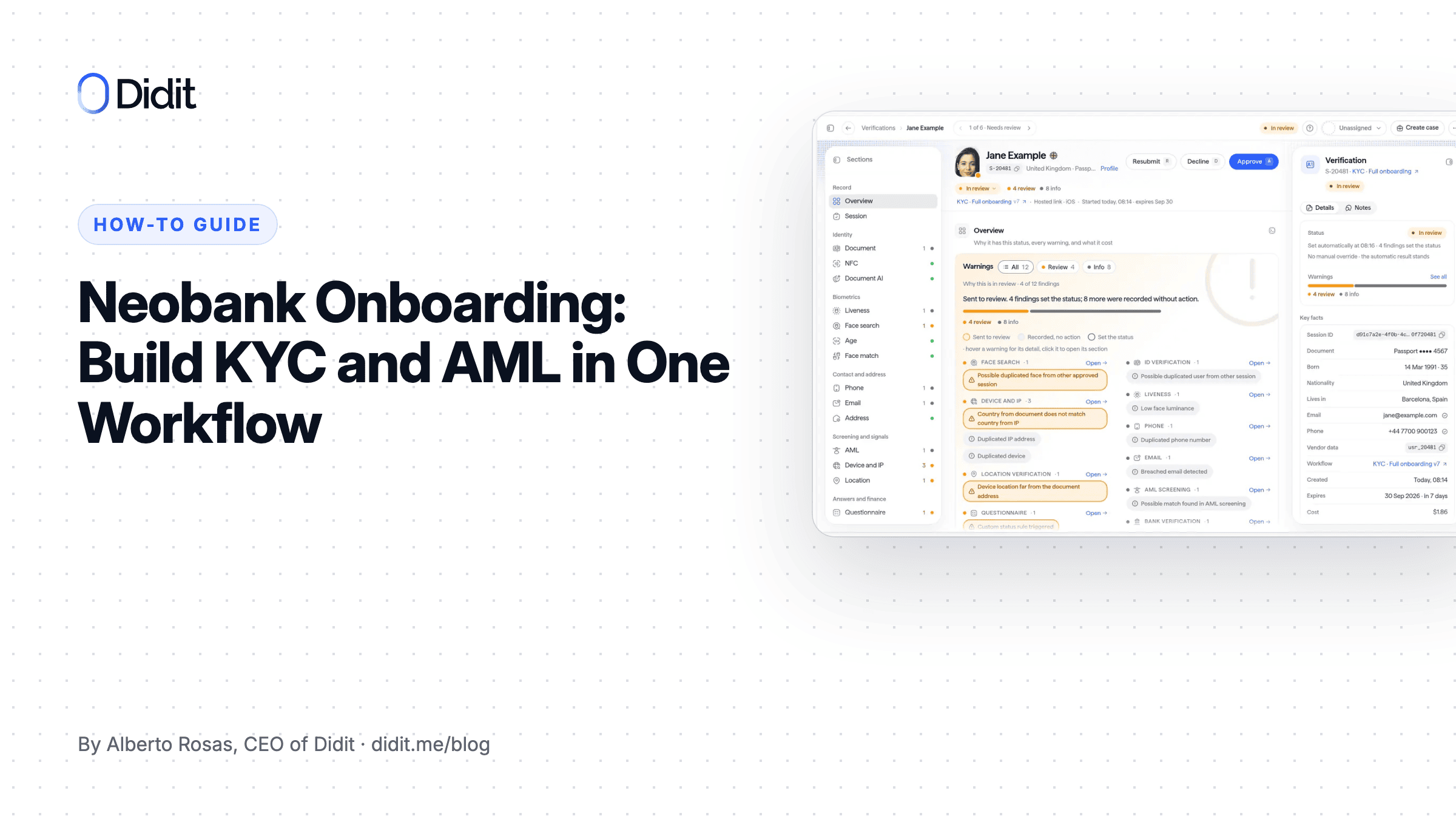
A neobank onboarding flow needs one workflow that returns an ID, liveness, face match and AML decision per applicant. A full KYC check is $0.33, AML screening adds $0.20; your policy, not the vendor, sets the review boundary.
Alberto RosasMar 15, 2026Decentralized Identity: The Future of Digital Trust (1)
Explore how decentralized identity (SSI) and self-sovereign identity are reshaping digital trust in the Web3 era, moving beyond traditional centralized systems. Learn about the benefits, challenges, and real-world applications.
Alberto RosasMar 15, 2026Decentralized Identity in Supply Chain: A New Era?
Explore how decentralized identity (DID) and verifiable credentials are revolutionizing supply chain management, combating counterfeiting, and enhancing transparency.
Alberto RosasMar 15, 2026Robust API Error Handling for Identity Verification (1)
Learn best practices for handling API errors in identity verification systems. Build resilient integrations with retries, circuit breakers, and detailed error analysis to ensure smooth user experiences.
Alberto RosasMar 15, 2026KYC/AML & Identity Verification in Real Estate
Real estate transactions require robust KYC and AML procedures to combat fraud and ensure compliance. Discover how automated identity verification streamlines processes and mitigates risk.
Alberto RosasMar 15, 2026Navigating the Evolving Digital Identity Regulations
The digital identity regulatory landscape is rapidly changing with updates to GDPR and the introduction of eIDAS 2.0. This guide breaks down key regulations and how to ensure compliance.
Alberto RosasMar 15, 2026Device Fingerprinting: A Guide to Fraud Prevention (2)
Device fingerprinting is a powerful fraud prevention technique that identifies users based on their device characteristics. Learn how it works, its benefits, and how Didit leverages it to enhance online security.
Alberto RosasMar 15, 2026Buyer Protection: A Guide to Fraud & Chargeback Prevention
Protecting buyers is crucial for business success. Learn how fraud prevention, identity verification, and chargeback prevention strategies can build trust and reduce risk.
Alberto RosasMar 15, 2026API Rate Limiting for Secure Document Verification
Protect your document verification API from abuse and ensure service reliability with effective rate limiting strategies. Learn best practices for throttling, API key management, and robust API security.
Alberto RosasMar 15, 2026Reduce KYC Drop-Off: Boost Conversion & Cut Costs (3)
KYC drop-off is a silent killer of user acquisition. Learn how to analyze and optimize your KYC process to improve conversion rates, reduce friction, and minimize lost revenue.
Alberto RosasMar 15, 2026Combating Seller Fraud: Patterns & Detection
Marketplace fraud is a growing threat, costing businesses billions annually. This post explores common seller fraud patterns, advanced detection methods, and how to protect your platform.
Alberto RosasMar 15, 2026Digital Signatures & KYC: A Secure Compliance Duo
Learn how integrating digital signatures into your KYC processes enhances security, reduces fraud, and streamlines compliance. Explore the legal validity of e-signatures and how Didit simplifies implementation.
Alberto RosasMar 15, 2026Combating Fraud in the Creator Economy
The creator economy is booming, but so is fraud. Learn how identity verification and advanced fraud prevention can protect platforms and creators from fake accounts, bot activity, and financial losses.
Alberto RosasMar 15, 2026Didit vs Face++: Face Matching Compared (2026)
Didit charges $0.05 per 1:1 face match and $0.05 per 1:N face search on a public price list, and sandbox testing is free and unlimited on every plan.
Alberto RosasMar 15, 2026Build vs. Buy Identity Verification: Didit vs Persona (2026)
Buying usually wins for product teams onboarding users, platforms adding KYB and compliance teams that need AML screening without hiring a model team.
Alberto RosasMar 15, 2026E-Signature Legal Validity: A Comprehensive Guide
Explore the legal landscape of e-signatures, including ESIGN, UETA, and eIDAS regulations. Ensure your digital signatures are legally binding and compliant. Learn how Didit can help streamline your e-signature workflows.
Alberto RosasMar 15, 2026NFC Passport Verification: A Deep Dive and Step-by-Step How-To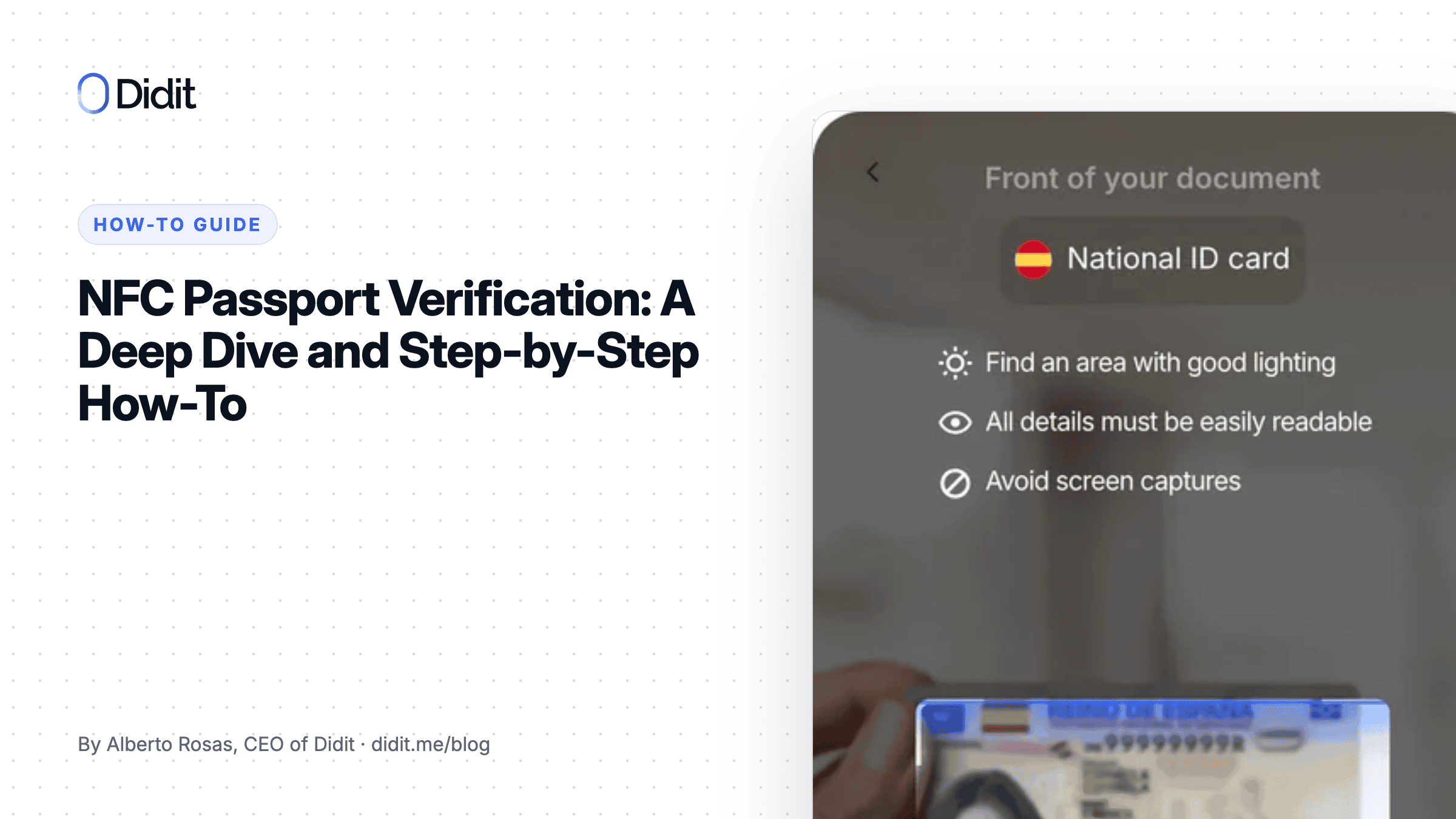
NFC passport verification reads the ePassport chip with a phone and validates the issuing country's signature. It costs $0.15 per chip read as a separate add-on to the $0.15 ID document check.
Alejandro RosasMar 15, 2026Marketplace Trust & Safety: Identity Verification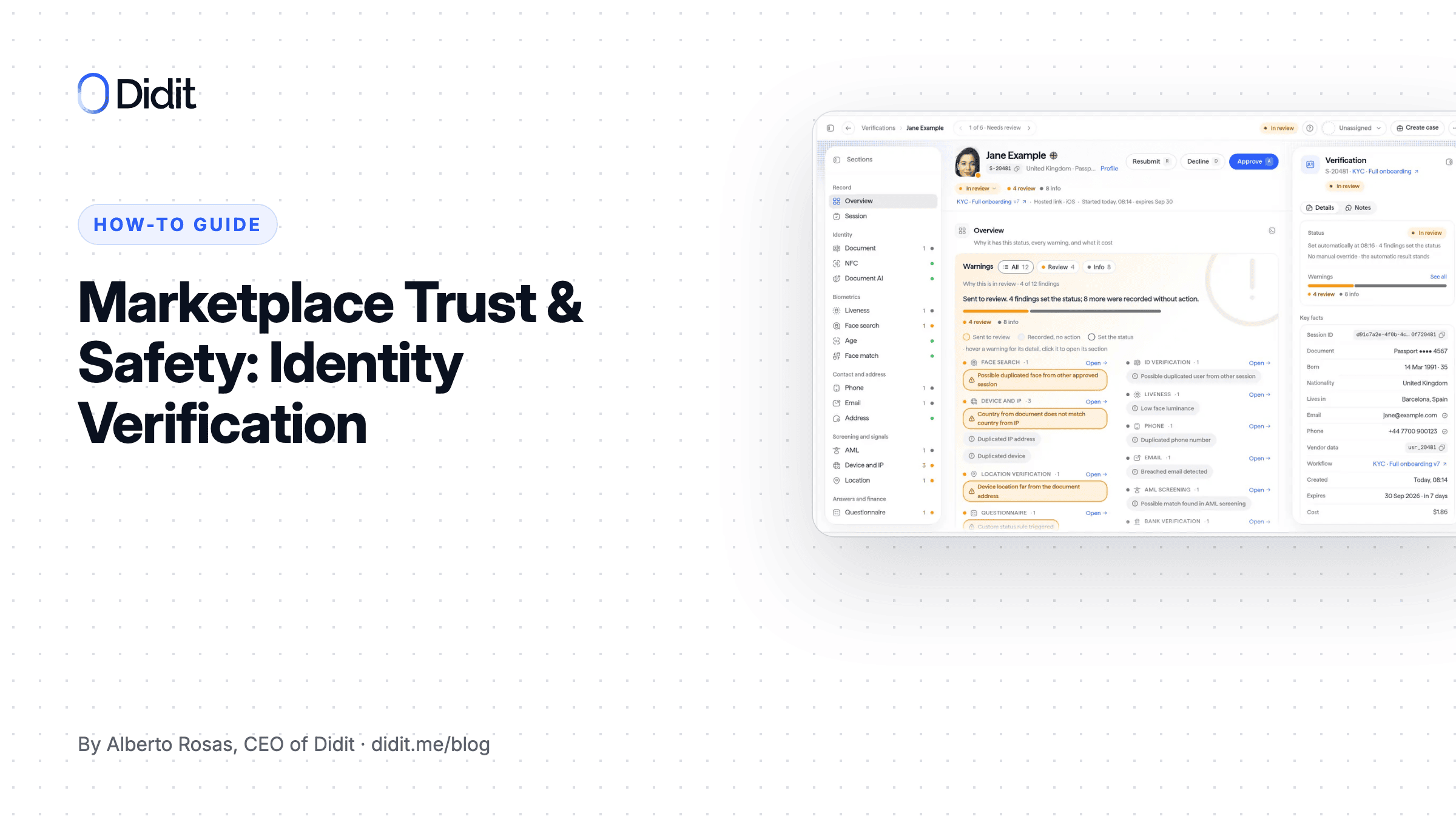
Verify sellers and buyers before they transact: one workflow per side, $0.33 per full KYC check, $0.20 per AML screening, and flagged sessions held for human review.
Alberto RosasMar 15, 2026KYC Cost Modeling: Unlock ROI & Reduce Risk (2)
Understanding KYC cost modeling is crucial for businesses balancing compliance with profitability. This guide breaks down the components of KYC costs, explores ROI calculations, and offers strategies for optimization.
Alberto RosasMar 15, 2026RON API Integration: Error Handling & Reliability
Integrating Remote Online Notarization (RON) requires robust API error handling. Learn best practices for retry logic, circuit breakers, and building resilient RON integrations.
Alberto RosasMar 15, 2026KYC for DAOs: Navigating Compliance in Web3 (1)
Decentralized Autonomous Organizations (DAOs) face unique KYC challenges. This guide explores compliance strategies, verifiable credentials, and how to balance decentralization with regulatory requirements.
Alberto RosasMar 15, 2026AI Agents & Identity: A New Era of Trust
AI agents are poised to revolutionize online interactions, but they require robust identity solutions. This post explores the challenges and opportunities of AI agent identity verification and authentication.
Alberto RosasMar 15, 2026IP Analysis for Fraud Prevention: A Deep Dive
Learn how IP analysis, geolocation, and ASN data are crucial for robust fraud prevention in identity verification. Discover techniques for proxy detection and risk scoring.
Alberto RosasMar 15, 2026Secure Web3 Wallets: Identity Verification How-To (2026)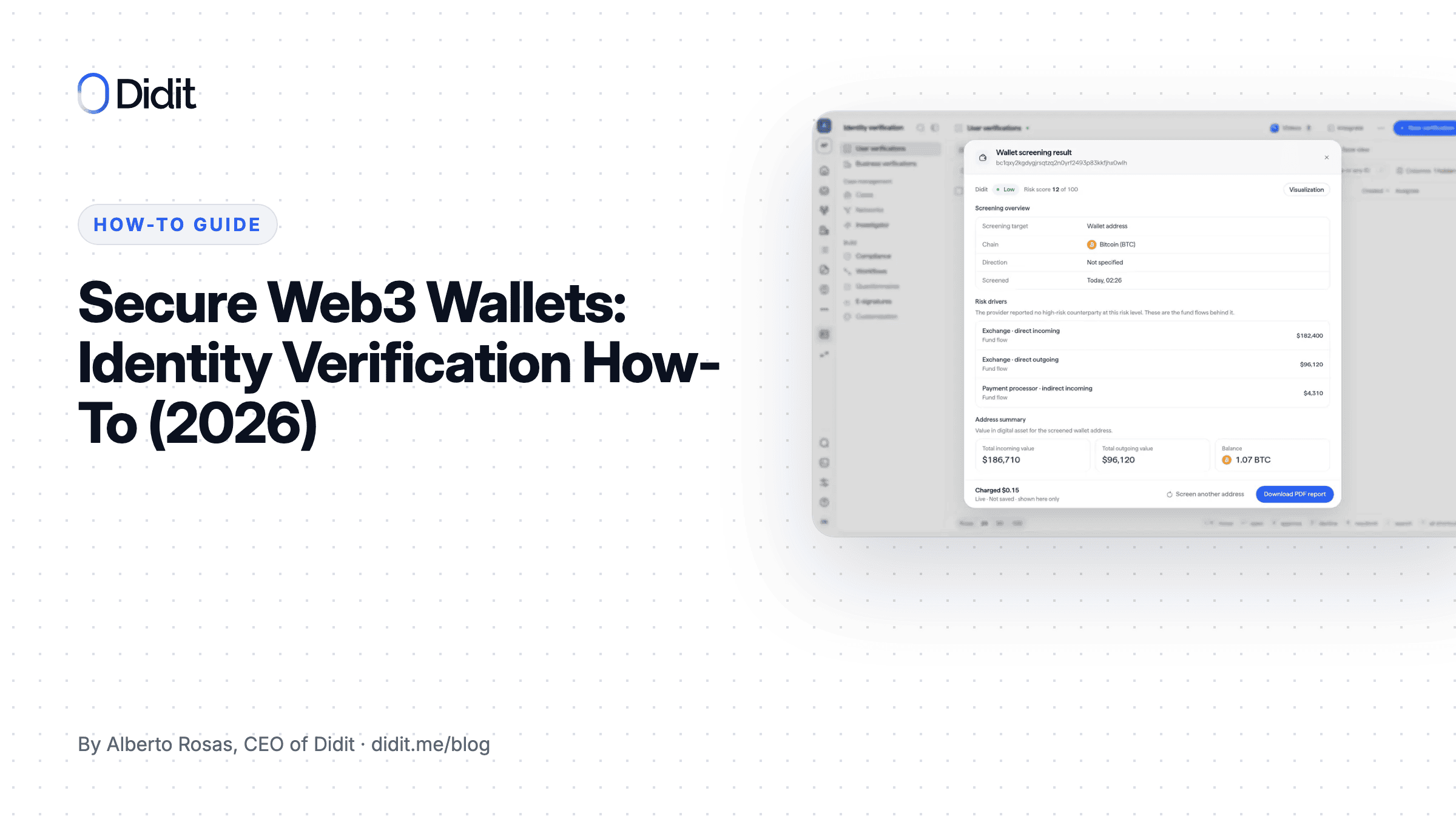
Verify each Web3 wallet user once with a $0.33 KYC check, screen every new address at $0.15 before funds move, and prove control of self-hosted wallets. Exact steps, error codes and costs inside.
Alberto RosasMar 15, 2026Combating Fraud in Remote Gambling: A Compliance Guide
Remote gambling faces unique fraud challenges like bonus abuse & multi-accounting. This guide details KYC/AML strategies, fraud detection, and regulatory compliance for online casinos and sportsbooks.
Alberto RosasMar 15, 2026Passive Authentication: 6 Steps to Risk-Based Sign-In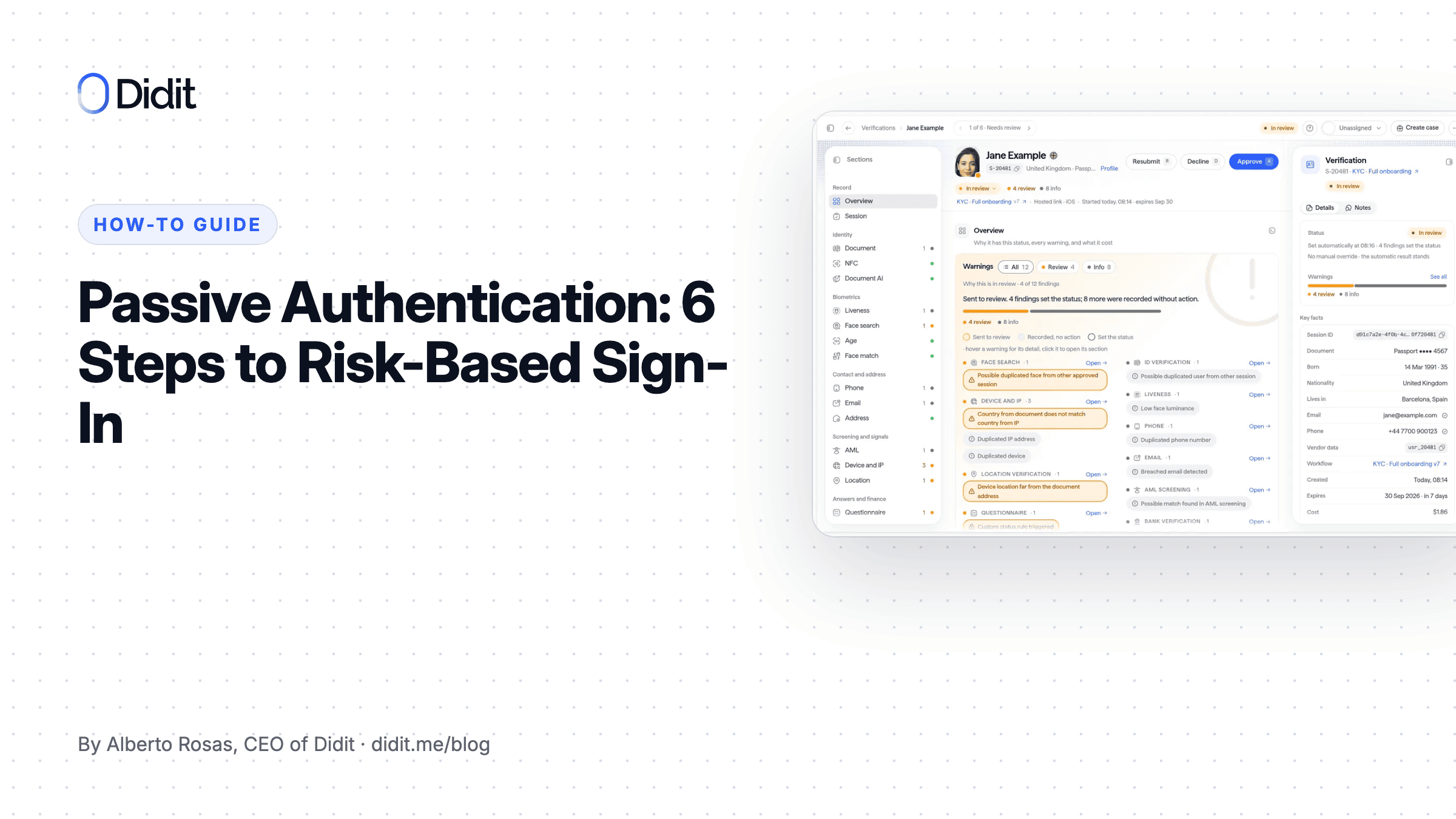
Passive authentication on Didit uses bot protection and sign-in signals covered by active-user pricing, plus Device & IP Analysis at $0.03 per verification check, then asks for a selfie only when a step-up rule fires ($0.10).
Alberto RosasMar 15, 2026Age Verification for iGaming: A Compliance Guide
iGaming faces strict age verification requirements. This guide explores the challenges, best practices, and technology solutions for robust age verification and responsible gambling compliance.
Alberto RosasMar 15, 2026DeFi DEX Travel Rule Compliance: A How-To Guide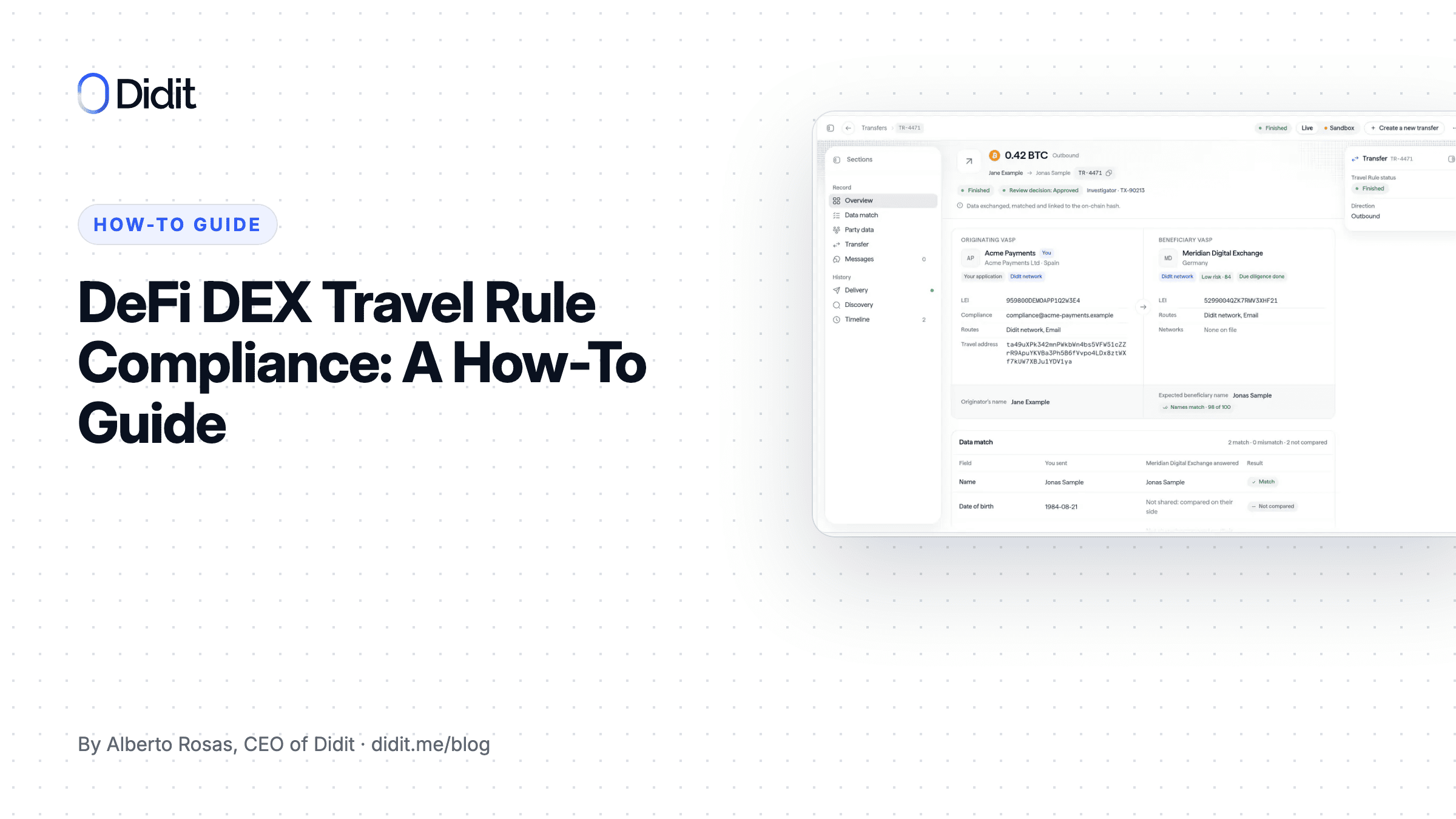
Didit runs the FATF Travel Rule exchange for a DEX: read your VASP settings, connect a network membership, submit the transfer, prove wallet ownership, close it with the on-chain hash. $0.02 per outbound exchange.
Alberto RosasMar 15, 2026MiCA & Identity: EU Crypto KYC/AML Guide (2026)
MiCA (Regulation (EU) 2023/1114) requires every CASP authorised in the EU to verify customers and screen for AML risk. The CASP regime applied from 30 December 2024 and the transition ended 30 June 2026.
Alberto RosasMar 15, 2026Mouse Movement Biometrics: A New Layer in Fraud Detection
Explore how behavioral biometrics, specifically mouse movement analysis, enhances fraud detection and identity verification. Learn about keystroke dynamics and its role in online security.
Alberto RosasMar 15, 2026Fraud Signal Orchestration: A Deep Dive (2)
Learn how fraud signal orchestration combines device intelligence, behavioral biometrics, and IP analysis to create robust risk scoring and prevent online fraud. Understand the technical nuances and best practices.
Alberto RosasMar 15, 2026Automated Compliance Reporting: A Modern Guide
Manual compliance reporting is costly and error-prone. Learn how automating KYC, AML, and regulatory reporting streamlines processes, reduces risk, and saves your business significant time and resources.
Alberto RosasMar 15, 2026Identity Verification API Error Handling: 2026 How-To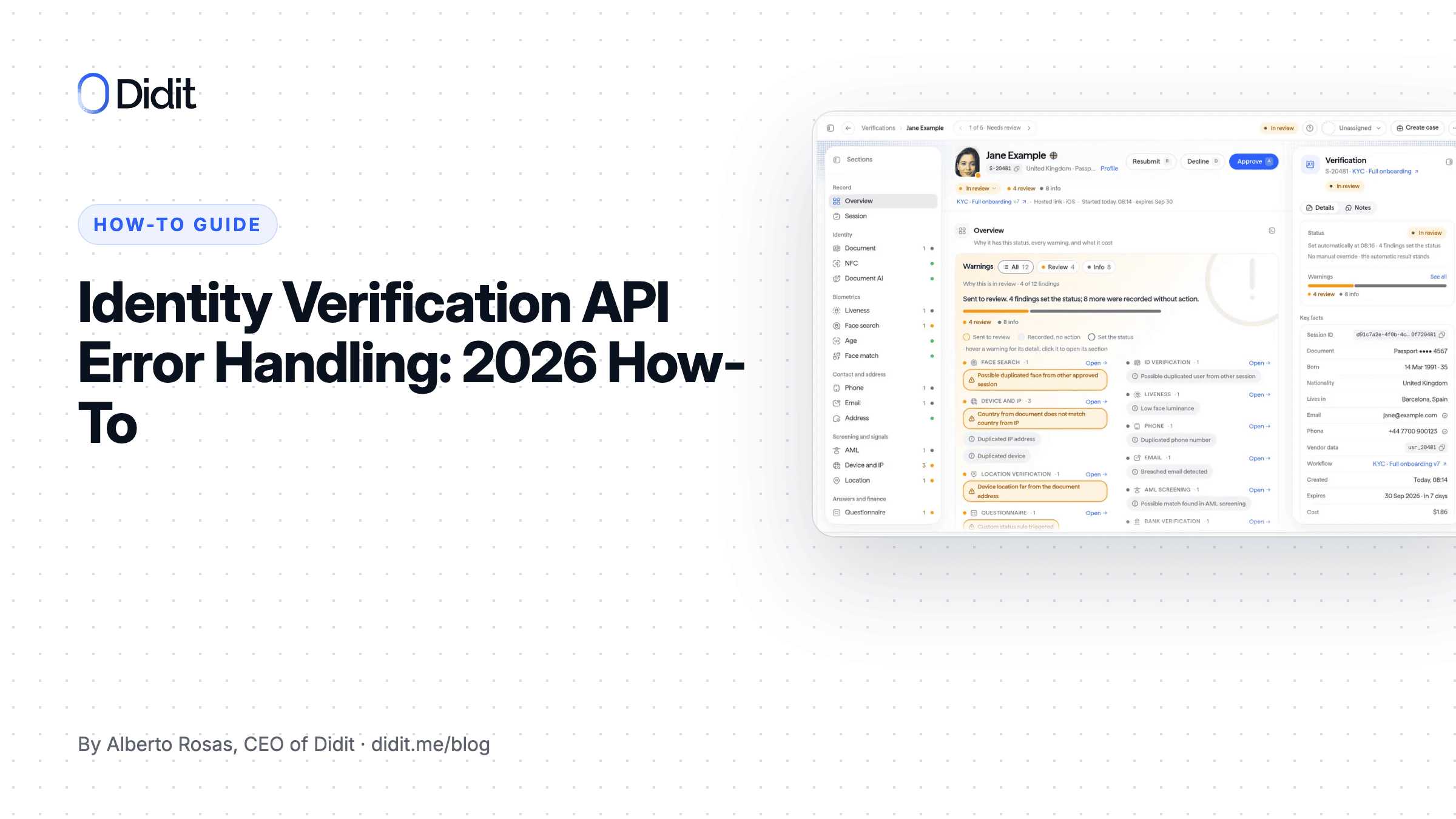
Read the HTTP status first and the code second: most 4xx responses need a correction, 429 means wait for Retry-After, 5xx means retry with backoff, and a 400 names a bad field, an unread image or document, or a low balance.
Alejandro RosasMar 15, 2026DAO Identity Verification: Navigating KYC & Compliance
Decentralized Autonomous Organizations (DAOs) face unique identity verification challenges. This guide explores how to implement KYC/AML compliance while preserving the core principles of Web3.
Alberto RosasMar 15, 2026Modular Identity: The Future of Verification
Discover how modular identity orchestration is revolutionizing online trust and security. Learn about the benefits of a composable identity approach, API-first architecture, and how Didit delivers a flexible, scalable solution.
Alberto RosasMar 15, 2026UK Economic Crime Act: A Compliance Guide (2)
The UK Economic Crime Act 2023 significantly strengthens AML regulations and corporate transparency. This guide explains its key provisions and how businesses can prepare for compliance.
Alberto RosasMar 15, 2026KYC Drop-Off: Reduce Friction & Boost Conversion (2)
High KYC drop-off rates are costing businesses customers and revenue. This guide explores the causes of onboarding friction and provides data-driven strategies to optimize your KYC process, improve user experience, and reduce.
Alberto RosasMar 15, 2026Combating Loan Fraud: A Lender's Guide
Loan fraud is a growing threat, costing lenders billions annually. This guide covers best practices for fraud prevention in lending, including identity verification, income verification, and risk assessment.
Alberto RosasMar 15, 2026Corporate Liability: Identity Verification & Compliance
Failing to verify identities can expose businesses to significant legal and financial risks. This post explores corporate liability for identity verification failures, focusing on AML, KYC, and regulatory compliance.
Alberto RosasMar 15, 2026Build Resilient Identity Verification APIs
Learn how to build robust and reliable identity verification APIs with strategies like circuit breakers, retries, and graceful degradation. Ensure seamless user experiences even during service disruptions.
Alejandro RosasMar 15, 2026Building a High-Performing Compliance Team (1)
A robust compliance program is essential for navigating today's complex regulatory landscape. This guide outlines optimal compliance team structures, including roles like the MLRO, and explores outsourcing options to maximize.
Alberto RosasMar 15, 2026Build a Robust OCR Pipeline for Identity
Learn how to build a high-accuracy OCR pipeline for identity document processing, covering image preprocessing, data extraction, and quality control. Ensure reliable identity verification with optimized OCR.
Alberto RosasMar 15, 2026MRZ Parsing: A Deep Dive for Developers
Learn how Machine Readable Zone (MRZ) parsing works, its importance in identity verification, and how to implement it securely. We cover standards, data extraction, and best practices.
Alberto RosasMar 15, 2026iGaming Deposit Limits: A Compliance Deep Dive
Explore the crucial role of iGaming deposit limits in responsible gambling and regulatory compliance. Learn about self-exclusion, AML considerations, and best practices for operators.
Alberto RosasMar 15, 2026Boost KYC Conversion: Reducing Friction & Maximizing Rates
Low KYC conversion rates erode revenue and frustrate customers. Learn how to optimize identity verification for higher acceptance, reduced abandonment, and improved ROI.
Alberto RosasMar 15, 2026Document Security Features: A Deep Dive (2026)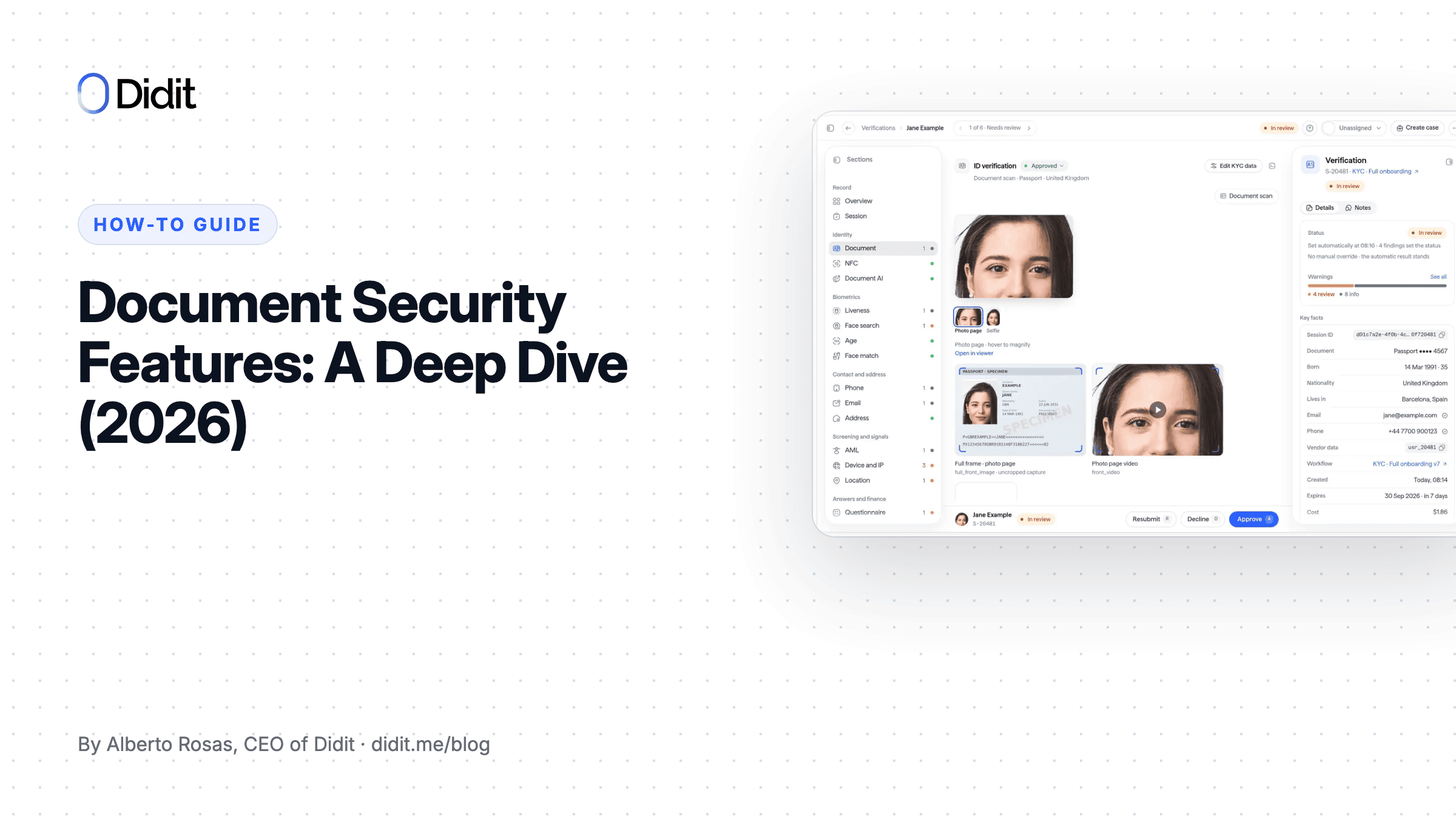
Document security features fall into four categories: overt, covert, forensic and chip. Didit checks the document image from $0.15 per check in a workflow, or $0.20 via the standalone API, and returns warnings you must act on.
Alberto RosasMar 15, 2026Influencer Verification: Combatting Fraud & Ensuring Brand Safety
The rise of fake influencers and social media fraud poses significant risks to brands. Learn how robust influencer verification protects your investment and maintains brand safety.
Alberto RosasMar 15, 2026KYC Cost Modeling: 10 Steps to a Compliance ROI Model in 2026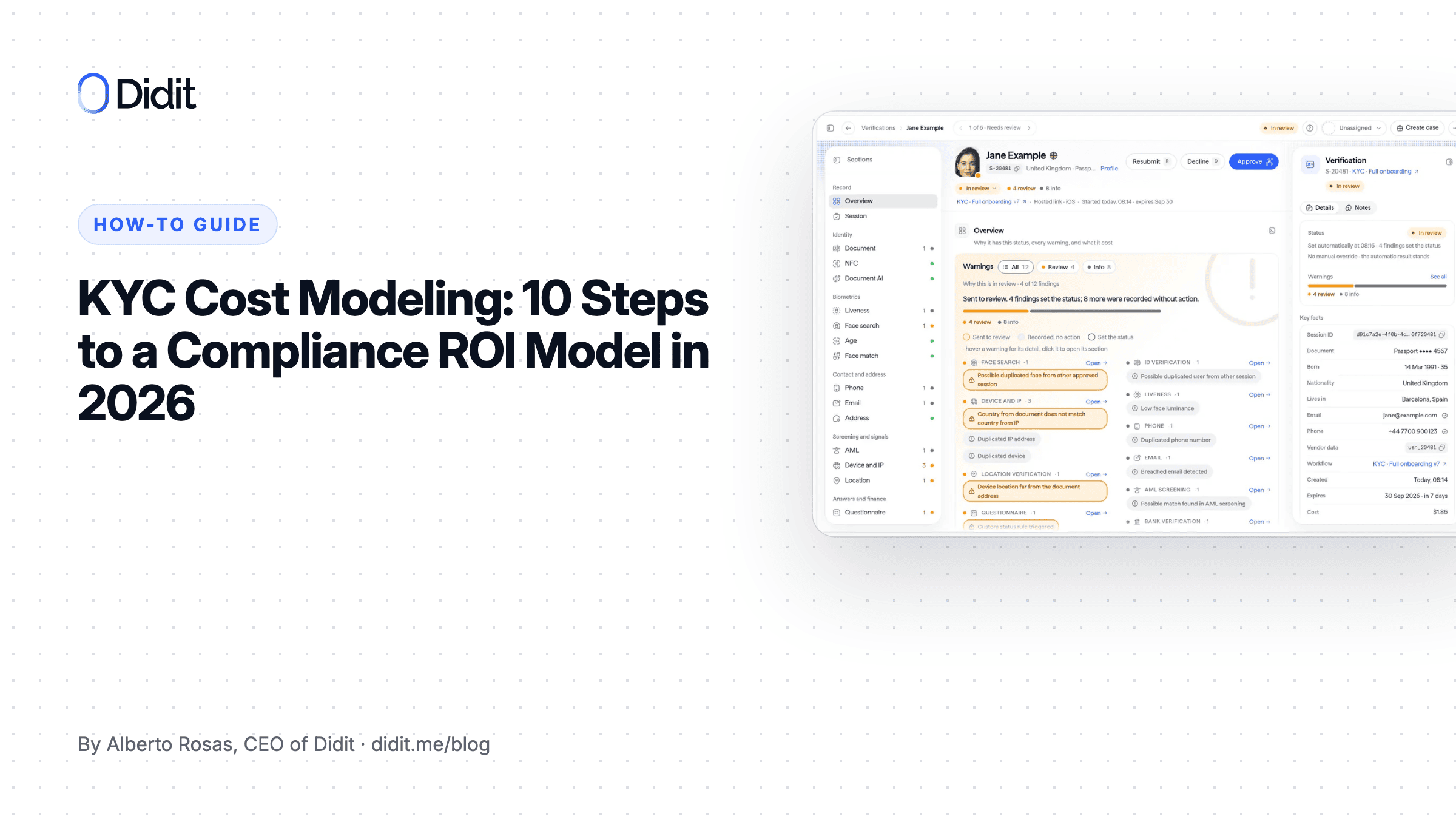
Add every completed check, resubmission, screening and add-on at published prices, subtract plan credit, add the plan fee, then divide by approved customers.
Alberto RosasMar 15, 2026Biometric Template Protection: A Deep Dive (3)
Biometric template protection is crucial for safeguarding sensitive biometric data. This post explores techniques like homomorphic encryption and secure multiparty computation to enhance biometric security and privacy.
Alberto RosasMar 15, 2026Responsible Gambling in iGaming: A Compliance Guide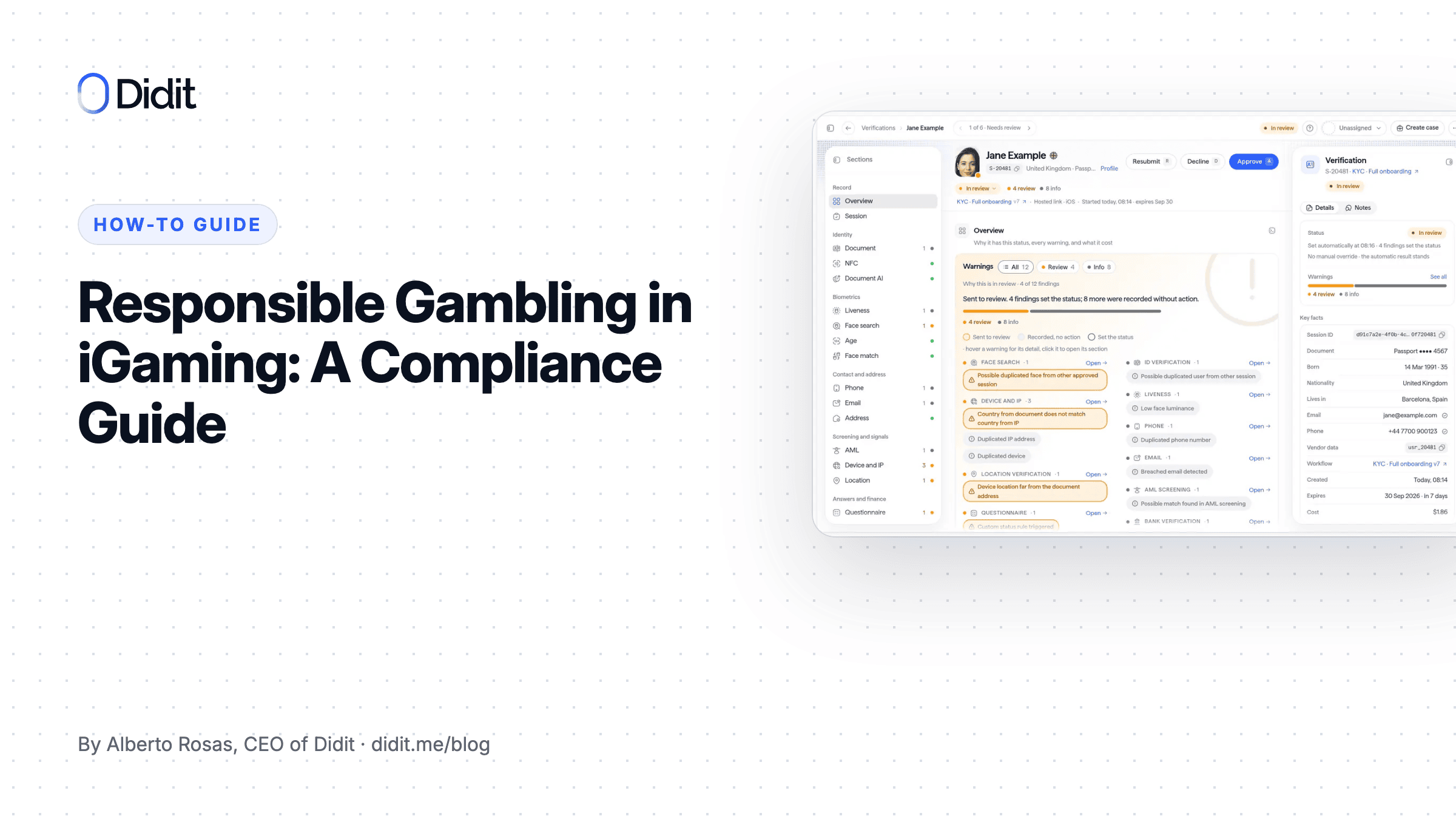
Set up responsible gambling controls in iGaming: age estimation from a selfie at $0.10, KYC at $0.33, AML screening at $0.20, exclusion checks recorded as events, and a person on every decision.
Alberto RosasMar 15, 2026Combating Proof of Address Fraud: A Deep Dive
Proof of address (PoA) fraud is surging. This post explores techniques to detect synthetic PoA, document forgery, and image manipulation, ensuring robust identity verification and compliance.
Alberto RosasMar 15, 2026Autonomous Compliance: The Future of RegTech
Explore how autonomous compliance frameworks, powered by AI and machine learning, are revolutionizing regulatory technology (RegTech). Learn about the benefits, challenges, and future trends in automating compliance processes.
Alberto RosasMar 15, 2026Building Trust on Content Platforms: A Guide
Content platforms face increasing pressure to combat misinformation and foster trust. This guide explores strategies for building a safe and reliable online environment, from robust identity verification to effective community.
Alberto RosasMar 15, 2026LLM Integration for KYC: AI-Powered Compliance
Explore how Large Language Models (LLMs) are revolutionizing KYC (Know Your Customer) processes, enhancing accuracy, efficiency, and fraud detection. Discover practical applications and future trends in AI-driven compliance.
Alejandro RosasMar 15, 2026Brand Safety & Identity Verification: A Powerful Duo
Protect your brand reputation and build online trust with robust identity verification. Learn how to combat fake accounts, fraud, and harmful content with Didit's solutions.
Alberto RosasMar 15, 2026Agentic KYC: The Future of Automated Compliance
Agentic KYC leverages AI agents to automate compliance processes, reducing costs, improving accuracy, and enhancing the customer experience. Explore the potential of this transformative technology and how Didit is leading the way.
Alberto RosasMar 15, 2026Detecting AI-Generated Utility Bills: A Growing Threat (1)
AI-generated documents, particularly synthetic proof of address like utility bills, pose a significant risk to identity verification. Learn how to detect these forgeries and protect your business.
Alberto RosasMar 15, 2026Machine-to-Machine Identity: Securing the API Economy (2026)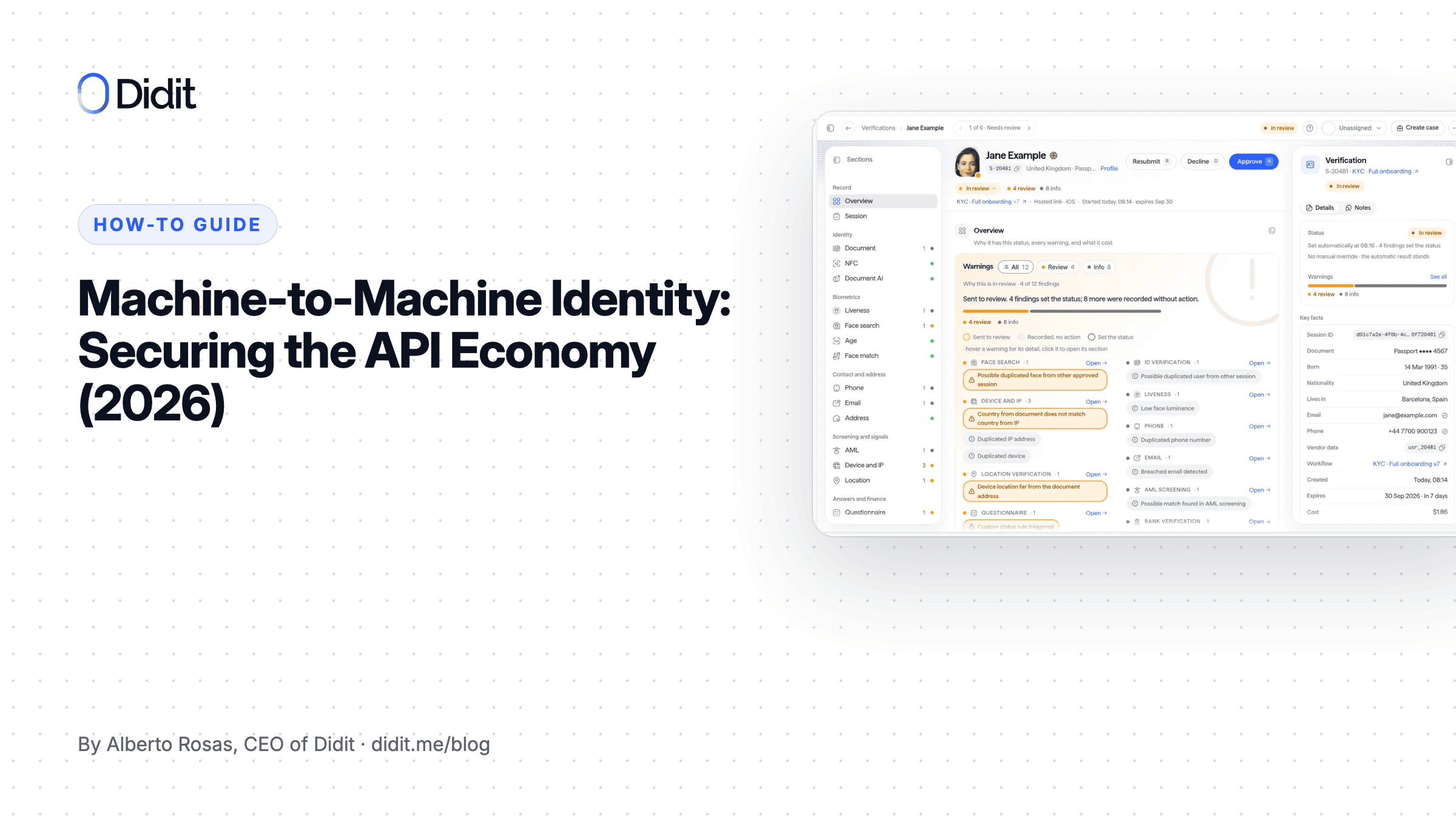
Machines authenticate with a scoped API key, receive results over HMAC-signed webhooks, and use short-lived tokens when an AI agent acts for a person. A full ID check is $0.33, AML screening $0.20.
Alejandro RosasMar 15, 2026Creator Economy Verification: Building Trust & Preventing Fraud
The creator economy is booming, but so are fraud risks. Learn how identity verification safeguards platforms, creators, and fans. Boost platform trust today!
Alberto RosasMar 15, 2026Fintech Regulatory Sandboxes: A Compliance Guide
Fintech regulatory sandboxes offer a safe space for innovation, but navigating them requires careful planning. This guide details how to leverage these programs, ensuring both compliance and growth.
Alberto RosasMar 15, 2026Secure API Integration: Identity Verification Best Practices
Protect your applications with robust API security for identity verification. Learn about OAuth, rate limiting, and best practices for a secure integration. Period.
Alberto RosasMar 15, 2026Zero-Knowledge Age Verification: 7 Steps With Didit Selfie Age Estimation
Zero-knowledge age verification proves an age threshold without revealing a birthdate. Didit's documented route is a selfie age check at $0.10 per completed check that returns no date of birth.
Alberto RosasMar 15, 2026Automate Buyer Protection & Slash Chargebacks
Discover how automating buyer protection with identity verification and fraud prevention tools reduces chargebacks, boosts revenue, and improves customer trust. Learn how Didit helps.
Alberto RosasMar 15, 2026Two-Sided Verification: Building Marketplace Trust (2)
Two-sided verification enhances marketplace trust by verifying both buyers and sellers. This approach minimizes fraud, increases user confidence, and boosts transaction success rates. Learn how to implement it effectively.
Alberto RosasMar 15, 2026KYC for Investor Accreditation: A Deep Dive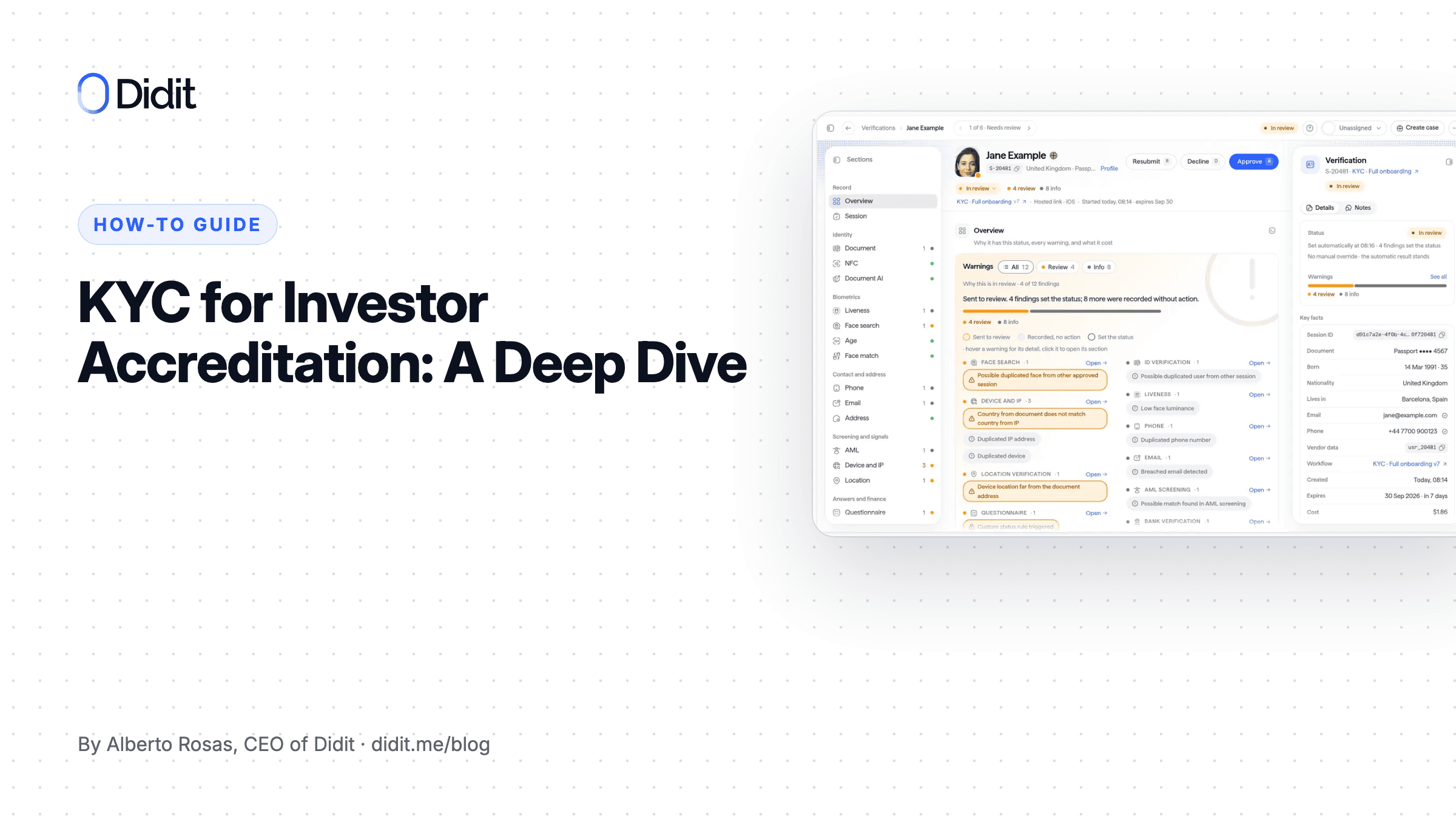
Didit runs the identity, AML and questionnaire steps of investor accreditation for $0.33 per investor plus $0.20 AML and $0.10 questionnaire. Your compliance team keeps the accreditation decision.
Alberto RosasMar 15, 2026Age Verification in the Metaverse: Ensuring Online Safety
The metaverse presents unique challenges for age verification. This article explores the current methods, emerging technologies, and the importance of protecting young users in virtual worlds.
Alberto RosasMar 15, 2026Selective Disclosure Credentials: A Privacy-First KYC
Selective Disclosure Credentials (SDCs) offer a revolutionary approach to KYC, enabling verifiable data sharing without revealing unnecessary personal information.
Alberto RosasMar 15, 2026Preventing P2P Lending Defaults: Identity & Risk
P2P lending faces rising default rates. Robust identity verification and risk assessment are crucial. Learn how to leverage technology to mitigate fraud and improve loan performance.
Alberto RosasMar 15, 2026Marketplace Seller Fraud: Patterns and Prevention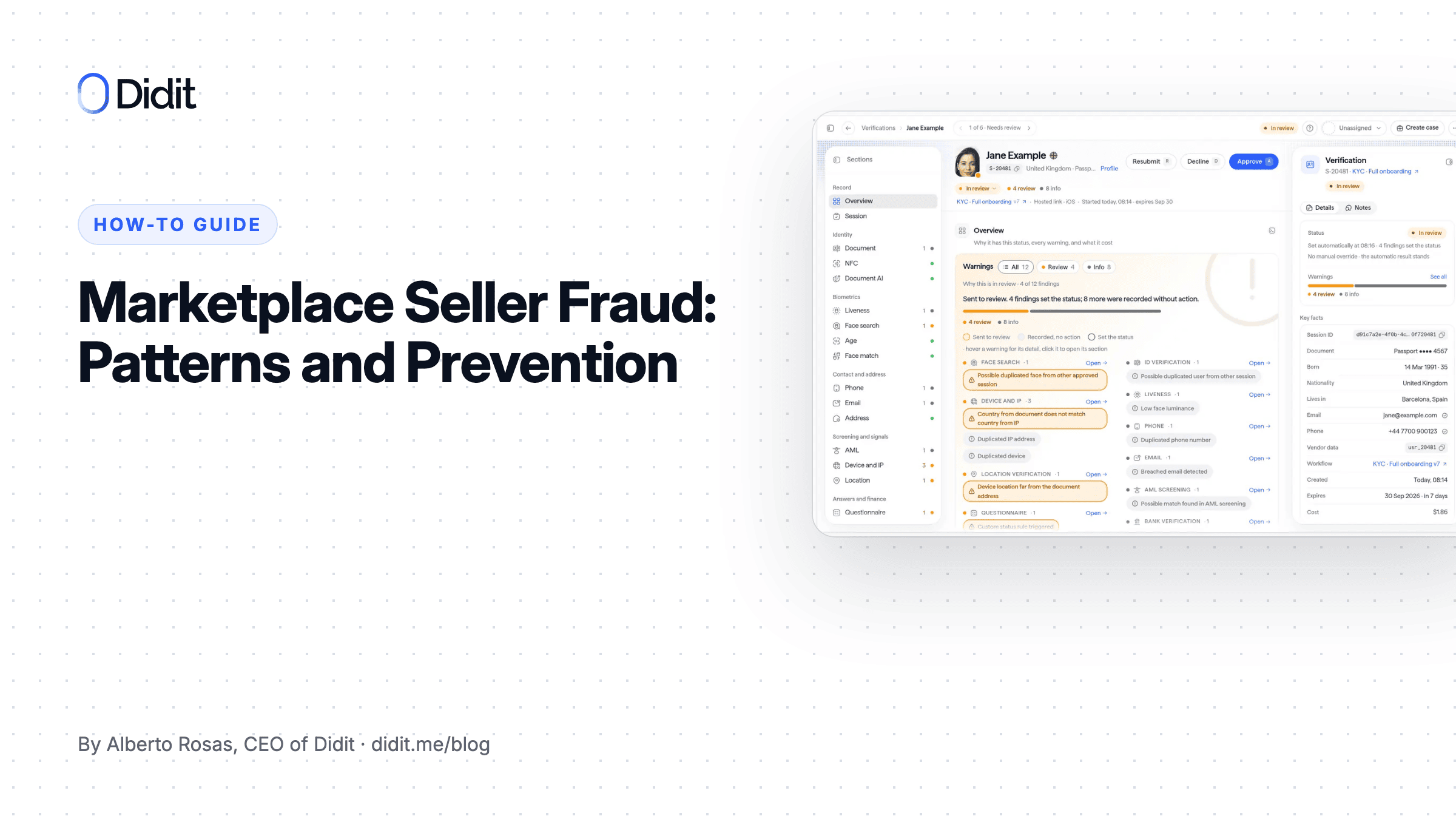
Verify each seller once with a full ID check at $0.33, bind it to your own seller id, and re-check payout changes. Device, IP and face reuse signals catch account takeover and multi-account sellers.
Alberto RosasMar 15, 2026Digital Identity in the Metaverse: A New Frontier
The metaverse promises immersive digital experiences, but it hinges on secure and reliable digital identity solutions. Explore the challenges and opportunities of identity verification in virtual worlds.
Alberto RosasMar 15, 2026Building a Neobank Identity Stack: KYC & Verification (1)
Neobanks face unique identity verification challenges. This guide covers building a robust, scalable KYC stack, leveraging modern technologies to balance compliance, UX, and fraud prevention.
Alberto RosasMar 15, 2026API Rate Limiting for Identity Verification (3)
Learn how to implement effective API rate limiting for your identity verification integration to ensure stability, security, and a positive developer experience. We cover best practices and Didit's approach.
Alberto RosasMar 15, 2026KYC Orchestration ROI: Maximizing Compliance Value (1)
Discover how KYC orchestration boosts ROI by streamlining compliance, reducing fraud, and lowering operational costs. Learn how to calculate your potential savings.
Alberto RosasMar 15, 2026Automated AML for High-Value Transactions
Discover how machine learning and automated AML systems are transforming fraud detection for high-value transactions, improving compliance, and reducing false positives. Learn about the technologies powering this shift.
Alberto RosasMar 15, 2026FATF Travel Rule: Originator and Beneficiary Info Guide 2026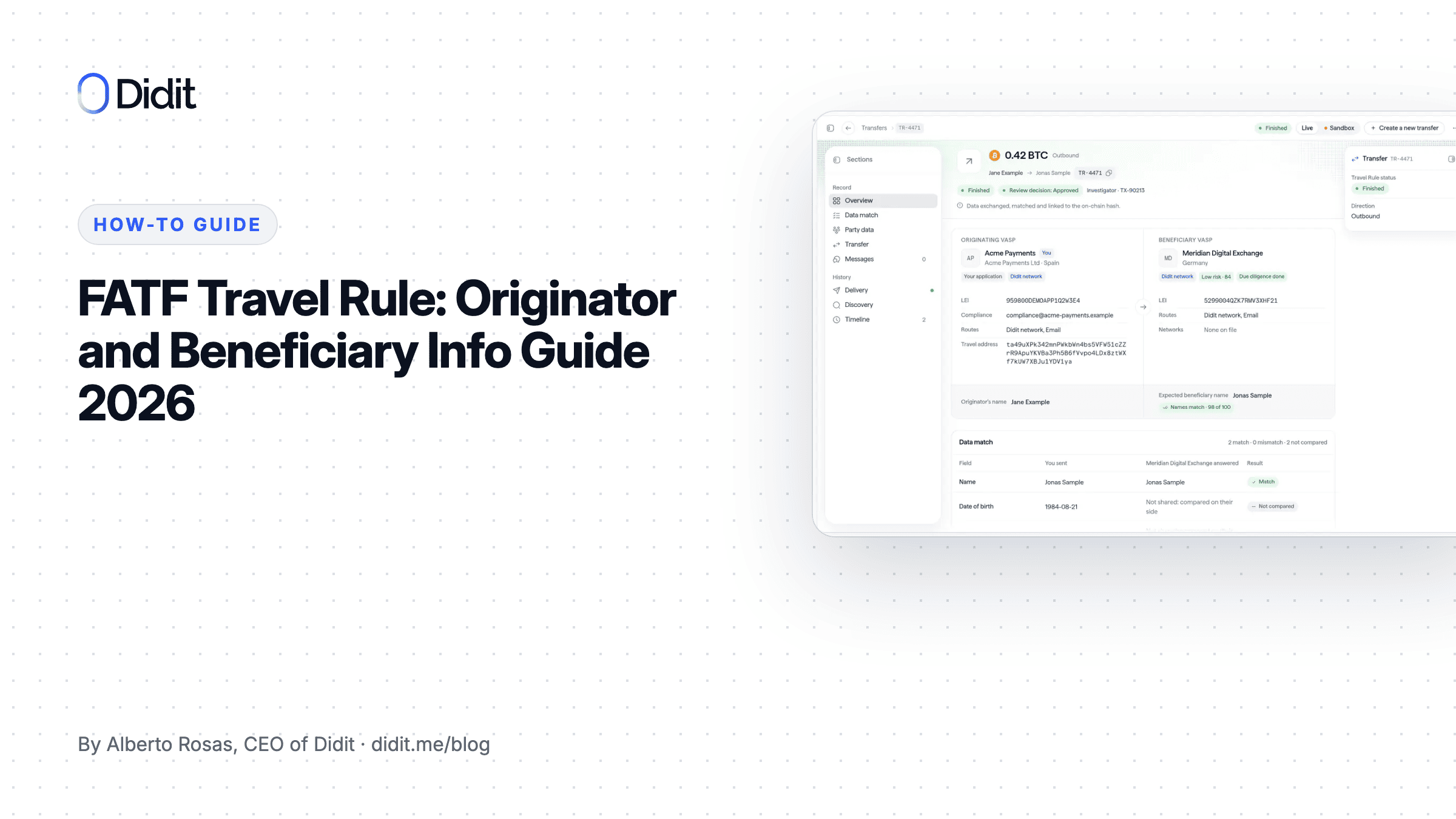
Didit runs the FATF Travel Rule originator to beneficiary exchange at $0.02 per outbound exchange: submit the transfer, route it to the counterparty VASP, and release funds when it reaches COMPLETED.
Alberto RosasMar 15, 2026Protecting Identity Verification: Injection Attack Risks
Injection attacks pose a serious threat to identity verification systems. This guide details common attack vectors like SQL injection and XSS, how they target identity data, and how to mitigate these risks with robust security.
Alejandro RosasMar 15, 2026Defending Against Face Swap Attacks: A Deep Dive
Face swap attacks pose a serious threat to digital security. This post examines how they work, the limitations of traditional methods, and how advanced liveness detection mitigates these risks.
Alberto RosasMar 15, 2026FATF Travel Rule: Navigating the Sunrise Issue
The FATF Travel Rule requires Virtual Asset Service Providers (VASPs) to share customer information for transactions over a certain threshold. This guide explains the 'sunrise issue,' compliance deadlines, and how Didit can help.
Alberto RosasMar 15, 2026Combating Voice Cloning Fraud: A Deep Dive
Voice cloning fraud, fueled by advancements in AI, poses a significant threat to identity and security. This article explores the technology, risks, detection methods, and how Didit helps prevent audio deepfake attacks.
Alberto RosasMar 15, 2026Identity Orchestration ROI: Lowering Costs & Boosting Conversions (1)
Explore the ROI of identity orchestration, comparing costs to fragmented solutions, improving conversion rates, and reducing fraud. Learn how Didit delivers measurable value.
Alberto RosasMar 15, 2026API Rate Limiting for Identity Verification (2)
Protect your identity verification system with effective API rate limiting. Learn best practices, implementation strategies, and how Didit's platform handles rate limits to ensure security and performance.
Alberto RosasMar 15, 2026Fraud Signal Orchestration: A Modern Approach (1)
Learn how fraud signal orchestration can dramatically improve fraud prevention rates and reduce false positives. This guide explores the benefits of combining device intelligence, behavioral biometrics, and real-time risk.
Alberto RosasMar 15, 2026Detecting Fraudulent Documents: An AI-Powered Approach
Fraudulent documents are a growing threat, costing businesses billions annually. This guide explores the latest AI-powered techniques for detecting fake IDs and preventing identity fraud, ensuring robust KYC/AML compliance.
Alberto RosasMar 15, 2026Barcode Decoding for IDV: A Deep Dive
Explore how barcode decoding, particularly PDF417, enhances identity verification (IDV) processes, improving accuracy and automation. Learn about the technical aspects and benefits.
Alberto RosasMar 15, 2026KYC for DeFi: Navigating Compliance in Decentralized Finance
Decentralized Finance (DeFi) presents unique KYC/AML challenges. This guide explores regulatory hurdles, innovative solutions, and how Didit helps DeFi platforms achieve compliance without sacrificing decentralization.
Alberto RosasMar 15, 2026Secure Biometrics with WebAssembly: A Deep Dive
Explore how WebAssembly (WASM) enhances the security and privacy of biometric authentication in web and mobile applications, offering a robust solution for identity verification.
Alberto RosasMar 15, 2026Questions
Blog questions
Who writes the Didit blog?
Which topics does the blog cover?
Is the blog available in my language?
Where do I find product updates?
Are these posts legal advice?
How do I find posts on one topic?
Are posts dated?
Do posts link to the docs?
Is the blog the same as the docs?
Compliance built in
Audited, certified and attested.
We hold the certifications and build each country's rules into your flows, so you can launch anywhere without worrying. Security and Compliance center
- Regulation encoded into your flows
Tell us what you do and where. Didit lists the rules that apply to you, with sources, and builds the checks each country needs into one workflow.
- Ready for AMLR
Every requirement of the new EU anti-money laundering rules, from checking customers to human review, is already covered by a Didit check.
- Tested in Spain's Treasury sandbox
Spain's Treasury published its supervised sandbox report on Didit's NFC plus active liveness onboarding; SEPBLAC took part and valued the added measures positively.
- Audited, not self-declared
iBeta Level 1 and Level 2. Liveness tested under ISO/IEC 30107-3.
Your obligations · 3 regions
 SOC 2 Type 2
 ISO 27001
 iBeta Level 1 and Level 2
 EU regulator attestation
 FSM youth protection
 GDPR
 EBA remote onboarding
 MiCA compatible
 FIDO Alliance member
- AMLREU AML Regulation ready
Integration · Didit MCP
Run Didit from your own AI agent
Connect Didit to Claude, Cursor, VS Code or ChatGPT and just ask in plain words. Your agent can do anything you can do in the console, with the same permissions you have.
 Add to Claude
 ChatGPT
 Cursor
- Build workflowsDescribe the checks you need. The agent creates and publishes the flow.
- Run investigationsAsk why a session was declined, review cases, search people and companies.
- Change rulesCreate payment rules, test them on past data and switch them on.
- Pull reportsAsk for numbers, exports or the audit log.
Didit Academy


