Blog
Blog archive
Every post on the Didit blog, newest first. Pick a category or search to find the subject you need.
All posts
Every post, newest first
Pick a category to filter.
Learn how to leverage Didit's structured identity data and the powerful analytics capabilities of Apache Superset to construct a robust fraud operations dashboard.
Alberto RosasMar 7, 2026From SDK to Microservice: Decoupling Biometrics for Scalability
Discover how decoupling biometric components from SDKs into microservices enhances scalability, flexibility, and security for identity verification.
Alberto RosasMar 7, 2026Centralized Logging & Monitoring for Didit API Events with ELK
Achieving robust observability for API events, especially within identity verification, is crucial for stability and security. This guide explores building a centralized logging and monitoring solution using the ELK Stack for.
Alejandro RosasMar 7, 2026GDPR Article 28 Compliance with Didit's APIs
Achieving GDPR Article 28 compliance for identity processing is critical. This guide explores the obligations for data processors and controllers, emphasizing the need for robust technical and organizational measures.
Alejandro RosasMar 7, 2026Seamless Identity: White-Labeling Didit's UI with React Micro-Frontends
Discover how to integrate Didit's powerful identity verification components into your React micro-frontend architecture with full white-labeling.
Alberto RosasMar 7, 2026Biometric Template Protection: HE vs. SMPC Explained
Explore the critical comparison between Homomorphic Encryption (HE) and Secure Multiparty Computation (SMPC) for protecting biometric templates.
Alberto RosasMar 7, 2026Securing Didit APIs with FIPS 140-2 and OpenSSL
Integrating Didit APIs into a FIPS 140-2 compliant environment requires careful configuration of cryptographic modules. This guide explores how to leverage OpenSSL in FIPS mode to secure your API communications, ensuring data.
Alejandro RosasMar 7, 2026Building Audit-Proof Identity Verification with Immutable Ledgers
Discover how integrating immutable ledger technologies can fortify identity verification processes, ensuring data integrity, traceability, and compliance.
Alberto RosasMar 7, 2026Real-time Identity Verification with GraphQL Subscriptions
Discover how GraphQL Subscriptions can power real-time identity verification feedback loops, enabling instant updates and improved user experiences.
Alberto RosasMar 7, 2026Rust & WebAssembly for On-Device Proof of Address Verification
Explore how Rust and WebAssembly enable secure, efficient, and privacy-preserving on-device Proof of Address verification. This approach minimizes data transfer, enhances user experience, and reduces latency by performing.
Alberto RosasMar 7, 2026Programmatic Wallet Binding: Securing Web3 Logins with Didit
Discover how programmatic wallet binding enhances Web3 security by linking blockchain wallets to verified identities. This blog explores the challenges of decentralization, the role of attestation APIs, and how Didit's AI-native.
Alberto RosasMar 7, 2026Integrating Didit's Database Validation with Legacy ERPs via ETL
Integrating modern identity verification solutions like Didit's Database Validation with legacy ERP systems presents unique challenges. This blog explores how ETL processes can bridge this gap, enabling seamless data flow for.
Alejandro RosasMar 7, 2026Programmatic Trust for On-Chain Governance with Didit & Substrate
Integrating Didit's AI-native identity verification with Substrate-based blockchains enhances on-chain governance by bringing verifiable, programmatic trust to decentralized autonomous organizations (DAOs).
Alberto RosasMar 7, 2026Securing Multi-Cloud Identity with Didit and HashiCorp Boundary
Effectively managing identities and access across diverse multi-cloud environments is a complex challenge for modern enterprises. This blog explores how Didit's advanced identity verification capabilities complement HashiCorp.
Alejandro RosasMar 7, 2026Orchestrating Device Intelligence with Didit and Kubernetes Operators
Effectively combating online fraud requires sophisticated device intelligence and anomaly detection. This blog explores how integrating Didit's AI-native identity platform with Kubernetes Operators provides a robust, scalable.
Alberto RosasMar 7, 2026Custom Didit Integrations with Apache Camel for ESB Architectures
Learn how to seamlessly integrate Didit's powerful identity verification platform into existing Enterprise Service Bus (ESB) architectures using Apache Camel.
Alejandro RosasMar 7, 2026Building AI Model Lineage Attestation with Didit's APIs
Learn how to build a robust attestation service for AI model lineage using Didit's powerful and flexible APIs. This guide covers the importance of verifiable AI, leveraging cryptographic proofs, and integrating identity.
Alejandro RosasMar 7, 2026Securely Handling Didit Webhooks in Kotlin Microservices
Learn to integrate Didit webhooks securely within a Kotlin microservice architecture. This guide covers best practices for signature verification, timestamp validation, and robust error handling to ensure data integrity and.
Alejandro RosasMar 7, 2026Integrating Didit's NFC Verification with .NET MAUI
Explore how to integrate Didit's NFC Verification into .NET MAUI desktop applications for robust, cross-platform identity verification. Leverage the highest security standards by reading secure chips in ePassports and eIDs.
Alejandro RosasMar 7, 2026GDPR-Compliant Data Tokenization with Didit's API
Achieving GDPR compliance while managing sensitive identity data is a critical challenge for businesses. This post explores how data tokenization, particularly with Didit's API, offers a robust solution for protecting identity.
Alejandro RosasMar 7, 2026Automating FinCEN CTR and SAR Reporting with Didit
Streamline FinCEN Currency Transaction Report (CTR) and Suspicious Activity Report (SAR) filings with Didit's advanced data orchestration and compliance tools.
Alberto RosasMar 7, 2026Event-Driven Fraud Prevention for BNPL Services
Learn how event-driven fraud prevention, powered by real-time orchestration, is crucial for Buy Now, Pay Later (BNPL) services. This approach helps combat evolving fraud tactics by integrating identity verification, device.
Alberto RosasMar 7, 2026Building a Developer-Friendly Identity Verification Mock Server
Integrating identity verification can be complex, especially during development and testing. Learn how to build a robust mock server to simulate API responses, accelerate development, and ensure thorough testing without.
Alejandro RosasMar 7, 2026Seamless User Onboarding: Didit with Azure AD B2C
Integrating Didit with Azure AD B2C supercharges user onboarding, combining robust identity verification with scalable identity management. This synergy enhances security, streamlines KYC, and delivers a superior user experience.
Alberto RosasMar 7, 2026Securing Financial Transactions with Didit's Orchestration Engine
Strong Customer Authentication (SCA) is crucial for securing financial transactions and combating fraud. This post explores SCA's role, its benefits, common challenges, and how Didit's AI-native orchestration engine provides a.
Alberto RosasMar 7, 2026Enhancing Liveness Detection with Edge ML for Superior Fraud Prevention
Discover how integrating custom machine learning models at the edge can significantly enhance Didit's Liveness Detection capabilities. This approach offers real-time fraud prevention, reduced latency, and improved data privacy.
Alejandro RosasMar 7, 2026Achieving NCSC Identity Assurance Levels with Didit
Meeting NCSC's stringent Identity Assurance Levels (IAL) is crucial for public sector and regulated organizations. This guide explores the NCSC IAL framework and demonstrates how Didit's modular, AI-native identity verification.
Alberto RosasMar 7, 2026Privacy-Preserving Proof of Humanity for DAOs
Decentralized Autonomous Organizations (DAOs) face a critical challenge: verifying unique human participants without compromising privacy. This blog explores how privacy-preserving Proof of Humanity (PoH) solutions can combat.
Alberto RosasMar 7, 2026Predictive AML with Didit's Structured Identity Data & XGBoost
Leverage Didit's rich, structured identity data to build powerful Anti-Money Laundering (AML) predictive models using XGBoost. This approach enhances fraud detection, streamlines compliance, and reduces false positives, moving.
Alberto RosasMar 7, 2026Privacy-Preserving KYC with FHE & Didit
Explore how Fully Homomorphic Encryption (FHE) can revolutionize KYC by enabling computations on encrypted data, enhancing user privacy while maintaining regulatory compliance.
Alberto RosasMar 7, 2026Data Residency & Compliance for Global Identity Data
Navigating the complexities of data residency and compliance for global identity data is crucial for businesses operating internationally. This blog explores strategies for managing identity information across borders.
Alberto RosasMar 7, 2026AI Model Provenance: Building Trust with Privacy-Preserving Attestation
Establishing trust in AI models requires verifiable provenance, ensuring transparency without compromising data privacy. This post explores how privacy-preserving attestation, powered by Verifiable Credentials, can secure the AI.
Alejandro RosasMar 7, 2026Privacy-Preserving Identity Attestation for Microservices
This article explores how confidential computing and Didit's identity platform enable robust, privacy-preserving identity attestation for containerized microservices.
Alberto RosasMar 7, 2026Optimizing Batch AML Screening with Didit and AWS Batch
Learn how to significantly reduce costs and boost performance for batch AML screening by integrating Didit's asynchronous API with AWS Batch.
Alberto RosasMar 7, 2026GDPR Article 22 & AI: Compliant Identity Verification with Didit
Navigate GDPR Article 22's requirements for automated decision-making in identity verification using Explainable AI (XAI). Discover how to build transparent, fair, and compliant systems while leveraging Didit's modular.
Alberto RosasMar 7, 2026Build Custom Proof of Address with Didit's API & ML
Learn how to integrate Didit's Proof of Address API to build a robust and highly customizable address verification service. This guide covers leveraging machine learning for document parsing, implementing configurable.
Alejandro RosasMar 7, 2026Implementing OID4VC Issuing Flow with Didit's API in C#/.NET
Dive into implementing OpenID for Verifiable Credentials (OID4VC) issuing flows using Didit's powerful and developer-friendly API in C#/.NET.
Alberto RosasMar 7, 2026Boosting FinTech Market Data: gRPC-Web, Edge & Didit APIs
Optimizing API latency is crucial for FinTechs dealing with real-time market data. This blog explores how combining gRPC-Web for efficient communication, edge computing for reduced network hops, and Didit's AI-native identity.
Alejandro RosasMar 7, 2026Batch Identity Verification: AWS SQS, Lambda, and Didit
Optimize batch identity verification cost and performance using AWS SQS and Lambda. This powerful combination enables scalable, event-driven processing, reducing operational overhead.
Alberto RosasMar 7, 2026Achieving PSD3 Compliance: SCA with Didit's Orchestration Engine
PSD3 is reshaping payment security, mandating Strong Customer Authentication (SCA) to combat fraud and enhance consumer trust. Didit's AI-native orchestration engine offers a modular, developer-first approach to meet these.
Alberto RosasMar 7, 2026Integrating Didit's AML Screening with Open-Source SIEM
Learn how to enhance your financial crime detection capabilities by integrating Didit's real-time AML Screening with open-source SIEM solutions.
Alejandro RosasMar 7, 2026Enhanced Due Diligence in Art & Luxury with Didit's API
The art and luxury goods market faces unique challenges in implementing Enhanced Due Diligence (EDD) to combat financial crime. Didit's AI-native identity platform, with its modular architecture and comprehensive AML screening.
Alejandro RosasMar 7, 2026API Gateway Patterns for Dynamic Risk Orchestration: Didit & Consul
Building resilient and secure microservices architectures requires sophisticated API gateway patterns for dynamic risk orchestration. Integrating identity verification with service mesh technologies like HashiCorp Consul allows.
Alberto RosasMar 7, 2026ISO 27001 Identity Verification Checklist for Developers (2026)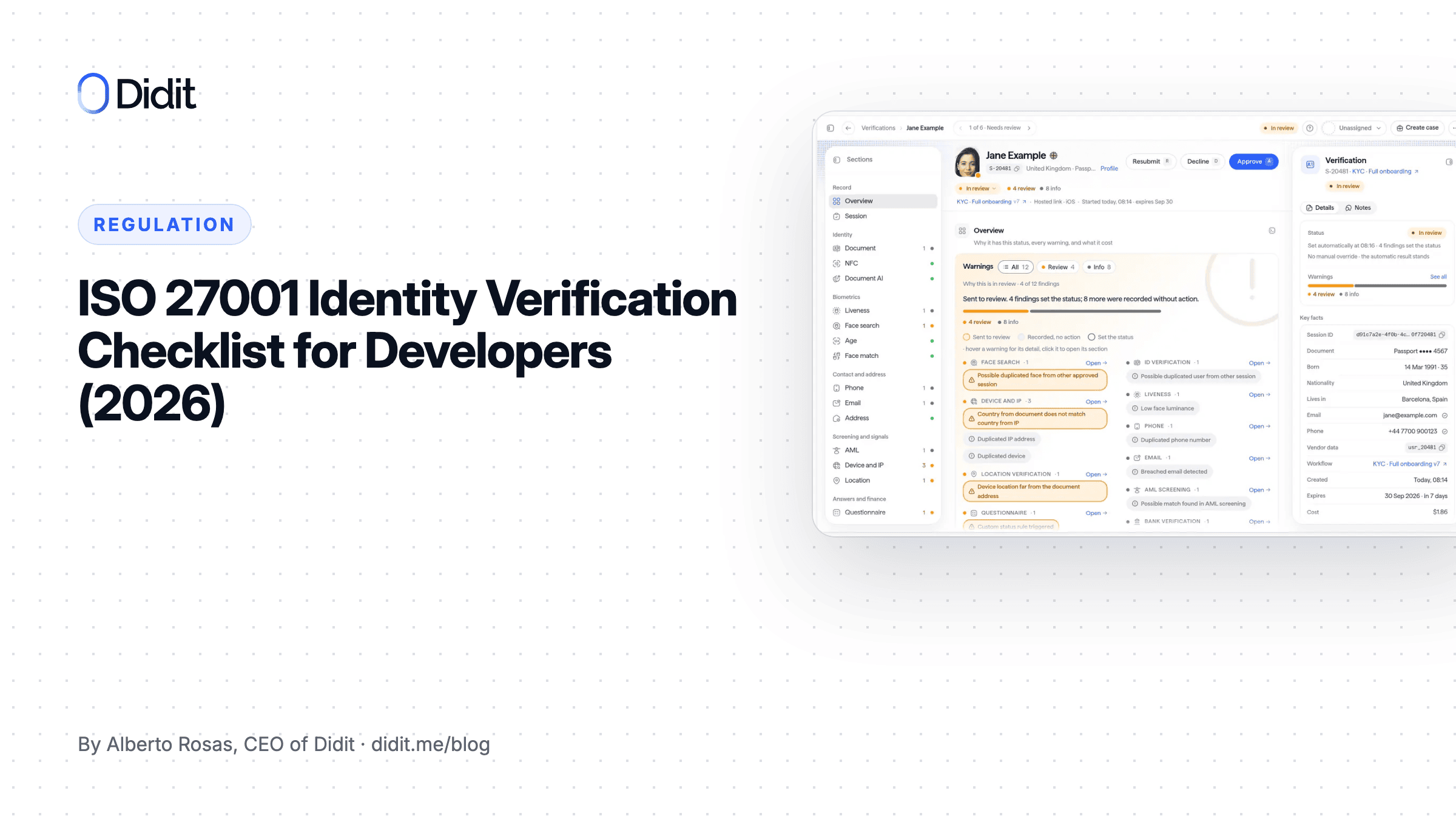
ISO/IEC 27001 certification is voluntary; contracts can require it. Scope your ISMS under Clause 4.3, assess the Annex A controls around your verification flow, and note that a supplier certificate covers the supplier, not you.
Alejandro RosasMar 7, 2026Boost Productivity with TypeScript for Didit API Integrations
Discover how leveraging TypeScript can dramatically enhance developer productivity and reduce integration complexities when working with Didit's identity verification APIs.
Alejandro RosasMar 7, 2026Secure Coding for Identity Verification APIs: OWASP Top 10 Guide
Protecting identity verification APIs from cyber threats is paramount. This guide explores secure coding practices aligned with the OWASP Top 10, offering developers actionable strategies to mitigate common vulnerabilities.
Alejandro RosasMar 7, 2026Monitoring Identity Verification APIs with Prometheus & Grafana
Effectively monitoring your identity verification API integrations is crucial for maintaining system health, ensuring a smooth user experience, and preventing fraud.
Alejandro RosasMar 7, 2026Architecting a Compliance Data Lake with Didit & Apache Iceberg
Building a robust compliance data lake is crucial for modern businesses. This article explores how to integrate Didit's structured identity data with Apache Iceberg to create an immutable, auditable, and scalable data foundation.
Alberto RosasMar 7, 2026Securing Microservices Identity with a Service Mesh
Microservices architecture introduces complex identity challenges, requiring robust authentication and authorization across distributed services.
Alberto RosasMar 7, 2026Optimizing Didit API Calls with HTTP/3 and QUIC for Low-Latency IDV
Discover how HTTP/3 and QUIC revolutionize identity verification by drastically reducing latency and improving reliability, especially for mobile and global users.
Alejandro RosasMar 7, 2026Zero-Knowledge KYC With Didit and Polygon ID: Developer Guide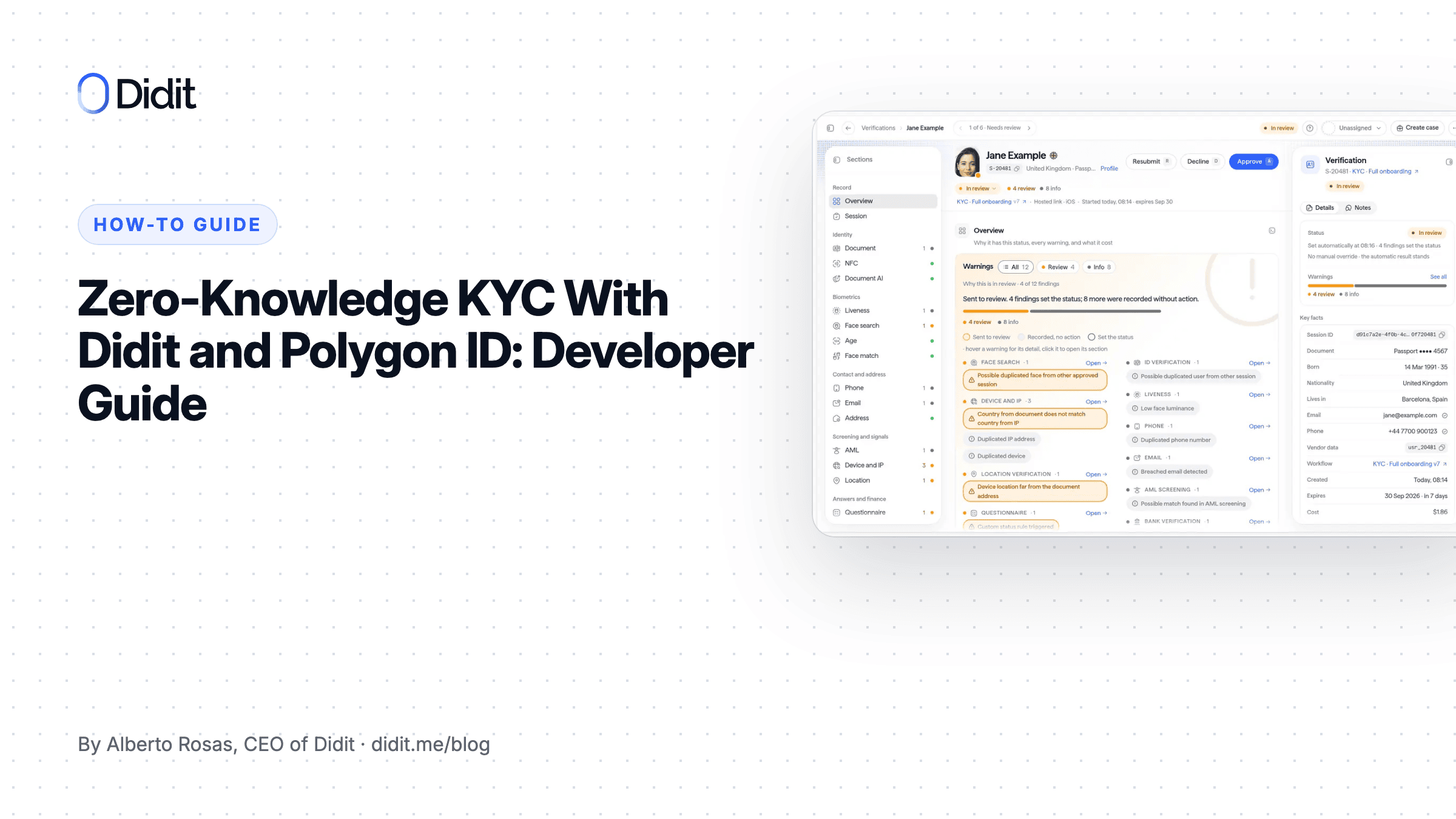
Didit verifies the person and returns a decision by webhook or API. Didit docs publish no Polygon ID connector, so credential issuance and proof verification are implementation choices you make. Full KYC costs $0.33.
Alejandro RosasMar 7, 2026Privacy-Preserving Proof of Address with Didit APIs
Discover how Homomorphic Encryption (HE) can revolutionize Proof of Address (PoA) verification by enhancing privacy. This blog post explores the challenges of traditional PoA, the promise of HE, and how Didit's modular.
Alejandro RosasMar 7, 2026Federated Credentials & Fine-Grained Authorization with Didit
Explore how to implement robust federated credentials and fine-grained authorization using Didit for identity verification and Cerbos for policy enforcement.
Alberto RosasMar 7, 2026Mastering API Contract Testing for Robust Didit Integrations
Ensure seamless and reliable integration with Didit's identity verification platform by mastering API contract testing. Learn how Pact and OpenAPI can prevent integration issues, enhance development efficiency, and maintain data.
Alejandro RosasMar 7, 2026Didit SDKs: Optimizing Bundle Size and Load Times for Mobile Apps
Discover how Didit's SDKs are engineered for minimal bundle size and rapid load times, crucial for superior mobile app performance. Learn about modularity, efficient data handling, and how our AI-native approach ensures a smooth.
Alejandro RosasMar 7, 2026Building Trust: Reputation Systems for Online Marketplaces
Online marketplaces thrive on trust, but building effective reputation systems to deter fraud and ensure user safety is a complex challenge.
Alberto RosasMar 7, 2026Data Residency for Identity Verification with Didit (2026)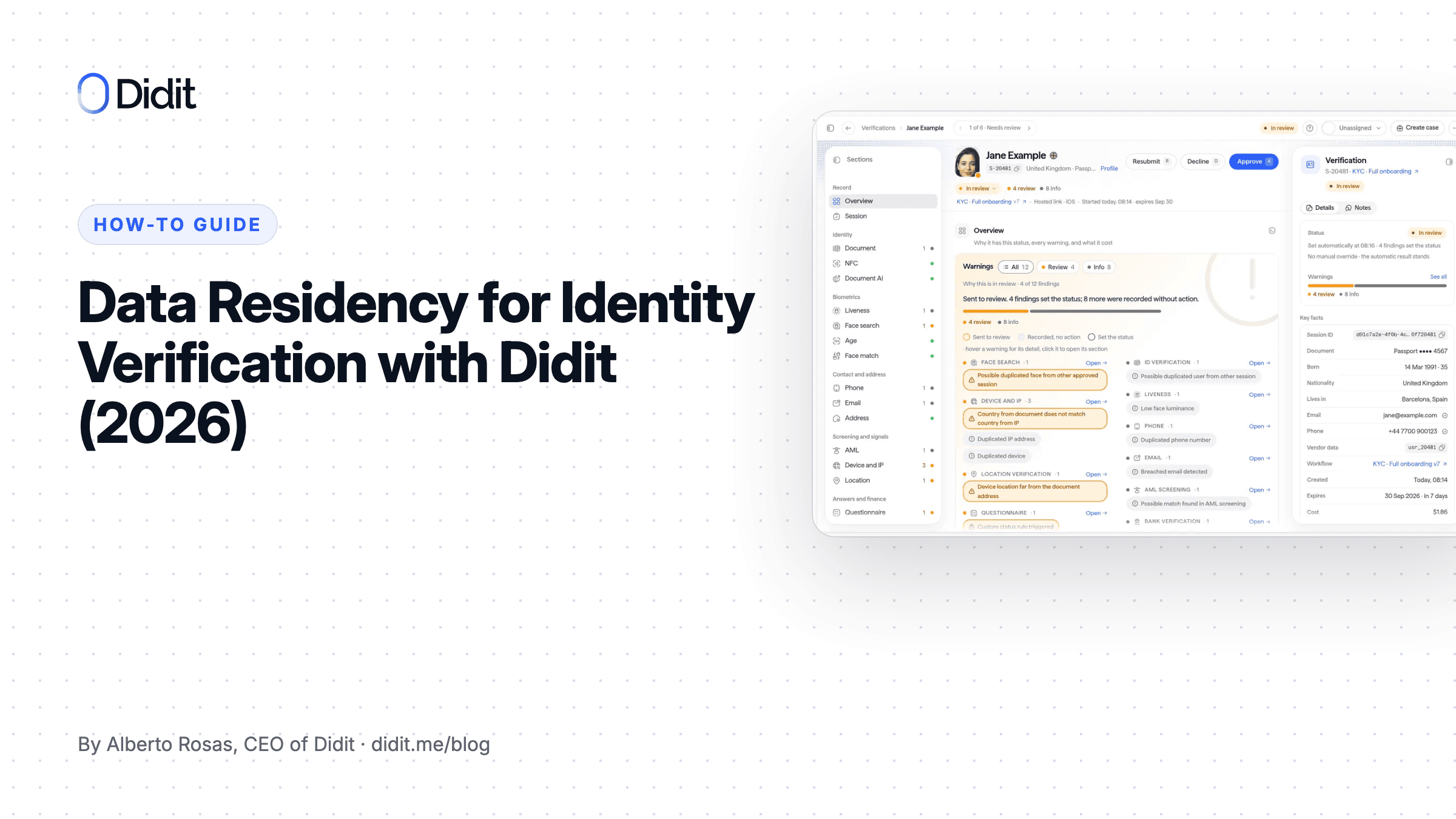
Didit stores verification data in the EU (Ireland) by default, sets the region per application at creation, lets you pick a retention window from 1 month to 10 years, and deletes sessions by API.
Alberto RosasMar 7, 2026Advanced Bot Detection in Web3 DApps with Didit's Device Intelligence
Web3 DApps face unique challenges from sophisticated bots, requiring advanced detection methods. Didit's Device Intelligence and IP Analysis provide crucial insights into user environments, helping identify and mitigate.
Alberto RosasMar 7, 2026Automated Compliance Auditing for KYC with Kubernetes & OPA
Achieving automated compliance auditing in complex KYC workflows within Kubernetes environments is crucial. This guide explores leveraging OPA Gatekeeper for policy enforcement, integrating with audit logs, and how Didit's.
Alberto RosasMar 7, 2026Real-Time Age Gating & Content Moderation with Didit & Kafka
Discover how to build a robust, real-time age gating and content moderation system by integrating Didit's AI-native Age Estimation API with Kafka Streams.
Alberto RosasMar 7, 2026GDPR Article 22: Mastering Automated Decision-Making with Didit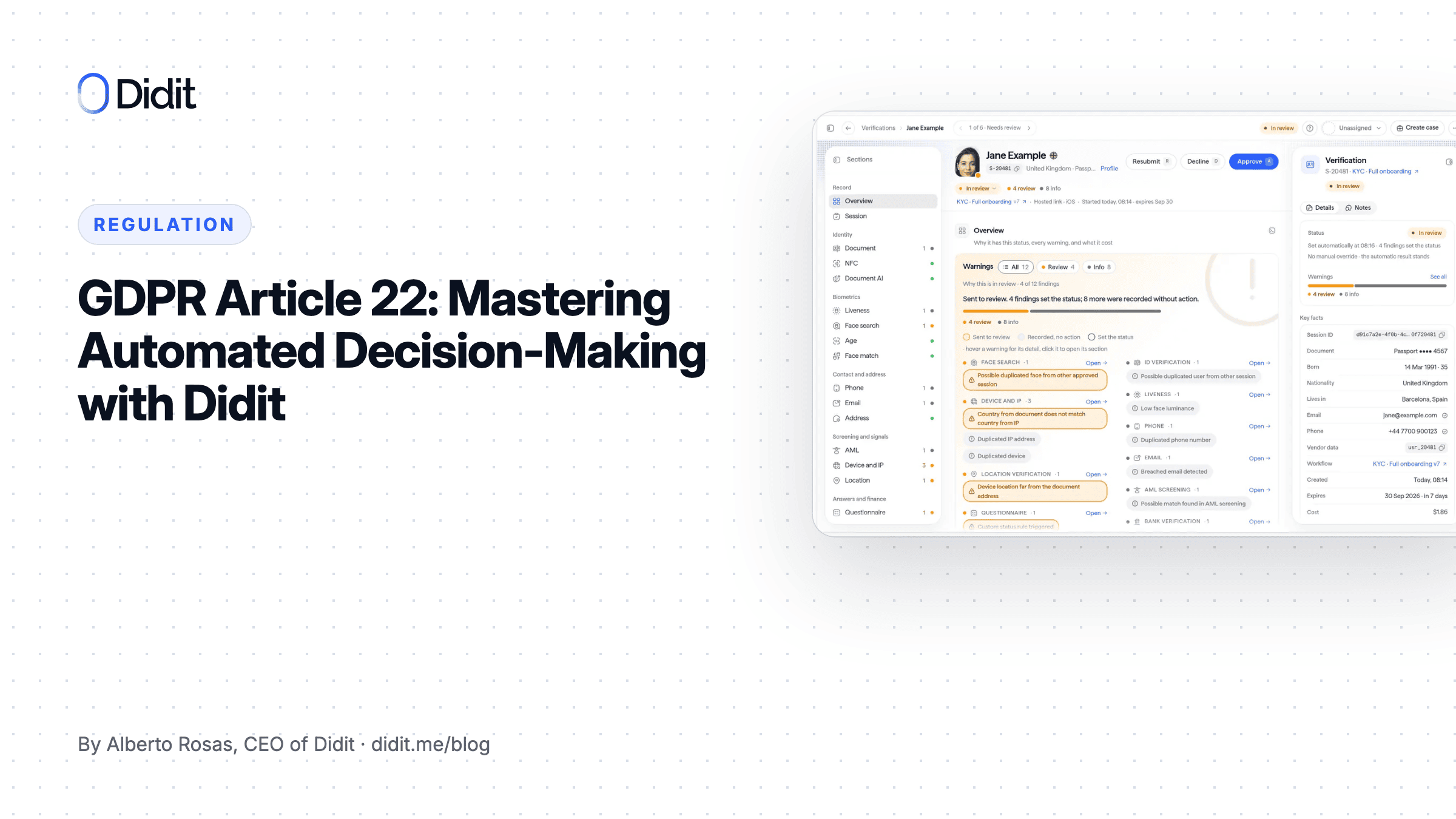
Article 22 GDPR restricts solely automated decisions with legal or similarly significant effects. Didit supplies the decision record, human review route and retention controls; you stay the controller.
Alberto RosasMar 7, 2026Extensible Identity Checks in Go with Didit's Primitives
Discover how to design a flexible plugin architecture in Go for custom identity checks, leveraging Didit's modular identity primitives. This approach allows for scalable, adaptable verification workflows that can easily.
Alberto RosasMar 7, 2026Cross-Border Data Residency for Identity Verification
Effectively managing cross-border data residency for identity verification is crucial for global businesses. This article explores the challenges of regulatory compliance, the strategic advantages of multi-cloud architectures.
Alberto RosasMar 7, 2026Robust CI/CD for Identity Verification with GitHub Actions & Didit
Building a reliable CI/CD pipeline for identity verification integrations is crucial for speed, security, and compliance. This guide explores leveraging GitHub Actions with Didit's developer-first platform to automate testing.
Alberto RosasMar 7, 2026Adaptive Fraud Scoring with Azure Functions and Didit
Discover how serverless event-driven architecture, combining Azure Functions with Didit's AI-native identity verification, creates a highly scalable and adaptive fraud scoring system.
Alberto RosasMar 7, 2026KYC Modernization: Strangler Fig Pattern with Didit
Migrating from monolithic KYC systems to modern microservices can be daunting. The Strangler Fig Pattern offers a safe, gradual approach to modernization, allowing businesses to incrementally replace legacy components without.
Alberto RosasMar 7, 2026Debugging Didit Integrations: Common Pitfalls and Fixes (2026)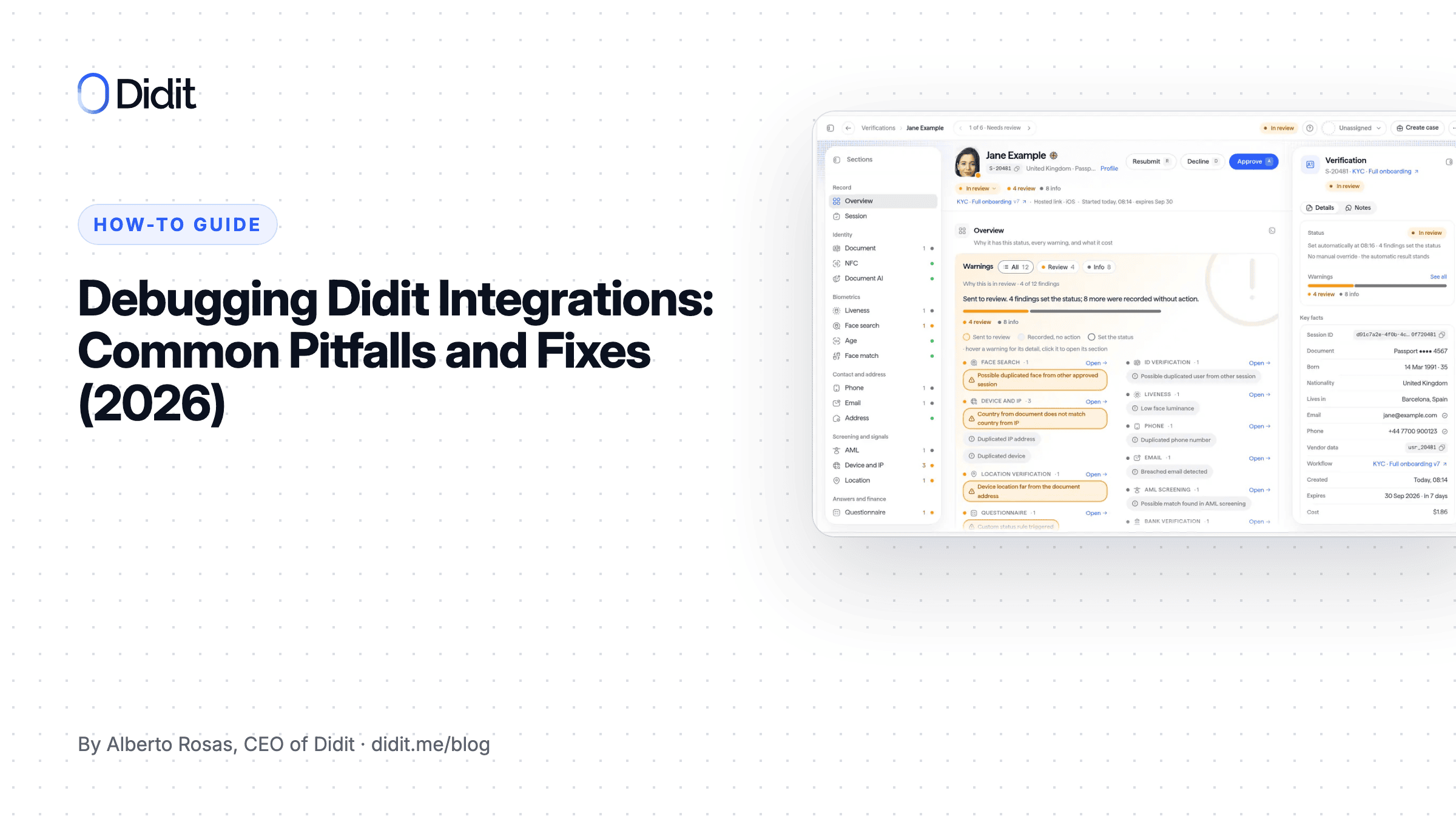
Most Didit integration bugs come down to five things: a wrong or scoped API key, ignoring Retry-After on 429, over-polling the decision endpoint, unverified webhook signatures, or a status string your code does not handle.
Alejandro RosasMar 7, 2026Privacy-Preserving Proof of Address with Didit and ZKPs in Python
This blog explores how Zero-Knowledge Proofs (ZKPs) can revolutionize Proof of Address (PoA) verification by enhancing user privacy, particularly when integrated with robust platforms like Didit.
Alejandro RosasMar 7, 2026Automating Consent & Data Sharing with Didit's UMA-driven APIs
Managing user consent for data sharing is crucial yet complex. This post explores how User-Managed Access (UMA) combined with robust APIs can automate consent, enhance privacy, and streamline data exchange.
Alejandro RosasMar 7, 2026Securing WebSockets for Real-Time Identity Updates with Didit
Learn how to secure WebSocket connections for real-time identity updates using Didit's robust platform. This guide covers authentication, authorization, data encryption, and best practices for integrating Didit's identity.
Alberto RosasMar 7, 2026Securing Identity Data: Encryption & Key Management for Didit
Protecting sensitive identity data is paramount in today's digital landscape. This post explores essential strategies like robust database encryption, secure key management, and tokenization, providing practical advice for.
Alejandro RosasMar 7, 2026Build a Dev-Friendly Identity Sandbox with Didit & Docker Compose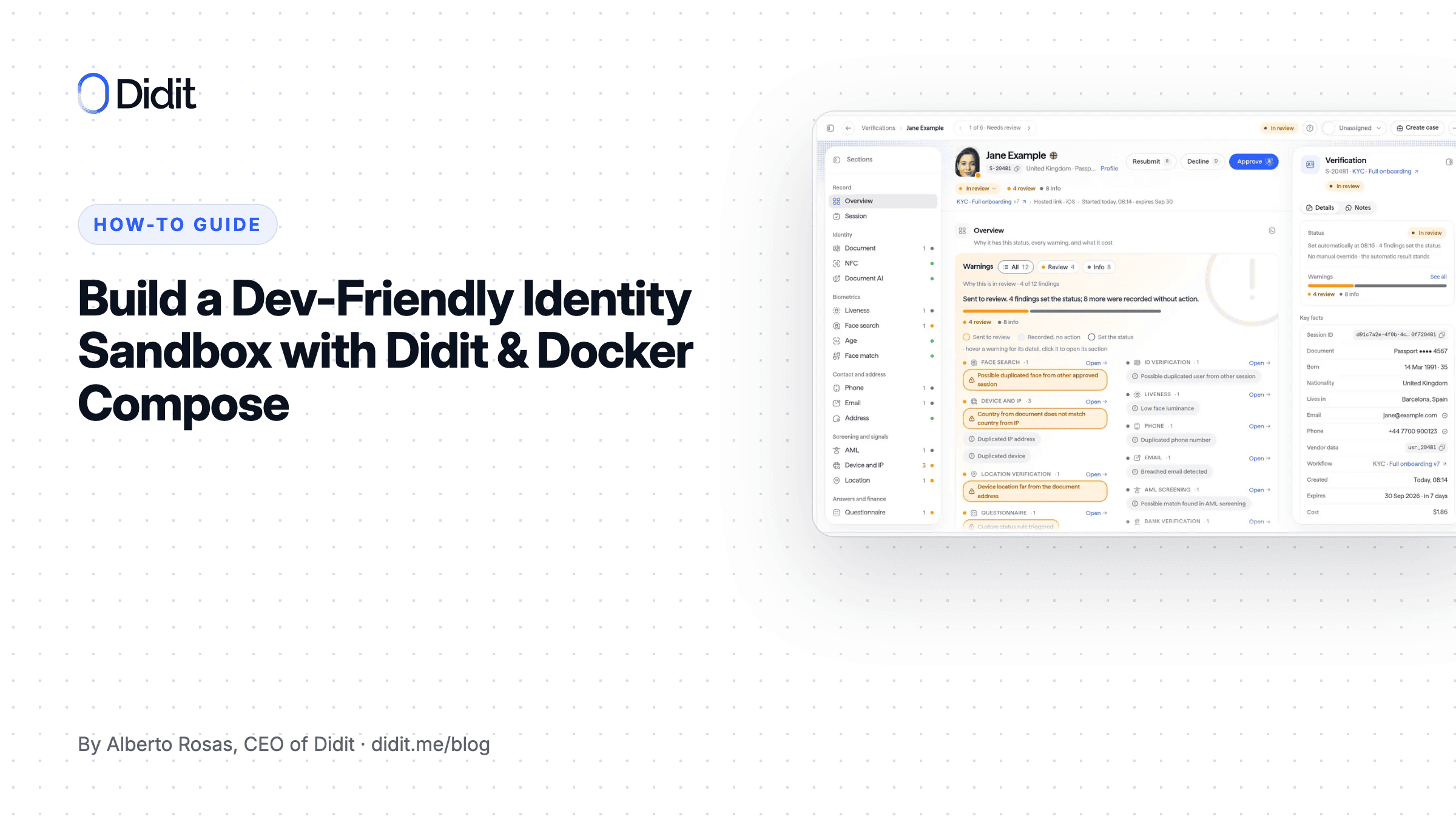
Didit's sandbox is free on every plan: providers mocked, outcomes set by scenarios, with a 500-session-per-24-hour quota per sandbox application. Docker Compose makes your test wiring repeatable. Live KYC checks cost $0.33.
Alejandro RosasMar 7, 2026Build an Adaptive Friction Engine with Didit & GPT-4
Discover how to build a real-time adaptive friction engine by integrating Didit's AI-native identity verification with GPT-4's contextual intelligence.
Alberto RosasMar 7, 2026API Gateway Patterns for Dynamic Risk Orchestration with Didit and Kong
This post explores how combining API Gateway patterns with Kong and Didit can create robust, dynamic risk orchestration systems. Learn to implement real-time identity verification, fraud prevention, and compliance checks at the.
Alberto RosasMar 7, 2026Zero-Knowledge Proofs for GDPR-Compliant Healthcare Data Sharing
Zero-Knowledge Proofs (ZKPs) offer a revolutionary approach to data privacy, particularly for GDPR-compliant healthcare APIs. By enabling verifiable data sharing without revealing underlying sensitive information, ZKPs can.
Alberto RosasMar 7, 2026Quantum-Proofing Identity Verification with Go
As quantum computing advances, current cryptographic standards face obsolescence. This blog explores implementing Post-Quantum Cryptography (PQC) in Go for robust identity verification, ensuring future-proof security for.
Alberto RosasMar 7, 2026Building a Decentralized KYC Oracle for Web3 Protocols with Didit
Decentralized KYC is crucial for Web3's mainstream adoption, bridging regulatory compliance with user privacy. Traditional KYC methods are centralized, but oracles can securely feed verified identity data onto blockchains.
Alberto RosasMar 7, 2026GDPR's Right to Be Forgotten: Didit-Integrated Data Erasure
Effectively implementing GDPR's Right to Be Forgotten is crucial for compliance. This guide explores the challenges of data erasure within identity verification systems and demonstrates how Didit's configurable data retention.
Alejandro RosasMar 7, 2026Federated Credentials with Didit and Keycloak: A Powerful Duo
Learn how to integrate Didit's robust identity verification capabilities with Keycloak to create a secure, scalable, and compliant federated identity system.
Alberto RosasMar 7, 2026Boost Didit API Throughput with Python Asyncio
Discover how Python's Asyncio can dramatically enhance the throughput and efficiency of your applications consuming Didit's identity verification APIs.
Alejandro RosasMar 7, 2026Scalable Webhook Processing with Go Channels and Goroutines
Learn how Go's concurrency primitives, Goroutines and Channels, can be leveraged to build highly scalable and resilient webhook processing systems, specifically for handling real-time identity verification notifications from.
Alberto RosasMar 7, 2026Choosing an IDV Provider: API, SDK, and Developer Experience
Selecting the right identity verification provider is crucial for seamless integration and future scalability. This guide compares leading platforms based on API design, SDK flexibility, and overall developer experience.
Alejandro RosasMar 7, 2026Blockchain Identity for Supply Chain Traceability
Explore how integrating blockchain identity, specifically Verifiable Credentials powered by Didit, with Hyperledger Fabric can revolutionize supply chain traceability.
Alberto RosasMar 7, 2026Automated Compliance Auditing for KYC Workflows with Kubernetes & OPA Gatekeeper
Discover how to streamline KYC compliance auditing using Kubernetes and OPA Gatekeeper. This blog explores automating policy enforcement, ensuring auditability, and integrating seamlessly with identity verification platforms.
Alberto RosasMar 7, 2026EBA eIDAS 2.0 Wallets: Verifiable Credentials Deep Dive
The European Banking Authority (EBA) is pushing for eIDAS 2.0 EUDI Wallets, revolutionizing digital identity. This deep dive explores the technical issuance and presentation of Verifiable Credentials (VCs).
Alberto RosasMar 7, 2026Automated Pen Testing for Identity Verification APIs with OWASP ZAP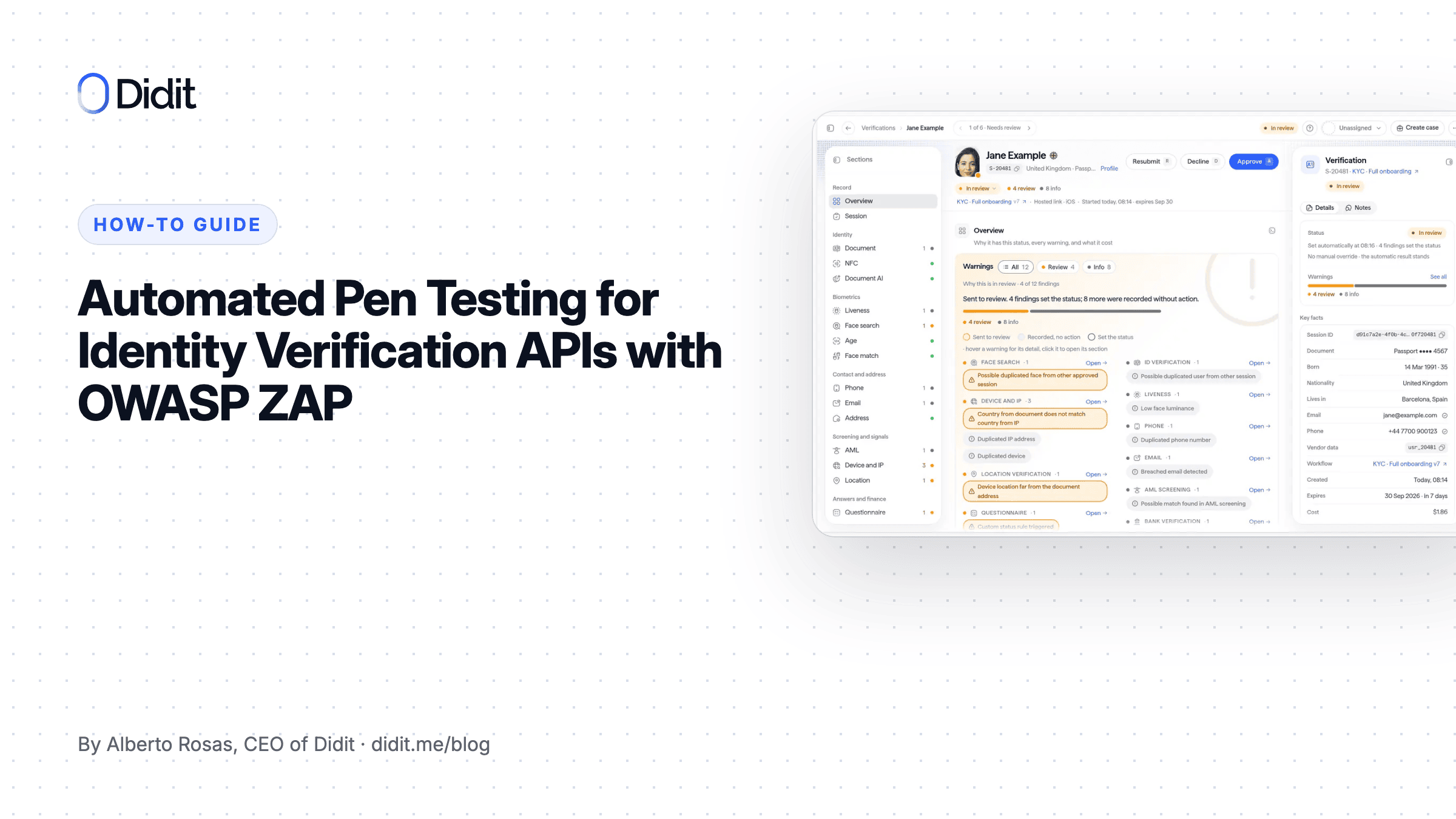
Run OWASP ZAP against your own backend endpoints that call Didit, never against Didit itself. Use a free sandbox application for test data, respect the documented rate limits, and gate deploys on High risk alerts.
Alejandro RosasMar 7, 2026OAuth 2.0 Client Credentials Flow for Didit API Access in Python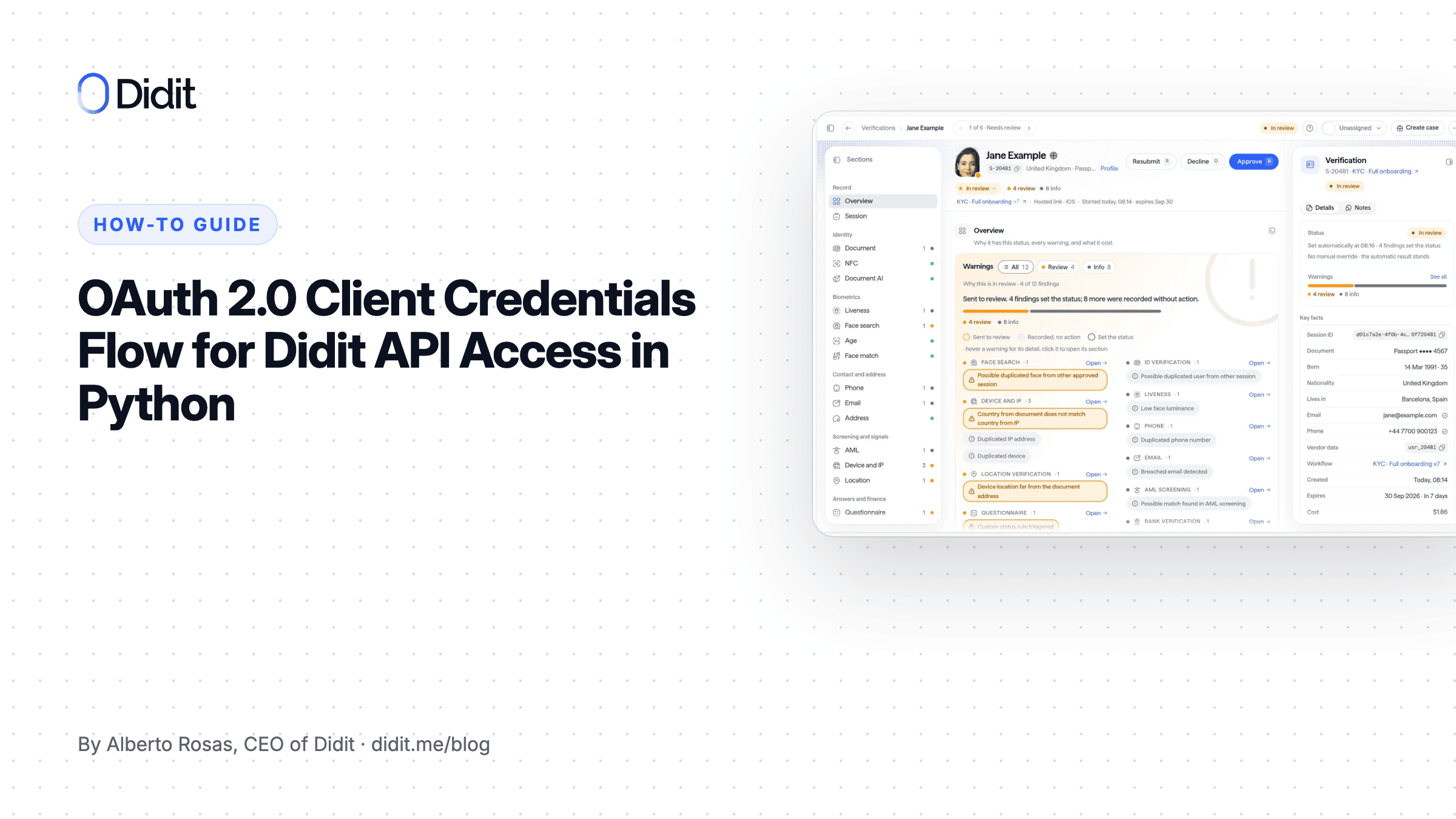
Didit has no OAuth 2.0 client credentials grant. Verification calls send a long-lived API key in the x-api-key header; account calls send a JWT from email login. Python code inside.
Alejandro RosasMar 7, 2026Optimizing Didit API Calls with GraphQL Federated Queries
Discover how GraphQL federated queries can dramatically cut costs and boost performance when interacting with the Didit API. Learn about reducing over-fetching, minimizing network latency, and streamlining data retrieval for.
Alberto RosasMar 7, 2026Event-Driven Identity Proofing with Didit and Apache Pulsar
Discover how combining Didit's AI-native identity verification with Apache Pulsar's event streaming capabilities creates a robust, scalable, and real-time identity proofing system.
Alberto RosasMar 7, 2026Securing Multi-Party Identity Workflows with Didit's APIs
Multi-party identity workflows introduce unique security challenges, especially when multiple entities need to verify a user without sharing sensitive data.
Alejandro RosasMar 7, 2026Quantum-Safe Identity Verification with Didit
Prepare your identity verification systems for the quantum era. This post explores the looming threat of quantum computing to current cryptographic standards and outlines strategies for implementing quantum-safe identity.
Alberto RosasMar 7, 2026Homomorphic Encryption with Didit: Securing Biometric Data
Explore how homomorphic encryption revolutionizes biometric template protection, enabling secure computations on encrypted data without decryption.
Alberto RosasMar 7, 2026Strategic Architectures for PII and Data Residency in Multi-Cloud
Effectively managing Personally Identifiable Information (PII) and ensuring data residency compliance across global multi-cloud deployments is a critical challenge for modern businesses.
Alejandro RosasMar 7, 2026GDPR Data Minimization with Go Microservices
Achieving GDPR compliance, especially data minimization, is crucial for businesses handling identity data. This blog explores how Go microservices can be architected to enforce data minimization principles effectively, improving.
Alberto RosasMar 7, 2026Developer's Guide: Optimizing Didit API Calls for CDN Edge Caching
Optimize your Didit API integrations for unparalleled performance and scalability by leveraging CDN edge caching strategies. This guide covers global and endpoint-specific rate limits, effective throttling, and the benefits of.
Alejandro RosasMar 7, 2026Build a Fault-Tolerant Identity Verification Gateway with NGINX & Didit
Discover how to build a robust, fault-tolerant identity verification gateway using NGINX as a reverse proxy and Didit's AI-native platform. This guide covers load balancing, caching, and secure API integration for seamless.
Alberto RosasMar 7, 2026EBA Guidelines & API-First Remote Onboarding: A Developer's Guide
Navigating the EBA Guidelines for remote customer onboarding requires a robust, API-first approach to identity verification. This guide offers developers a checklist to ensure compliance, emphasizing secure, user-friendly, and.
Alberto RosasMar 7, 2026Build a Scalable IdP with Didit's Identity Primitives & OIDC
Architecting a robust, scalable Identity Provider (IdP) is crucial for modern applications. This guide explores leveraging Didit's modular identity primitives, like ID Verification and Liveness Detection, alongside OpenID.
Alejandro RosasMar 7, 2026Advanced Biometric Template Protection: Tokenization & Homomorphic Encryption
Explore cutting-edge techniques like tokenization and homomorphic encryption for securing biometric data. Learn how these methods safeguard privacy while enabling robust identity verification.
Alejandro RosasMar 7, 2026LLM-Powered Chatbots for KYC & Compliance with Didit
Discover how Large Language Model (LLM)-powered chatbots can revolutionize KYC support and compliance queries. This post explores leveraging AI for enhanced customer experience and operational efficiency, and how Didit's.
Alberto RosasMar 7, 2026Questions
Blog questions
Who writes the Didit blog?
Which topics does the blog cover?
Is the blog available in my language?
Where do I find product updates?
Are these posts legal advice?
How do I find posts on one topic?
Are posts dated?
Do posts link to the docs?
Is the blog the same as the docs?
Compliance built in
Audited, certified and attested.
We hold the certifications and build each country's rules into your flows, so you can launch anywhere without worrying. Security and Compliance center
- Regulation encoded into your flows
Tell us what you do and where. Didit lists the rules that apply to you, with sources, and builds the checks each country needs into one workflow.
- Ready for AMLR
Every requirement of the new EU anti-money laundering rules, from checking customers to human review, is already covered by a Didit check.
- Tested in Spain's Treasury sandbox
Spain's Treasury published its supervised sandbox report on Didit's NFC plus active liveness onboarding; SEPBLAC took part and valued the added measures positively.
- Audited, not self-declared
iBeta Level 1 and Level 2. Liveness tested under ISO/IEC 30107-3.
Your obligations · 3 regions
 SOC 2 Type 2
 ISO 27001
 iBeta Level 1 and Level 2
 EU regulator attestation
 FSM youth protection
 GDPR
 EBA remote onboarding
 MiCA compatible
 FIDO Alliance member
- AMLREU AML Regulation ready
Integration · Didit MCP
Run Didit from your own AI agent
Connect Didit to Claude, Cursor, VS Code or ChatGPT and just ask in plain words. Your agent can do anything you can do in the console, with the same permissions you have.
 Add to Claude
 ChatGPT
 Cursor
- Build workflowsDescribe the checks you need. The agent creates and publishes the flow.
- Run investigationsAsk why a session was declined, review cases, search people and companies.
- Change rulesCreate payment rules, test them on past data and switch them on.
- Pull reportsAsk for numbers, exports or the audit log.
Didit Academy


