Blog
Blog archive
Every post on the Didit blog, newest first. Pick a category or search to find the subject you need.
All posts
Every post, newest first
Pick a category to filter.
A superior Developer Experience (DX) is crucial for rapid integration and innovation in identity verification. This blog explores key components of excellent DX, including clear documentation, flexible integration options, and.
Alberto RosasMar 6, 2026Latest Innovations in Passive Face Liveness Detection
Passive face liveness detection is revolutionizing fraud prevention by verifying user identity without requiring active participation. New AI-driven methods analyze subtle cues in images or videos to distinguish real faces from.
Alejandro RosasMar 6, 2026Active vs. Passive Liveness Detection: Choosing the Right Tech
Liveness detection is crucial for preventing fraud in online identity verification. Choosing between active and passive methods depends on your specific needs and risk tolerance.
Alberto RosasMar 6, 2026How to Integrate Identity Verification into Your Mobile App
Integrating identity verification into your mobile app is crucial for security and compliance. This blog post explores the benefits, methods, and best practices for seamless integration.
Alejandro RosasMar 5, 2026Biometrics: Streamlining Fintech Customer Onboarding
Biometrics are revolutionizing customer onboarding in fintech, offering enhanced security and a seamless user experience. This technology reduces fraud, speeds up verification, and ensures regulatory compliance.
Alberto RosasMar 5, 2026Implementing Biometric Authentication: A Developer's Guide
Explore a step-by-step guide for developers on implementing biometric authentication. Learn the key considerations, technologies, and best practices for secure and user-friendly biometric systems.
Alejandro RosasMar 5, 2026The Importance of Ongoing Identity Monitoring for AML Compliance
Ongoing identity monitoring is crucial for maintaining AML compliance. It helps detect suspicious activities, ensures KYC data accuracy, and mitigates risks associated with financial crime.
Alberto RosasMar 5, 2026The Ultimate Guide to Know Your Business (KYB) in 2026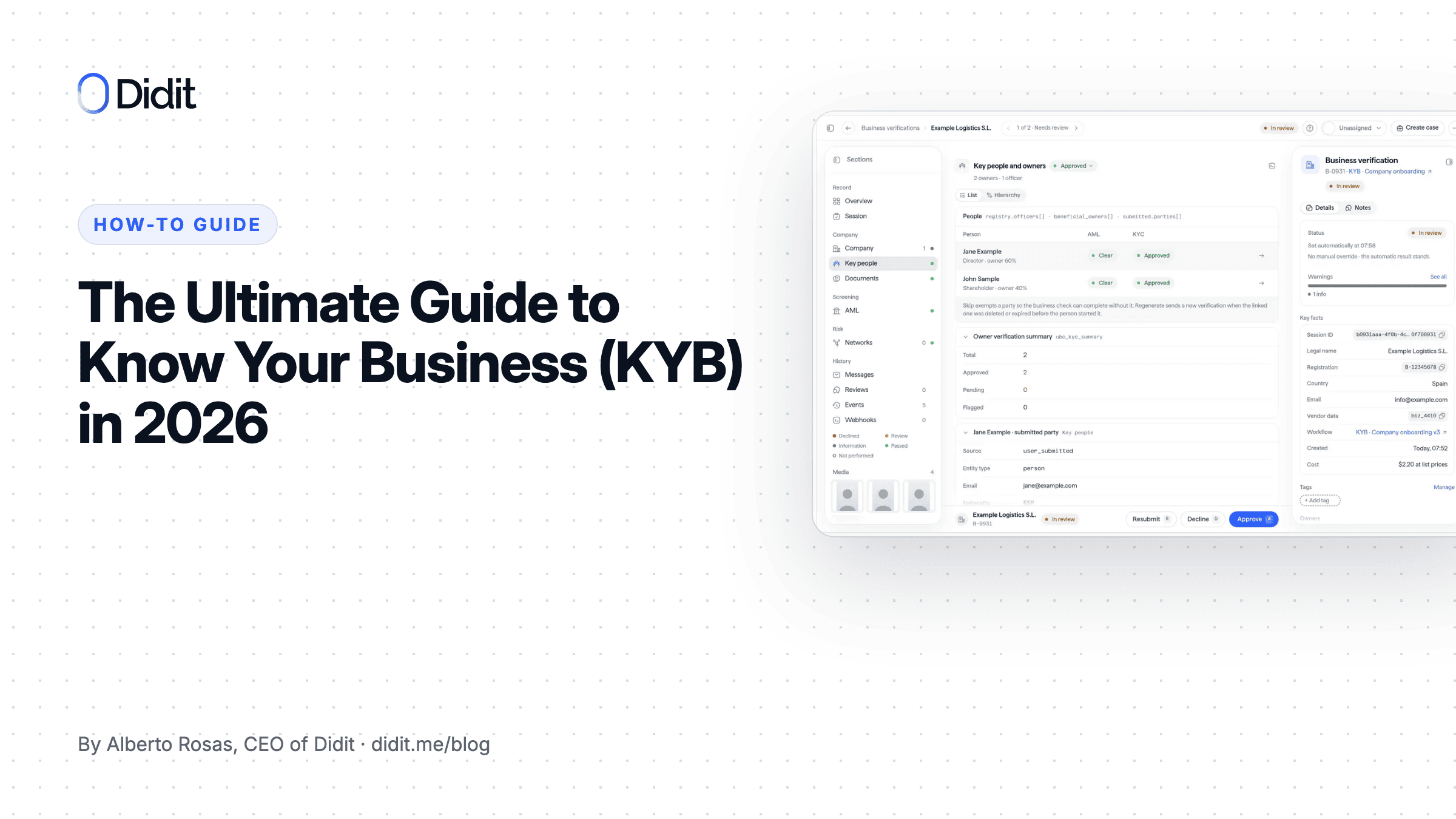
KYB verifies who owns and controls a company before you onboard it. Didit runs registry lookup, UBO extraction, company and person AML in the business session, with child KYC sessions for people who must verify, from $2.00 per.
Alberto RosasMar 5, 2026eKYC: A Comprehensive Guide to Electronic Know Your Customer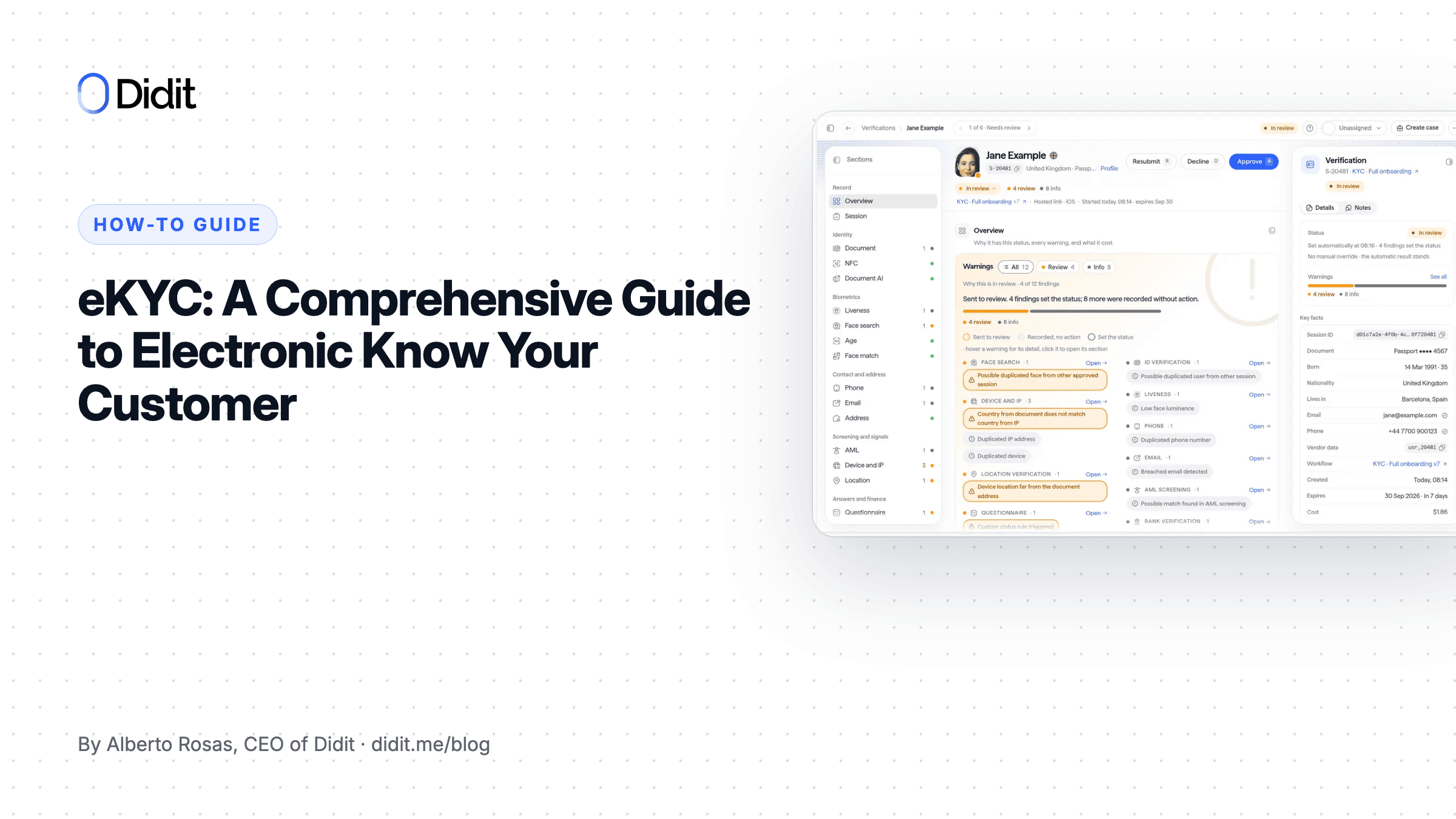
eKYC verifies a customer remotely: ID document, liveness, face match and optional AML screening, then a decision. On Didit a full ID check costs $0.33, and once the workflow and your credentials are configured, one.
Alberto RosasMar 5, 2026The Ultimate Guide to eIDAS 2.0: What Businesses Need to Know
eIDAS 2.0 is set to revolutionize digital identity and trust services in the EU. This guide breaks down the key changes, implications for businesses, and how Didit can help you navigate the new landscape.
Alberto RosasMar 5, 2026KYC Lite: When Simplified Due Diligence Is Enough (2026)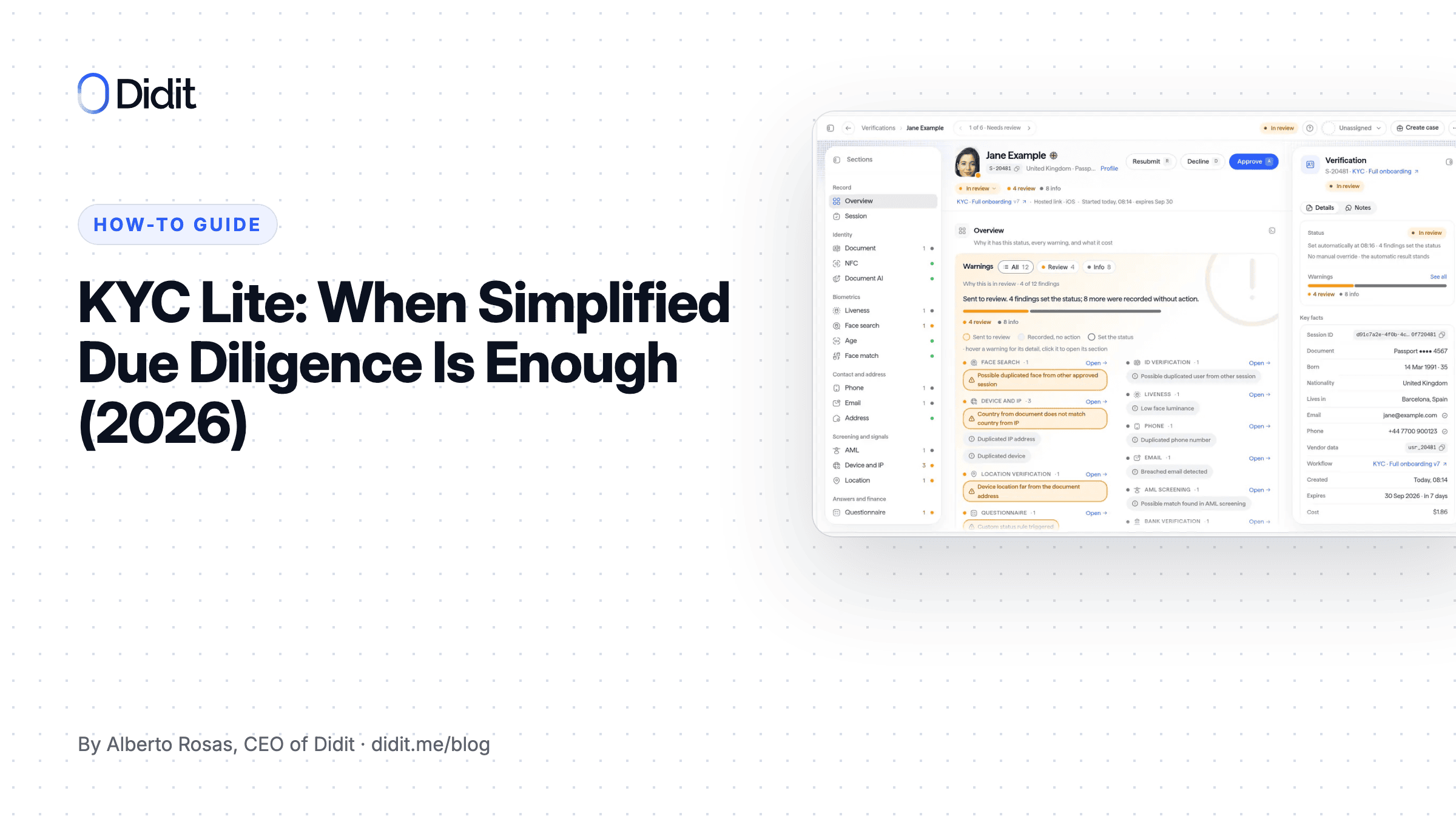
KYC Lite (light KYC, simplified due diligence) fits low-risk accounts with hard limits. Build it with email $0.02, phone from $0.02 and AML $0.20, then escalate to a $0.33 ID check when a trigger fires.
Alberto RosasMar 5, 2026Remote Identity Verification: Secure Onboarding in 8 Steps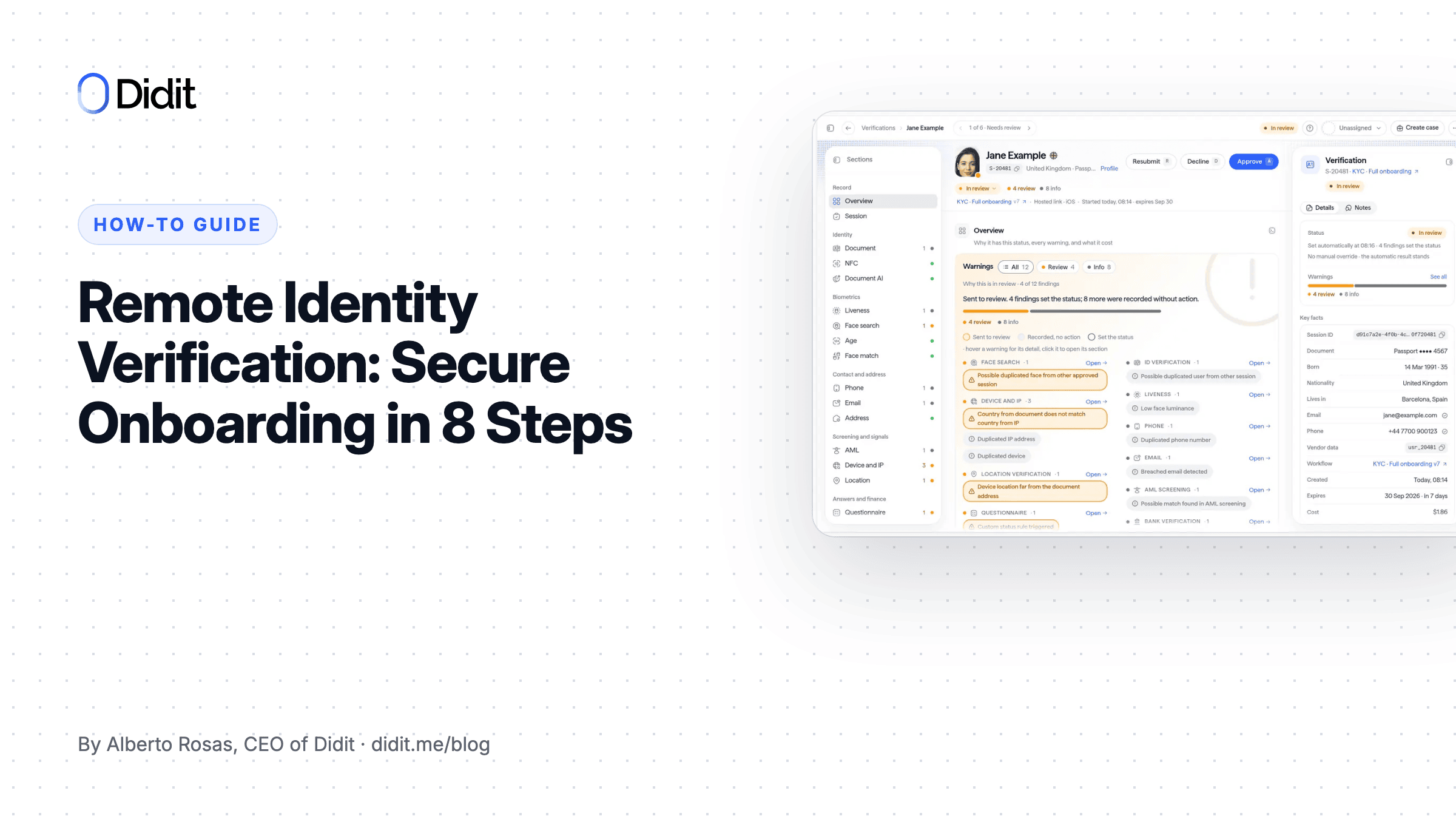
Remote identity verification reads a government ID, proves a live person is present, matches the face to the document and returns a decision.
Alberto RosasMar 5, 2026EUDI Wallet: A Business Guide
The EUDI Wallet is poised to revolutionize how citizens and businesses interact online. This guide explores the wallet's features, benefits, and challenges for businesses.
Alberto RosasMar 5, 2026KYC for Online Pharmacies: Combating Counterfeit Drugs
Online pharmacies offer convenience, but also risks like counterfeit drugs. Know Your Customer (KYC) is crucial for ensuring legitimacy. This blog explores how KYC protects consumers and the pharmaceutical industry from fraud.
Alberto RosasMar 5, 2026Identity Verification for Dating Apps: A 2026 How-To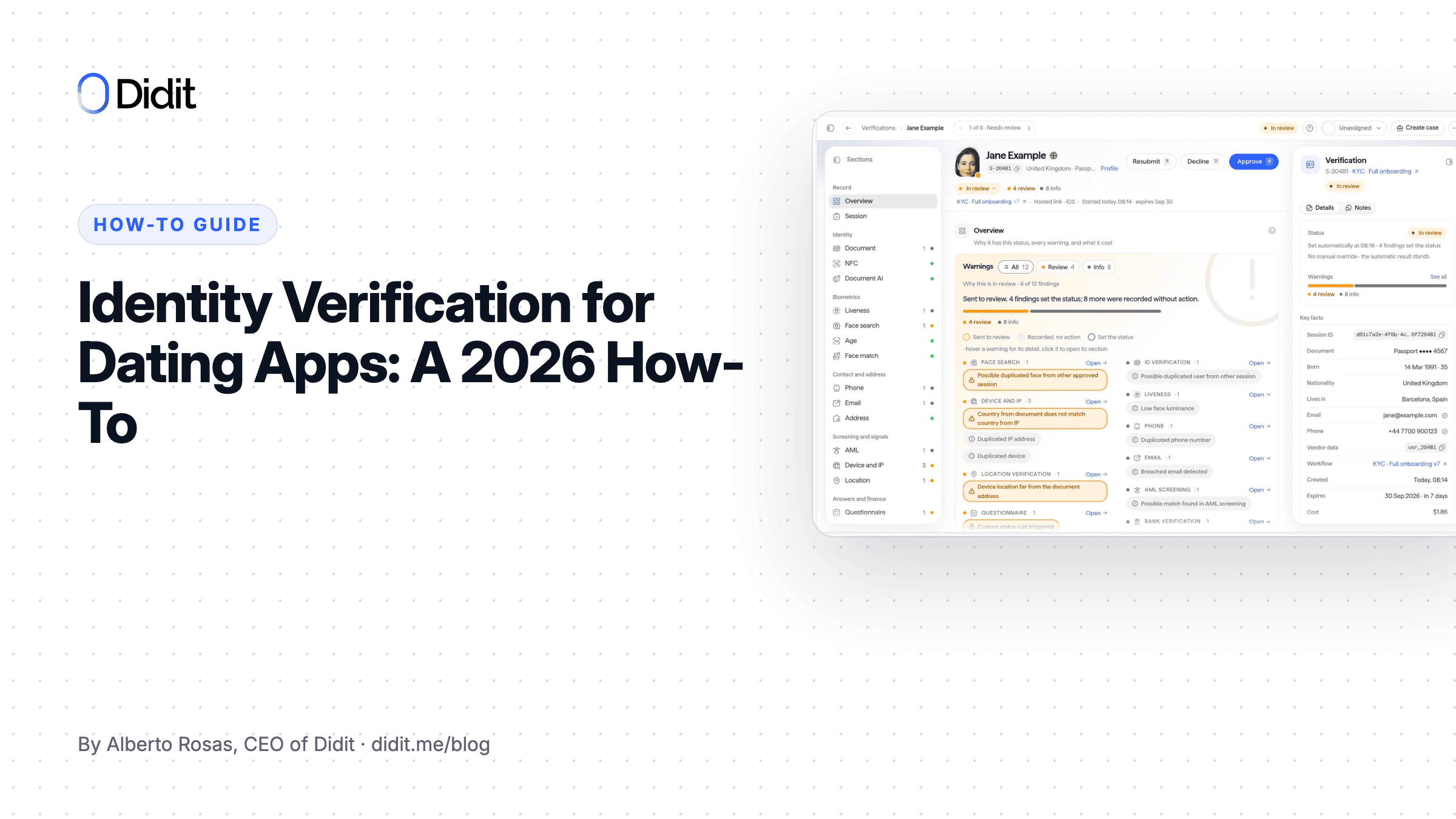
Dating apps can require a $0.33 full ID check before the first message. It covers document authenticity, passive liveness, selfie-to-ID matching, and device and IP analysis. Hosted liveness flags possible duplicates.
Alberto RosasMar 5, 2026Combatting Signup Abuse: Strategies & Solutions
Signup abuse can cripple online platforms with fake accounts, spam, and fraud. This post explores the tactics used by abusers and provides strategies to protect your platform, including leveraging AI-powered identity.
Alberto RosasFeb 15, 2026The Internet Illusion: Navigating a World of Fakes
The internet is increasingly filled with manipulated content, from deepfakes to fake reviews, making it difficult to discern what's real. This erosion of trust demands new strategies for verification and critical thinking.
Alberto RosasFeb 15, 2026Detect Unique Users in Your App with One Biometric Scan
Discover how to identify unique users in your app efficiently using biometric authentication. Learn about the challenges of user identification and how Didit's biometric solutions offer a seamless, secure, and privacy-preserving.
Alberto RosasFeb 15, 2026Dead Internet Theory: Why Identity Verification Will Be Mandatory
The 'Dead Internet Theory' suggests much of online content is generated by bots. As this becomes more apparent, mandatory identity verification will become crucial to restore trust and ensure authentic online interactions.
Alberto RosasFeb 15, 2026Multi-Account Fraud: Detection, Prevention, and Solutions (2026)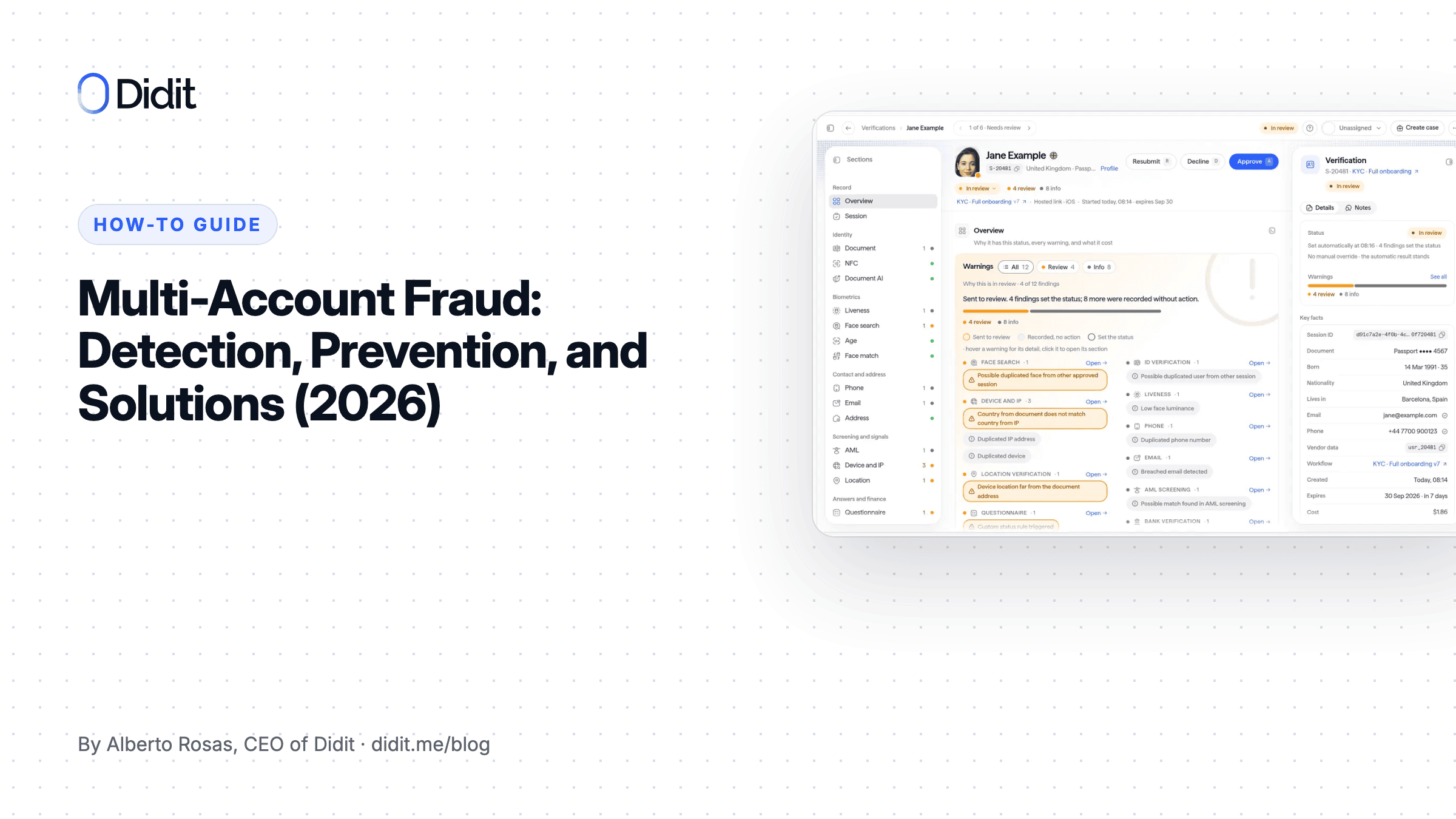
Detect multi-account fraud with a chain of checks: ID verification, 1:N face search, device and IP duplicate signals, and blocklists. Use duplicate signals to investigate account links.
Alberto RosasFeb 15, 2026Identity Verification for Crypto Exchanges With Less Friction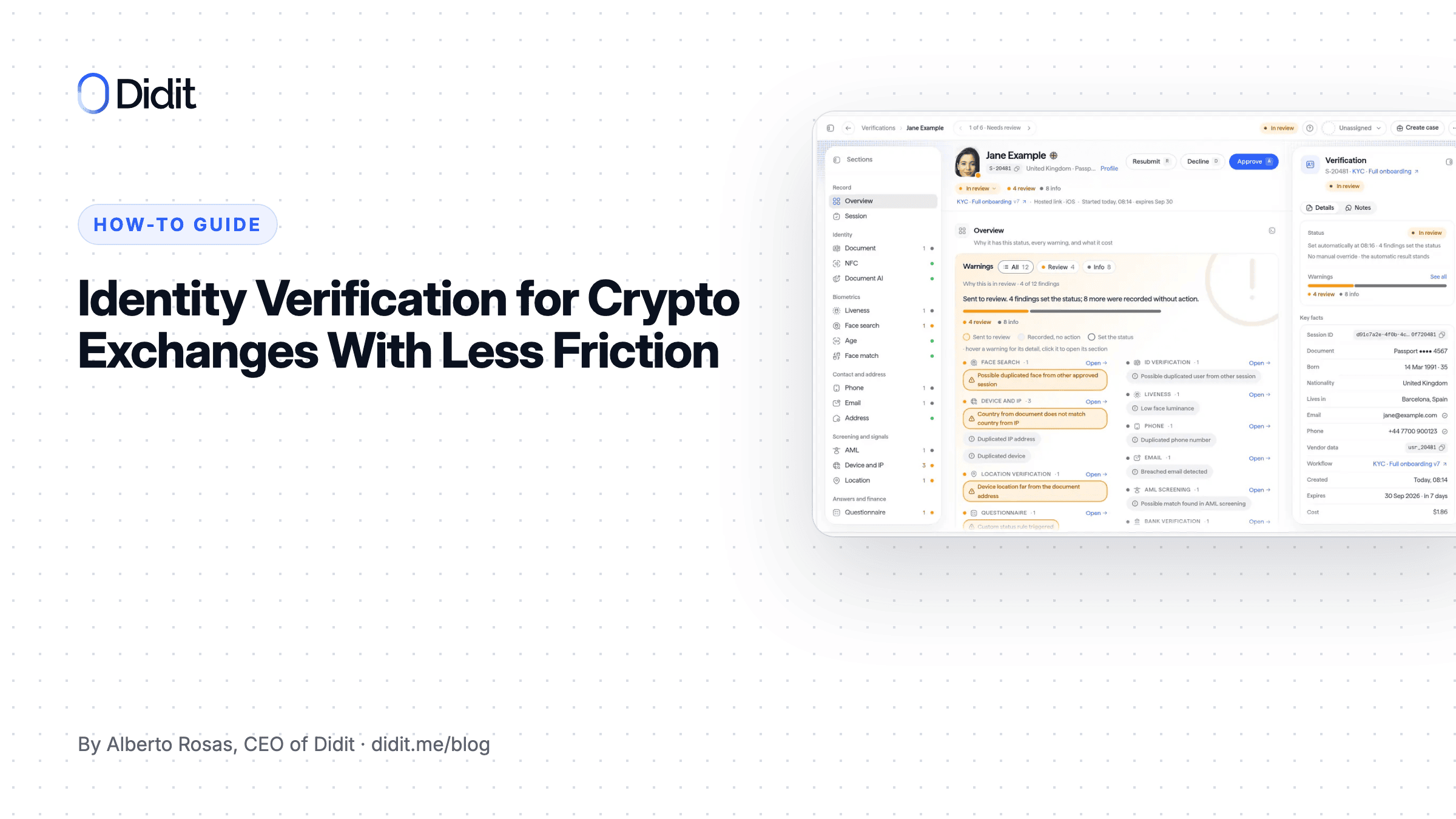
Run a Didit KYC workflow with AML screening, send customers to the hosted flow, and gate account functions on the backend decision. A full ID check is $0.33, AML $0.20, wallet screening $0.15, and sandbox testing is free.
Alberto RosasFeb 14, 2026Pay-Per-Use KYC vs Enterprise KYC: What You Need & Avoid Overpaying
Navigating the world of KYC can be complex. Understand the differences between free and enterprise KYC solutions, identify the features you actually need, and learn how to avoid overpaying.
Alberto RosasFeb 14, 2026How to Choose an Identity Verification Provider (2026 Guide)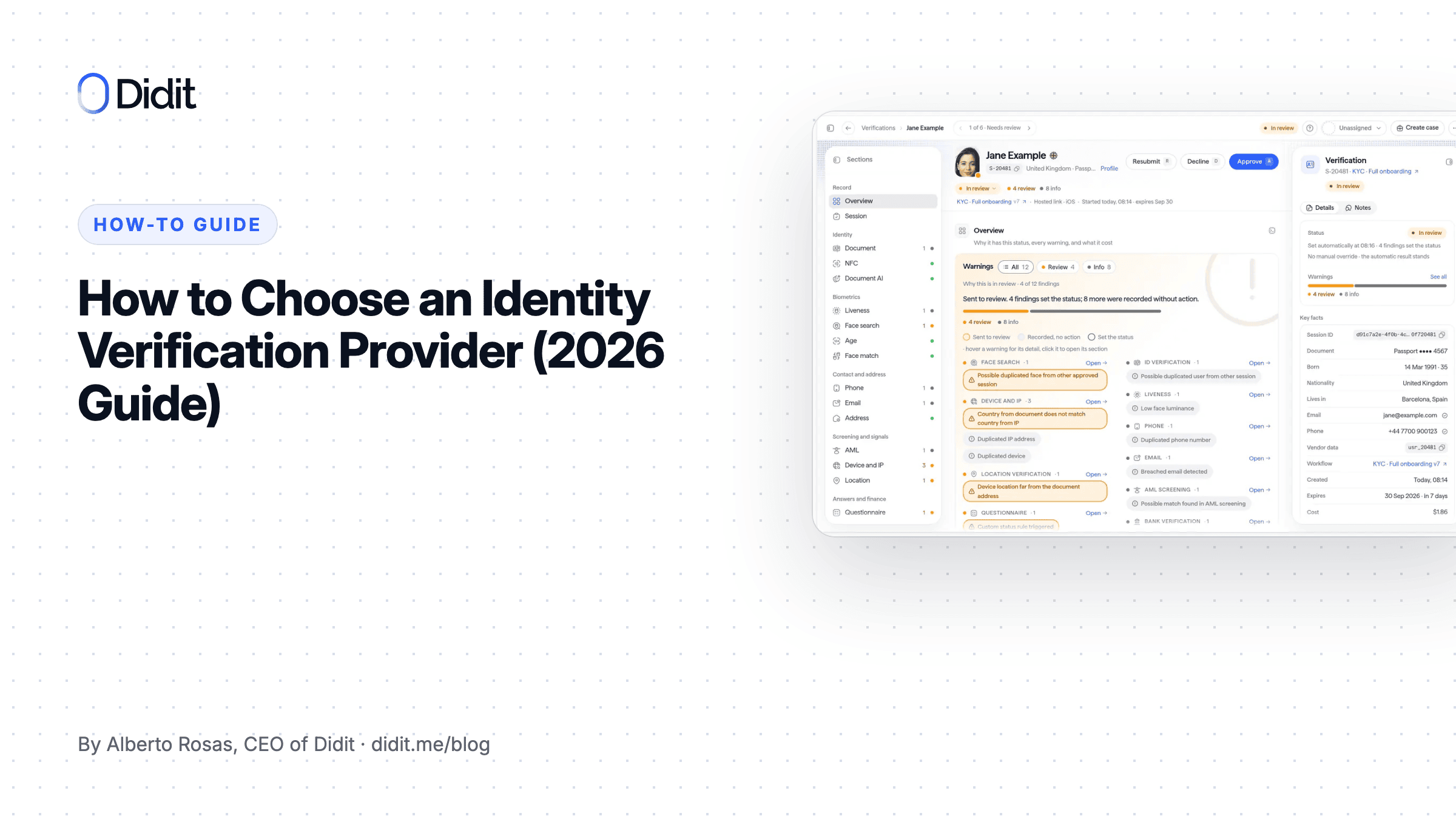
Choosing a provider means pricing one completed check, testing coverage in a sandbox and reading the decision payload. Didit publishes full KYC at $0.33 with a free sandbox.
Alberto RosasFeb 14, 2026Global IDV Coverage: Why Supported Documents & Countries Matter
We read 14,000+ document types across 220+ countries and territories at $0.15 per ID check in a workflow or $0.20 via the standalone API.
Alberto RosasFeb 14, 2026Identity Verification Market 2025: Trends, Growth & Insights
Explore the projected growth of the identity verification market by 2025, key trends driving its expansion, and critical insights for businesses.
Alberto RosasFeb 14, 2026Biometric Authentication vs. Passwords: 7 Methods for 2026
Biometric authentication proves a live person is present and costs $0.10 per authentication on Didit; the first 50,000 active users a month are free. Passwords remain fine for low-risk internal tools.
Alberto RosasFeb 14, 2026Proof of Personhood: How to Prove You're Real Online (2026)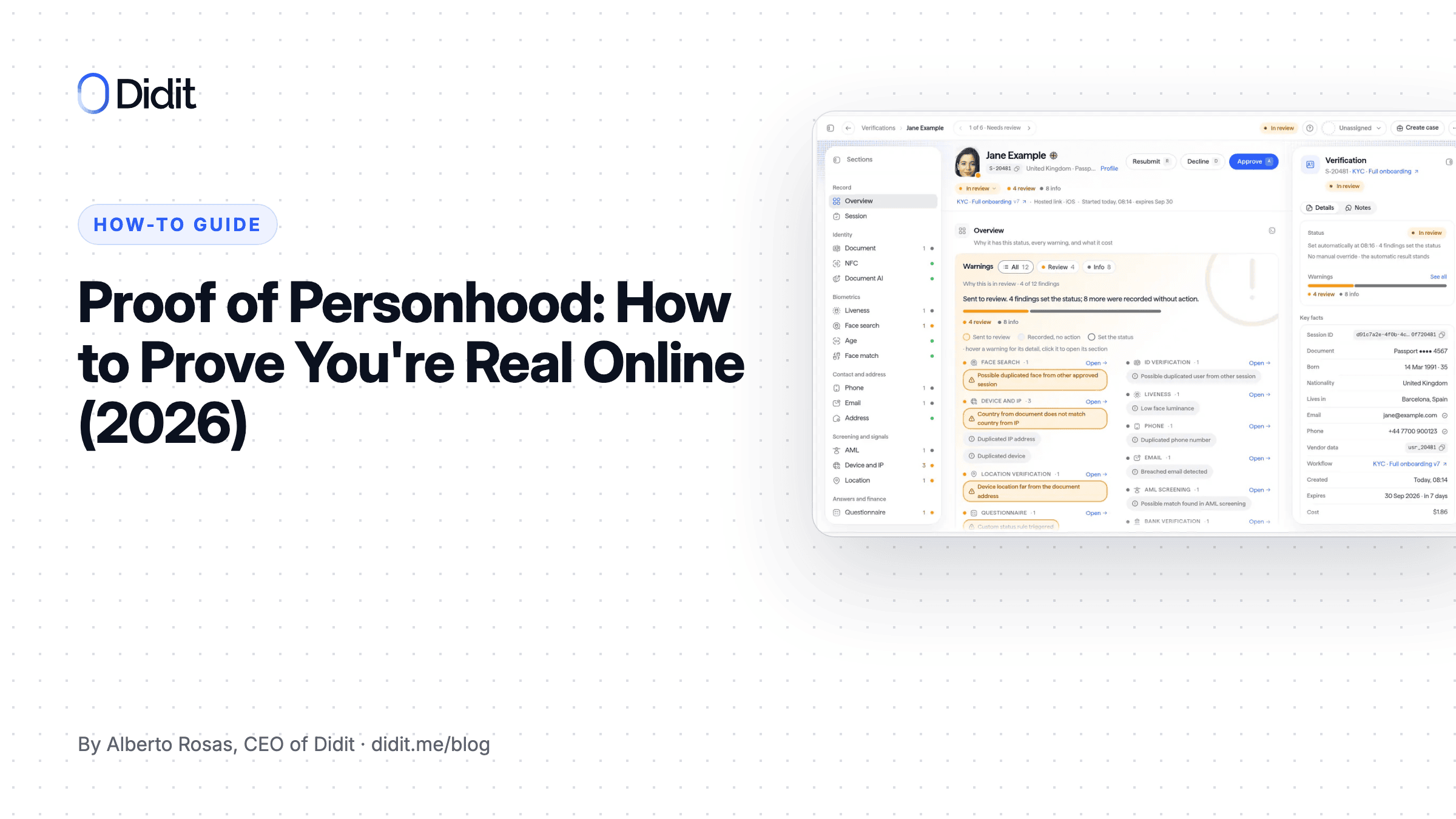
Proof of personhood confirms a live human is behind an account. On Didit you run ID verification, passive liveness and 1:1 face match in one workflow for $0.33 per completed check, tested free in the sandbox.
Alberto RosasFeb 14, 2026Phone and Email Verification: Your First Check for Digital Trust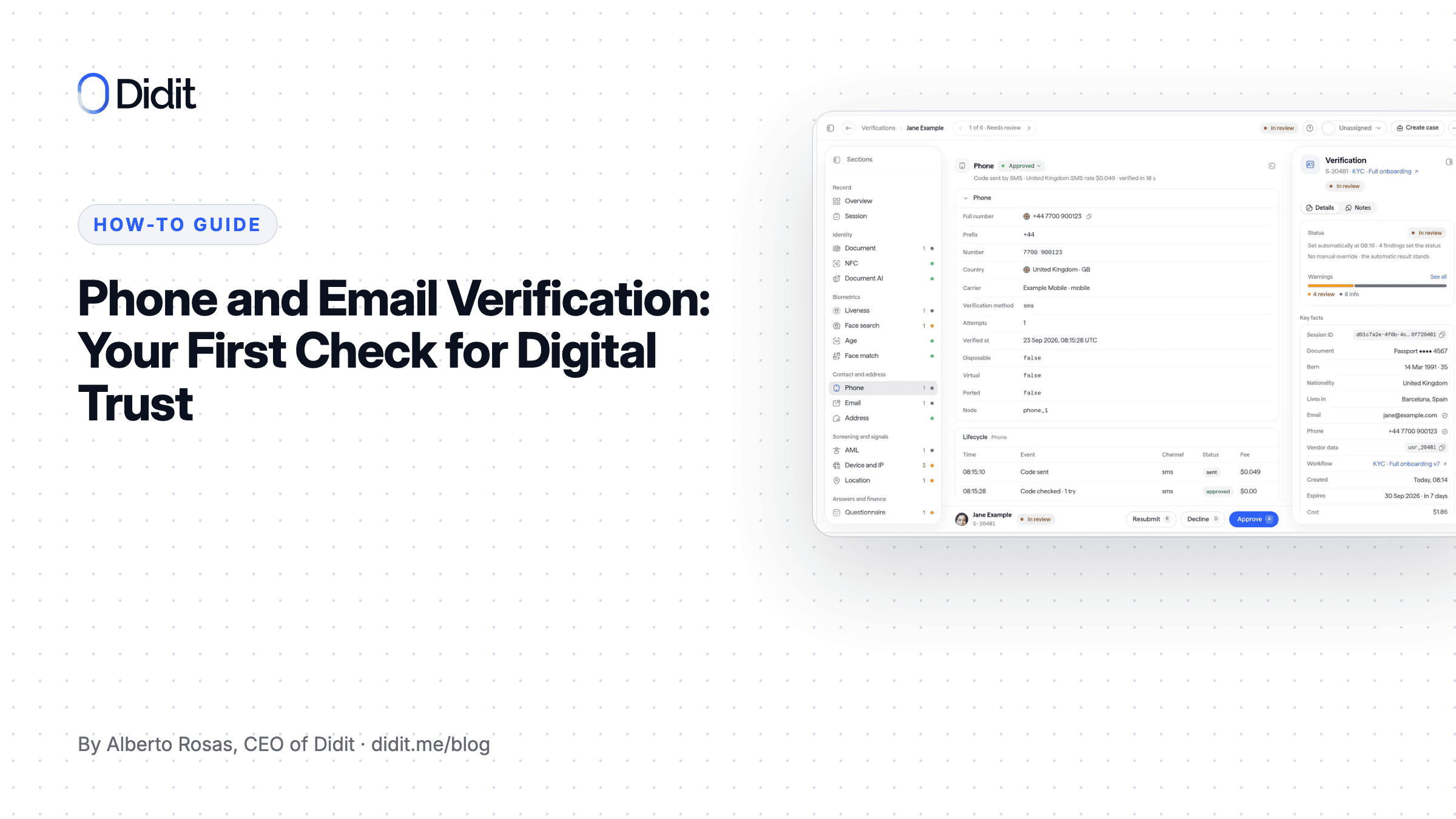
Verify phones and emails with two-step OTP: POST /v3/phone/send/ then /v3/phone/check/, and the same pair for email. Phone is carrier price plus $0.02 per code, email is $0.02 per check.
Alberto RosasFeb 14, 2026White-Label Identity Verification: Customize Your KYC Flow (2026)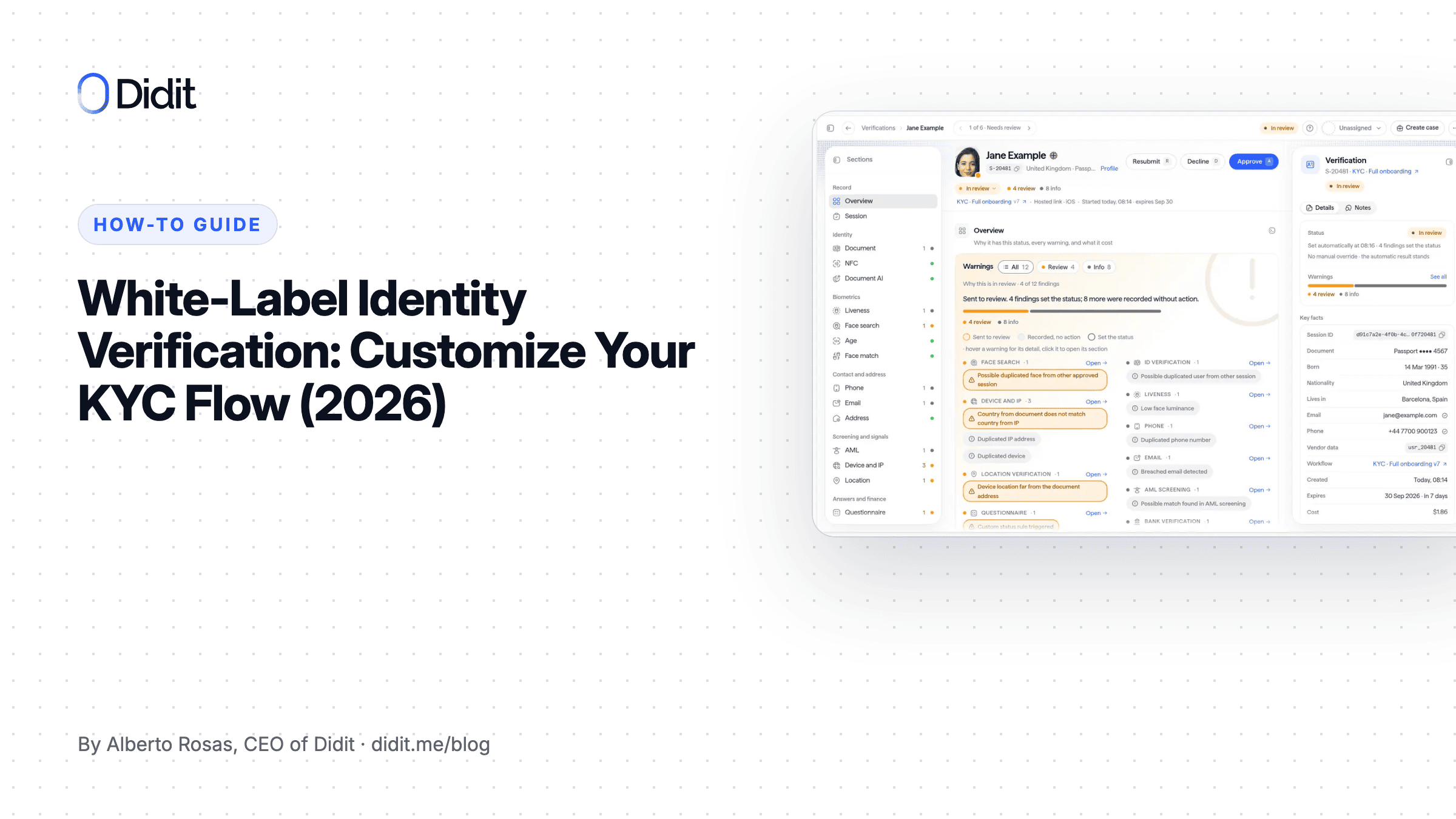
White-label KYC puts your brand on every verification screen: colors, logos, text, and your own domain on Scale or Enterprise. On Didit the white-label charge is $0.10 per completed check at list, separate from the identity.
Alberto RosasFeb 14, 2026No-Code KYC Workflows: Custom Verification Without Developers
Unlock the power of no-code KYC workflows to build custom verification processes without writing a single line of code. Design tailored onboarding experiences, automate compliance, and reduce fraud with intuitive visual tools.
Alberto RosasFeb 14, 2026API Authentication: OAuth, Bearer Tokens, and Best Practices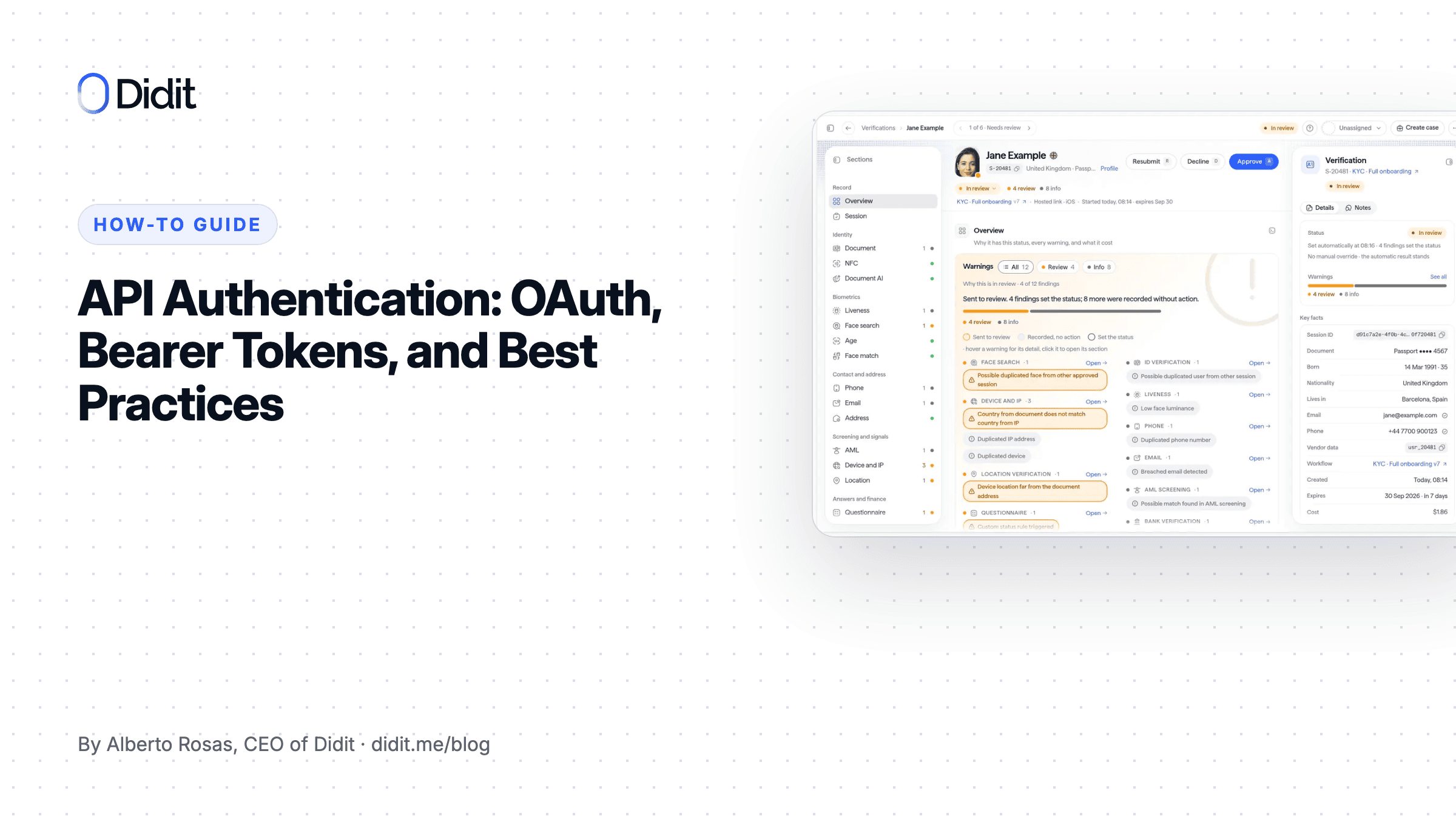
Didit's verification API authenticates with a scoped key in the x-api-key header, not OAuth. The account host apx.didit.me uses a JWT Bearer token, OAuth 2.1 is used by the hosted MCP server, and Didit Authentication issues.
Alejandro RosasFeb 14, 2026How to Add KYC to Your WordPress or WooCommerce Store
Learn how to seamlessly integrate KYC (Know Your Customer) verification into your WordPress or WooCommerce store. This guide covers plugin installation, configuration, and usage, ensuring compliance and security for your online.
Alberto RosasFeb 14, 2026Webhook Integration Guide: Real-Time Identity Verification
Didit sends identity, business, and transaction events to your POST endpoint. Verify X-Signature-V2, return 2xx quickly, and re-fetch decisions when using the deprecated simple signature.
Alejandro RosasFeb 14, 2026Native Identity Verification SDKs for iOS, Android, Flutter, RN
Didit ships native KYC SDKs for iOS, Android, React Native and Flutter, all at 4.15.4. Your backend creates the session, the SDK runs capture, a webhook returns the decision. Full KYC is $0.33.
Alejandro RosasFeb 14, 2026Integrate Identity Verification with the Didit JavaScript SDK
Learn how to seamlessly integrate identity verification into your web application using the Didit JavaScript SDK. This guide covers installation, setup, and implementation with code examples, ensuring a smooth and secure user.
Alejandro RosasFeb 14, 2026IP Analysis and Device Intelligence: Fortifying Fraud Prevention
IP analysis and device intelligence are critical for modern fraud prevention. By analyzing IP addresses and device characteristics, businesses can detect suspicious behavior, prevent fraudulent transactions, and enhance security.
Alejandro RosasFeb 14, 2026How Blocklists Prevent Repeat Fraud: Managing Blocked Users
Blocklists are crucial for fraud prevention, allowing businesses to prevent repeat offenders from creating new accounts or causing further harm.
Alberto RosasFeb 14, 2026Privacy-Preserving Age Verification Without Collecting ID Documents
Estimate age from one selfie for $0.10 per check, with passive liveness included. Turn off storage in the standalone API. Use document verification when an estimate is insufficient.
Alberto RosasFeb 14, 2026Data Retention in Identity Verification: GDPR Rules for 2026
GDPR limits how long you can keep identity data. AML law may require specific records for longer. Set a Didit session window and handle retained face templates separately when processing erasure requests.
Alberto RosasFeb 14, 2026KYC Compliance for Fintech Companies: A 2026 How-To Guide
Build fintech KYC compliance with identification, AML screening and ongoing monitoring. Didit full KYC is $0.33 per check; your policies and review decisions stay yours.
Alberto RosasFeb 14, 2026Manual Review in KYC: Human-in-the-Loop Verification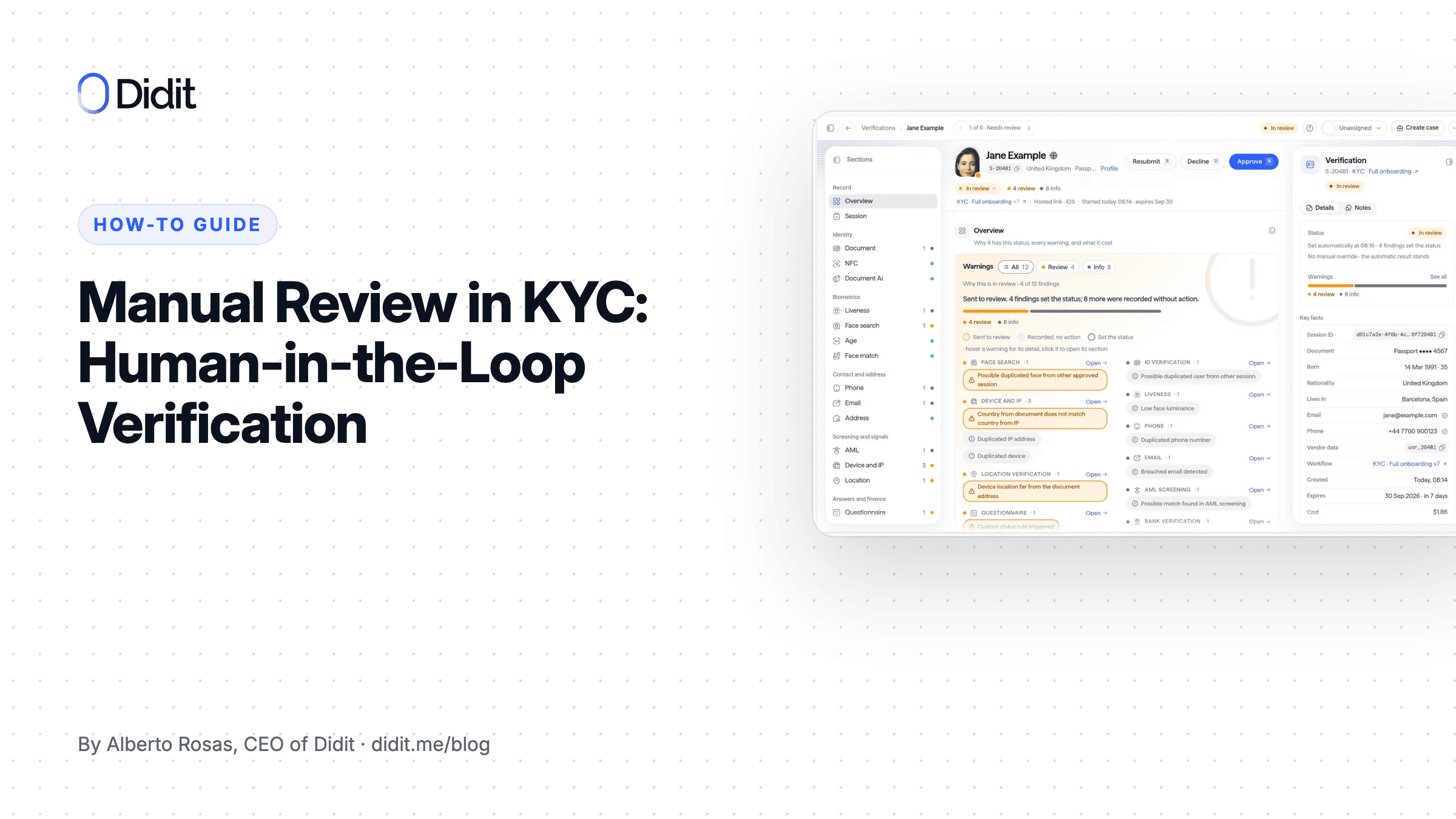
Manual review handles what automated checks cannot settle: a reviewer works the In Review queue, then approves, declines or requests a resubmission in the console or through the update-status API.
Alberto RosasFeb 14, 2026Automated Proof of Address Verification for KYC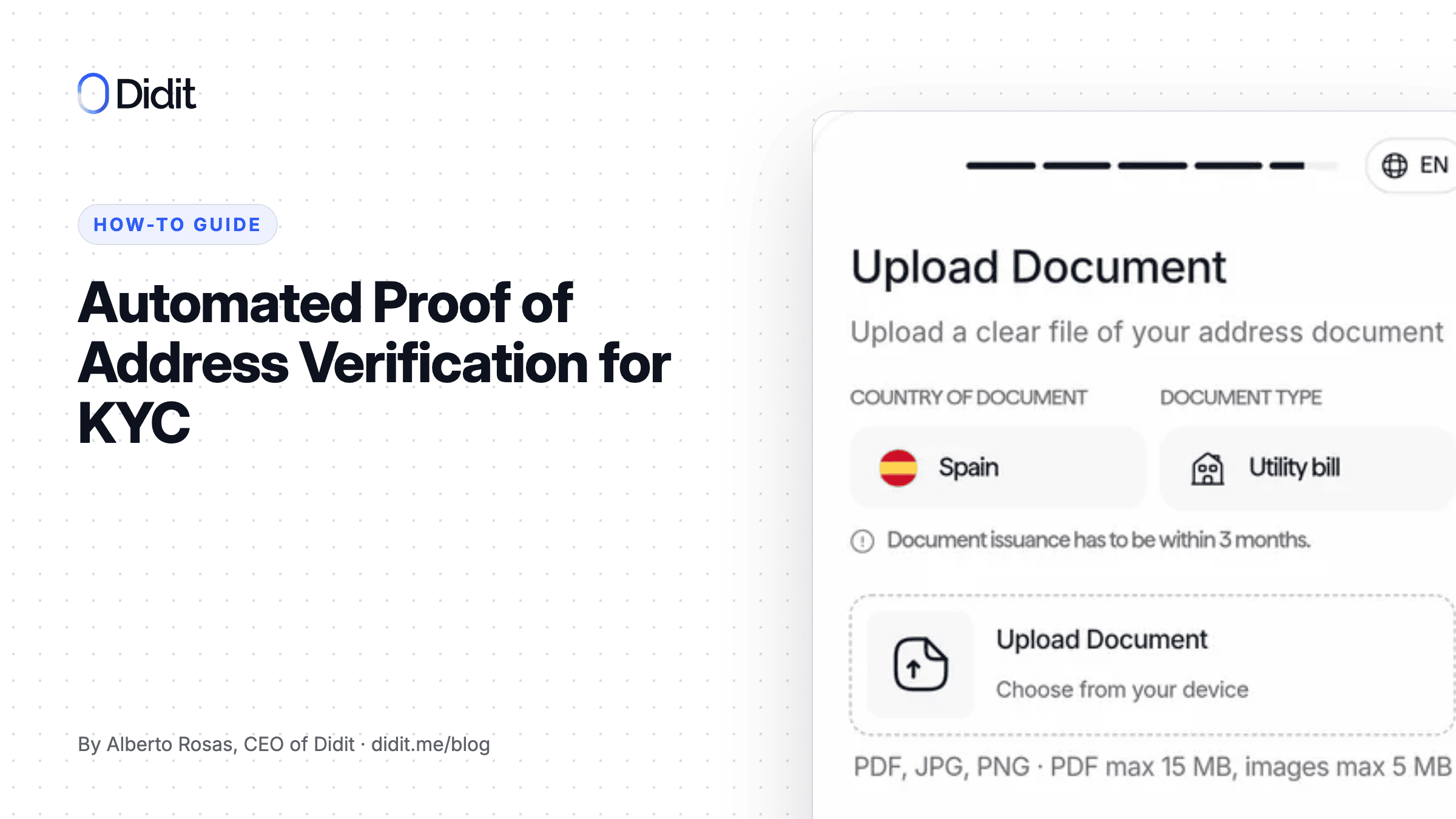
We verify a proof of address from a utility bill, bank statement or lease for $0.20 per check through POST /v3/poa/, returning Approved or Declined plus warnings that explain every issue found.
Alberto RosasFeb 14, 2026AML Continuous Monitoring: Why One-Time Checks Are Not Enough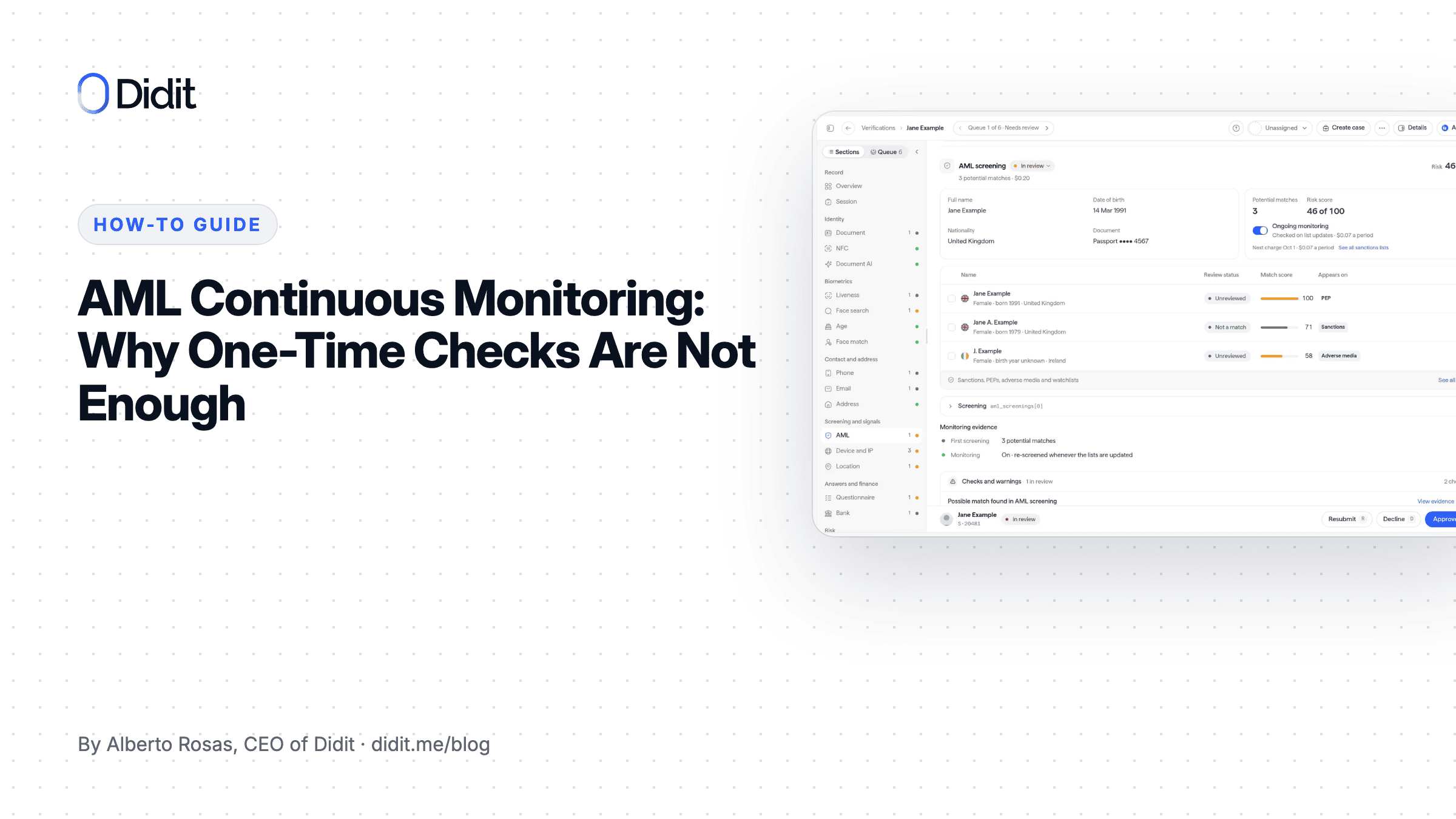
AML continuous monitoring re-screens approved customers against 1,300+ watchlists on a daily provider-driven cadence. AML screening costs $0.20 per check and ongoing monitoring $0.07 per person a year.
Alberto RosasFeb 14, 2026AML Screening Explained: Watchlists, Sanctions and PEPs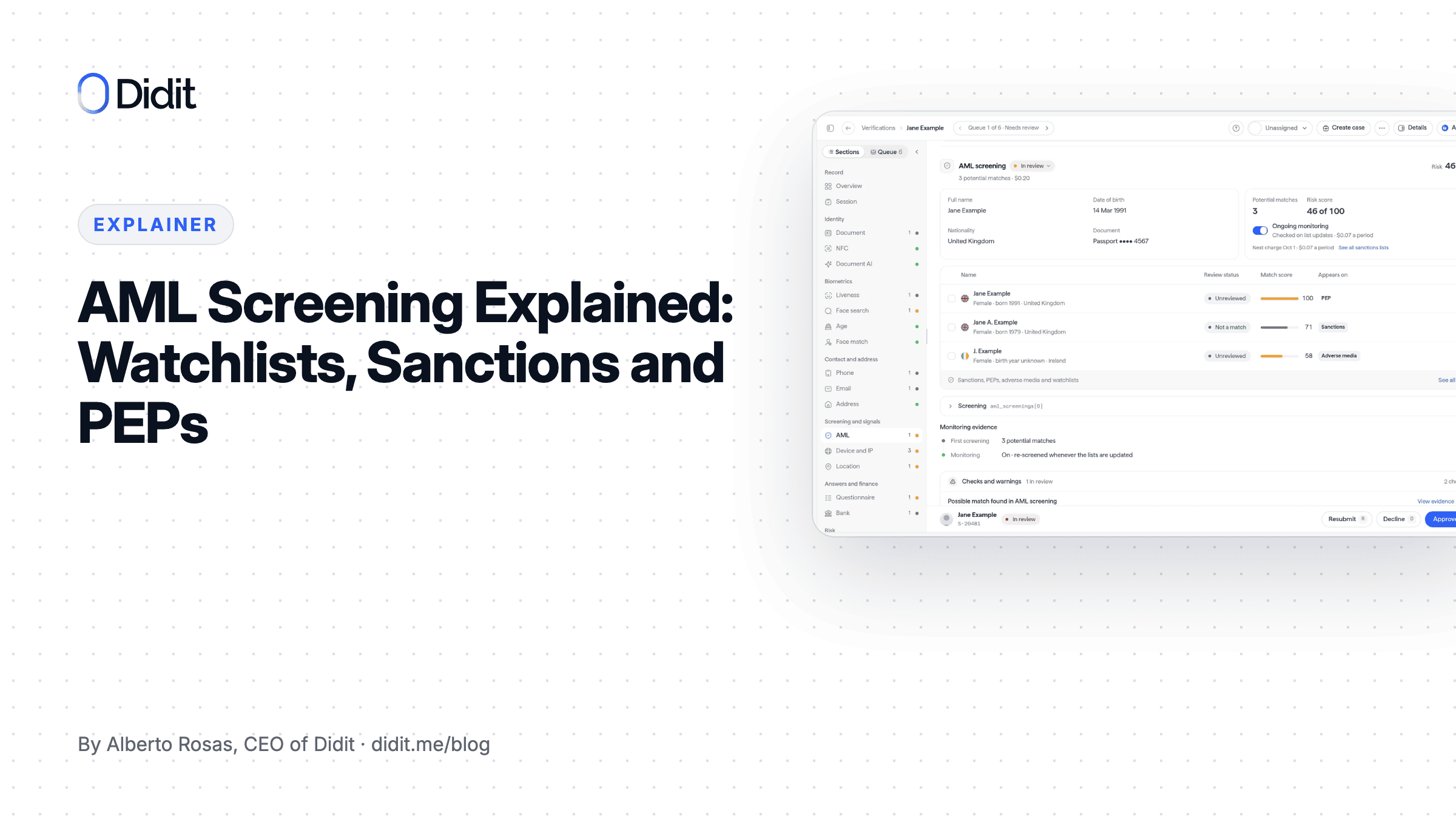
AML screening checks people and companies against watchlists and returns a match score and a risk score for each hit. We screen people against 1,300+ sanctions, PEP and watchlist sources at a list price of $0.20 per check.
Alberto RosasFeb 14, 2026Adaptive Age Verification: Passive Estimation & Document Fallback
How adaptive age verification works: a selfie estimate first, then a document only for borderline ages.
Alberto RosasFeb 14, 2026NFC Document Verification: Read an ePassport or eID Chip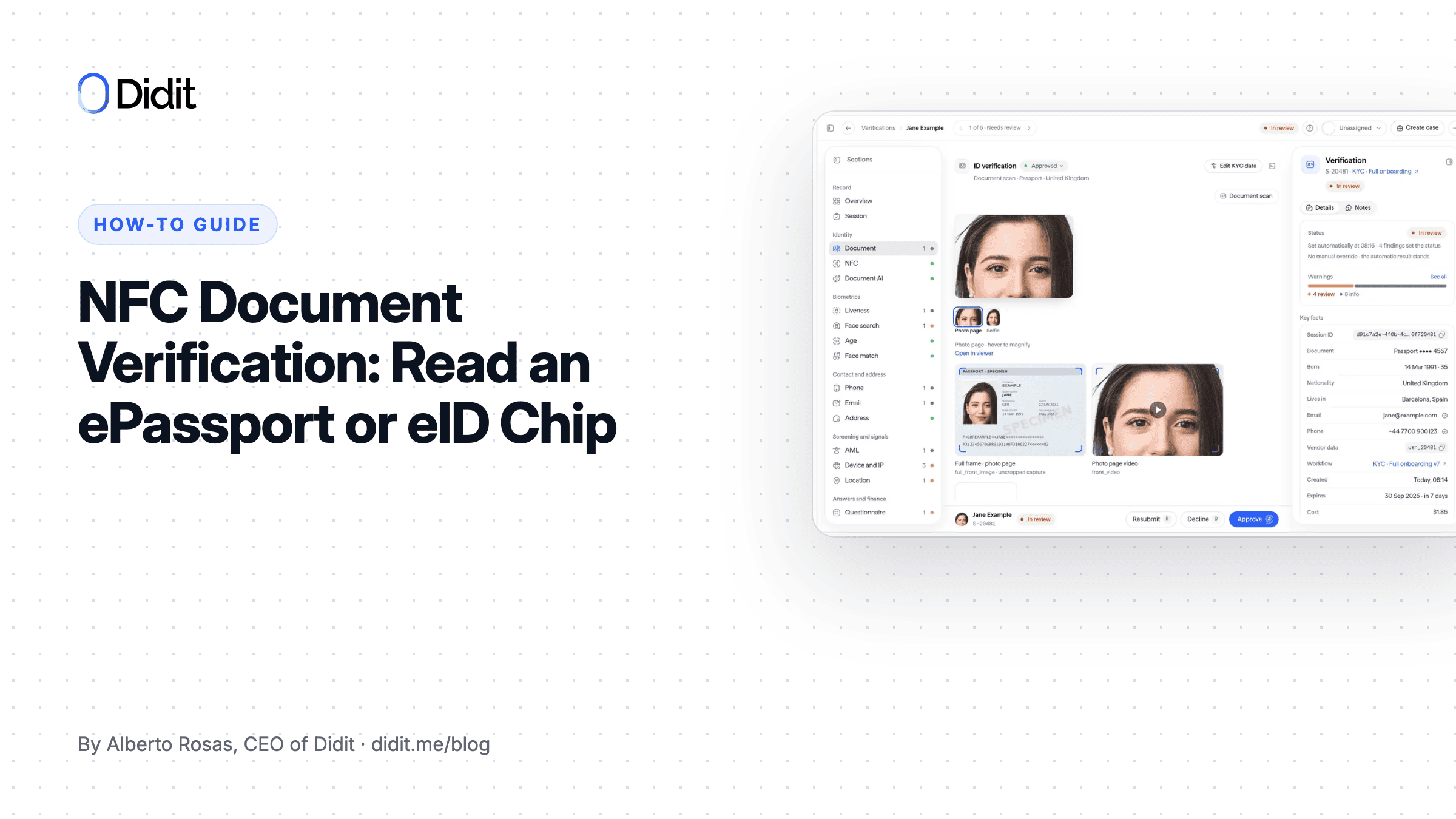
NFC document verification reads the signed chip in an ePassport or eID through the Didit iOS or Android SDK inside a session. NFC reading is a $0.15 add-on to the $0.15 ID document check; the full KYC bundle is $0.33.
Alejandro RosasFeb 14, 2026Face Match vs. Face Search: 1:1 and 1:N Verification (2026)
Face match (1:1) compares a selfie to one reference face. Face search (1:N) compares it to your own enrolled face index. Didit charges $0.05 per match and $0.05 per search. Jumio does not publish pricing.
Alberto RosasFeb 14, 2026Database Validation: Verifying Identities Against Official Records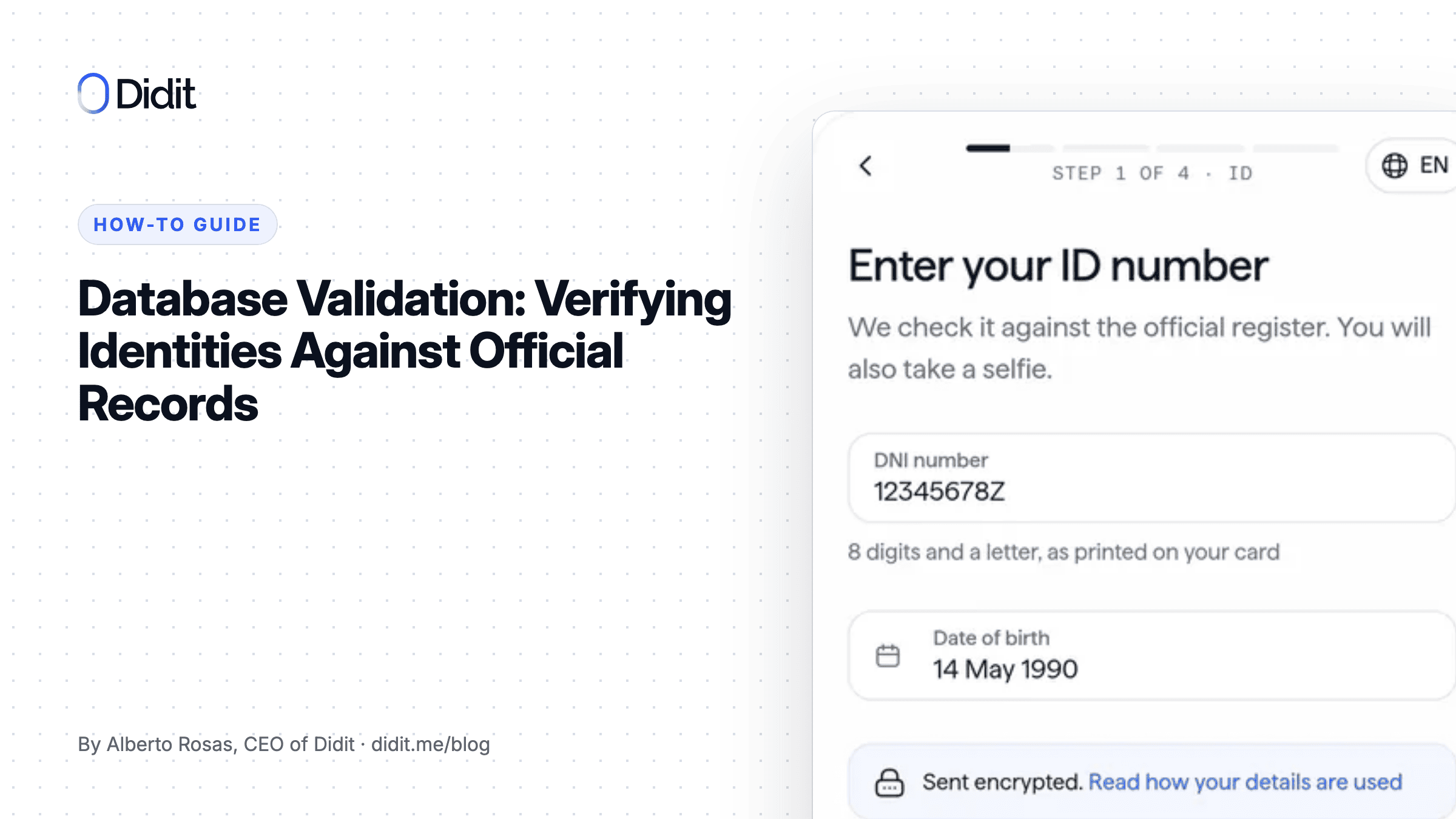
Database validation checks a name, date of birth and national ID number against the authoritative record for a country. On Didit it is a pay-per-call check from $0.05 to $7.00, billed per successful service hit.
Alberto RosasFeb 14, 2026Document Geolocation: Match a Document Address to a Device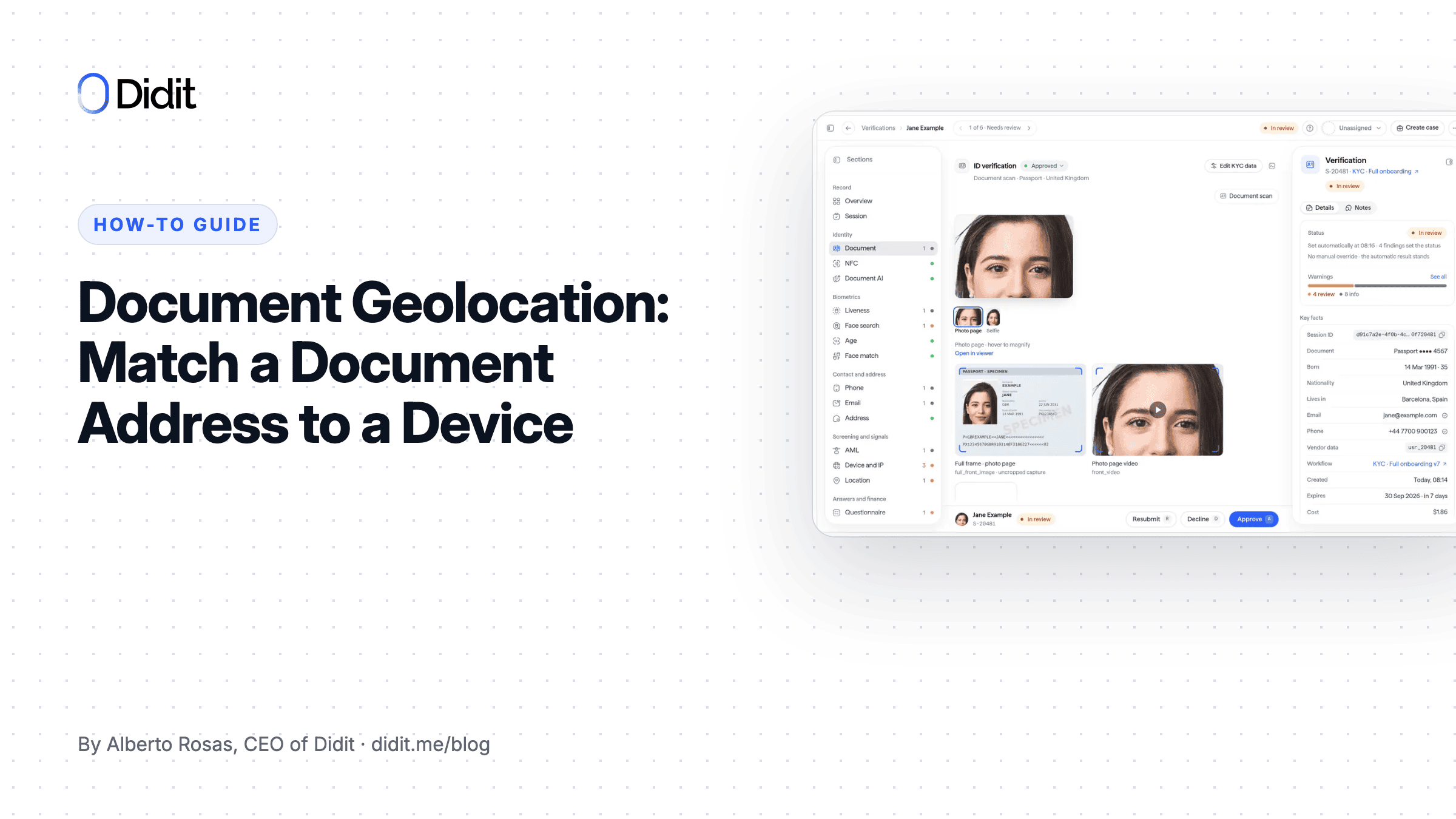
Didit's Location verification step compares a document address with the device position and IP location, geofences the session, and flags spoofing, VPN or proxy signals. $0.05 per check.
Alejandro RosasFeb 14, 2026Passive Liveness Detection in 9 Steps: Stop Deepfakes (2026)
Passive liveness detects deepfakes, printed photos and screen replays from one selfie. We charge $0.10 per Passive Liveness check, in a session or on the standalone API, with a free sandbox.
Alejandro RosasFeb 14, 2026Document Forgery Detection: How AI Catches Fake IDs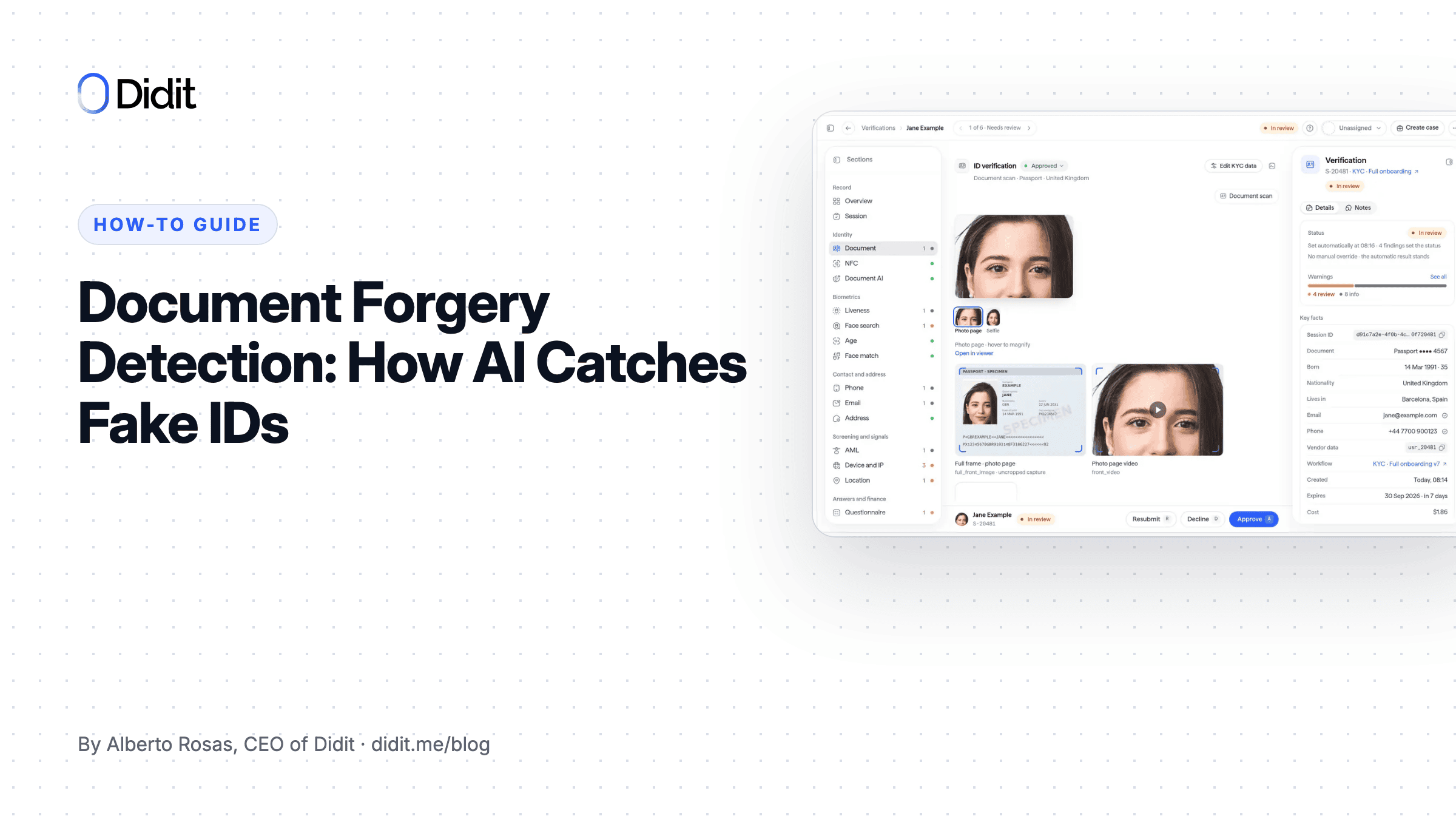
AI catches forged IDs by cross-checking OCR, MRZ and barcode data, running document liveness for screen replays and printed copies, and reading the NFC chip.
Alberto RosasFeb 14, 2026AI-Powered ID Document Verification: OCR, MRZ, and Beyond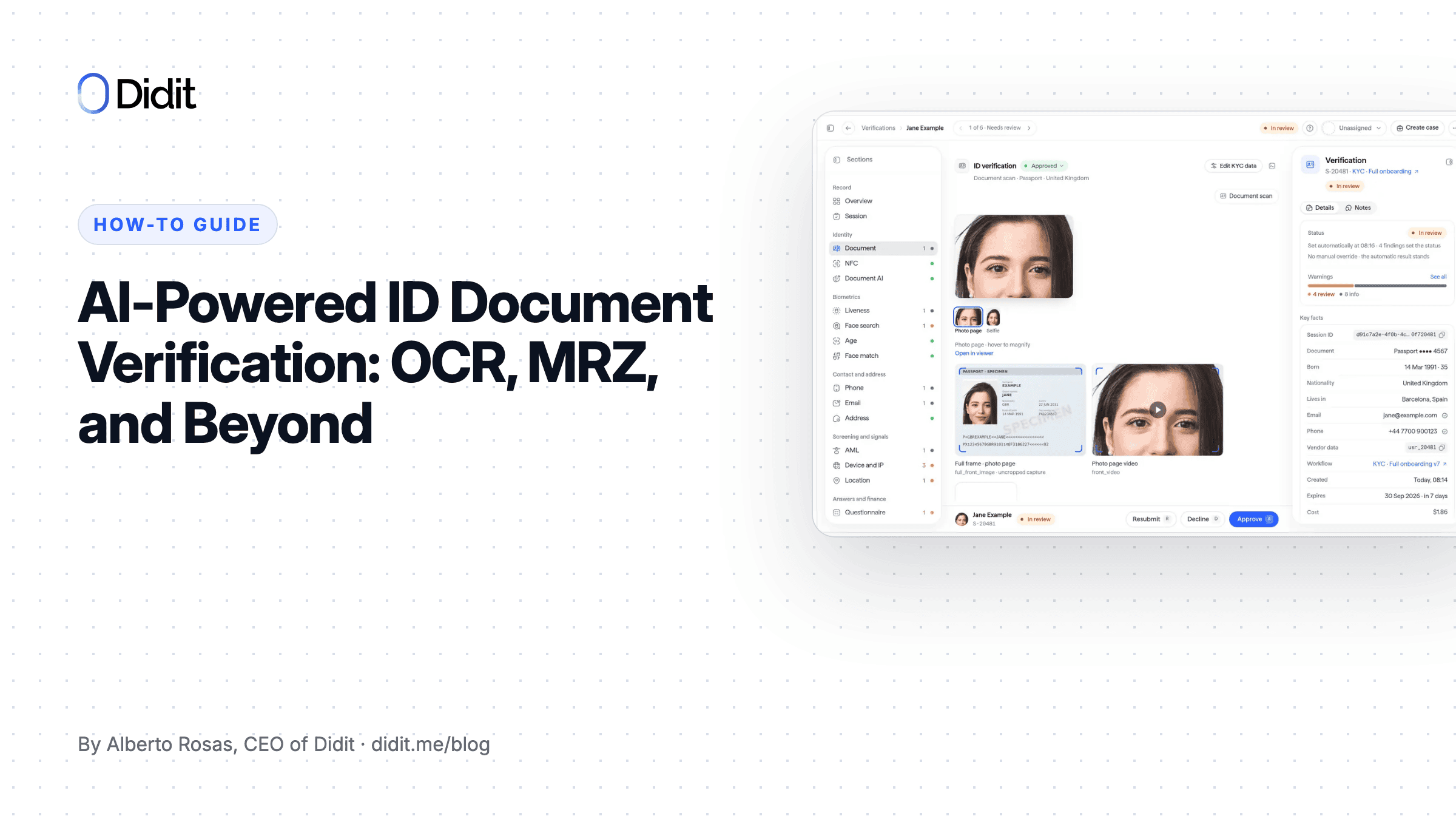
Didit reads 14,000+ document types with AI OCR, parses the MRZ and checks authenticity for $0.15 per check in a workflow or $0.20 per HTTP 200 response from the standalone API. Read status and warnings, not just the HTTP code.
Alberto RosasFeb 14, 2026iBeta Certification for Identity Verification: How to Check It (2026)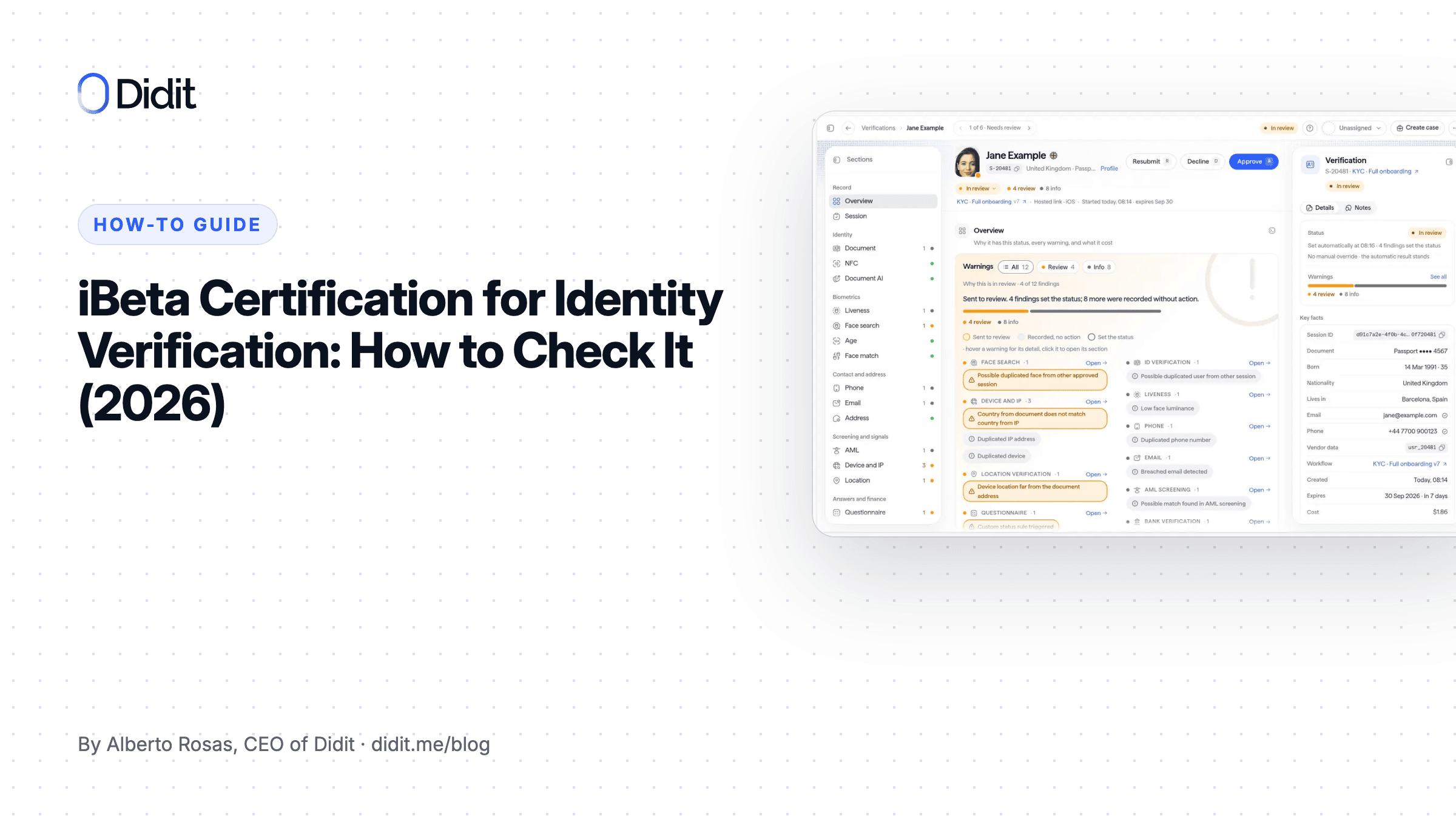
iBeta certification is independent presentation attack detection testing against ISO/IEC 30107-3. Didit holds Level 1 and Level 2. Here is what it covers and how to test it yourself.
Alberto RosasFeb 5, 2026The Future of Digital Identity: Trends and Predictions for 2024
Digital identity is rapidly evolving. In 2024, expect greater emphasis on user privacy, AI-powered verification, decentralized identity solutions, and seamless user experiences.
Alberto RosasJan 30, 2026How Document Tampering Detection Works: Step-by-Step (2026)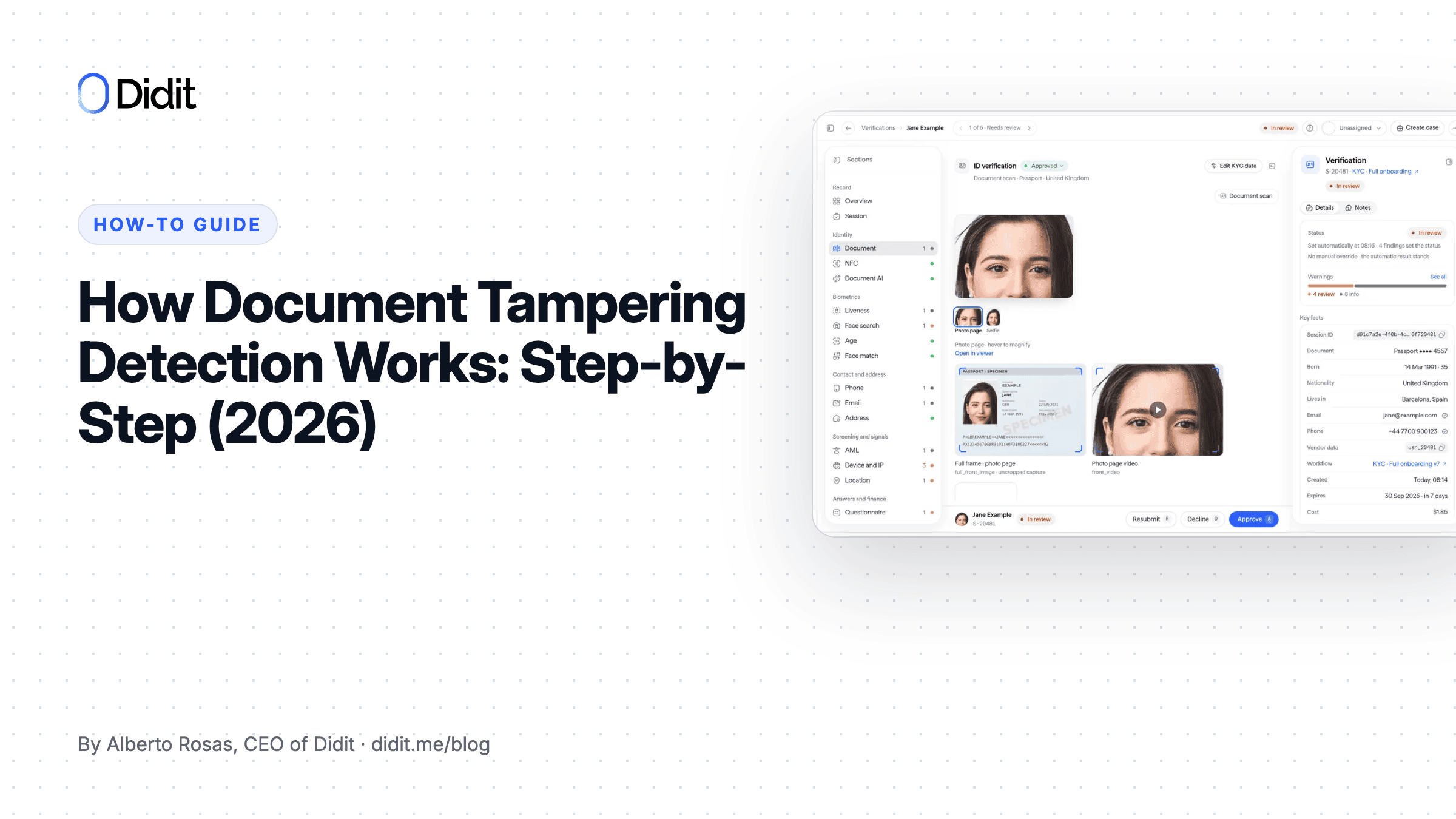
Check government IDs for forgery with ID Verification ($0.15 per workflow check or $0.20 per API call). Check statements and payslips for suspected manipulation with Document AI ($0.20 per document).
Alberto RosasJan 30, 2026The Future of Digital Identity: Trends and Predictions for 2025
Explore the future of digital identity, key trends shaping its evolution, and predictions for 2025. Learn about decentralized identity, biometric authentication, AI's role, and the increasing importance of privacy.
Alberto RosasJan 30, 2026KYC for CBDCs: A New Frontier in Digital Currency
Central Bank Digital Currencies (CBDCs) are poised to revolutionize finance, but their success hinges on robust KYC. This blog explores the challenges and opportunities of implementing KYC in the CBDC ecosystem, highlighting the.
Alberto RosasJan 30, 2026Identity Verification for Car Rental Companies: A Practical How-To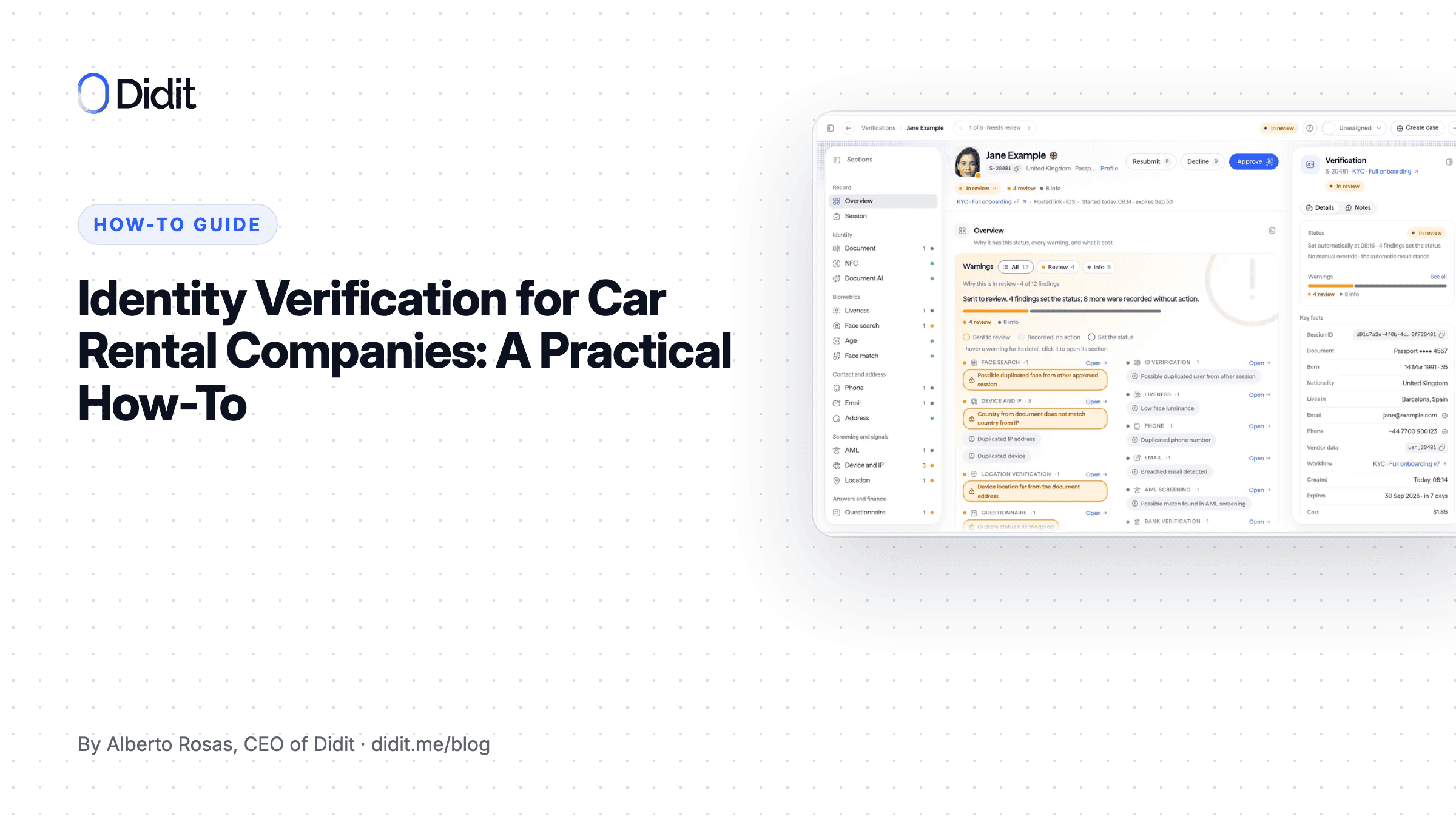
Car rental companies verify renters with a full Didit check at booking: ID document, passive liveness, face match, device and IP, at $0.33 per completed check, with a decision before the keys change hands.
Alberto RosasJan 30, 2026Age Verification Systems: Protecting Minors Online
Age verification systems are crucial for protecting minors from harmful online content and ensuring compliance with regulations. Implementing robust age verification is essential for creating a safer digital environment for.
Alberto RosasJan 30, 2026PSD2's Impact on Identity Verification for Financial Institutions
PSD2 has revolutionized identity verification in finance, mandating Strong Customer Authentication (SCA) and impacting fraud prevention. Financial institutions must adapt with robust solutions.
Alberto RosasJan 29, 2026The ROI of Automated Identity Verification: Justifying the Investment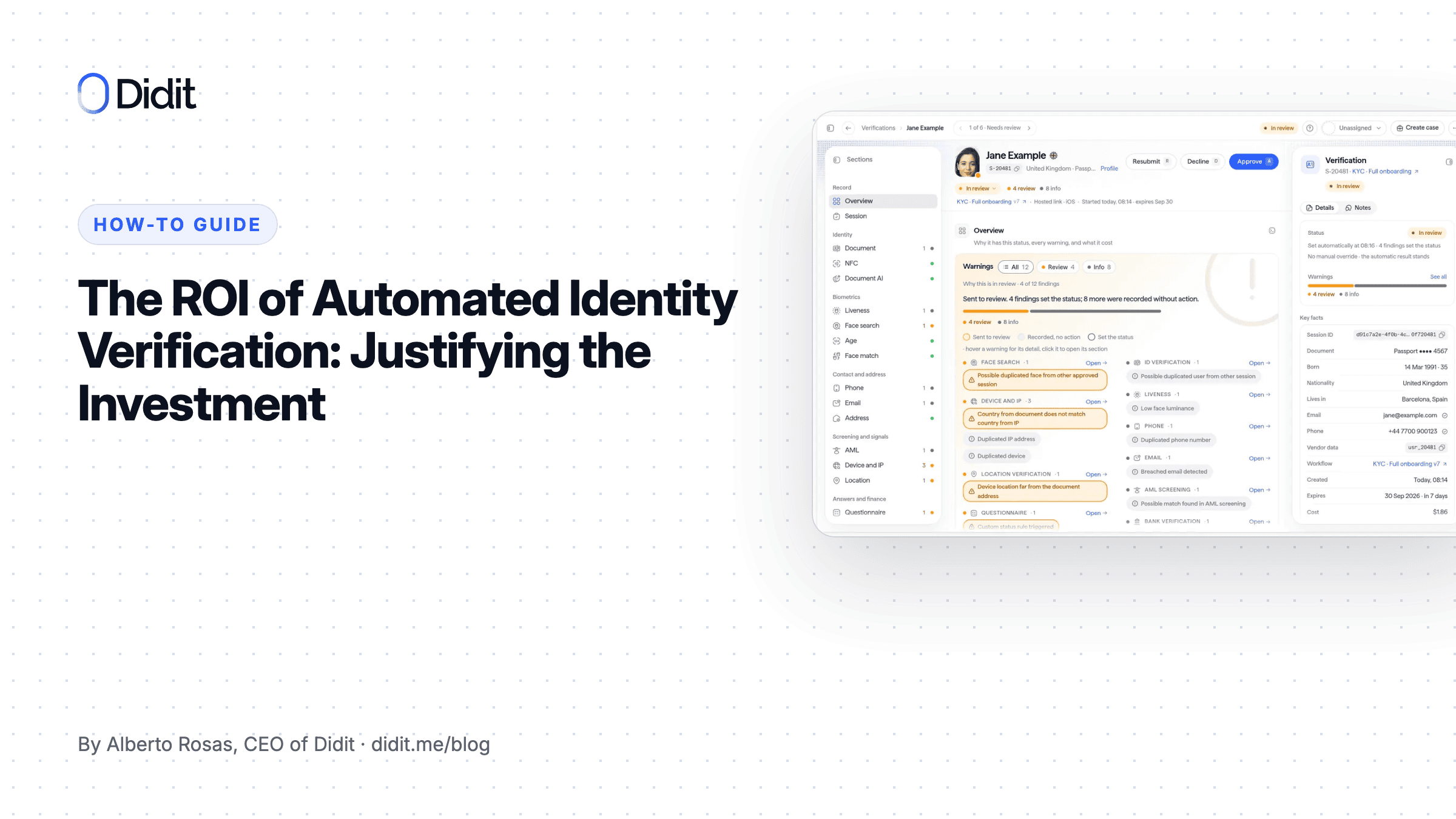
Automated identity verification pays back when you price it from published unit prices, not estimates: a full ID check is $0.33 on Didit, AML adds $0.20, and the sandbox is free.
Alberto RosasJan 29, 2026Unlock Growth: Benefits of Cloud-Based Identity Verification
Cloud-based identity verification offers scalability, security, and cost savings compared to traditional on-premise solutions. By leveraging AI and automation, businesses can streamline KYC/AML compliance, reduce fraud, and.
Alberto RosasJan 29, 2026Startup-Friendly KYC API: Streamline Verification
Navigating KYC can be tough for startups. A startup-friendly KYC API offers easy integration, transparent pricing, and scalable solutions. Look for modularity, free tiers, and developer-first design to ensure compliance without.
Alejandro RosasJan 27, 2026Pay-Per-Use KYC API: Flexible Identity Verification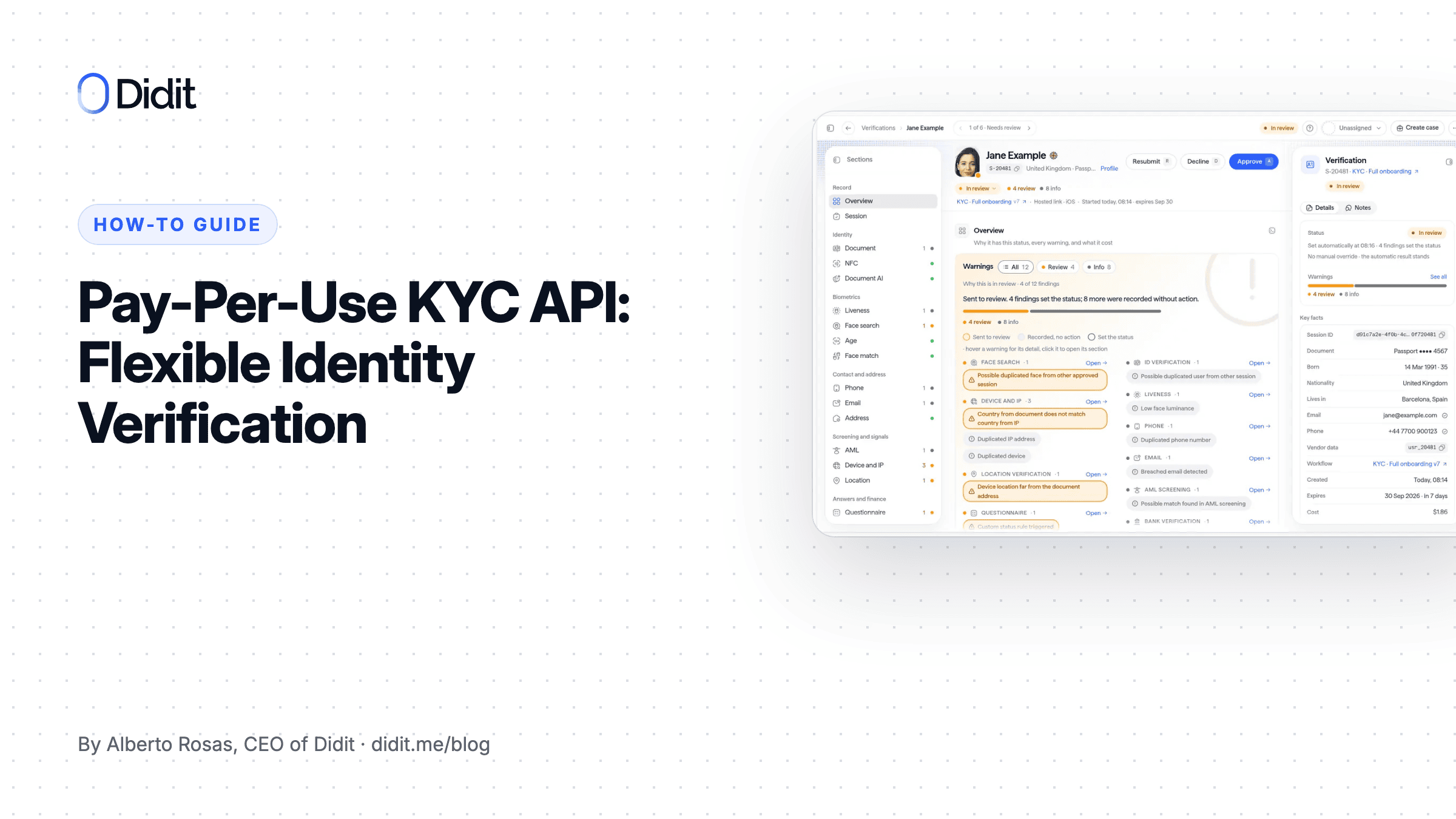
Didit bills per completed check: a full KYC check is $0.33. Create one workflow, start a session per person with POST /v3/session/, then read the decision by webhook or from the decision endpoint.
Alejandro RosasJan 27, 2026Free KYC API in 2026: Build a Low-Cost Verification Flow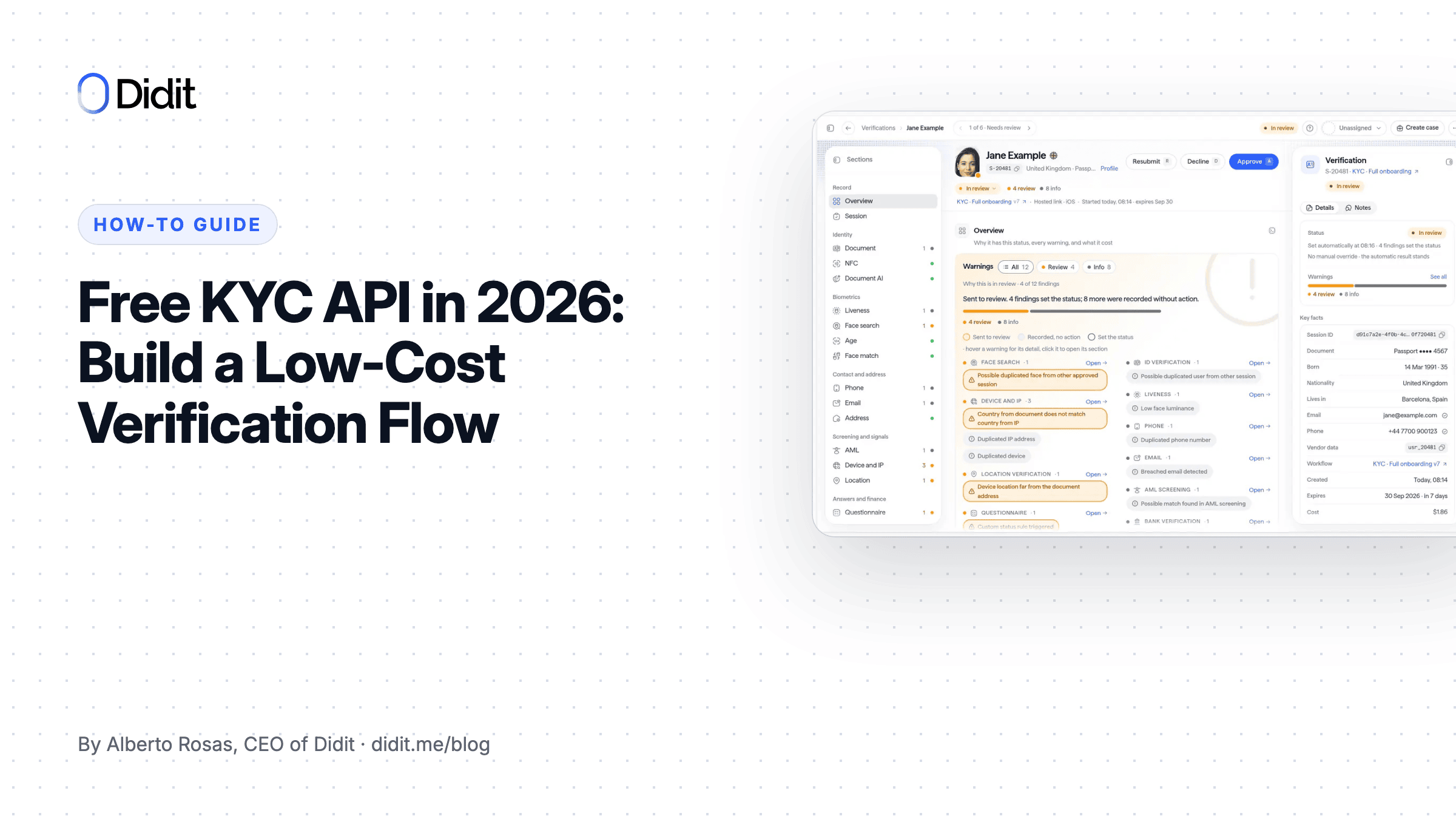
Didit gives you a free sandbox on every plan and $10 of monthly credit to the first eligible console organization with a work email. Live checks are billed per completed check, from $0.33 per full KYC at list price.
Alejandro RosasJan 27, 2026Didit vs Mitek: identity verification compared 2026
Our full KYC check costs $0.33 at list price. Our sandbox is free. Mitek pricing and product details could not be verified (Mitek homepage, read November 26, 2026). A quote is required to compare costs.
Alejandro RosasJan 27, 2026Zero-Retention Identity Verification: 2026 Setup Guide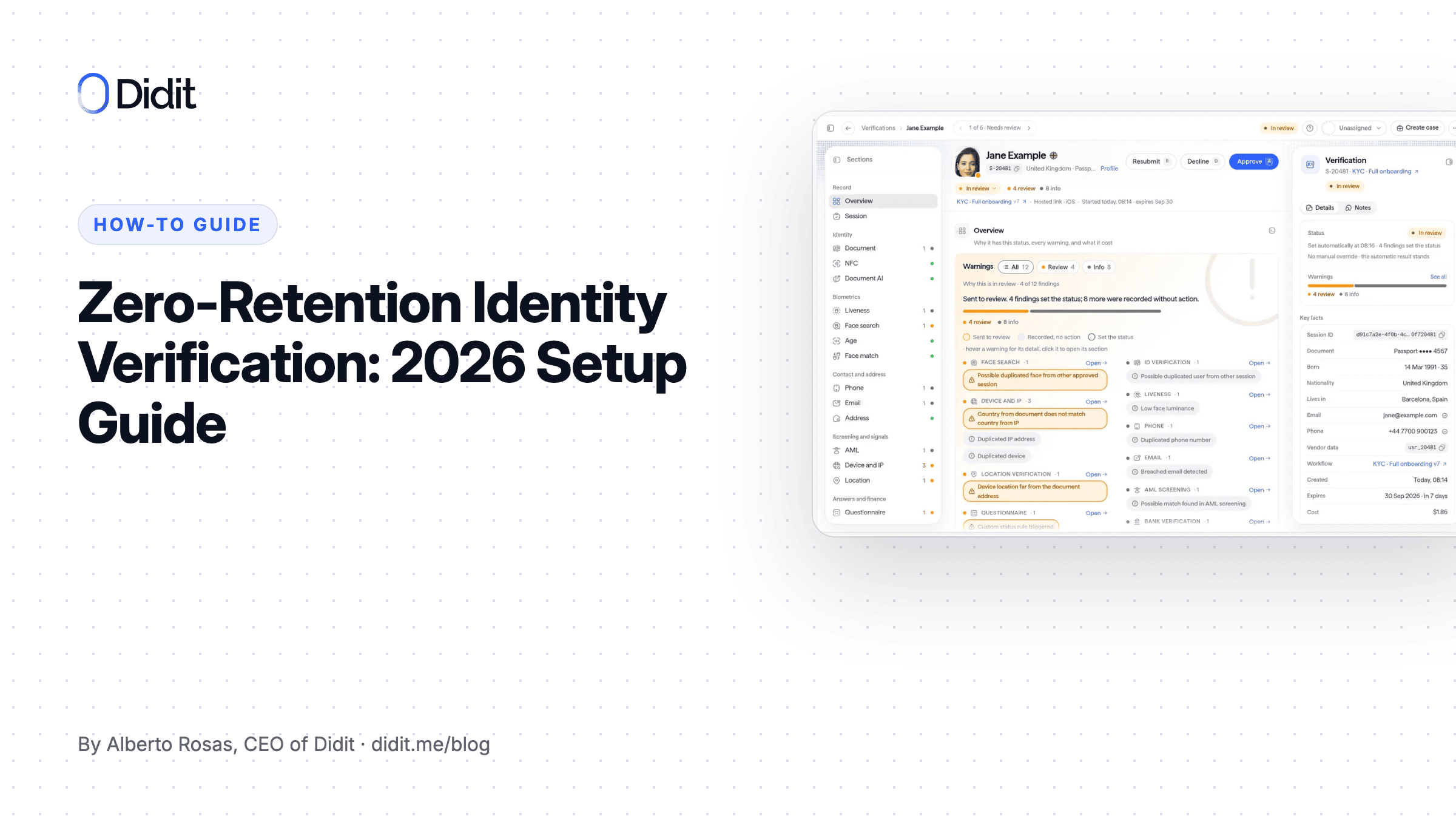
Zero retention on Didit is a configuration you own: keep the shortest one-month window, leave biometric template retention off, and call Delete Session as soon as you have consumed the decision.
Alberto RosasJan 27, 2026Privacy-Preserving Identity Verification: A 2026 How-To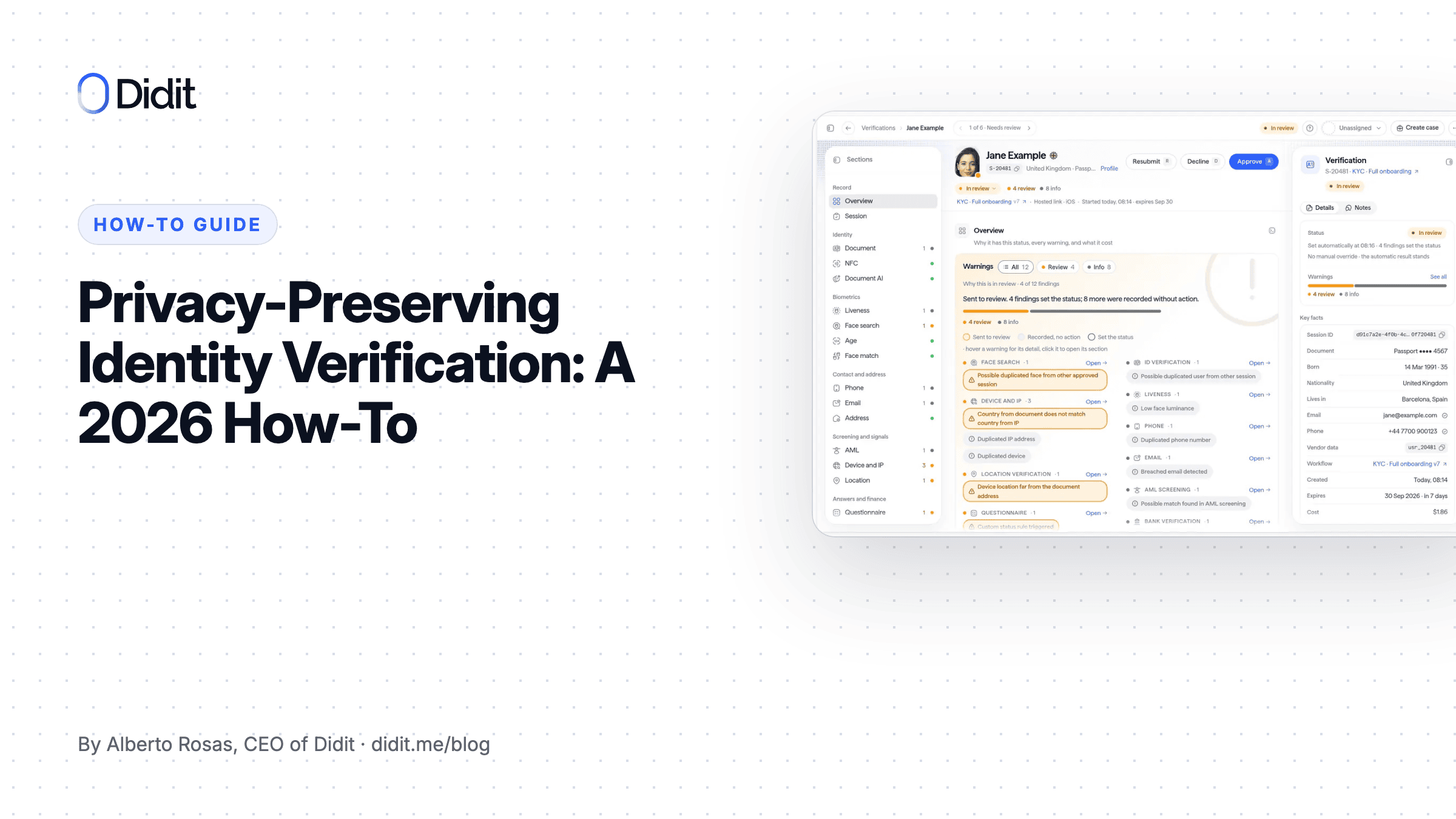
Privacy-preserving verification collects the minimum data a check needs, keeps it for a fixed window, records consent where required, and deletes on request. A full ID check costs $0.33 at list price.
Alberto RosasJan 27, 2026AI-Powered Identity Verification: Build It With One API in 2026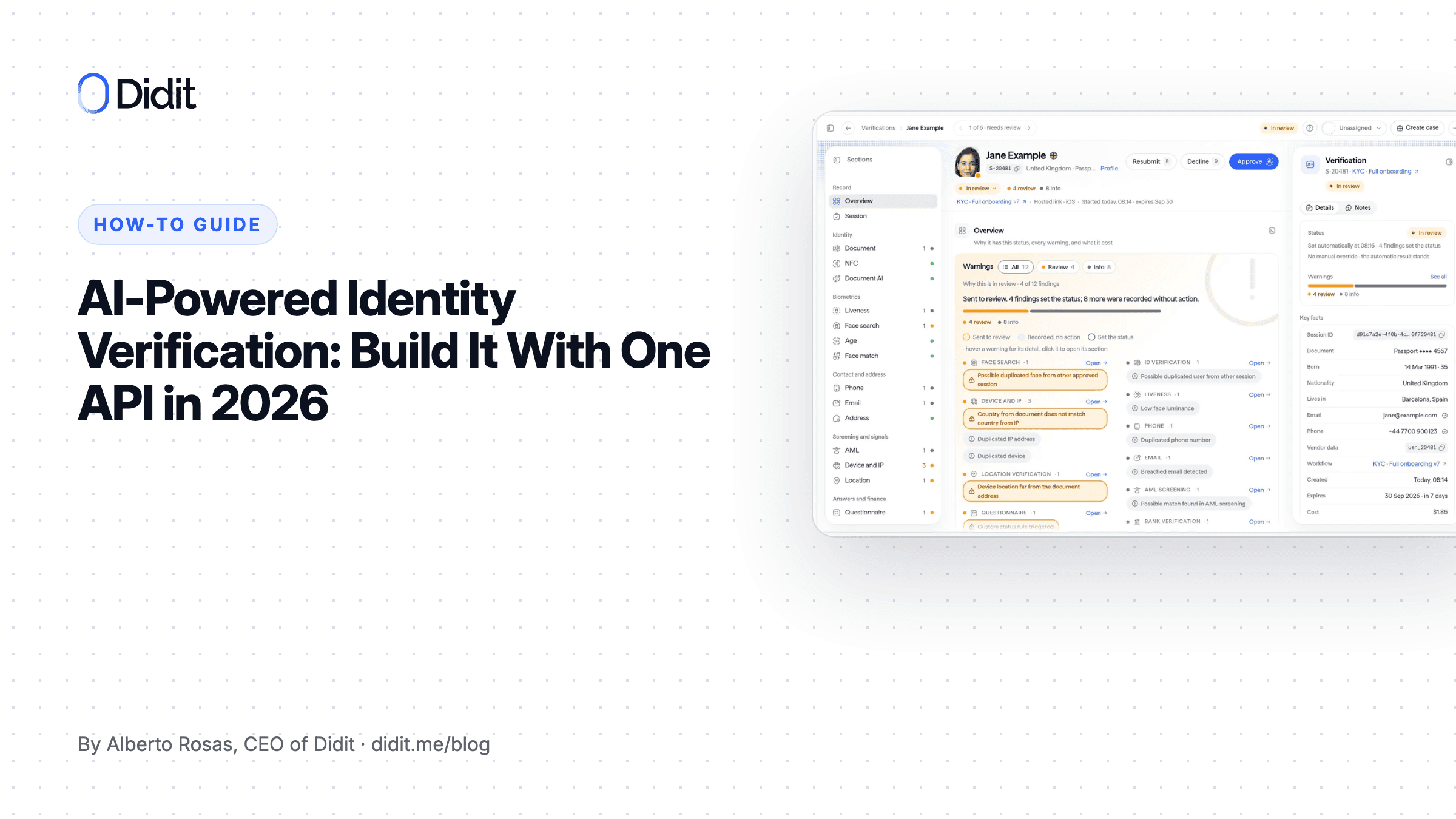
Didit's AI-powered identity verification API is one session call: create a workflow, redirect the user, read the decision by webhook. Full KYC costs $0.33 per completed check and the sandbox is free and unlimited.
Alberto RosasJan 27, 2026Modular Identity Verification: The Future of KYC/AML
Discover how modular identity verification platforms are revolutionizing KYC/AML. Learn about the benefits of flexibility, cost-effectiveness, and enhanced security.
Alberto RosasJan 27, 2026HIPAA-Compliant KYC API: Verifying Identities Securely
Navigating KYC in healthcare requires stringent security. A HIPAA-compliant KYC API is crucial for verifying identities while protecting patient data.
Alejandro RosasJan 27, 2026ISO/IEC 27001 KYC API: Secure Verification Step by Step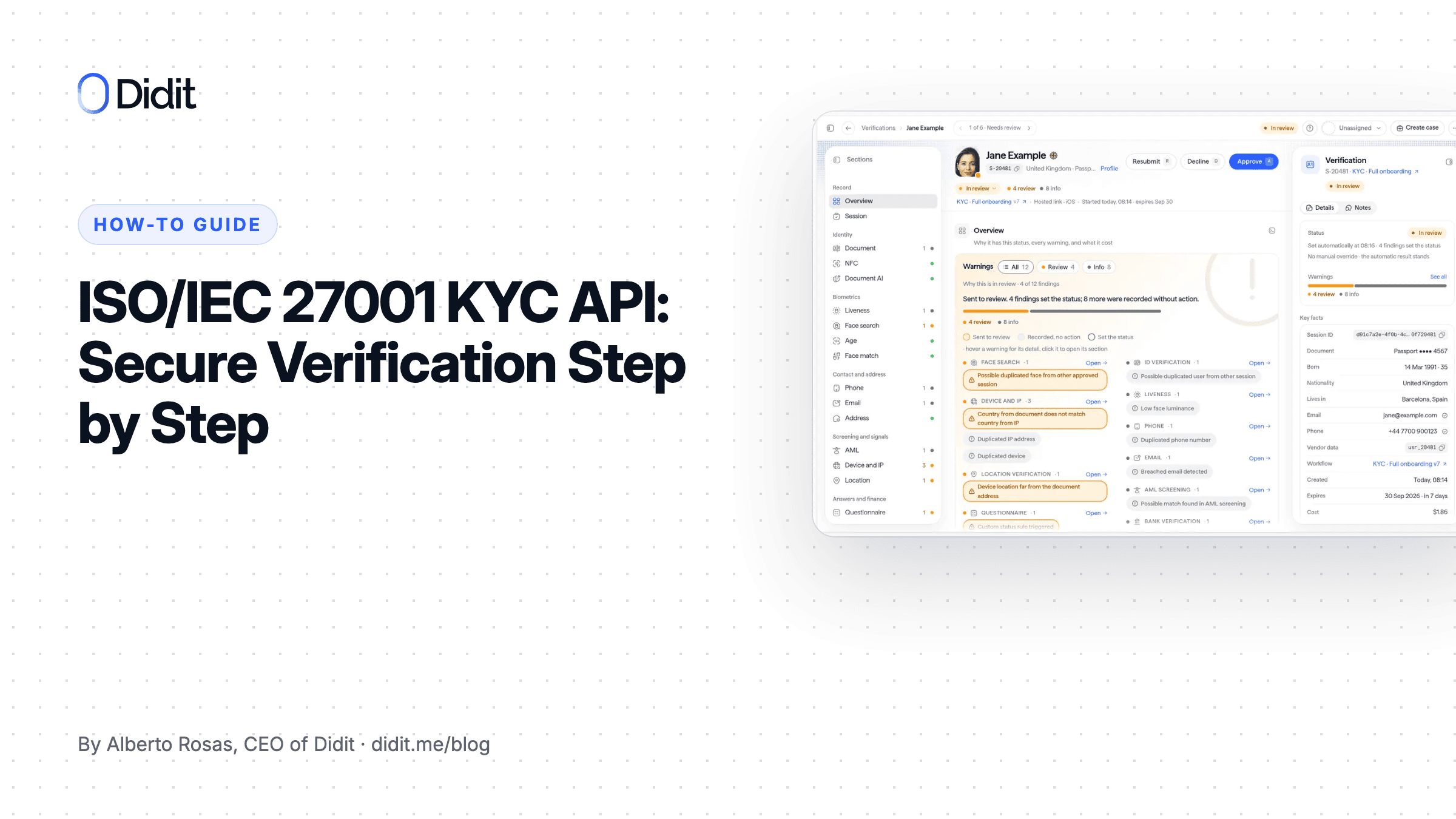
Run KYC under Didit's ISO/IEC 27001:2022-certified ISMS: create a workflow, open a session, verify signed webhooks, store the decision. Full KYC costs $0.33 per completed check.
Alejandro RosasJan 27, 2026GDPR Compliant KYC API: Navigating Data Privacy
Ensure GDPR compliance when integrating a KYC API. Learn about data minimization, consent management, and secure data handling. Discover how Didit's modular, AI-native platform helps you build a compliant and efficient KYC.
Alejandro RosasJan 27, 2026KYC API for React Native: A Developer's Guide
Learn how to integrate a KYC API into your React Native application for seamless identity verification. Discover best practices, security considerations, and how Didit's modular platform simplifies the KYC process with its free.
Alejandro RosasJan 27, 2026KYC API for Flutter: A Developer's Guide
Implementing KYC in your Flutter app can be complex. This guide simplifies the process, focusing on API integration and best practices. Learn how to choose the right KYC API, handle data securely, and ensure a seamless user.
Alberto RosasJan 27, 2026How to Integrate a KYC API Into a Web App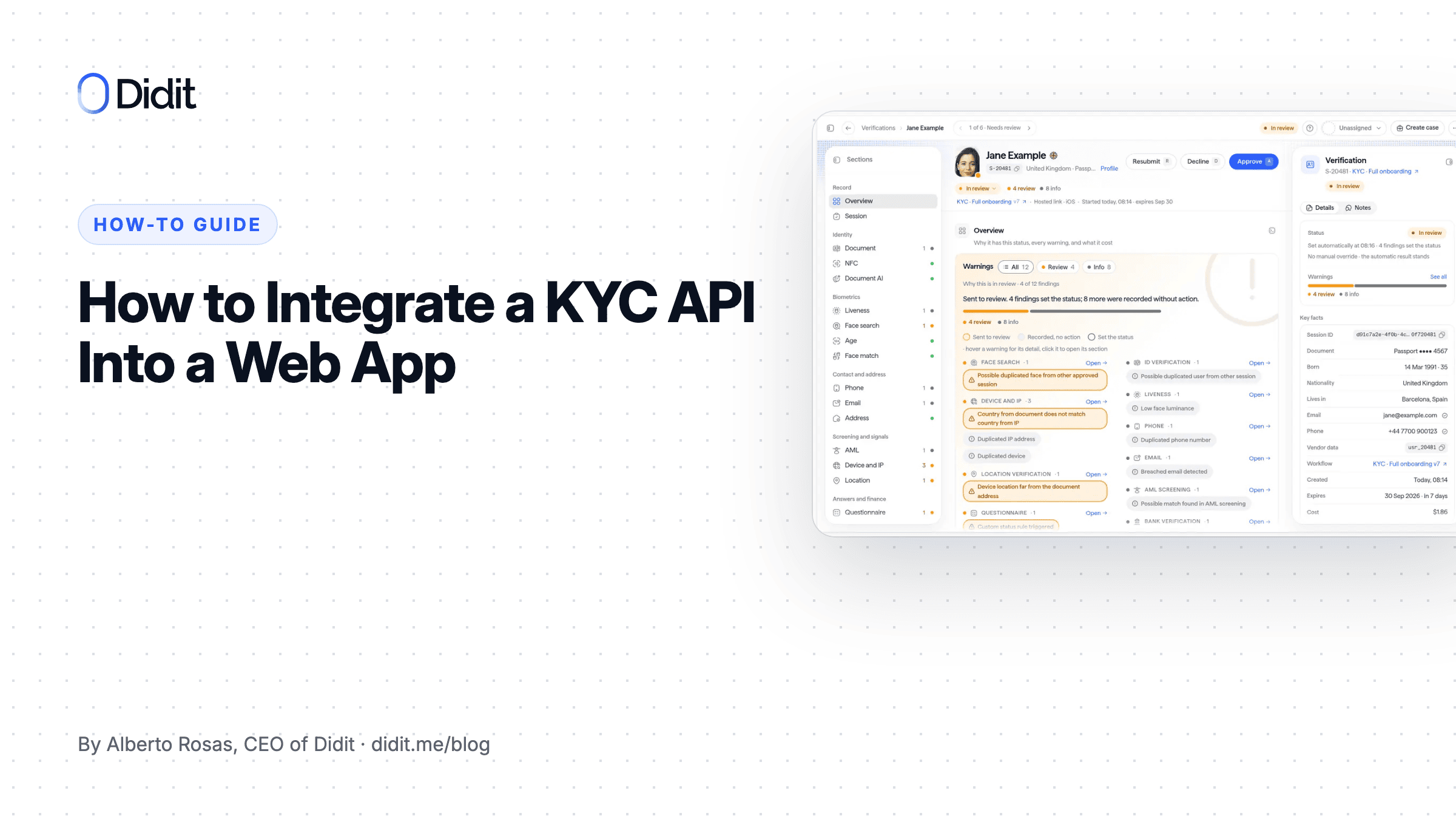
A KYC API turns identity checks into a workflow, one session call and a signed webhook. On Didit a full ID check costs $0.33, the sandbox is free, and your backend creates a session after you configure a workflow and webhook.
Alejandro RosasJan 27, 2026KYC API for Android: 7 Steps to Ship Verification in 2026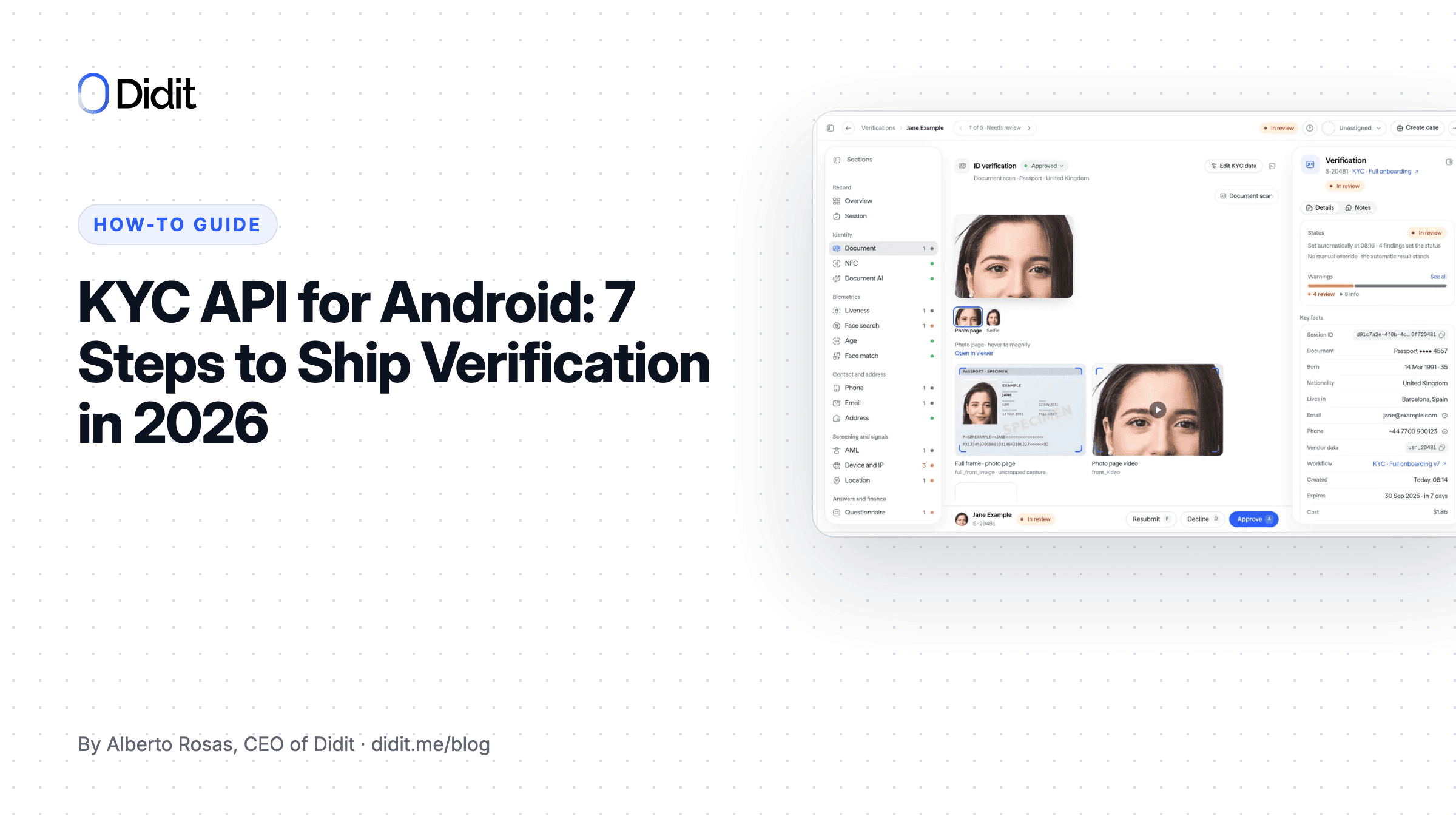
Use Didit Android SDK 4.15.4 with a server-side session API. Full KYC costs $0.33 at published list price and the sandbox is free. Keep the API key off the device.
Alejandro RosasJan 27, 2026KYC API for iOS: A Comprehensive Guide
Unlock seamless KYC integration in your iOS apps with a powerful API. This guide covers essential features, compliance, security, and implementation strategies.
Alberto RosasJan 27, 2026KYC API: Streamline Identity Verification in Mobile Apps
Integrate a KYC API into your mobile app to automate user verification, prevent fraud, and ensure compliance. Learn how a KYC API works, key features to look for, and how Didit's modular approach offers unparalleled flexibility.
Alejandro RosasJan 27, 2026Identity Verification in Laravel: A Comprehensive Guide
Learn how to integrate robust identity verification into your Laravel applications. Enhance security, ensure compliance, and improve user experience with practical examples, actionable advice, and the power of Didit's AI-native.
Alberto RosasJan 27, 2026Identity Verification for Express: A Comprehensive Guide
Identity verification is crucial for Express apps to enhance security, prevent fraud, and ensure compliance. This guide covers implementation strategies, best practices, and how Didit's AI-native platform offers a modular.
Alberto RosasJan 27, 2026Identity Verification in Spring Boot: A Comprehensive Guide
Learn how to integrate robust identity verification into your Spring Boot applications. This guide covers best practices, common challenges, and how Didit's AI-native platform simplifies the process with modular solutions and.
Alberto RosasJan 27, 2026Identity Verification in FastAPI: A Comprehensive Guide
Secure your FastAPI applications with robust identity verification. Learn how to implement verification using best practices and discover how Didit's AI-native platform simplifies the process with its free tier and modular.
Alejandro RosasJan 27, 2026Identity Verification in Django: A Comprehensive Guide
Learn how to integrate robust identity verification into your Django applications. Protect your platform from fraud and ensure compliance with KYC/AML regulations using best practices and tools.
Alberto RosasJan 27, 2026Identity Verification in Node.js: A 2026 How-To Guide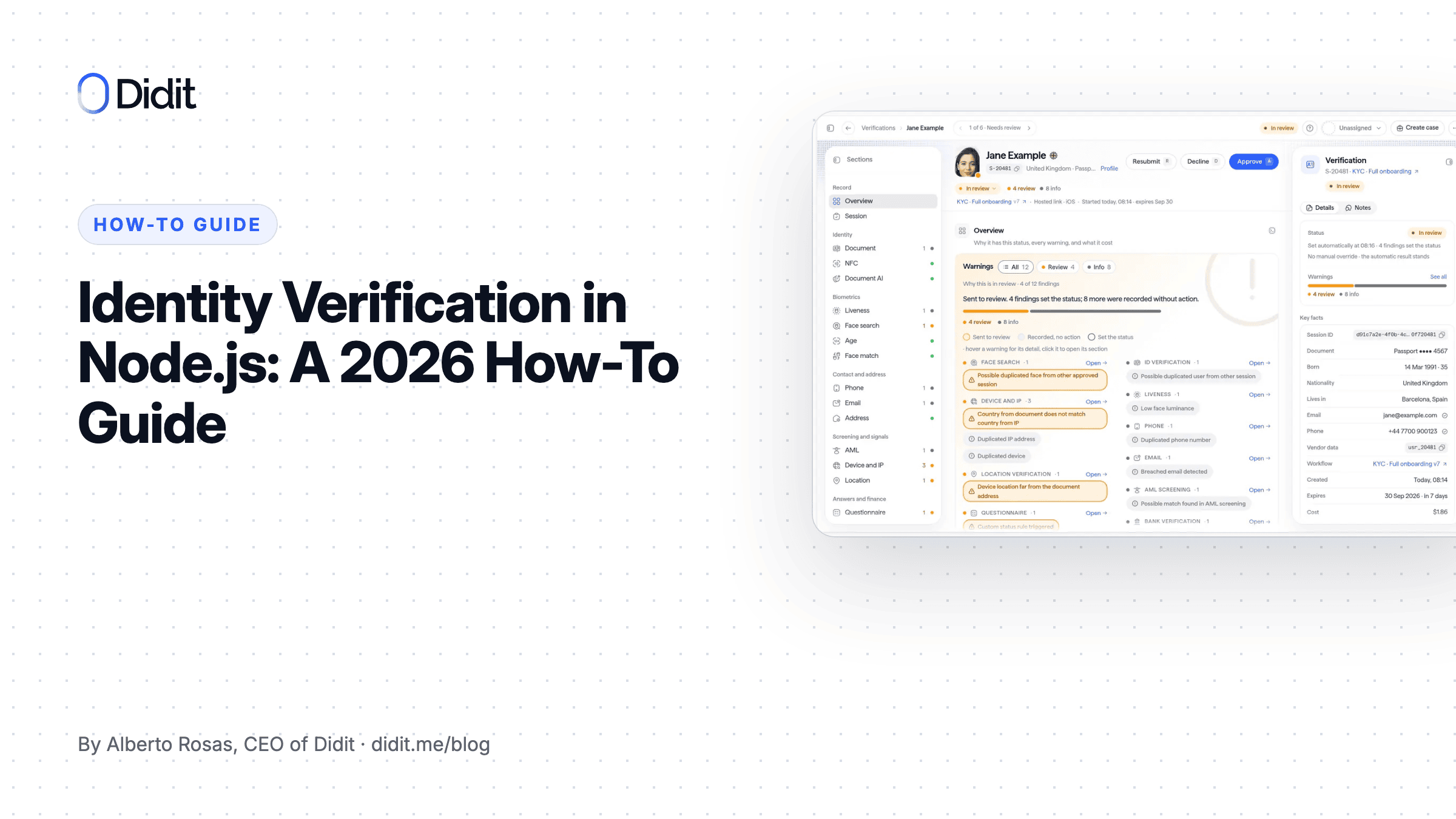
Create a verification session from your Node.js backend, send the user to Didit's hosted flow, then read the Approved or Declined decision on your server.
Alberto RosasJan 27, 2026Identity Verification in Angular: A Comprehensive Guide
Learn how to implement robust identity verification in your Angular applications. This guide covers essential techniques, security considerations, and how Didit's modular platform simplifies the process with AI-powered solutions.
Alberto RosasJan 27, 2026Identity Verification in Vue.js: A Comprehensive Guide
Integrate robust identity verification into your Vue.js applications. Learn best practices, explore leading solutions, and discover how Didit's AI-native platform simplifies KYC/AML compliance.
Alberto RosasJan 27, 2026Identity Verification in React: A Developer's Guide
Create a Didit session on your server, open the hosted flow from a React component with @didit-protocol/sdk-web, and read the decision from a status.updated webhook, with the decision endpoint as the fallback.
Alejandro RosasJan 27, 2026Identity Verification in Next.js on Vercel: 2026 Integration Guide
Add hosted KYC to Next.js on Vercel with a server route and a signed webhook. A full KYC check costs $0.33 at list price. Test in our free sandbox and keep the API key on your server.
Alberto RosasJan 27, 2026KYC SDK for Kotlin: A Developer's Guide
Discover how to streamline KYC integration in your Kotlin apps with SDKs. Learn best practices, overcome common challenges, and see how Didit's modular, AI-native platform simplifies identity verification with a free tier.
Alejandro RosasJan 27, 2026KYC SDK for Swift: Streamlining Identity Verification on iOS
Implementing KYC (Know Your Customer) in your iOS app can be complex. A Swift SDK simplifies this process, offering pre-built components for ID verification, liveness detection, and data extraction.
Alejandro RosasJan 27, 2026KYC SDK for .NET: Identity Verification Integration (2026)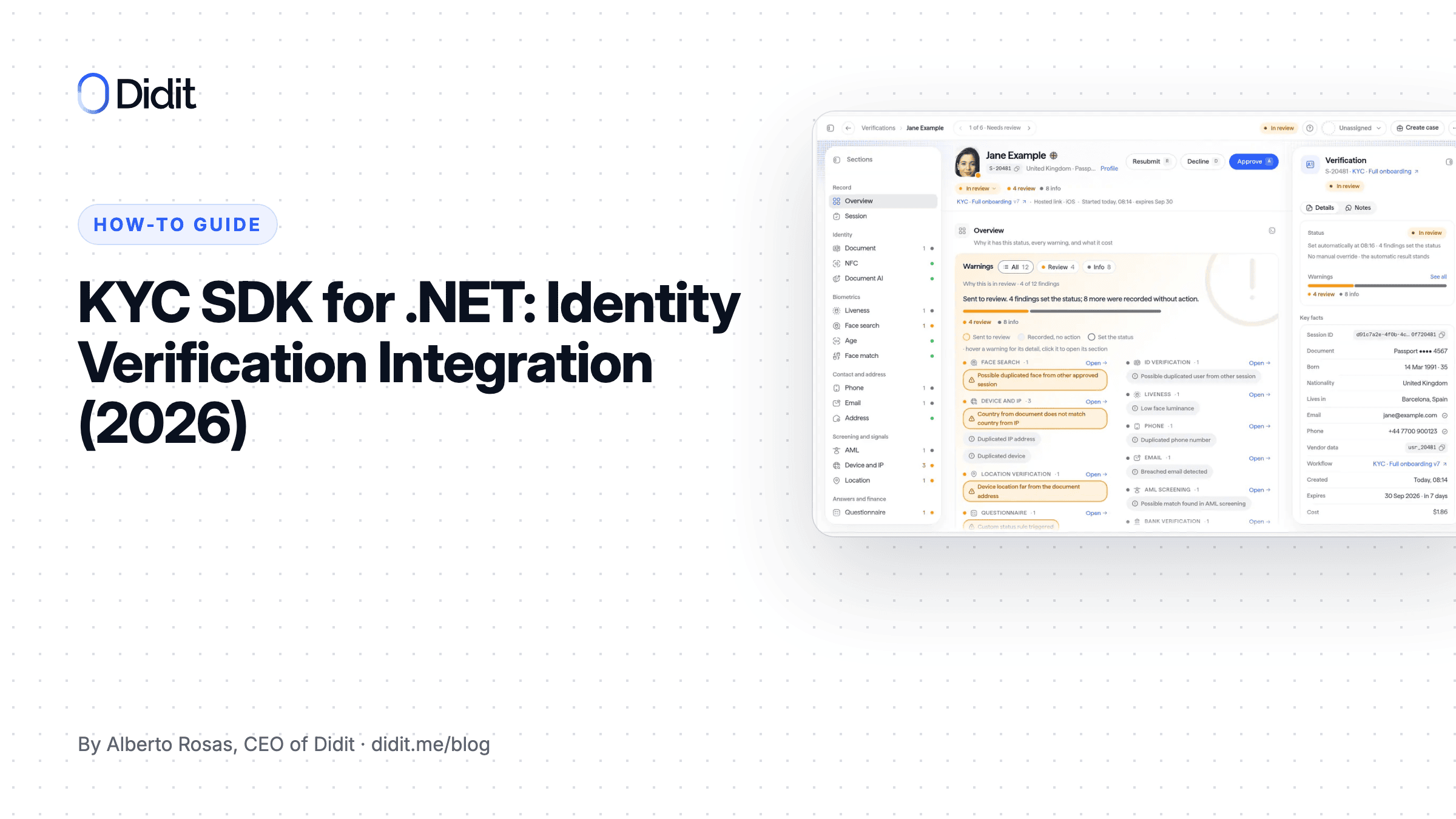
Install the Didit .NET package, create a KYC session from your backend, send the user to the hosted flow, verify the webhook and read the decision. A full KYC check costs $0.33.
Alejandro RosasJan 27, 2026KYC SDK for Ruby: Streamline Identity Verification
Discover how a KYC SDK for Ruby can simplify identity verification in your Ruby applications. Learn about the benefits, implementation, and key features to look for.
Alberto RosasJan 27, 2026KYC SDK for PHP: Start a Session and Read the Decision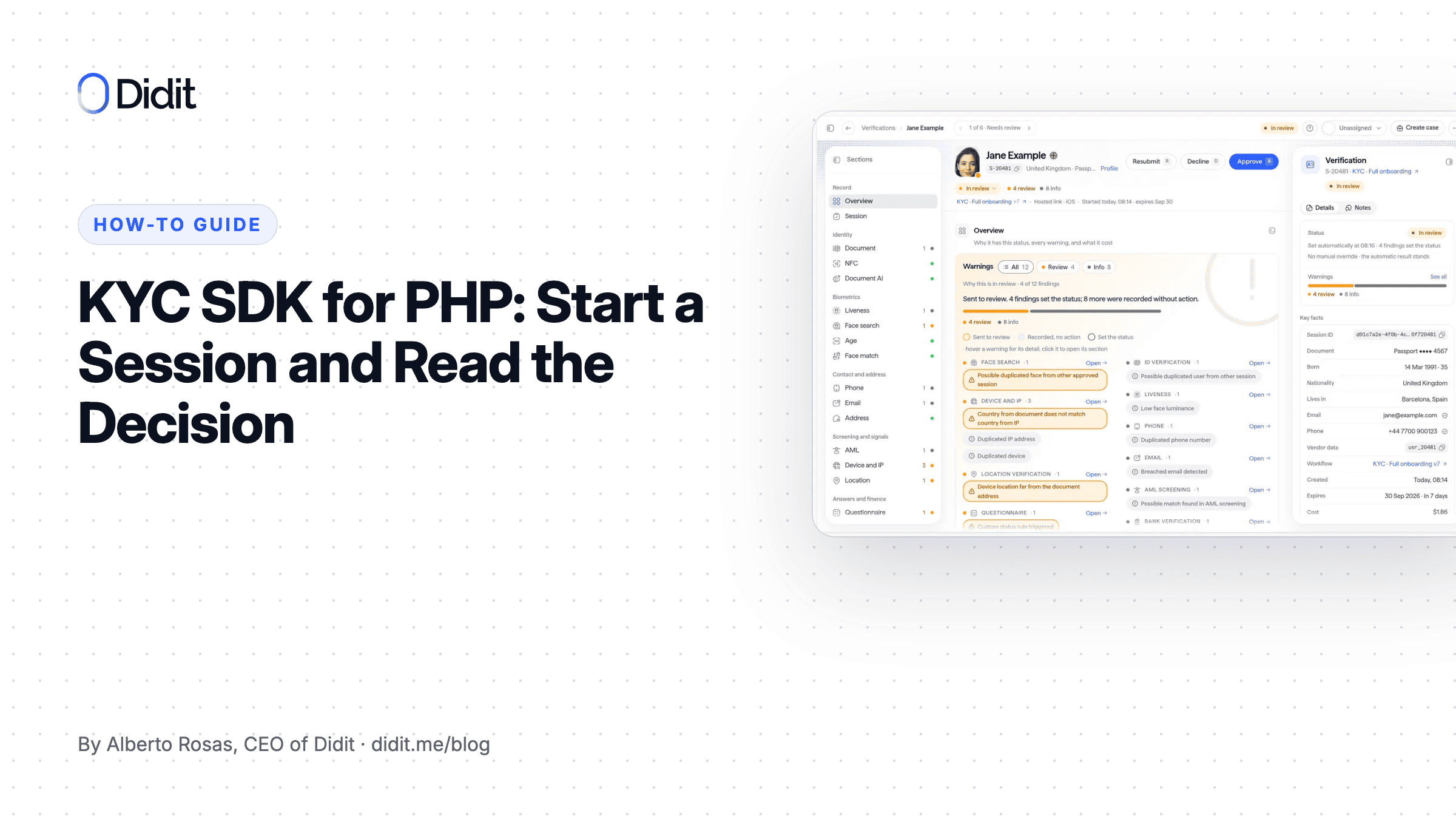
Didit's server SDK for PHP (didit-protocol/sdk-php, PHP 8.1+) starts a hosted KYC flow with one server call and returns the result through a signed webhook or the decision endpoint. A full ID check costs $0.33.
Alejandro RosasJan 27, 2026KYC SDK for Go: Streamlining Identity Verification
Simplify KYC integration into your Go applications with a dedicated SDK. Learn about the benefits, key features to look for, and how Didit's modular identity infrastructure can enhance your verification processes.
Alberto RosasJan 27, 2026KYC SDK for Java: Streamlining Identity Verification
Discover how a KYC SDK for Java simplifies identity verification. Learn about integration, benefits, and key features. See how Didit's modular, AI-native platform provides a flexible and efficient solution for KYC, offering free.
Alejandro RosasJan 27, 2026KYC SDK for Python: Streamlining Identity Verification
Unlock seamless KYC integration in your Python applications with a dedicated SDK. Simplify identity verification, ensure compliance, and enhance security.
Alejandro RosasJan 27, 2026KYC SDK for TypeScript: Streamlining Identity Verification
Discover how a KYC SDK for TypeScript simplifies identity verification in modern web applications. Learn about implementation best practices, security considerations, and how Didit's modular platform offers a flexible and.
Alejandro RosasJan 27, 2026KYC SDK for JavaScript: Add a KYC Check in 6 Steps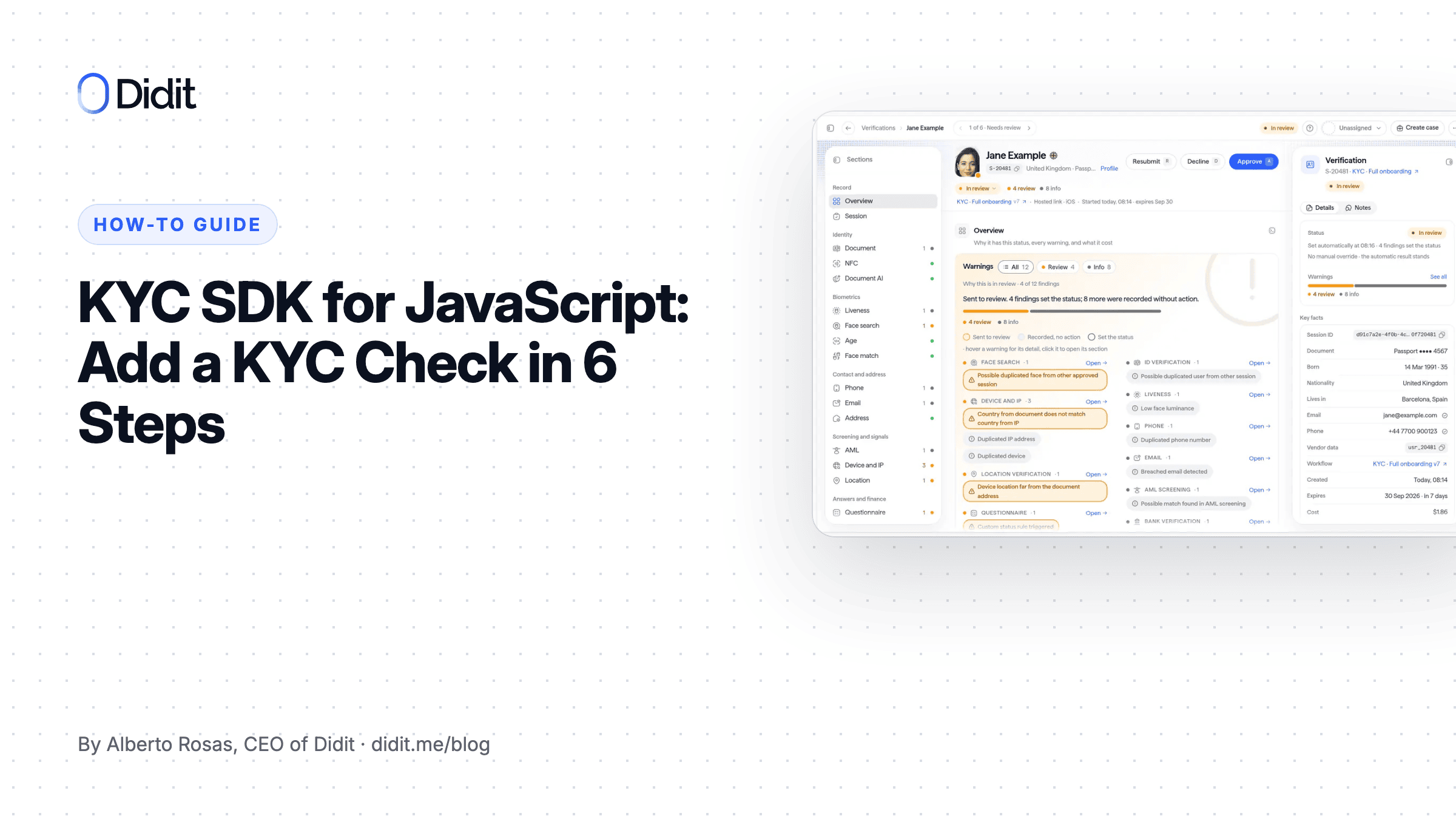
The Didit JavaScript SDK adds a KYC check to a web app in about three minutes. Your server creates the session, the SDK runs the flow, and the signed decision arrives by webhook or a server-side decision fetch.
Alejandro RosasJan 27, 2026Real-Time Identity Verification API: Build It in 2026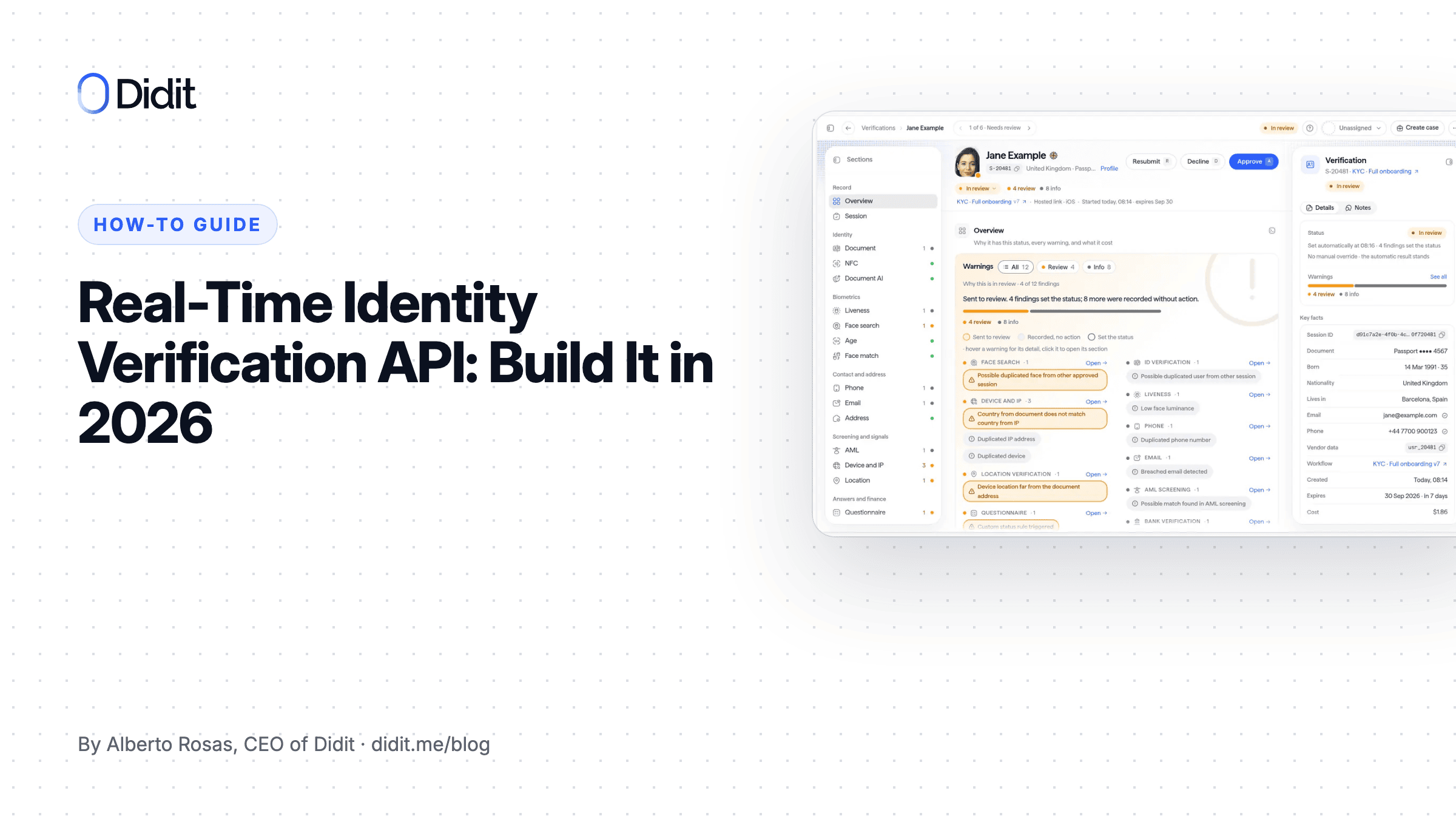
A real-time identity verification API returns a decision while the user waits. On Didit a full KYC check is $0.33 list, $0.297 on Scale, and sandbox testing is free and unlimited on every plan.
Alberto RosasJan 27, 2026Questions
Blog questions
Who writes the Didit blog?
Which topics does the blog cover?
Is the blog available in my language?
Where do I find product updates?
Are these posts legal advice?
How do I find posts on one topic?
Are posts dated?
Do posts link to the docs?
Is the blog the same as the docs?
Compliance built in
Audited, certified and attested.
We hold the certifications and build each country's rules into your flows, so you can launch anywhere without worrying. Security and Compliance center
- Regulation encoded into your flows
Tell us what you do and where. Didit lists the rules that apply to you, with sources, and builds the checks each country needs into one workflow.
- Ready for AMLR
Every requirement of the new EU anti-money laundering rules, from checking customers to human review, is already covered by a Didit check.
- Tested in Spain's Treasury sandbox
Spain's Treasury published its supervised sandbox report on Didit's NFC plus active liveness onboarding; SEPBLAC took part and valued the added measures positively.
- Audited, not self-declared
iBeta Level 1 and Level 2. Liveness tested under ISO/IEC 30107-3.
Your obligations · 3 regions
 SOC 2 Type 2
 ISO 27001
 iBeta Level 1 and Level 2
 EU regulator attestation
 FSM youth protection
 GDPR
 EBA remote onboarding
 MiCA compatible
 FIDO Alliance member
- AMLREU AML Regulation ready
Integration · Didit MCP
Run Didit from your own AI agent
Connect Didit to Claude, Cursor, VS Code or ChatGPT and just ask in plain words. Your agent can do anything you can do in the console, with the same permissions you have.
 Add to Claude
 ChatGPT
 Cursor
- Build workflowsDescribe the checks you need. The agent creates and publishes the flow.
- Run investigationsAsk why a session was declined, review cases, search people and companies.
- Change rulesCreate payment rules, test them on past data and switch them on.
- Pull reportsAsk for numbers, exports or the audit log.
Didit Academy


