Blog
Blog archive
Every post on the Didit blog, newest first. Pick a category or search to find the subject you need.
All posts
Every post, newest first
Pick a category to filter.
FinCEN's BOIR introduces new complexities for beneficial ownership reporting, demanding heightened accuracy. Manual review processes are prone to human error and inefficiency, increasing compliance risks.
Alberto RosasMar 12, 2026National IDs & Open Banking: The Future of European KYC
Integrating national ID databases with Open Banking APIs in Europe offers a powerful solution for enhanced KYC, fraud prevention, and streamlined customer onboarding.
Alberto RosasMar 12, 2026Seamless CRM Integration: Address Verification with Didit
Integrating robust address verification directly into CRM systems like Salesforce and HubSpot is crucial for data accuracy, compliance, and fraud prevention.
Alejandro RosasMar 12, 2026Securing DeFi from Sybil Attacks with Web3 KYC
Sybil attacks pose a significant threat to the integrity and fairness of DeFi protocols, distorting governance, draining liquidity, and enabling fraud.
Alberto RosasMar 12, 2026Frictionless Onboarding for Gen Z: Mobile App Strategies
Gen Z demands seamless, instant mobile app experiences. Designing frictionless onboarding flows requires intuitive design, minimal steps, robust security, and personalized interactions to boost conversion and retention.
Alberto RosasMar 12, 2026Streamlining Payment Processor Onboarding with Verifiable Credentials
Discover how verifiable credentials revolutionize payment processor onboarding by reducing friction, enhancing security, and accelerating compliance.
Alberto RosasMar 12, 2026Streamline AML Compliance: No-Code Automation Beyond KYC
Discover how no-code workflow automation can revolutionize your Anti-Money Laundering (AML) compliance, extending beyond initial Know Your Customer (KYC) onboarding.
Alejandro RosasMar 12, 2026Dynamic Risk Scoring for PropTech: Real-time Tenant Verification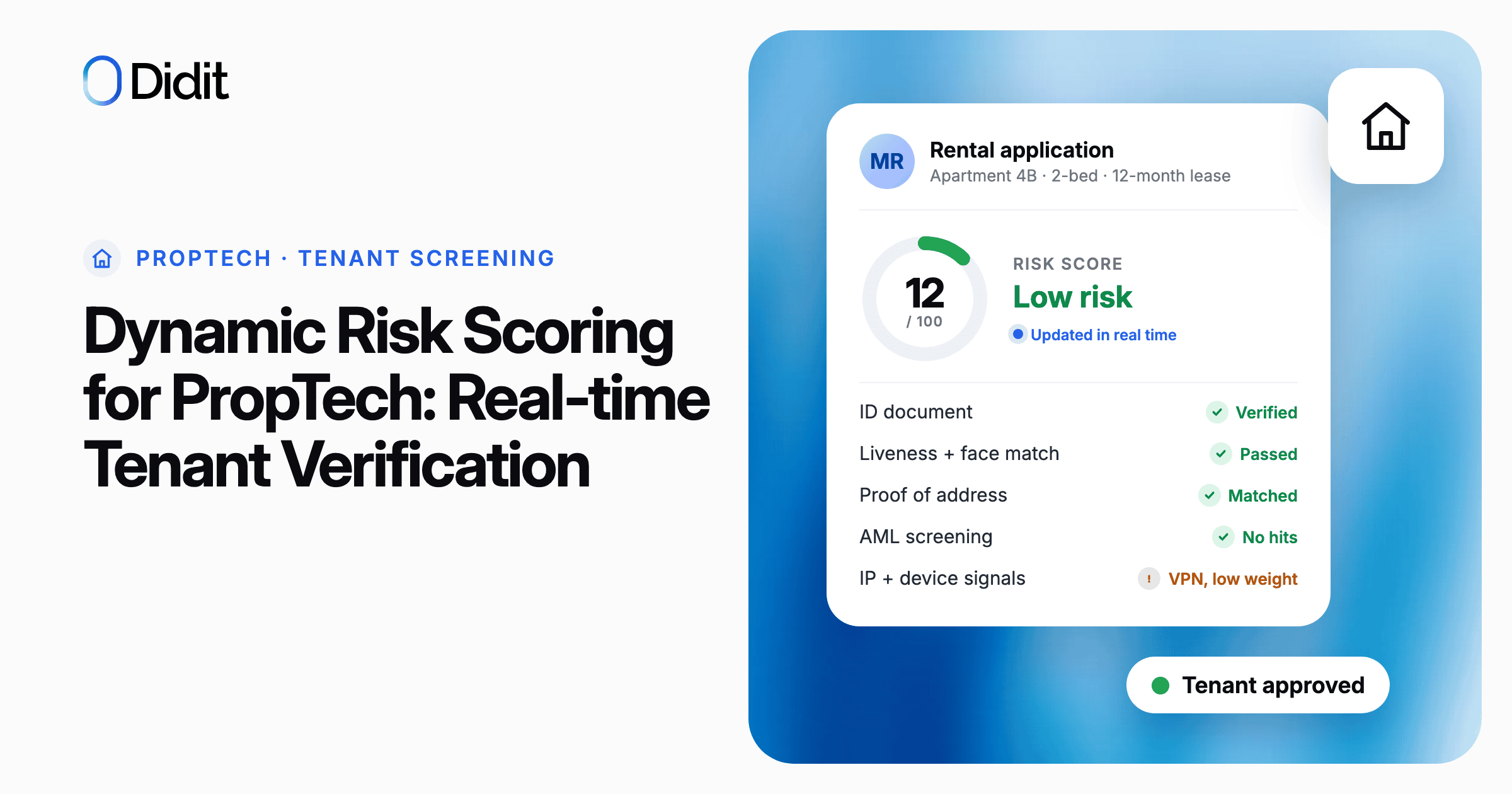
PropTech companies face unique challenges in tenant verification, balancing speed with robust fraud prevention. Dynamic risk scoring, powered by AI, offers a real-time solution, adapting to evolving threats and providing a.
Alberto RosasMar 12, 2026How to Bridge Web3 Wallets to Off-Chain Identity: 6 Steps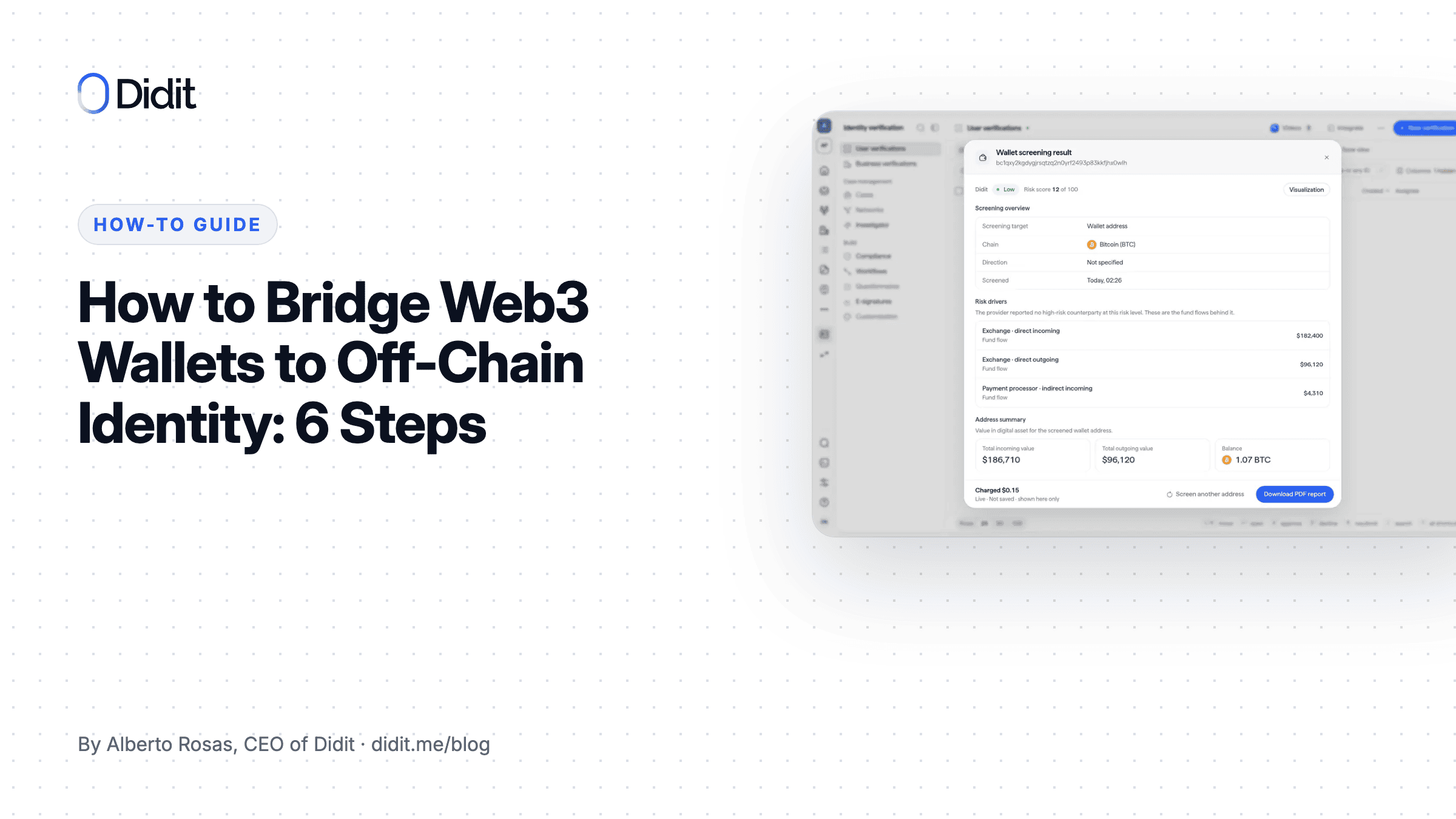
Bridge a wallet to a verified person in six steps: define the gates, configure screening, run a full ID check, screen the address on demand, prove wallet control, then exchange Travel Rule data.
Alberto RosasMar 12, 2026Orchestrating Sanctions Screening in DeFi: A Guide
Decentralized Finance (DeFi) presents unique challenges for sanctions screening due to its pseudonymous nature and global reach. This guide explores the complexities, regulatory landscapes, and how advanced AI-native solutions.
Alberto RosasMar 12, 2026The Future of Identity in Decentralized Autonomous Organizations (DAOs)
Explore how identity verification is evolving within DAOs, balancing pseudonymity with accountability. We delve into the challenges of Sybil attacks and compliance, and how advanced identity solutions like Didit's modular.
Alberto RosasMar 12, 2026Streamline AML Compliance with Python SDK Integration
Integrating a robust Python SDK for Anti-Money Laundering (AML) screening and monitoring can significantly enhance efficiency, accuracy, and compliance.
Alejandro RosasMar 12, 2026Adaptive User Journeys for Email Verification with Progressive Profiling
Discover how adaptive user journeys, coupled with progressive profiling, can revolutionize email verification. Learn to balance security and user experience by dynamically adjusting verification steps based on risk signals.
Alberto RosasMar 12, 2026Real-time Identity Proofing for PII Protection at the Network Edge
Protecting Personally Identifiable Information (PII) at the network edge is paramount in today's digital landscape. Real-time identity proofing offers a robust defense, verifying user identities precisely when and where.
Alberto RosasMar 12, 2026Leveraging IP Geolocation for Dynamic Risk Scoring and Compliance
IP geolocation is a powerful tool for enhancing dynamic risk scoring and ensuring compliance in identity verification. By analyzing location data, businesses can detect fraud, meet regulatory requirements, and tailor user.
Alejandro RosasMar 12, 2026Orchestrating Cross-Border Phone Verification with Dynamic Fallbacks
Effective cross-border phone verification requires dynamic strategies to navigate varying global telecommunication landscapes, ensuring high deliverability and fraud prevention.
Alberto RosasMar 12, 2026Micro-Verifications: Web3 Onboarding Without the Friction
Micro-verifications are crucial for balancing security and user experience in Web3 dApps, enabling frictionless onboarding by breaking down KYC into smaller, context-aware steps.
Alberto RosasMar 12, 2026A/B Testing Strategies for Optimized KYC Workflows
Discover how A/B testing can revolutionize your Know Your Customer (KYC) processes, balancing compliance with user experience and cost-efficiency.
Alberto RosasMar 12, 2026Real-time Fraud Signal Correlation in Gaming
Combat collusive networks in online gaming with real-time fraud signal correlation. This approach leverages advanced identity verification and behavioral analytics to detect and prevent sophisticated fraud rings, protecting game.
Alberto RosasMar 12, 2026Federated KYC in Healthcare: Payer-Provider Network Compliance
Federated Know Your Customer (KYC) is crucial for healthcare payer-provider networks to ensure compliance, streamline operations, and enhance trust.
Alberto RosasMar 12, 2026From Concept to Code: Building a Mini Identity Verification API in Python
Building an identity verification API in Python can be complex, involving secure data handling, robust logic, and integration with external services.
Alejandro RosasMar 12, 2026Optimizing Phone Verification for MENA's Complex Regulatory Zones
Navigating phone number verification across the diverse and intricate regulatory landscape of the MENA region presents unique challenges for businesses.
Alberto RosasMar 12, 2026The Evolution of Face Match: From Static Photos to 3D Scans
Face matching technology has rapidly evolved, moving beyond simple comparisons to sophisticated biometric analysis. This blog explores the journey from basic photo verification to advanced 3D scanning, highlighting its critical.
Alberto RosasMar 12, 2026Geolocation-Based OTP: Elevating Transactional Security
Traditional SMS OTPs are vulnerable to interception and SIM swap fraud. Geolocation-based OTPs enhance security by verifying the user's location against expected transaction parameters, adding a crucial layer of defense against.
Alejandro RosasMar 12, 2026The Economics of False Positives: Optimizing AML Screening Costs
False positives in Anti-Money Laundering (AML) screening are a significant financial drain for businesses, leading to wasted resources and operational inefficiencies.
Alberto RosasMar 12, 2026Cloud-Native Liveness Detection: Modernizing Fraud Prevention
Transitioning from on-premise to cloud-native liveness detection offers unparalleled scalability, real-time threat intelligence, and cost efficiency.
Alberto RosasMar 12, 2026Fraud Detection Beyond the Obvious: Uncovering Hidden Patterns
Effective fraud detection requires looking beyond surface-level indicators to uncover subtle, interconnected patterns. This blog explores advanced strategies, leveraging AI and behavioral analytics to identify sophisticated.
Alberto RosasMar 12, 2026Choosing a National Registry Validation Provider: Beyond Cost
Selecting a national registry validation provider involves more than just price. This guide explores crucial factors like data accuracy, coverage, matching methods, and compliance to ensure robust identity verification.
Alberto RosasMar 12, 2026Automating AML in Digital Art & NFT Markets with Didit
Digital art and NFT markets face unique AML challenges due to their decentralized nature and rapid transactions. Implementing robust, automated AML workflows is crucial for compliance and mitigating financial crime risks.
Alberto RosasMar 12, 2026Database Validation vs. Document OCR: Which to Use?
Choosing between database validation and Document OCR is crucial for effective identity verification. This guide explores the strengths of each method, their ideal applications, and how Didit's comprehensive platform seamlessly.
Alejandro RosasMar 12, 2026Automating Trust & Safety for Online Marketplaces
Online marketplaces face immense pressure to maintain trust and safety for their users. Automating these operations is crucial for scaling efficiently, mitigating fraud, and ensuring compliance without sacrificing user experience.
Alberto RosasMar 12, 2026Building a Robust Face Match System for Event & Venue Access
Discover how a robust face match system can revolutionize event and venue access, enhancing security, streamlining entry, and improving the user experience.
Alberto RosasMar 12, 2026Integrating DIDComm and VCs with Enterprise IAM
Explore how Decentralized Identifiers (DIDs), DIDComm, and Verifiable Credentials (VCs) can revolutionize enterprise Identity and Access Management (IAM).
Alejandro RosasMar 12, 2026Beyond Pass Rate: Optimizing Identity Verification KPIs
Achieving effective identity verification requires moving beyond simple pass rates to understand and optimize a broader set of KPIs. This includes conversion rates, fraud detection efficacy, operational efficiency, and overall.
Alberto RosasMar 12, 2026Developer's Guide to Federated Identity in Microservices
Federated identity is crucial for secure and scalable microservices architectures, enabling seamless user experiences and robust access control across distributed systems.
Alejandro RosasMar 12, 2026Mastering Geospatial Identity Verification for Regulatory Zones
Navigating complex regulatory landscapes requires precise geospatial identity verification. This blog explores the challenges, the critical role of IP analysis and Proof of Address, and how Didit's AI-native platform provides a.
Alberto RosasMar 12, 2026Zero-Trust Principles for Identity Provider Selection
Adopting a Zero-Trust approach to identity verification is crucial for modern security. This involves continuous verification, least privilege access, and understanding your identity provider's capabilities.
Alberto RosasMar 12, 2026Building a Robust Decentralized Reputation System for P2P Marketplaces
Decentralized reputation systems are crucial for fostering trust and security in P2P marketplaces, moving beyond centralized control. Integrating robust identity verification (IDV) components is key to preventing fraud and.
Alberto RosasMar 12, 2026The Economic Impact of Onboarding Drop-offs: Quantifying Lost Revenue
Onboarding drop-offs are a silent killer of revenue for digital services, leading to significant lost opportunities. This article explores how friction in the KYC/identity verification process directly impacts conversion rates.
Alberto RosasMar 12, 2026Enhancing Trust in the Gig Economy: DID for Worker Reputation
The gig economy thrives on trust, yet traditional reputation systems often fall short. Decentralized Identifiers (DIDs) offer a robust, user-centric approach to building verifiable worker reputations, empowering gig workers and.
Alberto RosasMar 12, 2026Real-time Identity Proofing for Insurtech: Accelerating Underwriting & Claims
Discover how real-time identity proofing is transforming the insurtech landscape, enabling faster policy underwriting and claims processing while combating fraud.
Alberto RosasMar 12, 2026The Business Case for Centralized User Identity Management in the Gig Economy
The gig economy thrives on trust, but fragmented identity verification processes can lead to significant fraud, compliance risks, and operational inefficiencies.
Alberto RosasMar 12, 2026Zero-Trust Architecture with Programmatic Identity Attestation
Implementing a Zero-Trust Architecture (ZTA) is critical in today's threat landscape. This blog explores how programmatic identity attestation, powered by AI-native platforms like Didit, can enforce continuous verification.
Alberto RosasMar 12, 2026Data Privacy Laws & AML Screening: Navigating the New Landscape
Evolving data privacy laws like CPRA and LGPD are reshaping how financial institutions conduct AML screening, creating challenges and opportunities.
Alberto RosasMar 12, 2026Combating AI Disinformation with Identity Verification
AI-generated disinformation poses a significant threat to trust and security online. Identity verification is crucial for authenticating users, ensuring accountability, and preventing the spread of deceptive content.
Alberto RosasMar 12, 2026Boosting Reusable KYC Adoption: Strategies for Success
Reusable KYC offers significant benefits for users and businesses, yet adoption can be a hurdle. This post explores key strategies, from clear communication and incentivization to seamless integration and robust security, to.
Alberto RosasMar 12, 2026Integrating Self-Sovereign Identity (SSI) with Traditional IAM Systems
Explore the benefits and challenges of integrating Self-Sovereign Identity (SSI) with existing Identity and Access Management (IAM) systems.
Alejandro RosasMar 12, 2026Building Adaptive Risk Engines for Loan Origination with Composable Identity
Discover how composable identity verification powers adaptive risk engines for loan origination, enabling real-time, dynamic decision-making.
Alberto RosasMar 12, 2026Privacy-Enhancing Cryptography in Self-Sovereign Identity
Explore how Privacy-Enhancing Cryptography (PEC) is fundamental to Self-Sovereign Identity (SSI), enabling secure, user-controlled data exchange.
Alberto RosasMar 12, 2026Navigating the UK's Online Safety Act: Age Verification Essentials
The UK's Online Safety Act (OSA) introduces stringent requirements for platforms to protect users, particularly children, from harmful content. Age verification is now a critical component of compliance.
Alberto RosasMar 12, 2026Proof of Humanity in the Age of LLMs and Synthetic Content
The rise of Large Language Models (LLMs) and synthetic content generation presents significant challenges to verifying genuine human interaction online.
Alberto RosasMar 12, 2026Navigating AML for DAOs: A Guide to Compliance in Decentralized Governance
Decentralized Autonomous Organizations (DAOs) face unique challenges in Anti-Money Laundering (AML) compliance due to their distributed nature.
Alberto RosasMar 12, 2026The Economics of Identity Trust: Quantifying Brand Reputation
In today's digital landscape, brand reputation is intrinsically linked to identity trust. This blog explores how robust identity verification practices not only protect against fraud but also significantly enhance customer.
Alberto RosasMar 12, 2026Mastering Age Gating for German Online Gaming (GlüStV 2021)
Online gaming operators targeting Germany face stringent age verification requirements under GlüStV 2021. This guide explores the regulatory landscape, compliance challenges, and how robust solutions like Didit's Age Estimation.
Alberto RosasMar 12, 2026Healthcare Identity Data Orchestration: EHRs, KYC, and AML
Integrating Electronic Health Records (EHRs) with Know Your Customer (KYC) and Anti-Money Laundering (AML) workflows is crucial for modern healthcare.
Alberto RosasMar 12, 2026CBDCs and Their Critical Identity Layer Requirements
Central Bank Digital Currencies (CBDCs) promise a new era of financial innovation but hinge on robust identity verification. Understanding the nuanced balance between privacy and compliance, especially with AML/KYC regulations.
Alberto RosasMar 12, 2026Combating Adversarial Attacks on Biometric Systems
Adversarial attacks pose a significant threat to biometric systems, exploiting vulnerabilities in AI models to bypass security or manipulate identities.
Alberto RosasMar 12, 2026Navigating the UK's DIATF: A Guide for Enterprises
The UK's Digital Identity and Attributes Trust Framework (DIATF) is reshaping how businesses verify identities, promoting secure, interoperable, and privacy-preserving digital interactions.
Alberto RosasMar 12, 2026Boost Acquisition: The ROI of Verification Links in KYC
Discover how verification links revolutionize customer acquisition by streamlining KYC. Learn how they reduce drop-off, accelerate onboarding, and provide measurable ROI for businesses seeking efficient, scalable identity.
Alberto RosasMar 12, 2026Custom Branding for Verification Links: Build Trust & Consistency
Custom branding on identity verification links is crucial for building user trust and maintaining brand consistency. By white-labeling verification flows, businesses can reduce abandonment rates and enhance the user experience.
Alberto RosasMar 12, 2026Building a Trust Framework for Interoperable Digital Identity in Europe
Europe is moving towards a unified digital identity framework, requiring robust, interoperable solutions. This blog explores the challenges and opportunities in creating a secure, user-centric system, emphasizing the role of.
Alberto RosasMar 12, 2026FATF Red Flags for Virtual Assets: A VASP How-To for 2026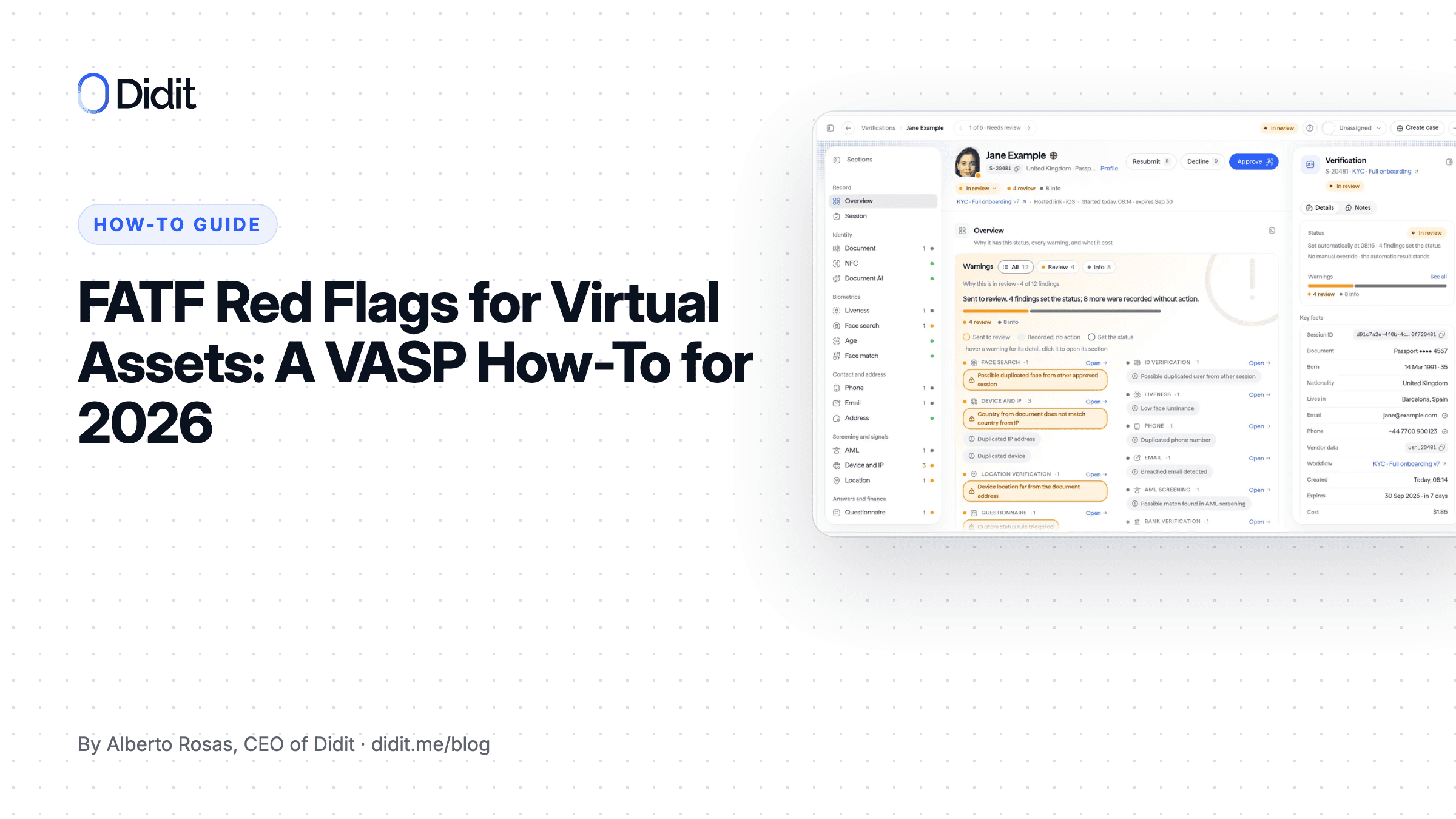
FATF groups virtual asset red flags into six categories, from transactions and anonymity to source of funds and geography. Map each to an identity, screening or Travel Rule control and route exceptions to a human reviewer.
Alberto RosasMar 12, 2026Email Verification: Your First Line of Defense Against Domain Spoofing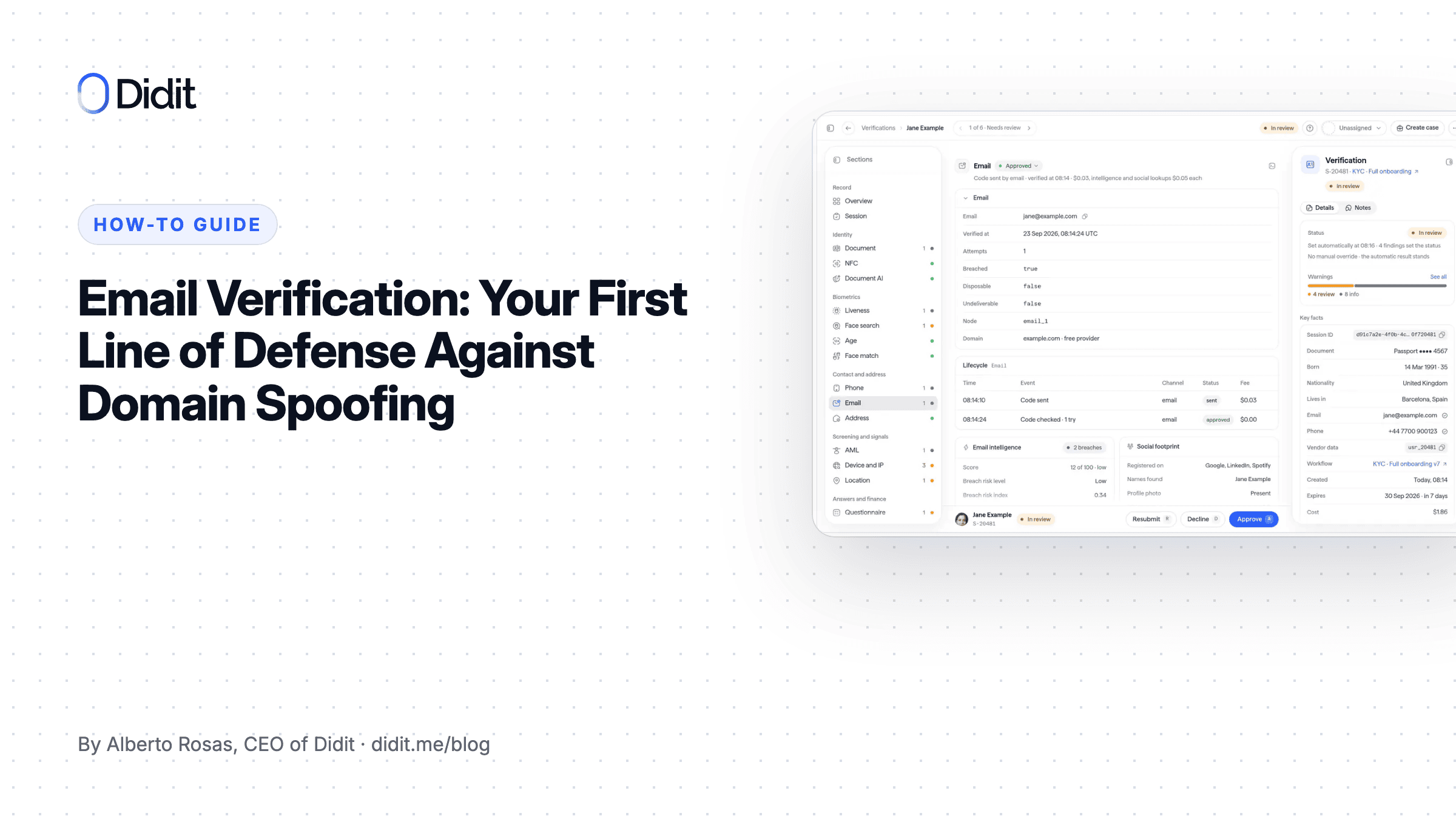
Didit Email Verification sends a one-time code and returns breach, disposable and deliverability signals for $0.02 per check. It proves the user's inbox, not the sender domain, so keep DMARC beside it.
Alberto RosasMar 12, 2026Verifiable Credentials: GDPR-Compliant Data Sharing in Multi-Party Systems
Verifiable Credentials (VCs) offer a robust framework for GDPR-compliant data sharing in complex multi-party systems. They enable individuals to control their personal data, ensuring privacy, security, and transparency.
Alberto RosasMar 12, 2026Robust Device Intelligence for Enhanced Identity Verification
Building a robust device intelligence strategy is crucial for modern identity verification, offering real-time fraud detection and risk assessment.
Alberto RosasMar 12, 2026SSI for Pharma: Enhancing Supply Chain Transparency
Self-Sovereign Identity (SSI) offers a revolutionary approach to pharmaceutical supply chain transparency, combating counterfeiting and ensuring product integrity.
Alberto RosasMar 12, 2026Optimizing Selfie Verification for High-Conversion Onboarding
Learn how to streamline selfie verification workflows to boost user onboarding conversion rates. This post covers best practices, advanced liveness detection, and the critical role of user experience in identity verification.
Alberto RosasMar 12, 2026Open-Source vs. Proprietary Liveness Detection SDKs (2026)
Open-source liveness through OpenCV means building and owning the model yourself, with no published price or accuracy figure. Didit publishes $0.10 per passive liveness check and $0.33 per full KYC, with iBeta Level 1 PAD, SOC.
Alejandro RosasMar 12, 20265 Best Phone Verification Vendors for SMS Gateway Spoofing, 2026
SMS gateway spoofing fakes the sender ID on OTP texts, so codes must travel over more than one channel and be gated by carrier and line-type signals before a code is sent. Didit charges the carrier price plus $0.02 per code.
Alberto RosasMar 12, 2026Fraud Detection Economics: Preventative vs. Reactive Costs
Understanding the economics of fraud signal detection is crucial for businesses. This post quantifies the significant difference between preventative and reactive fraud costs, highlighting how proactive measures save capital.
Alejandro RosasMar 12, 2026Privacy-Preserving Identity: The Future of Smart Contracts
Smart contracts promise automation and trust, but often clash with privacy regulations like GDPR. Privacy-preserving identity solutions are crucial for their widespread adoption, enabling secure, compliant interactions without.
Alberto RosasMar 12, 2026Fraud Signal Correlation: Unifying Data for Holistic Risk Scoring
Effectively combating fraud requires correlating disparate data sources. This blog explores the challenges of siloed information and how unifying identity verification, behavioral analytics, and transactional data creates a.
Alberto RosasMar 12, 2026Decentralized KYC for Global Freelance Platforms
Explore the challenges and solutions for implementing a decentralized Know Your Customer (KYC) ecosystem on global freelance platforms. This article delves into the benefits of blockchain for identity verification, the role of.
Alberto RosasMar 12, 2026Structuring Identity Workflows for Decentralized Autonomous Organizations (DAOs)
Decentralized Autonomous Organizations (DAOs) require robust identity verification to ensure fair governance, prevent Sybil attacks, and comply with regulations while maintaining decentralization.
Alberto RosasMar 12, 2026PSD2 SCA Exemptions: Reshaping Fintech Onboarding
PSD2's Strong Customer Authentication (SCA) aims to boost security, but its exemptions are crucial for fintechs to balance security with user experience.
Alejandro RosasMar 12, 2026Developer's Guide to eIDAS 2.0 EUDI Wallet Connectors in Python
eIDAS 2.0 introduces a paradigm shift in digital identity, with EUDI Wallets becoming central. This guide provides Python developers with practical insights into implementing connectors for these wallets, focusing.
Alberto RosasMar 12, 2026The Hidden Cost of Onboarding Drop-offs for Traditional Banks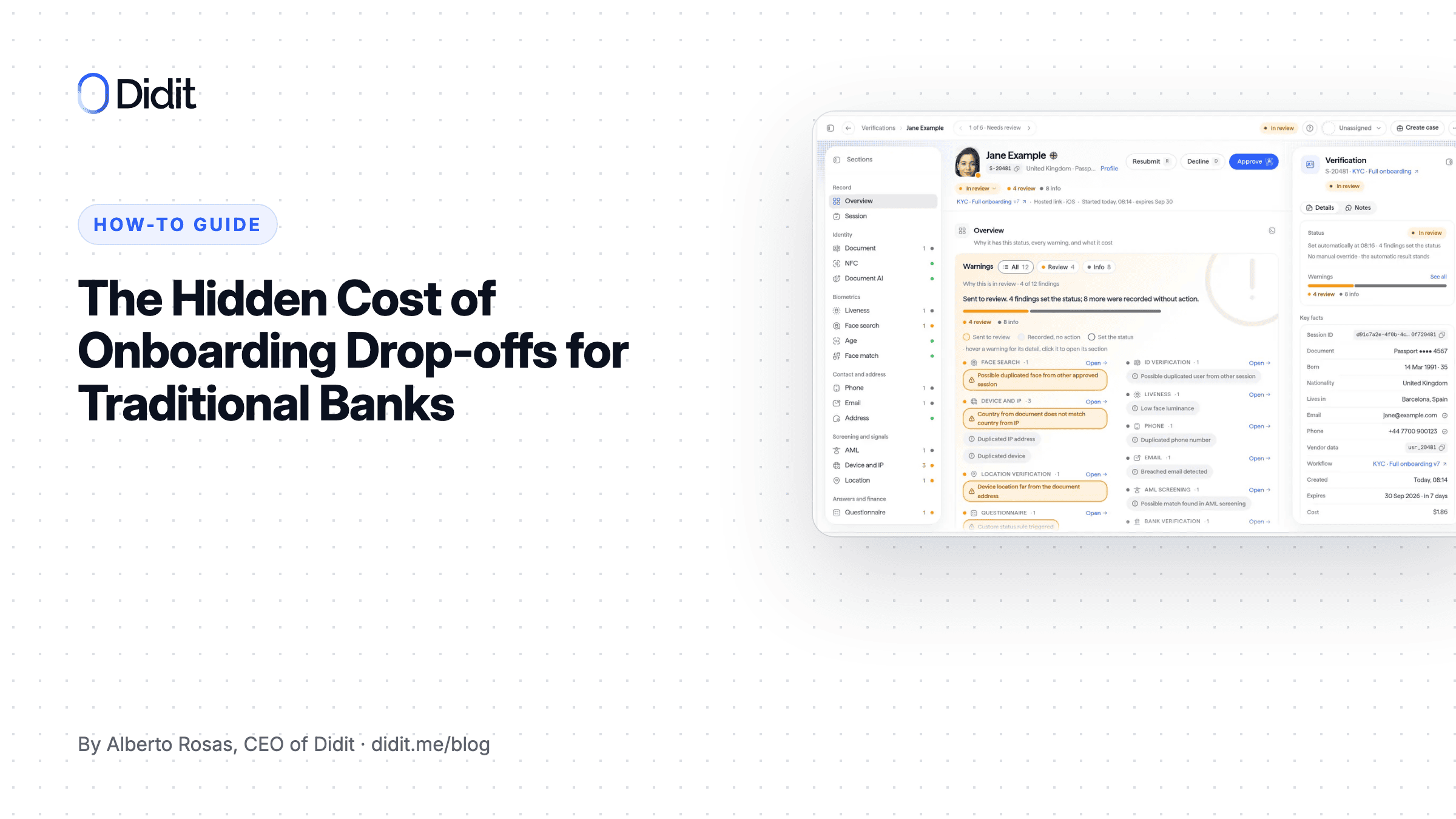
Abandoned remote onboarding costs a bank the revenue, the acquisition spend and the review hours. Measure it per workflow, price it with published unit costs, then remove the steps users abandon.
Alberto RosasMar 12, 2026Compliance-as-Code for Multi-Jurisdiction AML: A Developer's Guide to GitOps
Navigate complex multi-jurisdiction AML with Compliance-as-Code and GitOps. This guide offers developers a strategic framework to automate compliance, enhance auditability, and ensure consistency across diverse regulatory.
Alberto RosasMar 12, 2026Combating Synthetic Identity Fraud with Graph-Based Machine Learning
Synthetic identity fraud is a growing threat, merging real and fake data to create new personas. This post explores how graph-based machine learning offers a powerful defense, identifying complex fraud patterns that evade.
Alberto RosasMar 12, 2026Geolocation Compliance in Emerging Online Gaming Markets
Navigating geolocation compliance in emerging online gaming markets is critical for legal operation and fraud prevention. This blog explores the complexities, regulatory landscapes, and the essential role of robust identity.
Alejandro RosasMar 12, 2026Navigating GDPR Article 6: Lawful Identity Processing with Didit
Understanding and implementing GDPR Article 6 for lawful identity processing is crucial for businesses operating in the EU. This article breaks down the six legal bases, offering practical advice and highlighting how Didit's.
Alberto RosasMar 12, 2026Securing Remote Notarization with Biometric Liveness Detection
Remote notarization has surged in popularity, but it introduces unique security challenges. Biometric liveness detection is critical for verifying the identity of signers and preventing fraud.
Alejandro RosasMar 12, 2026Securing Decentralized Identity with Chip-Based Credentials
Decentralized Identity (DID) promises a user-centric future, but robust security is paramount. Chip-based credentials, like ePassports and eIDs, offer the highest level of assurance, bridging the gap between physical and digital.
Alberto RosasMar 12, 2026Streamlining Remote Work Visa Applications with Travel Document Scanning
Efficient travel document scanning is crucial for smooth remote work visa applications. This guide explores the benefits of advanced OCR and AI in processing diverse international documents, ensuring compliance and reducing fraud.
Alberto RosasMar 12, 2026Dynamic Friction Orchestration for Age Verification in Online Gaming
Discover how dynamic friction orchestration revolutionizes age verification in regulated online gaming. Learn to balance compliance with user experience, using AI-native solutions like Didit's Age Estimation to adapt.
Alberto RosasMar 12, 2026Building a Scalable ePassport Verification System in the Cloud
Discover the essential architecture for a scalable, cloud-native ePassport verification system, focusing on security, performance, and flexibility.
Alberto RosasMar 12, 2026The Economics of Data Minimization in Identity Verification
Understanding the ROI of data minimization in identity verification is crucial for modern businesses. This blog explores how reducing data collection can cut costs, enhance security, improve customer trust, and ensure.
Alberto RosasMar 12, 2026Biometric SDK Performance Benchmarking for iOS/Android
Benchmarking biometric SDKs on iOS/Android is crucial for robust identity verification, focusing on accuracy, speed, and user experience. Understanding key metrics like FAR, FRR, and latency ensures optimal performance and fraud.
Alejandro RosasMar 12, 2026GDPR Article 25: Implementing Privacy by Design with Didit's SDK
GDPR Article 25 mandates Privacy by Design and by Default, requiring organizations to integrate data protection into systems and processes from the outset.
Alejandro RosasMar 12, 2026CI/CD for Mobile IDV SDKs: Best Practices for Developers
Building a robust CI/CD pipeline for mobile identity verification (IDV) SDKs is crucial for rapid iteration, quality assurance, and seamless integration.
Alberto RosasMar 12, 2026Boosting Privacy in Mobile Health Apps with SDKs
Mobile health apps handle sensitive personal data, making privacy paramount. Privacy-enhancing SDKs are crucial for safeguarding user information, ensuring compliance, and building trust.
Alejandro RosasMar 12, 2026Boosting Security: NFC eID Verification with MFA
Integrating NFC eID verification with multi-factor authentication (MFA) creates a robust security framework for identity verification. This powerful combination significantly enhances fraud prevention and strengthens compliance.
Alejandro RosasMar 12, 2026Navigating Global Sanctions: OFAC, EU, UN, and Beyond
Understanding and complying with global sanctions lists like those from OFAC, the UN, and the EU is crucial for businesses worldwide. This blog explores key sanctions regimes, the complexities of compliance, and how advanced AML.
Alberto RosasMar 12, 2026Boost E-commerce Age Gating Conversion Rates
Optimizing age gating in e-commerce is crucial for compliance and user experience. This guide explores strategies to minimize friction, enhance accuracy, and leverage advanced AI solutions like Didit's Age Estimation to improve.
Alberto RosasMar 12, 2026Optimizing AML Screening for High-Frequency Trading
High-Frequency Trading (HFT) firms face unique challenges in Anti-Money Laundering (AML) compliance, demanding real-time, accurate, and scalable screening solutions.
Alberto RosasMar 12, 2026Cross-Border AML Screening: Navigating Global Watchlist Disparities
Effectively managing Anti-Money Laundering (AML) compliance across borders requires navigating a complex landscape of disparate global watchlists and regulatory requirements.
Alberto RosasMar 12, 2026White-Labeling KYC for PropTech: Seamless Identity Verification
Discover how white-labeling Know Your Customer (KYC) processes can transform user experience and build trust for PropTech platforms. This blog explores the benefits of integrating branded identity verification, ensuring.
Alberto RosasMar 12, 2026Verification Links: Cutting Customer Acquisition Costs
Verification links significantly reduce Customer Acquisition Costs (CAC) by streamlining onboarding and enhancing user experience. By offloading identity verification to pre-built, secure flows, businesses minimize development.
Alberto RosasMar 12, 2026Optimizing Identity Verification Costs: Beyond Pay-per-Success
Identity verification is crucial, but cost optimization often goes beyond simple pay-per-successful verification models. This post explores strategic approaches to reduce costs, enhance efficiency, and improve user experience by.
Alberto RosasMar 12, 2026Age Gating: Protecting Minors in the AI Era
Age gating is becoming crucial for responsible AI model access, safeguarding minors from inappropriate content and ensuring compliance. This post explores the challenges, best practices, and how Didit's advanced Age Estimation.
Alejandro RosasMar 12, 2026Questions
Blog questions
Who writes the Didit blog?
Which topics does the blog cover?
Is the blog available in my language?
Where do I find product updates?
Are these posts legal advice?
How do I find posts on one topic?
Are posts dated?
Do posts link to the docs?
Is the blog the same as the docs?
Compliance built in
Audited, certified and attested.
We hold the certifications and build each country's rules into your flows, so you can launch anywhere without worrying. Security and Compliance center
- Regulation encoded into your flows
Tell us what you do and where. Didit lists the rules that apply to you, with sources, and builds the checks each country needs into one workflow.
- Ready for AMLR
Every requirement of the new EU anti-money laundering rules, from checking customers to human review, is already covered by a Didit check.
- Tested in Spain's Treasury sandbox
Spain's Treasury published its supervised sandbox report on Didit's NFC plus active liveness onboarding; SEPBLAC took part and valued the added measures positively.
- Audited, not self-declared
iBeta Level 1 and Level 2. Liveness tested under ISO/IEC 30107-3.
Your obligations · 3 regions
 SOC 2 Type 2
 ISO 27001
 iBeta Level 1 and Level 2
 EU regulator attestation
 FSM youth protection
 GDPR
 EBA remote onboarding
 MiCA compatible
 FIDO Alliance member
- AMLREU AML Regulation ready
Integration · Didit MCP
Run Didit from your own AI agent
Connect Didit to Claude, Cursor, VS Code or ChatGPT and just ask in plain words. Your agent can do anything you can do in the console, with the same permissions you have.
 Add to Claude
 ChatGPT
 Cursor
- Build workflowsDescribe the checks you need. The agent creates and publishes the flow.
- Run investigationsAsk why a session was declined, review cases, search people and companies.
- Change rulesCreate payment rules, test them on past data and switch them on.
- Pull reportsAsk for numbers, exports or the audit log.
Didit Academy


