Blog
Blog archive
Every post on the Didit blog, newest first. Pick a category or search to find the subject you need.
All posts
Every post, newest first
Pick a category to filter.
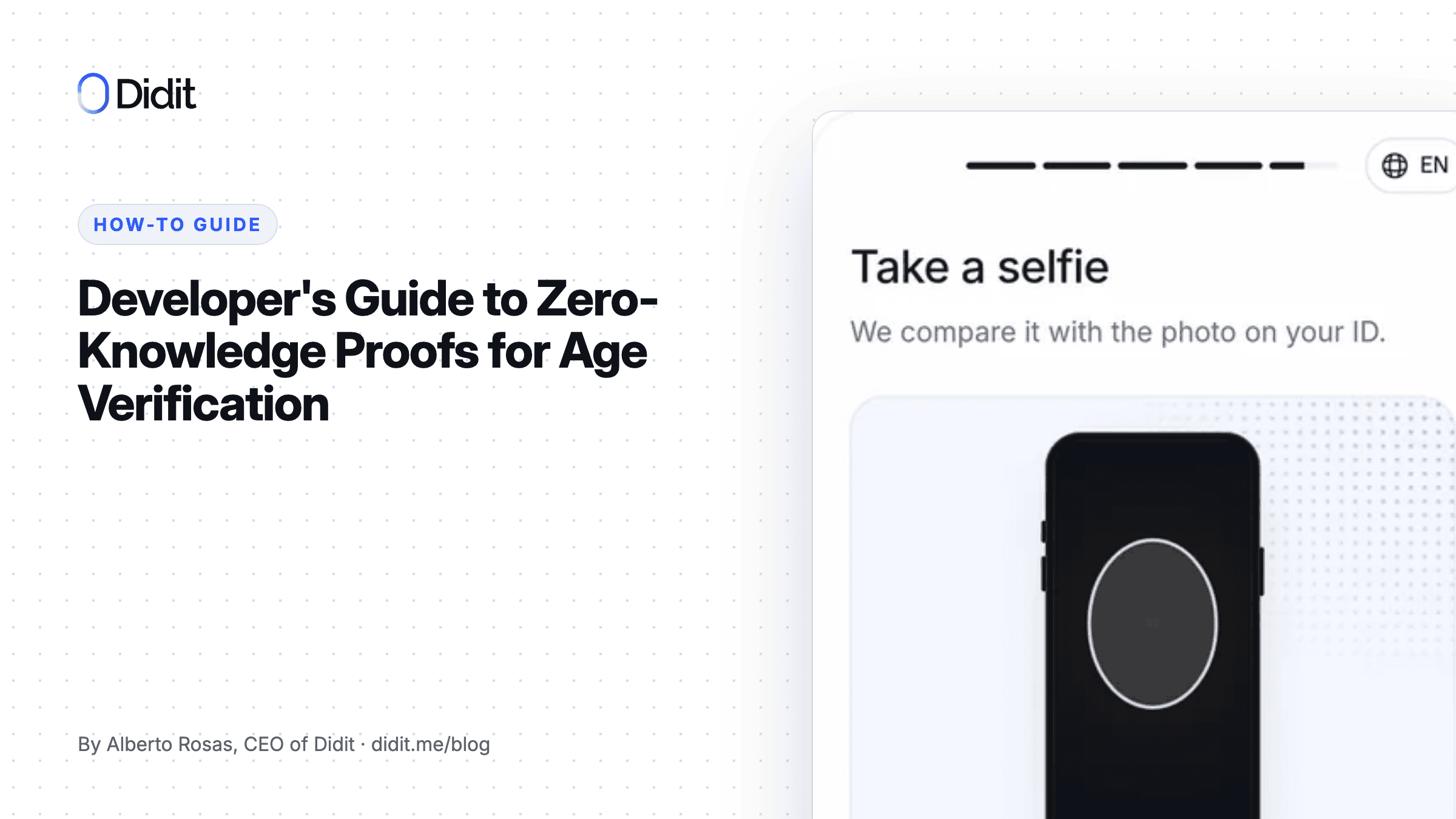
Didit does not issue zero-knowledge proofs. We return the age decision, $0.10 per Age Estimation check or $0.15 per ID Verification step, and you wrap it in a proof. A model-estimated age is an age gate, not legal proof.
Alejandro RosasMar 6, 2026Developer's Guide to Dynamic Fallback Workflows for IDV APIs
Learn how to implement robust dynamic fallback workflows for Identity Verification (IDV) APIs to enhance user experience and ensure high verification rates.
Alejandro RosasMar 6, 2026Privacy-Preserving Analytics on Identity Data with Spark and Didit
Learn how to implement privacy-preserving analytics on sensitive identity data using Apache Spark and Didit. This guide covers data anonymization techniques, secure processing workflows, and leveraging Didit's modular identity.
Alberto RosasMar 6, 2026Composable Identity Primitives for ZKP-Auth: A Developer's Guide
Dive into the future of privacy-preserving authentication with Zero-Knowledge Proofs (ZKP). This guide explores how composable identity primitives empower developers to build robust, privacy-centric systems, leveraging.
Alberto RosasMar 6, 2026Seamless E2E Testing: Playwright & Didit's Sandbox for Identity
Effectively testing identity verification workflows is crucial for user experience and compliance. This blog explores how Playwright, combined with Didit's developer-first sandbox environment, offers a robust solution for.
Alberto RosasMar 6, 2026WASI for Portable Identity Verification Runtimes
Explore how WebAssembly System Interface (WASI) is revolutionizing identity verification by enabling highly portable, secure, and performant runtimes.
Alberto RosasMar 6, 2026Programmatic Adverse Media Screening: Didit API How-To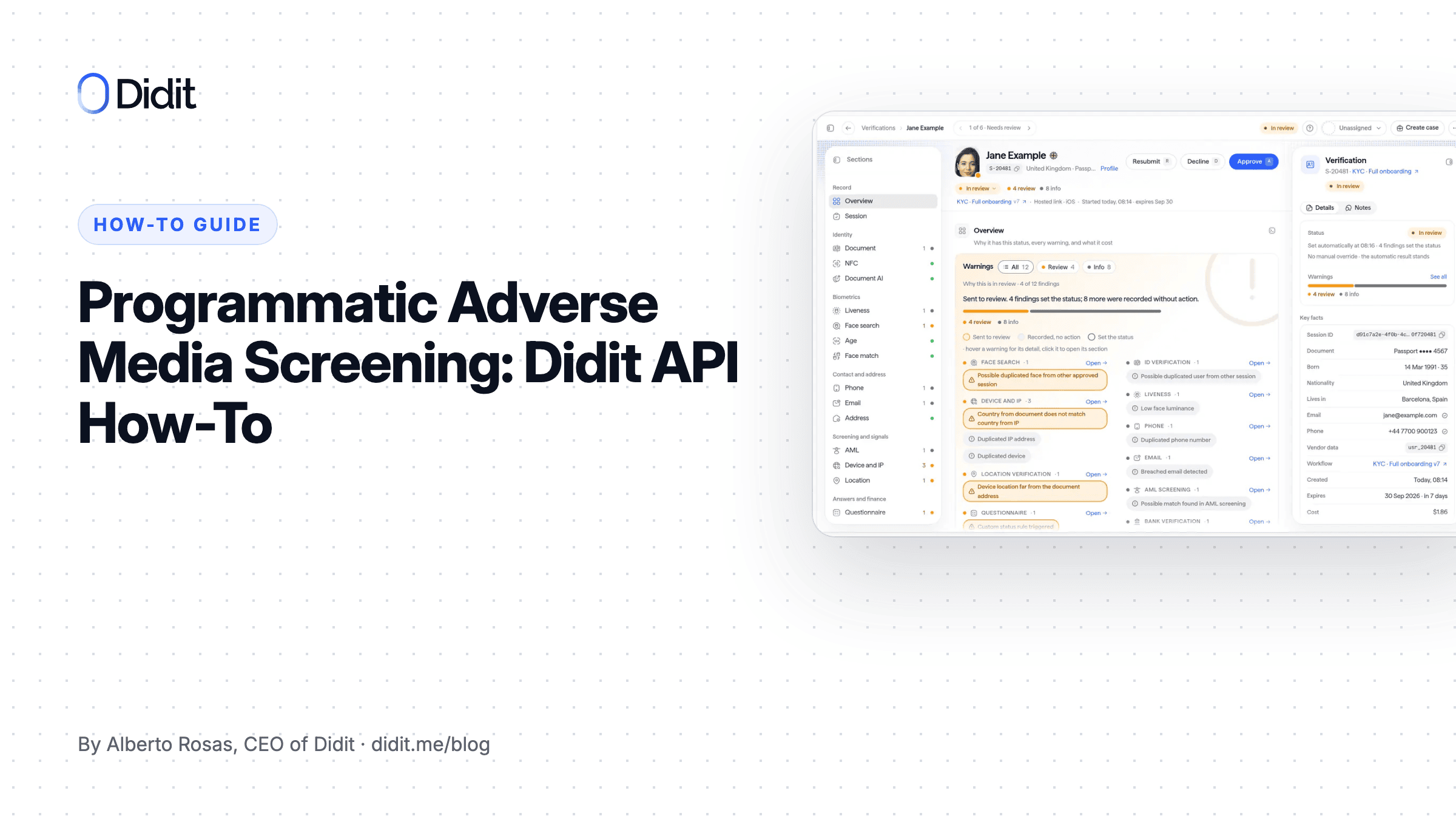
POST /v3/aml/ with include_adverse_media true screens a person against sanctions, PEP, warning and watchlist data from 1,300+ global watchlists, with adverse-media enrichment in the same call, for $0.20.
Alejandro RosasMar 6, 2026Real-time Anomaly Detection: Didit, eBPF & Transaction Monitoring
Discover how combining Didit's identity verification events with eBPF for transaction monitoring enables unparalleled real-time anomaly detection.
Alberto RosasMar 6, 2026PEC for Secure Biometric Templates: A Didit Perspective
Privacy-Enhancing Cryptography (PEC) is crucial for securing biometric templates, preventing data breaches, and maintaining user trust. Learn how techniques like homomorphic encryption and secure multi-party computation protect.
Alberto RosasMar 6, 2026Agent-Based Compliance: Automating KYC with Didit's Programmatic Identity
Discover how to build agent-based compliance frameworks using Didit's programmatic identity platform. Automate KYC, AML, and identity verification workflows with AI agents, ensuring efficiency, scalability, and robust security.
Alberto RosasMar 6, 2026LLM Tool-Use for KYC: Automating Document Analysis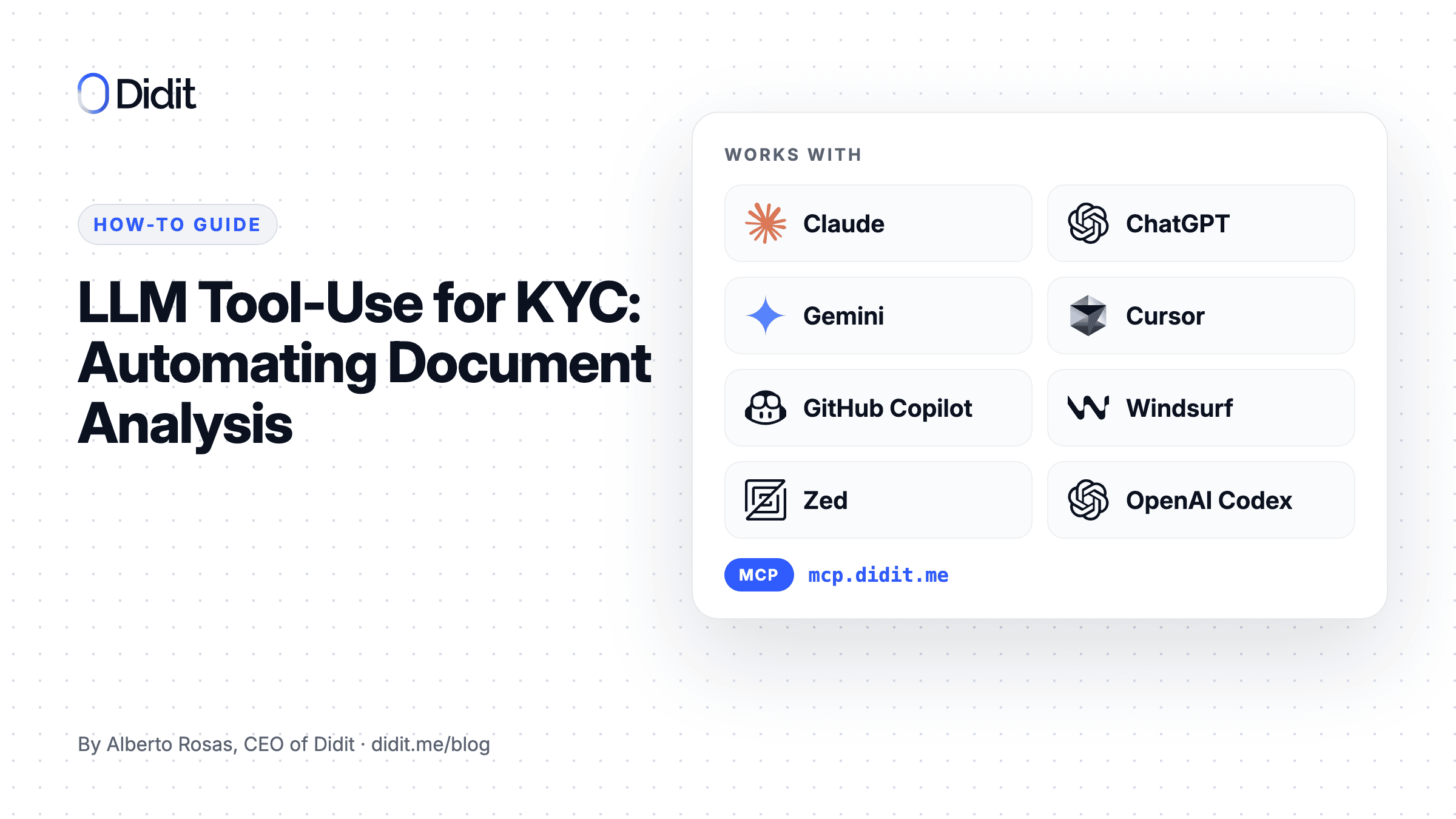
Automate KYC document analysis by calling Didit Document AI with a field list. The model returns typed fields, a name match score and risk codes. $0.20 per document; a person still decides In Review cases.
Alberto RosasMar 6, 2026Homomorphic Encryption for Privacy-Preserving Identity Protocols
This post explores Homomorphic Encryption (HE) as a transformative technology for identity verification, enabling computations on encrypted data without decryption.
Alejandro RosasMar 6, 2026LLM-Powered KYC: Automating Identity Workflows with AI Agents
Discover how LLM-powered AI agents are revolutionizing KYC by orchestrating identity verification workflows, enhancing efficiency, and reducing manual intervention.
Alberto RosasMar 6, 2026Securing API Gateway Micro-Authorizations with Didit's Identity Data
Effectively securing microservices with fine-grained authorization at the API gateway is crucial. This article explores common challenges and demonstrates how Didit's structured identity data and modular platform offer a robust.
Alberto RosasMar 6, 2026Securing Supply Chains: M2M Identity Verification for IoT
Machine-to-Machine (M2M) identity verification is critical for securing IoT devices in modern supply chains. This post explores the challenges, best practices, and how AI-native solutions like Didit's modular platform can.
Alberto RosasMar 6, 2026Automating API Contract Testing with Didit in CI/CD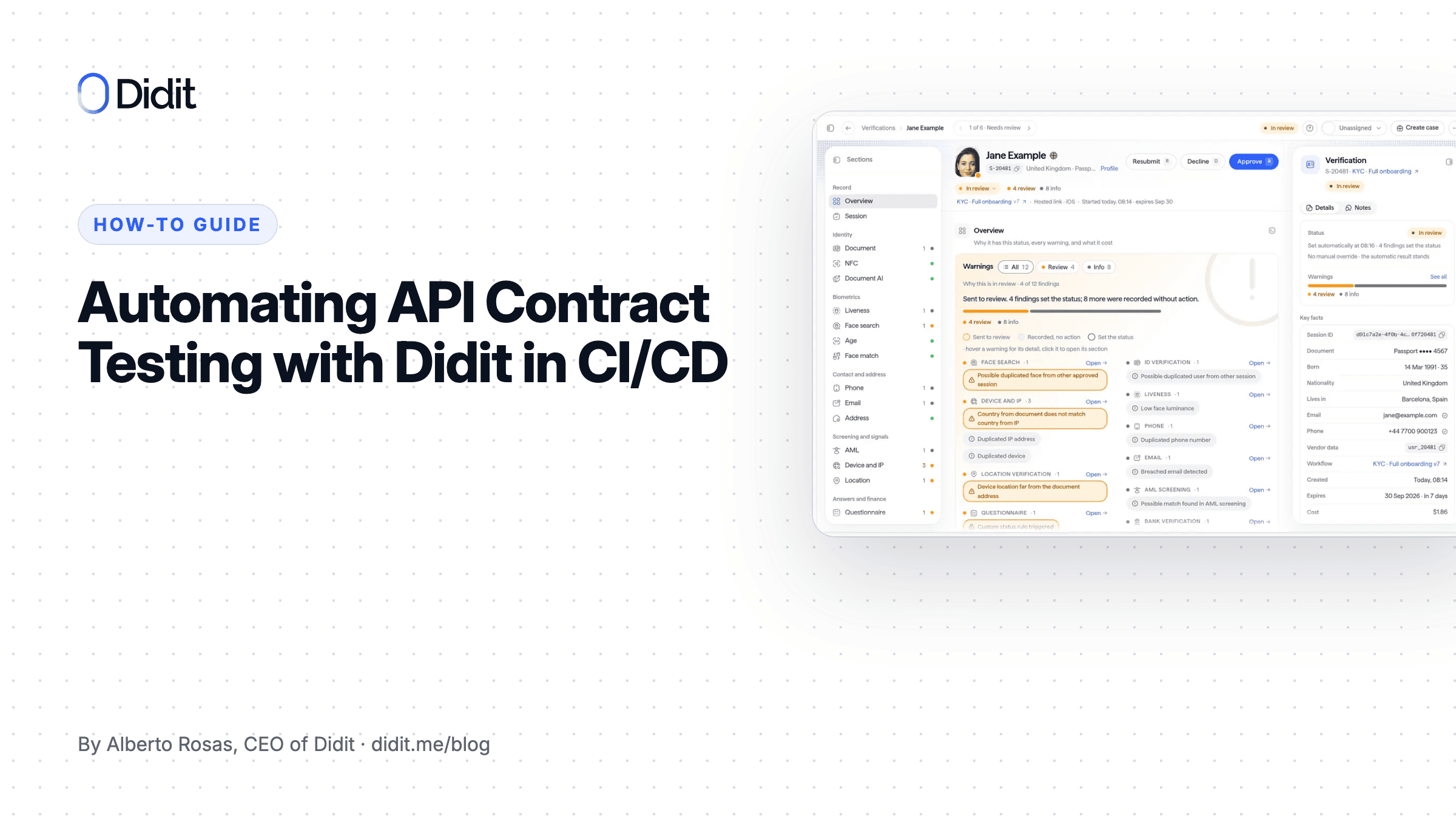
Contract-test the Didit API in CI/CD: pin the OpenAPI file, create sandbox sessions with fixed scenarios, assert decision and error shapes on every pull request. Sandbox sessions are never billed.
Alejandro RosasMar 6, 2026Rust & Tokio for High-Performance Didit Webhook Consumption
Discover how Rust and Tokio create a robust, high-performance system for processing Didit webhooks, ensuring reliability and scalability for critical identity verification events.
Alberto RosasMar 6, 2026Build an Adaptive Friction Engine with Didit & Redis Streams
Discover how to build a real-time adaptive friction engine using Didit's AI-native identity verification and Redis Streams. This powerful combination allows businesses to dynamically adjust identity verification steps.
Alberto RosasMar 6, 2026Optimizing IDV Data Pipelines with Kafka for Compliance
Discover how real-time ETL with Apache Kafka revolutionizes Identity Verification (IDV) data pipelines, enabling immediate compliance reporting and robust fraud detection.
Alberto RosasMar 6, 2026API Security for Webhooks: HMAC and Key Rotation (2026)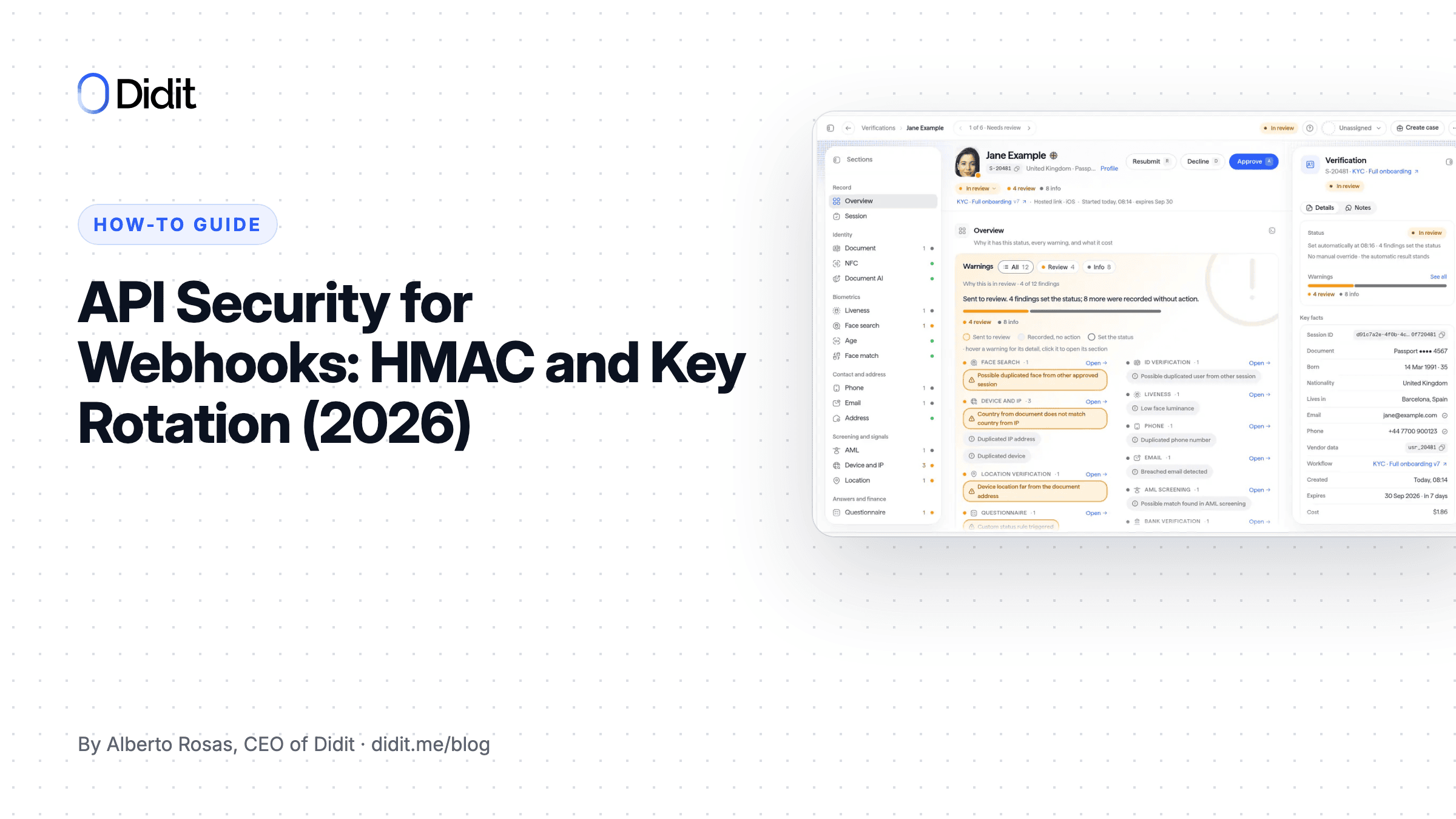
Verify every delivery with HMAC-SHA256 on the raw body or X-Signature-V2 canonical JSON, reject timestamps older than 300 seconds, and rotate a Business Console destination secret while -Previous headers are still sent for 24.
Alejandro RosasMar 6, 2026Implementing SIOP for Verifiable Credential Issuance (2026)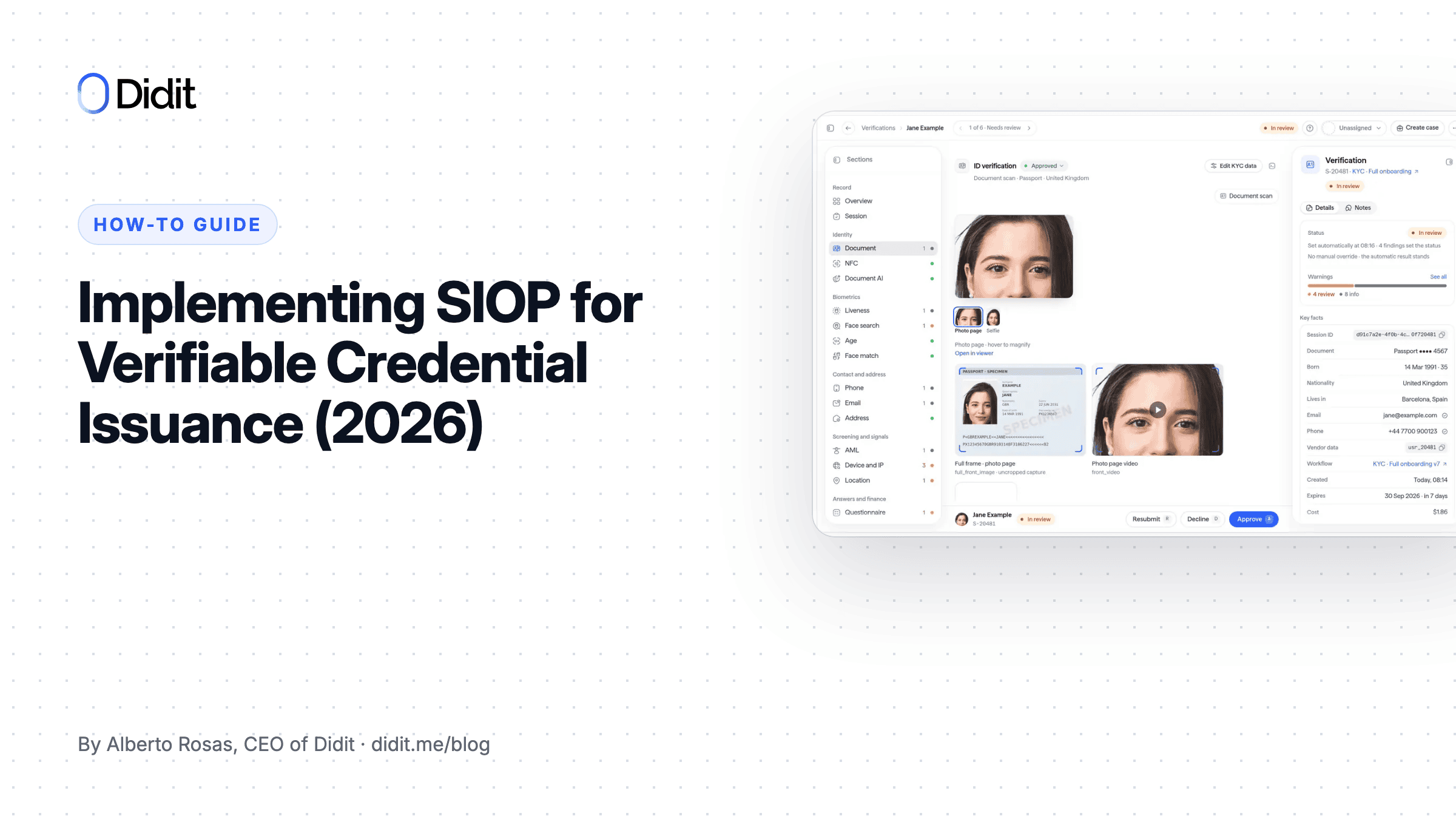
Verify the person with Didit before your issuer signs a credential. Use the Sessions API or a digital ID wallet, read the verification decision, then mint the VC bound to the holder key.
Alberto RosasMar 6, 2026Optimizing ID Verification API Latency for Real-time Trading
Low latency in ID verification is paramount for real-time trading platforms to ensure rapid onboarding, compliance, and fraud prevention without impeding user experience.
Alejandro RosasMar 6, 2026Escaping the Trap: Migrating from In-House Identity Verification
In-house identity verification systems often accumulate significant technical debt, leading to escalating maintenance costs, compliance burdens, and limitations in scalability and fraud prevention.
Alejandro RosasMar 6, 2026Complying with CA AADC: How Didit's Age Estimation API Helps
Navigating the California Age-Appropriate Design Code (CA AADC) is crucial for businesses handling user data. Didit's AI-native Age Estimation API offers a privacy-preserving and accurate solution to verify age, ensuring.
Alejandro RosasMar 6, 2026Zero-Trust Device Posture with Didit Device Intelligence
Implement robust Zero-Trust security with Didit's Device Intelligence and IP Analysis. Discover how continuous device posture assessment, VPN/Tor detection, and real-time analytics protect against sophisticated threats, ensuring.
Alberto RosasMar 6, 2026Dynamic Pricing for Identity Verification: Optimize Costs with Didit
Discover how dynamic pricing in identity verification, particularly Didit's pay-per-successful-check model, can significantly optimize operational costs.
Alberto RosasMar 6, 2026Enhancing Didit API Key Security with HSMs
Discover how Hardware Security Modules (HSMs) provide an unparalleled layer of protection for your Didit API keys, safeguarding sensitive operations and ensuring compliance.
Alejandro RosasMar 6, 2026Seamless Identity: Integrating Didit with Open-Source IAM
Discover how Didit's modular, AI-native identity verification platform seamlessly integrates with open-source Identity and Access Management (IAM) solutions.
Alejandro RosasMar 6, 2026Secure Your Webhooks: HMAC and Key Rotation for Didit Events
Read the raw body, check X-Timestamp within 300 seconds, recompute HMAC-SHA256 with your destination secret, compare in constant time, and rotate the secret with the 24 hour -Previous overlap.
Alejandro RosasMar 6, 2026Envoy Proxy for High-Throughput Identity Verification APIs
Building a robust API gateway is crucial for handling the demands of high-throughput identity verification. Envoy Proxy offers advanced features like load balancing, circuit breaking, and observability, ensuring reliable and.
Alejandro RosasMar 6, 2026Automated Incident Response for Identity Theft with Didit
Identity theft is a growing threat, demanding robust and automated incident response strategies. Integrating advanced identity verification platforms like Didit with SIEM/SOAR systems provides real-time detection, rapid.
Alberto RosasMar 6, 2026Automating GDPR DSAR Fulfillment with Didit's Workflow API
Efficiently manage GDPR Data Subject Access Requests (DSARs) by leveraging Didit's powerful Workflow API. This allows for automated, compliant, and secure retrieval and processing of personal data, reducing manual effort and.
Alejandro RosasMar 6, 2026Architect's Guide to Multi-Region, Active-Active Identity Verification
Building resilient, globally scalable identity verification systems requires a multi-region, active-active architecture. This guide provides architects with actionable strategies for achieving high availability, low latency, and.
Alberto RosasMar 6, 2026Microservices Identity Architecture: Centralized vs. Decentralized Models
Explore the nuances of centralized and decentralized identity architectures within microservices, understanding their trade-offs in scalability, security, and compliance.
Alberto RosasMar 6, 2026Microservices Identity with Didit: Securing Communication
Securing microservices communication is paramount, especially as architectures grow more distributed. This blog explores how SPIFFE/SPIRE provides a robust framework for cryptographic workload identity, enabling secure, verified.
Alberto RosasMar 6, 2026Advanced Error Handling & Observability for Identity Verification Microservices
Building robust identity verification microservices requires sophisticated error handling and observability. This post explores common challenges, best practices for proactive monitoring, and how Didit's AI-native platform.
Alberto RosasMar 6, 2026Securing Multi-Tenant SaaS KYC: Data Isolation & API Keys
Multi-tenant SaaS platforms face unique KYC challenges, demanding robust data isolation and secure API key management. This post explores best practices for protecting sensitive user data, ensuring compliance, and leveraging.
Alejandro RosasMar 6, 2026Microservices Identity Architecture: Orchestrating Verification
Implementing identity verification within a microservices architecture presents unique challenges, from data consistency to maintaining compliance across distributed systems.
Alejandro RosasMar 6, 2026Serverless Edge Functions for Low-Latency Identity Checks
Discover how integrating Didit with serverless edge functions revolutionizes identity verification, offering unparalleled speed and security.
Alberto RosasMar 6, 2026Batch Processing Identity Verifications: Optimizing Throughput and Cost
Discover how batch processing identity verifications can significantly reduce costs and improve efficiency for businesses. Learn about the strategic advantages of processing multiple verifications simultaneously and how Didit's.
Alberto RosasMar 6, 2026Predictive Fraud Modeling with Didit's Structured Data & TensorFlow
Discover how Didit's structured identity data, combined with TensorFlow, empowers organizations to build advanced predictive fraud models. Learn to leverage comprehensive verification outputs, from ID Verification to Liveness.
Alejandro RosasMar 6, 2026Building a Graph-Based AML Anti-Collusion System with Didit and Neo4j
Discover how to combat sophisticated financial crime by leveraging graph databases like Neo4j with enriched identity data from Didit. This post explores identifying collusion, detecting synthetic identities, and enhancing AML.
Alberto RosasMar 6, 2026Architect's Guide to Building a 'Bring Your Own Identity' (BYOI) System
Building a BYOI system allows users to leverage existing verified identities, enhancing security and user experience. This guide explores the architectural considerations, integration strategies, and best practices for.
Alberto RosasMar 6, 2026Graph-Based Fraud Detection with Didit and Amazon Neptune
Discover how to build a powerful, real-time fraud detection system by integrating Didit's robust identity verification data with Amazon Neptune's graph database capabilities.
Alberto RosasMar 6, 2026Building a Robust Fraud Operations Playbook for BNPL Services
Establishing a strong fraud operations playbook is crucial for Buy Now, Pay Later (BNPL) services to mitigate risks, protect revenue, and maintain customer trust.
Alberto RosasMar 6, 2026Kubernetes Admission Controllers for Automated Identity Policy Enforcement
Kubernetes Admission Controllers are vital for enforcing identity and security policies, ensuring only authorized actions and resources are deployed.
Alberto RosasMar 6, 2026Real-time Identity Verification Results to Your Data Warehouse
Integrating identity verification results into your data warehouse in real-time is crucial for advanced analytics, fraud detection, and compliance.
Alberto RosasMar 6, 2026Composable Identity Primitives for ZKP-Auth: A New Era of Privacy
Zero-Knowledge Proof-Based Authentication (ZKP-Auth) is revolutionizing how we approach privacy and security in digital identity. By enabling users to prove specific attributes without revealing underlying data, ZKP-Auth.
Alberto RosasMar 6, 2026Rust + WebSockets: Real-time Identity Event Streaming
Discover how Rust and WebSockets combine to create a robust, high-performance solution for real-time identity event streaming. This powerful duo is ideal for handling the demands of modern identity verification, offering speed.
Alberto RosasMar 6, 2026Building a Resilient API Gateway for High-Throughput Identity Verifications with Envoy Proxy
Discover how Envoy Proxy can fortify your identity verification infrastructure, ensuring high-throughput, resilience, and security. We explore its role in microservices, rate limiting, and advanced traffic management.
Alberto RosasMar 6, 2026Idempotent Webhook Consumers in Ruby on Rails for Didit Events
Building robust webhook consumers is crucial for reliable data processing, especially for real-time events from identity verification platforms like Didit.
Alejandro RosasMar 6, 2026Off-Chain Identity for On-Chain Governance: Bridging Didit with Aragon/Snapshot
Explore how off-chain identity verification, powered by Didit, can enhance the integrity and security of on-chain governance platforms like Aragon and Snapshot.
Alberto RosasMar 6, 2026Implementing Federated Identity with Didit and SAML for Enterprise SSO
Federated identity, powered by SAML, streamlines enterprise Single Sign-On (SSO) by enabling seamless, secure access across multiple applications.
Alejandro RosasMar 6, 2026Implementing ZTNA with Didit Identity Attributes
Zero-Trust Network Access (ZTNA) is essential for modern security, but its effectiveness hinges on robust identity verification. This post explores how identity attributes, especially those provided by Didit, can elevate your.
Alberto RosasMar 6, 2026Advanced Privacy: Secure Multi-Party Computation with Didit
Explore the power of Secure Multi-Party Computation (SMC) in protecting sensitive data while enabling critical identity verification processes.
Alberto RosasMar 6, 2026Enhancing Identity Analytics with Differential Privacy
Explore how advanced data privacy techniques, particularly Differential Privacy, are revolutionizing identity analytics by enabling valuable insights without compromising individual data.
Alberto RosasMar 6, 2026Observability for Identity Workflows: Prometheus & Grafana
Achieving robust observability for identity verification workflows is crucial for performance, security, and compliance. This post explores leveraging Prometheus and Grafana to monitor key metrics, identify bottlenecks, and.
Alberto RosasMar 6, 2026WebAssembly for On-Device Identity: Powering AI Agents
Explore how WebAssembly (Wasm) is revolutionizing on-device identity processing, enabling faster, more secure, and privacy-preserving verification directly on user devices.
Alberto RosasMar 6, 2026GDPR Data Minimization in Rust for Identity Workflows
Achieving GDPR-compliant data minimization in identity verification workflows is crucial for privacy and regulatory adherence. This post explores practical strategies, Rust's role in secure data handling, and how Didit's.
Alberto RosasMar 6, 2026Orchestrating Device Intelligence & Kubernetes for Fraud Prevention
Discover how combining robust device intelligence with Kubernetes orchestration can revolutionize fraud prevention strategies. Learn to detect sophisticated fraud, enhance security, and scale your identity verification processes.
Alberto RosasMar 6, 2026Accelerate Go Integration Testing with Didit's Sandbox API
Efficient integration testing is crucial for robust identity verification systems. Didit's Sandbox API provides a powerful, developer-first environment for Go developers to test integrations thoroughly, ensuring seamless.
Alejandro RosasMar 6, 2026Programmatic Identity Orchestration with Apache Camel and Didit
Discover how to achieve seamless, automated identity verification by integrating Apache Camel with Didit's AI-native identity platform. This guide explores programmatic registration, dynamic workflow orchestration, and.
Alberto RosasMar 6, 2026Predictive AML with Scikit-learn & Didit's Structured Data
Discover how Didit's granular, structured AML data fuels powerful predictive models using Scikit-learn. Learn to build more effective financial crime detection systems, enhance compliance, and reduce false positives by.
Alberto RosasMar 6, 2026Enhancing Identity Security with HSMs for Key Management
Hardware Security Modules (HSMs) are crucial for safeguarding cryptographic keys in identity systems, offering tamper-proof protection and robust compliance.
Alberto RosasMar 6, 2026Securing Multi-Region Identity Verification Deployments
Deploying identity verification services across multiple regions introduces unique security and compliance challenges. This post explores best practices for data residency, robust encryption, and high availability, emphasizing.
Alberto RosasMar 6, 2026Implementing GDPR-Compliant DSARs for Identity Data
Navigating Data Subject Access Requests (DSARs) under GDPR is crucial for businesses handling identity data. This post explores the complexities of DSARs, including data identification, secure access, and timely fulfillment.
Alberto RosasMar 6, 2026Building Custom Identity Checks with an Extensible Plugin Architecture
Discover how an extensible plugin architecture is crucial for modern identity verification, allowing businesses to adapt to evolving compliance needs and fraud threats.
Alejandro RosasMar 6, 2026Rust Microservice for High-Performance AML Screening with Didit
Discover how to build a high-performance Rust microservice for Anti-Money Laundering (AML) screening, leveraging Didit's robust API. This guide covers the benefits of Rust for compliance, integrating Didit's real-time AML.
Alberto RosasMar 6, 2026Data Residency Compliance in Global ID Verification
Navigating data residency requirements is crucial for global identity verification. This post explores the challenges, regulatory landscape, and strategies for ensuring compliance while maintaining seamless user onboarding.
Alberto RosasMar 6, 2026Optimizing API Gateways for Didit Webhook Scalability and Security
Effectively managing webhooks from identity verification providers like Didit requires robust API Gateway strategies. This guide explores best practices for ensuring scalability, enhancing security through HMAC signature.
Alejandro RosasMar 6, 2026Building a Graph Database for Identity Resolution with Didit Data
Discover how graph databases enhance identity resolution by connecting disparate data points, combatting synthetic fraud, and improving compliance.
Alberto RosasMar 6, 2026Homomorphic Encryption for Privacy-Preserving Identity Analytics
Explore how homomorphic encryption (HE) can revolutionize privacy-preserving analytics on structured identity data, enabling secure computations without decrypting sensitive information.
Alejandro RosasMar 6, 2026Integrating Didit's API with GraphQL Gateways
This guide explores best practices for integrating Didit's robust identity verification API with GraphQL gateways, ensuring seamless, secure, and scalable data flow.
Alejandro RosasMar 6, 2026Building an Age Estimation API Proxy with Rate Limiting in Go
Learn how to build a robust API proxy for age estimation services in Go, incorporating essential features like rate limiting to manage traffic and protect your backend.
Alberto RosasMar 6, 2026Blockchain Identity: Verifiable Credentials on Ethereum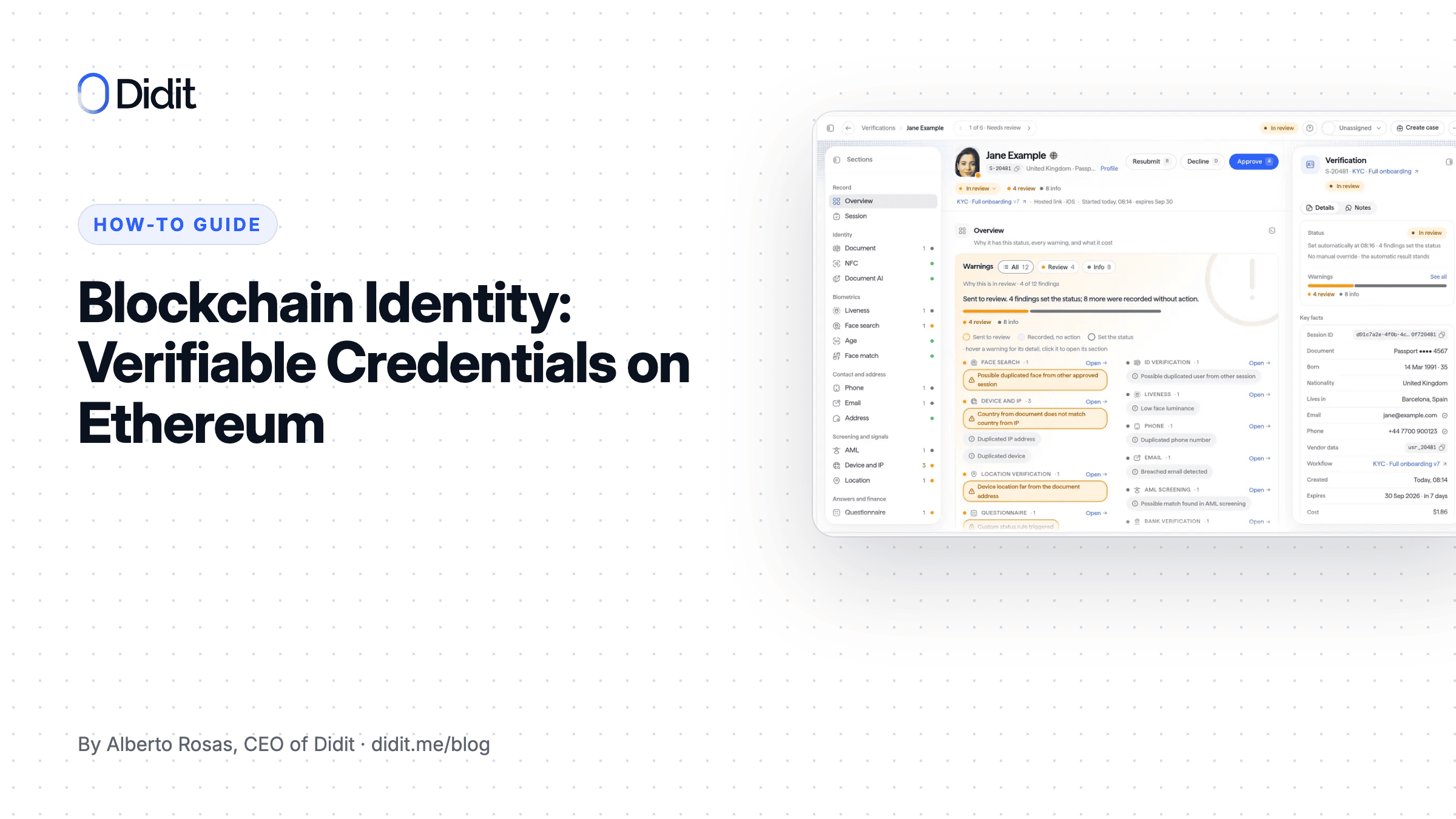
Didit verifies the person and screens the wallet; your issuer service signs the W3C credential and your Ethereum contract stores its hash and revocation state. ID check $0.33, wallet screening $0.15.
Alberto RosasMar 6, 2026Seamless Branding: Theming Didit's Mobile SDK UI Components
Achieving a consistent brand experience during identity verification is crucial for user trust and conversion. This post explores how advanced UI theming, particularly with Didit's Mobile SDK, allows businesses to fully.
Alejandro RosasMar 6, 2026Database Validation: Securely Verify Identities Programmatically
Discover how database validation endpoints enable businesses to programmatically verify identities against official government registries, significantly enhancing security and compliance.
Alberto RosasMar 6, 2026Bridging Off-Chain Identity to On-Chain Applications with Didit and Chainlink Functions
Integrating real-world identity with blockchain applications is crucial for Web3 adoption. This post explores how Didit's robust identity verification solutions, combined with Chainlink Functions, create a secure, verifiable.
Alberto RosasMar 6, 2026Building a DID Resolver for Didit's Verifiable Credentials
Building a Decentralized Identifier (DID) resolver is crucial for unlocking the full potential of Verifiable Credentials (VCs). This guide explores the architecture, implementation, and the importance of secure resolution for.
Alberto RosasMar 6, 2026Securing Multi-Party Computation for Sensitive Identity Data
Multi-Party Computation (MPC) offers a revolutionary way to process sensitive identity data while preserving privacy, but its implementation presents unique security challenges.
Alberto RosasMar 6, 2026Programmatic Identity Attestation for Container Orchestration with Didit and eBPF
Secure your containerized environments with programmatic identity attestation. This blog explores how Didit's AI-native identity platform, combined with eBPF, can provide real-time, verifiable trust for microservices, enhancing.
Alberto RosasMar 6, 2026Verifiable Credentials for KYC PII: No Centralized Storage
Explore how Verifiable Credentials (VCs) can revolutionize KYC by eliminating centralized storage of Personally Identifiable Information (PII), enhancing privacy, and reducing data breach risks.
Alberto RosasMar 6, 2026Boost Fraud Scoring in Next.js with Didit Device Intelligence
Integrating robust device intelligence into your Next.js applications is crucial for advanced fraud detection and scoring. Didit's AI-native platform provides comprehensive device and IP analysis, enabling real-time risk.
Alberto RosasMar 6, 2026Federated Learning for Privacy-Preserving Biometrics
Explore how Federated Learning revolutionizes biometric data handling by enabling privacy-preserving machine learning. This approach allows AI models to learn from decentralized data sources without direct data sharing, crucial.
Alberto RosasMar 6, 2026Optimizing Webhook Processing in Go for Real-time AML
Achieving real-time Anti-Money Laundering (AML) compliance requires efficient webhook processing. This post explores Go-specific strategies, including concurrency, error handling, and secure signature verification, to build.
Alejandro RosasMar 6, 2026Zero-Knowledge Proofs for Privacy-Preserving Age Verification
Explore how Zero-Knowledge Proofs (ZKPs) revolutionize age verification by enabling privacy-preserving checks without revealing personal data.
Alberto RosasMar 6, 2026High-Throughput Batch Verification with Didit & Apache Spark
Discover how to build a scalable, high-throughput batch identity verification system by integrating Didit's powerful API with Apache Spark. This guide covers architecture, data processing, and best practices for efficiently.
Alberto RosasMar 6, 2026Building a Decentralized Identity Gateway with Didit and Hyperledger Indy
Explore how to build a robust Decentralized Identity (DID) gateway using Didit's identity verification platform alongside Hyperledger Indy. This post covers the core concepts of DID, the role of verifiable credentials, and.
Alberto RosasMar 6, 2026Privacy-Preserving Record Linkage with Didit's APIs
Explore how to implement Privacy-Preserving Record Linkage (PPRL) using advanced cryptographic techniques like Homomorphic Encryption (HE) and Didit's robust APIs.
Alberto RosasMar 6, 2026Dynamic Identity Exchange with Didit and OPA for Access Control
Discover how to build a dynamic identity attribute exchange using Didit and Open Policy Agent (OPA) for robust, fine-grained access control.
Alberto RosasMar 6, 2026Securing Multi-Tenant SaaS KYC Architecture with Didit
Multi-tenant SaaS platforms face unique challenges in securing customer data, especially for Know Your Customer (KYC) processes. This article explores architectural patterns, data isolation strategies, and how Didit's modular.
Alberto RosasMar 6, 2026Building a Rust gRPC Client for High-Performance Didit API Integrations
Discover how to build a high-performance gRPC client in Rust for seamless integration with Didit's identity verification APIs. Learn about Rust's benefits for reliability and speed, and how Didit's modular, AI-native platform.
Alejandro RosasMar 6, 2026Distributed Tracing for Identity Workflows with Jaeger and Didit
Distributed tracing is essential for understanding and optimizing complex identity verification workflows. This post explores how Jaeger, combined with Didit's modular identity platform, provides unparalleled visibility into the.
Alberto RosasMar 6, 2026Optimizing Identity Verification API Performance
Understanding and optimizing identity verification API performance is crucial for a seamless user experience and robust security. This guide compares key metrics: latency, throughput, and error rates, offering actionable.
Alejandro RosasMar 6, 2026Building Resilient IDV: Circuit Breakers & Didit's Fault Tolerance
Discover how to design fault-tolerant identity verification systems using circuit breakers to prevent cascading failures. Learn best practices for implementing robust IDV, ensuring high availability, and integrating with.
Alberto RosasMar 6, 2026Terraform for Didit: Infrastructure-as-Code for Identity
Discover how Infrastructure-as-Code (IaC) with Terraform streamlines Didit identity verification deployments. Automate workflow configuration, enhance scalability, and maintain consistency across environments.
Alberto RosasMar 6, 2026Real-time Fraud Signal Orchestration with Didit, Flink, & Feature Stores
Discover how combining Didit's AI-native identity verification with Apache Flink and Feature Stores creates a powerful, real-time fraud detection system.
Alberto RosasMar 6, 2026Programmatic Identity Attestation for Microservices with Didit
Secure your containerized microservices by implementing robust programmatic identity attestation. This post explores how Didit, combined with Envoy Proxy, enables automated, headless identity verification for machine-to-machine.
Alberto RosasMar 6, 2026EBA Guidelines for Remote Onboarding: A Developer's Guide
The EBA Guidelines on Remote Onboarding set stringent standards for verifying identity in financial services. This guide explores the technical challenges and solutions for fintech developers, focusing on secure, compliant, and.
Alberto RosasMar 6, 2026Real-time Identity Verification Dashboard with Didit & React
Discover how to build a dynamic, real-time identity verification dashboard using Didit's powerful API and WebSockets, integrated with a React frontend.
Alberto RosasMar 6, 2026Questions
Blog questions
Who writes the Didit blog?
Which topics does the blog cover?
Is the blog available in my language?
Where do I find product updates?
Are these posts legal advice?
How do I find posts on one topic?
Are posts dated?
Do posts link to the docs?
Is the blog the same as the docs?
Compliance built in
Audited, certified and attested.
We hold the certifications and build each country's rules into your flows, so you can launch anywhere without worrying. Security and Compliance center
- Regulation encoded into your flows
Tell us what you do and where. Didit lists the rules that apply to you, with sources, and builds the checks each country needs into one workflow.
- Ready for AMLR
Every requirement of the new EU anti-money laundering rules, from checking customers to human review, is already covered by a Didit check.
- Tested in Spain's Treasury sandbox
Spain's Treasury published its supervised sandbox report on Didit's NFC plus active liveness onboarding; SEPBLAC took part and valued the added measures positively.
- Audited, not self-declared
iBeta Level 1 and Level 2. Liveness tested under ISO/IEC 30107-3.
Your obligations · 3 regions
 SOC 2 Type 2
 ISO 27001
 iBeta Level 1 and Level 2
 EU regulator attestation
 FSM youth protection
 GDPR
 EBA remote onboarding
 MiCA compatible
 FIDO Alliance member
- AMLREU AML Regulation ready
Integration · Didit MCP
Run Didit from your own AI agent
Connect Didit to Claude, Cursor, VS Code or ChatGPT and just ask in plain words. Your agent can do anything you can do in the console, with the same permissions you have.
 Add to Claude
 ChatGPT
 Cursor
- Build workflowsDescribe the checks you need. The agent creates and publishes the flow.
- Run investigationsAsk why a session was declined, review cases, search people and companies.
- Change rulesCreate payment rules, test them on past data and switch them on.
- Pull reportsAsk for numbers, exports or the audit log.
Didit Academy


