Blog
Blog archive
Every post on the Didit blog, newest first. Pick a category or search to find the subject you need.
All posts
Every post, newest first
Pick a category to filter.
Explore the critical need for privacy-preserving proofs of competency in heavily regulated sectors. This article delves into the challenges of balancing compliance with user privacy, spotlighting how advanced identity.
Alberto RosasMar 13, 2026GDPR's Right to Restrict Processing with Identity Orchestration
Understanding and implementing GDPR's Right to Restrict Processing is crucial for data privacy. Identity orchestration provides a powerful framework to manage data flows, ensuring compliance without compromising operational.
Alberto RosasMar 13, 2026Boost Developer Productivity with Modular Go Microservices for Identity
Discover how using modular identity microservices, especially with Go, can significantly enhance developer productivity, streamline identity management, and reduce time-to-market.
Alberto RosasMar 13, 2026Data Privacy & Biometric Templates: Navigating Regulatory Waters
Data privacy regulations like GDPR are reshaping how organizations store and manage biometric templates. This blog explores the critical impact on architectural choices, emphasizing secure processing, data minimization, and user.
Alberto RosasMar 13, 2026Orchestrating Real-time KYC for Rapid-Growth PropTech Platforms
PropTech platforms need robust, real-time KYC to manage rapid growth, ensure compliance, and prevent fraud. This article explores the challenges of identity verification in property technology and how an AI-native, modular.
Alejandro RosasMar 13, 2026Centralized Compliance for Multi-Jurisdiction Operations
Operating across multiple jurisdictions presents significant compliance challenges. A centralized compliance dashboard is essential for maintaining oversight, ensuring regulatory adherence, and streamlining operations.
Alberto RosasMar 13, 2026Build vs. Buy for KYC Orchestration: The Smart Choice for Trust
Deciding whether to build an in-house KYC orchestration system or buy a ready-made solution is a critical strategic choice for businesses. This article explores the complexities, costs, and benefits of each approach.
Alberto RosasMar 13, 2026Agent-Based Orchestration for Dynamic Risk in Insurance Claims
Discover how agent-based orchestration revolutionizes insurance claims processing by enabling dynamic risk assessment. This approach uses intelligent agents to adapt to real-time data, enhancing fraud detection, improving.
Alberto RosasMar 13, 2026Beyond KYC: Proactive Identity Monitoring for B2B API Marketplaces
Discover why one-time KYC isn't enough for B2B API marketplaces. Learn about proactive identity monitoring, continuous compliance, and how Didit's AI-native platform, featuring Document Monitoring, ensures ongoing trust and.
Alberto RosasMar 13, 2026Automating GDPR's Right to Be Forgotten with Microservices
The GDPR's Right to Be Forgotten (RTBF) presents significant challenges for data-intensive organizations. This article explores how microservices and verifiable credentials can automate RTBF compliance, enhance data privacy, and.
Alberto RosasMar 13, 2026Digital Identity in Smart Homes: Matter, Thread, and Trust
The rise of smart homes and connected devices, fueled by standards like Matter and Thread, brings unprecedented convenience but also critical challenges for digital identity and security.
Alberto RosasMar 13, 2026Dynamic Identity Assurance for Serverless Functions
Implementing dynamic identity assurance in serverless functions is crucial for robust security and compliance, especially with the ephemeral nature of these environments.
Alberto RosasMar 13, 2026Geolocation-Based Adaptive Friction for Cross-Border E-commerce
Implement smart identity verification in cross-border e-commerce using geolocation-based adaptive friction. This approach optimizes user experience while bolstering security and compliance, crucial for global expansion and fraud.
Alejandro RosasMar 13, 2026Real-time Fraud Signal Orchestration for Global Logistics
Global logistics faces escalating fraud, from identity theft to cargo diversion. Real-time fraud signal orchestration is crucial for mitigating these risks, ensuring secure operations, and protecting assets.
Alberto RosasMar 13, 2026Architect's Guide: Building a 'Bring Your Own Watchlist' AML Solution
Discover how to architect a flexible 'Bring Your Own Watchlist' (BYOW) AML solution, allowing custom risk management beyond standard sanctions lists.
Alberto RosasMar 13, 2026The ROI of Composable Identity for BNPL Success
Discover how composable identity solutions drive significant ROI for Buy Now, Pay Later (BNPL) providers by dramatically reducing chargebacks and operational costs.
Alberto RosasMar 13, 2026Building a Composable Identity Fabric with DLT
Explore how Distributed Ledger Technologies (DLT) can underpin a robust, composable identity fabric. This guide provides architects with insights into leveraging DLT for self-sovereign identity, enhanced security, and modular.
Alberto RosasMar 13, 2026Orchestrating Real-time Trust Signals for IoT Device Onboarding
Effectively managing IoT device onboarding and lifecycle requires robust trust signals. This blog explores the challenges of securing IoT ecosystems, from initial provisioning to ongoing monitoring, and highlights how advanced.
Alberto RosasMar 13, 2026Developer's Guide: Integrating Silent Network Authentication
Silent Network Authentication (SNA) offers a seamless, secure way to verify user identities during onboarding, leveraging mobile network data.
Alejandro RosasMar 13, 2026Frictionless Onboarding for Micro-Financing in Emerging Markets
Achieving frictionless onboarding for micro-financing in emerging markets is crucial for financial inclusion. This requires balancing ease of access with robust identity verification and fraud prevention, often in regions with.
Alberto RosasMar 13, 2026Orchestrating Trust Signals for DAOs in Web3
Decentralized Autonomous Organizations (DAOs) promise a new era of governance, but ensuring trustworthy participation remains a significant challenge.
Alberto RosasMar 13, 2026Building a Privacy-Preserving Trust Score for the Sharing Economy
P2P sharing economy platforms thrive on trust, but privacy is paramount. This post explores how to build robust, privacy-preserving trust scores using advanced identity verification techniques, balancing user safety with data.
Alberto RosasMar 13, 2026Achieving MiCA Compliance: A Technical Deep Dive for Custodial Wallet Providers
Custodial wallet providers face stringent technical and regulatory challenges under MiCA. This post dives into key compliance areas like robust KYC/AML, auditability, and data management, demonstrating how an AI-native identity.
Alberto RosasMar 13, 2026The Strategic Shift: From Managed to Composable Identity
This blog explores the evolution from rigid managed identity services to flexible, AI-native composable identity orchestration. Discover how businesses can gain agility, reduce costs, and enhance security by building tailored.
Alberto RosasMar 13, 2026The Hidden Costs of Failed Proof of Fund Checks in Lending
Failed Proof of Fund (PoF) checks can have significant economic repercussions for lenders, leading to increased operational costs, higher fraud rates, and lost revenue.
Alberto RosasMar 13, 2026Privacy-Preserving Attestation for AI Model Lineage
AI model lineage demands robust attestation, but privacy concerns often arise from sensitive training data. This blog explores how to build privacy-preserving systems using cryptographic techniques and modular identity platforms.
Alejandro RosasMar 13, 2026National ID Verification for Gig Economy in Southeast Asia
The gig economy in Southeast Asia faces unique challenges in verifying worker identities due to diverse national ID cards and varying regulatory landscapes.
Alberto RosasMar 13, 2026Unlocking Healthcare Identity: FHIR, Open eHealth & Didit
Healthcare identity data interoperability is crucial for patient safety, efficient care, and compliance. This post explores how FHIR and Open eHealth standards facilitate seamless data exchange, addressing challenges like data.
Alberto RosasMar 13, 2026Navigating GDPR Compliance for DLT in Digital Identity
Distributed Ledger Technology (DLT) offers transformative potential for digital identity, but its immutable and decentralized nature poses unique challenges for GDPR compliance.
Alberto RosasMar 13, 2026NFC Verification for Digital Driving Licenses: Global Adoption & Challenges
Digital driving licenses verified via NFC offer enhanced security and convenience, but global adoption faces hurdles like standardization and infrastructure.
Alberto RosasMar 13, 2026Composable Identity for Regulated Remote Notarization Platforms
Remote Online Notarization (RON) platforms face stringent identity verification challenges. Composable identity solutions offer the flexibility and robustness needed to meet regulatory requirements and combat sophisticated.
Alberto RosasMar 13, 2026ISO/IEC 27001 Controls for Identity Management Systems
ISO/IEC 27001 is crucial for securing identity management systems. This guide explores key controls, including access management, cryptographic controls, and supplier relationships, offering insights into their implementation.
Alberto RosasMar 13, 2026EU AI Act Compliance for Biometric Identity Verification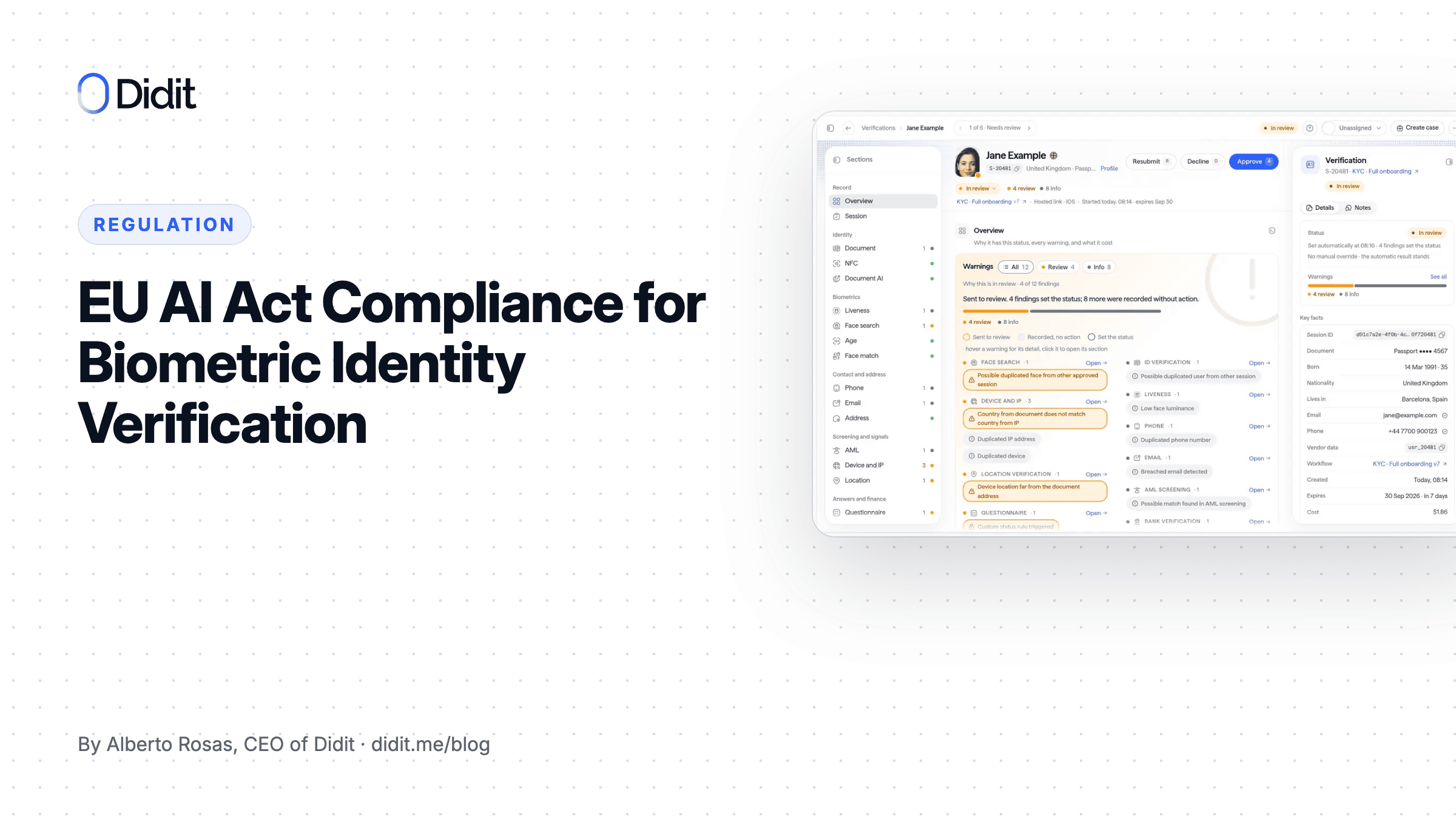
A 1:1 selfie-to-ID check is excluded from the EU AI Act high-risk list in Annex III point 1(a). 1:N face search and blocklist matching are separate uses and are not excluded.
Alberto RosasMar 13, 2026Database Validation for Proof of Address in Emerging Markets
Verifying proof of address in emerging markets presents unique challenges due to fragmented data and varied infrastructure. Database validation offers a robust, scalable solution.
Alberto RosasMar 13, 2026Proof of Address Evolution: From Bills to Decentralized Attestations
Proof of Address (PoA) has evolved significantly, moving from traditional utility bills to advanced digital verification methods and decentralized attestations.
Alberto RosasMar 13, 2026Beyond Sanctions: Building Your Internal Fraud Watchlist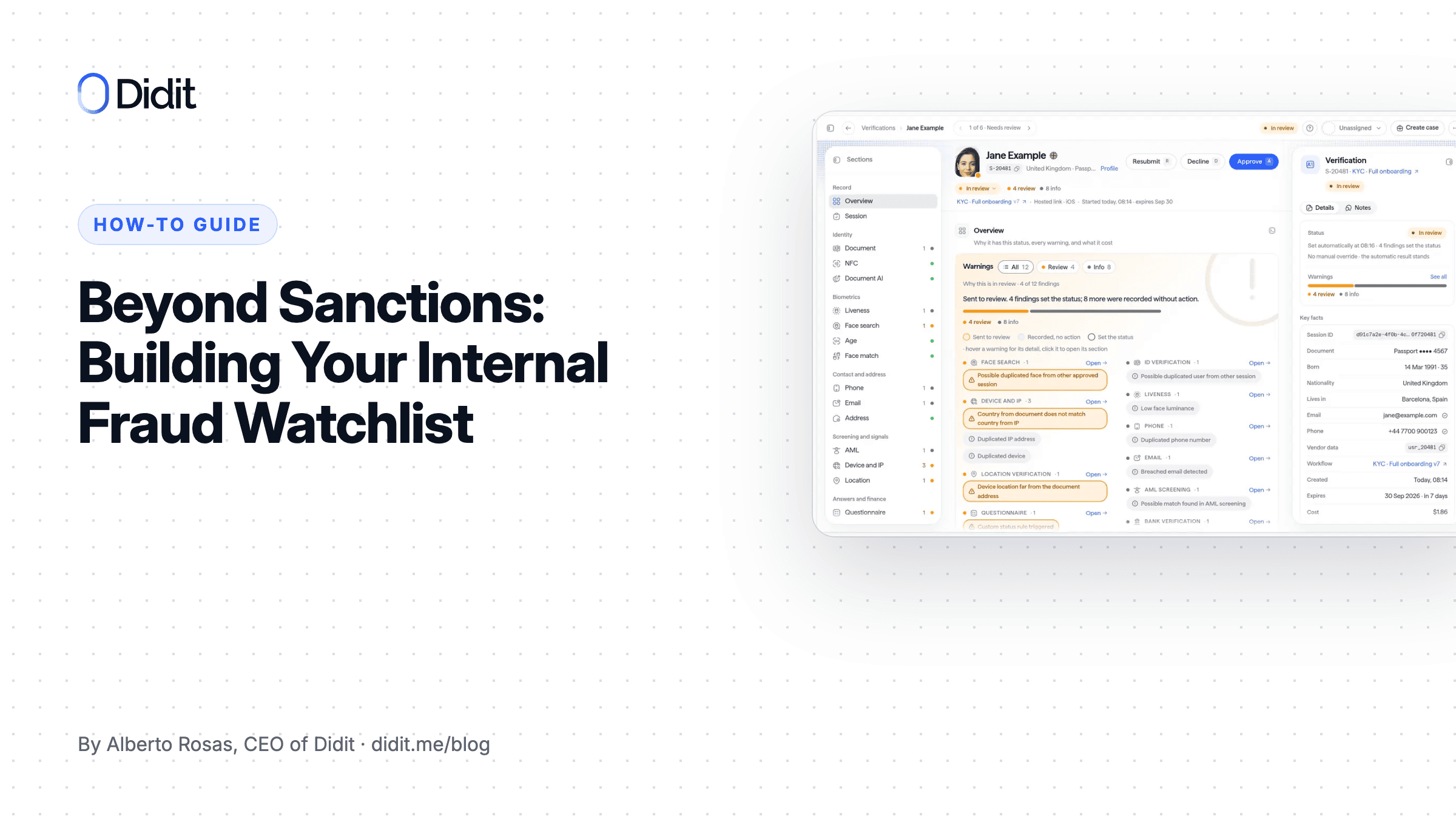
An internal fraud watchlist catches the people sanctions lists miss. You add their document, face, phone, email, IP or device to a Didit system blocklist, and every matching session is declined automatically.
Alberto RosasMar 13, 2026Securing Event-Driven APIs for Regulatory Reporting
Event-driven architectures (EDAs) offer agility for regulatory reporting but introduce unique API security challenges. This post explores best practices for safeguarding data streams, ensuring compliance, and maintaining data.
Alejandro RosasMar 13, 2026AI Governance & Ethics in Identity Verification
AI governance and ethical guidelines are crucial for preventing algorithmic bias in identity verification. Implementing robust frameworks ensures fairness, transparency, and accountability, protecting vulnerable populations.
Alberto RosasMar 13, 2026Automating Trust & Safety for Web3 Gaming with Composable Identity
Web3 gaming presents unique trust and safety challenges, from preventing bot farms to ensuring fair play and regulatory compliance. Composable identity solutions, like Didit's AI-native platform, are crucial for automating.
Alberto RosasMar 13, 2026API-First Compliance: Integrating Identity Verification with SIEM
Building a robust compliance audit trail requires integrating identity verification data with Security Information and Event Management (SIEM) systems.
Alejandro RosasMar 13, 2026Verifiable Credentials: Revolutionizing EU Age Verification for Retailers
New EU regulations demand robust age verification, presenting challenges for online retailers. Verifiable Credentials (VCs) offer a privacy-preserving, secure solution.
Alberto RosasMar 13, 2026The Economics of Trust: Quantifying ROI in Neobank Synthetic Identity Fraud Prevention
Synthetic identity fraud is a growing menace for neobanks, creating significant financial losses and reputational damage. This article explores the economic impact of this fraud, detailing how proactive prevention, especially.
Alberto RosasMar 13, 2026Building a Privacy-Preserving Compliance Dashboard for Cross-Border Healthcare Data Sharing
Navigate the complexities of cross-border healthcare data sharing with a privacy-preserving compliance dashboard. Learn how to achieve regulatory adherence, protect sensitive patient information, and leverage advanced identity.
Alberto RosasMar 13, 2026Reusable KYC for Cross-Border Gig Platforms: A Technical Blueprint
Building a robust, reusable Know Your Customer (KYC) framework is crucial for cross-border gig economy platforms to ensure compliance, reduce friction, and prevent fraud.
Alberto RosasMar 13, 2026The ROI of Verification Analytics for Compliance Audit Success
Understanding the return on investment (ROI) of robust verification analytics is crucial for businesses aiming to reduce compliance audit failures.
Alberto RosasMar 13, 2026Headless vs. UI Components: Biometric SDK Integration
Choosing the right biometric SDK integration method is crucial for balancing control, customization, and development speed. This post compares headless APIs and pre-built UI components, highlighting their pros and cons for.
Alejandro RosasMar 13, 2026The ROI of Proof of Funds for Luxury Resale Platforms
Discover how implementing Proof of Funds verification can significantly boost the ROI for luxury goods resale platforms. Mitigate fraud, enhance buyer trust, streamline operations, and protect your brand's reputation by ensuring.
Alberto RosasMar 13, 2026Automating Risk Orchestration for Supply Chain Finance Under Basel IV
Basel IV regulations demand a sophisticated approach to risk management in supply chain finance. This article explores how financial institutions can leverage automation and advanced identity verification to navigate these.
Alberto RosasMar 13, 2026Navigating the EU Digital Identity Toolbox with QES
The European Digital Identity Toolbox is reshaping online interactions, with Qualified Electronic Signatures (QES) playing a pivotal role in ensuring trust and non-repudiation.
Alberto RosasMar 13, 2026Flutter SDK & NFC: Revolutionizing Supply Chain Traceability
Discover how Didit's Flutter SDK, with its powerful NFC capabilities, can transform supply chain traceability. Learn to implement robust identity verification, prevent fraud, and ensure product authenticity from origin to.
Alberto RosasMar 13, 2026Designing a Superior Developer Experience for White-Label Biometric SDKs
Building biometric SDKs with an exceptional developer experience is crucial for widespread adoption. This involves prioritizing seamless integration, comprehensive customization, and robust error handling.
Alejandro RosasMar 13, 2026Boost Trust with AI-Powered Phone Number Reputation Scoring
AI-powered phone number reputation scoring is crucial for modern businesses to combat fraud, enhance security, and improve user experience. By analyzing various data points, this technology can identify risky numbers and prevent.
Alberto RosasMar 13, 2026Optimizing iOS SDK for Seamless Photo ID Auto-Capture
Discover how to enhance the user experience and accuracy of photo ID auto-capture within your iOS applications. This guide covers best practices for integrating SDKs, leveraging AI for intelligent capture, and ensuring.
Alejandro RosasMar 13, 2026Seamless Onboarding: Integrating White-Label iOS SDKs for Telcos
Discover best practices for integrating a white-label iOS SDK to streamline high-volume telco onboarding. Learn how to ensure brand consistency, optimize user experience, and meet regulatory compliance while leveraging advanced.
Alejandro RosasMar 13, 2026Open-Source vs. Commercial Digital Credential Wallets (2026)
walt.id fits teams that must issue their own verifiable credentials. Didit fits teams that need a priced identity check, $0.33 for full KYC, including sign-in through national digital ID wallets.
Alejandro RosasMar 13, 2026Building a Robust Fraud Operations Playbook for the Metaverse
The metaverse presents unprecedented opportunities alongside complex fraud challenges. This post outlines how to build a robust fraud operations playbook, emphasizing the need for advanced identity verification, proactive.
Alberto RosasMar 13, 2026Advanced OTP Verification for Secure IoT Onboarding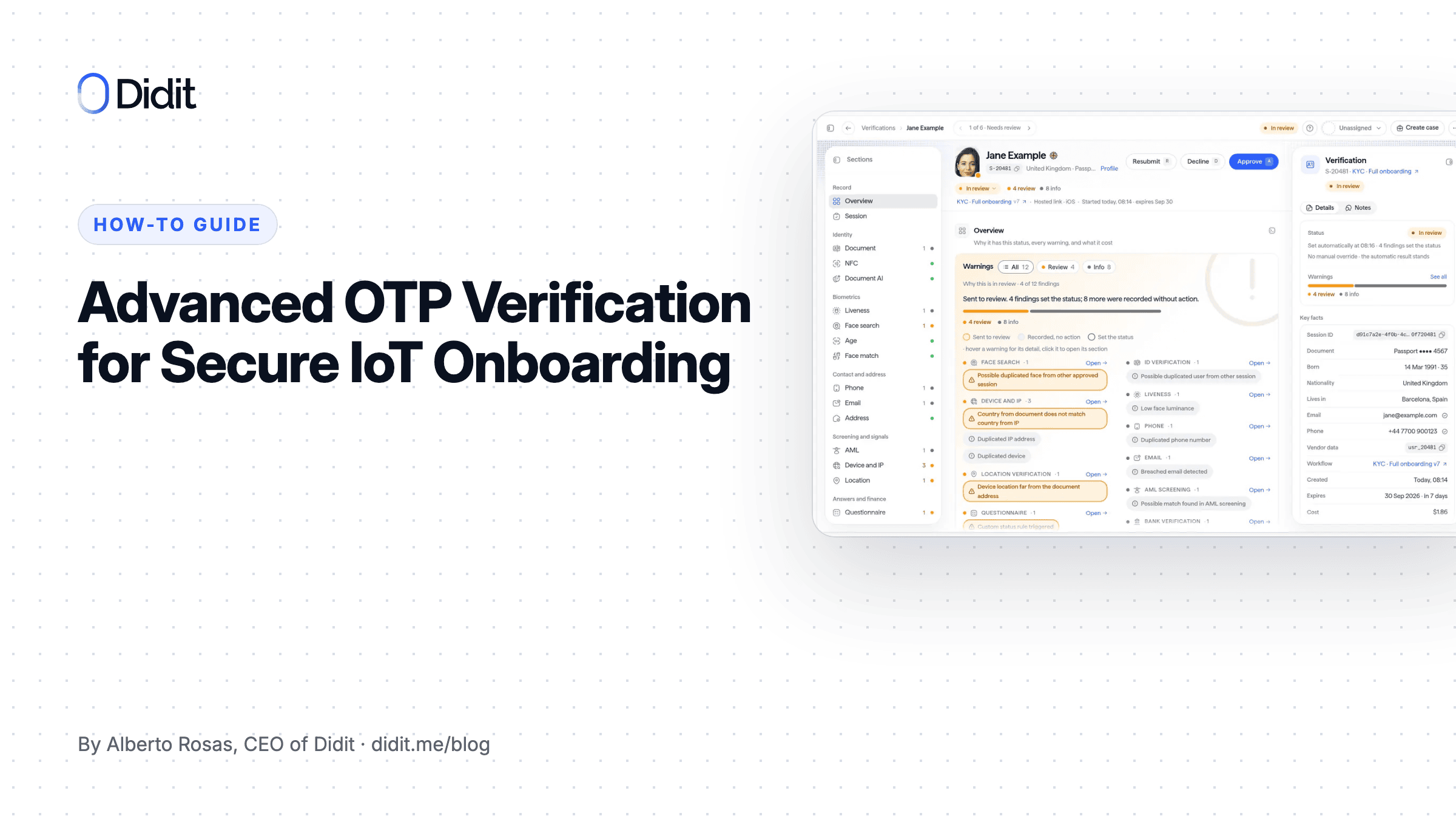
Verify the owner with ID, liveness and face match, then confirm the phone with an OTP plus carrier and VoIP signals. A full ID check is $0.33; each code is carrier plus $0.02.
Alberto RosasMar 13, 2026Cross-Border Phone Verification: Securing Mobile Roaming from Fraud
Mobile roaming presents unique challenges for fraud prevention, especially with the rise of sophisticated cyber threats. This post explores the complexities of cross-border phone verification, highlighting methods to detect and.
Alberto RosasMar 13, 2026DIDComm in Healthcare: Secure, Serverless Identity
DIDComm (Decentralized Identity Communication) offers a transformative approach to secure, serverless communication in healthcare, enabling direct, privacy-preserving interactions.
Alberto RosasMar 13, 2026Streamlining Cross-Border ESG Reporting with Programmable Identity
Cross-border ESG reporting presents significant challenges due to varied regulations and data inconsistencies. Programmable identity data, powered by AI-native platforms like Didit, offers a transformative solution, enabling.
Alberto RosasMar 13, 2026Blockchain Identity: Securing Pharma Supply Chains
The pharmaceutical supply chain faces immense challenges, from counterfeit drugs to ensuring regulatory compliance. Blockchain identity offers a transformative solution by providing immutable data provenance and integrity.
Alberto RosasMar 13, 2026Technical Guide: Implementing FIPS 140-3 for Secure Identity Data Processing
FIPS 140-3 is crucial for securing sensitive identity data. This guide explores its principles, implementation strategies, and the role of cryptographic modules in compliance.
Alberto RosasMar 13, 2026SSI for EU Cross-Border Professional Licensing: A Didit Approach
Self-Sovereign Identity (SSI) offers a transformative solution for streamlining cross-border professional licensing within the EU. By empowering professionals with control over their verifiable credentials, SSI can significantly.
Alberto RosasMar 13, 2026Adaptive Risk-Based Authentication for Critical Infrastructure under NIS2
NIS2 mandates robust cybersecurity for critical infrastructure, making adaptive risk-based authentication essential. This approach dynamically assesses user and device risk, ensuring appropriate security measures are applied.
Alberto RosasMar 13, 2026The ROI of Zero-Retention NFC Verification for Age-Restricted Events
Discover how zero-retention NFC verification offers a powerful ROI for age-restricted event ticketing, ensuring compliance, preventing fraud, and enhancing user privacy.
Alberto RosasMar 13, 2026Streamline Cross-Border Mortgages with Automated Proof of Address
Cross-border mortgage applications face significant hurdles, especially with Proof of Address (PoA) verification. This article explores how automated PoA solutions can drastically improve efficiency, reduce fraud, and ensure.
Alberto RosasMar 13, 2026Orchestrating AML for Art & Antiquities Marketplaces in Europe
The European art and antiquities market faces strict AML regulations, requiring robust due diligence. This blog explores the complexities of compliance, the importance of risk-based approaches, and how advanced identity.
Alberto RosasMar 13, 2026Benchmarking Identity Verification for Startups
Startup founders face critical decisions when choosing identity verification solutions. This guide offers key benchmarks, focusing on scalability, compliance, and user experience, while highlighting Didit's advantages for rapid.
Alberto RosasMar 13, 2026Building an Adaptive Identity Proofing Layer for PSD3 Compliance
PSD3 is reshaping the financial services landscape, demanding more robust and adaptive identity proofing. This blog explores the critical components of a future-proof identity layer, focusing on advanced verification.
Alberto RosasMar 13, 2026Digital Identity for Secure Remote Voting: A Technical Overview
Secure remote voting is crucial for modern democracies, but it presents significant challenges in identity verification and fraud prevention.
Alberto RosasMar 13, 2026The ROI of Explainable AI in Age Verification for Consumer Platforms
Explore how Explainable AI (XAI) enhances age verification, offering transparency, accuracy, and compliance. Understand its impact on user trust, fraud prevention, and operational efficiency, with a focus on Didit's advanced.
Alberto RosasMar 13, 2026Optimizing Flutter SDK for High-Performance OCR in 2026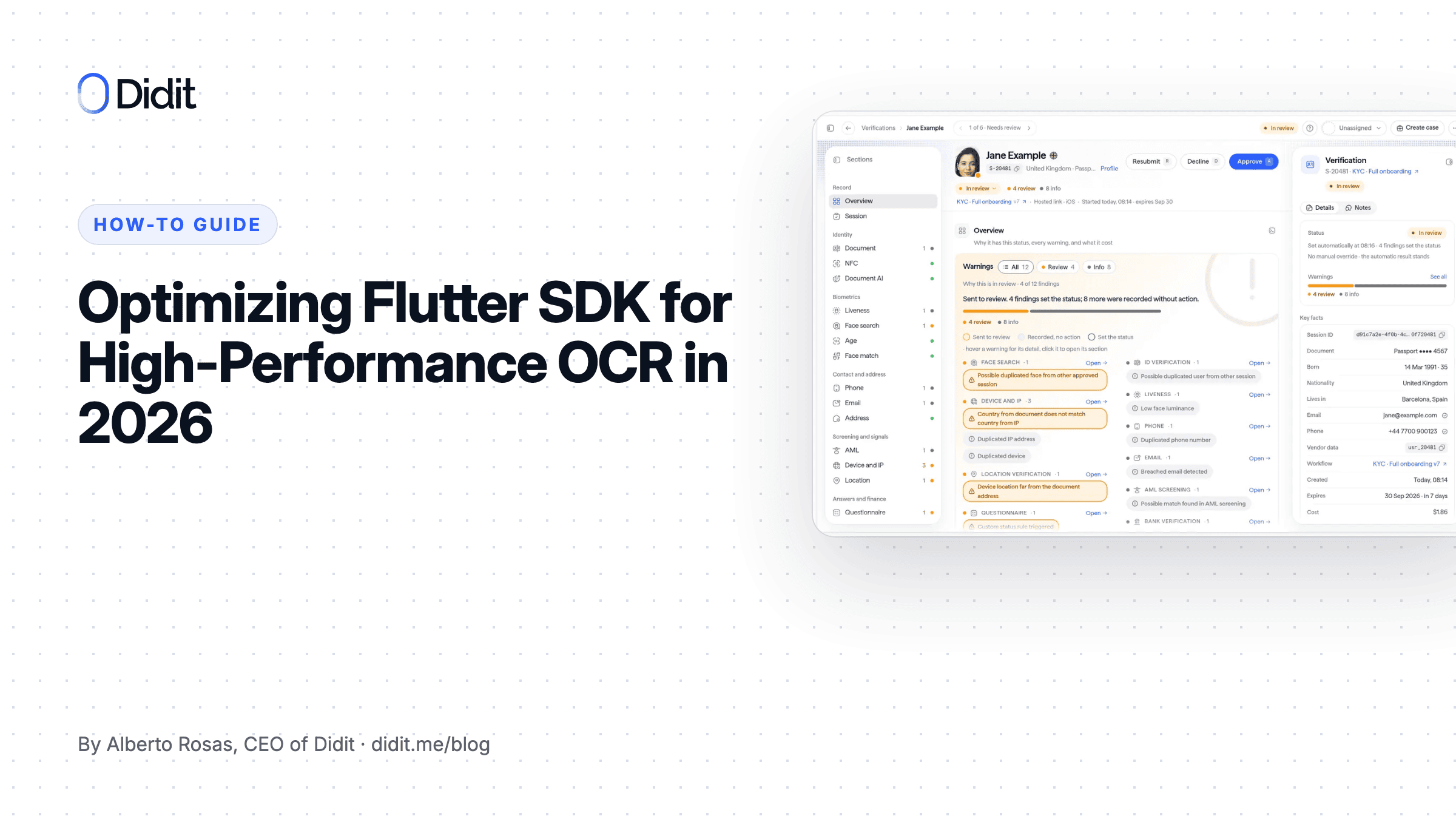
Didit's Flutter SDK 4.15.4 wraps native iOS and Android capture, so OCR quality depends on capture and upload rules. ID verification is $0.15 in a workflow and $0.20 via the standalone API.
Alejandro RosasMar 13, 2026A/B Testing Mobile SDK Integrations: Best Practices for Success
Optimize your mobile app's performance and user experience by mastering A/B testing for SDK integrations. Learn how to define clear goals, segment users effectively, and utilize tools for robust analysis.
Alberto RosasMar 13, 2026Combating API Abuse: Securing Identity Verification Endpoints
API abuse poses a significant threat to identity verification, leading to fraud, data breaches, and service disruptions. Implementing robust security measures, including strong authentication, rate limiting, and AI-powered.
Alejandro RosasMar 13, 2026Building a PSD3 Compliance Dashboard: Best Practices
Navigating PSD3 compliance requires robust, real-time dashboards to monitor KYC, AML, and transactional data. This guide outlines best practices for designing an effective compliance dashboard, focusing on data integration.
Alberto RosasMar 13, 2026Designing Developer-Friendly APIs for Global Travel Document Scanning
Discover how to build robust, developer-friendly APIs for scanning global travel documents, focusing on OCR, MRZ, and barcode extraction. Learn best practices for error handling, data standardization, and internationalization to.
Alberto RosasMar 13, 2026Mitigating AML Risk in P2P Car Sharing Platforms
Peer-to-peer car sharing platforms face unique AML challenges due to their decentralized nature and high-value transactions. Robust identity verification, continuous monitoring, and advanced risk scoring are crucial to protect.
Alberto RosasMar 13, 2026Orchestrating AML Screening for Climate Finance & ESG Compliance
Integrating robust AML screening into climate finance and ESG initiatives is crucial for mitigating financial crime risks and ensuring regulatory compliance.
Alberto RosasMar 13, 2026AML Screening for Emerging Crypto Assets like RWA Tokens
The rise of emerging crypto assets, particularly Real World Asset (RWA) tokens, introduces new complexities for Anti-Money Laundering (AML) compliance.
Alberto RosasMar 13, 2026Mastering P2P Lending Risk Orchestration with AI
P2P lending platforms face unique risks requiring robust orchestration strategies. Leveraging AI-native solutions for identity verification, fraud detection, and compliance is crucial.
Alberto RosasMar 13, 2026Orchestrating Global Sanctions Screening with AI for OFAC
Navigating global sanctions like OFAC requires robust, real-time screening. This post explores how machine learning enhances compliance, reduces false positives, and streamlines operations.
Alberto RosasMar 13, 2026Real-Time KYC for Smart Contracts: Bridging On-Chain Trust
Integrating real-time Know Your Customer (KYC) into smart contracts is crucial for regulatory compliance and preventing illicit activities in decentralized finance (DeFi).
Alberto RosasMar 13, 2026Global Watchlist Data Providers: Coverage & Update Frequency
Understanding the critical differences in global watchlist data providers' coverage and update frequency is essential for robust Anti-Money Laundering (AML) compliance.
Alberto RosasMar 13, 2026Building a Real-Time AML Dashboard With Custom Watchlists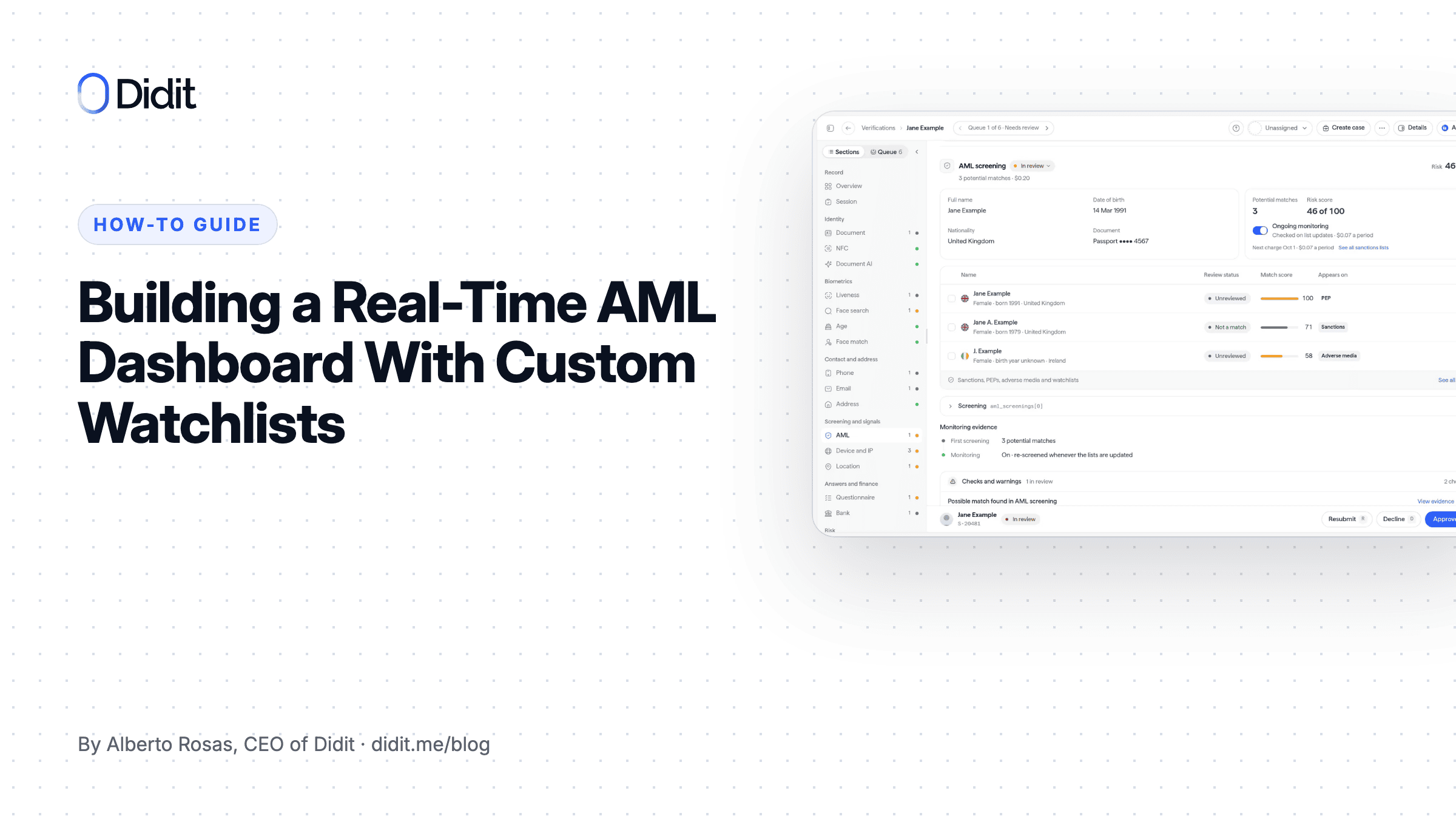
Assemble an AML dashboard from Didit's documented APIs: AML Screening at $0.20 per check, the Lists API for custom watchlists, and webhooks for events, plus $0.07 per person per year monitoring.
Alberto RosasMar 13, 2026Identity Verification for NFT Gating in Digital Art Marketplaces
Identity verification is crucial for secure NFT gating, protecting digital art marketplaces from fraud, ensuring compliance, and enhancing user trust.
Alberto RosasMar 13, 2026Continuous Authentication with Biometrics: The Future of Security
Discover how continuous authentication, powered by behavioral biometrics, redefines digital security by constantly verifying user identity. Learn about its benefits, challenges, and implementation strategies, and see how Didit's.
Alberto RosasMar 13, 2026Granular Control: Implementing Privacy Tags for Identity Data
Achieving granular control over identity data is crucial for compliance and building user trust. Privacy tags offer a powerful solution, enabling organizations to categorize and manage data based on sensitivity and purpose.
Alberto RosasMar 13, 2026IP Geolocation for Cross-Border Compliance & Regulatory Mapping
Effectively navigating cross-border compliance is crucial for global businesses. This post explores how IP geolocation is a powerful tool for regulatory zone mapping, helping companies adhere to diverse international laws and.
Alberto RosasMar 13, 2026Structured vs. Unstructured Identity Data for Fraud Prediction
Optimizing AI/ML models for fraud prediction hinges on effectively utilizing both structured and unstructured identity data. While structured data provides clear, categorized insights, unstructured data offers rich, nuanced.
Alberto RosasMar 13, 2026EBA Guidelines and Dynamic Risk-Based Authentication
The European Banking Authority's (EBA) guidelines for dynamic risk-based authentication are crucial for securing Open Banking. These guidelines mandate adaptive security measures, influencing how financial institutions manage.
Alberto RosasMar 13, 2026Architecting Zero-Trust Identity for Embedded Finance
Embedded finance offers immense opportunities, but also introduces significant identity and fraud challenges. Implementing a zero-trust identity framework is crucial for security, compliance, and user trust in these integrated.
Alberto RosasMar 13, 2026From Sandbox to Production: Programmatic KYC Best Practices
Transitioning programmatic KYC from a sandbox to production requires careful planning, robust testing, and a deep understanding of security and compliance.
Alberto RosasMar 13, 2026From Mainframe to Cloud-Native Identity: A Modernization Playbook
Modernizing identity verification from legacy mainframe systems to cloud-native platforms is crucial for combating AI-era fraud and enhancing scalability.
Alberto RosasMar 13, 2026Streamlining Insurtech Claims with Identity Verification
Efficient and secure identity verification is crucial for insurtech claims processing, preventing fraud while enhancing customer experience. Orchestrating robust KYC and AML checks ensures compliance and reduces operational costs.
Alberto RosasMar 13, 2026The Hidden Costs of Unoptimized Cross-Border Identity Data
Unoptimized cross-border identity data storage and retrieval can lead to significant financial, compliance, and operational burdens. This article explores the complexities of data localization, regulatory compliance, and the.
Alberto RosasMar 13, 2026Understanding False Acceptance Rates (FAR) in Biometrics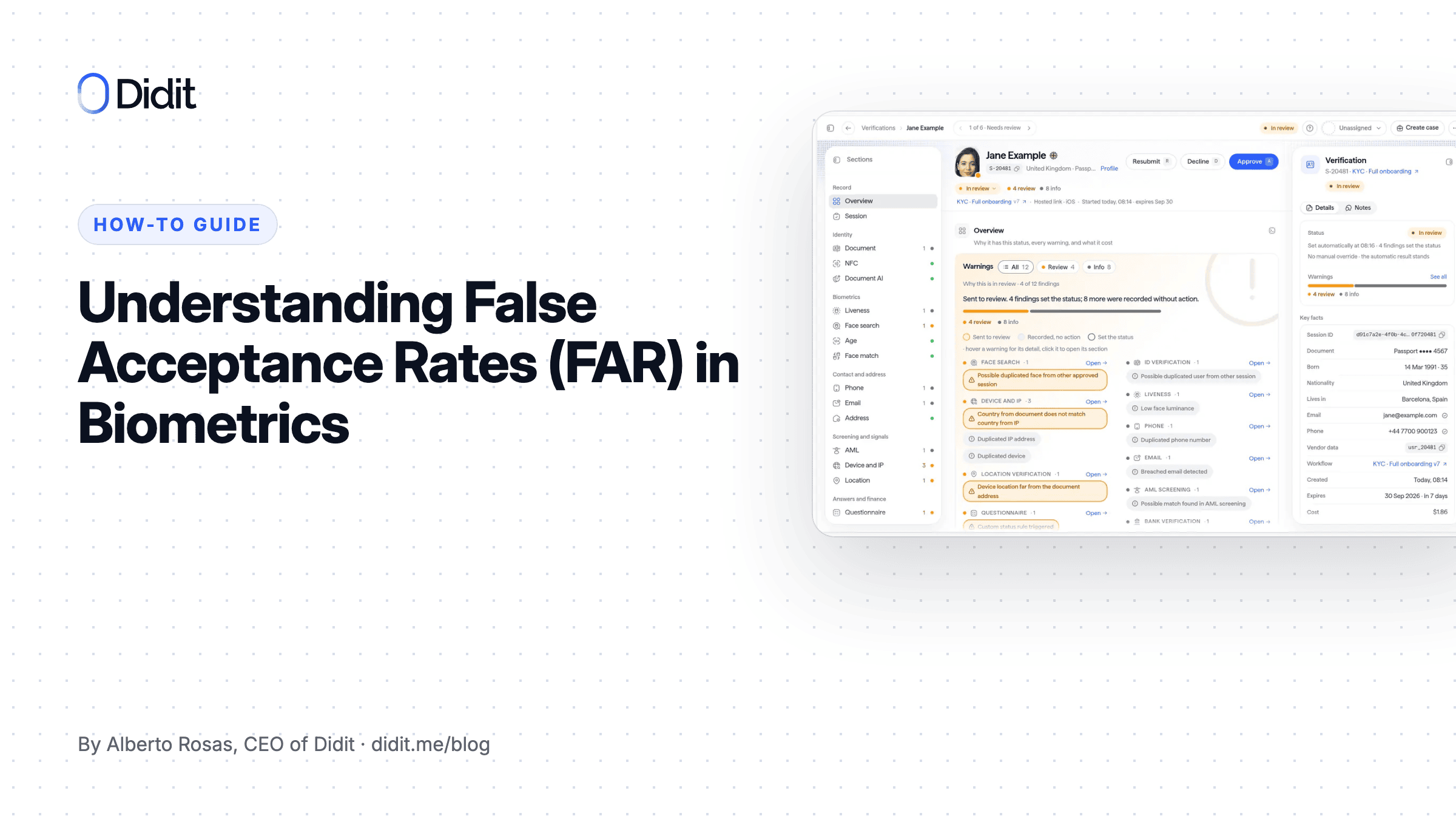
FAR is the share of impostor attempts a biometric system wrongly accepts. Measure it on your own labeled sets with live calls, tune one threshold at a time on standalone face match, and validate the point on held-out pairs.
Alberto RosasMar 13, 2026Mastering Selfie Verification Accuracy: Beyond Basic Face Alignment
Achieving highly accurate selfie verification requires more than just basic face alignment. This blog explores advanced techniques like passive and active liveness detection, 1:1 face matching, and robust image quality analysis.
Alberto RosasMar 13, 2026Dynamic Risk Scoring for Age-Restricted Gaming Content
Gaming platforms face increasing pressure to verify user age for age-restricted content. Dynamic risk scoring offers a sophisticated solution, moving beyond static checks to continuously assess risk.
Alberto RosasMar 13, 2026Real-Time Identity for Autonomous Systems: Securing AI-to-AI
As autonomous systems and AI agents become more prevalent, establishing secure, real-time identity verification for AI-to-AI interactions is paramount.
Alberto RosasMar 13, 2026Optimizing Cross-Platform Liveness Detection SDKs for WebAssembly
This guide explores how developers can leverage WebAssembly (Wasm) to build high-performance, cross-platform liveness detection SDKs. We cover Wasm's benefits, optimization strategies for performance and security, and.
Alejandro RosasMar 13, 2026Questions
Blog questions
Who writes the Didit blog?
Which topics does the blog cover?
Is the blog available in my language?
Where do I find product updates?
Are these posts legal advice?
How do I find posts on one topic?
Are posts dated?
Do posts link to the docs?
Is the blog the same as the docs?
Compliance built in
Audited, certified and attested.
We hold the certifications and build each country's rules into your flows, so you can launch anywhere without worrying. Security and Compliance center
- Regulation encoded into your flows
Tell us what you do and where. Didit lists the rules that apply to you, with sources, and builds the checks each country needs into one workflow.
- Ready for AMLR
Every requirement of the new EU anti-money laundering rules, from checking customers to human review, is already covered by a Didit check.
- Tested in Spain's Treasury sandbox
Spain's Treasury published its supervised sandbox report on Didit's NFC plus active liveness onboarding; SEPBLAC took part and valued the added measures positively.
- Audited, not self-declared
iBeta Level 1 and Level 2. Liveness tested under ISO/IEC 30107-3.
Your obligations · 3 regions
 SOC 2 Type 2
 ISO 27001
 iBeta Level 1 and Level 2
 EU regulator attestation
 FSM youth protection
 GDPR
 EBA remote onboarding
 MiCA compatible
 FIDO Alliance member
- AMLREU AML Regulation ready
Integration · Didit MCP
Run Didit from your own AI agent
Connect Didit to Claude, Cursor, VS Code or ChatGPT and just ask in plain words. Your agent can do anything you can do in the console, with the same permissions you have.
 Add to Claude
 ChatGPT
 Cursor
- Build workflowsDescribe the checks you need. The agent creates and publishes the flow.
- Run investigationsAsk why a session was declined, review cases, search people and companies.
- Change rulesCreate payment rules, test them on past data and switch them on.
- Pull reportsAsk for numbers, exports or the audit log.
Didit Academy


