Blog
Blog archive
Every post on the Didit blog, newest first. Pick a category or search to find the subject you need.
All posts
Every post, newest first
Pick a category to filter.
Didit lists full KYC at $0.33 per completed check. iDenfy Basic lists $1.35 per verification with a $135 monthly minimum. Compare what each rate covers and what 24/7 human review adds.
Alberto RosasMar 16, 2026Didit vs Socure: identity verification compared (2026)
We list full KYC at $0.33 and AML screening at $0.20. Socure’s home page does not publish pricing. Compare verification scope, costs at three volumes and how to test a switch.
Alberto RosasMar 16, 2026Didit vs Stripe Identity: KYC Pricing and Coverage in 2026
Didit lists full KYC at $0.33 per completed check and publishes rates for AML, KYB and monitoring. See what to confirm with Stripe before you budget or migrate.
Alberto RosasMar 16, 2026Didit vs Sardine 2026: fraud and compliance compared
We charge $0.33 for full KYC and $0.20 for AML screening at list price. Sardine's home page lists device intelligence and behavior biometrics and gives no prices (Sardine home page, read November 26, 2026).
Alberto RosasMar 16, 2026Didit vs Ondato: identity verification compared
Didit full KYC is $0.33 per completed check at list price. Ondato pricing could not be verified. Use our worked cost example and free sandbox to evaluate your workflow.
Alberto RosasMar 16, 2026Real-Time KYC for DeFi: Navigating Regulation
Decentralized Finance (DeFi) faces growing regulatory scrutiny. Implementing real-time KYC and AML solutions is crucial for compliance and sustainable growth. Explore strategies and solutions for navigating this complex landscape.
Alberto RosasMar 15, 2026Dynamic Risk-Based Authentication: A Deep Dive (1)
Explore dynamic risk-based authentication (RBA), a crucial fraud prevention method that adapts security measures to user behavior. Learn how it balances security and user experience.
Alberto RosasMar 15, 2026Decentralized Identity for Supply Chain Traceability (1)
Explore how decentralized identity (DID) and verifiable credentials revolutionize supply chain transparency, reducing fraud and enhancing traceability. Learn about real-world applications and benefits.
Alberto RosasMar 15, 2026Fraud Prevention in Embedded Finance: A Deep Dive
Embedded finance introduces unique fraud risks. This guide explores KYC best practices, API security, and advanced fraud detection strategies to protect your platform and customers.
Alberto RosasMar 15, 2026Prescription Verification with Biometrics: A Secure Future
Explore how biometrics are revolutionizing prescription verification, bolstering telehealth security, and ensuring DEA compliance. Learn about the technology and its benefits.
Alberto RosasMar 15, 2026Microprint Analysis: Detecting ID Fraud & Forgeries
Microprint analysis is a crucial technique in modern document verification, helping to detect sophisticated ID fraud and forgery attempts. This guide explores the technology, its benefits, and how it enhances security.
Alberto RosasMar 15, 2026FATF Travel Rule: Bridging the Crypto Compliance Gap
The FATF Travel Rule requires Virtual Asset Service Providers (VASPs) to share customer data for transactions over a certain threshold. This post breaks down the challenges of travel rule implementation and how Didit can help.
Alberto RosasMar 15, 2026DEA Compliance: Navigating Digital Identity Rules
Maintaining DEA compliance in the age of telehealth and digital prescriptions requires robust digital identity verification. This guide breaks down the key rules and how to implement effective solutions.
Alberto RosasMar 15, 2026How to Verify an Influencer: Stop Creator Fraud in 2026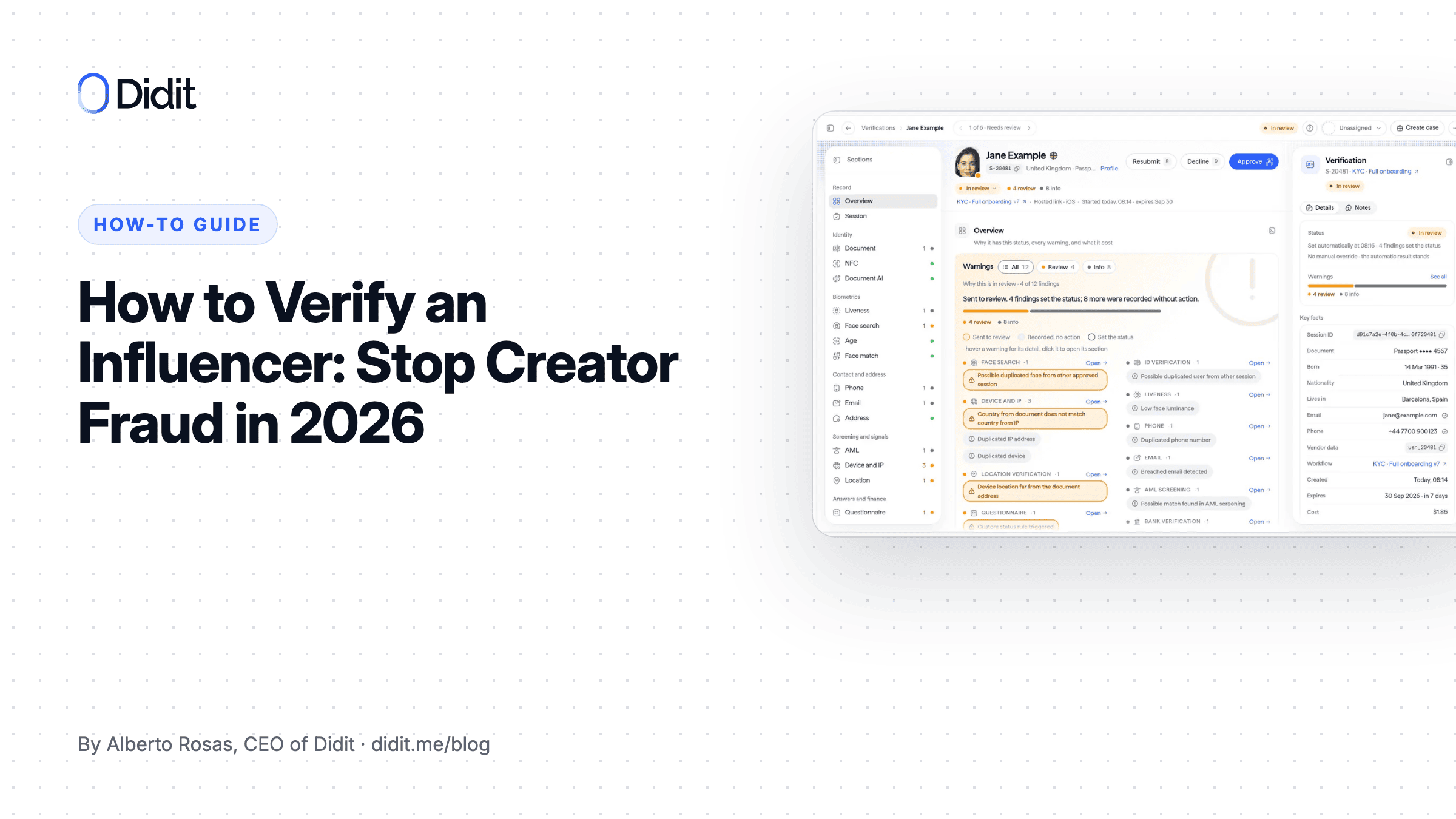
Verify an influencer by running a full ID check ($0.33), optional AML screening ($0.20) and a 1:N face search ($0.05), then approve only on a clean Approved decision.
Alberto RosasMar 15, 2026Defeating Synthetic Identity Fraud with Graph Neural Networks
Synthetic identity fraud is a growing threat, costing financial institutions billions annually. Learn how graph neural networks (GNNs) are revolutionizing fraud detection and AML compliance.
Alberto RosasMar 15, 2026Dynamic Pricing for Identity Verification: Cut Costs & Maximize ROI (1)
Explore dynamic pricing in identity verification, a strategy to optimize costs based on fraud risk. Learn how to lower expenses, improve conversion rates, and boost your ROI.
Alberto RosasMar 15, 2026API Error Handling for Identity Verification (2026 Guide)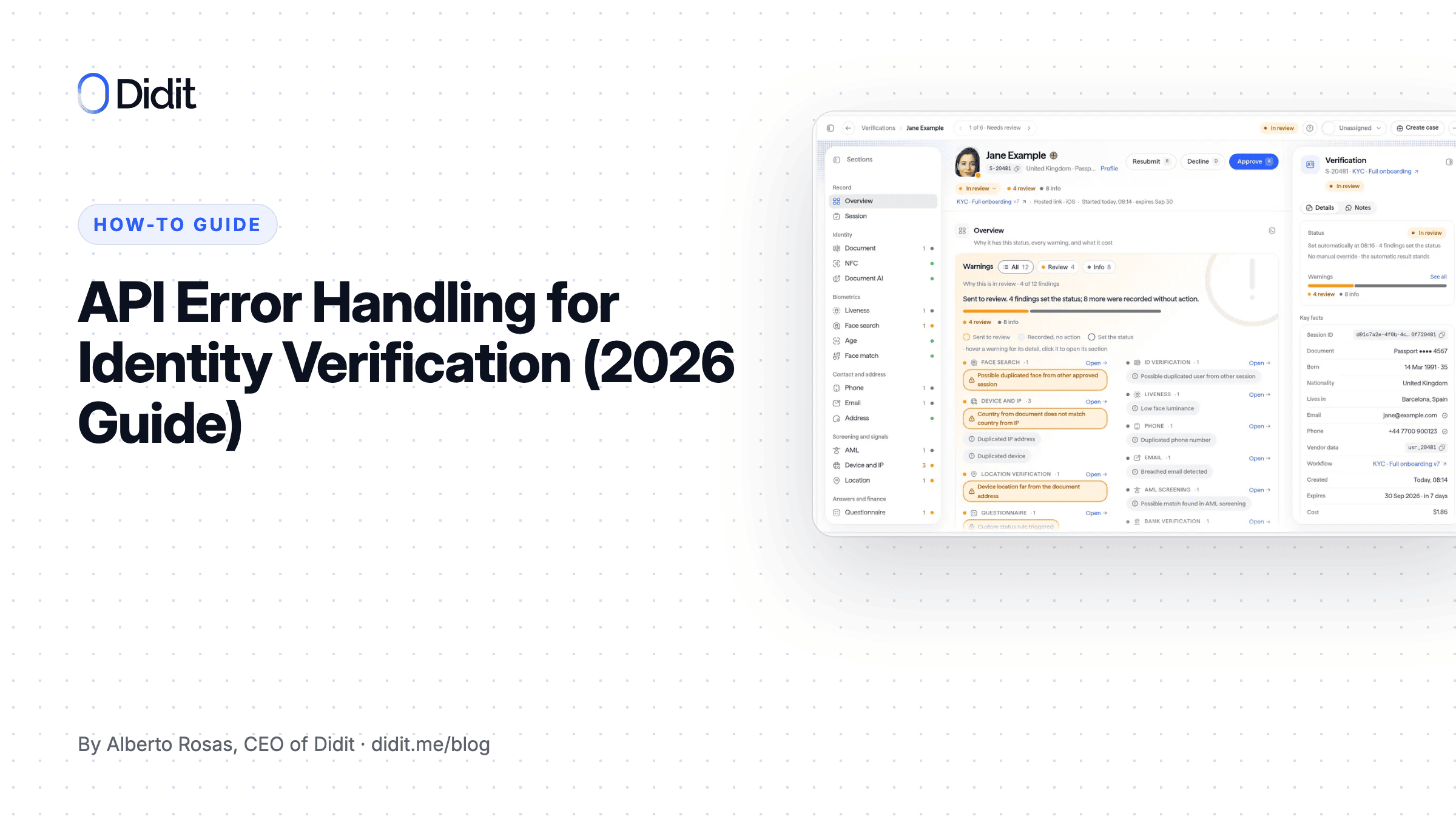
Handle Didit API errors by branching on the HTTP status first, on code second. Retry only 429 and 5xx, respect Retry-After, send the same Idempotency-Key so a reused key can answer 409, then reload the session state and follow.
Alberto RosasMar 15, 2026P2P Lending Fraud Prevention: A Complete Guide
Discover how robust fraud prevention strategies, including identity verification, can safeguard your P2P lending platform and minimize loan defaults. Learn best practices for risk assessment and secure growth.
Alberto RosasMar 15, 2026Graceful Degradation for Identity Verification (2)
Learn how to build resilient identity verification into your applications with graceful degradation strategies. Ensure high availability and a seamless user experience even during outages.
Alberto RosasMar 15, 2026Secure Your APIs: HMAC Signature Validation
Learn how HMAC signature validation enhances API security, protecting your KYC integrations and sensitive data. This guide provides a developer-focused overview with code examples.
Alejandro RosasMar 15, 2026Investor Accreditation Verification: How to Run It in 2026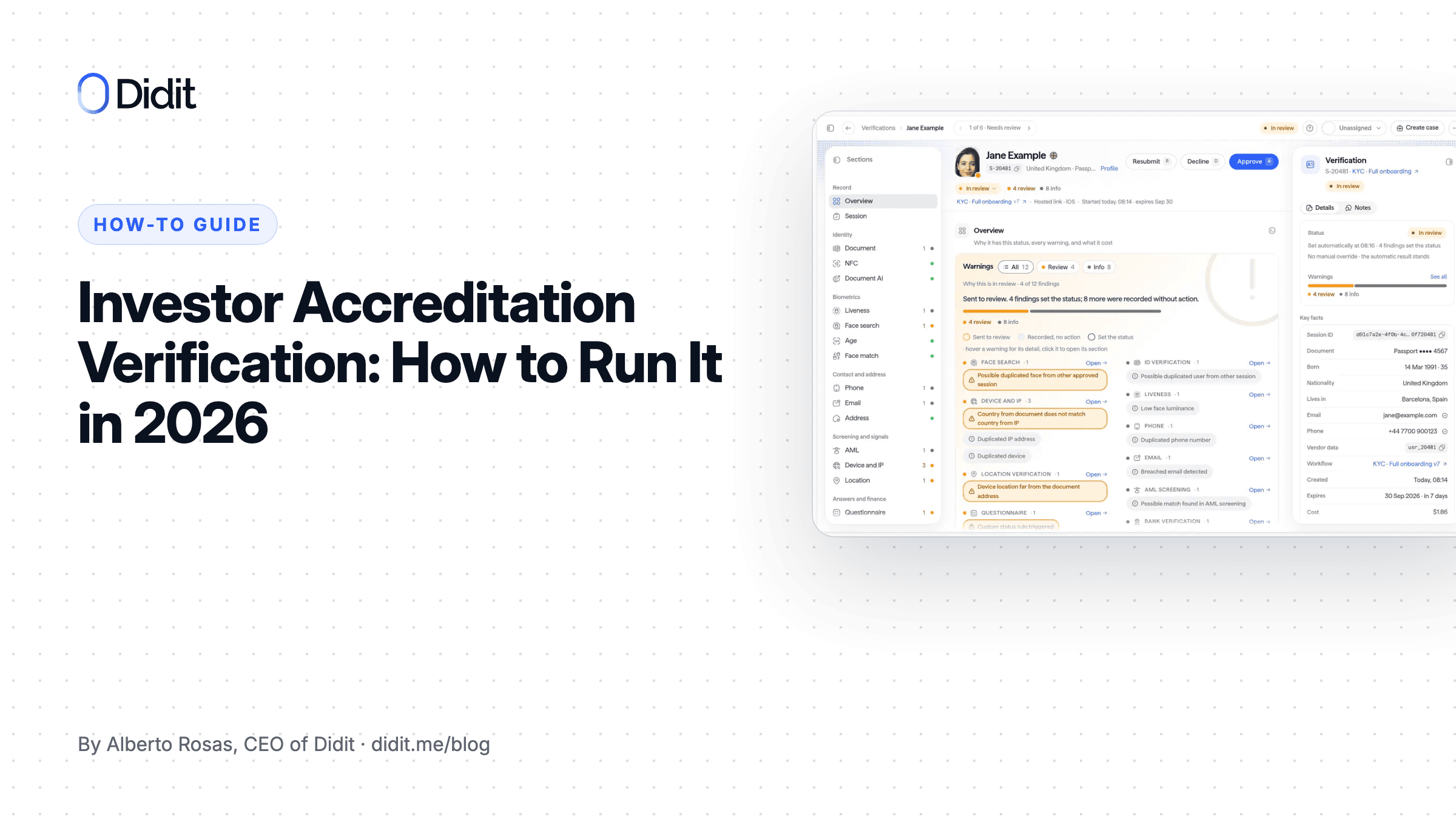
Accredited investor verification means identity checks, an attestation and AML screening. On Didit it costs $0.63 per investor at list price. Your counsel still owns the reasonable-steps decision.
Alberto RosasMar 15, 2026Device Intelligence: A New Era in Fraud Detection (1)
Device intelligence leverages data points from user devices to detect and prevent fraud, enhancing identity verification and bolstering security. Learn how it works and its benefits.
Alberto RosasMar 15, 2026Age Verification in Mobile Gaming: A Compliance Guide for 2026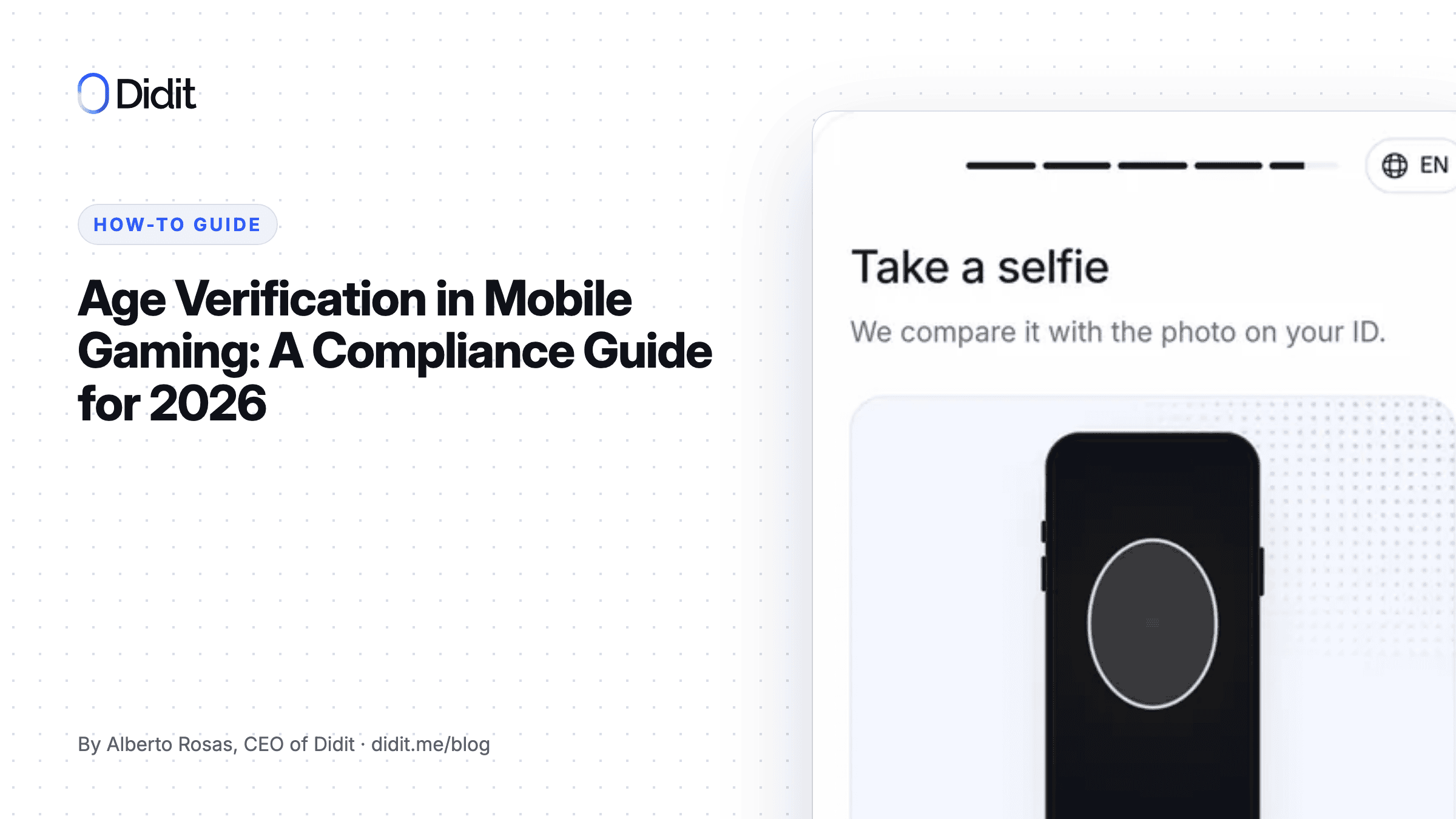
Selfie age estimation at $0.10 gates a mobile game before account creation. A document check at $0.15 and full KYC at $0.33 cover cases needing stronger evidence. A selfie estimate is a gate, not legal proof of age.
Alberto RosasMar 15, 2026Identity Assurance Levels (LoA 1-4): How to Choose One in 2026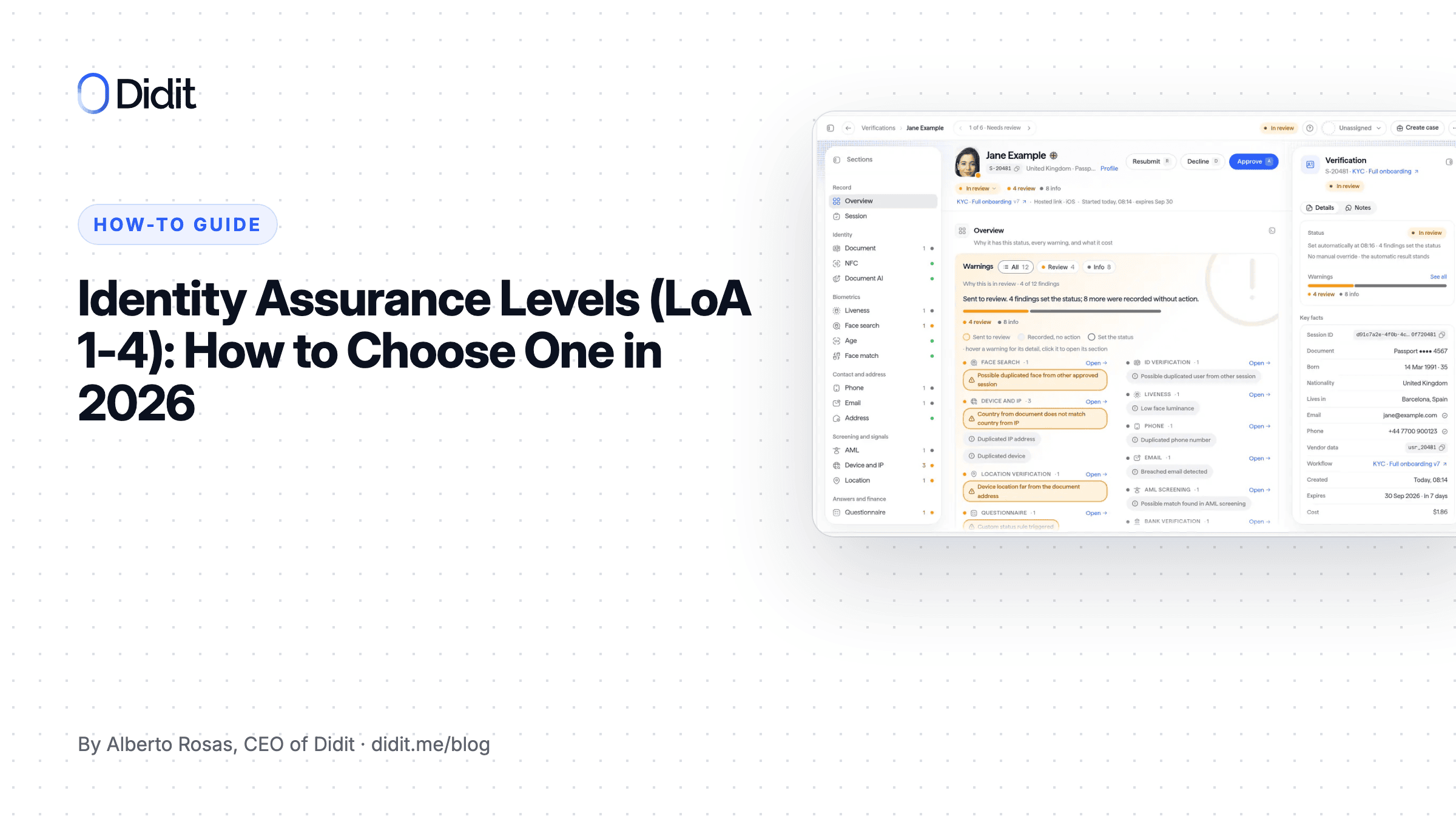
LoA 1 to 4 is legacy shorthand for confidence in a claimed identity. NIST and eIDAS ask different questions, and we record three evidence tiers from the method used. See how an illustrative policy maps onto those tiers and costs.
Alberto RosasMar 15, 2026Detecting AI-Generated Utility Bills: A KYC & Fraud Guide (3)
AI-generated documents, like forged utility bills, are a growing threat to KYC compliance. Learn how advanced fraud detection techniques can identify these fakes and protect your business.
Alberto RosasMar 15, 2026Fraud Detection With Graph Databases: How-To for 2026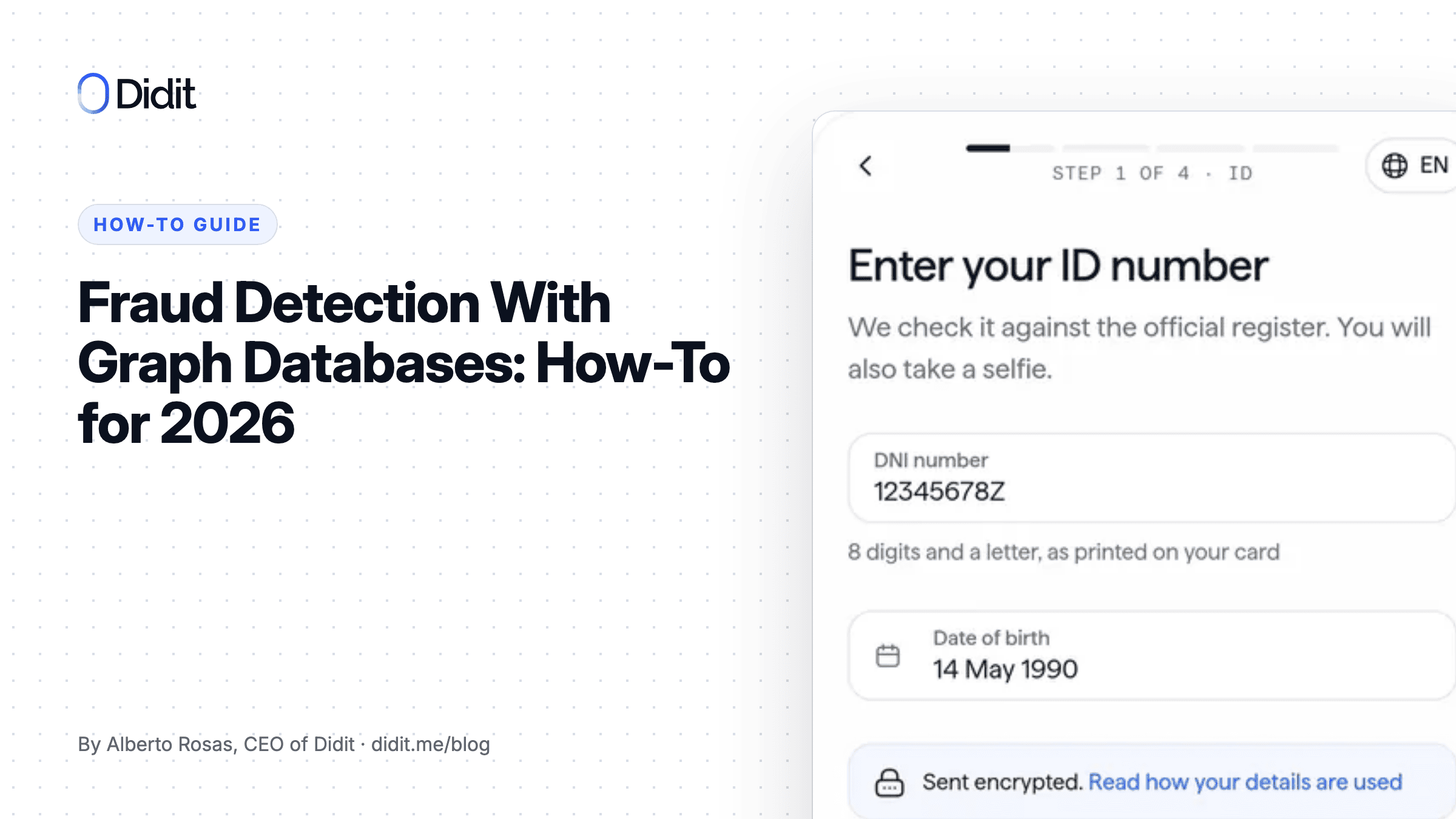
Use Didit transaction and device signals to model a fraud graph, test a structuring rule, and trace accounts that share a device. Includes API examples and published prices.
Alberto RosasMar 15, 2026Selective Disclosure: Protecting Identity in the Digital Age
Selective disclosure empowers users to control their data by sharing only necessary information, enhancing identity privacy. Learn how verifiable credentials and zero-knowledge proofs underpin this technology and how Didit.
Alberto RosasMar 15, 2026EUDI Wallet Architecture: A Deep Dive (1)
Explore the architecture of the EUDI Wallet, including verifiable credentials, decentralization, and security aspects. Learn how businesses can prepare for upcoming regulations.
Alberto RosasMar 15, 2026Decentralized Identity: Adoption Barriers & What's Next (2)
Decentralized Identity (DID) and Self-Sovereign Identity (SSI) promise a future of user-controlled data, but significant adoption barriers remain. This post explores challenges and potential solutions for wider SSI implementation.
Alberto RosasMar 15, 2026Creator Economy Verification: Protecting Brands & Talent (1)
The creator economy is booming, but rife with fraud. Learn how identity verification protects brands, creators, and platforms from fake accounts and ensures brand safety. Explore solutions with Didit.
Alberto RosasMar 15, 2026Synthetic Proof of Address: A Growing Threat
Synthetic proof of address (SPOA) is a sophisticated form of document fraud utilizing AI to create realistic, yet fake, utility bills and other documents.
Alberto RosasMar 15, 2026Decentralized Identity and Digital ID Wallets: SSI and DIDs, a 2026 Guide
Didit lists available digital ID wallet checks at $0.10 to $0.95 USD per completed verification. For standalone checks, accept the result only when outcome is verified and simulated is false.
Alberto RosasMar 15, 2026Age Verification for E-commerce: Boost Sales with Biometrics
Learn how age verification impacts e-commerce conversion rates and how biometrics offer a seamless, secure solution. Reduce chargebacks, comply with regulations, and improve customer experience.
Alberto RosasMar 15, 2026Decentralized Identity: The Future of KYC & Data Privacy
Explore how decentralized identity and verifiable credentials are revolutionizing KYC processes, enhancing data privacy, and empowering users with control over their personal information.
Alberto RosasMar 15, 2026MiCA and VASP Registration Requirements in 2026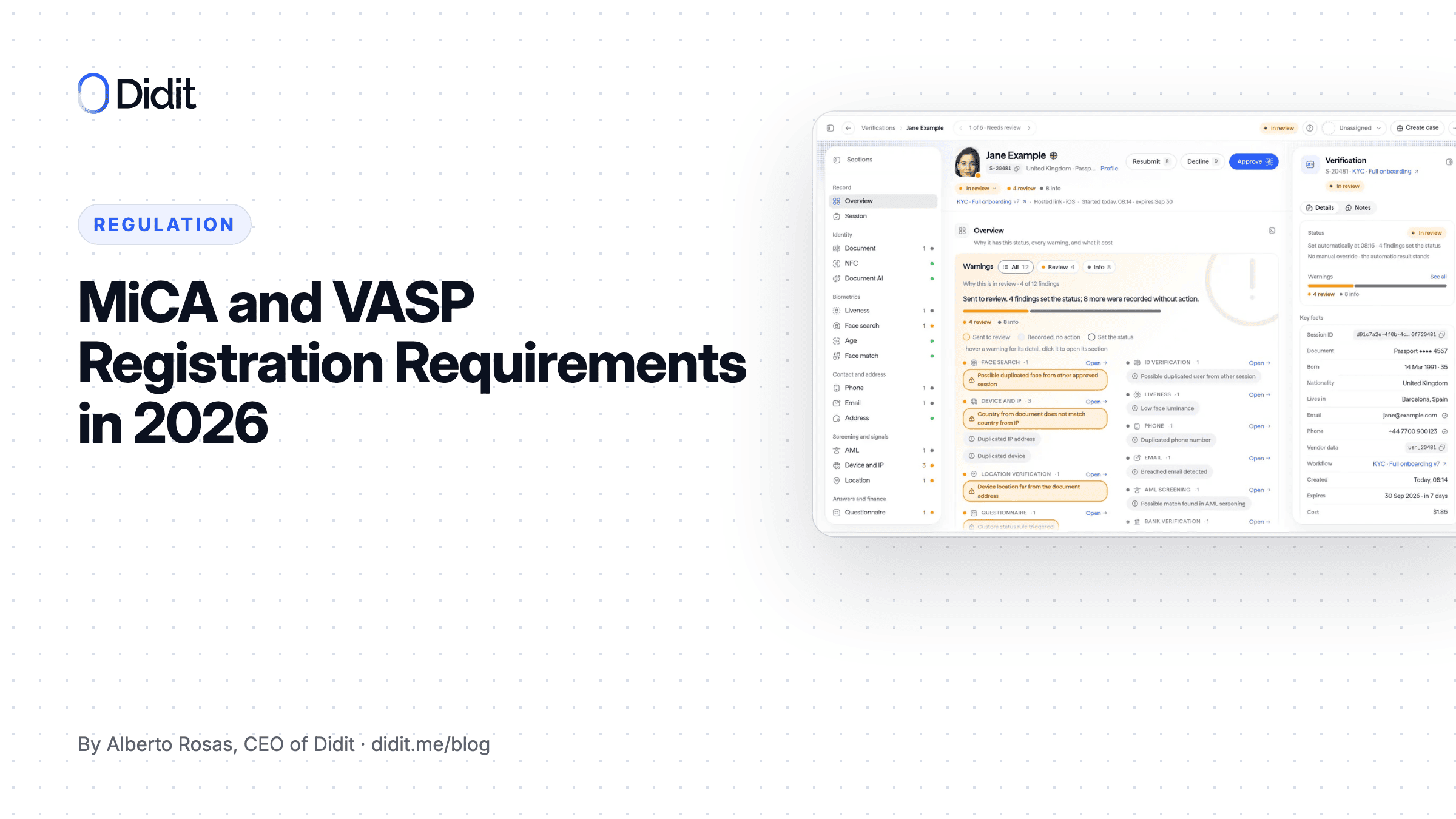
MiCA CASP authorisation in 2026: who needs Article 63, the Article 60 advance notification route, the Annex IV minimums, and Didit prices of $0.33 per KYC check and $0.20 per AML screen.
Alberto RosasMar 15, 2026Telehealth Patient Identity Verification: A Complete Guide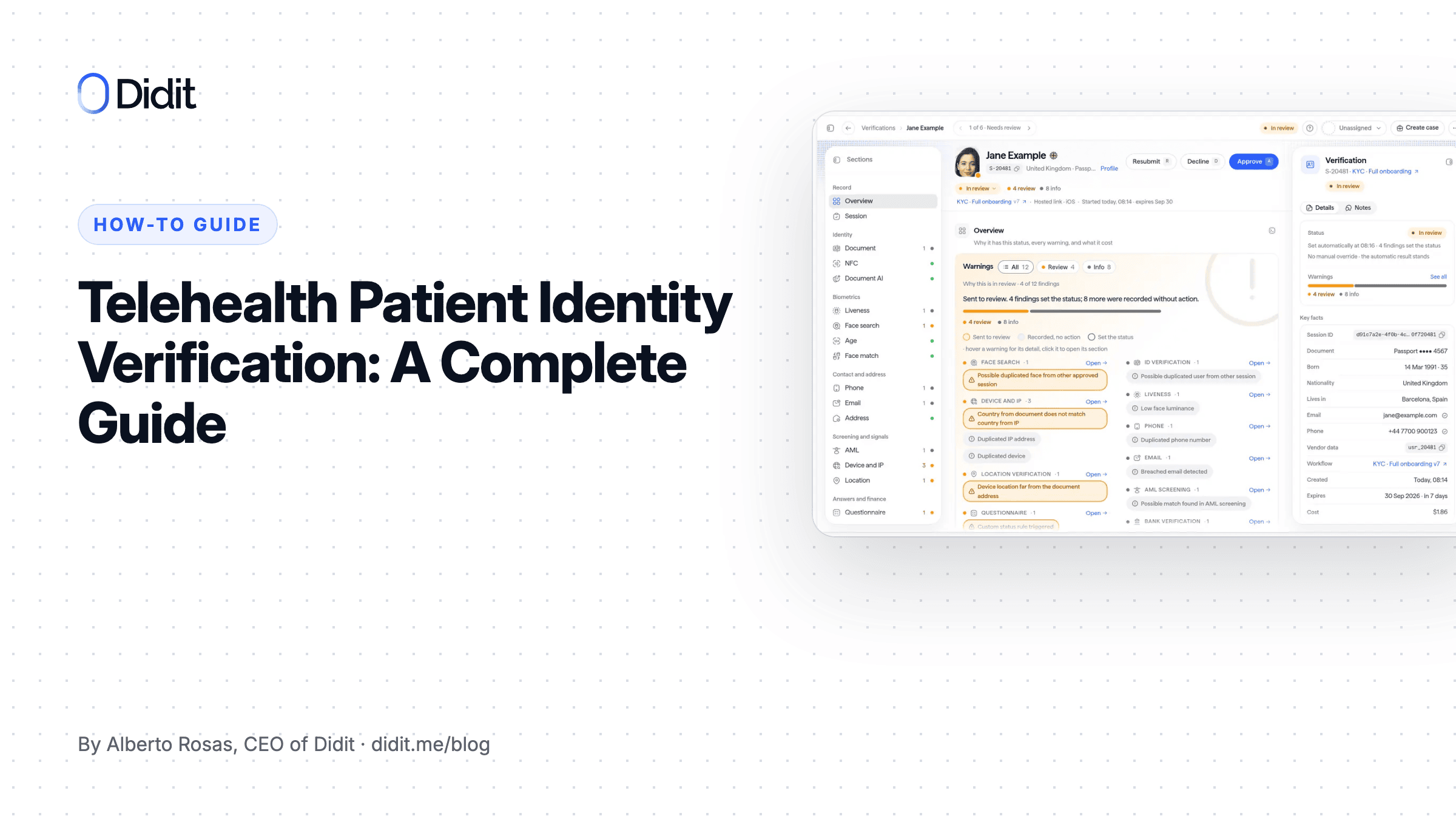
Verify telehealth patients in one Didit session: ID document, passive liveness, face match and device/IP for $0.33 per completed check, with webhooks, retry behavior and biometric consent built in.
Alberto RosasMar 15, 2026Synthetic Identity Fraud: Stopping Identity Rings in 2026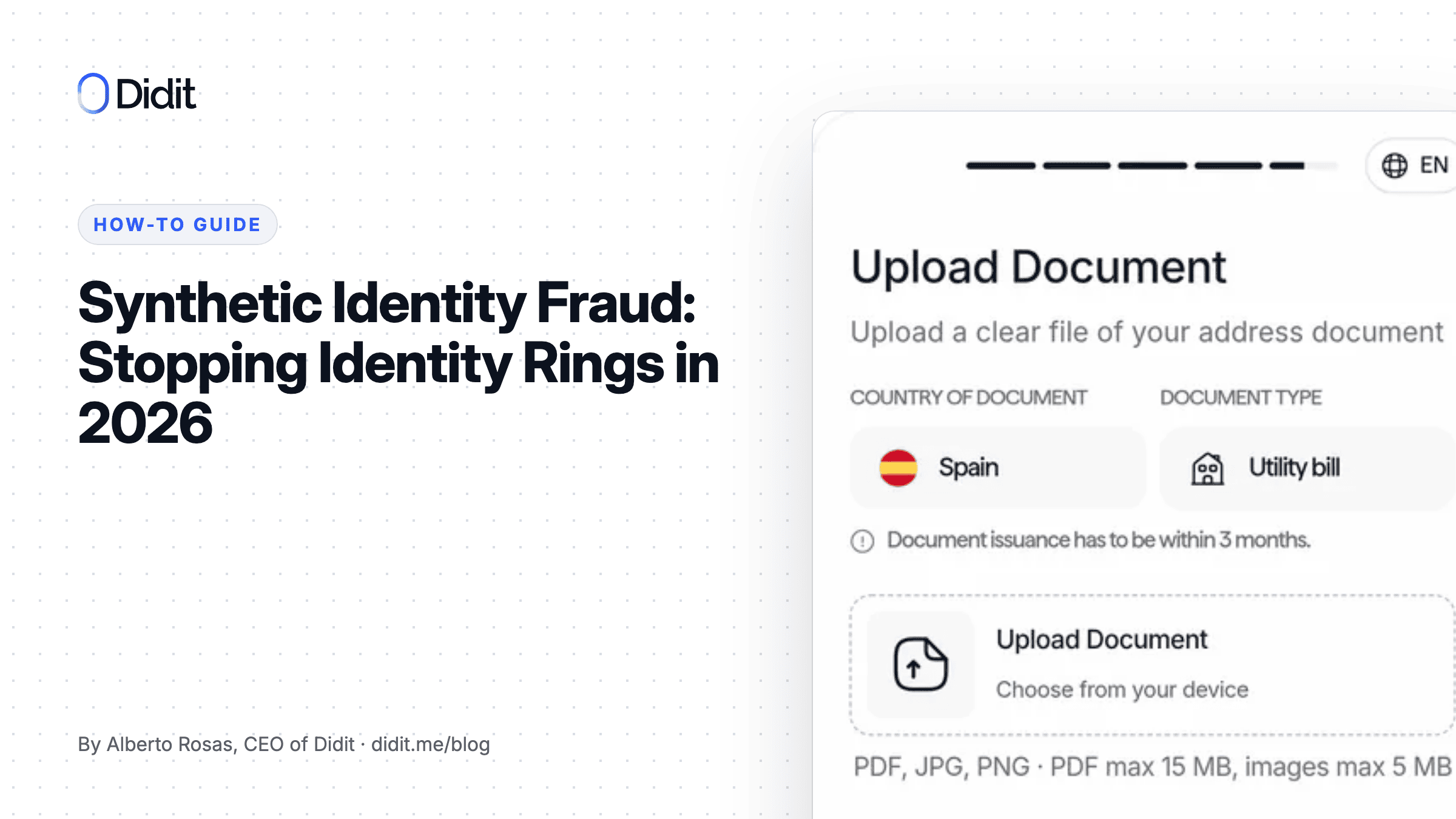
Synthetic identity rings reuse addresses, documents and devices. Validate the address, verify a proof of address document against the name, and link every session to face, device and blocklist signals.
Alberto RosasMar 15, 2026Seamless Identity: Didit Iframe Integration Guide
Learn how to quickly and securely integrate identity verification into your web application using Didit's embedded iframe solution. Enhance UX and reduce friction with our simple configuration guide.
Alejandro RosasMar 15, 2026Corporate Liability & Identity Verification: A Legal Guide
Understand the growing risks of corporate liability related to inadequate identity verification and fraud. Learn how to protect your business and ensure legal compliance.
Alberto RosasMar 15, 2026UK Economic Crime Act: KYC for Digital Identity
The UK Economic Crime and Corporate Transparency Act 2023 significantly impacts digital identity providers. This guide explains KYC compliance, AML regulations, and what you need to do to stay compliant.
Alberto RosasMar 15, 2026Automated AML Reporting and SAR Filing: A 2026 How-To Guide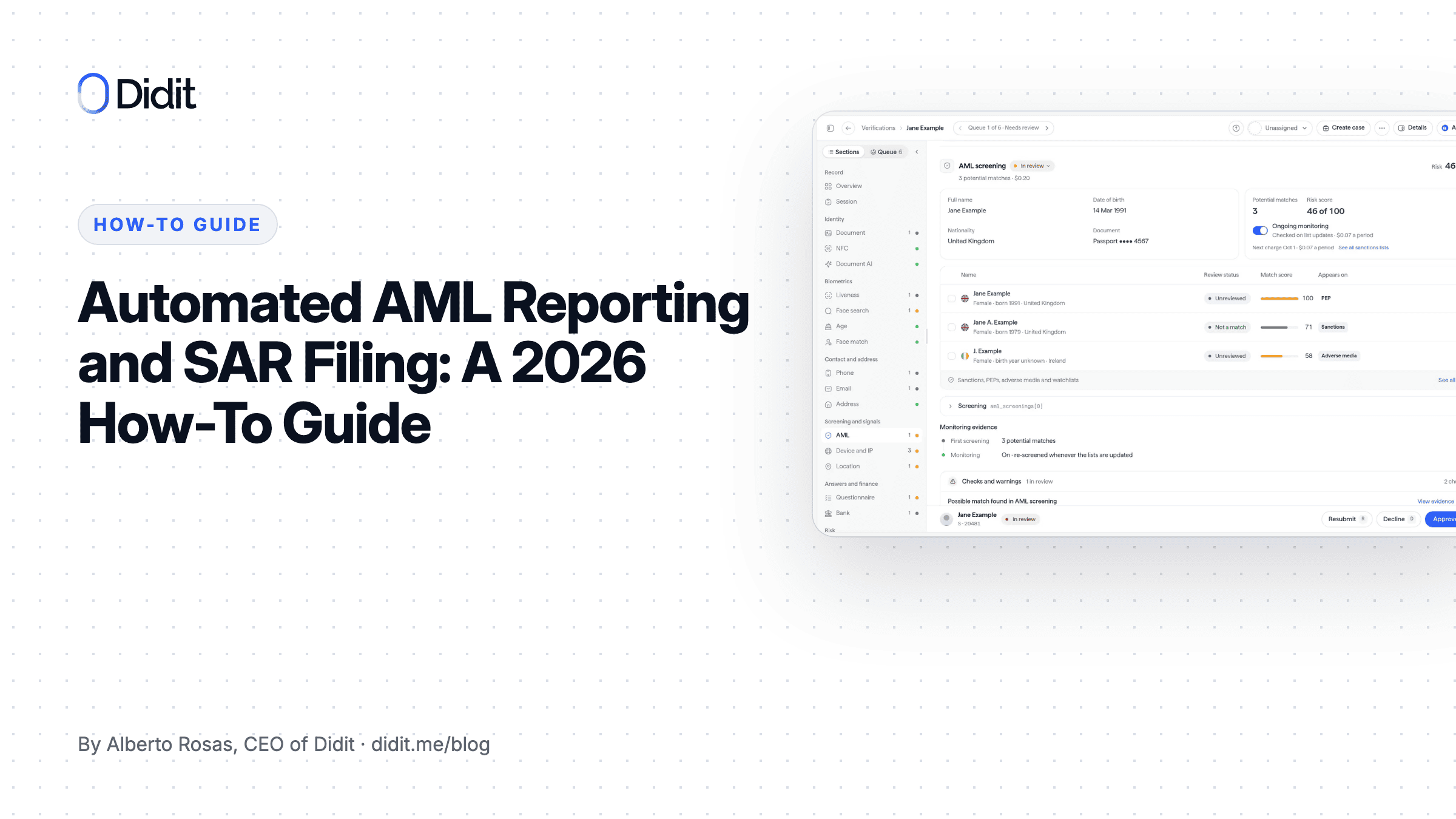
Automate everything up to the filing: screen at $0.20 a check, hold and triage transactions, investigate in cases, draft the SAR from the resolved case. Your compliance team still signs and submits it.
Alberto RosasMar 15, 2026RON Security: Safeguarding Remote Notarizations
Remote Online Notarization (RON) offers convenience, but ensuring RON security is paramount. This guide explores the risks, best practices, and technologies for secure RON processes, protecting against fraud and ensuring legal.
Alberto RosasMar 15, 2026Digital Signatures: Legal Validity & Compliance (1)
Understand the legal standing of digital signatures, e-signature laws (ESIGN & UETA), and how they impact KYC compliance. Ensure your electronic agreements are enforceable.
Alberto RosasMar 15, 2026Age Verification in Germany: A 2024 Compliance Guide
Use selfie age estimation with passive liveness at $0.10 as the German age gate and escalate borderline users to a full ID check at $0.33. An estimate is a gate, not legal proof of age.
Alberto RosasMar 15, 2026Mastering API Retry Strategies for Reliable KYC
Learn how to implement robust API retry strategies, including exponential backoff and circuit breakers, to ensure the reliability of your KYC and AML integrations. Avoid common pitfalls and build resilient systems.
Alejandro RosasMar 15, 2026Dynamic Risk-Based Authentication: How to Build It in 2026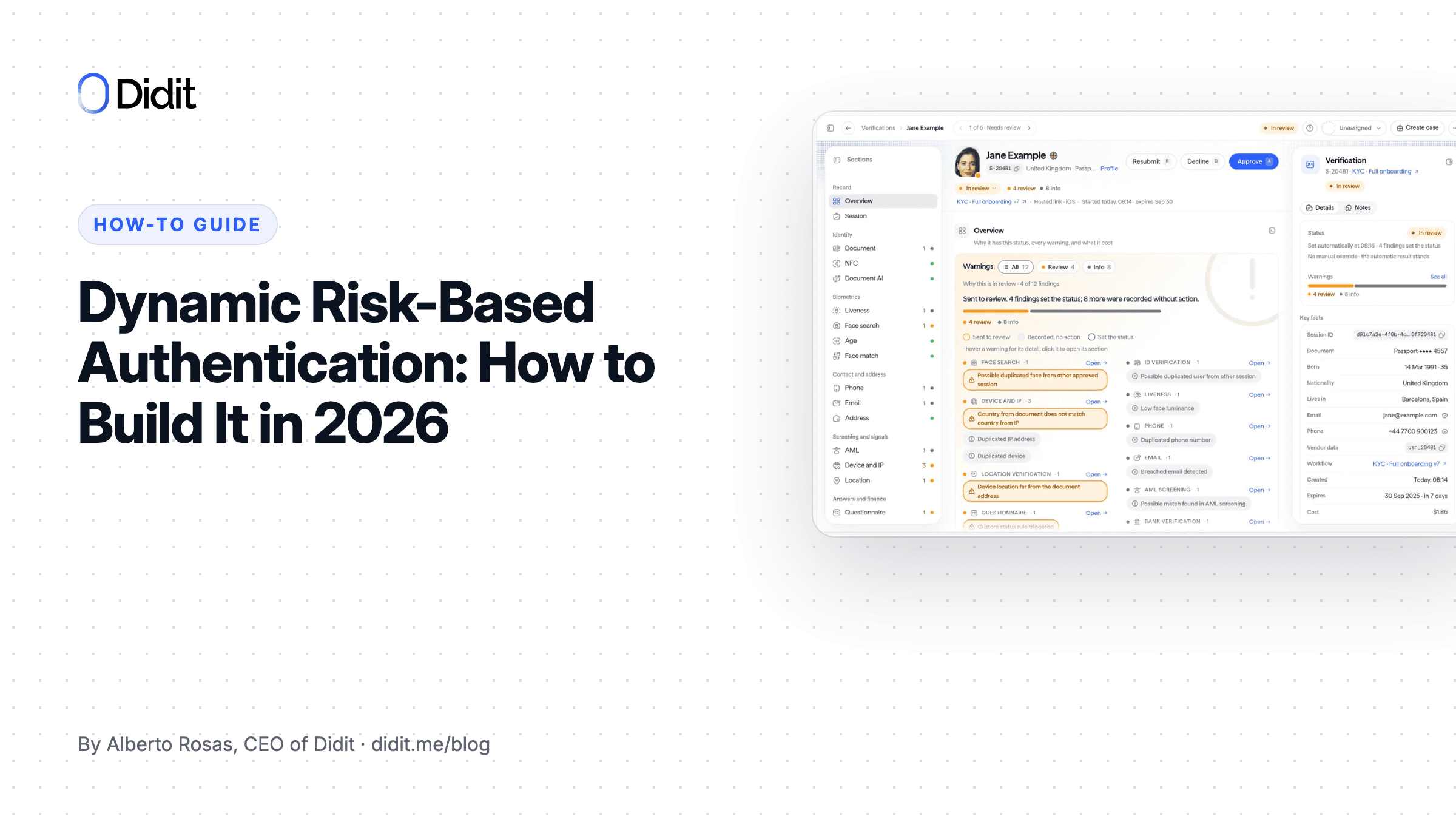
Dynamic risk-based authentication asks for an extra check only when a rule matches. On Didit you set bot protection policies and step-up rules, then your backend acts only on an approved result.
Alberto RosasMar 15, 2026P2P Lending Identity Verification: A Complete Guide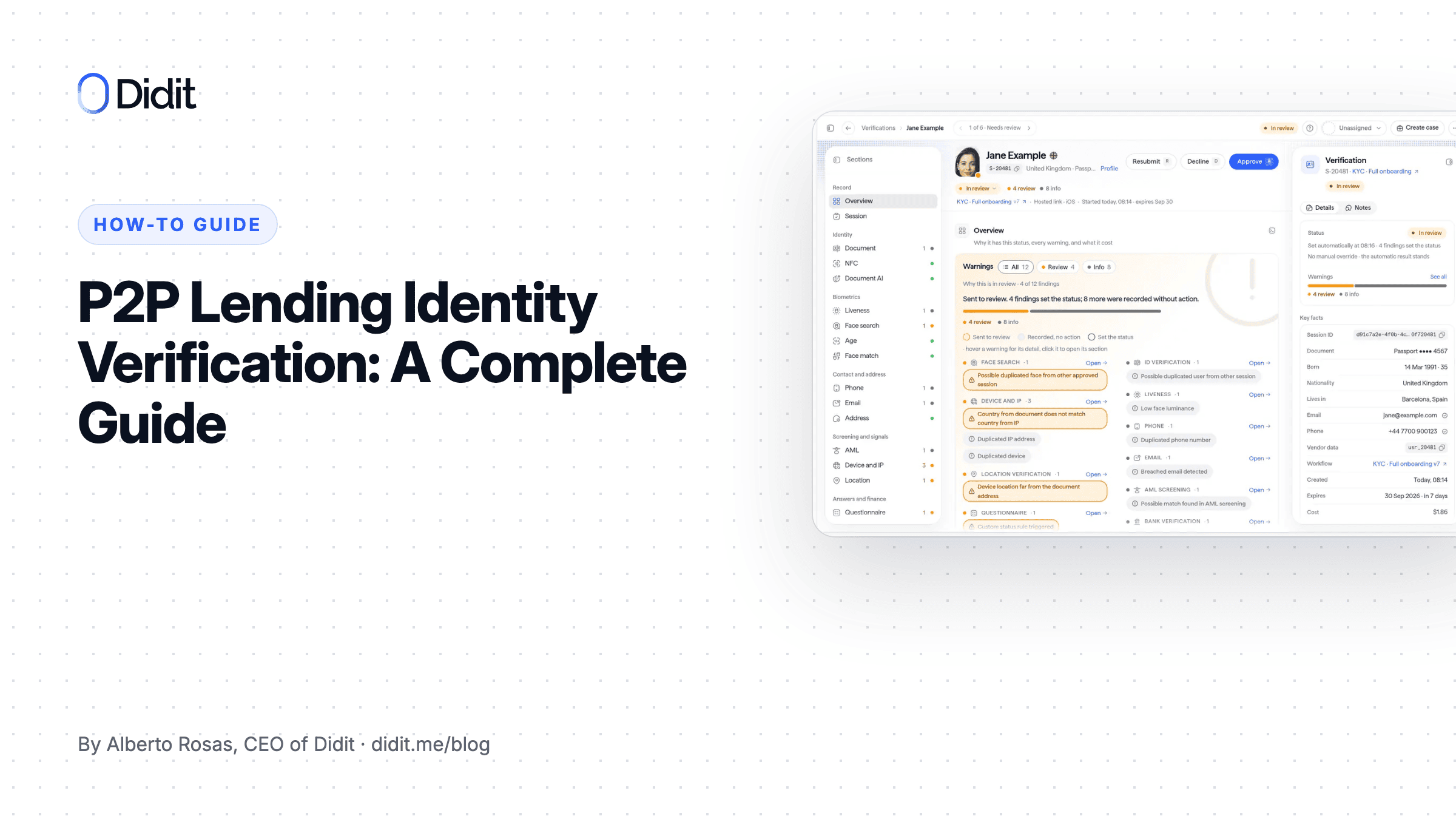
Run a Didit KYC workflow on every borrower and lender: ID document, liveness, face match and device and IP at $0.33, AML at $0.20, then re-screen the book at $0.07 per person a year.
Alberto RosasMar 15, 2026Detecting AI-Generated Utility Bills: A Deep Dive (2)
AI-generated document forgery is on the rise, especially with utility bills. This post explores the techniques used to detect synthetic documents, the challenges involved, and how Didit combats utility bill fraud.
Alberto RosasMar 15, 2026ICT Risk Management: A Practical DORA Guide for 2026
DORA ICT risk rules (Regulation (EU) 2022/2554) apply to in-scope EU entities from 17 January 2025. A full ID check costs $0.33. We provide identity checks, biometric authentication and audit logs; you own the DORA framework.
Alberto RosasMar 15, 2026EUDI Wallet Architecture: A Deep Dive
Explore the technical architecture of the EUDI Wallet (EUDI), its underlying standards, and how businesses can prepare for its rollout. This guide covers key components and future implications.
Alejandro RosasMar 15, 2026Webhook Idempotency for KYC: A Developer's Guide (2026)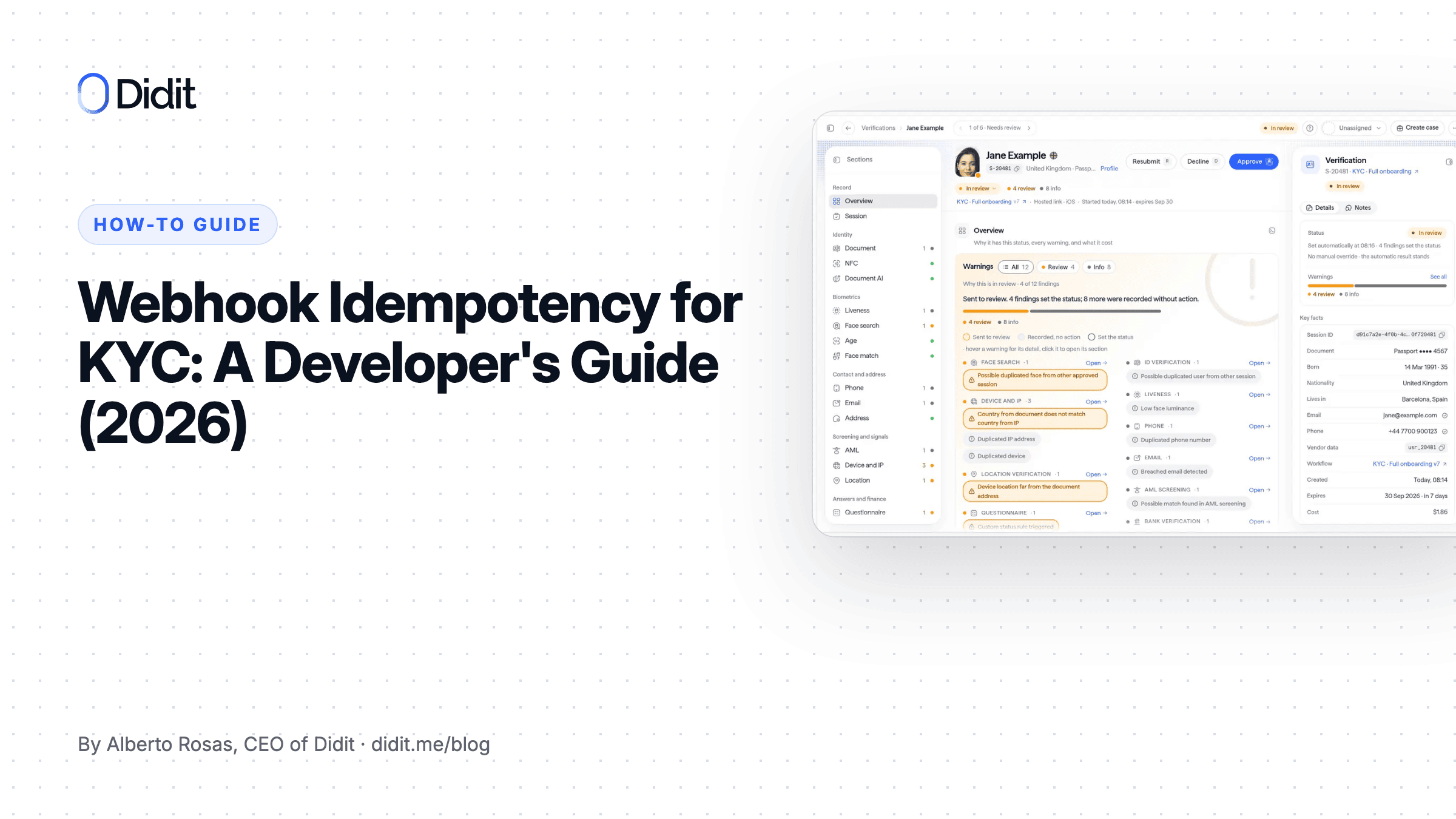
Didit webhooks arrive with bounded retries. Verify X-Signature-V2, reject timestamps older than 300 seconds, then deduplicate on the event identifier and process each decision idempotently.
Alejandro RosasMar 15, 2026KYC Orchestration ROI: Boost Conversions & Cut Fraud (3)
Explore the significant ROI of KYC orchestration, including improved conversion rates, reduced fraud, and streamlined compliance. Learn how to justify the investment.
Alberto RosasMar 15, 2026White-Labeling Didit SDK: Complete Branding Guide
Learn how to fully white-label the Didit SDK for seamless integration into your brand. Customize the UI with CSS overrides and control the user experience. Start building now!.
Alejandro RosasMar 15, 2026LoA Levels Explained: A Digital Identity Guide
Understanding Levels of Assurance (LoA) is crucial for secure digital identity verification. This guide breaks down LoA levels, compliance, and how Didit can help.
Alberto RosasMar 15, 2026ePassport Migration: A Deep Dive into Digital Identity
ePassports are revolutionizing international travel with enhanced security and convenience. This guide explores the technology, ICAO standards, migration timelines, and the future of digital identity with biometric chips.
Alberto RosasMar 15, 2026Biometric Consent: A Guide for GDPR Compliance
Biometric data is highly sensitive. Learn how to obtain valid consent for facial recognition and other biometric technologies under GDPR and global privacy regulations. Ensure compliance and build trust with your users.
Alberto RosasMar 15, 2026Fraud Operations Playbook: A Step-by-Step Guide
A comprehensive guide to building a robust fraud operations playbook, covering incident response, prevention strategies, and the tools to safeguard your business. Learn how to minimize losses and maximize efficiency.
Alberto RosasMar 15, 2026POC Best Practices for Identity Verification
Launching a proof of concept (POC) for identity verification can be complex. This guide outlines best practices to ensure a successful evaluation, maximize ROI, and choose the right solution for your needs.
Alberto RosasMar 15, 2026WebAssembly for Liveness Detection: A Deep Dive
Explore how WebAssembly (Wasm) revolutionizes liveness detection, enhancing security and performance in web applications. Learn about its benefits, implementation, and future potential.
Alberto RosasMar 15, 2026WebAssembly & Biometrics: Securing the Future of Online Identity
Explore how WebAssembly (Wasm) enhances biometrics and liveness detection in browsers, boosting security and privacy for online identity verification.
Alberto RosasMar 15, 2026Streamline Loan Underwriting with Borrower Verification
Robust borrower verification is crucial for effective loan underwriting and minimizing risk. Learn how modern solutions can enhance fraud prevention and streamline the lending process.
Alberto RosasMar 15, 2026Detecting Synthetic Proof of Address: A Deep Dive (1)
Synthetic Proof of Address (PoA) is a growing fraud threat. Learn how AI-powered identity verification platforms like Didit detect forged documents and protect your business from financial loss.
Alberto RosasMar 15, 2026P2P Lending Identity Verification: Reducing Loan Defaults
P2P lending platforms face unique fraud risks. Robust identity verification is crucial for minimizing loan defaults and maximizing profitability. Learn how to implement effective solutions.
Alberto RosasMar 15, 2026AI Risk Scoring for Fraud Detection: A 2026 How-To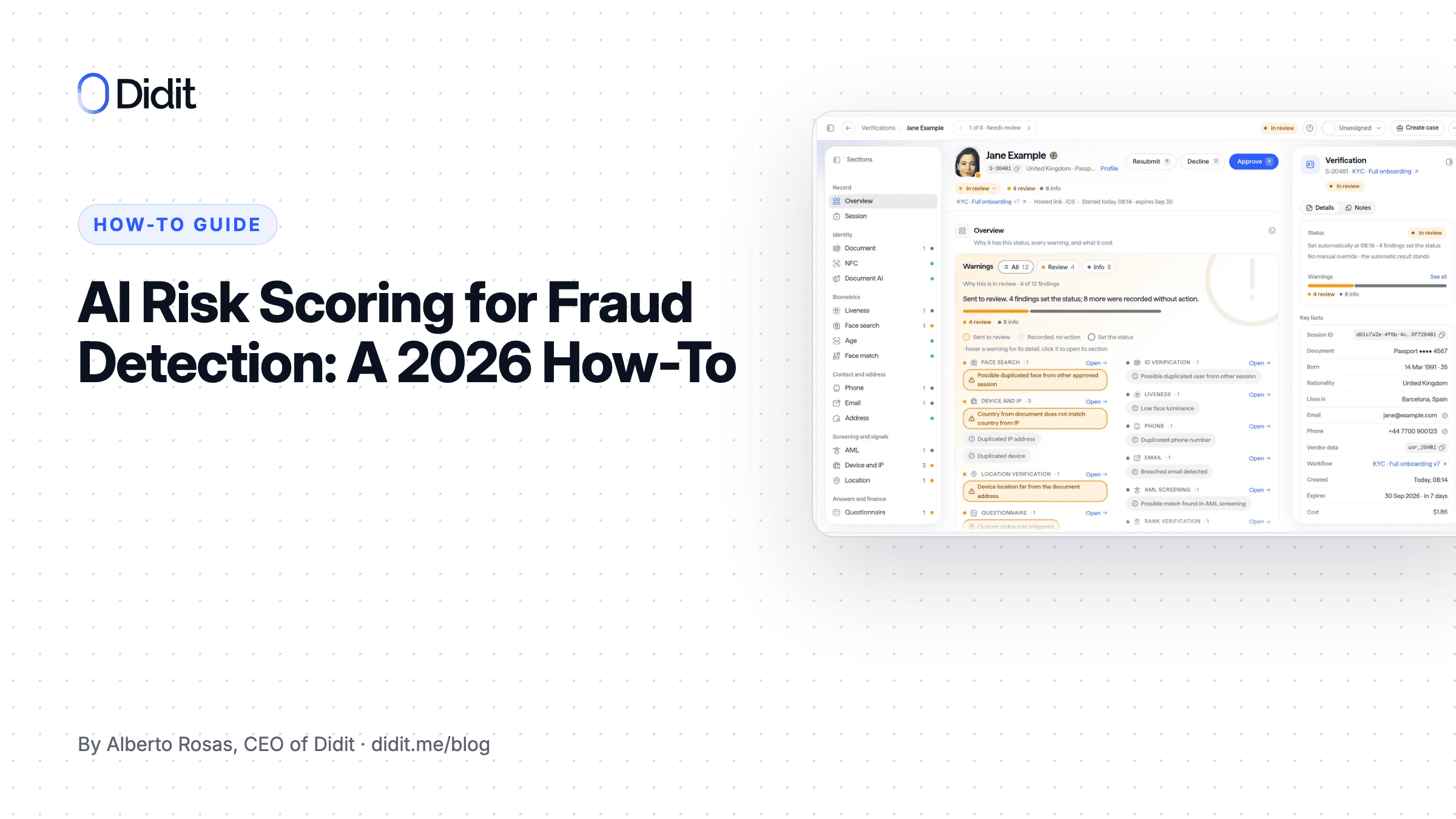
AI risk scoring turns signals into one number. Didit sums matched rule points and applies thresholds unless a rule action sets the status. Pricing is $0.001 per transaction beyond the allowance; Free includes 1,000 monthly.
Alberto RosasMar 15, 2026Document Verification & Data Privacy: A Guide
Navigating data privacy regulations like GDPR and CCPA during document verification is crucial. This guide explains how to balance compliance with effective KYC processes, protecting sensitive PII.
Alberto RosasMar 15, 2026KYC for DAOs: Navigating Compliance in Web3 (2)
Decentralized Autonomous Organizations (DAOs) require unique KYC solutions. This guide explores the challenges & opportunities of bringing KYC/AML compliance to DAOs, covering decentralized identity and practical implementation.
Alberto RosasMar 15, 2026Multi-Vendor Risk: Avoiding Lock-In & Control
Managing multiple identity verification vendors creates complexity and hidden costs. Discover how identity orchestration can reduce risk, improve compliance, and unlock savings.
Alberto RosasMar 15, 2026Post-Quantum Identity: Securing Verification Now
As quantum computing advances, current encryption methods become vulnerable. This post explores post-quantum cryptography and how it impacts identity verification, focusing on lattice-based signatures and future-proofing your.
Alberto RosasMar 15, 2026Age Verification & Privacy: A Compliance Guide
Balancing age verification with user privacy is crucial. This guide explores legal requirements (GDPR, CCPA), best practices, and how Didit helps ensure compliance while protecting user data.
Alberto RosasMar 15, 2026DORA & Identity: A Compliance Guide
Digital Operational Resilience Act (DORA) is a new EU regulation impacting financial entities. This guide explains DORA’s identity verification requirements and how to achieve compliance.
Alberto RosasMar 15, 2026KYC in Emerging Markets: Driving Financial Inclusion
Navigating KYC and compliance in emerging markets presents unique challenges. This guide explores strategies for balancing regulatory requirements with the need to expand financial inclusion, focusing on identity verification.
Alberto RosasMar 15, 2026NFT KYC: A Workflow for Compliance
NFT marketplaces face unique AML and KYC challenges. This guide details building a robust KYC workflow to stay compliant and mitigate risk in the Web3 space. Learn best practices now.
Alberto RosasMar 15, 2026Optical vs. Electronic ID Verification: A Deep Dive (2)
Explore the differences between optical and electronic ID verification, including their technologies, security levels, and suitability for various use cases.
Alberto RosasMar 15, 2026ROI of Identity Verification: Boost Growth & Cut Costs
Explore the substantial ROI of identity verification, including fraud reduction, improved conversion rates, enhanced customer trust, and long-term business growth. Learn how to optimize your strategy.
Alberto RosasMar 15, 2026Dynamic Risk Scoring API: Prevent Fraud in Real-Time
Learn how a dynamic risk scoring API can improve your fraud prevention and identity verification processes. Explore architecture, integration, and best practices with Didit.
Alejandro RosasMar 15, 2026Composable Identity: Unlocking ROI in Verification
Discover how a composable identity approach—built on modular identity verification—can deliver significant ROI through cost savings, increased conversion rates, and enhanced security.
Alberto RosasMar 15, 2026Avoid Vendor Lock-In: A Guide to Identity Integration
Vendor lock-in in identity verification can stifle innovation and inflate costs. Learn how to build a flexible identity integration strategy with an API-first approach.
Alejandro RosasMar 15, 2026WebAssembly for Secure Identity Verification (2)
Explore how WebAssembly (Wasm) enhances identity verification by bringing near-native performance and improved security to web and mobile applications.
Alberto RosasMar 15, 2026KYC for Remote Workforces: A Compliance Guide
Remote work introduces unique KYC challenges. This guide explores best practices for global onboarding, compliance, and fraud prevention in distributed teams. Ensure secure and compliant remote operations today.
Alberto RosasMar 15, 2026IP Address Analysis: A Key to Fraud Detection
IP address analysis is a crucial component of modern fraud detection and identity verification. Learn how analyzing IP data helps prevent online fraud, identify proxies and VPNs, and enhance security.
Alejandro RosasMar 15, 2026API Rate Limiting for Identity Verification: A Developer’s Guide (4)
Protect your identity verification APIs from abuse and ensure scalability with effective rate limiting strategies. Learn best practices, algorithms, and implementation tips.
Alberto RosasMar 15, 2026Fraud Scoring: Leveraging Device Intelligence
Learn how device intelligence and behavioral biometrics enhance fraud scoring, significantly improving fraud detection rates and protecting your business. Discover key techniques and how Didit delivers superior results.
Alberto RosasMar 15, 2026Device Fingerprinting: A Powerful Tool for Fraud Prevention (3)
Device fingerprinting is a crucial technique for fraud prevention, going beyond IP addresses to uniquely identify users. Learn how it works, its limitations, and how Didit leverages it for robust security.
Alberto RosasMar 15, 2026Defending Against Deepfakes: Adversarial Attacks on Liveness Detection
Liveness detection is crucial for biometric security, but increasingly sophisticated adversarial attacks, including deepfakes, pose a significant threat. This post explores the vulnerabilities and defenses against these attacks.
Alberto RosasMar 15, 2026Combating Document Fraud with Generative AI
Generative AI is revolutionizing many fields, but it also introduces new threats like AI forgery and sophisticated document fraud. This post explores how generative AI impacts digital identity and outlines detection strategies.
Alberto RosasMar 15, 2026Identity Verification for Fintech Lending: A Deep Dive
Fintech lenders face unique identity verification challenges. This guide explores best practices for fraud prevention, KYC/AML compliance, and streamlining the lending process.
Alberto RosasMar 15, 2026WebAssembly for Identity Verification: A Secure Edge (2)
Explore how WebAssembly (Wasm) revolutionizes identity verification, enabling secure, performant, and portable solutions for edge computing. Learn about its benefits for fraud prevention and KYC/AML compliance.
Alberto RosasMar 15, 2026Digital Credential Wallets and Fraud: A 2026 How-To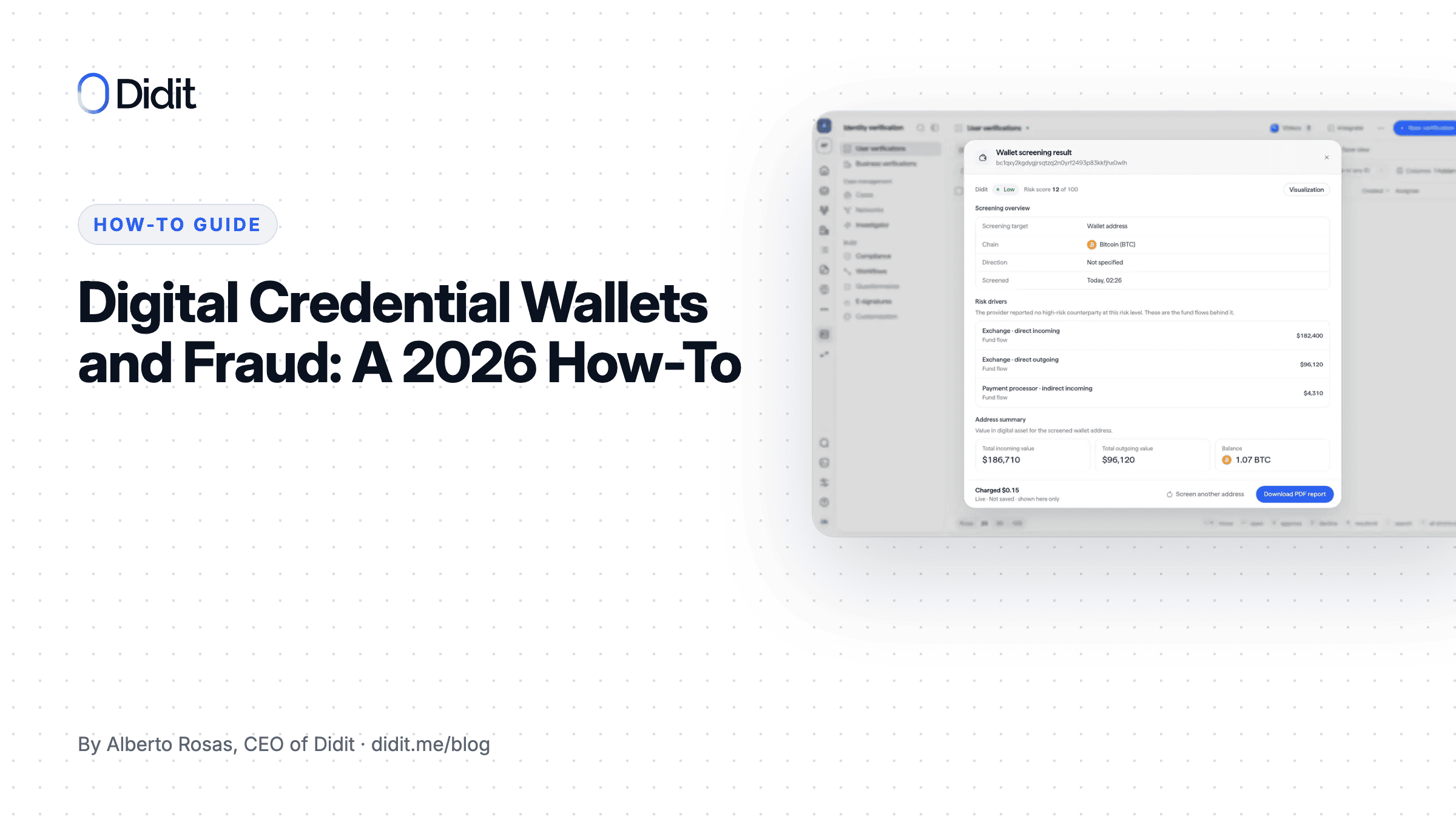
Wallet sign-in proves the issuer authenticated the person, not that the session is clean. Add wallet APIs first, a document fallback second, then liveness, device and IP, AML and monitoring on the fallback path.
Alberto RosasMar 15, 2026Vendor Evaluation: A Framework for Identity Verification
Choosing the right identity verification vendor is crucial for security, compliance, and user experience. This guide provides a robust vendor evaluation framework to help you make informed decisions and maximize ROI.
Alberto RosasMar 15, 2026IP Geolocation: Accuracy, Fraud Detection and Limitations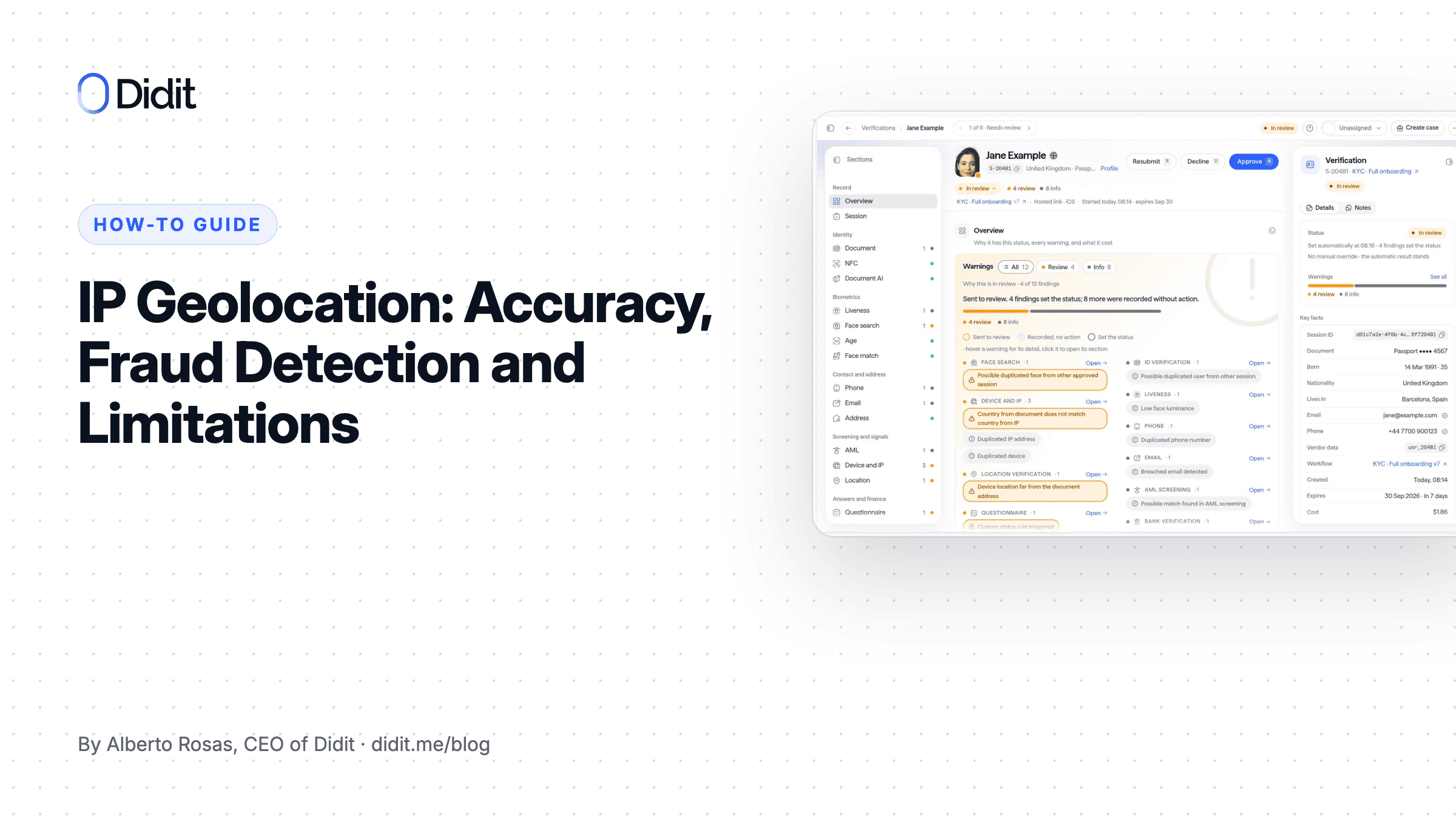
IP geolocation is reliable at country level, approximate at city level and never a street address. Use it as one fraud signal alongside device and document checks, not as a reason to block on its own.
Alberto RosasMar 15, 2026Advanced Proxy Detection: A Deep Dive (1)
Protect your business from fraud with robust proxy detection. This guide explores techniques like IP reputation, TLS fingerprinting, and behavioral analysis to identify and block malicious actors.
Alberto RosasMar 15, 2026DAO KYC: Navigating Compliance in Web3
Explore customer checks and wallet-risk review for DAOs. Connect an available provider key or start pay-as-you-go wallet screening through Didit.
Alberto RosasMar 15, 2026Build a No-Code KYC Workflow: A Step-by-Step Guide
Learn how to build a powerful KYC workflow without writing a single line of code, reducing fraud, and accelerating user onboarding. Discover the benefits of automation and a no-code approach to identity verification.
Alejandro RosasMar 15, 2026Document Coverage Gaps: A KYC Risk You Can't Ignore (1)
Expanding globally? Don't let limited document coverage derail your KYC compliance. Discover how to identify and address gaps in ID verification, mitigate fraud, and unlock international growth.
Alberto RosasMar 15, 2026Automated SAR Filing: A Compliance Game Changer (1)
Suspicious Activity Reporting (SAR) is a crucial part of AML compliance. Automating SAR filing reduces manual effort, minimizes errors, and improves detection rates. Learn how to streamline your process today.
Alberto RosasMar 15, 2026Build a Fraud Operations Playbook: A Step-by-Step Guide
A robust fraud operations playbook is essential for mitigating risk in today’s digital landscape. This guide provides a comprehensive framework for building a playbook to enhance fraud prevention and incident response.
Alberto RosasMar 15, 2026Streamline Compliance: Beneficial Ownership Verification
Beneficial ownership verification is crucial for AML compliance. Discover how to streamline the process, reduce risk, and meet regulatory requirements with modern technology.
Alejandro RosasMar 15, 2026KYC Localization: A Global Compliance Guide (1)
Navigating KYC localization is crucial for international expansion. This guide details regional compliance, cost considerations, and strategies for effective identity verification across borders.
Alberto RosasMar 15, 2026AI-Powered Sanctions Screening: A Modern AML Solution
Cross-border sanctions screening is crucial for AML compliance. This post explores how AI is revolutionizing sanctions screening, improving accuracy, and reducing false positives.
Alberto RosasMar 15, 2026Automated KYC Queue Management: Cut Costs and Risk (2026)
Automated KYC queue management routes each session by risk so reviewers only open flagged cases. Didit charges $0.33 per full ID check and $0.20 per AML screening, and a session flagged for review needs a written policy and a.
Alberto RosasMar 15, 2026Questions
Blog questions
Who writes the Didit blog?
Which topics does the blog cover?
Is the blog available in my language?
Where do I find product updates?
Are these posts legal advice?
How do I find posts on one topic?
Are posts dated?
Do posts link to the docs?
Is the blog the same as the docs?
Compliance built in
Audited, certified and attested.
We hold the certifications and build each country's rules into your flows, so you can launch anywhere without worrying. Security and Compliance center
- Regulation encoded into your flows
Tell us what you do and where. Didit lists the rules that apply to you, with sources, and builds the checks each country needs into one workflow.
- Ready for AMLR
Every requirement of the new EU anti-money laundering rules, from checking customers to human review, is already covered by a Didit check.
- Tested in Spain's Treasury sandbox
Spain's Treasury published its supervised sandbox report on Didit's NFC plus active liveness onboarding; SEPBLAC took part and valued the added measures positively.
- Audited, not self-declared
iBeta Level 1 and Level 2. Liveness tested under ISO/IEC 30107-3.
Your obligations · 3 regions
 SOC 2 Type 2
 ISO 27001
 iBeta Level 1 and Level 2
 EU regulator attestation
 FSM youth protection
 GDPR
 EBA remote onboarding
 MiCA compatible
 FIDO Alliance member
- AMLREU AML Regulation ready
Integration · Didit MCP
Run Didit from your own AI agent
Connect Didit to Claude, Cursor, VS Code or ChatGPT and just ask in plain words. Your agent can do anything you can do in the console, with the same permissions you have.
 Add to Claude
 ChatGPT
 Cursor
- Build workflowsDescribe the checks you need. The agent creates and publishes the flow.
- Run investigationsAsk why a session was declined, review cases, search people and companies.
- Change rulesCreate payment rules, test them on past data and switch them on.
- Pull reportsAsk for numbers, exports or the audit log.
Didit Academy


