Blog
Blog archive
Every post on the Didit blog, newest first. Pick a category or search to find the subject you need.
All posts
Every post, newest first
Pick a category to filter.
Identity verification is more than just approving or declining users. By leveraging comprehensive analytics, businesses can gain deep insights into user behavior, optimize onboarding flows, detect emerging fraud patterns, and.
Alberto RosasMar 6, 2026Build a Real-Time AML Compliance Dashboard with Didit (2026)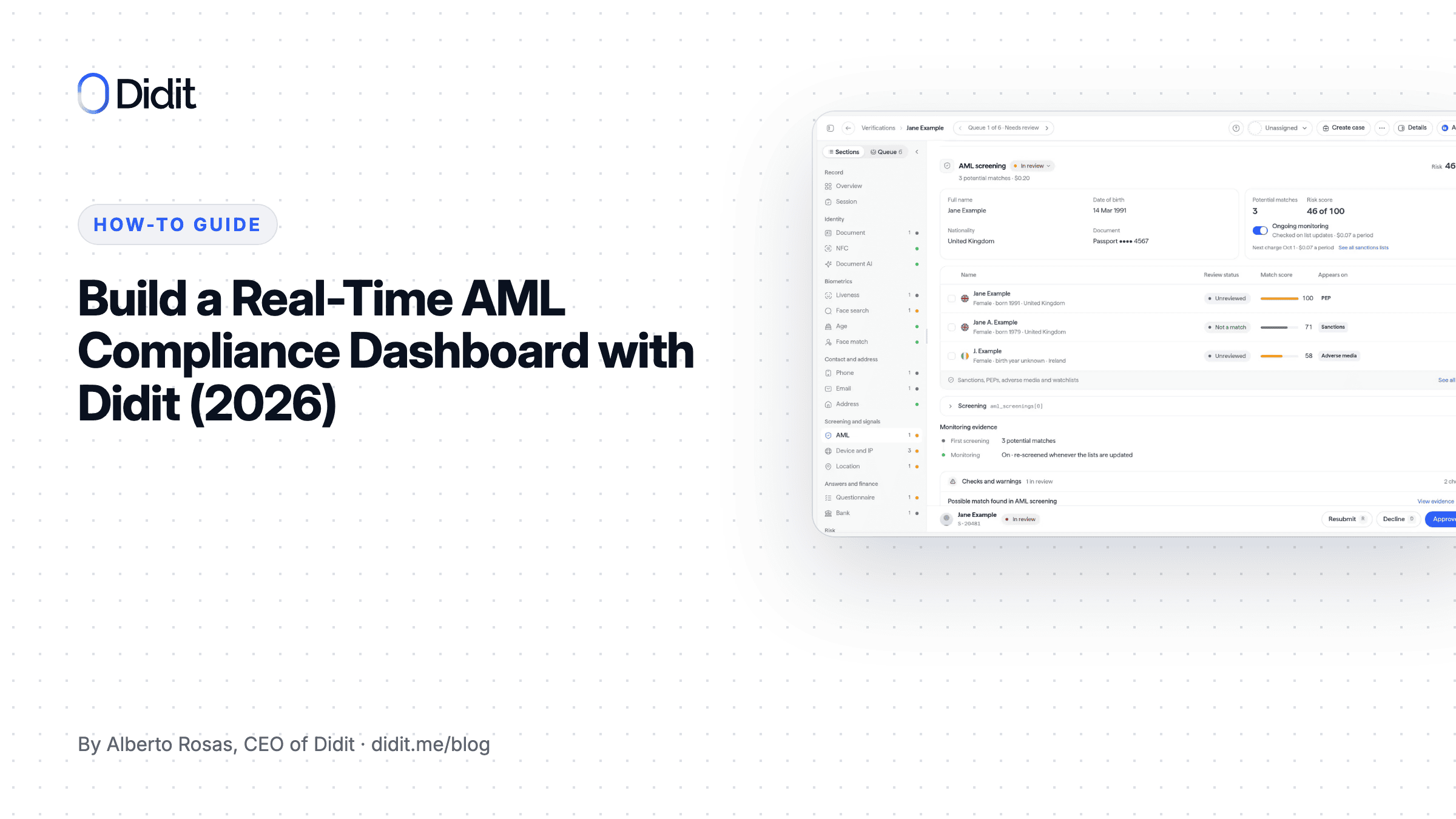
Build a real-time AML dashboard from Didit AML screening at $0.20 per check, ongoing monitoring at $0.07 per person a year and held transactions, read from the decision endpoint and webhooks.
Alberto RosasMar 6, 2026Unlock Insights: Didit's Structured Data for Advanced Analytics
Leverage Didit's granular, structured identity data for unparalleled network analytics and threat intelligence. Gain real-time insights into user behavior, identify emerging fraud patterns, and enhance your security posture with.
Alberto RosasMar 6, 2026Privacy-Enhancing Computations in EUDI Wallets
Explore the critical role of Privacy-Enhancing Computations (PECs) in securing EUDI Wallets, ensuring user control and data minimization.
Alberto RosasMar 6, 2026Programmatic Identity Proofing for Edge Devices with WebAssembly
Discover how programmatic identity proofing, powered by WebAssembly, is revolutionizing identity verification on edge devices, enabling secure, efficient, and privacy-preserving KYC workflows.
Alberto RosasMar 6, 2026Real-Time Sanctions Watchlist Monitoring with Webhooks
Building a robust, real-time sanctions watchlist monitoring system is crucial for compliance. This guide explores leveraging webhooks for instant alerts, continuous screening, and efficient risk management to ensure your.
Alberto RosasMar 6, 2026KYC for DeFi Lending: Mitigating Sanctions Risk Effectively
Decentralized Finance (DeFi) lending protocols face increasing pressure to implement Know Your Customer (KYC) and Anti-Money Laundering (AML) measures to mitigate sanctions risk and ensure regulatory compliance.
Alberto RosasMar 6, 2026Defining Trust Metrics for AI Agents in Autonomous Systems
As AI agents become integral to autonomous systems, establishing robust trust metrics is paramount for security and reliability. This post explores key components of agent trust, from identity verification to behavioral.
Alberto RosasMar 6, 2026eIDAS 2.0 & QES: Revolutionizing Digital Contracts
eIDAS 2.0 is transforming digital identity and contract workflows across the EU, enhancing security and trust. Qualified Electronic Signatures (QES) offer the highest legal validity, backed by stringent identity verification.
Alberto RosasMar 6, 2026Robust KYC: Advanced Error Handling & Fallback Strategies
Building resilient Know Your Customer (KYC) microservices requires sophisticated error handling and robust fallback strategies. This blog explores common failure points, proactive design patterns, and how Didit's modular.
Alberto RosasMar 6, 2026Crafting Idempotent API Requests for Reliable Identity Verification
Ensuring reliability in identity verification workflows is crucial. This blog explores how idempotent API requests prevent duplicate processing, enhance data consistency, and improve user experience.
Alejandro RosasMar 6, 2026Ensuring API Reliability: The Power of Idempotency Keys in Identity Verification
Idempotency keys are crucial for building robust and reliable API integrations, especially in sensitive areas like identity verification. They prevent duplicate operations caused by retries, network issues, or unexpected system.
Alejandro RosasMar 6, 2026Boost Developer Productivity with Modular Identity APIs
Unlock unparalleled developer productivity by leveraging modular identity APIs. This approach eliminates the need for monolithic identity solutions, allowing teams to integrate only the necessary verification components.
Alberto RosasMar 6, 2026In-House vs. Outsourcing Identity Verification: A Deep Dive
Deciding whether to build an in-house identity verification system or outsource it is a critical strategic choice for businesses. This blog explores the pros and cons of each approach, highlighting operational complexities, cost.
Alberto RosasMar 6, 2026Building a Robust Fraud Operations Playbook for Fintech Startups
Fintech startups face unique fraud challenges. This guide outlines how to build an effective fraud operations playbook, focusing on proactive measures, technology integration, and continuous adaptation.
Alberto RosasMar 6, 2026Digital Identity for Humanitarian Aid Verification (2026)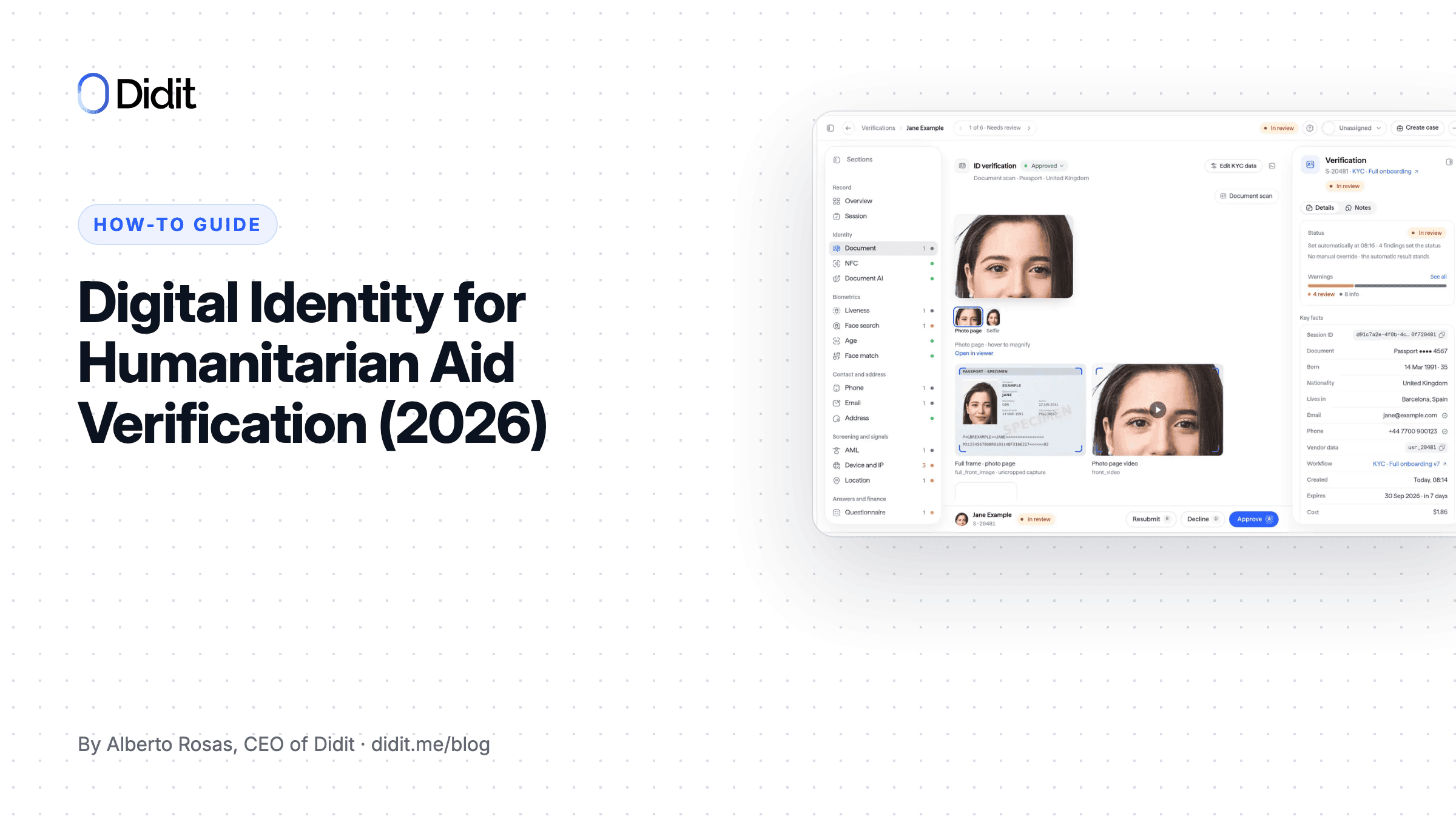
Verify beneficiaries with one Didit workflow per program and one session per person: $0.33 per full ID check, decisions by webhook, and eligibility and humanitarian safeguards remain with your agency.
Alberto RosasMar 6, 2026Navigating Cross-Border Identity Data Flows with Confidence
Effectively managing cross-border identity data flows is critical for global businesses. This guide outlines key compliance best practices, including understanding regulatory landscapes, implementing robust data protection, and.
Alberto RosasMar 6, 2026Real-Time KYC for Instant Payments and Open Banking
Instant payments and open banking demand real-time KYC to prevent fraud and ensure compliance. This article explores the challenges and solutions, emphasizing how AI-native platforms like Didit provide the necessary speed.
Alberto RosasMar 6, 2026Cross-Border Database Validation for KYC: A Deep Dive
Navigating Know Your Customer (KYC) regulations across borders presents unique challenges, particularly in database validation. This blog explores the complexities, from data access to regulatory compliance, and highlights how.
Alberto RosasMar 6, 2026Navigating FATF Guidance on Virtual Assets and VASPs (2026)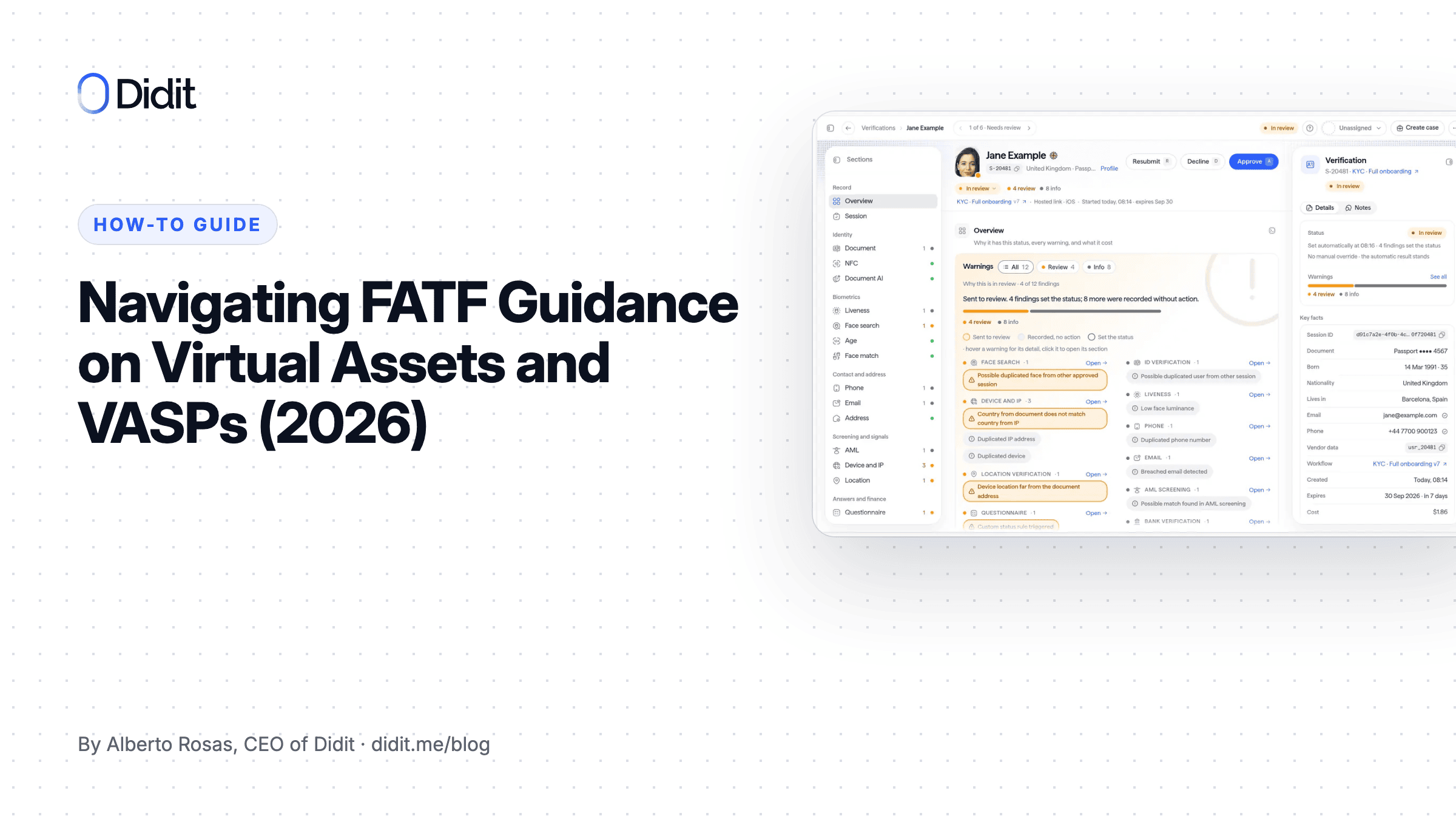
FATF asks VASPs to run a risk-based process on every transfer: verify the customer, screen the wallet, exchange originator and beneficiary data, prove wallet control. Didit prices each call separately.
Alberto RosasMar 6, 2026Revolutionizing Healthcare Identity with FHIR and Didit
Healthcare identity verification is critical for patient safety, data security, and compliance. Integrating FHIR standards streamlines data exchange, but robust identity solutions are needed to ensure accuracy and prevent fraud.
Alberto RosasMar 6, 2026Preventing Synthetic Identity Fraud with Database Validation
Synthetic identity fraud is a growing threat, costing businesses billions annually. This blog explores how advanced database validation, leveraging authoritative sources, is crucial in detecting and preventing these.
Alberto RosasMar 6, 2026Navigating GDPR & CCPA: Identity Data Compliance Mapping
Understanding and implementing compliance across global privacy regulations like GDPR and CCPA is crucial for businesses handling identity data.
Alberto RosasMar 6, 2026Edge AI for Biometric Liveness Detection on iOS
Discover how Edge AI enhances biometric liveness detection on iOS, providing robust fraud prevention, improved user experience, and enhanced privacy.
Alejandro RosasMar 6, 2026Building a Custom Risk Engine with Mobile SDK Telemetry Data
Discover how to leverage mobile SDK telemetry data to construct a robust, custom risk engine for enhanced identity verification and fraud prevention.
Alejandro RosasMar 6, 2026Beyond KYC: Proactive Risk Scoring in Online Gambling
Online gambling platforms face unique challenges in balancing user experience with stringent regulatory compliance and fraud prevention. Proactive risk scoring, moving beyond basic KYC, is essential for identifying high-risk.
Alberto RosasMar 6, 2026Agent-Based Onboarding: Personalized KYC Workflows Demystified
Agent-based onboarding leverages human interaction to enhance complex KYC workflows, offering personalized support and reducing friction for high-value customers.
Alberto RosasMar 6, 2026Global Age Verification: Navigating Country-Specific Enforcement
The global landscape of age verification is complex, with country-specific regulations impacting industries from online gaming to social media.
Alberto RosasMar 6, 2026Real-Time Identity Scoring for Gig Economy Onboarding
The gig economy demands rapid and reliable identity verification. Real-time identity scoring offers businesses a dynamic approach to assess risk, improve onboarding, and maintain trust.
Alberto RosasMar 6, 2026Autonomous Trust Networks: The Future of Machine Identity
Autonomous Trust Networks (ATNs) represent a paradigm shift in how machines establish and maintain trust, moving beyond static credentials to dynamic, verifiable identities.
Alberto RosasMar 6, 2026Automated Proof of Funds for High-Value Transactions
Automated Proof of Funds (PoF) streamlines high-value transactions by verifying financial capacity efficiently and securely. This approach mitigates fraud, ensures compliance, and accelerates deal closures, moving beyond manual.
Alberto RosasMar 6, 2026Mobile IDV: Bridging the Gap in Offline Emerging Markets
Mobile Identity Verification (IDV) is crucial for digital inclusion in emerging markets, often requiring offline capabilities due to intermittent connectivity.
Alberto RosasMar 6, 2026Geolocation Compliance for KYC: Navigating Global Data Laws
Effectively managing geolocation data for Know Your Customer (KYC) compliance is crucial in today’s global digital economy. This post explores the complexities of data sovereignty, privacy regulations like GDPR, and the role of.
Alejandro RosasMar 6, 2026The Economics of Trust: Quantifying ROI in Proactive AML Monitoring
Proactive AML monitoring is no longer a luxury but a necessity for financial institutions. This post delves into the tangible ROI of continuous AML screening, from reducing fraud losses and regulatory fines to enhancing.
Alberto RosasMar 6, 2026European KYC for Insurtech: Navigating EBA Guidelines
European insurtechs face stringent Know Your Customer (KYC) requirements, particularly with the European Banking Authority (EBA) guidelines.
Alberto RosasMar 6, 2026API-First Identity vs. All-in-One KYC: A Developer's Choice
Choosing between API-first identity solutions and all-in-one KYC platforms is crucial for developers. This post explores the benefits of modular, developer-centric approaches for flexibility, control, and cost-effectiveness.
Alejandro RosasMar 6, 2026Boost KYC Conversion: Smart Fallback Workflows
Optimize your KYC conversion rates by implementing intelligent fallback workflows. Learn how to design multi-step verification journeys that reduce friction and ensure compliance, turning potential drop-offs into successful.
Alberto RosasMar 6, 2026NIS2 Directive and Digital Identity: What Article 21 Requires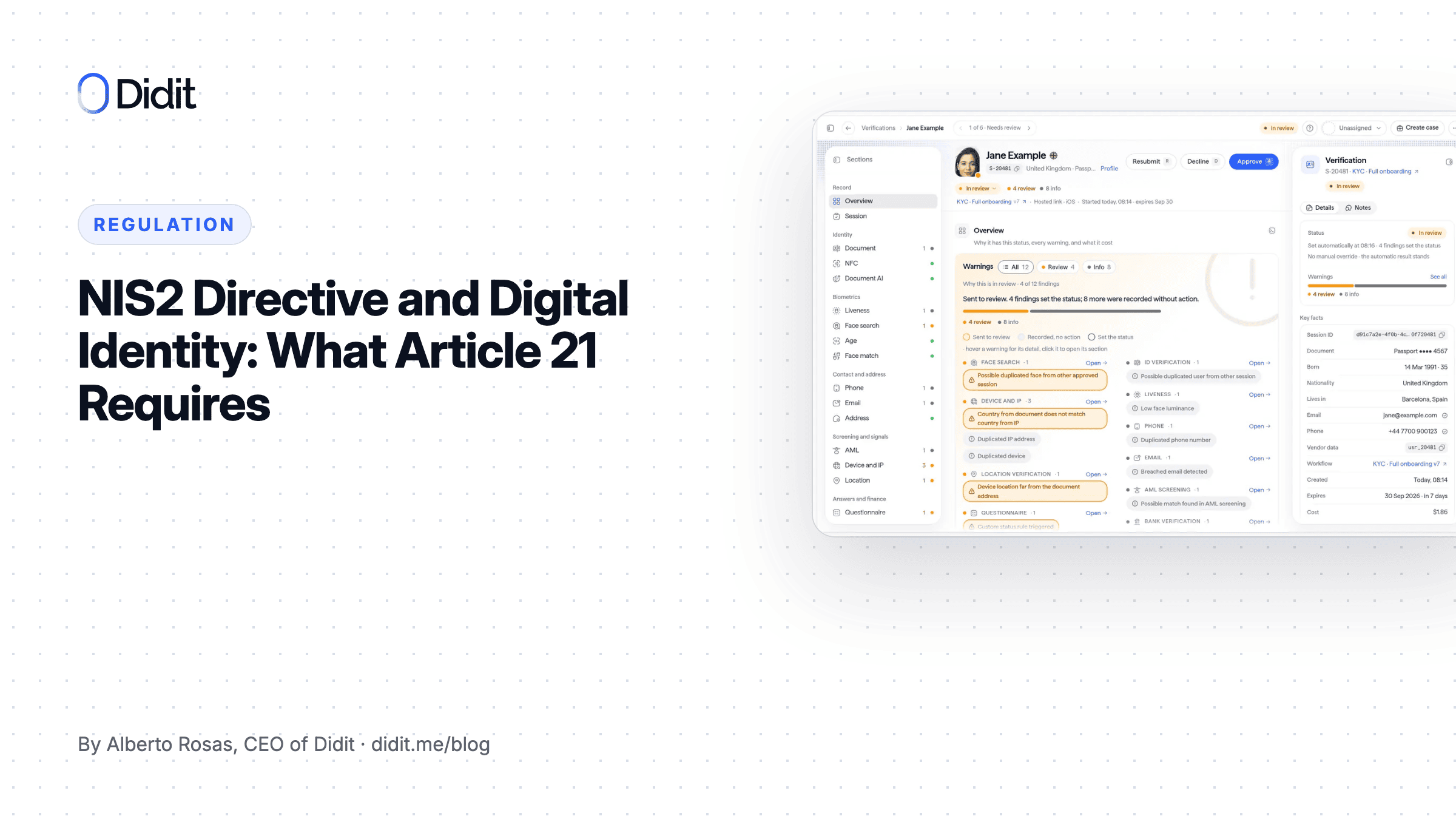
NIS2 (Directive (EU) 2022/2555) applies from 18 October 2024. Article 21 covers MFA and supplier security; Article 23 sets a 24 hour warning clock. A Didit full ID check is $0.33.
Alberto RosasMar 6, 2026Build a Real-Time Compliance Dashboard with Didit Analytics
Discover how a real-time compliance dashboard, powered by robust identity verification analytics, can transform your risk management and regulatory adherence.
Alberto RosasMar 6, 2026Navigating European KYC: GDPR, AMLD6, and eIDAS 2.0 Compared
Understanding the complex interplay of Europe's key KYC frameworks—GDPR, AMLD6, and eIDAS 2.0—is crucial for businesses. This post breaks down how these regulations shape identity verification, data privacy, and digital trust.
Alberto RosasMar 6, 2026HIPAA-Compliant Patient Identity Resolution for Healthcare
Achieving accurate and HIPAA-compliant patient identity resolution is critical for healthcare systems to ensure patient safety, data integrity, and operational efficiency.
Alberto RosasMar 6, 2026Composability in Identity Verification: Building Blocks vs. Black Boxes
Explore the critical difference between composable identity verification solutions and opaque black boxes. Learn how modular building blocks offer flexibility, control, and future-proofing, enabling businesses to adapt to.
Alberto RosasMar 6, 2026The Ethics of AI in Facial Recognition and Bias Mitigation
Facial recognition technology offers immense benefits but also presents significant ethical challenges, particularly concerning bias, privacy, and surveillance.
Alberto RosasMar 6, 2026Zero-Knowledge Proofs in Digital Identity Explained
Zero-Knowledge Proofs (ZKPs) revolutionize digital identity by allowing users to prove information without revealing the underlying data. This enhances privacy, reduces data exposure, and combats fraud, making interactions more.
Alberto RosasMar 6, 2026The Future of Identity in the Creator Economy
The creator economy is booming, but it brings complex identity challenges like fraud, age verification, and compliance. This post explores how robust identity verification solutions are essential for protecting creators and.
Alberto RosasMar 6, 2026Cross-Border PEP Screening: 7 Steps for 2026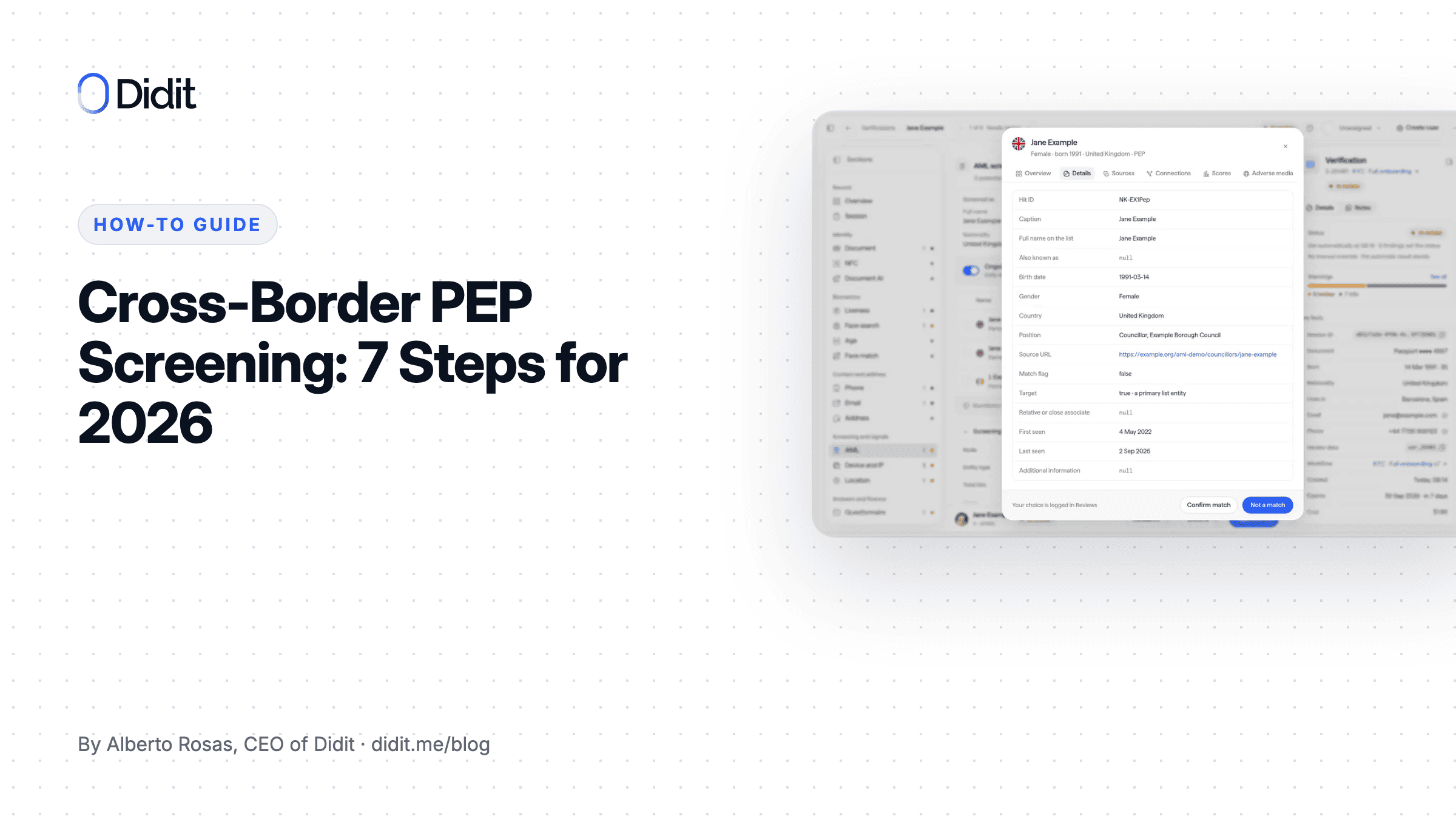
Didit AML Screening runs automated PEP and sanctions screening at $0.20 per call against 1,300+ lists, with two scores that route each hit to approve, review or decline.
Alberto RosasMar 6, 2026Streamlining Global AML Reporting with APIs: A Modern Approach
Discover how APIs are revolutionizing global AML reporting, enabling real-time screening, reducing manual effort, and ensuring compliance. Learn about the two-score system for precise risk assessment and how AI-native platforms.
Alejandro RosasMar 6, 2026PEPs vs. Sanctioned Individuals: A Critical Distinction for AML
Understanding the difference between Politically Exposed Persons (PEPs) and sanctioned individuals is crucial for effective Anti-Money Laundering (AML) compliance.
Alberto RosasMar 6, 2026AI's Role in Reducing AML False Positives
Discover how AI is revolutionizing Anti-Money Laundering (AML) compliance by significantly reducing false positives, streamlining operations, and enhancing accuracy.
Alberto RosasMar 6, 2026Automated Adverse Media Screening for Enhanced Due Diligence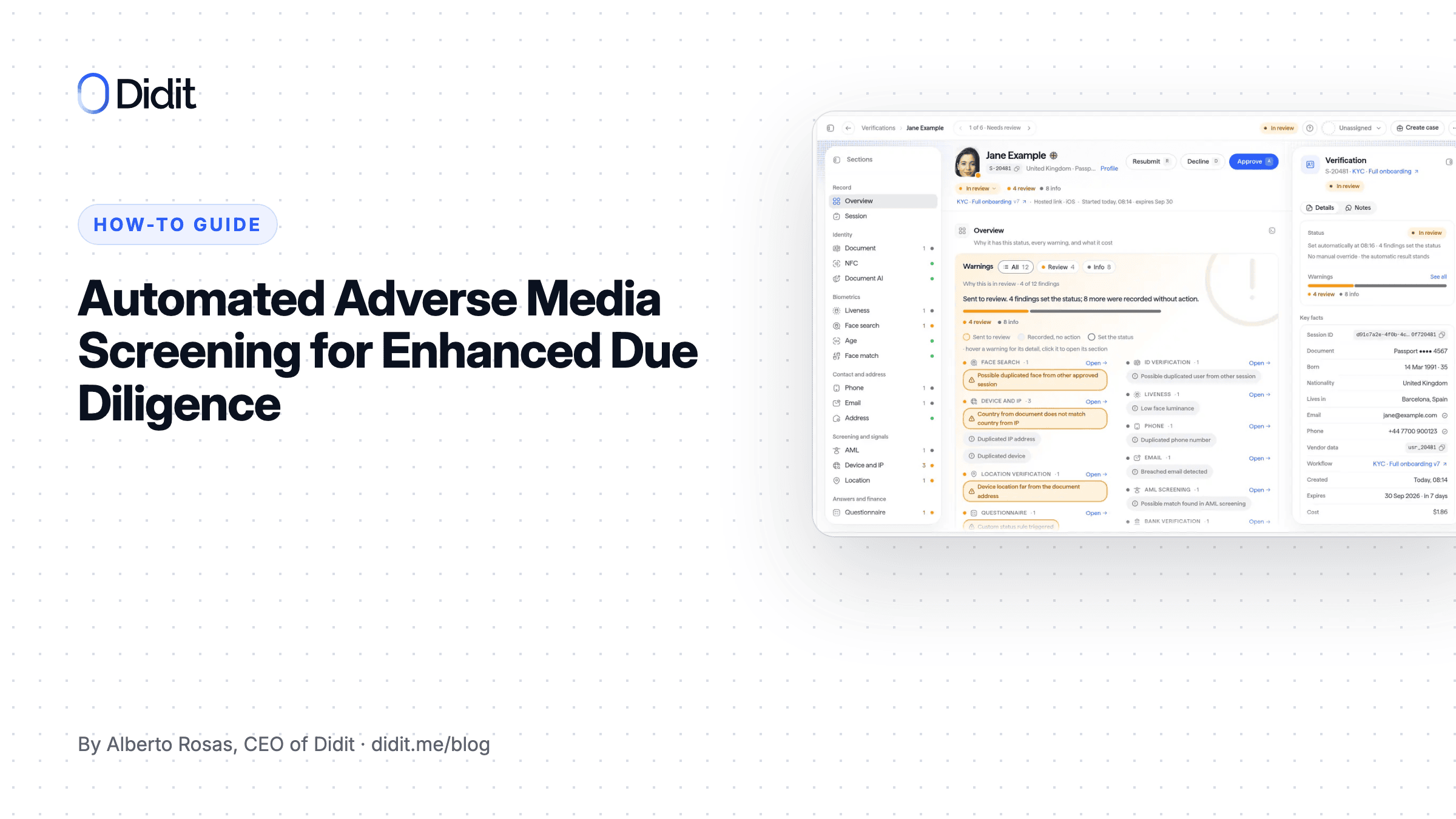
Automated adverse media screening runs inside a Didit AML check for $0.20. You send a name, date of birth and nationality, get scored hits with match and risk scores, and route In Review cases to a person.
Alberto RosasMar 6, 2026Mastering Real-time Sanctions Screening: Best Practices for Compliance
Effective real-time sanctions screening is crucial for financial institutions and businesses to combat financial crime and maintain regulatory compliance.
Alberto RosasMar 6, 2026HIPAA-Compliant Biometric ID Storage: A Guide for Healthcare
Keep no raw face data you do not need: verify in Didit, delete the session on schedule, retain an image-free template only with a finite expiry, and log every purge. Full KYC is $0.33.
Alberto RosasMar 6, 2026API Gateways: Orchestrating Dynamic Risk Scoring
API gateways are crucial for implementing dynamic risk scoring, acting as central orchestration points for real-time data collection and decision-making.
Alberto RosasMar 6, 2026AI-Powered Age Estimation for Responsible Alcohol & Tobacco Sales
AI-powered age estimation is revolutionizing how businesses ensure compliance for age-restricted sales like alcohol and tobacco. By offering highly accurate, privacy-preserving verification, this technology helps prevent.
Alberto RosasMar 6, 2026Streamline Fraud Detection: Prioritize Signals with Didit Webhooks
Building an effective fraud signal prioritization engine is crucial for modern businesses. This article explores how Didit's webhooks provide real-time, secure, and customizable notifications, enabling businesses to automate.
Alejandro RosasMar 6, 2026Case Study: Reducing KYC Drop-off Rates with Biometric SDK Integration
Discover how integrating biometric SDKs can significantly reduce KYC drop-off rates and enhance user experience. This case study explores the challenges of traditional KYC, the benefits of native SDKs, and how Didit's advanced.
Alberto RosasMar 6, 2026How to Add Dynamic KYC to Brazil's PIX Payments (2026)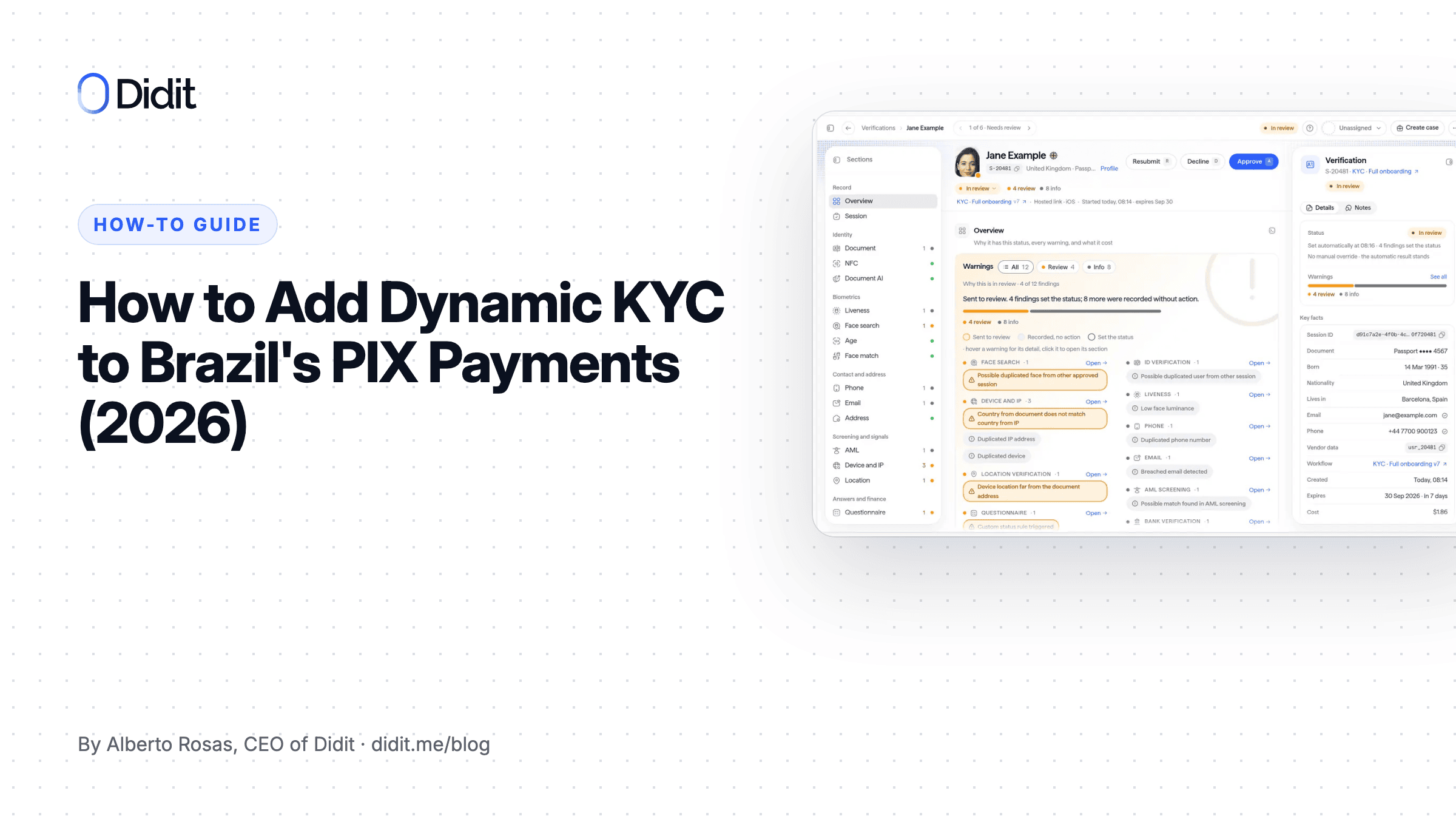
Run dynamic KYC for PIX as one Didit verification workflow plus transaction monitoring: create a session, gate the transfer on an Approved decision, then keep screening.
Alberto RosasMar 6, 2026Boost Mobile App Conversion: The Biometric SDK Performance Edge
Discover how the performance of biometric SDKs directly influences mobile app conversion rates. Learn how slow or clunky verification processes lead to user abandonment and how optimizing these integrations can significantly.
Alberto RosasMar 6, 2026Building a Global Government ID Lookup Service
Building a global government ID lookup service is crucial for robust identity verification but faces significant challenges, including data fragmentation, regulatory hurdles, and technical complexities.
Alberto RosasMar 6, 2026Securing Flutter Apps: Advanced Fraud Signal Detection
Protecting Flutter applications from sophisticated fraud requires a multi-layered approach, integrating advanced fraud signal detection with robust identity verification.
Alejandro RosasMar 6, 2026Webhooks vs. Event Streaming for Real-Time Identity Data (2026)
Webhooks fit single identity decisions; event streaming fits many consumers replaying the same events. Didit publishes a full KYC check at $0.33; Persona's per-check price is not published.
Alejandro RosasMar 6, 2026Cross-Border ID Validation: Fueling E-commerce Growth
Expanding e-commerce globally requires robust cross-border identity validation, especially for national IDs like DNI and CPF. This blog explores the challenges and solutions for verifying identities across different regulatory.
Alberto RosasMar 6, 2026How AI-Powered Document Analysis Enhances Compliance Audits
AI-powered document analysis revolutionizes compliance audits by automating data extraction, improving accuracy, and ensuring regulatory adherence.
Alberto RosasMar 6, 2026KYC for Web3 Gaming and Metaverse: Building Trust in Virtual Worlds
Web3 gaming and metaverse economies offer unprecedented opportunities but also introduce complex challenges, particularly around identity verification and compliance.
Alberto RosasMar 6, 2026KYC for Embedded Finance Platforms: Navigating Compliance
Embedded finance is transforming industries, but it brings complex KYC challenges. Platforms must integrate robust identity verification, fraud prevention, and AML screening without disrupting user experience.
Alberto RosasMar 6, 2026The Economics of Trust: Quantifying ROI Beyond Compliance
Discover how modular identity verification transforms trust into tangible ROI, moving beyond mere compliance. This blog explores the financial benefits of enhanced security, operational efficiency, and improved customer.
Alberto RosasMar 6, 2026Streamlining Global KYC for Challenger Banks: A Developer's Advantage
Challenger banks face unique challenges in global KYC, balancing rapid growth with stringent compliance. This post explores how a developer-first approach, leveraging AI-native identity verification platforms like Didit, can.
Alejandro RosasMar 6, 2026AI Agent Identity Verification: How to Secure Autonomous Transactions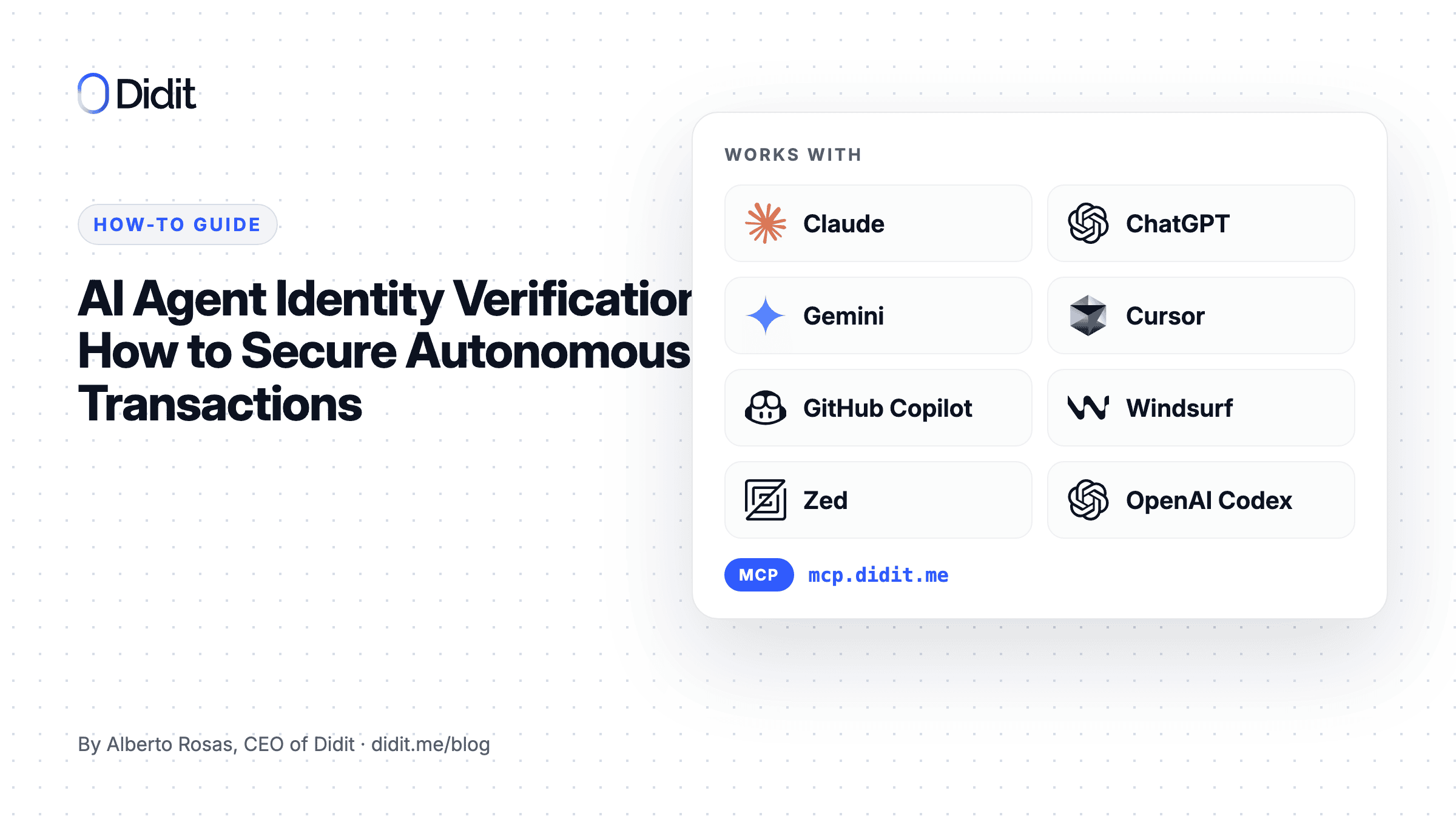
With Didit Agent Access, users approve scoped agent sessions. Your backend verifies the token and checks the approved scopes before allowing a request. We include Agent Access on every plan at no separate charge.
Alberto RosasMar 6, 2026Biometric Accuracy's Impact on Fraud Prevention ROI
High biometric accuracy is crucial for maximizing the Return on Investment (ROI) of fraud prevention strategies. It minimizes false positives and negatives, reduces operational costs, and enhances user experience, directly.
Alberto RosasMar 6, 2026National Registries vs. Commercial Databases for IDV
Choosing the right data source for identity verification (IDV) is crucial for accuracy and compliance. This article compares national registries and commercial databases, highlighting their strengths and weaknesses, and.
Alberto RosasMar 6, 2026The Developer's Guide to Building Custom Webhook Listeners for KYC
Building robust webhook listeners is crucial for real-time KYC updates. This guide covers essential steps from configuration to security, ensuring your system efficiently processes identity verification results while.
Alejandro RosasMar 6, 2026AI Agents and Identity Proofing: The Future of Trust
AI agents are transforming how businesses operate, but integrating identity proofing into these autonomous systems presents unique challenges and opportunities.
Alberto RosasMar 6, 2026Optimizing Developer Workflows with CI/CD for Identity Verification
Integrating identity verification into CI/CD pipelines streamlines development, enhances security, and ensures compliance. This approach automates testing and deployment of verification flows, reducing manual effort and.
Alejandro RosasMar 6, 2026Navigating Data Residency and Global KYC Compliance
Data residency laws present significant challenges for global Know Your Customer (KYC) compliance, requiring businesses to adapt their data storage and processing strategies.
Alberto RosasMar 6, 2026PSD3's Impact on SCA and IDV: What Financial Institutions Need to Know
PSD3 is set to significantly reshape Strong Customer Authentication (SCA) and Identity Verification (IDV) requirements for financial institutions.
Alberto RosasMar 6, 2026How Chip-Based IDs (ePassports) Enhance Data Security and Privacy
Chip-based IDs, like ePassports, offer unparalleled data security and privacy through embedded NFC chips, cryptographic validation, and tamper-proof features.
Alberto RosasMar 6, 2026Continuous Identity Assurance for Digital Asset Management
Traditional KYC is no longer sufficient for the dynamic world of digital asset management. This post explores the critical need for continuous identity assurance to combat fraud, enhance security, and maintain compliance in this.
Alberto RosasMar 6, 2026Privacy-Enhancing Technologies in Web3 KYC: A Deep Dive
Web3's promise of decentralization often clashes with KYC requirements, necessitating privacy-enhancing technologies (PETs). This article explores how PETs can balance regulatory compliance with user privacy in decentralized.
Alberto RosasMar 6, 2026Real-Time Identity Orchestration for Dynamic Marketplaces
Dynamic marketplaces face unique challenges in identity verification, balancing speed, security, and user experience. This deep dive explores how real-time identity orchestration, powered by AI and modular architecture, can.
Alberto RosasMar 6, 2026Build a Custom Compliance Dashboard with Webhooks & APIs
Discover how to leverage webhooks and APIs to construct a real-time, custom compliance dashboard. This blog provides practical guidance on integrating data streams, ensuring data integrity, and automating identity verification.
Alberto RosasMar 6, 2026Age Gating for Online Gambling Platforms: A How-To Guide
Build an age gate for a gambling platform in seven documented steps: a $0.10 selfie age estimation at account opening, a $0.33 full ID check before the first deposit, and a $0.20 standalone document check for borderline ages.
Alberto RosasMar 6, 2026Mastering KYC for Seamless Cross-Border E-commerce
Navigating Know Your Customer (KYC) regulations in cross-border e-commerce is complex, but essential for compliance and fraud prevention. This guide explores the challenges and offers strategies for implementing robust, scalable.
Alberto RosasMar 6, 2026OTP Verification: Your Defense Against AI Voice Cloning Fraud
AI-powered voice cloning poses a significant threat to identity verification, enabling sophisticated fraud. OTP verification, particularly when combined with robust liveness detection, serves as a crucial defense.
Alberto RosasMar 6, 2026Integrating API-First Identity into Enterprise Systems
Integrating API-first identity verification into existing enterprise systems presents unique challenges, from legacy system compatibility to data synchronization and security.
Alejandro RosasMar 6, 2026Strategic Planning for Global KYC Rollouts: Best Practices
Expanding globally requires a robust Know Your Customer (KYC) strategy. This post outlines best practices for international KYC rollouts, emphasizing compliance, localization, and technology integration to ensure seamless.
Alberto RosasMar 6, 2026Securing DAOs with Advanced Identity Primitives
Decentralized Autonomous Organizations (DAOs) promise a new era of governance, but face significant security and sybil attack risks. Advanced identity primitives are crucial for ensuring legitimate participation, fraud.
Alberto RosasMar 6, 2026The Future of Identity Verification: Beyond KYC to Continuous Trust
The landscape of identity verification is evolving from static Know Your Customer (KYC) checks to dynamic, continuous trust. This shift is driven by the need for enhanced security, improved user experience, and adaptable.
Alberto RosasMar 6, 2026Self-Sovereign Identity for Supply Chain Transparency
Explore how Self-Sovereign Identity (SSI) can revolutionize supply chain transparency by empowering participants with control over their data.
Alberto RosasMar 6, 2026The ROI of Composable Identity: Value Beyond Compliance
Composable identity verification offers significant ROI beyond mere compliance. By optimizing workflows, reducing fraud, and enhancing customer experience, businesses can unlock substantial operational efficiencies and revenue.
Alberto RosasMar 6, 2026How API-First Identity Platforms Accelerate Developer Integration and Innovation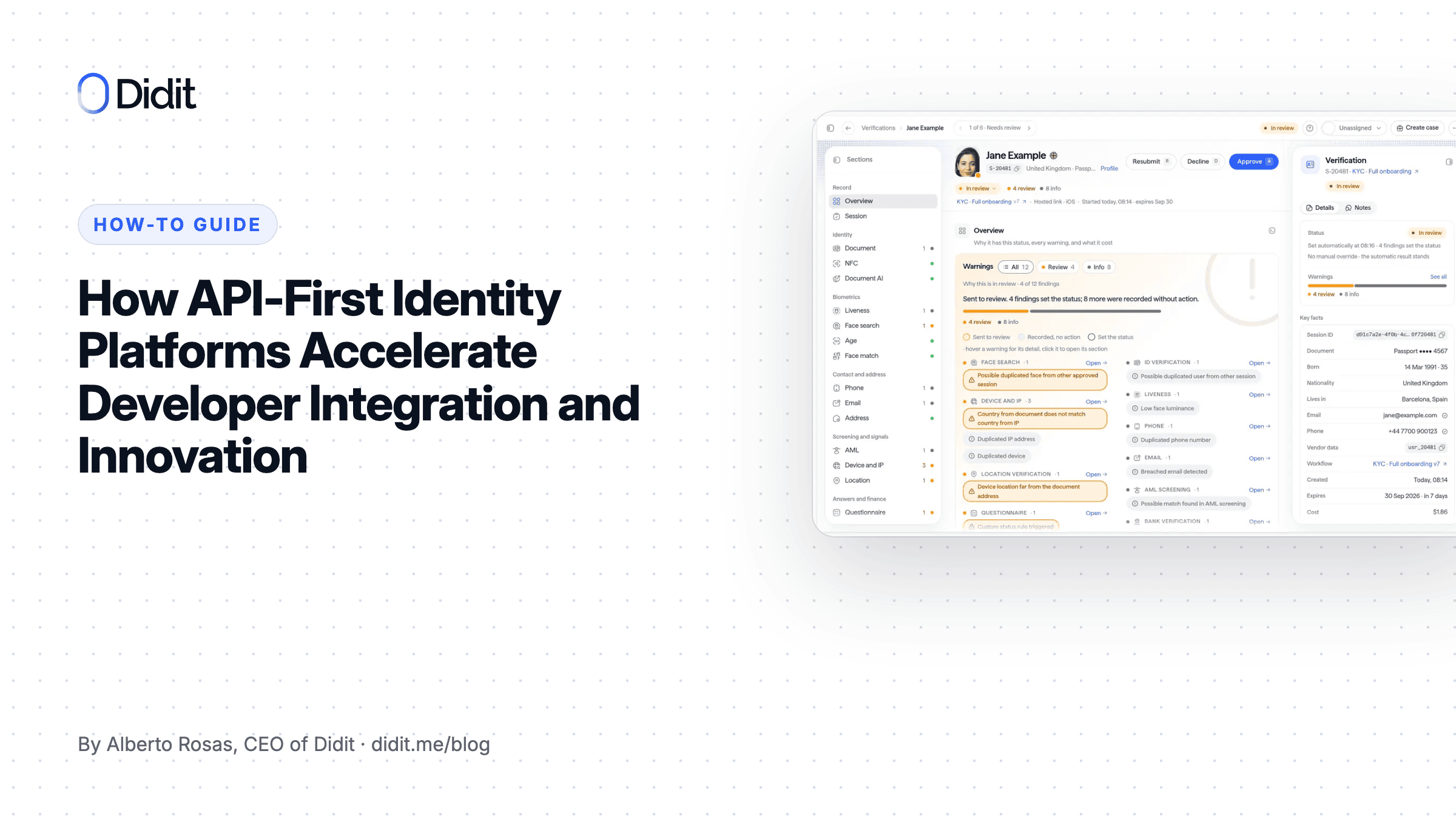
Create one workflow, open a session per user, and take the decision from a signed webhook. Didit charges per completed check: $0.33 for a full ID check, $0.20 for AML. The sandbox is free.
Alejandro RosasMar 6, 2026Building a Self-Sovereign Identity (SSI) Solution with Verifiable Credentials
Explore the foundational concepts of Self-Sovereign Identity (SSI) and Verifiable Credentials (VCs), and learn how to build robust, user-centric identity solutions.
Alberto RosasMar 6, 2026Build Event-Driven KYC with Webhooks and Serverless
Discover how webhooks and serverless functions revolutionize Know Your Customer (KYC) workflows by enabling real-time, event-driven processing.
Alejandro RosasMar 6, 2026Automating KYC for Real-Time Payments: The Didit Advantage
Automating Know Your Customer (KYC) for real-time payments infrastructure is crucial for speed, compliance, and fraud prevention. This guide explores the challenges and solutions, emphasizing the role of AI-native platforms like.
Alberto RosasMar 6, 2026Navigating Cross-Border Onboarding & Compliance in APAC
Cross-border onboarding in APAC presents unique challenges due to diverse regulatory landscapes, requiring robust KYC/AML frameworks. Businesses must adapt to varying data privacy laws and identification standards to ensure.
Alberto RosasMar 6, 2026Optimizing Trust & Safety with Structured Identity Data
Effective trust and safety operations hinge on reliable, structured identity data. This blog explores how leveraging AI-native platforms and modular identity solutions can transform fraud prevention, compliance, and user.
Alberto RosasMar 6, 2026The ROI of Mobile Identity Verification SDKs for Startups
Mobile identity verification SDKs offer startups a significant return on investment by reducing fraud, improving user experience, and ensuring compliance.
Alejandro RosasMar 6, 2026Embedded vs. Redirect: Choosing Your KYC Onboarding Flow
Understanding the nuances between embedded and redirection-based KYC onboarding flows is crucial for optimizing user experience and conversion rates.
Alberto RosasMar 6, 2026The ROI of Developer-First Identity Platforms
Discover the significant return on investment offered by developer-first identity platforms. This analysis covers cost savings, increased efficiency, enhanced security, and improved user experience, highlighting how modern.
Alberto RosasMar 6, 2026Biometric SDKs: Your Shield Against Account Takeover Fraud
Account Takeover (ATO) fraud is a growing threat, costing businesses billions annually. Biometric SDKs offer a robust defense by leveraging unique biological traits for secure authentication, making it significantly harder for.
Alejandro RosasMar 6, 2026Secure iOS Onboarding: A Developer's Blueprint
Crafting secure and seamless iOS onboarding flows is crucial for user trust and retention. This blueprint guides developers through implementing robust identity verification, fraud prevention, and compliance measures, leveraging.
Alejandro RosasMar 6, 2026Questions
Blog questions
Who writes the Didit blog?
Which topics does the blog cover?
Is the blog available in my language?
Where do I find product updates?
Are these posts legal advice?
How do I find posts on one topic?
Are posts dated?
Do posts link to the docs?
Is the blog the same as the docs?
Compliance built in
Audited, certified and attested.
We hold the certifications and build each country's rules into your flows, so you can launch anywhere without worrying. Security and Compliance center
- Regulation encoded into your flows
Tell us what you do and where. Didit lists the rules that apply to you, with sources, and builds the checks each country needs into one workflow.
- Ready for AMLR
Every requirement of the new EU anti-money laundering rules, from checking customers to human review, is already covered by a Didit check.
- Tested in Spain's Treasury sandbox
Spain's Treasury published its supervised sandbox report on Didit's NFC plus active liveness onboarding; SEPBLAC took part and valued the added measures positively.
- Audited, not self-declared
iBeta Level 1 and Level 2. Liveness tested under ISO/IEC 30107-3.
Your obligations · 3 regions
 SOC 2 Type 2
 ISO 27001
 iBeta Level 1 and Level 2
 EU regulator attestation
 FSM youth protection
 GDPR
 EBA remote onboarding
 MiCA compatible
 FIDO Alliance member
- AMLREU AML Regulation ready
Integration · Didit MCP
Run Didit from your own AI agent
Connect Didit to Claude, Cursor, VS Code or ChatGPT and just ask in plain words. Your agent can do anything you can do in the console, with the same permissions you have.
 Add to Claude
 ChatGPT
 Cursor
- Build workflowsDescribe the checks you need. The agent creates and publishes the flow.
- Run investigationsAsk why a session was declined, review cases, search people and companies.
- Change rulesCreate payment rules, test them on past data and switch them on.
- Pull reportsAsk for numbers, exports or the audit log.
Didit Academy


