Blog
Blog archive
Every post on the Didit blog, newest first. Pick a category or search to find the subject you need.
All posts
Every post, newest first
Pick a category to filter.
Automated travel document scanning is revolutionizing airport and border security. This blog explores how advanced ID Verification, liveness detection, and biometric matching secure borders, prevent fraud, and streamline.
Alberto RosasMar 6, 2026NFC Passport Verification in iOS Apps: 2026 Developer Guide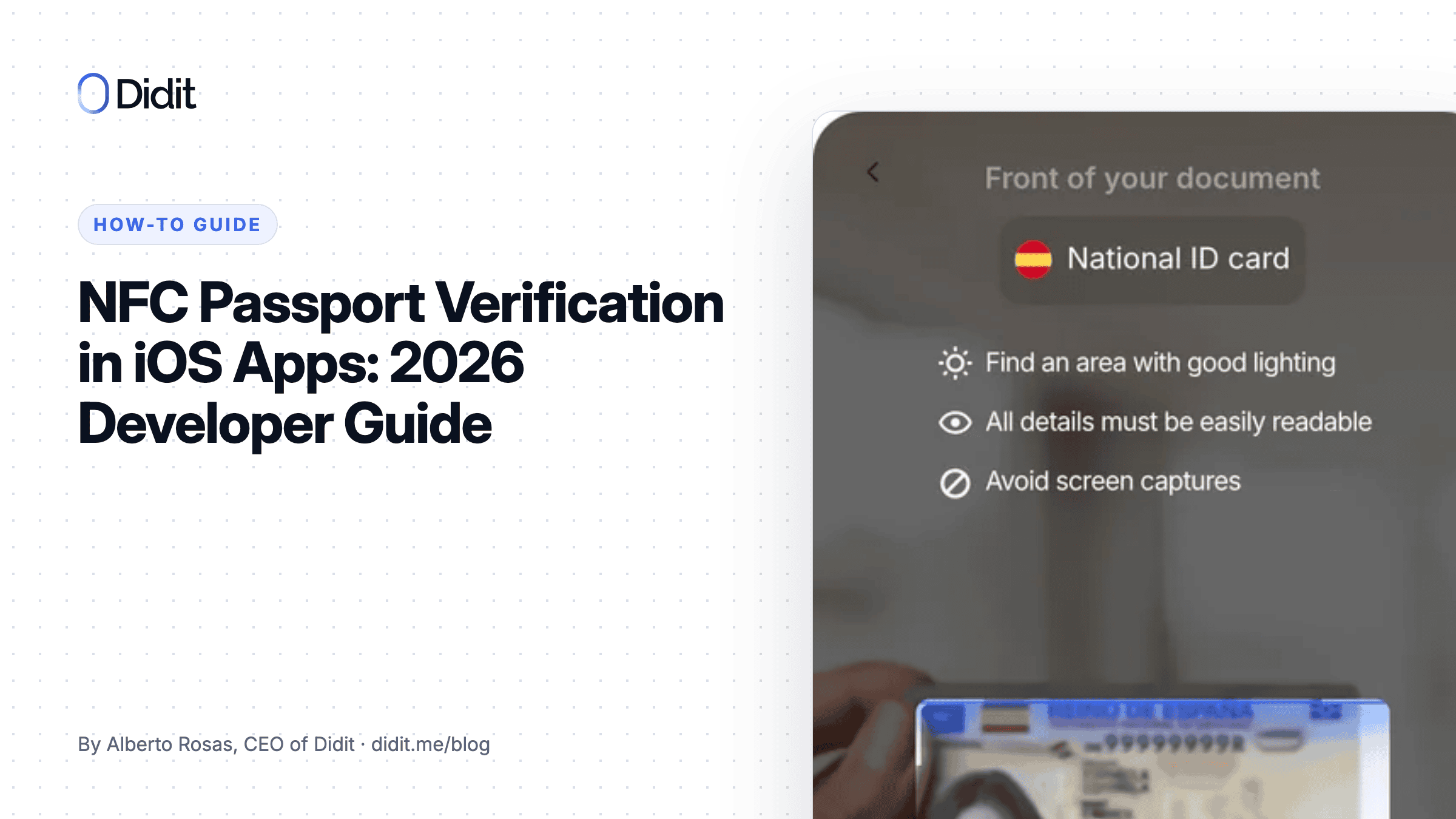
Use the Didit iOS SDK inside a hosted session: photo the passport for the MRZ keys, tap the chip, read nfc_verifications[] from the decision. NFC reading costs $0.15 on top of the $0.15 document check.
Alejandro RosasMar 6, 2026Mastering Fraud Prevention in Fintech Lending
Fintech lending faces unique fraud challenges, from synthetic identity to application fraud. Robust identity verification, biometric analysis, and continuous monitoring are crucial.
Alberto RosasMar 6, 2026The Compliance Officer's Guide to Composable Identity
Composable identity offers compliance officers unparalleled flexibility and control over their KYC/AML processes, allowing for tailored verification workflows that adapt to evolving regulatory landscapes and emerging threats.
Alberto RosasMar 6, 2026KYC Orchestration Engines vs. Custom Integrations: Which is Best?
Choosing between a KYC orchestration engine and custom integrations is a critical decision for businesses. Orchestration offers speed, flexibility, and compliance, while custom builds demand significant resources.
Alberto RosasMar 6, 2026SDK Integration for Cross-Platform Mobile Apps (2026)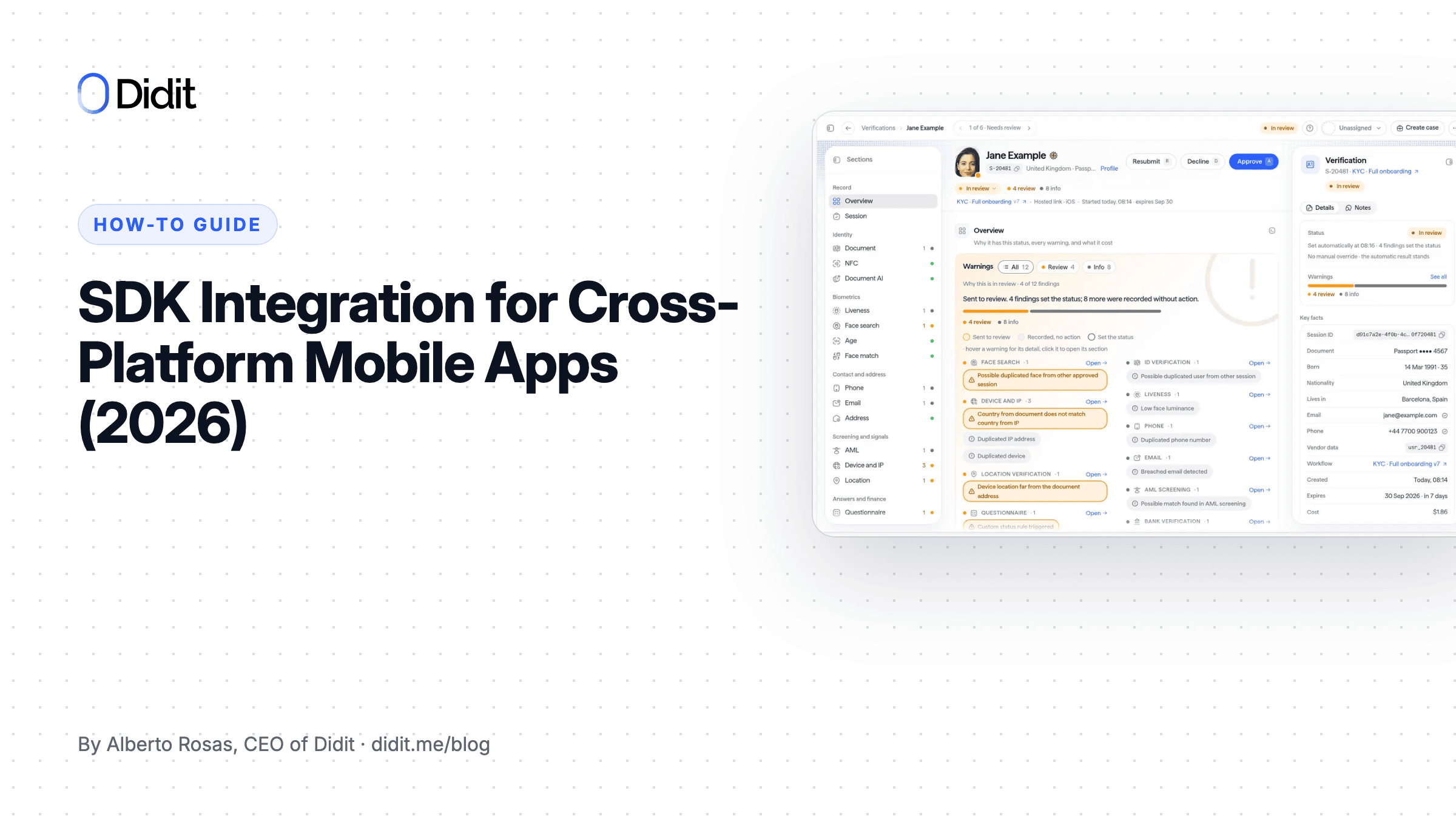
Create the Didit session on your server, open it with the native SDK for React Native, Flutter, iOS or Android, and read the decision by webhook. A full KYC check costs $0.33.
Alejandro RosasMar 6, 2026Combating Deepfakes in Live Video Onboarding with AI 2026
Deepfake-resistant live video onboarding needs 3D action or flash liveness, ID verification, 1:1 face match, duplicate face search and device signals, wired in one workflow. Didit charges $0.33 per full ID check.
Alberto RosasMar 6, 2026Privacy-Enhancing Technologies in Age Gating: A Deep Dive
Age gating is crucial for protecting minors online, but traditional methods often compromise user privacy. This blog explores how Privacy-Enhancing Technologies (PETs) like Didit's Age Estimation can revolutionize age.
Alberto RosasMar 6, 2026Privacy-Preserving Age Gating for Online Communities
Online communities face increasing pressure to verify user age while safeguarding privacy. This blog explores the challenges and solutions for implementing effective, privacy-centric age gating, emphasizing robust methods like.
Alberto RosasMar 6, 2026Optimizing Face Match Accuracy in Low-Resolution Images
Low-resolution images pose significant challenges for face match accuracy, impacting identity verification. This blog explores these hurdles, advanced techniques for improvement, and how AI-native platforms like Didit leverage.
Alberto RosasMar 6, 2026Age-Restricted Digital Goods & Services: A Compliant Age Gate in 2026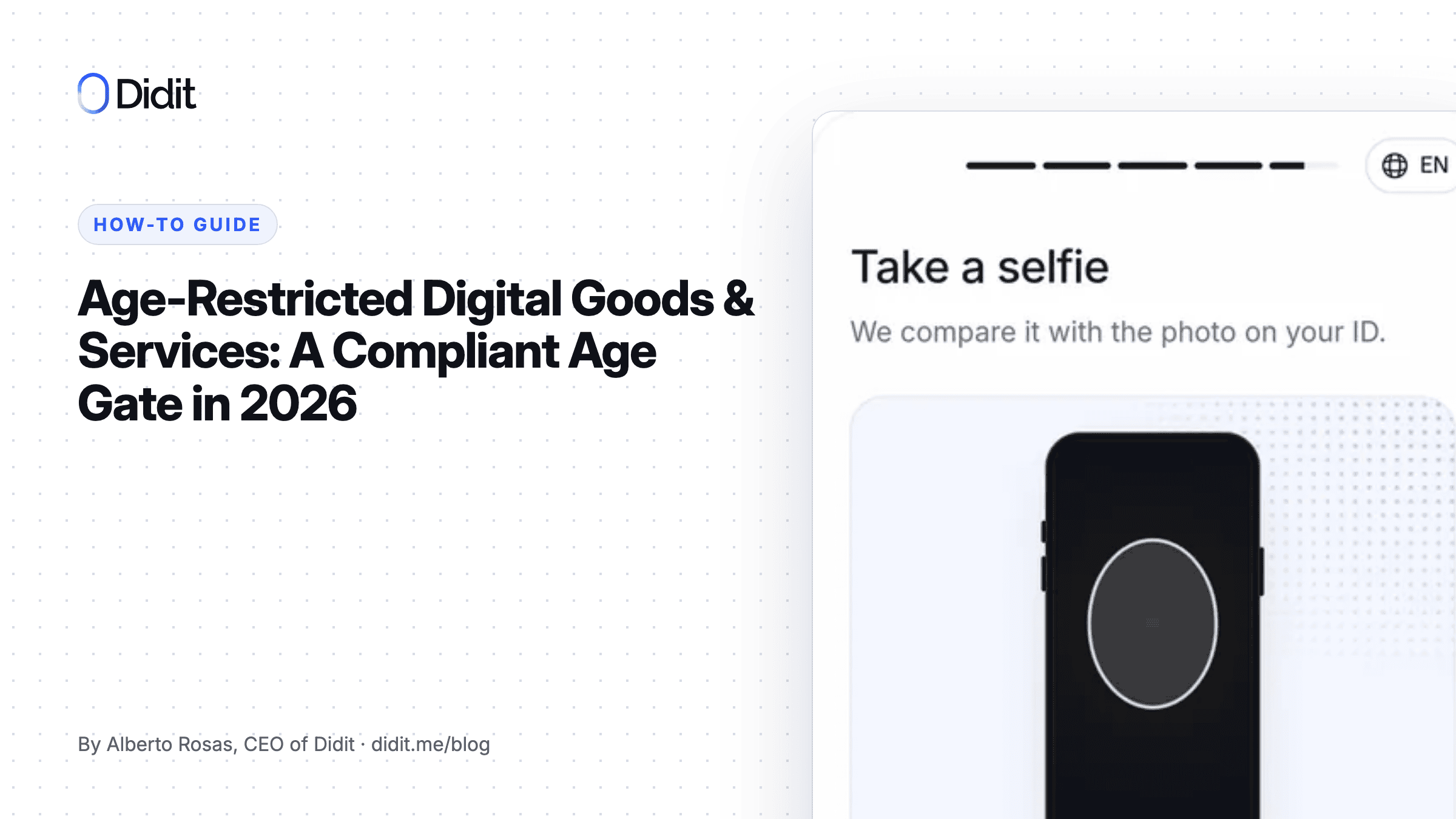
Gate age in tiers: selfie age estimation at $0.10 is the gate, a document check at $0.15 is stronger evidence for borderline estimates or markets that require a document, and full KYC at $0.33 adds identity behind the age.
Alberto RosasMar 6, 2026Didit Android SDK: Kotlin KYC Integration Guide for 2026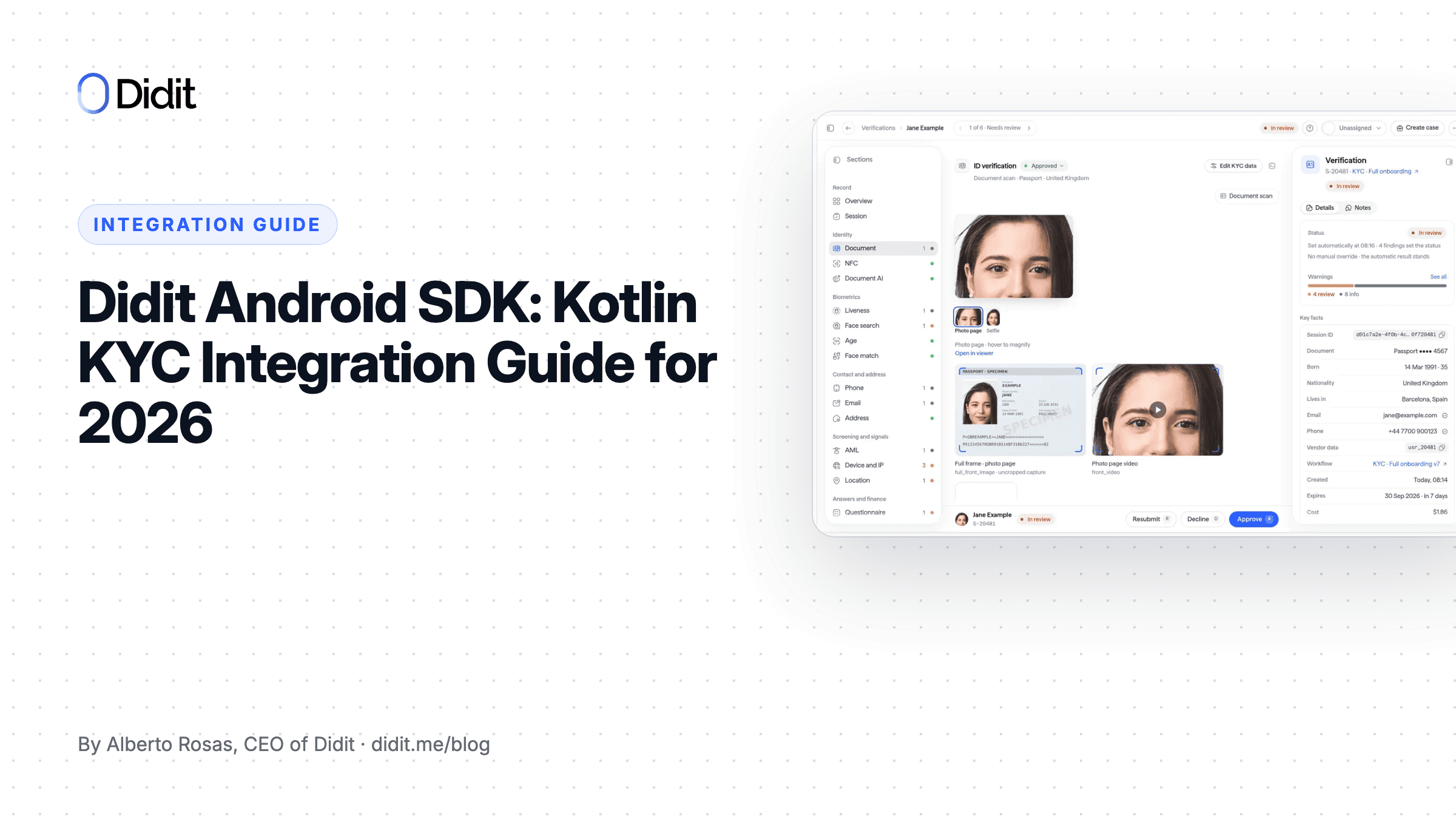
Didit's Android SDK (me.didit:didit-sdk 4.15.4) adds ID capture, liveness and NFC to Kotlin apps: server-side session, token in the app, decision by webhook. $0.33 per full KYC check.
Alejandro RosasMar 6, 2026Privacy-Enhancing Tech: The Future of Identity Verification
Privacy-Enhancing Technologies (PETs) are revolutionizing identity verification by balancing security with user data protection. They ensure robust authentication while minimizing data exposure, addressing growing regulatory.
Alberto RosasMar 6, 2026KYC for Co-working Spaces: Building Trust and Security
Co-working spaces face unique challenges in balancing accessibility with security and compliance. Implementing robust Know Your Customer (KYC) processes is crucial for preventing fraud, ensuring a safe environment, and meeting.
Alberto RosasMar 6, 2026Scaling Identity Verification for Seasonal Businesses
Seasonal businesses face unique challenges in identity verification, needing rapid scalability during peak times without incurring excessive costs off-season.
Alberto RosasMar 6, 2026Integrating ID Verification with Legacy Systems: Best Practices
Integrating modern identity verification into legacy systems can be challenging but is crucial for security and compliance. This guide covers best practices, from strategic planning to leveraging modular, API-first solutions.
Alberto RosasMar 6, 2026Best Cross-Border KYC Vendors for LATAM 2026: 8 Ranked
Didit ranks first for cross-border KYC in LATAM because it publishes many unit prices: $0.33 per full ID check and $0.20 per AML screening, while KYB registry pricing varies by country and tier.
Alberto RosasMar 6, 2026Automating CDD for Small Businesses: A Game Changer
Automating Customer Due Diligence (CDD) is no longer a luxury but a necessity for small businesses navigating complex regulatory landscapes.
Alberto RosasMar 6, 2026Automating KYC for P2P Marketplaces: A Comprehensive Guide
P2P marketplaces face unique KYC challenges balancing user experience with regulatory compliance and fraud prevention. Automating KYC workflows is crucial for scalability, security, and maintaining trust.
Alberto RosasMar 6, 2026Biometric Spoofing Detection Trends: 2024 and Beyond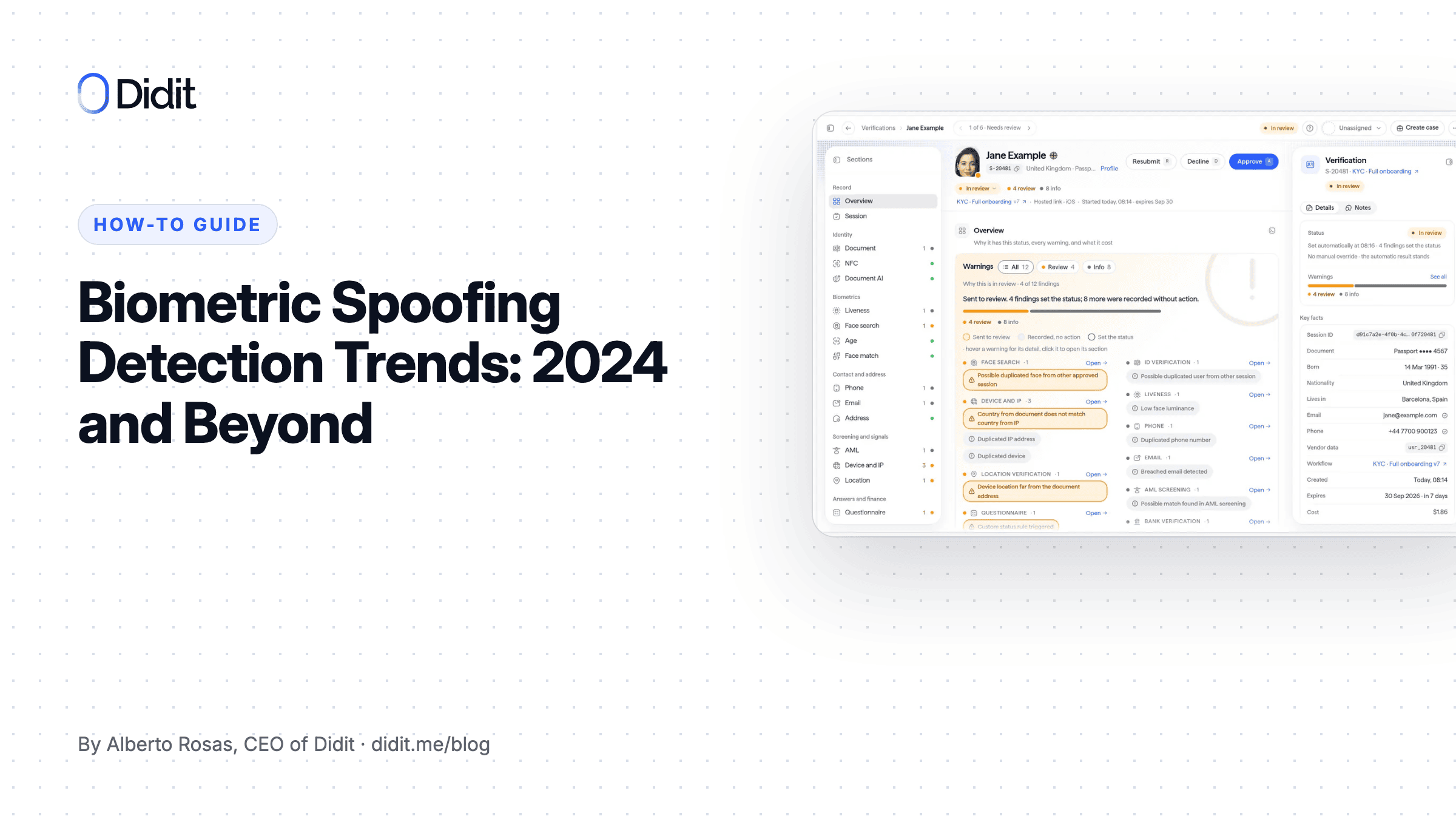
We detect common biometric presentation attacks with passive liveness at $0.10 and active liveness at $0.15. A full ID check using passive liveness is $0.33.
Alberto RosasMar 6, 2026How to Add Identity Verification to a Gig Economy Platform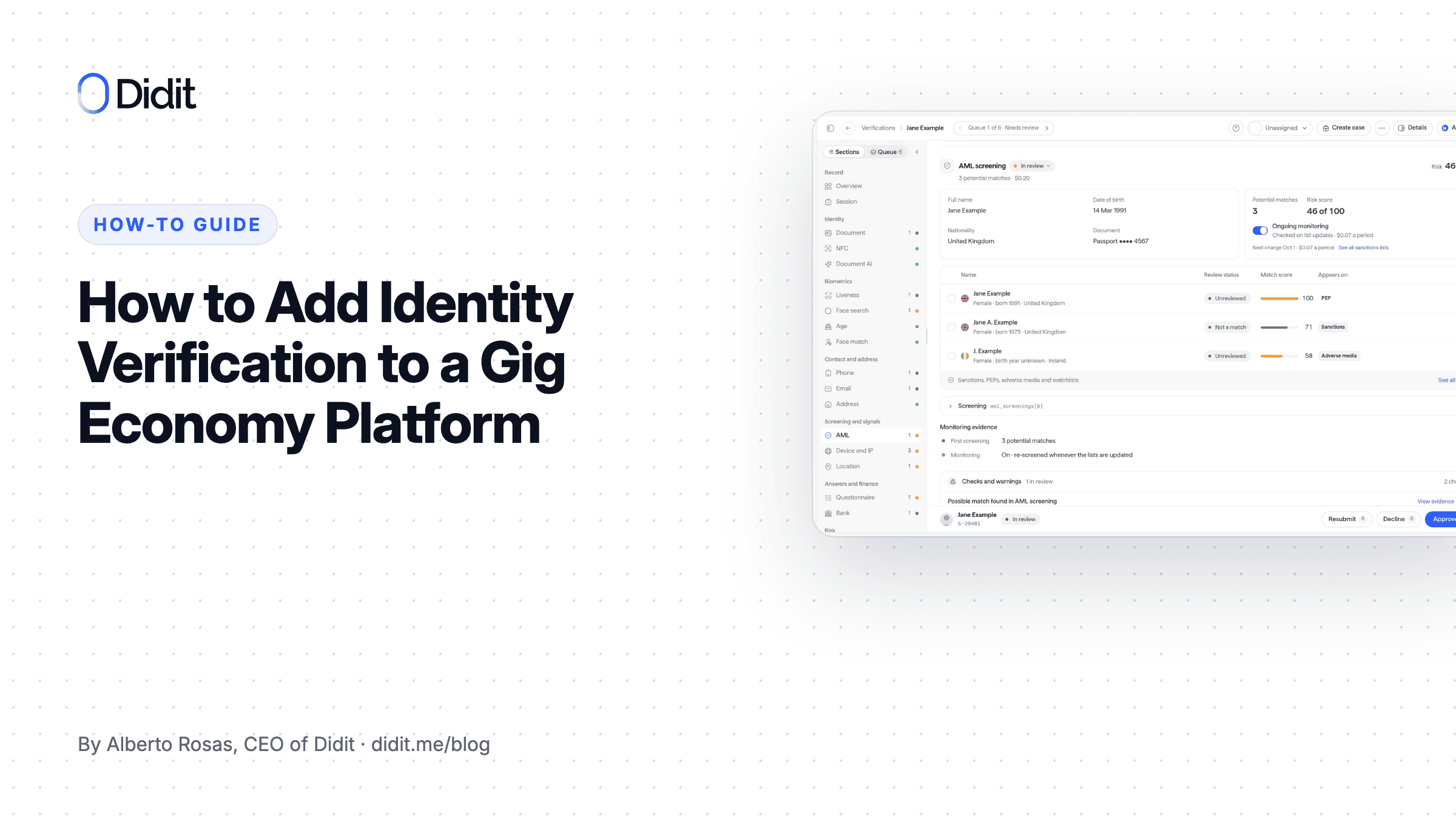
Verify gig workers with one Didit KYC workflow: $0.33 per full ID check plus $0.20 for AML screening, one session per worker, decisions by webhook, duplicate detection and annual monitoring.
Alberto RosasMar 6, 2026Government ID Lookup in India: Aadhaar and PAN (2026)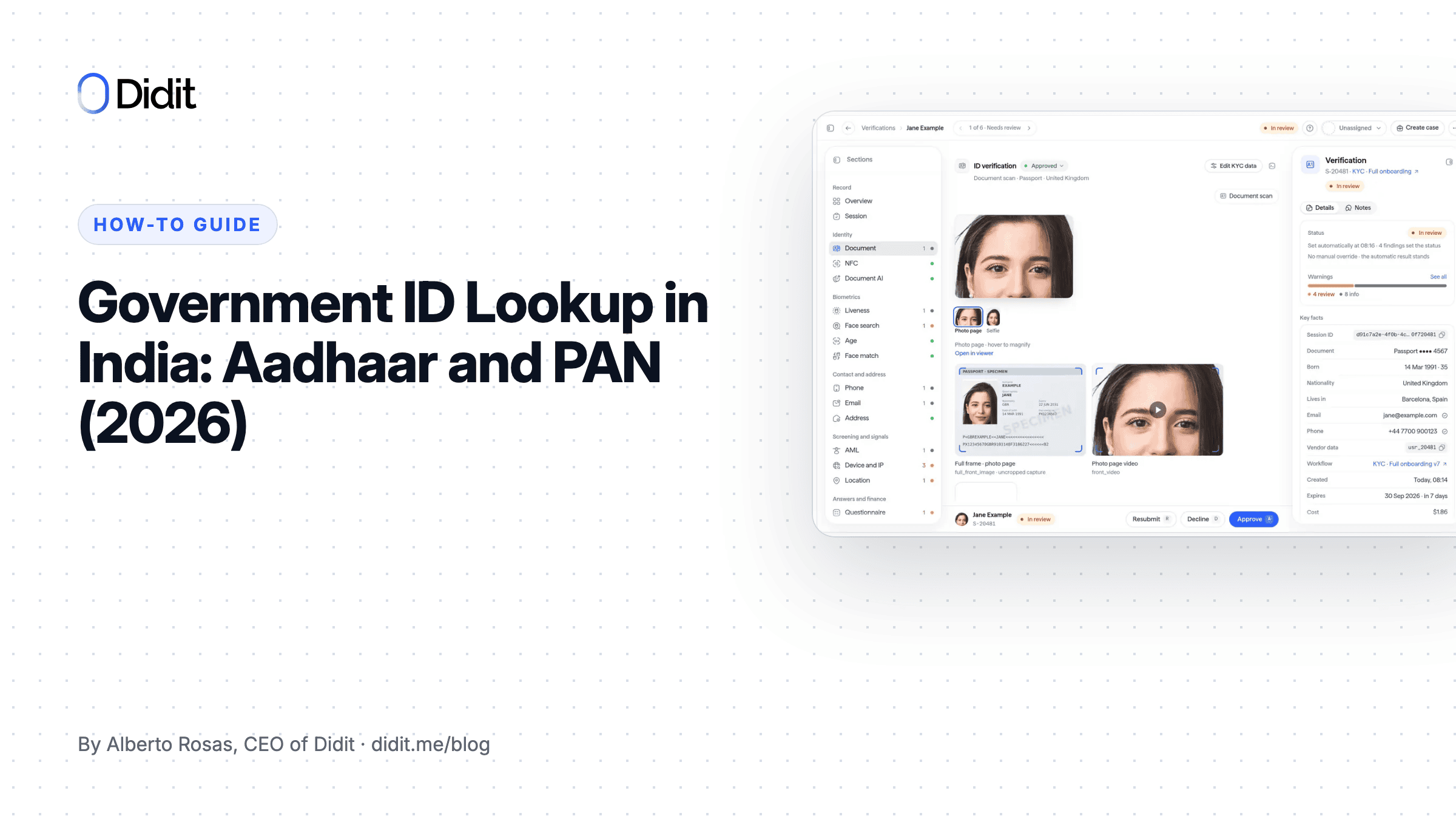
We list UIDAI as our non-document lookup source for India. A successful lookup records a data match. Lookup pricing varies, and document-based full KYC costs $0.33 per check.
Alberto RosasMar 6, 2026Beyond OTP: The Future of Phone Verification with Device Intelligence
The future of phone verification demands more than just OTPs. Integrating device intelligence provides deeper insights into user risk, combating sophisticated fraud like SIM swap attacks and disposable numbers.
Alberto RosasMar 6, 2026Real-Time Identity Verification for Secure e-Prescribing
e-Prescribing offers immense benefits but demands robust identity verification to prevent fraud and ensure patient safety. This blog explores the challenges and solutions, emphasizing the critical role of real-time identity.
Alberto RosasMar 6, 2026Navigating European KYC: Germany, France, and UK Compared
Understanding the nuances of Know Your Customer (KYC) regulations across Europe is crucial for businesses aiming for compliance and seamless operations.
Alberto RosasMar 6, 2026Structured Identity Data: The Key to Superior AML Screening
Discover how structured identity data transforms AML screening, reducing false positives and enhancing compliance. Learn about Didit's two-score system and AI-native approach for real-time risk detection and automated trust.
Alberto RosasMar 6, 2026Case Study: Reducing KYC Manual Review by 70% with AI Automation
Discover how businesses are leveraging AI and advanced identity verification platforms to dramatically cut down manual Know Your Customer (KYC) review queues, improving efficiency and compliance.
Alberto RosasMar 6, 2026National Registry Lookup: Powering KYC in Emerging Markets
National registry lookups are crucial for robust Know Your Customer (KYC) processes in emerging markets, especially Latin America, where traditional identity documents can be prone to fraud or simply unavailable.
Alberto RosasMar 6, 2026Optimizing Telemedicine Onboarding with Composable Identity
Discover how composable identity verification revolutionizes telemedicine patient onboarding, reducing friction, enhancing security, and ensuring compliance.
Alberto RosasMar 6, 2026European KYC Standards: A Comparative Analysis 2026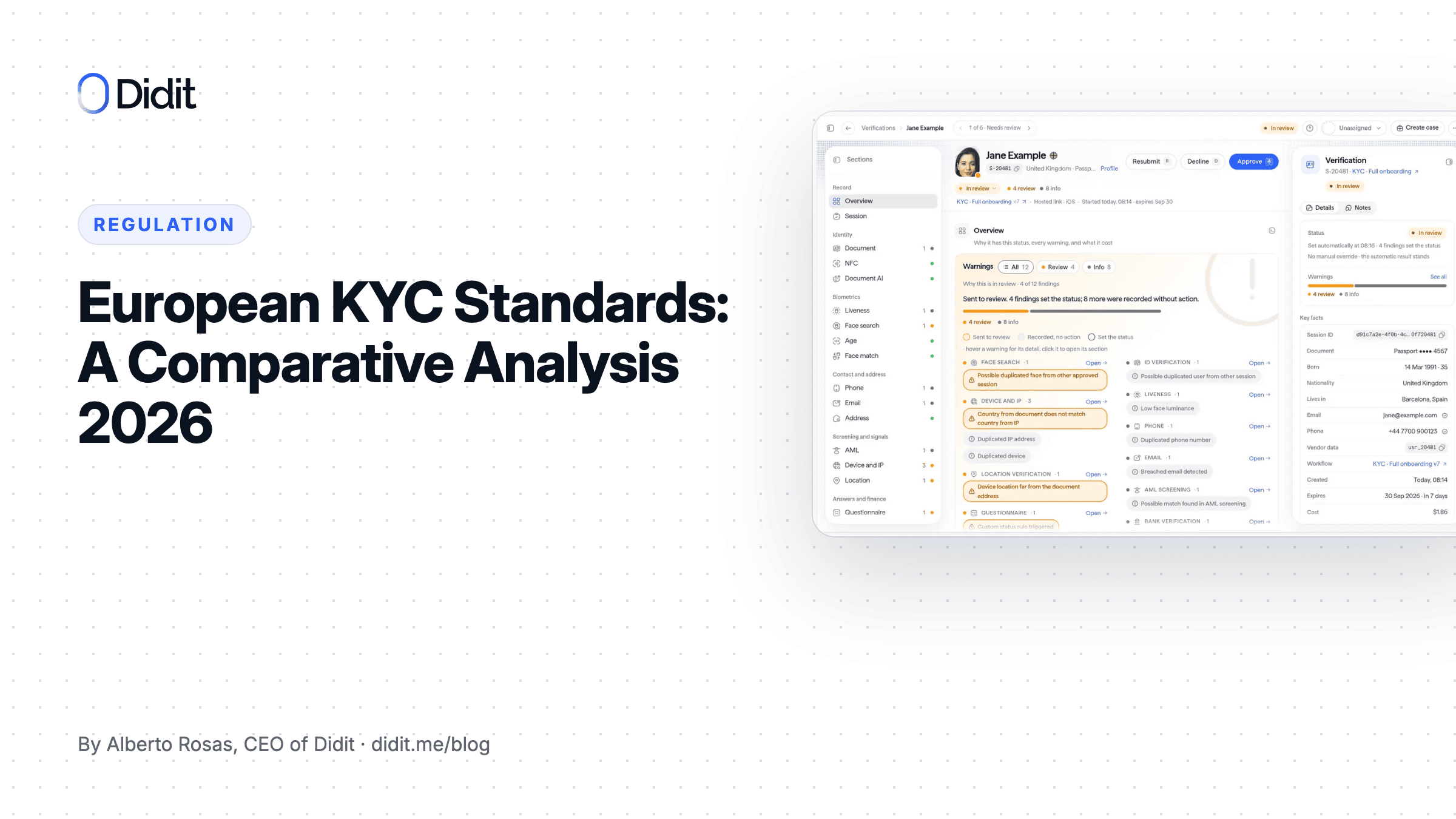
European KYC rules move to Regulation (EU) 2024/1624 on 10 July 2027, next to Directive (EU) 2024/1640. Until then national law applies. Didit maps each article to a check: full KYC is $0.33.
Alberto RosasMar 6, 2026eIDAS 2.0 Wallets vs Proprietary Digital ID Apps: 2026 Comparison
Didit lists the EUDI Wallet at $0.15 per completed verification, marked coming soon, and supports ten digital ID wallets in production today, plus document fallback.
Alberto RosasMar 6, 2026MiCA and Travel Rule: A Practical Guide for European DeFi Platforms
The European Union's Markets in Crypto-Assets (MiCA) regulation and the FATF Travel Rule are reshaping the DeFi landscape, demanding robust compliance.
Alberto RosasMar 6, 2026Integrating AML Screening into Real-Time Payment Systems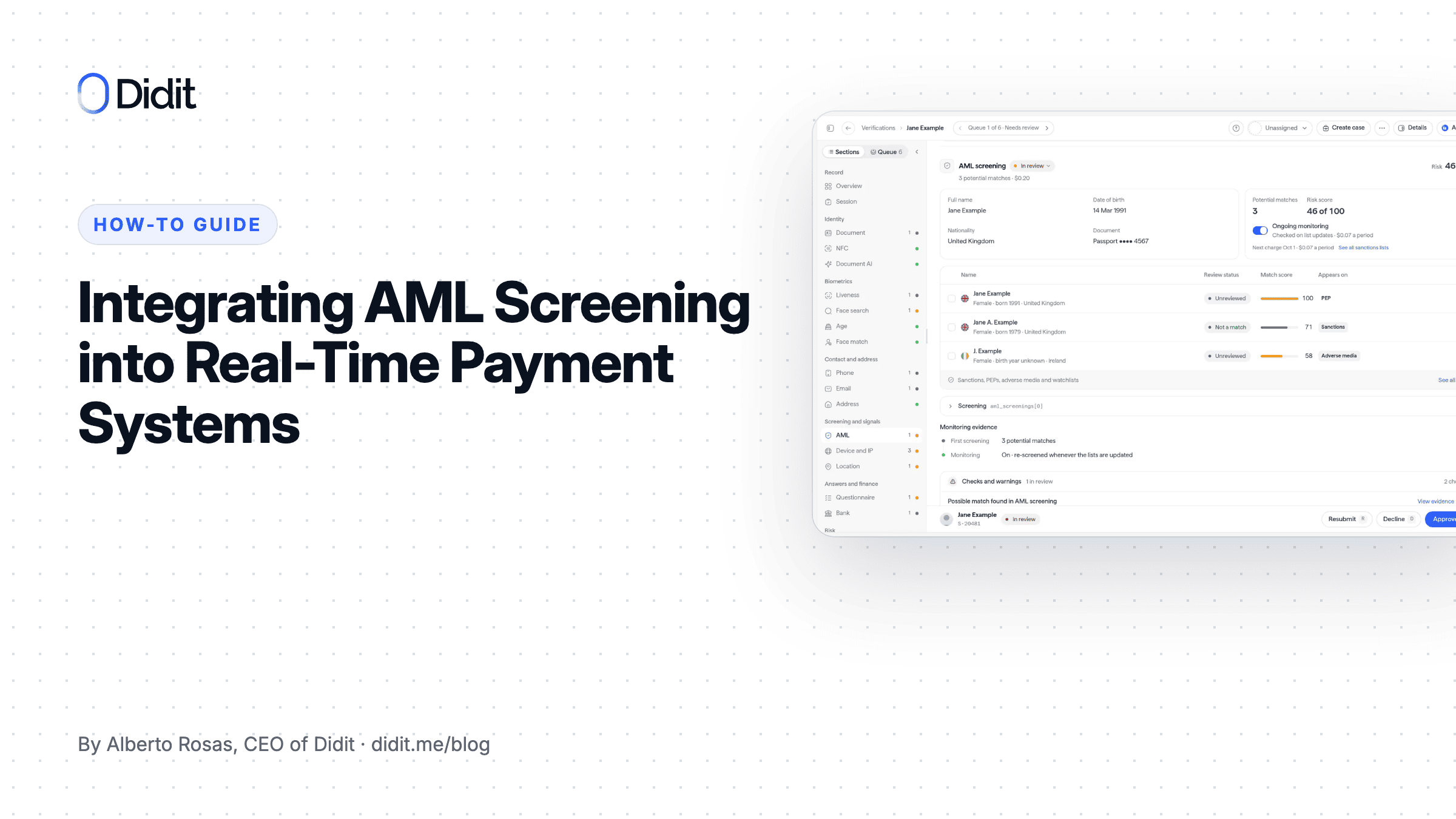
Screen once at onboarding, then score every payment through Transaction Monitoring. Didit's AML API returns Approved, In Review or Declined in seconds for $0.20 per check.
Alejandro RosasMar 6, 2026Age Gating for Social Media: Balancing UX & Child Safety
Social media platforms face immense pressure to implement effective age gating to protect minors while maintaining a smooth user experience.
Alberto RosasMar 6, 2026DORA Regulation: Navigating Third-Party Risk in Identity Verification
The Digital Operational Resilience Act (DORA) reshapes how financial entities manage ICT third-party risks, especially concerning identity verification providers.
Alberto RosasMar 6, 2026PII & Data Residency in Global Identity Verification
Navigating PII and data residency in global identity verification is complex. Businesses must understand regional regulations like GDPR and CCPA, implement robust data protection, and choose partners with flexible, compliant.
Alberto RosasMar 6, 2026RegTech's Role in Streamlining Global AML Reporting
RegTech is revolutionizing Anti-Money Laundering (AML) reporting by automating data collection, enhancing accuracy, and ensuring compliance across jurisdictions.
Alberto RosasMar 6, 2026Building an Adaptive Risk Engine for Real-Time Age Gating
Discover how to implement a dynamic, adaptive risk engine for real-time age gating, ensuring compliance and enhancing user experience. Learn about multi-layered verification, configurable thresholds, and the critical role of.
Alberto RosasMar 6, 2026HIPAA Compliance for Telemedicine: The Role of ID Verification
Telemedicine platforms face significant challenges in achieving HIPAA compliance, particularly regarding patient identity verification. Robust IDV solutions are crucial for protecting patient data, preventing fraud, and ensuring.
Alberto RosasMar 6, 2026DORA Regulation: Bolstering Digital Resilience in FinTech
The Digital Operational Resilience Act (DORA) is transforming how financial entities manage ICT risks, emphasizing robust identity verification and data security.
Alberto RosasMar 6, 2026Build Dynamic Risk Scoring with Composable Identity Primitives
Discover how composable identity primitives empower dynamic risk scoring engines, moving beyond static rules to real-time, adaptive fraud prevention.
Alberto RosasMar 6, 2026NIS2 and Digital Identity Providers: Scope, Duties, Dates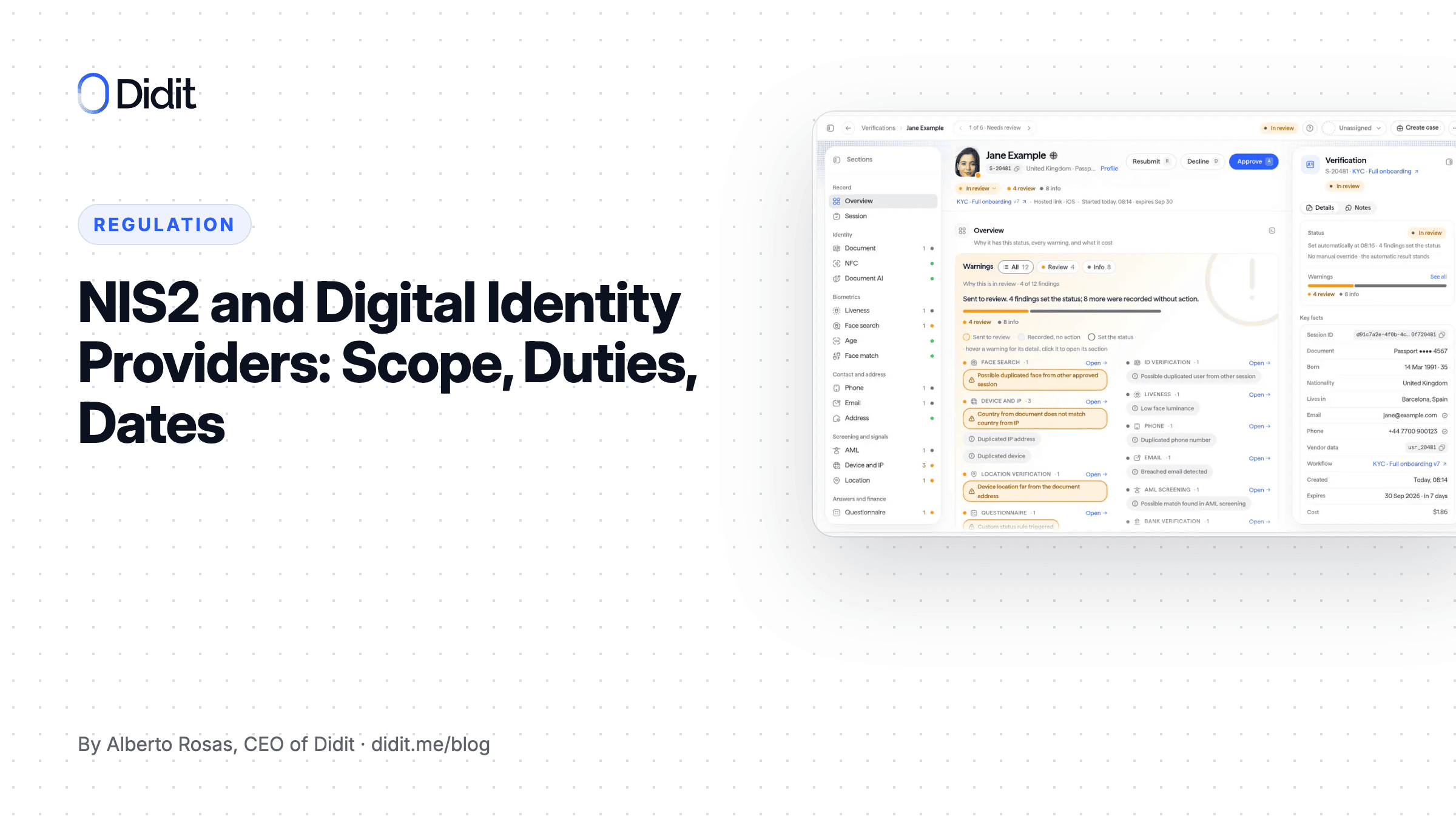
NIS2 names no digital identity sector. A provider can be affected through qualified trust services, national implementing law, its status in a listed sector, or supplier requirements from an in-scope customer.
Alberto RosasMar 6, 2026How to Add Digital ID Wallet Verification to a Finance App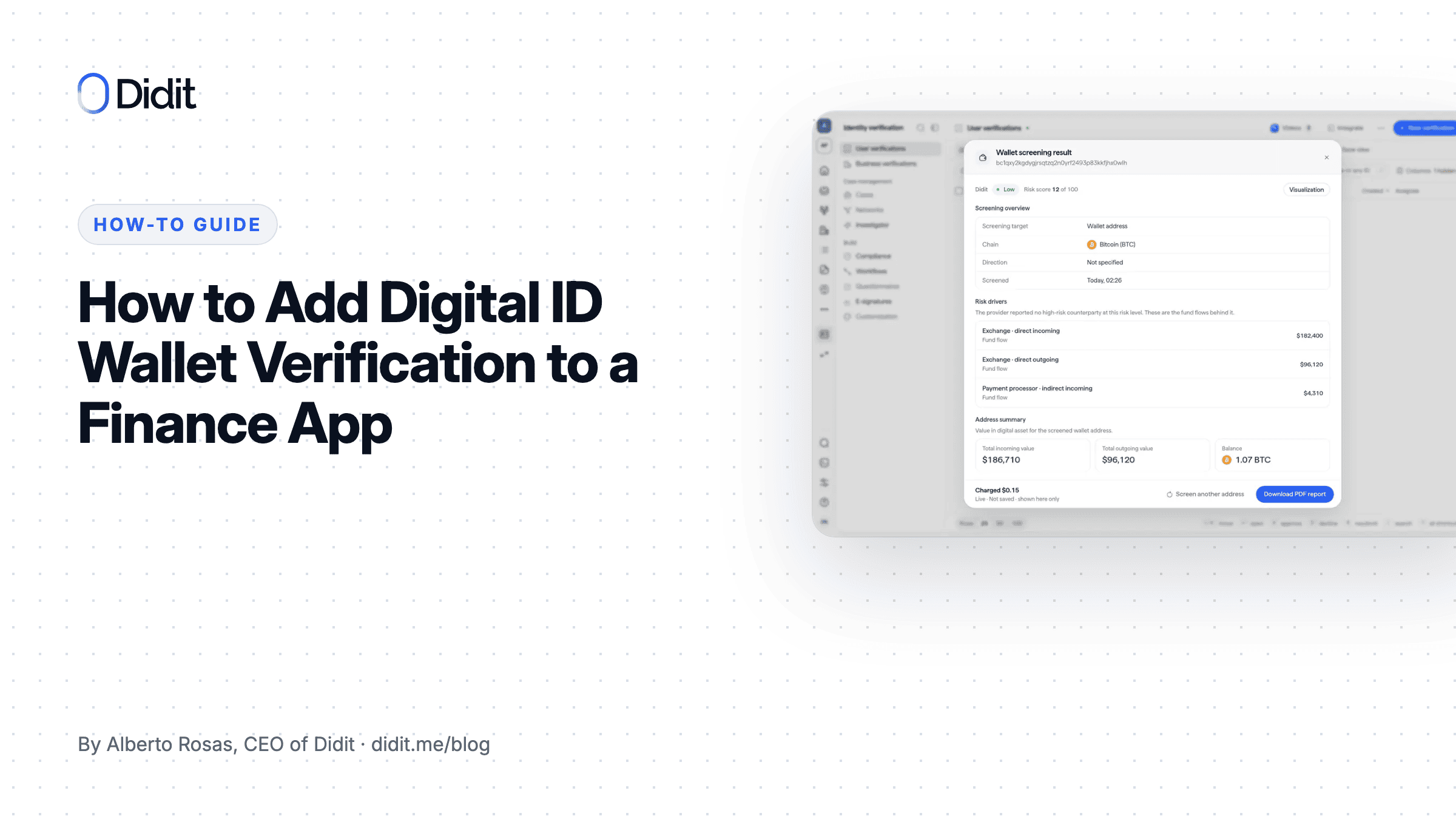
Add digital ID wallet verification to a finance app with Didit: pick a wallet, register a return host, start the check, read the outcome. Wallet checks cost $0.10 to $0.95 each.
Alberto RosasMar 6, 2026Mastering National Registry and CPF Validation in Brazil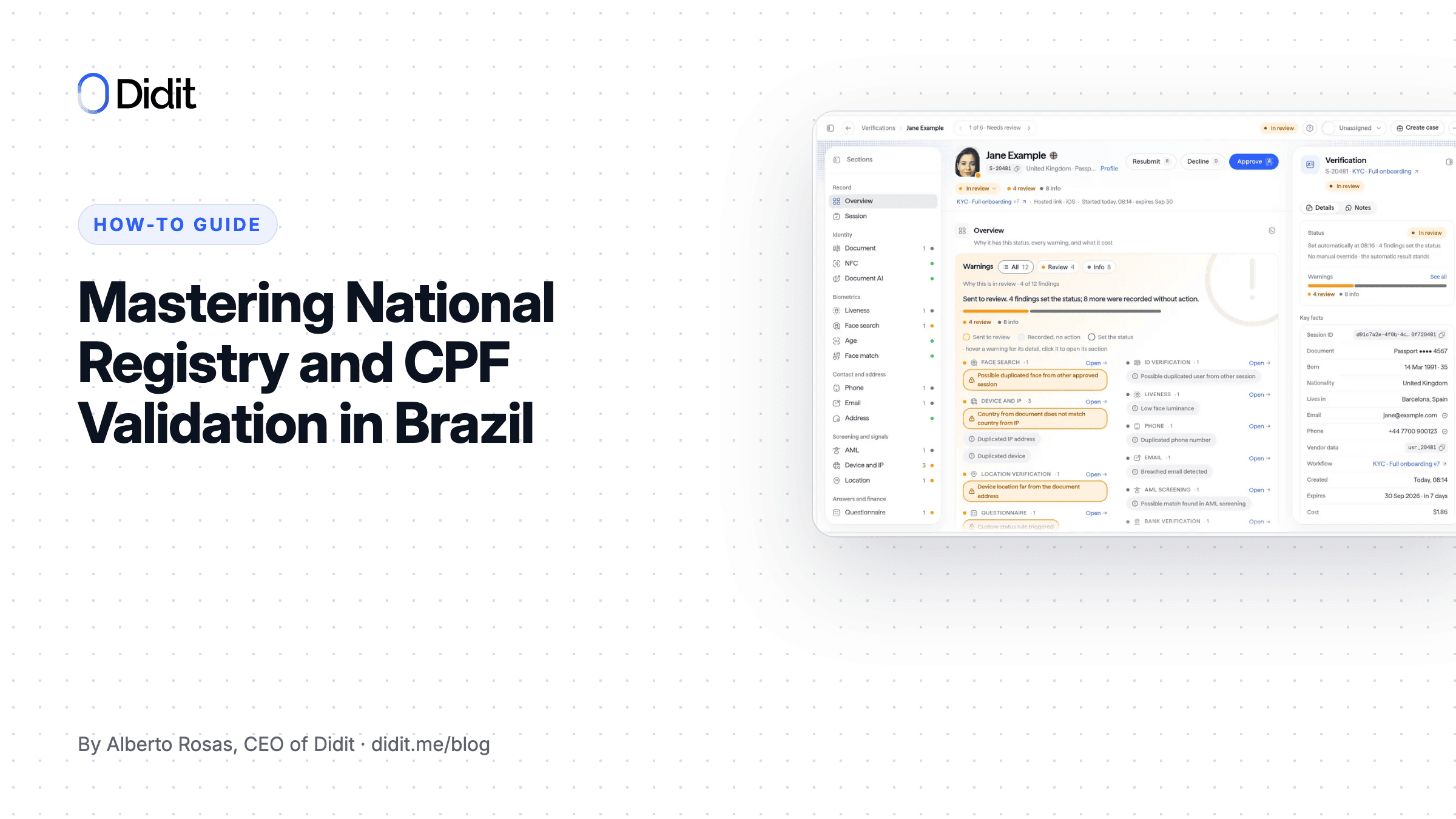
Validate Brazilian CPF data with a Didit Database Validation call: issuing_state=BRA, the CPF in identification_number, plus name and date of birth. Database Validation is variable per service.
Alberto RosasMar 6, 2026The ROI of Low-Cost Core KYC: Beyond Just Saving Money
Core KYC offers more than just cost savings; it's a strategic investment that drives customer acquisition, enhances compliance, and improves operational efficiency.
Alberto RosasMar 6, 2026Securing the Sharing Economy with Advanced Identity Verification
The sharing economy thrives on trust, yet faces significant challenges from fraud and user safety concerns. Robust identity verification is crucial for maintaining platform integrity, protecting users, and ensuring regulatory.
Alberto RosasMar 6, 2026Cross-Border KYC Compliance in the EU: Beyond MiCA
Navigating Know Your Customer (KYC) regulations across the European Union presents significant challenges for businesses, extending far beyond the scope of MiCA.
Alberto RosasMar 6, 2026How to Verify a Brazilian CPF With Database Validation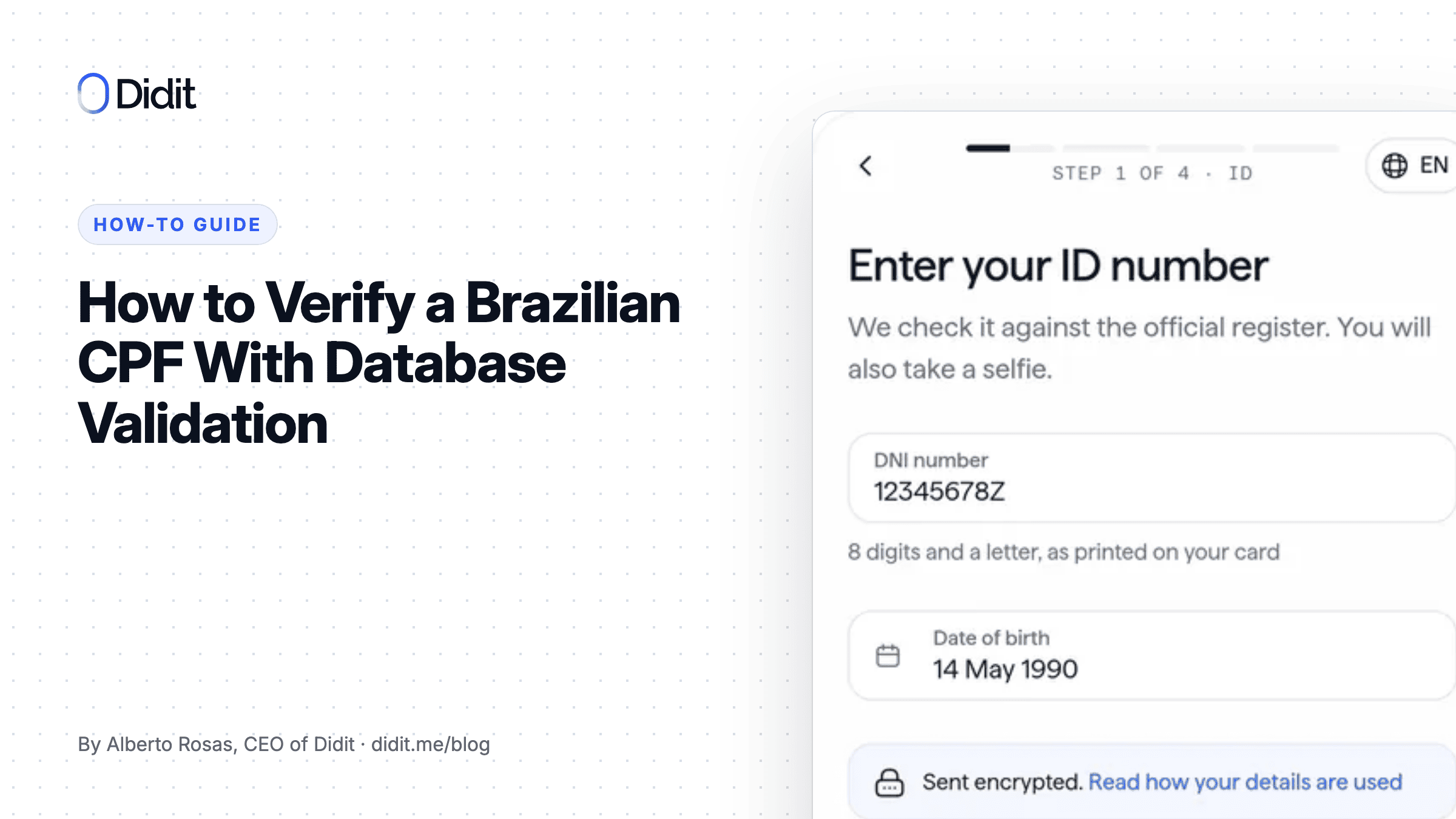
Didit's Database Validation API checks a Brazilian CPF, and optionally the name and date of birth, against Receita Federal records through SERPRO, returning a per-field match and an aggregate match type you can branch on.
Alberto RosasMar 6, 2026The Evolution of Identity Data Standards: From XML to JSON-LD
Explore the journey of identity data standards from the early days of XML to the rise of JSON and the sophisticated capabilities of JSON-LD.
Alejandro RosasMar 6, 2026Token-Bound Accounts and Identity: A Web3 Evolution
Token-Bound Accounts (TBAs) are revolutionizing Web3 identity by linking digital assets directly to smart contract wallets, creating persistent and verifiable digital personas.
Alberto RosasMar 6, 2026Phygital Identity: Bridging the Gap Between Physical and Digital
The convergence of physical and digital identity, known as 'phygital,' is reshaping how businesses verify and interact with users. This blog explores how integrating physical and digital identity verification creates seamless.
Alberto RosasMar 6, 2026CDR's Impact on Identity Verification in Australia
The Consumer Data Right (CDR) is reshaping identity verification in Australia, empowering consumers with data control while presenting opportunities for businesses to enhance accuracy and efficiency.
Alberto RosasMar 6, 2026The True Cost of Fraud: Quantifying its Financial Impact
Fraud is a pervasive threat, costing businesses trillions annually and impacting profitability, reputation, and customer trust. Understanding its multifaceted financial implications is crucial for developing robust prevention.
Alberto RosasMar 6, 2026Real-Time Transaction Monitoring for Crypto: Staying Ahead of Risk
Real-time transaction monitoring is crucial for crypto businesses to combat financial crime, ensure compliance, and build trust in a rapidly evolving landscape.
Alberto RosasMar 6, 2026Trust Anchors in Decentralized Identity: Building a Robust Future
Understanding trust anchors is crucial for the widespread adoption and security of decentralized identity systems. These foundational elements establish initial trust, enabling verifiable digital interactions without central.
Alberto RosasMar 6, 2026Building Robust DAOs with Advanced Identity Layers
Decentralized Autonomous Organizations (DAOs) promise a new era of governance, but face significant challenges in ensuring secure, verifiable, and equitable participation.
Alberto RosasMar 6, 2026Choosing the Right Identity Proofing Level (IAL/AAL) for Your Needs
Understanding Identity Assurance Levels (IAL) and Authentication Assurance Levels (AAL) is crucial for robust digital identity strategies. This guide explores how to select the appropriate levels to mitigate risk, ensure.
Alberto RosasMar 6, 2026Decentralized Personal Data Vaults and KYC Integration
Decentralized Personal Data Vaults (DPDVs) offer a user-centric approach to identity management, giving individuals control over their data.
Alberto RosasMar 6, 2026How Data Privacy is Shaping the Future of Financial Services
Data privacy is a paramount concern for financial institutions, driven by evolving regulations and consumer demand for control over personal information.
Alejandro RosasMar 6, 2026Automating Compliance: The Rise of RegTech in Financial Services
RegTech is transforming financial services compliance, offering automation and efficiency in a complex regulatory landscape. This post explores how technology, particularly AI, addresses challenges like KYC, AML, and data.
Alberto RosasMar 6, 2026Navigating the Evolving AML Landscape in MENA
The MENA region is rapidly transforming its AML regulations, driven by global standards and a commitment to combating financial crime. This blog explores key regulatory shifts, the impact on businesses, and how advanced.
Alberto RosasMar 6, 2026Data Minimization in AML Transaction Monitoring
Explore effective data minimization strategies for AML transaction monitoring, balancing regulatory compliance with privacy. Learn how to reduce data footprints, leverage pseudonymization, and utilize advanced analytics while.
Alberto RosasMar 6, 2026Ensuring Fair Play: Identity Verification in Esports.
Esports tournaments face unique challenges in maintaining player integrity, from age fraud and smurfing to account sharing. Robust identity verification is crucial for fair competition, regulatory compliance, and a credible.
Alberto RosasMar 6, 2026Digital Identity in Developing Nations: Overcoming Hurdles
Implementing digital identity solutions in developing nations presents unique challenges, from infrastructure limitations to digital literacy gaps.
Alberto RosasMar 6, 202610 Best PEP Screening Providers Compared (2026)
For most teams Didit is the best PEP screening provider in 2026: $0.20 per check, 1,300+ lists, $0.07 per person a year to monitor, sandbox testing free and unlimited on every plan.
Alberto RosasMar 6, 2026Building a Fraud Signal Prioritization Engine: A Developer's Guide
Effectively managing fraud signals is crucial for any business. This guide provides developers with insights into building a robust fraud signal prioritization engine, covering data ingestion, risk scoring, and workflow.
Alejandro RosasMar 6, 2026Building a 'Trust Score' for Identity: Beyond Simple Pass/Fail
Traditional identity verification often relies on binary pass/fail outcomes, which can be insufficient for complex risk landscapes. A sophisticated 'Trust Score' provides a nuanced approach, integrating multiple data points and.
Alberto RosasMar 6, 2026Immutable Audit Trails: Event-Driven KYC Architectures
Discover how event-driven KYC architectures create immutable audit trails, ensuring regulatory compliance and enhancing security. Learn the benefits of an immutable record for identity verification, fraud prevention, and.
Alejandro RosasMar 6, 2026Secure Onboarding for Regulated Industries: A Compliance Checklist
Navigate the complex landscape of regulatory compliance in secure onboarding with our essential checklist. Discover how robust identity verification, fraud prevention, and comprehensive record-keeping are crucial for regulated.
Alberto RosasMar 6, 2026Patient Identity in Digital Healthcare: How to Verify Patients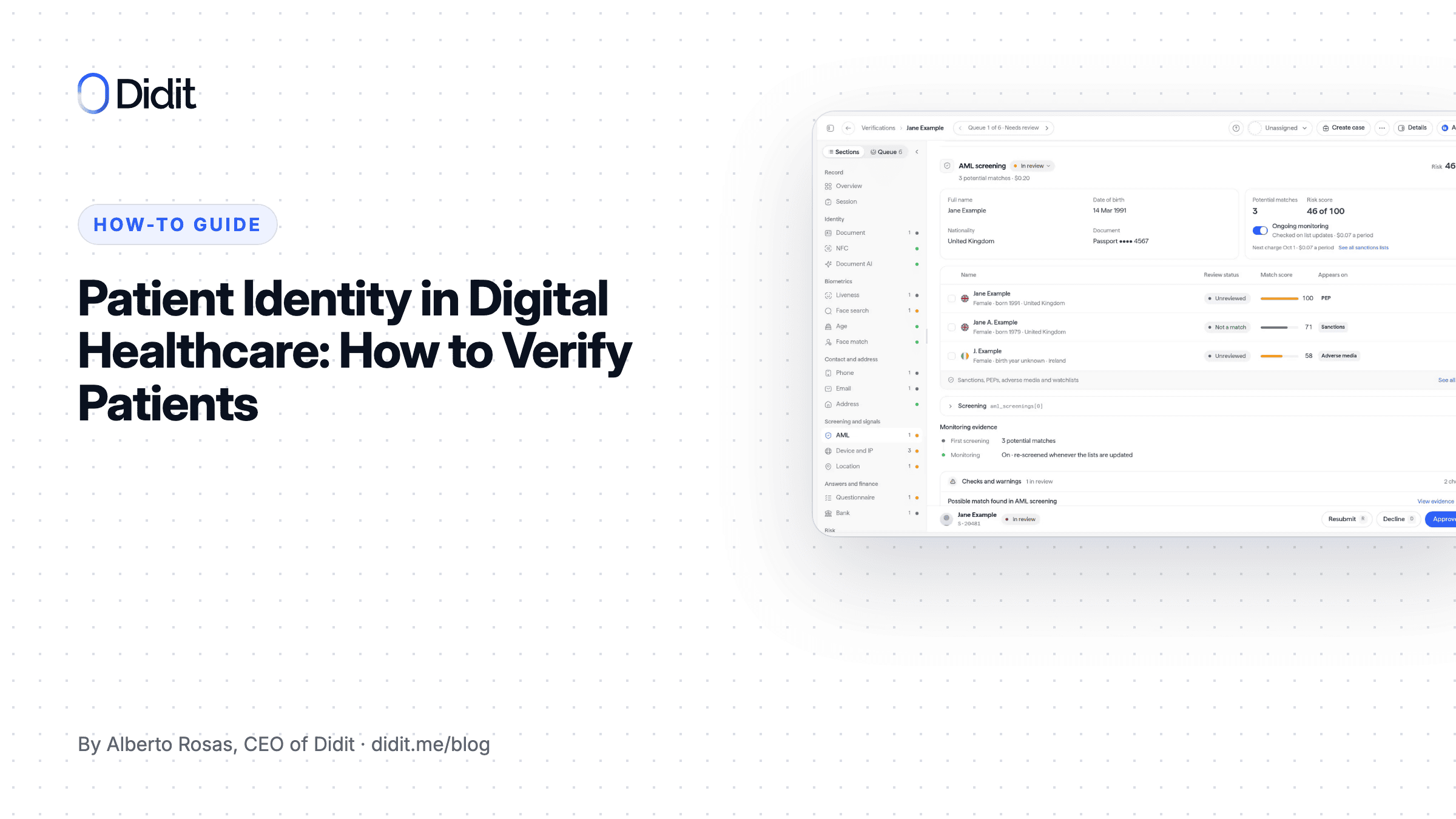
Verify patients with a Didit workflow: create a session per patient, send them to the hosted flow, and act on the webhook decision. A full check costs $0.33, a bundle of ID document verification, passive liveness, face match.
Alberto RosasMar 6, 2026Biometric Templates and Secure Storage: A Business How-To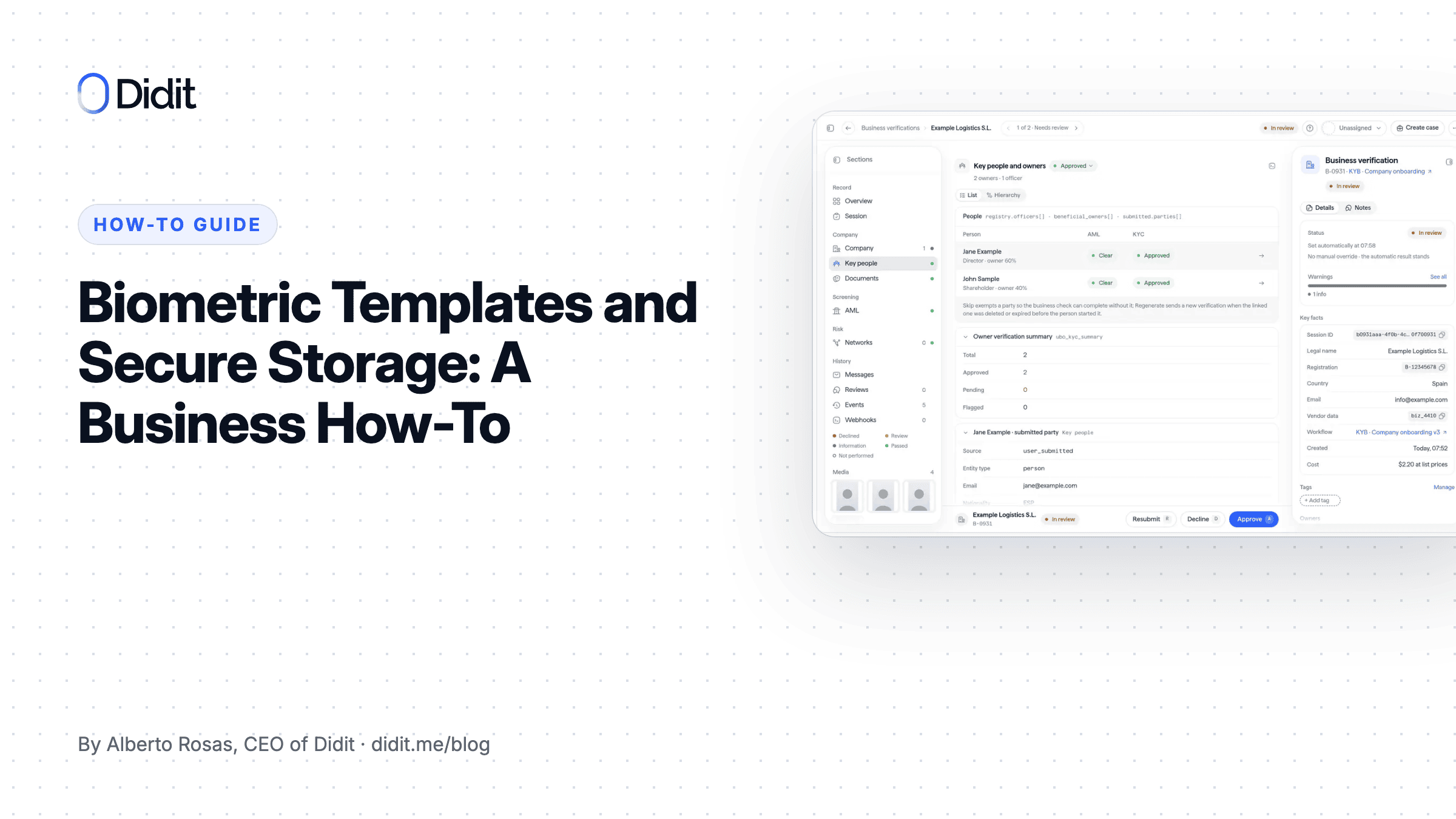
Didit keeps one image-free face template per user after a session deletion only if you opt in, for 1 to 3650 days. The Biometric Templates API lists, inspects and purges each template.
Alberto RosasMar 6, 2026Unlocking Secure Government Services with Chip-Based Digital IDs
Chip-based digital IDs are transforming how citizens interact with government services, offering enhanced security, privacy, and efficiency.
Alberto RosasMar 6, 2026Navigating Biometric Compliance in Latin America
Understanding and adhering to biometric compliance in Latin America is crucial for businesses. This blog explores the complex regulatory landscape, highlights key challenges, and provides actionable strategies for robust.
Alberto RosasMar 6, 2026Quantum-Resistant Cryptography: Securing Digital Identity
The advent of quantum computing poses a significant threat to current cryptographic standards, jeopardizing digital identity and data security.
Alberto RosasMar 6, 2026Avoiding Vendor Lock-in in Identity Verification
Vendor lock-in is a significant challenge in identity verification, limiting flexibility and increasing costs. This blog explores strategies to mitigate it, emphasizing modularity, open standards, and the benefits of an.
Alberto RosasMar 6, 2026Privacy-Preserving Face Match with Homomorphic Encryption
Explore the future of secure identity verification with privacy-preserving face matching using Homomorphic Encryption. Learn how this advanced cryptographic technique enables biometric comparisons without compromising sensitive.
Alejandro RosasMar 6, 2026Digital Proof of Ownership: Securing Assets with Identity
Digital proof of ownership is crucial for securing assets in the digital age, from NFTs to intellectual property. Robust identity verification is the bedrock for establishing and maintaining this trust, preventing fraud, and.
Alberto RosasMar 6, 2026Enhancing Trust: Pre-Trial Identity Verification in Clinical Research
Robust pre-trial identity verification is crucial for maintaining data integrity, patient safety, and regulatory compliance in clinical research.
Alberto RosasMar 6, 2026Leveraging IP Analysis for Geofencing in Online Regulated Activities
Geofencing is crucial for businesses operating in regulated online sectors, ensuring compliance and preventing fraud by restricting access based on geographic location.
Alejandro RosasMar 6, 2026The Future of Identity Verification in the Subscription Economy
The subscription economy thrives on seamless access, but this growth presents unique identity verification challenges. Businesses must balance user experience with robust fraud prevention and compliance.
Alberto RosasMar 6, 2026Unlocking Value: Dynamic Pricing for Identity Verification
Dynamic pricing models are transforming identity verification, offering businesses flexibility and cost-effectiveness. This approach moves beyond static fees, aligning costs with actual usage and risk profiles.
Alberto RosasMar 6, 2026API Versioning for Identity Verification Microservices
Effective API versioning is crucial for maintaining stability and enabling innovation in identity verification microservices. This post explores common strategies, best practices, and how Didit's modular, developer-first.
Alejandro RosasMar 6, 2026The Pivotal Role of API Gateways in Orchestrating IDV Workflows
API gateways are crucial for streamlining and securing Identity Verification (IDV) workflows, acting as a central control point. They enable seamless integration of diverse verification services, enforce security policies, and.
Alberto RosasMar 6, 2026The Crucial Role of OTP in Preventing SIM Swap Fraud
SIM swap fraud is a growing threat, allowing attackers to gain control of phone numbers and access sensitive accounts. One-Time Passwords (OTPs) play a vital role in securing these accounts, but their effectiveness depends on.
Alberto RosasMar 6, 2026OTP vs. Silent Network: Choosing a Phone Verification Method
Use OTP where users can receive a code. Use silent verification where a live route is confirmed. Didit charges the carrier rate plus $0.02 per OTP code. The public price feed omits silent verification pricing.
Alberto RosasMar 6, 2026False Rejection Rate (FRR) in Biometrics: Measure and Tune It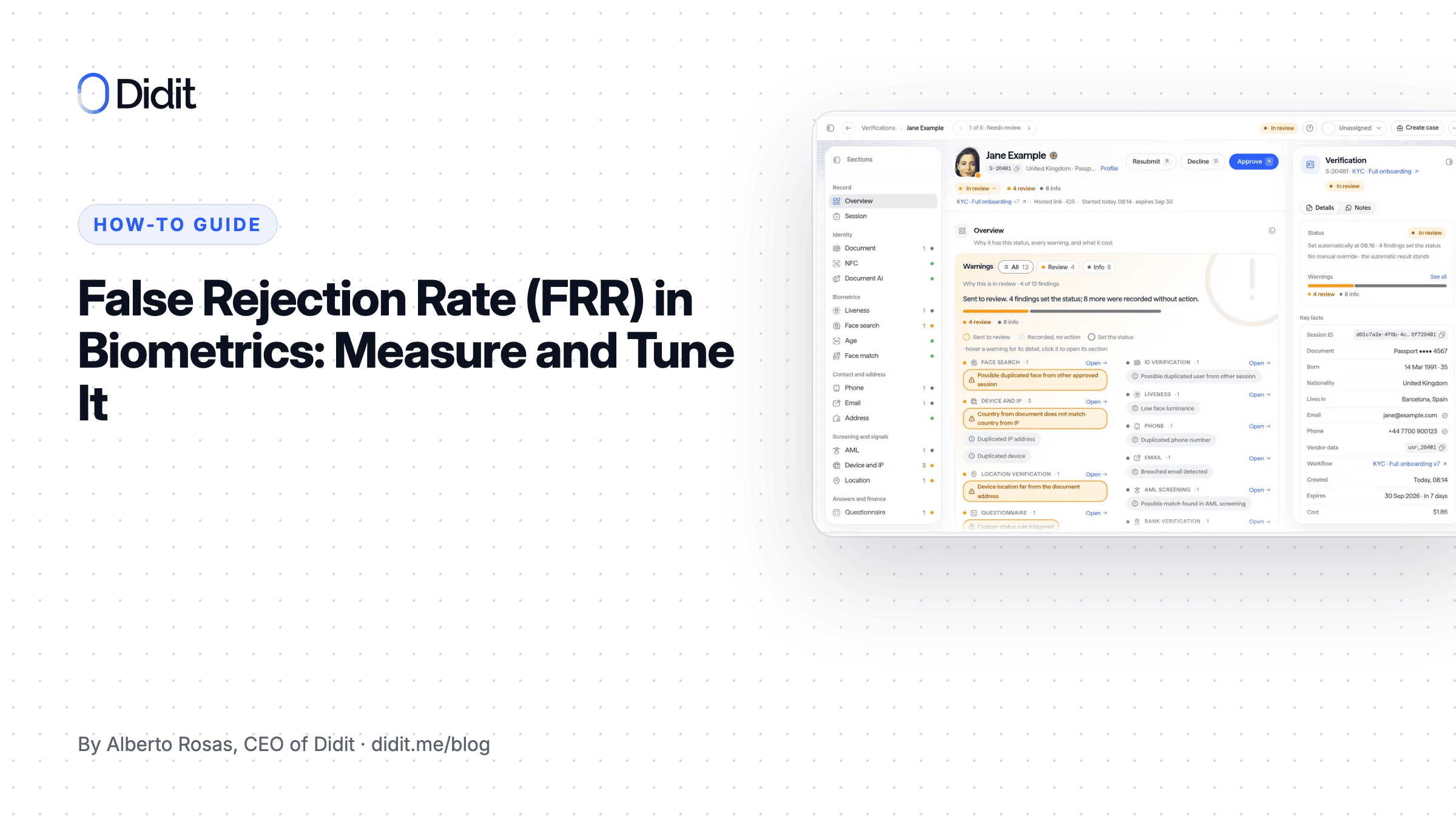
FRR is the share of legitimate users a biometric check wrongly rejects. You lower it by setting explicit face match and liveness thresholds, giving users retries, and routing borderline cases to review.
Alberto RosasMar 6, 2026Machine-to-Machine KYC: Securing Autonomous Transactions
As the digital economy evolves, the need for robust Machine-to-Machine (M2M) Know Your Customer (KYC) processes becomes critical. This blog explores the challenges and solutions for verifying autonomous entities and securing M2M.
Alberto RosasMar 6, 2026AI & ML: Optimizing Fraud Signal Detection
Discover how AI and Machine Learning revolutionize fraud detection by identifying subtle patterns and enhancing real-time risk assessment. Learn about advanced techniques like behavioral biometrics and predictive analytics, and.
Alberto RosasMar 6, 2026False Positives vs. Negatives in Fraud Detection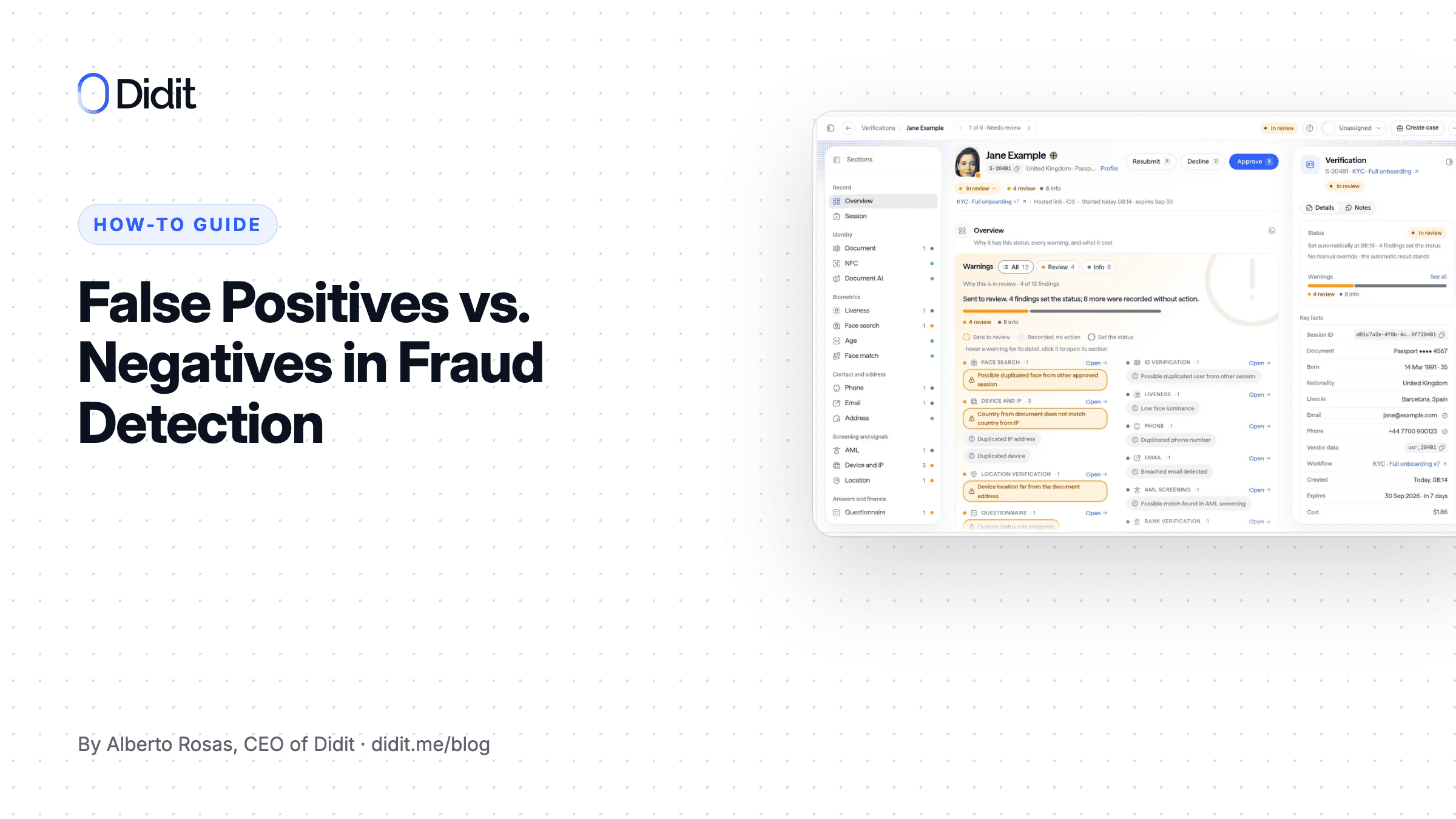
A false positive flags a legitimate customer or transaction; a false negative lets fraud through. Test rules first, then tune Didit score thresholds and resolve cases as false positive or valid threat.
Alberto RosasMar 6, 2026What Is a Sanctions Hit? AML False Positives Explained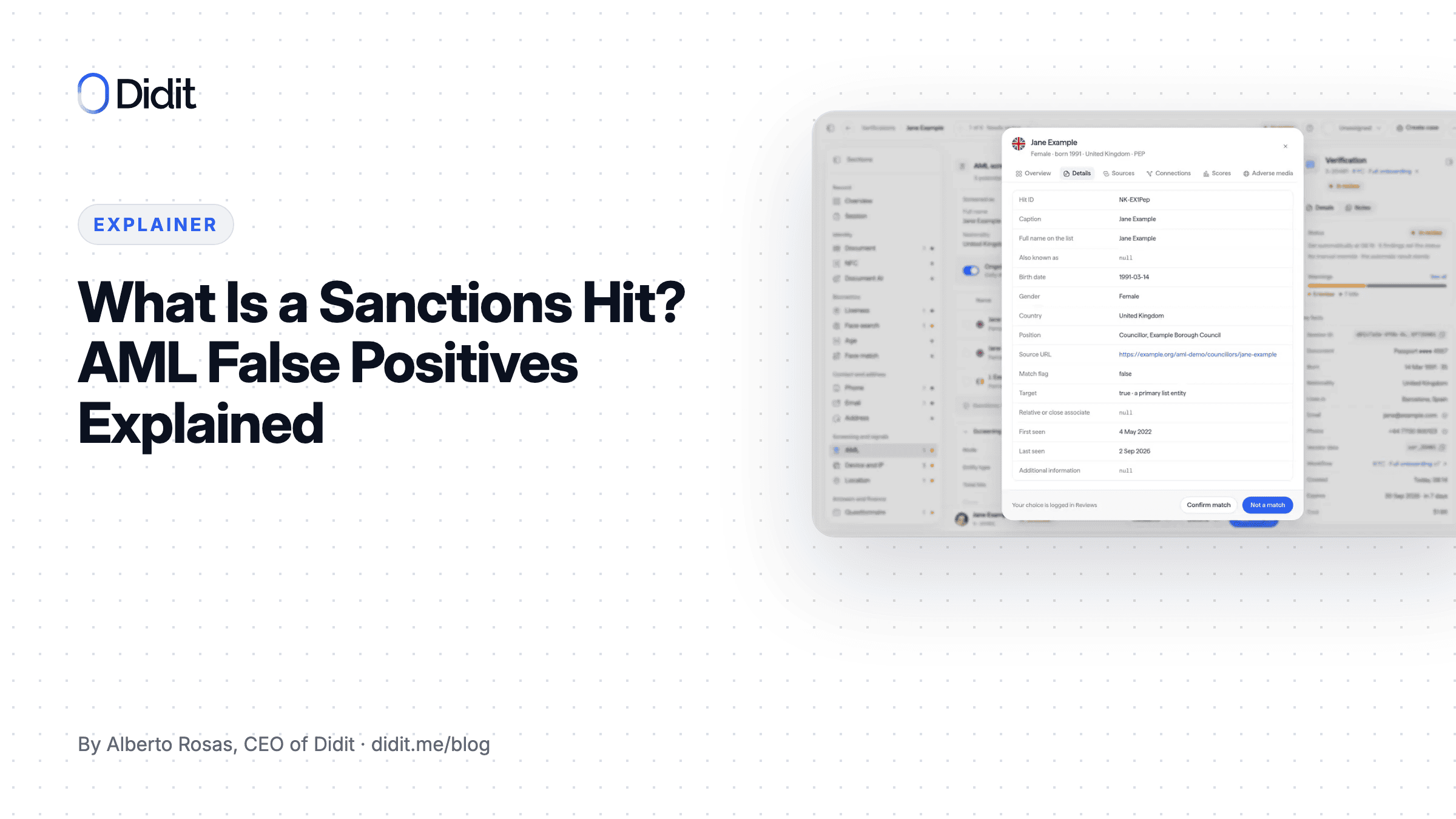
A sanctions hit is an alert that your data may match a sanctions list entry, not a finding. Match score estimates identity, risk score sets the screening status.
Alberto RosasMar 6, 2026Biometric Spoofing: Attack Types and Countermeasures (2026)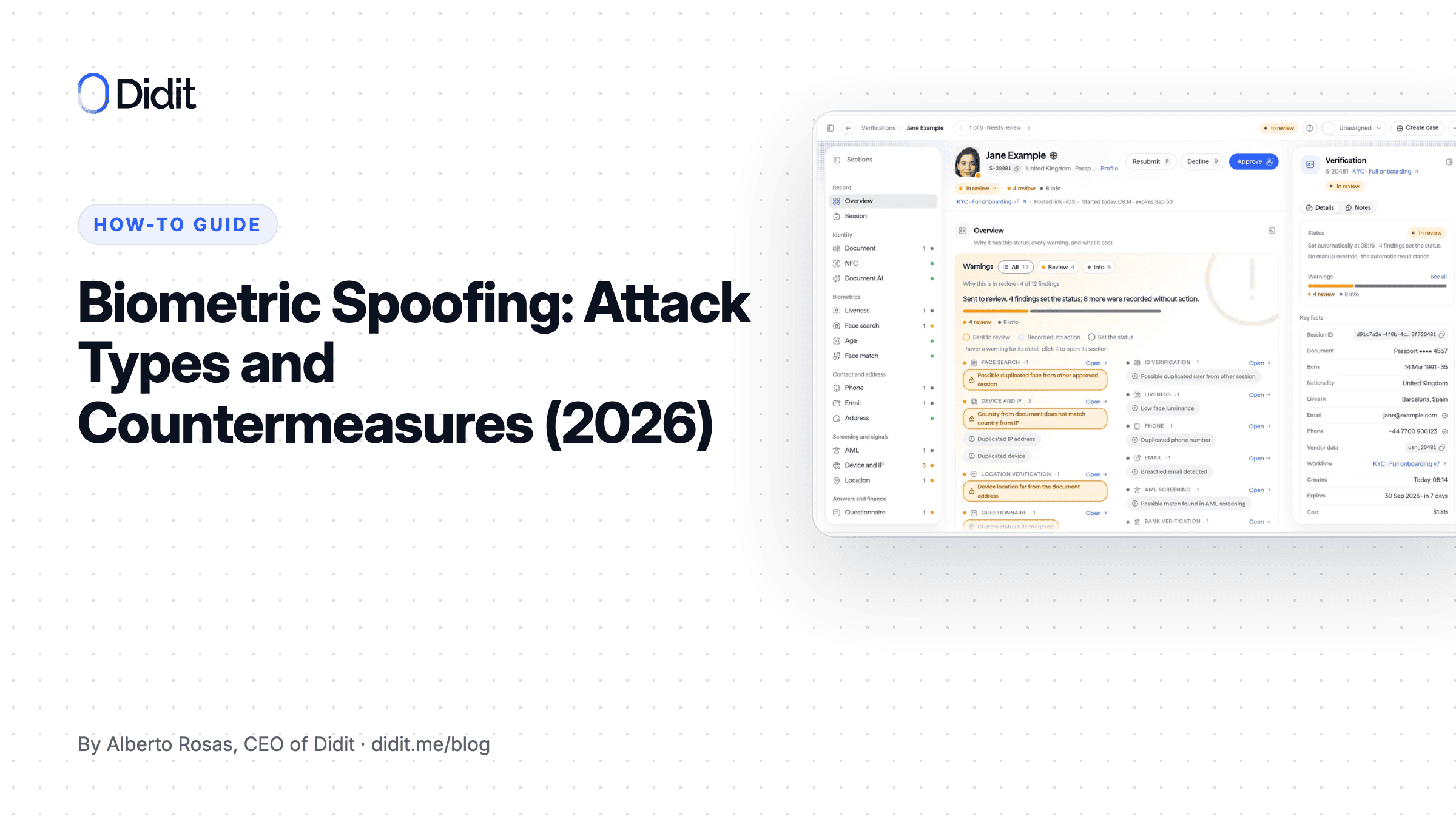
Biometric spoofing is a fake face, replay, mask or synthetic face presented to a camera. Stop it with the liveness method matched to your risk, then chain face match, face search and device checks.
Alberto RosasMar 6, 2026BNPL Identity Verification: Stopping Fraud in its Tracks
Buy Now, Pay Later (BNPL) services are booming, but so is the risk of fraud. Robust identity verification is crucial to protect both providers and consumers from account takeover, synthetic identity fraud, and credit abuse.
Alberto RosasMar 6, 2026Navigating the UK's Economic Crime Act with IDV
The UK's Economic Crime Act introduces stringent measures to combat illicit finance, placing significant new demands on businesses for robust identity verification and AML compliance.
Alberto RosasMar 6, 2026Understanding Fraud Rings and How to Disrupt Them
Fraud rings pose a significant threat to businesses by orchestrating sophisticated attacks. Disrupting them requires a multi-layered defense strategy, leveraging advanced identity verification, biometric analysis, and.
Alberto RosasMar 6, 2026Decentralized Identity Frameworks: A Deep Dive
Decentralized Identity (DeID) frameworks promise to revolutionize how we manage digital identities by giving users more control over their personal data.
Alberto RosasMar 6, 2026Strengthening Security: MFA with Identity Verification
Multi-Factor Authentication (MFA) is crucial for robust digital security, but its effectiveness is amplified when integrated with strong identity verification.
Alberto RosasMar 6, 2026Navigating Travel Rule Compliance for VASPs with Didit
The FATF Travel Rule mandates that Virtual Asset Service Providers (VASPs) share originator and beneficiary information for crypto transactions above a certain threshold.
Alberto RosasMar 6, 2026Navigating FATF Recommendations for Robust AML Compliance
Understanding the Financial Action Task Force (FATF) recommendations is crucial for any business combating money laundering and terrorist financing.
Alberto RosasMar 6, 2026Facial Recognition for Customer Loyalty Programs: The Future of Engagement
Facial recognition is set to revolutionize customer loyalty programs by offering hyper-personalized experiences, frictionless redemption, and enhanced security.
Alberto RosasMar 6, 2026How to Read Facial Recognition Accuracy Benchmarks (2026)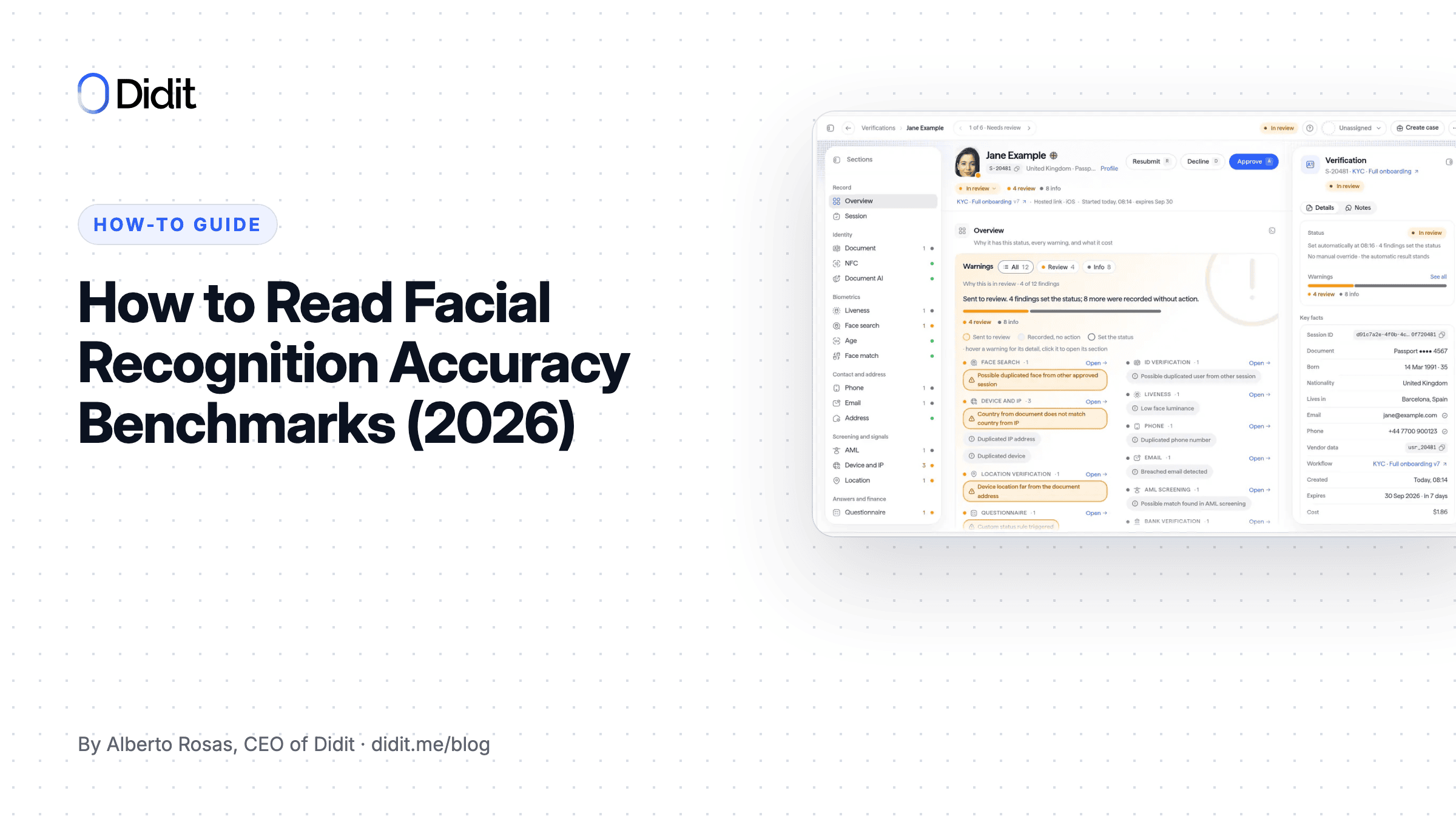
Facial recognition accuracy is a trade-off curve: FAR, FRR and EER only compare at the same threshold and population. Test on your own images, then set the decline threshold per risk.
Alberto RosasMar 6, 2026Questions
Blog questions
Who writes the Didit blog?
Which topics does the blog cover?
Is the blog available in my language?
Where do I find product updates?
Are these posts legal advice?
How do I find posts on one topic?
Are posts dated?
Do posts link to the docs?
Is the blog the same as the docs?
Compliance built in
Audited, certified and attested.
We hold the certifications and build each country's rules into your flows, so you can launch anywhere without worrying. Security and Compliance center
- Regulation encoded into your flows
Tell us what you do and where. Didit lists the rules that apply to you, with sources, and builds the checks each country needs into one workflow.
- Ready for AMLR
Every requirement of the new EU anti-money laundering rules, from checking customers to human review, is already covered by a Didit check.
- Tested in Spain's Treasury sandbox
Spain's Treasury published its supervised sandbox report on Didit's NFC plus active liveness onboarding; SEPBLAC took part and valued the added measures positively.
- Audited, not self-declared
iBeta Level 1 and Level 2. Liveness tested under ISO/IEC 30107-3.
Your obligations · 3 regions
 SOC 2 Type 2
 ISO 27001
 iBeta Level 1 and Level 2
 EU regulator attestation
 FSM youth protection
 GDPR
 EBA remote onboarding
 MiCA compatible
 FIDO Alliance member
- AMLREU AML Regulation ready
Integration · Didit MCP
Run Didit from your own AI agent
Connect Didit to Claude, Cursor, VS Code or ChatGPT and just ask in plain words. Your agent can do anything you can do in the console, with the same permissions you have.
 Add to Claude
 ChatGPT
 Cursor
- Build workflowsDescribe the checks you need. The agent creates and publishes the flow.
- Run investigationsAsk why a session was declined, review cases, search people and companies.
- Change rulesCreate payment rules, test them on past data and switch them on.
- Pull reportsAsk for numbers, exports or the audit log.
Didit Academy


