Blog
Blog archive
Every post on the Didit blog, newest first. Pick a category or search to find the subject you need.
All posts
Every post, newest first
Pick a category to filter.
Discover how to leverage serverless functions for efficient, scalable, and cost-effective dynamic document processing with Didit. This integration streamlines identity verification, automates workflows, and enhances compliance.
Alberto RosasMar 6, 2026LLM Tool-Use for Automated Compliance Monitoring
Discover how Large Language Models (LLMs) leveraging tool-use with API integrations are revolutionizing compliance monitoring. This blog explores automating AML and document expiration checks, enhancing risk assessment, and.
Alejandro RosasMar 6, 2026Build Dynamic Verification Pipelines with Didit's Workflow API in Python
Discover how Didit's Workflow API empowers developers to create flexible, multi-step identity verification pipelines using Python. Leverage our no-code builder and comprehensive APIs to design KYC, age verification, and AML.
Alejandro RosasMar 6, 2026Secure IoT with M2M Identity & TinyML via Didit's API
This post explores how to implement robust machine-to-machine (M2M) identity verification in IoT edge devices using TinyML for efficiency and Didit's powerful API for secure, scalable identity management.
Alberto RosasMar 6, 2026Securing Multi-Cloud Identity Verification with Didit and Vault
This blog explores how to secure API Gateways for multi-cloud identity verification using Didit's robust platform and HashiCorp Vault for secrets management.
Alberto RosasMar 6, 2026Programmatic Identity Verification for AI Agents in Python
Discover how AI agents can programmatically register and integrate with identity verification platforms. Learn about Didit's API-first approach, enabling headless registration, workflow configuration, and session management for.
Alejandro RosasMar 6, 2026Digital Credential Wallet for Federated Learning with Didit
Explore how Digital Credential Wallets, combined with Federated Learning and Secure Multi-Party Computation (MPC), can revolutionize data privacy and utility.
Alberto RosasMar 6, 2026Implementing Federated Identity with Didit and OIDC
Federated identity streamlines user authentication across multiple services, enhancing security and user experience. OpenID Connect (OIDC) is the modern standard for achieving this, building on OAuth 2.0.
Alejandro RosasMar 6, 2026Streamline CI/CD: Testing and Mocking Didit's APIs
Robust CI/CD pipelines are crucial for reliable identity verification. Learn how to effectively test and mock Didit's APIs, including ID Verification and Liveness, to ensure your integrations are resilient, performant, and.
Alejandro RosasMar 6, 2026Real-time Sanctions Screening with Programmable Logic
Discover how to implement real-time sanctions screening by integrating Didit's powerful AML API with WebAssembly. This approach offers unparalleled flexibility, allowing businesses to define custom risk logic and achieve.
Alberto RosasMar 6, 2026Securing AI Agents: Composable Identity for LLMs
As AI agents become autonomous, verifying their identities and ensuring secure interactions is paramount. This guide explores the challenges of securing Large Language Models (LLMs) and introduces composable identity attestation.
Alberto RosasMar 6, 2026Building an AI Agent Trust Layer with Didit's Programmatic API
Discover how Didit's programmatic identity API enables AI agents to self-register, configure verification workflows, and automate trust, creating a robust real-time trust layer.
Alejandro RosasMar 6, 2026Rust Backend for High-Performance Didit Webhook Processing
Building a robust, high-performance backend for processing webhooks is crucial for real-time identity verification. Rust offers unparalleled safety and speed, making it an ideal choice for handling Didit's secure, real-time KYC.
Alberto RosasMar 6, 2026Integrating Didit's Data Extraction API with Go Microservices and gRPC
Discover how to seamlessly integrate Didit's powerful Data Extraction API into your Go microservices architecture using gRPC. This guide covers the benefits of this approach, practical implementation steps, and how Didit's.
Alejandro RosasMar 6, 2026Boost Performance: Async Python for Didit API & Webhooks
Discover how Python's asyncio can revolutionize your integration with Didit's API and webhooks, enabling high-throughput identity verification and efficient processing.
Alejandro RosasMar 6, 2026Fortifying Data Extraction APIs: A Guide to Robust Security
Securing data extraction API endpoints for OCR, MRZ, and barcode scanning is paramount for protecting sensitive information and maintaining trust.
Alejandro RosasMar 6, 2026Zero-Trust Principles for API-First Identity Gateways
Discover how to design robust, secure API-first identity gateways using zero-trust principles. This guide covers granular access control, continuous verification, and the critical role of AI-native platforms like Didit in.
Alberto RosasMar 6, 2026Mastering API Versioning for Seamless KYC Integration
Implementing backward-compatible API versioning is crucial for maintaining stable and evolving KYC services. This guide explores strategies like URL path, custom headers, and query parameters, emphasizing the importance of clear.
Alejandro RosasMar 6, 2026Programmatic Identity for Kubernetes Workloads
Securing containerized applications in Kubernetes requires robust identity attestation. This post explores the challenges of managing identities for dynamic workloads and how programmatic approaches, especially with AI-native.
Alberto RosasMar 6, 2026Mastering Didit API Error Handling & Retries in Go
Building robust integrations with the Didit API in Go requires sophisticated error handling and retry strategies. This guide explores best practices, from understanding Didit's rate limits and specific error codes to.
Alejandro RosasMar 6, 2026Enhancing Identity Workflow Observability with Didit and OpenTelemetry
Achieve unparalleled visibility into your identity verification processes by integrating Didit's powerful platform with OpenTelemetry. This guide explores how distributed tracing, metrics, and logs provide real-time insights.
Alberto RosasMar 6, 2026Build Dynamic KYC Workflows with Didit and Temporal.io
Discover how Didit's Workflow API, combined with Temporal.io, empowers businesses to construct robust, dynamic, and resilient KYC workflow engines.
Alberto RosasMar 6, 2026Building Resilient Identity Verification with Queues & Idempotency
Designing fault-tolerant identity verification systems is crucial for modern businesses. This blog explores how message queues ensure reliable processing by decoupling services and managing retries, while idempotency guarantees.
Alberto RosasMar 6, 2026Real-time KYC with AWS Kinesis and Didit Webhooks
Building a real-time KYC decisioning engine requires robust infrastructure to handle asynchronous data streams. This blog explores how to leverage AWS Kinesis for scalable event processing and Didit's secure webhooks for instant.
Alberto RosasMar 6, 2026Building a Unified Identity Layer with Didit and a Service Mesh
Discover how combining Didit's AI-native identity platform with a service mesh like Istio creates a robust, scalable, and secure unified identity layer.
Alberto RosasMar 6, 2026Dynamic Access Control: Didit and Open Policy Agent
Achieve dynamic, fine-grained access control by integrating Didit's robust identity verification with Open Policy Agent (OPA). This powerful combination allows businesses to make real-time, context-aware authorization decisions.
Alejandro RosasMar 6, 2026Securing API Gateway KYC Routing with Kong and Didit
Discover how to implement robust Know Your Customer (KYC) verification directly within your API gateway using Kong and Didit. This guide covers leveraging custom plugins for dynamic routing, enhancing security, and ensuring.
Alejandro RosasMar 6, 2026Real-Time Transaction Risk Scoring with Kafka Streams & Didit Events
Discover how to implement real-time transaction risk scoring using Kafka Streams and Didit's event-driven identity verification platform. This guide covers leveraging streaming data for immediate fraud detection and enhancing.
Alberto RosasMar 6, 2026Securing Identity Verification: API Rate Limits and Throttling
Implementing robust API rate limits and throttling is crucial for protecting identity verification endpoints from abuse, ensuring system stability, and maintaining service quality.
Alejandro RosasMar 6, 2026Implementing DIDComm with Didit for Secure Credential Exchange
Discover how to leverage DIDComm for secure, privacy-preserving credential exchange, enhancing digital trust. Learn about the architecture, use cases, and challenges, and see how Didit's modular, AI-native platform seamlessly.
Alberto RosasMar 6, 2026Automated Client Due Diligence: Didit AML & Salesforce
Discover how integrating Didit's AI-native AML Screening with Salesforce streamlines client due diligence, enhances compliance, and mitigates financial crime risks.
Alberto RosasMar 6, 2026Programmatic Identity Attestation for AI Microservices with Rust
Discover how to implement programmatic identity attestation for AI microservices using Rust, ensuring secure and automated access control. This guide covers the challenges of machine-to-machine authentication and highlights.
Alberto RosasMar 6, 2026Idempotent API Calls in Go for Identity Verification (2026)
In Go, keep one Idempotency-Key per logical verification operation, set vendor_data to your stable user id for duplicate detection, and treat a 409 as a state reload, not a retry. A full KYC check costs $0.33.
Alejandro RosasMar 6, 2026Programmatic IDV Workflows: Didit and Kubernetes Operators
Discover how to programmatically orchestrate identity verification (IDV) workflows using Didit's API-first approach and Kubernetes Operators.
Alberto RosasMar 6, 2026Secure Your Node.js Backend: HMAC Validation for Didit Webhooks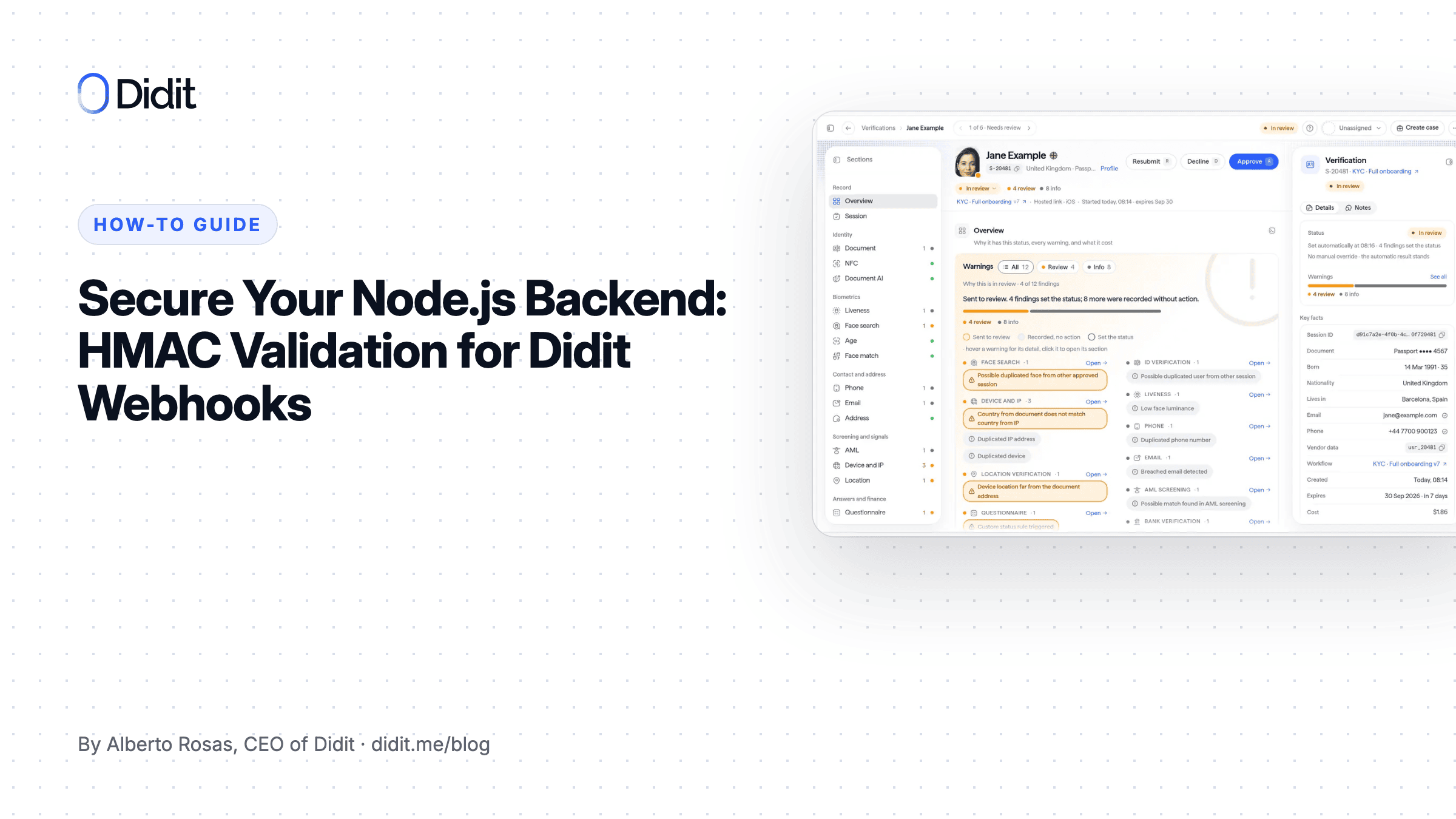
Read the raw body, verify the signature with the official Node SDK verifier before any parsing, accept X-Signature-V2-Previous during a secret rotation, then parse, deduplicate on event_id and reject timestamps older than 300.
Alejandro RosasMar 6, 2026Mastering Webhook Retries & DLQs in Identity Verification
Effectively managing webhook retries and dead letter queues (DLQs) is crucial for robust identity verification systems. This guide explores best practices for ensuring data integrity and system reliability, preventing data loss.
Alberto RosasMar 6, 2026Securing API Keys for Identity Verification: Best Practices
API keys are the gatekeepers to your identity verification services. Proper management and rotation are crucial to prevent unauthorized access, data breaches, and service disruptions.
Alejandro RosasMar 6, 2026Orchestrating Complex AML Workflows with Didit's API and Apache Airflow
Effectively managing Anti-Money Laundering (AML) compliance requires robust, automated workflows. This post explores how Didit's API, combined with Apache Airflow, empowers organizations to build scalable, resilient, and highly.
Alberto RosasMar 6, 2026Idempotent API Clients for Reliable Identity Verification
Designing an idempotent API client is crucial for robust identity verification systems, ensuring consistent results despite retries and network issues.
Alejandro RosasMar 6, 2026How to Secure AI Agent-to-Agent Transactions With Attestation
Secure agent-to-agent transactions with Didit: a person approves a scoped agent session, your backend checks the token's act claim, and agent access is free on every plan.
Alberto RosasMar 6, 2026Orchestrating Compliance: Webhooks, AWS Step Functions & Didit
Learn how to build a robust, custom compliance orchestration layer using Didit's real-time webhooks and AWS Step Functions. This powerful combination enables dynamic, multi-step identity verification workflows, ensuring.
Alberto RosasMar 6, 2026Robust Identity Verification: Idempotency and Retries
Building resilient identity verification microservices requires careful implementation of idempotency and retry mechanisms. This blog explores strategies to ensure data consistency and system reliability, even in the face of.
Alberto RosasMar 6, 2026Securing API Keys for Identity Verification Services
API keys and credentials are the gatekeepers to your identity verification services. This guide explores best practices for safeguarding these critical assets, from secure storage and rotation to granular access control and.
Alberto RosasMar 6, 2026Fortifying Identity Verification: API Security Best Practices
This blog post explores critical API security best practices for identity verification workflows, emphasizing the need for robust authentication, authorization, data encryption, and continuous monitoring.
Alejandro RosasMar 6, 2026Elevate API Security: Implementing mTLS with Didit
Discover how Mutual TLS (mTLS) can significantly enhance the security of your API communications, protecting against sophisticated threats like impersonation and data breaches.
Alejandro RosasMar 6, 2026mTLS for Secure API-First KYC Microservices: A Deep Dive
Explore how mutual TLS (mTLS) enhances security for API-first KYC microservices, safeguarding sensitive identity data. This post details mTLS implementation, its benefits in preventing unauthorized access, and how Didit's.
Alejandro RosasMar 6, 2026HMAC Signature Verification: Securing Your Didit Webhooks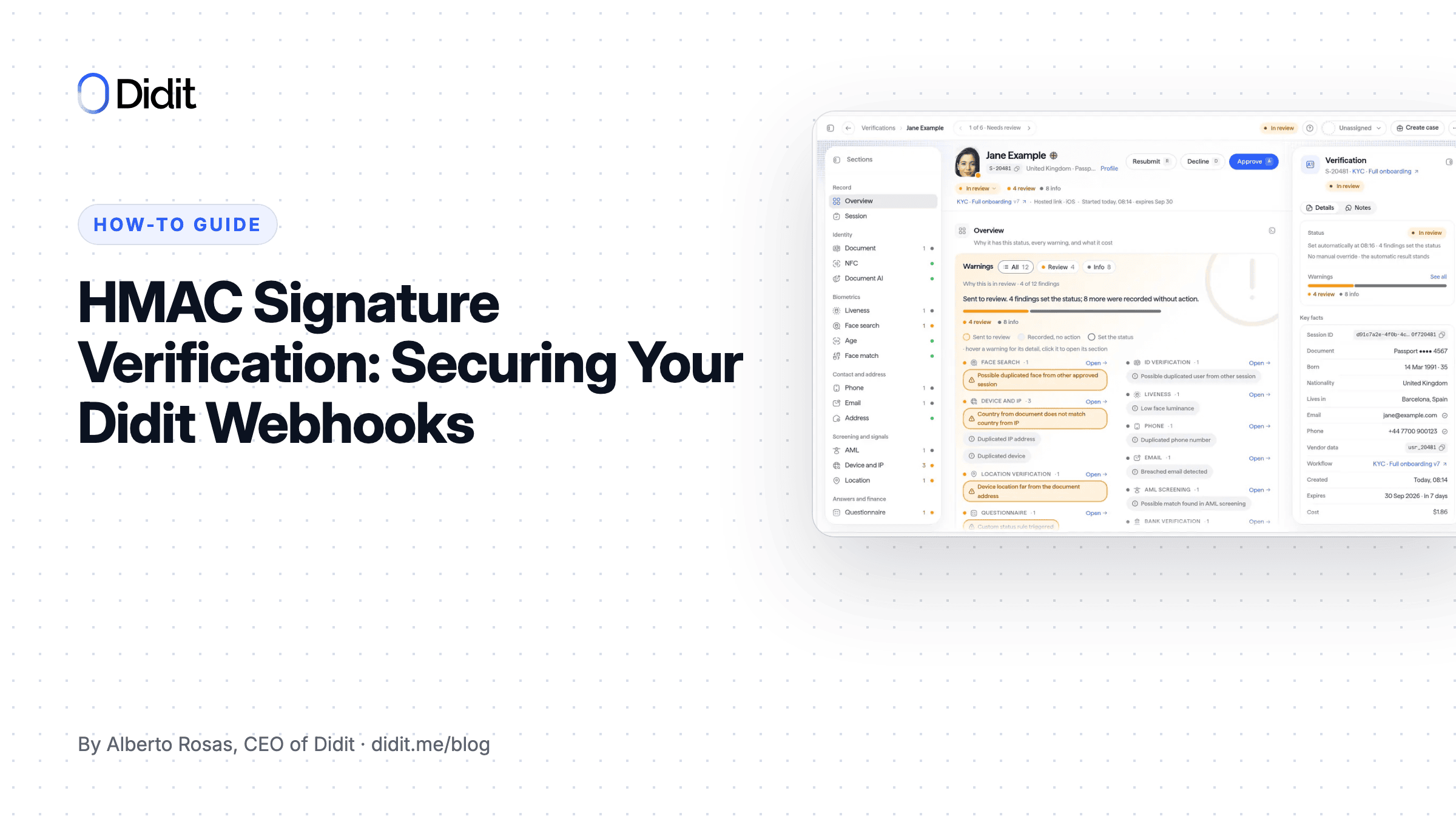
Verify Didit webhooks with the signing input for the header you check: X-Signature-V2 over canonical JSON, X-Signature over exact raw bytes. Check X-Timestamp within 300 seconds and compare in constant time.
Alejandro RosasMar 6, 2026EBA Guidelines for Remote Customer Onboarding: 2026 Guide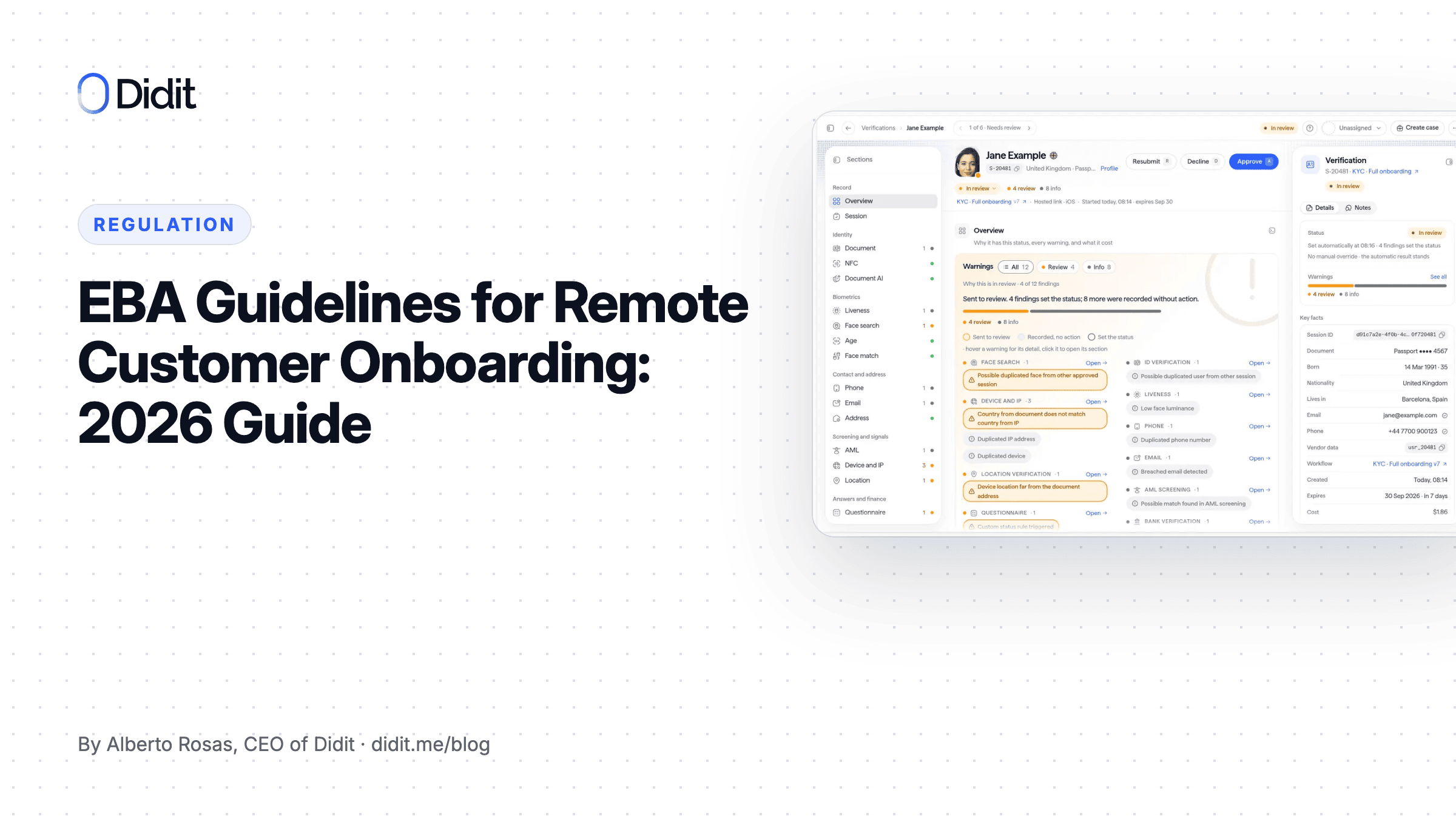
EBA/GL/2022/15 applies from 2 January 2023 to EU and EEA financial institutions under Article 13(1) of Directive (EU) 2015/849. Didit charges $0.33 per full KYC and $0.20 per AML screen.
Alberto RosasMar 6, 2026SOC 2 Type 2 Report for Identity Verification: 2026 How-To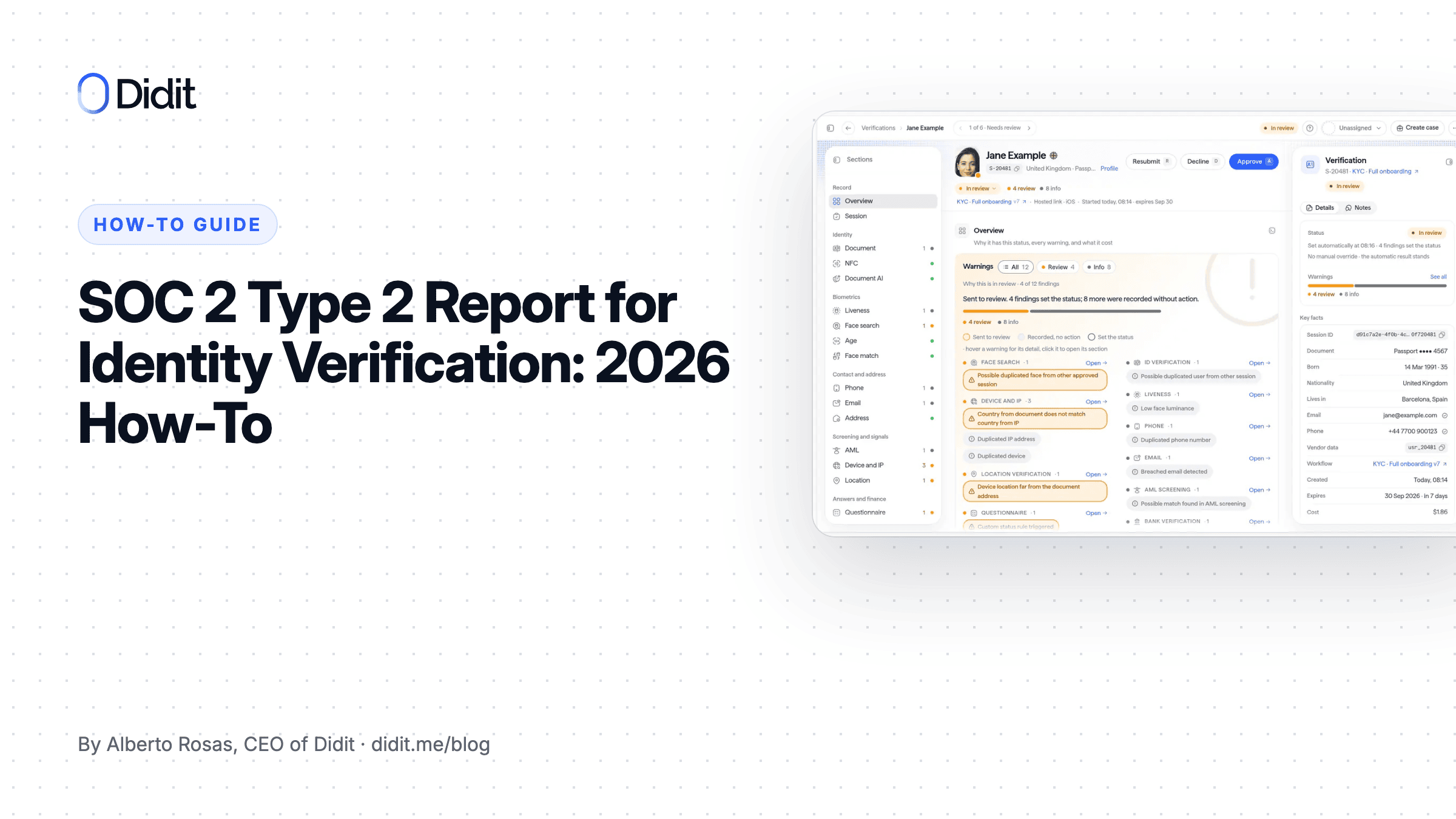
Didit holds SOC 2 Type 2, observation period March 9 to July 1, 2026, report issued July 30, 2026 and shared under NDA. You still need your own evidence: roles, 2FA, retention, audit logs and per-session PDFs.
Alberto RosasMar 6, 2026M2M KYC: Securing Autonomous Vehicle Fleets
M2M KYC is crucial for the secure and compliant operation of autonomous vehicle fleets. It ensures trust between vehicles, infrastructure, and services, preventing fraud and enabling seamless, verifiable interactions.
Alberto RosasMar 6, 2026Geolocation Verification for Crypto Travel Rule Compliance
Meeting the FATF Travel Rule in crypto requires robust identity and transaction monitoring, including advanced geolocation verification. Didit offers an AI-native, modular platform that streamlines compliance, ensuring secure.
Alejandro RosasMar 6, 2026Build a Composable Digital Credential Wallet with Didit's APIs
Discover how Didit's modular, AI-native APIs empower developers to build flexible, secure, and user-centric composable credential wallets. Leverage features like ID Verification, Liveness, and AML Screening to create robust.
Alejandro RosasMar 6, 2026Programmatic Identity for Edge Devices with Rust & Didit
Discover how to implement robust, automated identity provisioning for edge devices using Rust, leveraging its performance and security features.
Alberto RosasMar 6, 2026Programmatic Identity Proofing for ERP: Enhancing Security & Efficiency
Integrating programmatic identity proofing into ERP systems is crucial for modern businesses, streamlining user onboarding, securing access, and ensuring compliance.
Alberto RosasMar 6, 2026Achieving SOC 2 Compliance for Identity Verification
SOC 2 compliance is critical for identity verification providers, ensuring the security, availability, processing integrity, confidentiality, and privacy of customer data.
Alberto RosasMar 6, 2026Integrating Bank Statement Validation into AML Workflows
Bank statement validation is crucial for robust AML compliance, offering deep insights into financial behavior and mitigating risks. Integrating this process enhances due diligence, detects suspicious activities, and strengthens.
Alejandro RosasMar 6, 2026AI-Powered Utility Bill Verification for German BaFin Compliance
Discover how AI-driven utility bill verification revolutionizes Proof of Address for BaFin compliance in Germany. Learn about regulatory requirements, common challenges, and the advanced solutions offered by platforms like Didit.
Alberto RosasMar 6, 2026GDPR-Compliant Data Minimization in KYC Workflows
Achieving GDPR compliance in Know Your Customer (KYC) processes requires stringent data minimization. This post explores strategies like purpose limitation, anonymization, and secure data handling to reduce identity data.
Alberto RosasMar 6, 2026Real-time Sanctions Screening with Didit and Kafka
Discover how to implement a robust, high-throughput sanctions screening system using Didit's AML Screening API and Apache Kafka. This guide covers architectural design, real-time processing, and ensuring compliance, all while.
Alberto RosasMar 6, 2026The Economics of Trust: Quantifying ROI in Digital Identity Orchestration
Digital identity orchestration is crucial for security and user experience. This blog explores how to quantify the ROI of these systems, focusing on reduced fraud, improved compliance, and operational efficiency through advanced.
Alberto RosasMar 6, 2026Streamline Data Extraction with Didit's API Workflows
Efficiently orchestrate complex data extractions from IDs using OCR, MRZ, and barcodes within a single Didit API workflow. Discover how to enhance accuracy, reduce manual effort, and ensure compliance with Didit's powerful.
Alejandro RosasMar 6, 2026Privacy-Enhancing ML in Secure Biometric Onboarding
Discover how Privacy-Enhancing Machine Learning (PEML) is revolutionizing secure biometric onboarding, balancing robust identity verification with user data protection.
Alberto RosasMar 6, 2026The Architect's Guide to Building a Modular, API-First Identity Ecosystem
Discover how to design and implement a robust, scalable, and future-proof identity ecosystem using a modular, API-first approach. Learn the benefits of composable identity services, orchestrating verification workflows, and.
Alejandro RosasMar 6, 2026Traditional KYC vs. Decentralized Identity (DID): A Comparative Analysis
Explore the fundamental differences, advantages, and challenges of traditional Know Your Customer (KYC) processes versus the emerging Decentralized Identity (DID) paradigm.
Alberto RosasMar 6, 2026Cross-Border KYC in Go: Integrating Didit's Database Validation
Mastering cross-border KYC is crucial for global expansion, but navigating diverse data sources and compliance can be complex. This guide explores how Didit's Database Validation endpoint simplifies this by providing a unified.
Alejandro RosasMar 6, 2026Integrating Didit's OCR API with Python for Document Data Extraction
Learn how to seamlessly integrate Didit's powerful OCR API with Python to extract crucial data from identity documents. This guide covers everything from setting up your environment to processing verification reports, showcasing.
Alejandro RosasMar 6, 2026Mastering Document Data Extraction: OCR, MRZ, and Barcode Parsing
Unlock the power of automated identity verification with Didit's advanced API, integrating OCR, MRZ, and barcode parsing. This guide explores how to efficiently extract and validate critical data from identity documents.
Alejandro RosasMar 6, 2026DNI Verification in Spain: A Technical Deep Dive for Developers
Understanding DNI verification in Spain is crucial for developers building compliant and secure applications. This deep dive covers the technical nuances, regulatory landscape, and how to implement robust verification processes.
Alejandro RosasMar 6, 2026Choosing a Reusable KYC Provider: Buyer's Guide & Checklist
Selecting the right Reusable KYC provider is crucial for streamlining onboarding, enhancing user experience, and maintaining compliance. This guide offers key considerations, from data security to integration flexibility, and.
Alberto RosasMar 6, 2026Privacy-Enhancing Cryptography in Decentralized Identity
Explore how Privacy-Enhancing Cryptography (PEC) is revolutionizing decentralized identity by enabling secure, private, and user-centric verification.
Alberto RosasMar 6, 2026GDPR's Right to Erasure in Identity Verification: Challenges
GDPR's Right to Erasure, or the 'Right to be Forgotten,' presents significant challenges for identity verification processes. This blog explores these complexities, focusing on data retention policies, fraud prevention, and the.
Alberto RosasMar 6, 2026Zero-Trust Architecture & API-First Identity with Didit
Explore the synergy between Zero-Trust Architecture (ZTA) and API-first identity solutions. Learn how continuous verification, granular access control, and robust fraud prevention are powered by modern identity platforms.
Alberto RosasMar 6, 2026Predictive AML: The Power of Structured Identity Data
Leveraging structured identity data is revolutionizing Anti-Money Laundering (AML) analytics, moving from reactive to proactive fraud detection.
Alberto RosasMar 6, 2026Integrating Age Gating with E-commerce: Shopify & Magento
Effectively implementing age gating on e-commerce platforms like Shopify and Magento is crucial for businesses selling age-restricted products.
Alejandro RosasMar 6, 2026Real-Time Identity Verification for On-Demand Delivery
On-demand delivery services face unique challenges in identity verification, balancing rapid onboarding with robust fraud prevention and compliance.
Alberto RosasMar 6, 2026The ROI of Automated AML Monitoring for SME Fintechs
Automated AML monitoring is crucial for SME fintechs to ensure continuous compliance, mitigate financial crime risks, and enhance operational efficiency.
Alberto RosasMar 6, 2026Building a Robust Fraud Operations Playbook for Neobanks
Neobanks face unique fraud challenges due to rapid growth and digital-first models. A robust fraud operations playbook, integrating advanced identity verification and real-time monitoring, is crucial for mitigating risks like.
Alberto RosasMar 6, 2026Boost Payment Gateway Security with Event-Driven IDV
Event-driven identity verification (IDV) is crucial for payment gateways to combat fraud, ensure compliance, and enhance user experience. By integrating real-time verification checks at critical junctures, businesses can.
Alberto RosasMar 6, 2026Streamlining Developer Workflow for API-First Identity Adoption
Optimizing developer workflows for API-first identity verification is crucial for rapid deployment and innovation. This blog explores best practices, from clear documentation to modular architectures, ensuring seamless.
Alejandro RosasMar 6, 2026Benchmarking Liveness Detection Accuracy: A Buyer's Guide
Understanding and benchmarking liveness detection accuracy is crucial for robust fraud prevention. This guide helps buyers evaluate solutions, focusing on key metrics like FAR and FRR, and the importance of diverse liveness.
Alejandro RosasMar 6, 2026Deepfake Prevention in Video KYC: Technologies & Best Practices
Deepfake prevention in video KYC stacks passive or 3D liveness, 1:1 face match, 1:N face search and device/IP signals in one session. On Didit a full check is $0.33.
Alberto RosasMar 6, 2026Top 10 Identity Verification Platforms for Crypto Exchanges (2026)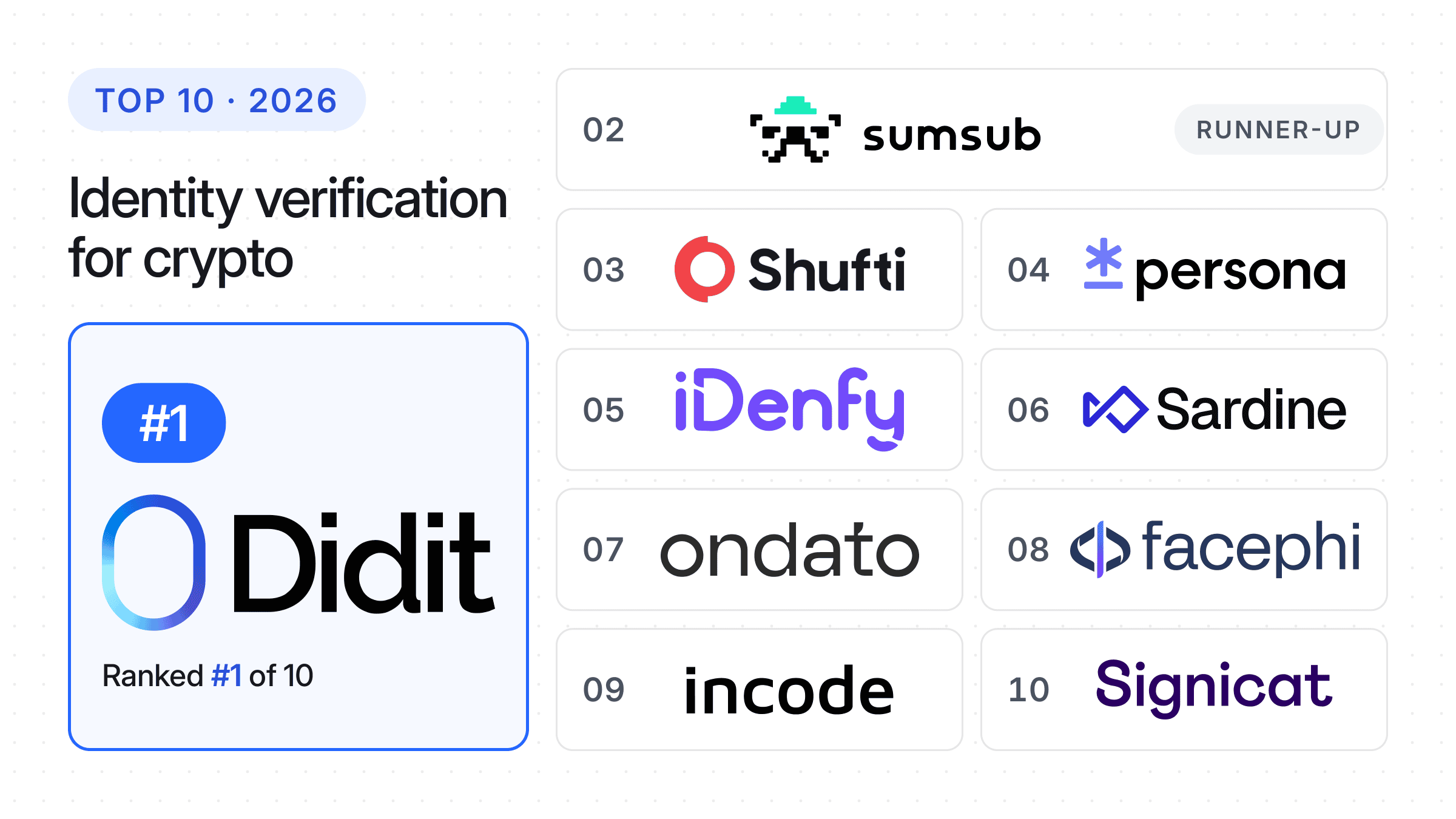
Ten identity verification platforms compared for crypto exchange compliance, evaluating KYC, KYB, wallet screening, Travel Rule, transaction monitoring, and pricing.
Alberto RosasMar 6, 2026Real-Time Identity Verification for Loan Origination
Real-time identity verification is crucial for modern loan origination, enabling financial institutions to combat fraud, ensure compliance, and streamline the customer journey.
Alberto RosasMar 6, 2026Combating AI-Generated Fake Reviews with Robust Identity Verification
AI-generated fake reviews pose a significant threat to consumer trust and brand reputation. Establishing real user identity is crucial to differentiate genuine feedback from malicious AI content.
Alberto RosasMar 6, 2026The True Cost of Identity Theft and Smart Prevention
Identity theft is a pervasive threat with staggering financial and reputational costs for businesses and individuals. Understanding the economic impact and implementing robust, AI-native identity verification solutions is.
Alberto RosasMar 6, 2026Complying with Australia's CDR for Identity Providers
Australia's Consumer Data Right (CDR) mandates strict guidelines for data sharing, presenting unique challenges for identity providers. This blog explores key compliance aspects, from consent management to data security, and.
Alberto RosasMar 6, 2026Government ID Lookup in APAC: Challenges & Solutions
Navigating government ID lookup in the diverse APAC region presents unique challenges due to varying regulations, data privacy laws, and technological infrastructures.
Alberto RosasMar 6, 2026Building a Decentralized Identity (DID) Framework for Web3
Decentralized Identity (DID) is pivotal for Web3, offering self-sovereign identity management, enhanced privacy, and user control. This post explores the core components, benefits, and challenges of DID frameworks, emphasizing.
Alberto RosasMar 6, 2026Beyond KYC: Proactive Identity Monitoring for Gaming Platforms
Gaming platforms face evolving threats from account takeovers, underage gambling, and sophisticated fraud. Moving beyond one-time KYC, proactive identity monitoring is crucial for sustained security and compliance.
Alberto RosasMar 6, 2026Navigating KYC for Online Mental Health Platforms
Online mental health platforms face unique KYC challenges, balancing patient privacy with regulatory compliance and safety. Implementing robust identity verification is crucial for preventing fraud, protecting vulnerable.
Alberto RosasMar 6, 2026Navigating Brazil's LGPD: Identity Data Retention Best Practices
Brazil's LGPD mandates strict rules for personal data, including identity verification data. Businesses must implement robust data retention policies, understand their roles as data controllers/processors, and ensure data.
Alberto RosasMar 6, 2026Optimizing Neobank Onboarding with Progressive KYC
Progressive KYC is transforming neobank onboarding by balancing user experience with robust compliance. This approach allows for staged identity verification, reducing initial friction while meeting regulatory requirements.
Alberto RosasMar 6, 2026Automated End-to-End Testing for Identity Verification APIs
Mastering automated end-to-end testing for identity verification API integrations is crucial for reliability and compliance. This guide explores strategies, tools, and best practices to ensure robust and error-free identity.
Alejandro RosasMar 6, 2026Developer's Guide to Secure WebAuthn for Passwordless Onboarding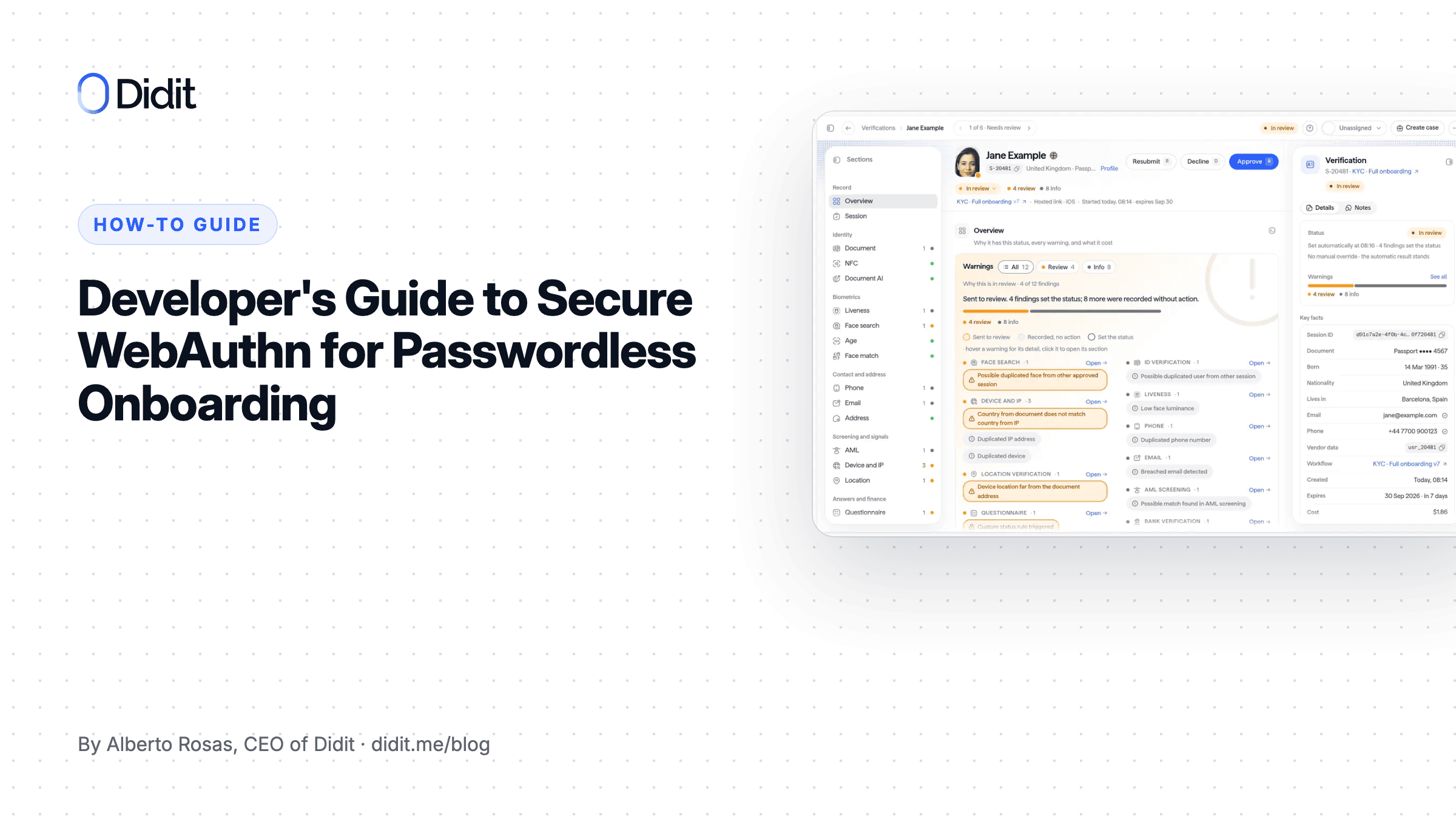
Add passkeys with Didit Authentication: enable the passkey method, register a redirect URL, sign in on the hosted page, verify the ES256 token on your server. First 50,000 monthly active users are free.
Alejandro RosasMar 6, 2026Dynamic AML Risk Scoring: Beyond Obvious Signals
Traditional AML screening often misses sophisticated financial crime. This post delves into dynamic AML risk scoring, leveraging non-obvious signals like IP analysis and device intelligence to build a more robust defense.
Alberto RosasMar 6, 2026Event-Driven Identity Verification with Kafka and Didit Webhooks
Discover how to build highly scalable and reactive identity verification systems by integrating Apache Kafka with Didit's powerful webhooks.
Alejandro RosasMar 6, 2026Build a Go Webhook Handler for Identity Verification Events (2026)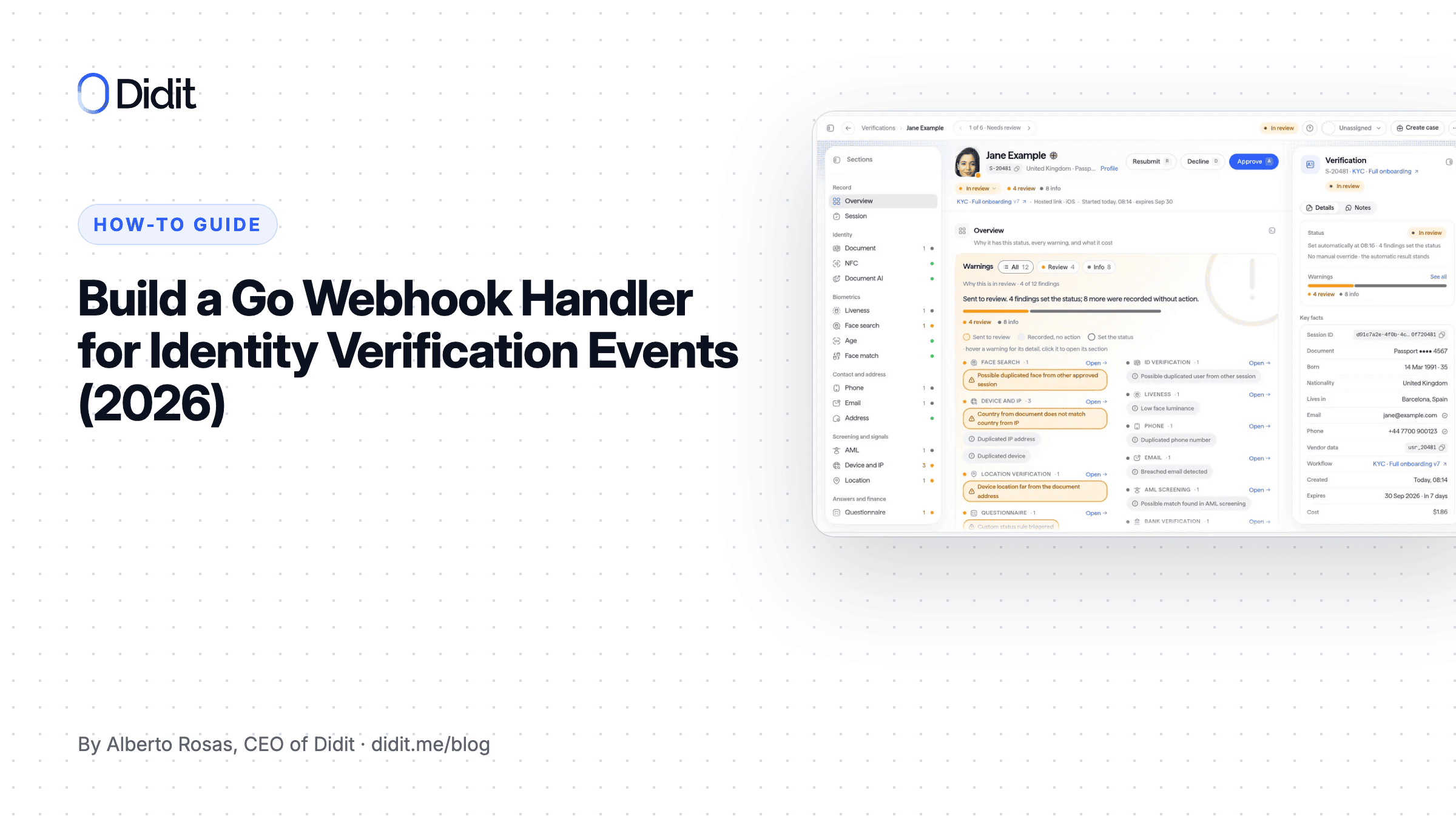
Build one Go HTTPS endpoint that verifies Didit's HMAC-SHA256 signature, checks the timestamp, branches on the exact webhook_type and status strings, and returns 200 fast. Webhooks carry no price; the checks behind them do.
Alejandro RosasMar 6, 2026Dynamic Risk Scoring with Didit Webhooks & Serverless
Implement dynamic risk scoring efficiently using Didit's webhook data and a serverless backend. This approach allows for real-time fraud detection, adaptive verification flows, and enhanced security without managing complex.
Alberto RosasMar 6, 2026Identity Orchestration Engine Buyer's Guide
Choosing the right identity orchestration engine is crucial for modern businesses navigating complex KYC, fraud prevention, and compliance landscapes.
Alberto RosasMar 6, 2026Solving Interoperability for EUDI Wallets (2026 How-To)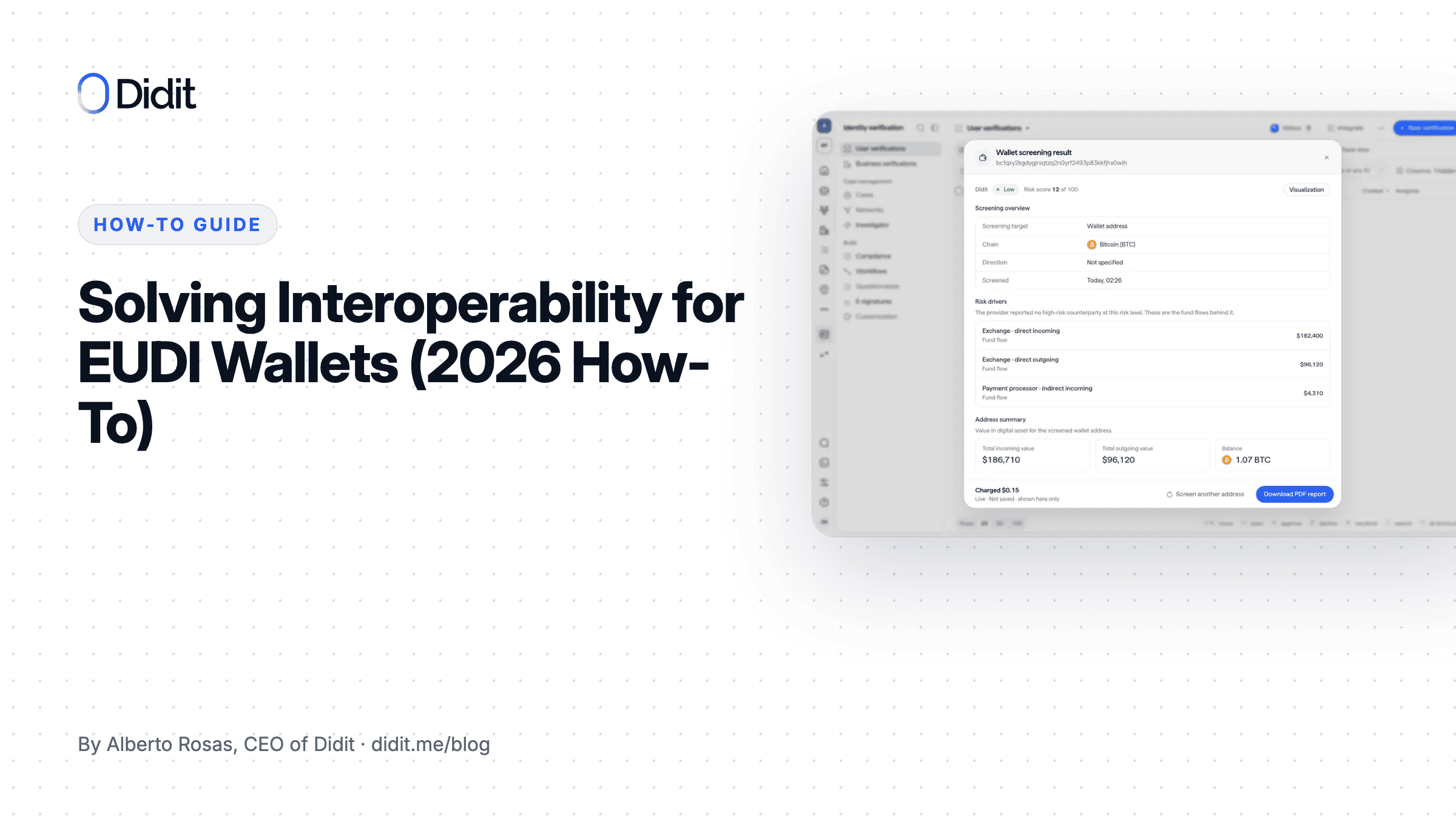
Accept EUDI Wallet credentials and today's national eIDs in one Didit ID Verification flow, with document fallback, a cryptographic assurance tier, and $0.15 per EUDI Wallet check when it launches.
Alberto RosasMar 6, 2026Questions
Blog questions
Who writes the Didit blog?
Which topics does the blog cover?
Is the blog available in my language?
Where do I find product updates?
Are these posts legal advice?
How do I find posts on one topic?
Are posts dated?
Do posts link to the docs?
Is the blog the same as the docs?
Compliance built in
Audited, certified and attested.
We hold the certifications and build each country's rules into your flows, so you can launch anywhere without worrying. Security and Compliance center
- Regulation encoded into your flows
Tell us what you do and where. Didit lists the rules that apply to you, with sources, and builds the checks each country needs into one workflow.
- Ready for AMLR
Every requirement of the new EU anti-money laundering rules, from checking customers to human review, is already covered by a Didit check.
- Tested in Spain's Treasury sandbox
Spain's Treasury published its supervised sandbox report on Didit's NFC plus active liveness onboarding; SEPBLAC took part and valued the added measures positively.
- Audited, not self-declared
iBeta Level 1 and Level 2. Liveness tested under ISO/IEC 30107-3.
Your obligations · 3 regions
 SOC 2 Type 2
 ISO 27001
 iBeta Level 1 and Level 2
 EU regulator attestation
 FSM youth protection
 GDPR
 EBA remote onboarding
 MiCA compatible
 FIDO Alliance member
- AMLREU AML Regulation ready
Integration · Didit MCP
Run Didit from your own AI agent
Connect Didit to Claude, Cursor, VS Code or ChatGPT and just ask in plain words. Your agent can do anything you can do in the console, with the same permissions you have.
 Add to Claude
 ChatGPT
 Cursor
- Build workflowsDescribe the checks you need. The agent creates and publishes the flow.
- Run investigationsAsk why a session was declined, review cases, search people and companies.
- Change rulesCreate payment rules, test them on past data and switch them on.
- Pull reportsAsk for numbers, exports or the audit log.
Didit Academy


