Blog
Blog archive
Every post on the Didit blog, newest first. Pick a category or search to find the subject you need.
All posts
Every post, newest first
Pick a category to filter.
Global sanctions screening is crucial for trade finance to prevent financial crime and maintain compliance. This blog explores the complexities of sanctions, the risks of non-compliance, and how AI-driven solutions like Didit's.
Alberto RosasMar 12, 2026Navigating Crypto Compliance: The Power of Adverse Media Screening
Adverse media screening is crucial for crypto startups to combat financial crime and maintain regulatory compliance. This involves analyzing global news for negative information about users, such as fraud, sanctions, or illicit.
Alberto RosasMar 12, 2026Building Trust: Composable Identity for Online Marketplace Reputation
Online marketplaces thrive on trust, but building a robust reputation system is complex. Leveraging composable identity primitives allows marketplaces to verify users, prevent fraud, and build dynamic, reliable reputation scores.
Alberto RosasMar 12, 2026OTP Verification for High-Volume Systems: Best Practices
Implementing One-Time Passcode (OTP) verification in high-volume transactional systems requires careful planning to balance security, user experience, and scalability.
Alberto RosasMar 12, 2026KYC/AML & Data Analytics: Powering Smarter Financial Crime Prevention
Explore how data analytics is revolutionizing KYC and AML compliance, moving beyond traditional methods to proactively detect and prevent financial crime.
Alberto RosasMar 12, 2026Secure Onboarding for Cannabis & Alcohol Delivery Services
Operating a regulated cannabis or alcohol delivery service demands robust age verification and KYC processes to ensure compliance and prevent underage access.
Alberto RosasMar 12, 2026KYC Automation for SMEs: A Practical Setup Guide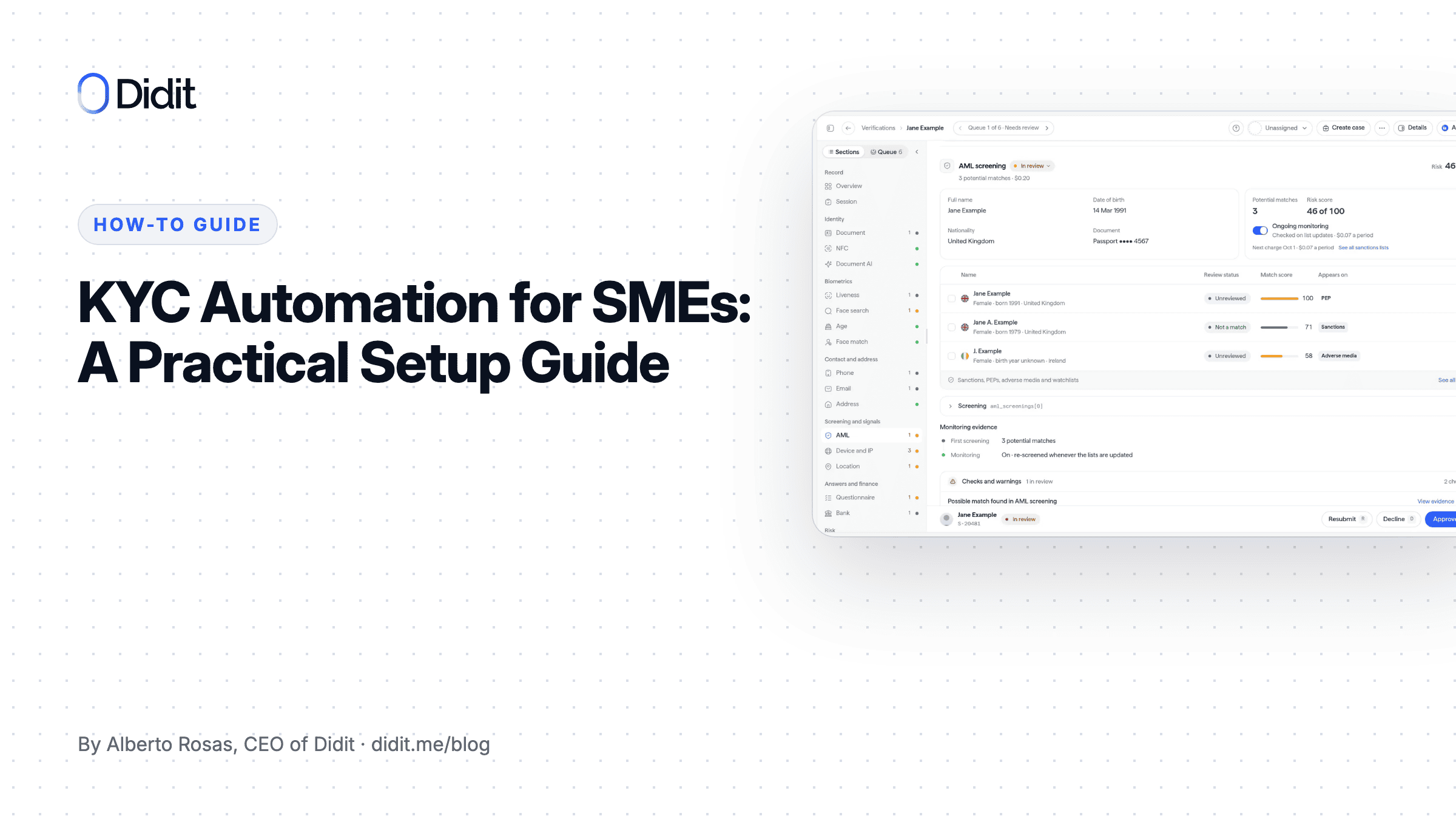
An SME automates KYC by creating a Didit workflow, opening one session per customer, reading the decision by webhook, and sending only In Review cases to a person.
Alberto RosasMar 12, 2026Optimizing Biometric Consent in APAC: A Didit Guide
Effectively managing consent for biometric data in the Asia-Pacific region is crucial for compliance and building user trust. This guide explores the complexities of APAC's diverse regulatory landscape, best practices for.
Alberto RosasMar 12, 2026AI's Crucial Role in Detecting Sanctions Evasion (2026 How-To)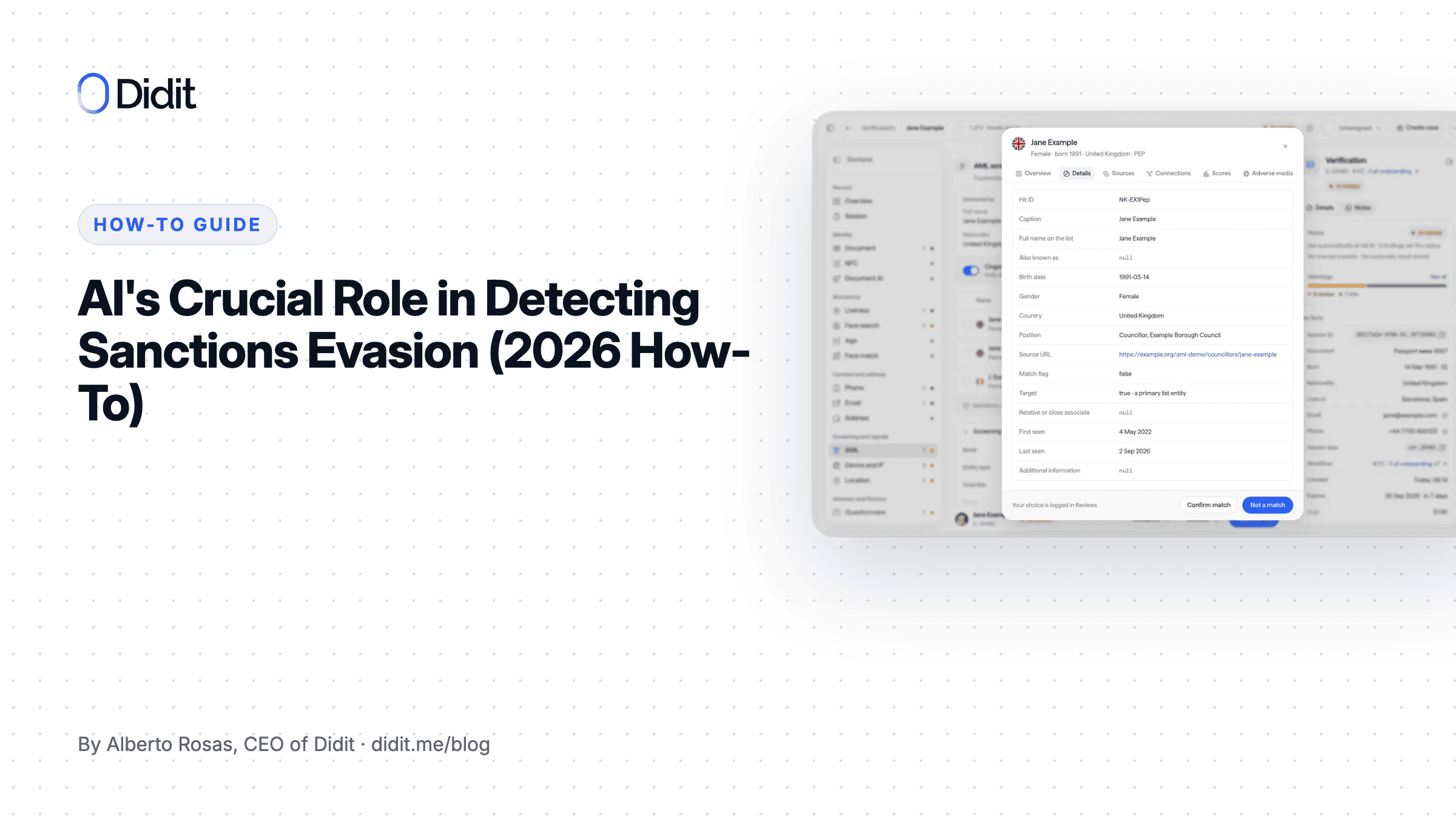
How to detect sanctions evasion with Didit: one $0.20 screening call against 1,300+ lists, a match score and a risk score, documented failure modes, then network review. A named reviewer handles hits that require manual review.
Alberto RosasMar 12, 2026DIY Identity Verification: A Costly Illusion
Building in-house identity verification can seem appealing, but it often leads to hidden costs, security vulnerabilities, and slow development.
Alberto RosasMar 12, 2026Optimizing Remote Onboarding for Regulated Industries: A Developer's Checklist
Remote onboarding in regulated industries demands robust, compliant, and user-friendly solutions. This guide provides developers with a checklist to navigate complex identity verification requirements, mitigate fraud, and ensure.
Alejandro RosasMar 12, 2026Streamline Your KYC API Testing and Mocking Workflows
Optimizing developer workflows for KYC API testing and mocking is crucial for rapid development and reliable integration. This guide explores strategies like using mock servers, API sandboxes, and Didit's developer-first tools.
Alejandro RosasMar 12, 2026Building a Modern Developer Portal for Identity Verification APIs
A robust developer portal is crucial for integrating identity verification APIs. This guide explores key components like comprehensive documentation, SDKs, and self-service tools, emphasizing how a developer-first approach.
Alejandro RosasMar 12, 2026Age Estimation 2026: Passive Biometrics vs. Document Scan
Passive biometrics fit fast age gates at $0.10 per selfie check; document scan fits regulated proof of age at $0.15 for the ID document and $0.33 for full KYC. Borderline ages need the fallback.
Alberto RosasMar 12, 2026Embedded KYC for Decentralized Autonomous Organizations (DAOs)
Decentralized Autonomous Organizations (DAOs) face a unique challenge in balancing their core values of decentralization and anonymity with the growing need for regulatory compliance, especially regarding Know Your Customer.
Alberto RosasMar 12, 2026Custom Verification Links: Beyond SMS OTP for Account Recovery
Discover how custom verification links offer a more secure and flexible approach to account recovery than traditional SMS OTPs. Learn about their benefits, implementation, and how they enhance user experience and fraud.
Alberto RosasMar 12, 2026ROI of White-Labeling Identity Verification Forms: Beyond Branding
White-labeling identity verification forms offers significant ROI beyond just branding. It builds trust, enhances user experience, improves conversion rates, and reduces operational costs.
Alberto RosasMar 12, 2026Webhooks for Dynamic Age Gating in E-commerce
Discover how webhooks can revolutionize age gating in e-commerce, offering real-time, dynamic verification. This post explores the technical implementation, compliance benefits, and how Didit's Age Estimation product ensures.
Alejandro RosasMar 12, 2026Real-time Identity Proofing for Secure Loan Servicing
Real-time identity proofing is crucial for loan servicers to mitigate fraud, ensure compliance, and enhance customer experience. By instantly verifying user identities, servicers can prevent account takeovers, streamline.
Alberto RosasMar 12, 2026The ROI of Event-Driven Fraud Prevention for Subscriptions
Event-driven fraud prevention offers significant ROI for subscription services by stopping fraud in real-time, reducing chargebacks, and improving customer experience.
Alberto RosasMar 12, 2026Dynamic Age Gating with Webhooks: A Developer's Guide
Implement robust and dynamic age verification using webhooks to ensure compliance and enhance user experience. This guide covers the technical implementation, security considerations, and how Didit's Age Estimation and webhook.
Alejandro RosasMar 12, 2026Securing Webhook Endpoints for Identity Verification
Webhook endpoints are crucial for real-time identity verification updates, but they present significant security risks. This guide explores best practices including signature verification, HTTPS, IP whitelisting, and robust.
Alejandro RosasMar 12, 2026Structured Identity Data: Fighting Synthetic Fraud in P2P Lending
Synthetic identity fraud poses a significant threat to P2P lending platforms, creating fake personas to secure loans. This article explores how structured identity data, combined with advanced verification techniques, is crucial.
Alberto RosasMar 12, 2026Biometric Consent Management: GDPR Best Practices
Navigating biometric consent under GDPR is crucial for businesses leveraging advanced identity verification. This guide outlines best practices, focusing on explicit consent, transparency, data minimization, and robust security.
Alberto RosasMar 12, 2026Orchestrating AML Screening for Global Corporations
Navigating multi-jurisdictional Anti-Money Laundering (AML) screening is a complex challenge for global corporations. This article explores strategies to centralize compliance, manage diverse regulations, and leverage advanced.
Alberto RosasMar 12, 2026Gig Worker Identity Networks: Building Cross-Platform Trust
Discover how identity networks can revolutionize the gig economy by fostering trust and streamlining operations across multiple platforms. Learn about the challenges of fragmented identity verification and the benefits of a.
Alberto RosasMar 12, 2026Seamless Identity: Custom Branding for White-Label KYC
Discover how custom branding and UI/UX integration for white-label identity verification flows can significantly enhance user trust and conversion rates.
Alberto RosasMar 12, 2026Autonomous ID Verification for Smart City Ecosystems
Smart cities require robust, autonomous identity verification to manage citizen access, ensure security, and streamline services. This post explores the challenges and solutions for implementing such systems, highlighting.
Alberto RosasMar 12, 2026Robust Fraud Operations for P2P Marketplaces
Building an effective fraud operations playbook for P2P marketplaces requires adaptive friction to balance user experience with strong security.
Alberto RosasMar 12, 2026White-Label Biometric SDKs for Secure Healthcare Apps
Discover how white-label biometric SDKs enhance security and user experience in healthcare apps. This post explores the benefits of seamless, branded identity verification, crucial for patient data protection and regulatory.
Alberto RosasMar 12, 2026Embedded KYC for B2B SaaS Onboarding: Seamless & Secure
Integrating Know Your Customer (KYC) processes directly into B2B SaaS onboarding workflows is crucial for compliance and user experience. This guide explores the benefits, challenges, and best practices for embedded KYC.
Alberto RosasMar 12, 2026The Economics of Trust: Quantifying ROI in API-First Fraud Prevention
Understanding the financial return on investment (ROI) for fraud prevention is crucial for modern businesses. This article delves into how API-first identity verification platforms, like Didit, offer measurable benefits by.
Alejandro RosasMar 12, 2026Developer's Guide to Dynamic Fallback Workflows for Age Estimation
Implement robust age verification with dynamic fallback workflows, ensuring compliance and user experience. This guide covers configurable thresholds, multi-method liveness, and automated ID verification integration.
Alejandro RosasMar 12, 2026Mastering KYC: Custom Workflows with Scriptable Hooks
Optimize your KYC processes with scriptable hooks, enabling dynamic, risk-adaptive verification. Learn best practices for integrating custom logic, enhancing fraud detection, and ensuring compliance.
Alberto RosasMar 12, 2026Building a Decentralized Reputation System for Web3 with ZK-KYC
Explore how Zero-Knowledge KYC (ZK-KYC) can be the cornerstone of robust, privacy-preserving reputation systems in Web3. Learn about the challenges of identity in decentralized environments and how ZK-KYC, combined with modular.
Alberto RosasMar 12, 2026Streamlining Property Management with Global ID Lookup APIs
Property managers face significant challenges in tenant verification, including fraud prevention and compliance. Global Government ID Lookup APIs offer a robust solution by providing real-time verification against official.
Alberto RosasMar 12, 2026Privacy-Preserving Proof of Address via Decentralized Storage
Discover how decentralized storage can revolutionize Proof of Address (PoA) verification by enhancing privacy and security. This blog explores the challenges of traditional PoA, the benefits of combining decentralized storage.
Alberto RosasMar 12, 2026Navigating Data Localization Laws for Global Identity Verification
Data localization laws are reshaping how identity verification providers operate globally, demanding careful strategies for data storage and processing.
Alberto RosasMar 12, 2026Biometric Proof of Humanity: The Web3 Sybil Attack Shield
Sybil attacks pose a significant threat to Web3's decentralized integrity, enabling bad actors to control networks and exploit protocols. Biometric Proof of Humanity offers a robust defense by verifying unique individuals.
Alberto RosasMar 12, 2026DSA's Impact on Online Identity Verification
The EU's Digital Services Act (DSA) introduces stringent requirements for online platforms, particularly concerning identity verification for transparency and safety. This necessitates robust, privacy-preserving KYC solutions.
Alberto RosasMar 12, 2026In-House vs. API-First for Government ID Lookups
Choosing between in-house development and an API-first solution for government ID lookups is a critical decision for businesses. This blog explores the complexities, costs, and benefits of each approach, highlighting how an.
Alberto RosasMar 12, 2026Optimizing Developer Experience for Global KYC Deployments
Deploying KYC solutions across multiple jurisdictions presents unique challenges for developers, from navigating diverse regulatory landscapes to integrating disparate verification methods.
Alberto RosasMar 12, 2026Optimizing Patient Onboarding in Pharmacy Services with IDV
Streamlining patient onboarding in pharmacies is crucial for efficiency, compliance, and patient satisfaction. Identity verification (IDV) solutions offer a robust way to prevent fraud, ensure regulatory adherence, and improve.
Alberto RosasMar 12, 2026ISO 30107-3: The Gold Standard for Biometric Liveness Detection
The ISO 30107-3 standard defines crucial testing and reporting methodologies for Presentation Attack Detection (PAD) in biometric systems, significantly enhancing fraud prevention.
Alejandro RosasMar 12, 2026KYC for Micro-Lending in Emerging Markets: A Comprehensive Guide
Micro-lending platforms in emerging markets face unique challenges in Know Your Customer (KYC) compliance due to limited formal identification and diverse regulatory landscapes.
Alberto RosasMar 12, 2026Age Estimation for Subscription Box Services
Subscription box services face increasing regulatory pressure to verify the age of their subscribers, especially for age-restricted products.
Alberto RosasMar 12, 2026Streamlining Cross-Border CDD with Digital Credential Wallets
Credential wallets are revolutionizing Cross-Border Customer Due Diligence (CDD) by empowering users to securely manage and share their verified identity data.
Alberto RosasMar 12, 2026Compliance-as-Code for Age Verification: Automating Regulatory Maps
Compliance-as-Code is revolutionizing age verification by embedding regulatory requirements directly into software, ensuring automated adherence to global and local laws.
Alberto RosasMar 12, 2026Optimizing Patient Onboarding in Pharmaceutical Clinical Trials
Efficient and secure patient onboarding is crucial for the success of pharmaceutical clinical trials. This blog explores key strategies to streamline the process, enhance data integrity, and ensure compliance, reducing drop-off.
Alberto RosasMar 12, 2026Device Intelligence & Age Estimation: Protecting Minors Online
Protecting minors online requires robust age verification. This post explores how device intelligence complements age estimation technologies, creating a multi-layered defense against underage access.
Alberto RosasMar 12, 2026Developer's Guide to ePassport Biometric Checks in Go
Implementing ePassport biometric checks in Go can be complex, requiring deep understanding of NFC, secure data extraction, and biometric verification.
Alejandro RosasMar 12, 2026Age Estimation: Protecting Children's Online Privacy
Age estimation technology is becoming crucial for safeguarding children's online privacy and ensuring compliance with regulations like COPPA and GDPR.
Alberto RosasMar 12, 2026Leveraging AI for Explainable AML Decisions
AI is transforming AML compliance, moving beyond black-box models to provide transparent, explainable decisions. Understanding risk scores, match scores, and the factors influencing them is crucial for effective fraud prevention.
Alberto RosasMar 12, 2026Securely Sharing KYC Data in Consortia and Ecosystems
Discover how businesses can securely and compliantly share Know Your Customer (KYC) data within consortia and partner ecosystems, eliminating repetitive verification and enhancing user experience.
Alberto RosasMar 12, 2026Orchestrating Cross-Border Notary Identity Verification
Cross-border notary services face significant challenges in verifying identities securely and compliantly across jurisdictions. This post explores the intricacies of global identity verification for notaries, the risks involved.
Alberto RosasMar 12, 2026Open Banking & KYC: The Future of Compliance
Open Banking is transforming the Know Your Customer (KYC) landscape by offering a richer, more dynamic data source for identity verification and risk assessment.
Alberto RosasMar 12, 2026Compliance-as-Code for Identity: Automating Regulatory Adherence
Compliance-as-Code (CaC) revolutionizes identity verification by embedding regulatory requirements directly into workflows, ensuring automated adherence and reducing manual overhead.
Alejandro RosasMar 12, 2026Mitigating Synthetic Identity Fraud with Advanced Link Analysis
Synthetic identity fraud is a growing threat, costing businesses billions annually. Advanced link analysis, powered by AI, is crucial for detecting the subtle connections fraudsters exploit.
Alberto RosasMar 12, 2026EBA Guidelines on Customer Due Diligence: A Practical Guide 2026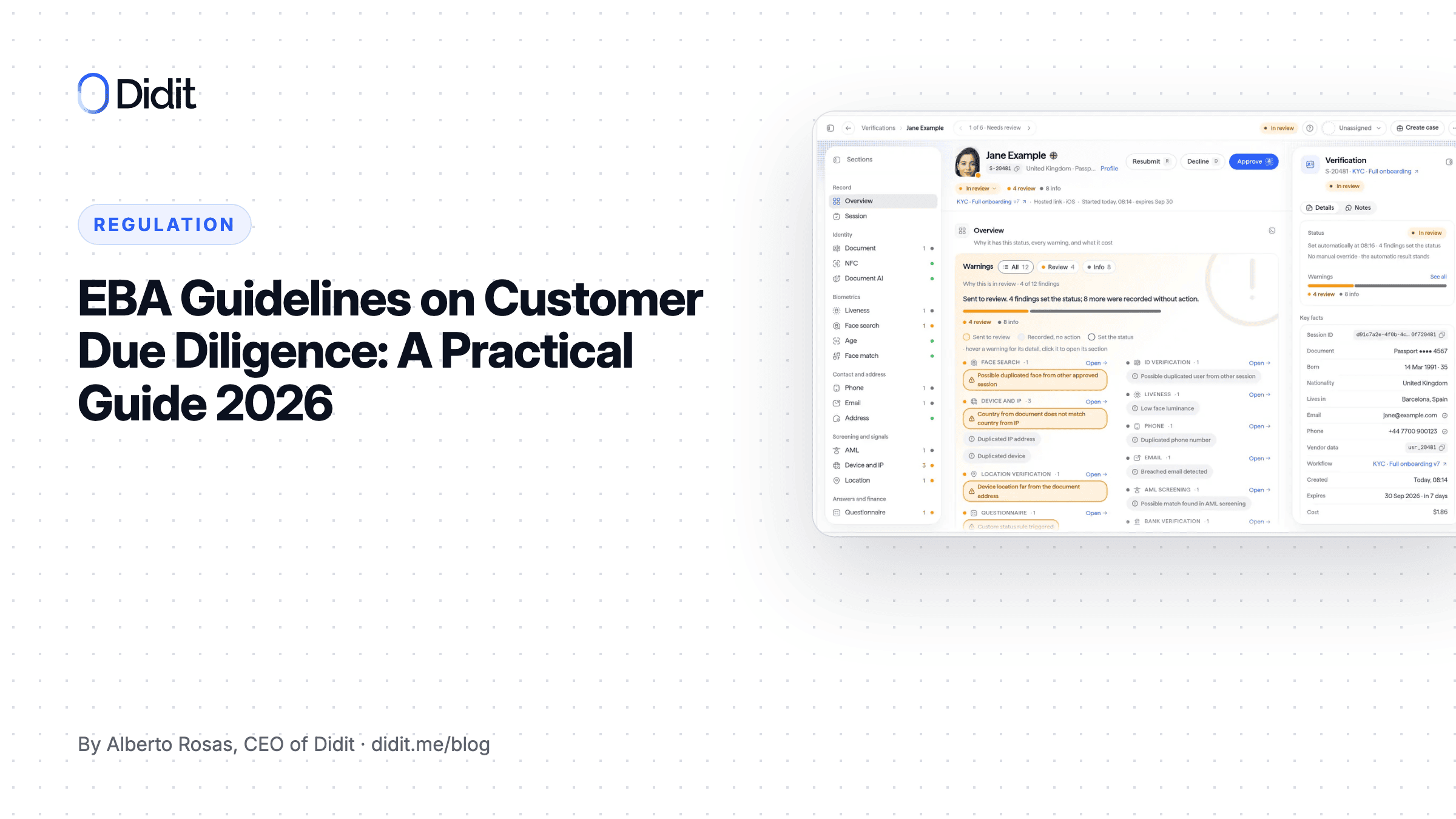
The EBA CDD guidelines (EBA/GL/2021/02) bind EU and EEA credit and financial institutions from 26 October 2021. Here are the obligations, the Didit checks that support them, a worked cost example, the open questions and an.
Alberto RosasMar 12, 2026Proof of Address vs. Utility Bill Verification (2026)
Utility bill verification is one document type inside proof of address. Proof of address accepts utility bills plus bank statements and government letters, and checks the same fields.
Alberto RosasMar 12, 2026LATAM Gaming: Mastering Country-Specific Database Validation
Expanding into the vibrant Latin American gaming market requires robust, country-specific database validation. This ensures compliance, prevents fraud, and builds trust with users.
Alberto RosasMar 12, 2026Unpacking the New EU AI Act: Implications for Digital Identity
The EU AI Act introduces a landmark regulatory framework for artificial intelligence, significantly impacting digital identity solutions. Businesses leveraging AI for identity verification must understand compliance.
Alberto RosasMar 12, 2026Real-time Verification for Contactless Payments in Retail
Contactless payments are booming, but they introduce new fraud risks. Real-time verification is crucial for securing these transactions without hindering customer experience.
Alberto RosasMar 12, 2026AMLD6 and Beneficial Ownership Verification: A Deep Dive
AMLD6 significantly tightens beneficial ownership verification, requiring robust procedures to combat financial crime. Businesses face increased scrutiny, demanding advanced identity and compliance solutions.
Alberto RosasMar 12, 2026Biometric Modalities for AI Agent Authentication: A Comparison
AI agents are becoming increasingly sophisticated, necessitating robust authentication methods to ensure secure and trustworthy interactions.
Alberto RosasMar 12, 2026The Compliance Officer's Roadmap for Automated Fraud Signal Orchestration
Compliance officers face an evolving landscape of fraud and regulations. This roadmap details how to implement automated fraud signal orchestration, leveraging advanced identity verification, continuous monitoring, and AI-driven.
Alberto RosasMar 12, 2026Best Phone Verification APIs in 2026: 3 Vendors Ranked
We rank Didit first for OTP and phone risk signals in one API. Codes cost $0.02 plus the carrier charge. Delivery channels vary by country.
Alberto RosasMar 12, 2026Data Privacy & AI Agent Identity: Navigating Compliance
Data privacy regulations are profoundly impacting how AI agents handle identity verification, demanding robust, compliant solutions. Organizations face challenges in balancing AI efficiency with user privacy, requiring secure.
Alberto RosasMar 12, 2026Navigating KYC for Online Travel Agencies (OTAs)
Online Travel Agencies (OTAs) face unique challenges in identity verification, balancing seamless user experiences with stringent regulatory compliance and fraud prevention.
Alberto RosasMar 12, 2026Zero-Trust Identity for API Gateways: A Developer's Guide
Implement robust zero-trust identity verification at your API gateway to secure modern applications. This guide covers best practices, architectural considerations, and how identity platforms like Didit provide essential tools.
Alejandro RosasMar 12, 2026Adaptive Friction: The Future of Mobile Gaming Anti-Cheat
Discover how adaptive friction, powered by advanced identity verification, is transforming mobile gaming anti-cheat systems. This approach balances security with user experience, applying varying levels of verification based on.
Alberto RosasMar 12, 2026Predictive Scoring: Securing the Gig Economy from Identity Risk
The gig economy thrives on speed, but this rapid onboarding can expose platforms to significant identity fraud. Predictive scoring, powered by AI, offers a robust solution to assess and mitigate risk in real-time, ensuring trust.
Alberto RosasMar 12, 2026Headless Identity Verification: Seamless UX for Progressive Onboarding
Discover how headless identity verification empowers businesses to craft exceptional user experiences through progressive onboarding. Learn about Didit's modular, AI-native approach to integrating KYC/AML checks, reducing.
Alberto RosasMar 12, 2026Event-Driven Fraud Prevention for Subscription Services
Traditional rule-based fraud detection struggles with the dynamic nature of subscription fraud. Event-driven fraud prevention, powered by AI and real-time data analysis, offers a superior approach to protect subscription services.
Alberto RosasMar 12, 2026The Future of Identity: Metaverse, Web3, and Verified Trust
The metaverse and Web3 promise immersive digital experiences, but they also introduce complex identity challenges. Establishing verifiable, secure, and privacy-preserving digital identities is crucial for preventing fraud.
Alberto RosasMar 12, 2026Building a Robust Fraud Operations Playbook for Mobile Gaming
Mobile gaming faces unique fraud challenges, from account takeovers to payment and bonus abuse. A robust fraud operations playbook is essential for protecting players and revenue.
Alberto RosasMar 12, 2026API Gateways: Orchestrating Adaptive Friction in Identity
API gateways are crucial for implementing adaptive friction in identity verification, allowing businesses to dynamically adjust security measures based on risk.
Alberto RosasMar 12, 2026Event-Driven Architecture for Scalable Real-time AML
Discover how an event-driven architecture can transform Anti-Money Laundering (AML) processes, enabling real-time detection and scalable compliance.
Alejandro RosasMar 12, 2026Silent Network Authentication for Frictionless Onboarding
Silent Network Authentication (SNA) offers a seamless, secure way to verify users during digital onboarding, minimizing friction and boosting conversion.
Alberto RosasMar 12, 2026Dynamic Fallback Workflows for Mobile Liveness Detection
Building robust biometric liveness detection into mobile apps is crucial for fraud prevention. A dynamic fallback workflow ensures high user pass rates while maintaining security, adapting to various scenarios like poor lighting.
Alberto RosasMar 12, 2026Automate SMS OTPs With Programmable Identity Verification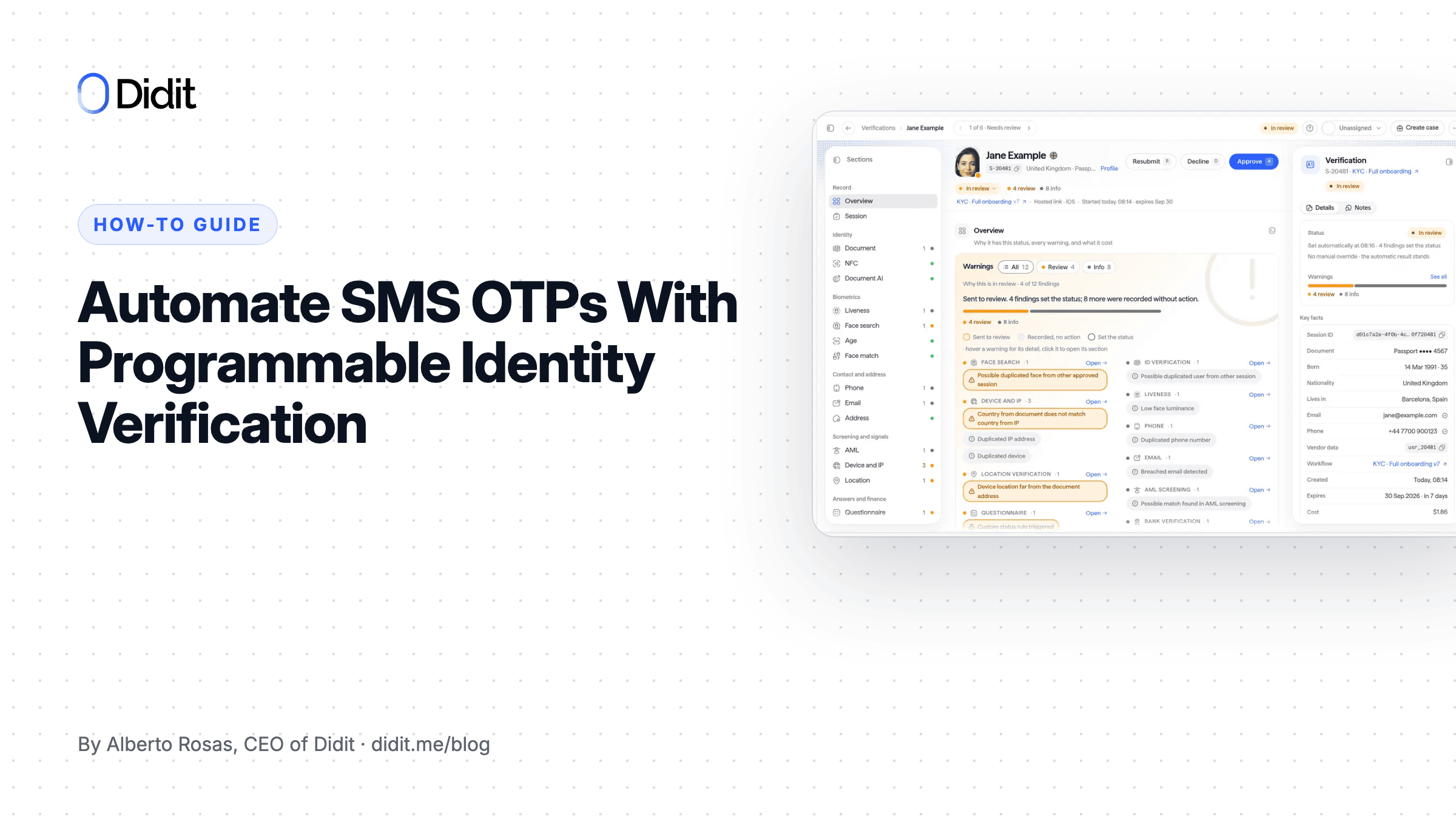
Didit automates SMS OTPs with two endpoints: send a code by SMS, WhatsApp, Telegram or voice, then check it and get carrier, disposable and VoIP risk signals.
Alberto RosasMar 12, 2026Beyond HMAC: Advanced Webhook Security Best Practices for 8 Identity Vendors
A valid HMAC authenticates signed data from a shared-key holder. Check freshness, handle repeated events, rotate secrets and monitor delivery. We show how Didit documents each control.
Alejandro RosasMar 12, 2026Digital Identity & ERP: Streamlining Operations with Didit
Integrating digital identity solutions with Enterprise Resource Planning (ERP) systems is crucial for modern businesses to enhance security, compliance, and operational efficiency.
Alberto RosasMar 12, 2026ePassports & Digital Identity: Securing Cross-Border Commerce
ePassports are revolutionizing cross-border commerce by enhancing security and streamlining identity verification. Integrating their advanced cryptographic features with digital identity solutions offers robust fraud prevention.
Alberto RosasMar 12, 2026How to Build a Decentralized KYC Oracle for DeFi with Didit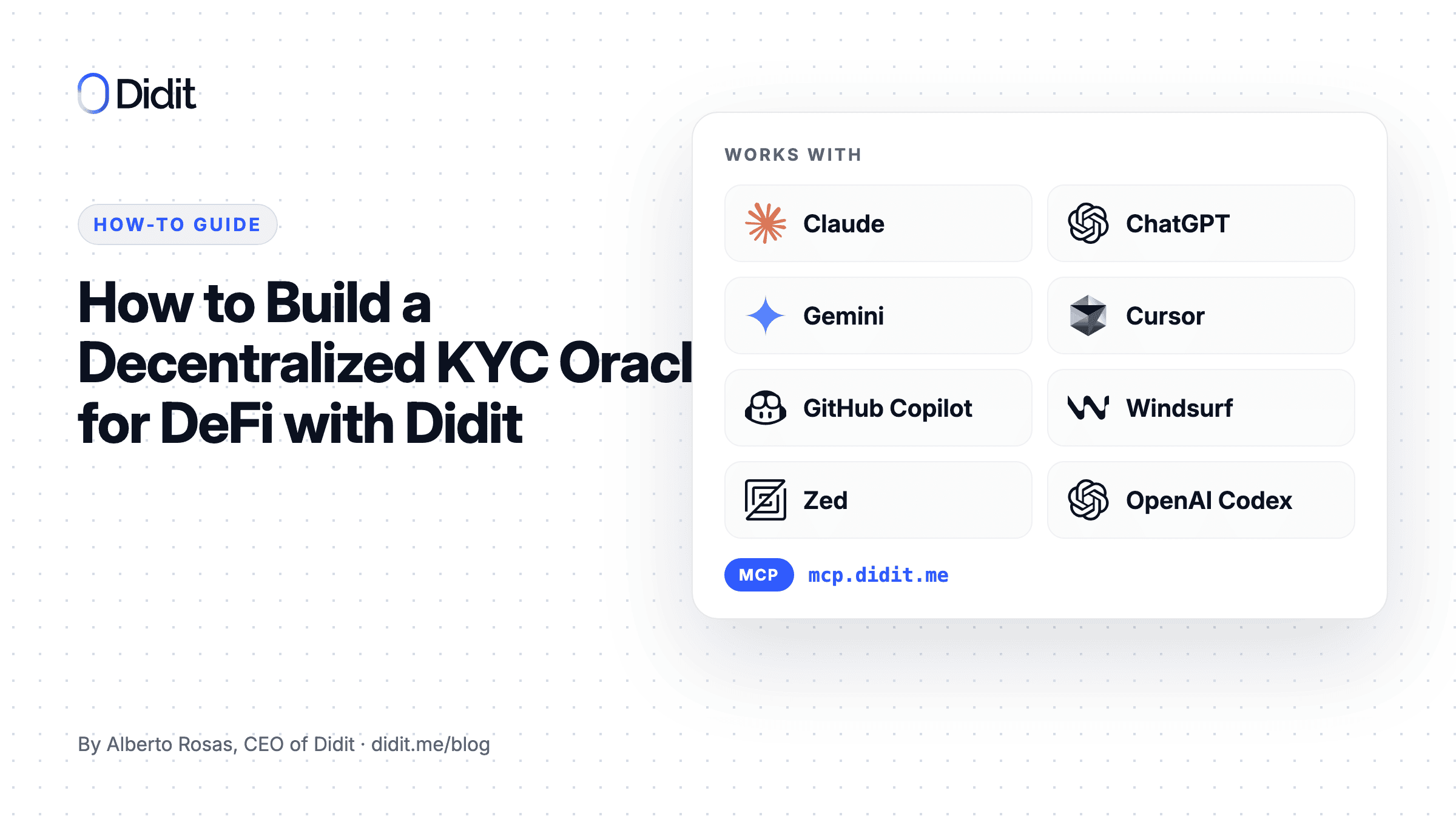
Verify the user off-chain with Didit, screen the wallet for sanctions and watchlists, and publish a reusable attestation. Full KYC costs $0.33, AML screening $0.20, wallet screening $0.15.
Alberto RosasMar 12, 2026Integrating Programmatic Identity into ERP Systems for Security and Efficiency
Integrating programmatic identity verification into ERP systems is crucial for modern businesses, enhancing security, streamlining operations, and ensuring compliance.
Alberto RosasMar 12, 2026Overcoming Interoperability in Blockchain Travel Rule Solutions
The FATF Travel Rule for virtual assets presents significant challenges, particularly regarding interoperability across diverse blockchain platforms and VASPs.
Alberto RosasMar 12, 2026Navigating European KYC: BaFin (Germany) vs. ACPR (France)
Understanding the nuances of Know Your Customer (KYC) regulations across Europe is crucial for businesses. Germany's BaFin and France's ACPR represent distinct approaches to identity verification, influencing how financial and.
Alberto RosasMar 12, 2026Travel Rule Compliance for FinTechs: A Step-by-Step Guide
Navigating Travel Rule compliance is crucial for FinTechs dealing with virtual assets. This guide offers a step-by-step approach to understanding and implementing the necessary protocols, ensuring regulatory adherence and.
Alberto RosasMar 12, 2026Navigating Travel Rule Compliance for NFTs and Digital Collectibles
The Travel Rule is extending its reach to NFTs and digital collectibles, posing new compliance challenges for Virtual Asset Service Providers (VASPs).
Alberto RosasMar 12, 2026Programmatic KYC for Travel Rule Compliance in VASPs
Meeting Travel Rule compliance as a Virtual Asset Service Provider (VASP) requires robust, programmatic Know Your Customer (KYC) processes. This post explores leveraging automated identity verification, AML screening, and secure.
Alberto RosasMar 12, 2026Real-time Fraud Detection in Gaming: A Comprehensive Guide
Gaming platforms face escalating fraud threats, from account takeovers to bonus abuse. Real-time signal detection is crucial for mitigating these risks, protecting revenue, and ensuring fair play.
Alberto RosasMar 12, 2026The Economics of Identity Fraud: Quantifying Hidden Costs
Identity fraud is a growing global menace, costing businesses and consumers billions annually. Beyond direct financial losses, it erodes trust, damages reputations, and inflates operational expenses.
Alberto RosasMar 12, 2026Privacy-Preserving Government ID Lookup for Regulated Industries
Regulated industries face a complex challenge: verifying identities against government databases while upholding stringent privacy standards like GDPR.
Alberto RosasMar 12, 2026Optimizing Trust & Safety for the AI Creator Economy
The AI creator economy presents unique trust and safety challenges, from deepfake fraud to content authenticity. Robust identity verification, liveness detection, and continuous monitoring are crucial to protect platforms and.
Alberto RosasMar 12, 2026Securing DeFi Protocols: Web3 KYC and AML Best Practices
Decentralized Finance (DeFi) protocols face increasing regulatory scrutiny, making robust Know Your Customer (KYC) and Anti-Money Laundering (AML) solutions critical.
Alberto RosasMar 12, 2026Email Verification Strategies to Combat Bot Traffic and Spam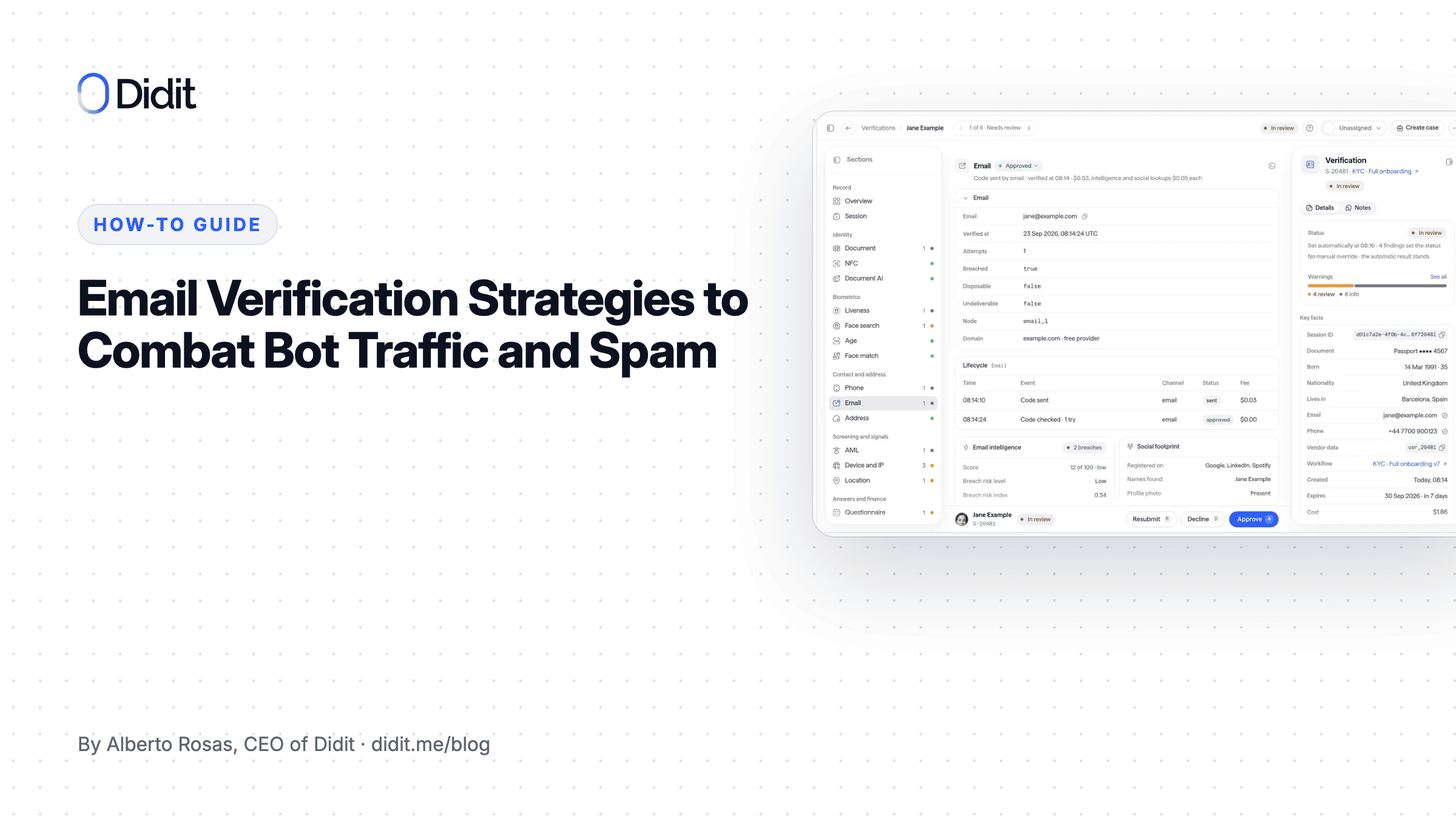
Run a 6-digit OTP email check, read the breach, disposable and deliverability flags in the response, and block high-risk sign-ups before an account exists. Didit charges $0.02 per email verification check.
Alberto RosasMar 12, 2026The Hidden Costs of DIY Database Validation vs. API Solutions
Building and maintaining an in-house database validation system can seem cost-effective initially, but it often leads to significant hidden expenses, compliance risks, and operational inefficiencies.
Alejandro RosasMar 12, 2026Optimize KYC Costs: The Power of Pay-Per-Success APIs
Discover how pay-per-success KYC APIs revolutionize identity verification, slashing costs and boosting efficiency. This model ensures you only pay for successful verifications, aligning vendor incentives with your business goals.
Alejandro RosasMar 12, 2026Neobank Onboarding: Beyond Document Uploads
Neobanks face unique challenges in onboarding, extending beyond simple document uploads. This article explores common friction points in the neobank onboarding journey, including identity verification, liveness checks, and.
Alberto RosasMar 12, 2026Questions
Blog questions
Who writes the Didit blog?
Which topics does the blog cover?
Is the blog available in my language?
Where do I find product updates?
Are these posts legal advice?
How do I find posts on one topic?
Are posts dated?
Do posts link to the docs?
Is the blog the same as the docs?
Compliance built in
Audited, certified and attested.
We hold the certifications and build each country's rules into your flows, so you can launch anywhere without worrying. Security and Compliance center
- Regulation encoded into your flows
Tell us what you do and where. Didit lists the rules that apply to you, with sources, and builds the checks each country needs into one workflow.
- Ready for AMLR
Every requirement of the new EU anti-money laundering rules, from checking customers to human review, is already covered by a Didit check.
- Tested in Spain's Treasury sandbox
Spain's Treasury published its supervised sandbox report on Didit's NFC plus active liveness onboarding; SEPBLAC took part and valued the added measures positively.
- Audited, not self-declared
iBeta Level 1 and Level 2. Liveness tested under ISO/IEC 30107-3.
Your obligations · 3 regions
 SOC 2 Type 2
 ISO 27001
 iBeta Level 1 and Level 2
 EU regulator attestation
 FSM youth protection
 GDPR
 EBA remote onboarding
 MiCA compatible
 FIDO Alliance member
- AMLREU AML Regulation ready
Integration · Didit MCP
Run Didit from your own AI agent
Connect Didit to Claude, Cursor, VS Code or ChatGPT and just ask in plain words. Your agent can do anything you can do in the console, with the same permissions you have.
 Add to Claude
 ChatGPT
 Cursor
- Build workflowsDescribe the checks you need. The agent creates and publishes the flow.
- Run investigationsAsk why a session was declined, review cases, search people and companies.
- Change rulesCreate payment rules, test them on past data and switch them on.
- Pull reportsAsk for numbers, exports or the audit log.
Didit Academy


