Blog
Blog archive
Every post on the Didit blog, newest first. Pick a category or search to find the subject you need.
All posts
Every post, newest first
Pick a category to filter.
Moving beyond viewing Anti-Money Laundering (AML) as a mere cost center, this article explores how an API-first approach to AML can deliver significant return on investment (ROI).
Alejandro RosasMar 12, 2026Enterprise Identity Verification RFP Checklist (2026)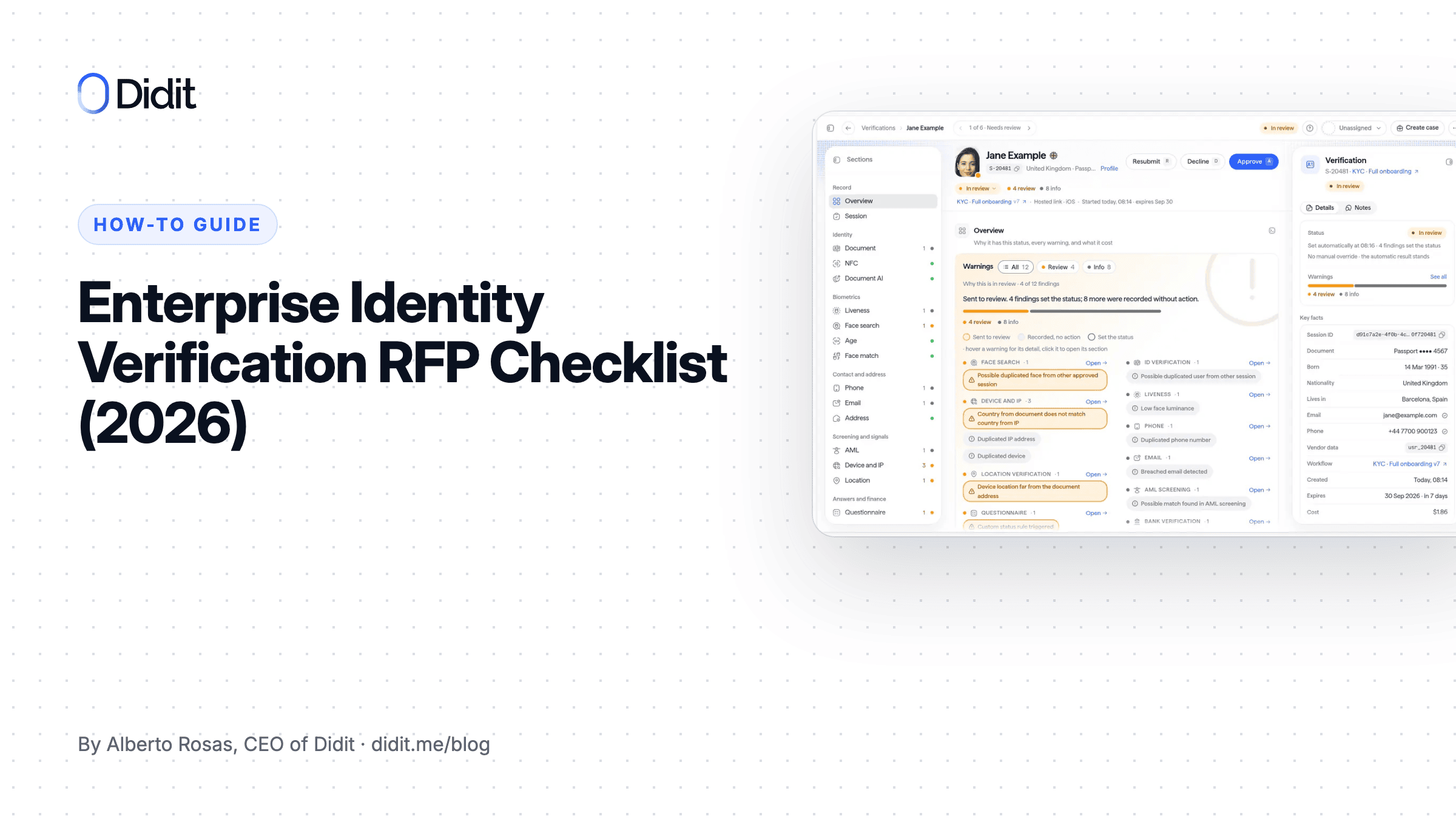
Run an identity verification RFP in eight evidence-first steps: ask for artifacts, run a sandbox pilot with your own documents, build a unit-price cost model, and set review boundaries before signature.
Alberto RosasMar 12, 2026Streamlining AML: Automated Manual Review for Complex Cases
Discover how to optimize your Anti-Money Laundering (AML) compliance by implementing an automated manual review workflow. This approach ensures efficiency, reduces human error, and focuses expert resources on the most complex.
Alberto RosasMar 12, 2026Proactive vs. Reactive AML: Choosing the Right Strategy
Understanding the differences between proactive and reactive Anti-Money Laundering (AML) strategies is crucial for financial institutions. This blog explores both approaches, highlighting their benefits, drawbacks, and how a.
Alejandro RosasMar 12, 2026Scalable Age-Gating Microservices with Docker & Kubernetes
Implement robust and scalable age-gating microservices using Docker and Kubernetes. This blog explores architectural patterns, containerization, orchestration, and how Didit's AI-native Age Estimation streamlines compliance and.
Alberto RosasMar 12, 2026Real-Time Sanctions Screening with Programmable Logic
Discover how real-time sanctions screening, powered by programmable logic and serverless functions, can revolutionize compliance. Learn about the two-score system for risk assessment and how AI-native solutions like Didit offer.
Alberto RosasMar 12, 2026Optimizing AML/PEP Screening with Dynamic Risk Profiles
Discover how dynamic risk profiling transforms AML/PEP screening, moving beyond static checks to intelligent, adaptive systems. Learn about the critical role of customizable thresholds, real-time data, and AI-native platforms in.
Alberto RosasMar 12, 2026Automating Global Watchlist Mapping for Multi-Jurisdictional Sanctions
Navigating multi-jurisdictional sanctions and global watchlist mapping presents significant challenges for businesses. This post explores these complexities, from data inconsistency to real-time screening needs, and offers.
Alberto RosasMar 12, 2026Proof of Address: Utility Bill OCR for Global Markets
Discover how advanced OCR technology, particularly for utility bills, is revolutionizing Proof of Address (PoA) verification in global markets.
Alejandro RosasMar 12, 2026Combating AI Hallucinations in Automated KYC
AI hallucinations in KYC document analysis can lead to severe compliance breaches and fraud. This post explores how advanced AI, robust data validation, and continuous monitoring are crucial to prevent these errors and ensure.
Alberto RosasMar 12, 2026Real-time PEP Screening: A Must for SMB Compliance
Small-to-medium businesses (SMBs) often underestimate the critical need for Politically Exposed Persons (PEP) screening. This blog explores why real-time PEP screening is essential for regulatory compliance, mitigating financial.
Alberto RosasMar 12, 2026AI Governance for Explainable Biometric KYC Decisions
AI governance frameworks are crucial for ensuring transparency and accountability in biometric KYC, especially in high-risk scenarios. Explainable AI (XAI) helps demystify complex biometric decisions, allowing for clear.
Alberto RosasMar 12, 2026Cross-Border Regulatory Sandboxes: Fueling Fintech Innovation
Cross-border regulatory sandboxes are vital for fintech innovation, offering a controlled environment for testing new solutions across jurisdictions.
Alberto RosasMar 12, 2026NIS2 Directive's Impact on SBOMs for Digital Identity Providers
The NIS2 Directive significantly elevates cybersecurity requirements for digital identity providers, making Software Bills of Materials (SBOMs) crucial for supply chain transparency and risk management.
Alberto RosasMar 12, 2026Global Watchlist Mapping: Harmonizing Sanctions and PEP Data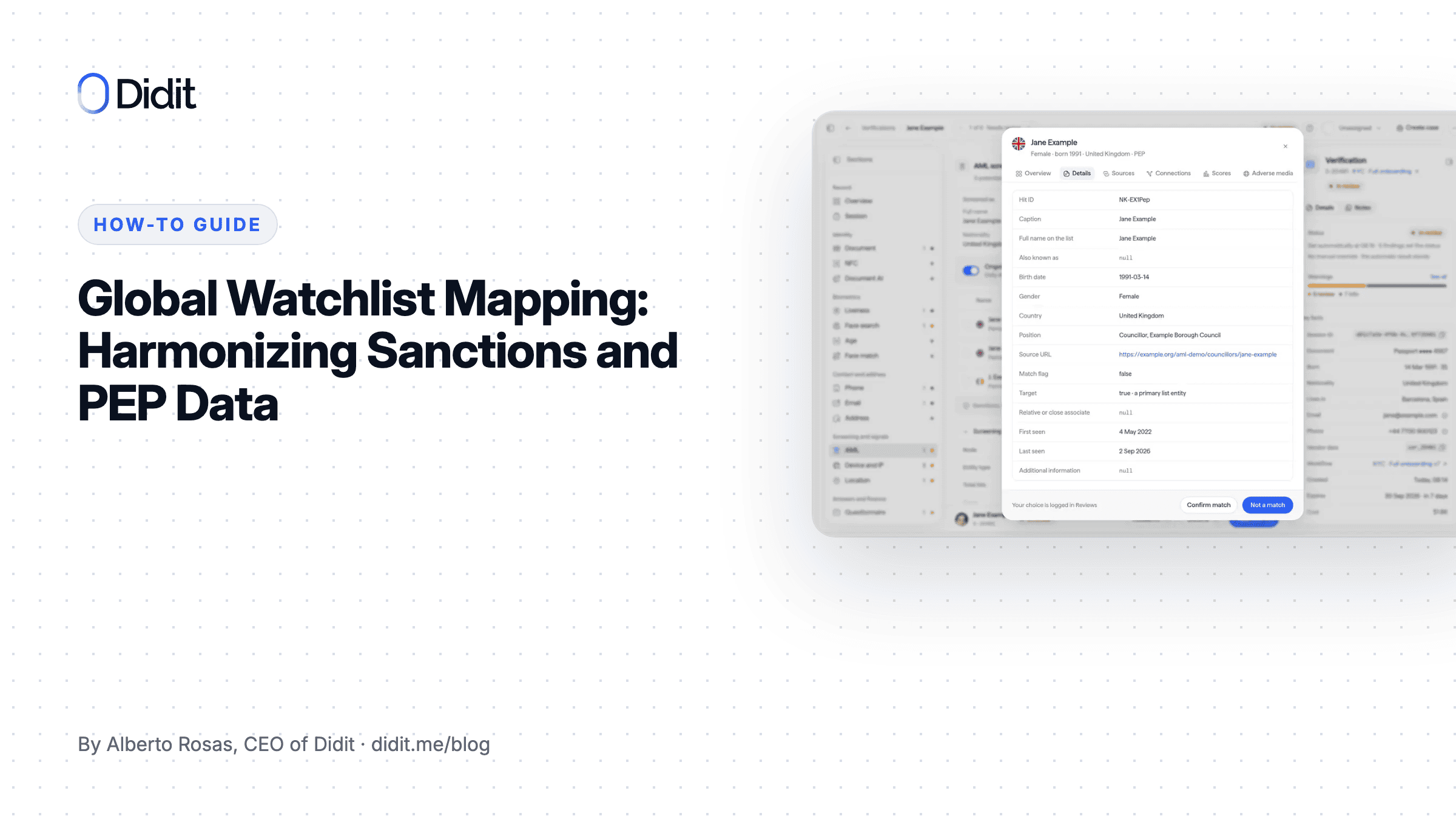
Screen once against 1,300+ sanctions, PEP and watchlist sources at $0.20 per check, then let a match score and a risk score decide what is approved, reviewed or declined.
Alberto RosasMar 12, 2026Ethical AI Training Data: The Foundation of Fair Biometrics
Ethical sourcing and vetting of AI training data are paramount for developing unbiased and fair biometric systems. This involves rigorous data governance, diversity in datasets, and transparent consent mechanisms to prevent.
Alberto RosasMar 12, 2026GDPR Article 5: Storage Limitation and Integrity in KYC Data
Mastering GDPR Article 5 principles, specifically storage limitation and integrity, is crucial for compliant KYC data handling. This guide explores strategies for secure data management, minimizing retention, and ensuring.
Alberto RosasMar 12, 2026DSA Age Gating: Best Practices for Digital Platforms
Navigating the Digital Services Act (DSA) requires robust age gating strategies to protect minors online. This article explores best practices for implementing effective age verification, balancing compliance with user.
Alberto RosasMar 12, 2026Real-time Identity Validation for Government Benefits Programs
Real-time identity validation is crucial for government benefits programs to prevent fraud, ensure compliance, and deliver services efficiently.
Alberto RosasMar 12, 2026Automating Trust & Safety with Real-Time Identity Signals
Discover how real-time identity signals are revolutionizing trust and safety operations. This post explores the challenges of manual processes, the power of automation, and how AI-native platforms like Didit provide immediate.
Alberto RosasMar 12, 2026Cross-Border AML for Online Gaming: Navigating Global Sanctions
Online gaming platforms face complex challenges in adhering to Anti-Money Laundering (AML) regulations, especially when operating across borders.
Alberto RosasMar 12, 2026Developer's Guide to Integrating Bank Statement Validation APIs
Integrating a Bank Statement Validation API is crucial for robust financial identity verification and fraud prevention. This guide offers developers practical insights into API selection, data extraction, and secure.
Alejandro RosasMar 12, 2026Leveraging Bank Statement Validation for Enhanced Loan Underwriting
Discover how advanced bank statement validation transforms loan underwriting, offering deeper insights into financial stability and reducing risk.
Alberto RosasMar 12, 20269 Best Identity Webhook Providers for Microservices 2026
Didit is the best fit for webhook-driven identity checks in microservices: HMAC-SHA256 signing, per-destination delivery health and full KYC at $0.33 per check. Start in the free sandbox.
Alejandro RosasMar 12, 2026Optimizing Webhook Latency for Real-time AML in HFT
Achieving real-time Anti-Money Laundering (AML) in high-frequency trading (HFT) environments demands ultra-low webhook latency. This article explores strategies to minimize delays, from network optimization to efficient data.
Alejandro RosasMar 12, 2026Dynamic Fallbacks for Utility Bill OCR in Challenging Markets
Implementing robust identity verification in challenging markets requires dynamic fallbacks for utility bill OCR. This guide explores strategies for handling diverse document types, varying quality, and regulatory nuances.
Alejandro RosasMar 12, 2026Architecting Resilient KYC with Apache Kafka and Didit
Building a robust Know Your Customer (KYC) pipeline is crucial for compliance and fraud prevention. This post explores leveraging Apache Kafka's event-driven architecture to create a scalable, resilient KYC system, integrating.
Alberto RosasMar 12, 2026Embedded SDK vs. WebView vs. Verification Links: Didit vs Persona
Native SDK for NFC and camera control, WebView only as a fallback, links for speed. Didit charges $0.33 per full KYC check and publishes list prices for its modules; Persona publishes a $250/month floor.
Alejandro RosasMar 12, 2026Advanced Fraud Detection: Graph Neural Networks in Identity
Discover how Graph Neural Networks (GNNs) are revolutionizing fraud detection by identifying complex, hidden connections within identity data.
Alberto RosasMar 12, 2026Cloud-Native Identity Platforms: Balancing Cost and Performance
Choosing the right cloud-native identity platform means weighing cost against performance and scalability. This guide explores the trade-offs, highlights common pitfalls, and showcases how AI-native solutions like Didit offer.
Alberto RosasMar 12, 2026Ethical AI in Biometrics: Proactive Fairness & Trust
Ethical AI in biometrics extends beyond mere bias detection, demanding a proactive approach to fairness, transparency, and accountability. This involves designing systems that inherently minimize bias, ensuring diverse training.
Alberto RosasMar 12, 2026Identity Verification: Your Shield Against AI Model Poisoning
AI model poisoning attacks pose a significant threat to the integrity and reliability of AI systems by injecting malicious data during training.
Alejandro RosasMar 12, 2026DID for Digital Art Provenance: Securing NFTs
Digital Identity (DID) offers a robust solution for ensuring the provenance and authenticity of digital art within the burgeoning NFT market.
Alberto RosasMar 12, 2026EHDS & Decentralized Identity: Secure Patient Data Exchange
The European Health Data Space (EHDS) aims to revolutionize patient data exchange, but secure and private identity verification is paramount.
Alberto RosasMar 12, 2026Verifiable Credentials for Carbon Credits: Ensuring Trust
A carbon credit credential is only as good as the identity behind it. Verify the issuer with KYB and owner KYC, cite that session in the credential, and let buyers reuse it with a share token without reading the source session.
Alberto RosasMar 12, 2026Gig Worker Identity: Portable Work Histories With Reusable KYC
Reusable KYC lets one Didit application share a finished gig worker verification with another by token, so the worker verifies once. The share and import calls are free on every plan.
Alberto RosasMar 12, 2026PETs & Sustainable Decentralized Identity: A Powerful Duo
Privacy-Enhancing Technologies (PETs) are crucial for the sustainable growth of decentralized identity, balancing user control with necessary verification. They enable robust privacy, minimize data exposure, and combat fraud.
Alberto RosasMar 12, 2026Choosing the Best Identity Orchestration Platform for DevOps
Selecting the right identity orchestration platform is crucial for enterprise DevOps, impacting efficiency, security, and scalability. This guide compares key features, focusing on developer-friendliness, modularity, and.
Alberto RosasMar 12, 2026How AlloVoisins Verifies 4.5M Users With Didit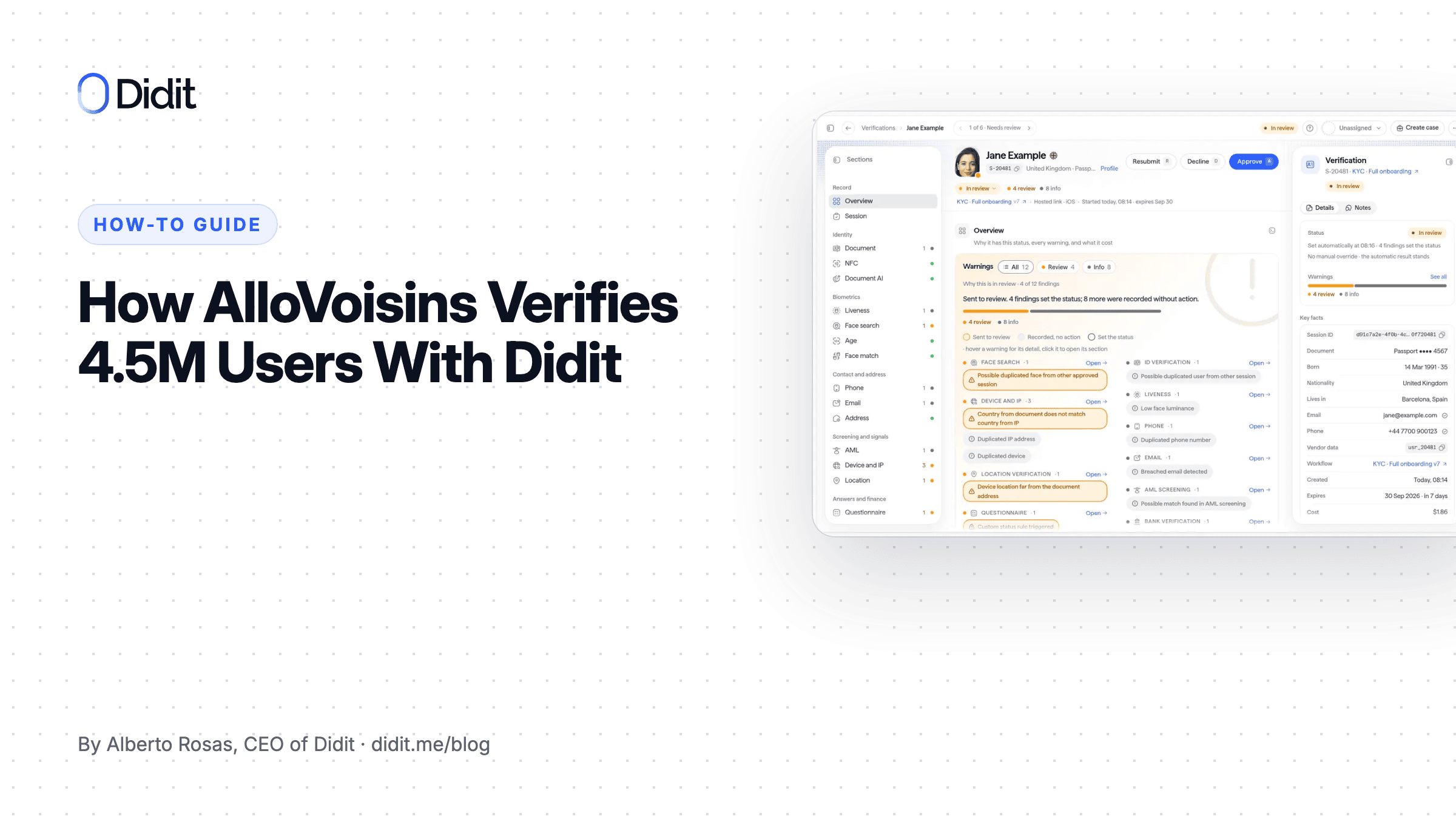
AlloVoisins verifies its 4.5 million users with Didit full ID checks at $0.33 per completed check: ID document, passive liveness, face match and device and IP analysis, in French, with the decision delivered on webhooks.
Alberto RosasMar 12, 2026Real-time Verification Analytics: Spotting Onboarding Friction
Real-time verification analytics are crucial for identifying and resolving onboarding friction points. By monitoring key metrics like conversion rates and geographic distribution, businesses can optimize user journeys, reduce.
Alberto RosasMar 12, 2026The ROI of Low-Cost Core KYC: A Deep Dive into TCO Analysis
Explore the true Total Cost of Ownership (TCO) for Know Your Customer (KYC) solutions, and uncover the significant ROI offered by pay-per-use pricing.
Alberto RosasMar 12, 2026Real-Time Verification Analytics for Enhanced Fraud Prevention
Discover how real-time verification analytics are crucial for combating fraud, improving conversion rates, and optimizing identity verification workflows.
Alberto RosasMar 12, 2026Behavioral Biometrics: A New Frontier in Fraud Detection
Behavioral biometrics analyzes unique user interactions like typing patterns and mouse movements to detect fraud. This passive, continuous verification method adds a crucial layer of security, identifying anomalies that signal.
Alberto RosasMar 12, 2026Proof of Address: Geo-Fencing vs. Document Validation
Understanding the nuances between geo-fencing and document validation for Proof of Address (PoA) is crucial for robust identity verification strategies.
Alberto RosasMar 12, 2026Boost Underwriting Speed with Real-Time Phone and Email Verification
Insurtech companies can significantly enhance underwriting speed and accuracy by implementing real-time phone and email verification. This crucial step helps prevent fraud, improves data quality, and streamlines the customer.
Alberto RosasMar 12, 2026Leveraging Phone Number Intel for Zero-Trust Access Control
Discover how phone number intelligence strengthens zero-trust access, verifying user identities beyond simple OTPs. Learn about carrier data, disposable number detection, and VoIP identification for enhanced security.
Alberto RosasMar 12, 2026GDPR-Compliant Phone & Email Verification: A Guide
Ensuring phone and email verification processes comply with GDPR is crucial for data privacy. This guide explores key principles like consent, data minimization, and security, offering practical advice to build trust and avoid.
Alberto RosasMar 12, 2026Minor Protection in Online Gaming: Beyond Age Gating
Protecting minors in online gaming requires more than simple age gating. Advanced identity verification, including AI-powered age estimation and liveness detection, is crucial for fostering safer digital environments.
Alberto RosasMar 12, 2026Email Verification: Beyond Basic Syntax Checks
Effective email verification goes beyond simple syntax checks. Businesses must assess deliverability, detect disposable addresses, and identify breach exposure to enhance security, reduce fraud, and improve user experience.
Alberto RosasMar 12, 2026Streamline KYC: Automated Utility Bill Verification
Discover how automated utility bill verification transforms KYC processes, enhancing accuracy, reducing fraud, and improving customer onboarding.
Alberto RosasMar 12, 2026The Economics of Digital Identity: Beyond Fraud Prevention
Digital identity offers far more than just fraud prevention; it's a strategic asset for businesses. By improving customer experience, enhancing compliance, and driving operational efficiency, robust identity solutions can unlock.
Alberto RosasMar 12, 2026Combating Synthetic Identity Fraud with Phone and Email Data
Synthetic identity fraud is a growing threat, costing businesses billions annually. This article explores how leveraging cross-referenced phone and email data, combined with advanced identity verification techniques, can.
Alberto RosasMar 12, 2026Digital Identity in Smart Homes & IoT: A New Era of Trust
The proliferation of smart homes and IoT devices demands robust digital identity solutions to ensure security, privacy, and seamless user experiences.
Alberto RosasMar 12, 2026Orchestrating Fraud Signals with GraphQL Subscriptions
Effectively combating fraud requires real-time data orchestration. GraphQL Subscriptions offer a powerful, efficient way to manage complex fraud signals, providing instant updates and reducing latency.
Alberto RosasMar 12, 2026Data Minimization in KYC: A Post-Quantum Cryptography Era
Explore secure data minimization strategies for Know Your Customer (KYC) processes, especially in the looming post-quantum cryptography era.
Alberto RosasMar 12, 2026Integrating National ID Schemes with Legacy ERPs: A Developer's Perspective
Integrating national ID schemes into legacy ERP systems presents unique challenges, from data format inconsistencies to security and compliance hurdles.
Alejandro RosasMar 12, 2026AI Ethics in Passive Liveness Benchmarking for IDV
Benchmarking passive liveness detection is crucial for robust identity verification, but it demands a strong ethical framework. This blog explores key ethical considerations, from bias mitigation and data privacy to transparency.
Alberto RosasMar 12, 2026Bridging Borders: Identity Data Harmonization in Cross-Border Mergers
Cross-border mergers present unique challenges in identity data harmonization, requiring robust strategies to integrate disparate systems and comply with diverse regulations.
Alberto RosasMar 12, 2026Agent-Based AML Monitoring: A New Frontier in Financial Crime Prevention
Agent-based Anti-Money Laundering (AML) monitoring is revolutionizing how financial institutions combat illicit financial activities. This advanced approach moves beyond traditional rule-based systems, leveraging AI to detect.
Alberto RosasMar 12, 2026Compliance-as-Code for Cross-Border Database Validation
Discover how Compliance-as-Code streamlines cross-border database validation, ensuring regulatory adherence and fraud prevention. This approach automates identity verification against authoritative sources, offering scalability.
Alberto RosasMar 12, 2026Build Your Own Watchlist: Curating Custom Sanctions Data
Discover how businesses can build and integrate custom watchlists for niche compliance requirements, moving beyond standard sanctions lists.
Alberto RosasMar 12, 2026National Registry Lookups: Argentina vs. Brazil (DNI vs. CPF)
Navigating identity verification in Latin America requires understanding national identifiers like Argentina's DNI and Brazil's CPF. This post compares their roles, validation methods, and the complexities businesses face.
Alberto RosasMar 12, 2026Microservices Identity Governance with OPA
Effectively managing identity and access in microservices architectures is complex, requiring robust, scalable, and granular policy enforcement.
Alberto RosasMar 12, 2026From Legacy SOAP to Modern REST: Migrating Identity Verification
Migrating from legacy SOAP to modern REST APIs for identity verification is crucial for scalability, flexibility, and performance. This playbook offers practical steps, from assessment to implementation, to ensure a smooth.
Alberto RosasMar 12, 2026Scalable Identity Microservices: Event Sourcing & Kafka
Discover how event sourcing and Apache Kafka architect robust, scalable identity microservices. This approach ensures data consistency, auditability, and real-time processing for dynamic identity verification needs, overcoming.
Alberto RosasMar 12, 2026Optimizing Identity Data Pipelines with Apache Flink for Real-Time Compliance
Discover how Apache Flink can revolutionize real-time identity data processing for compliance analytics, enabling instant fraud detection and KYC.
Alberto RosasMar 12, 2026Navigating Global Digital ID Regulations: A Comparative Analysis
Understanding the complex and evolving landscape of global digital identity regulations is crucial for businesses operating internationally.
Alberto RosasMar 12, 2026Cross-Border Payments & IDV: Navigating Global Regulations
Cross-border payment regulations are increasingly complex, demanding robust Identity Verification (IDV) strategies to ensure compliance, combat financial crime, and maintain smooth transactions.
Alberto RosasMar 12, 2026Navigating Financial Crime in Crypto: Typologies & Solutions 2026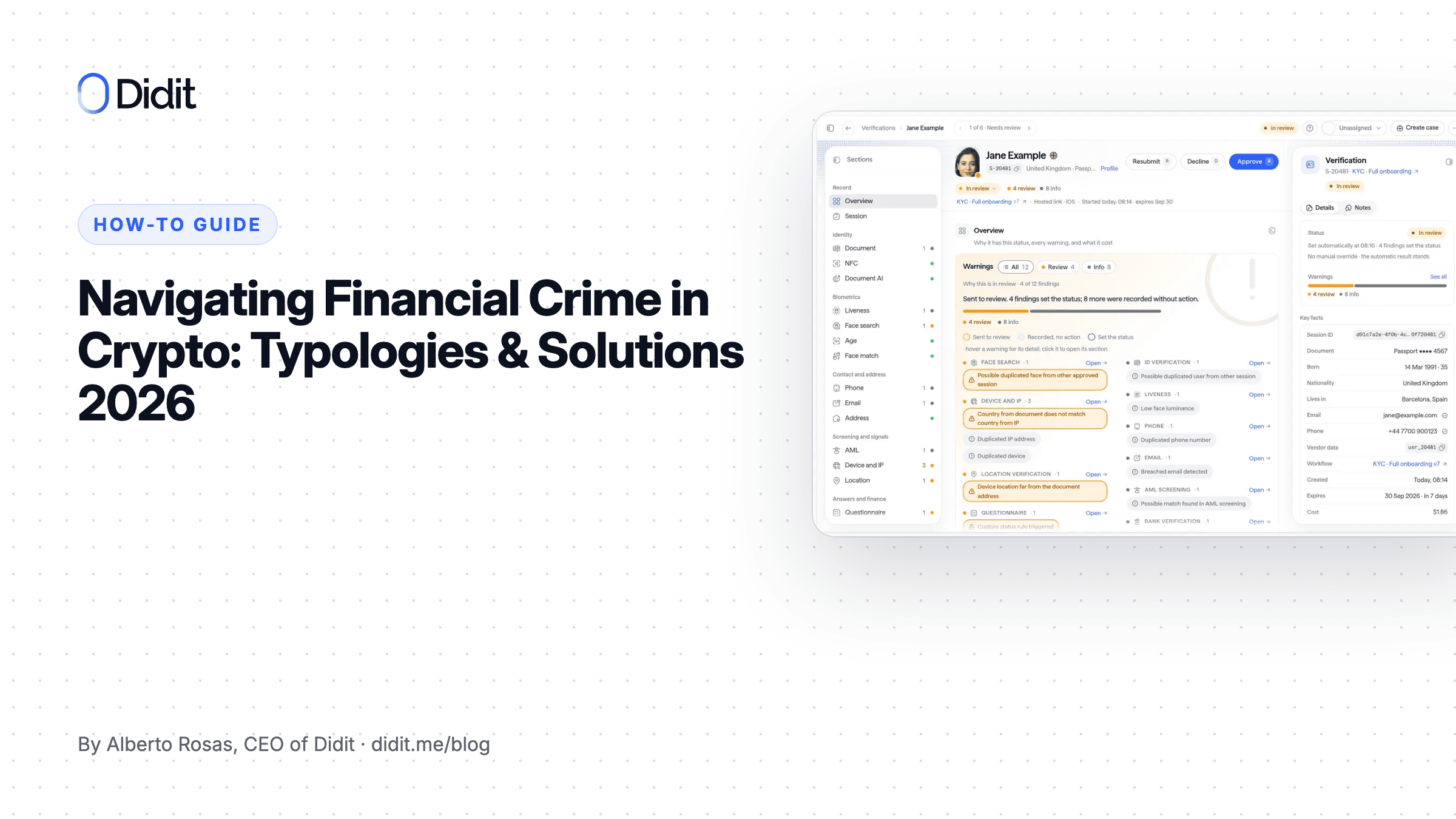
Crypto financial crime shows up in mixers, chain hopping, P2P off-ramps, sanctions evasion and ransomware. Didit screens the person at $0.20 per check, the wallet at $0.15 per screening, scores each transfer at $0.001 beyond.
Alberto RosasMar 12, 2026Comparing KYC Software for Global Enterprise Deployment
Selecting the right Know Your Customer (KYC) software for global enterprise deployment is critical for compliance, fraud prevention, and user experience.
Alberto RosasMar 12, 2026Ethical AI in Sanctions Screening: Mitigating Bias for Fair Compliance
Ethical AI is crucial in sanctions screening to prevent bias and ensure fair compliance. Traditional systems can perpetuate discrimination, leading to false positives and negative impacts.
Alberto RosasMar 12, 2026Global PEP Screening Beyond Sanctions: AI Graph Analysis
Discover how AI graph analysis elevates PEP screening beyond traditional sanctions checks, enhancing risk detection. Learn about the complexities of identifying politically exposed persons and how advanced technology provides a.
Alberto RosasMar 12, 2026Passport MRZ vs. NFC Scanning for Global Onboarding (2026)
Didit runs MRZ and NFC in one session: ID check $0.15, NFC add-on $0.15, full KYC $0.33. Regula publishes no price and lists 254 countries. NFC needs a native SDK and an NFC phone;
Alejandro RosasMar 12, 2026Building Resilient Webhook Consumers for Identity Verification
Learn best practices for designing robust webhook consumers in identity verification workflows. This guide covers idempotency, error handling, security, and scaling, ensuring your systems reliably process critical verification.
Alberto RosasMar 12, 2026Digital Identity Verification in B2B Onboarding: KYB How-To (2026)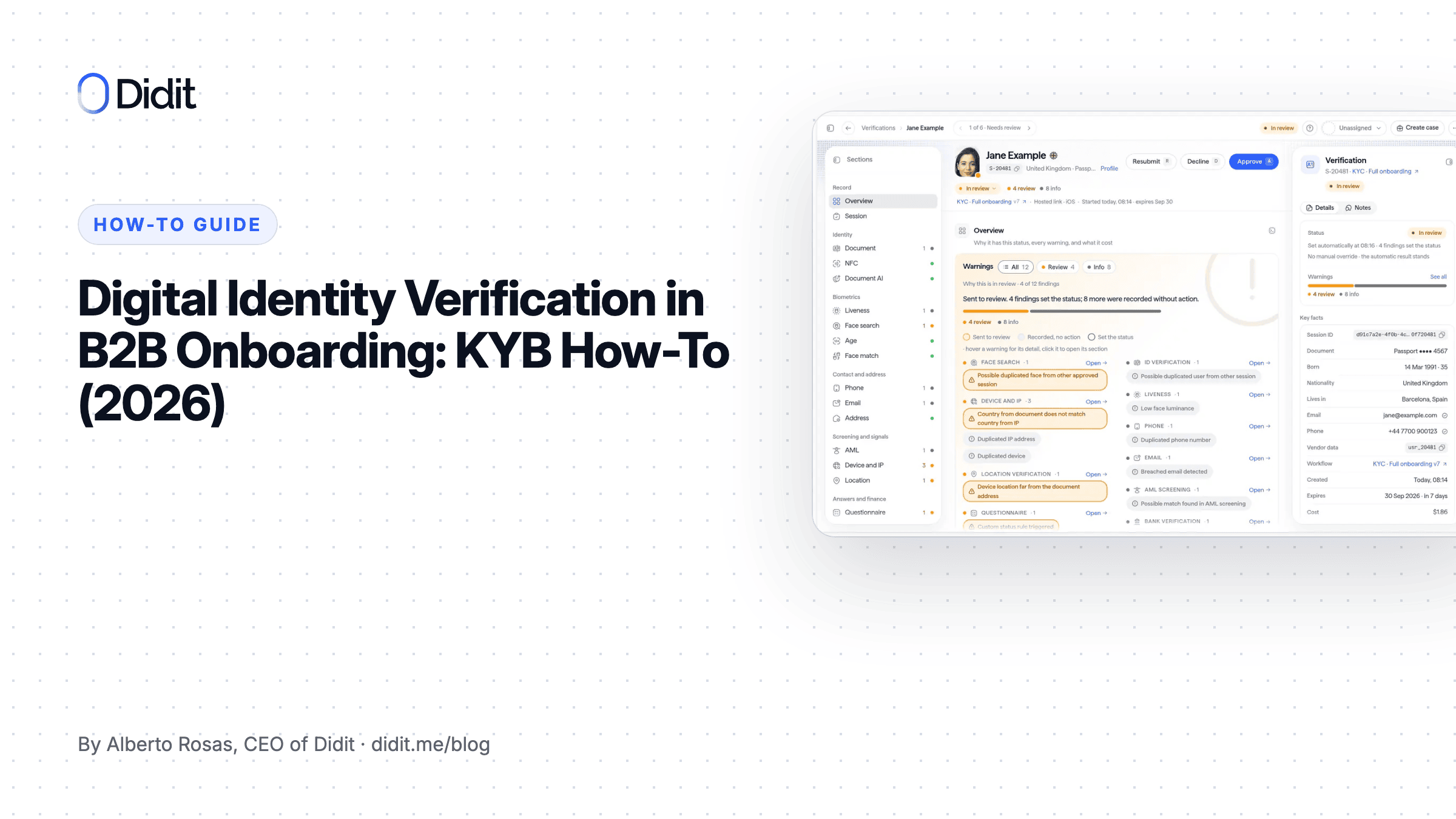
Create a Business Verification workflow in our console, start a session through our API, send the hosted flow to the company, and process status webhooks. From $2.00 per company registry retrieval, plus published add-ons.
Alberto RosasMar 12, 2026Integrating National Registry Verification with Legacy CRMs
Integrating national registry verification with legacy CRM systems presents unique challenges, from data format mismatches to security concerns.
Alejandro RosasMar 12, 2026Dynamic Risk-Based Orchestration for Cross-Border KYC
Implementing dynamic risk-based orchestration is crucial for effective cross-border Know Your Customer (KYC) compliance. This approach allows businesses to adapt verification processes based on real-time risk assessments.
Alberto RosasMar 12, 2026Database Validation for CDD in Emerging Markets
Emerging markets present unique challenges for Customer Due Diligence (CDD), often due to fragmented data and high fraud risks. Database validation is a critical tool for robust identity verification, enabling businesses to.
Alberto RosasMar 12, 2026Implementing Travel Rule for P2P Crypto Transfers: A Technical Guide
The FATF Travel Rule extends to P2P crypto transfers, posing significant technical and compliance challenges for Virtual Asset Service Providers (VASPs).
Alberto RosasMar 12, 2026Choosing an ePassport Verification Provider: A Technical Guide
Selecting an ePassport verification provider requires evaluating technical capabilities like NFC support, security protocols, data extraction accuracy, and global coverage.
Alberto RosasMar 12, 2026The Economic Case for Pay-Per-Successful-Check ID Verification
Unlock significant cost savings and operational efficiency with pay-per-successful-check identity verification models. This approach aligns costs with value, reduces wasted spend on failed verifications, and offers unparalleled.
Alberto RosasMar 12, 2026Choosing the Best Digital Identity Platform for Global Payment Orchestration
Global payment orchestration providers need robust digital identity platforms to ensure compliance, prevent fraud, and facilitate seamless transactions across diverse markets.
Alberto RosasMar 12, 2026Webhook Reliability: Retry and DLQ in 9 Steps (2026)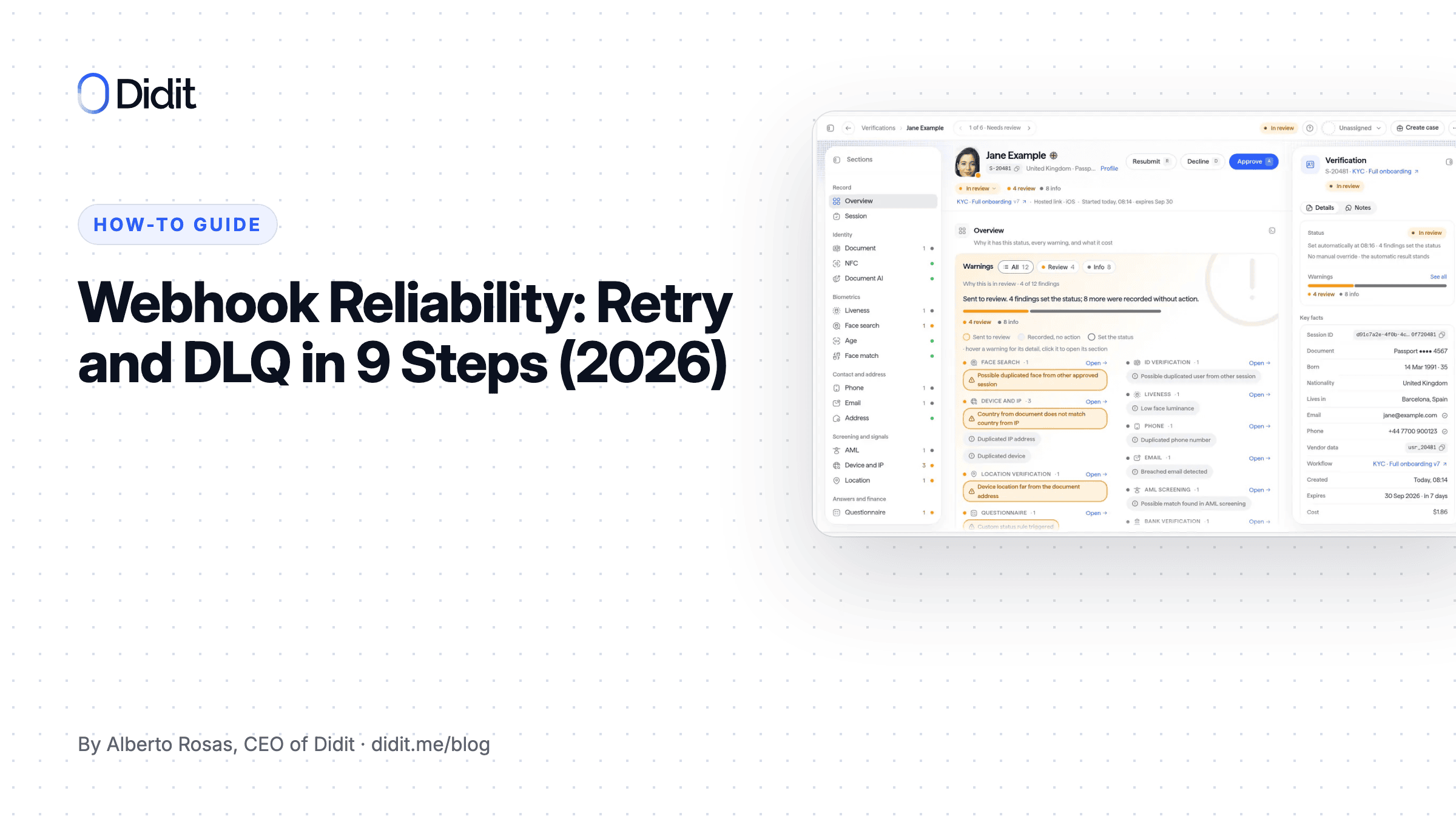
Verify the signature, answer 2xx fast, deduplicate on event ID, dead-letter events that need intervention, alert on destination health, and recover by reading the current decision instead of replaying a stale payload.
Alejandro RosasMar 12, 2026Verifiable Credentials & DIDs for Zero-Party Data Strategies
Explore how Verifiable Credentials (VCs) and Decentralized Identifiers (DIDs) are revolutionizing zero-party data strategies, empowering users with control over their personal information.
Alberto RosasMar 12, 2026Leveraging Webhooks for Dynamic Pricing in Subscriptions
Discover how webhooks can revolutionize dynamic pricing strategies for subscription services, enabling real-time adjustments based on user behavior, market conditions, or identity verification outcomes.
Alejandro RosasMar 12, 2026Architecting Zero-Trust Identity for SaaS Onboarding
Implement a Zero-Trust approach to SaaS onboarding to enhance security, reduce fraud, and improve user experience. This strategy verifies every user and device, leveraging continuous authentication and dynamic authorization.
Alberto RosasMar 12, 2026Programmatic Identity in CRM: Elevating Customer Journeys
Integrating programmatic identity verification directly into CRM systems revolutionizes customer journeys by automating trust and compliance.
Alberto RosasMar 12, 2026Modular AML Workflows: Powering FinTech Innovation with Flexibility
FinTechs need agile, scalable Anti-Money Laundering (AML) solutions to navigate complex regulatory landscapes and combat financial crime. Modular AML workflows offer the flexibility to adapt to evolving threats and regulatory.
Alberto RosasMar 12, 2026Composing KYC for the Cross-Border Gig Economy
The cross-border gig economy presents unique challenges for Know Your Customer (KYC) compliance, requiring robust yet flexible solutions. Companies need to navigate diverse regulations, prevent fraud, and ensure seamless.
Alberto RosasMar 12, 2026Programmatic Identity Attestation for CI/CD Pipelines
Integrating programmatic identity attestation into CI/CD pipelines is crucial for enhancing security and automating trust. This approach ensures that every step of the deployment process, from code commit to production, is.
Alberto RosasMar 12, 2026Optimizing AML Screening: Reducing False Positives with Didit
False positives in AML screening lead to significant operational inefficiencies and compliance burdens. This post explores the causes of high false positive rates, the critical role of configurable match scores, and strategies.
Alberto RosasMar 12, 2026Optimizing Developer Integration for National Registry Verification
Integrating with National Registry Verification APIs can be complex, but strategic development practices can streamline the process. This post explores common challenges and provides solutions for efficient, secure, and scalable.
Alberto RosasMar 12, 2026Digital Identity Proofing for Sovereign Citizens
Digital identity proofing for sovereign citizens presents unique challenges due to diverse documentation and privacy concerns. Secure, adaptable solutions are crucial.
Alberto RosasMar 12, 2026AI-Powered Adverse Media Screening: Beyond Keywords
Traditional adverse media screening falls short by relying solely on keywords, leading to false positives and missed risks. AI-powered solutions, like Didit's, move beyond this by employing contextual analysis, sentiment.
Alberto RosasMar 12, 2026Digital Identity for Metaverse Avatars: Proof of Personhood & Ownership
The metaverse promises immersive digital experiences, but robust digital identity for avatars is crucial for security, trust, and preventing fraud.
Alejandro RosasMar 12, 2026Brazil's eTítulo Verification: Securing Online Elections
Brazil's eTítulo app plays a crucial role in modernizing elections, but its online nature demands robust identity verification. Ensuring compliance and preventing fraud requires advanced solutions for secure digital.
Alberto RosasMar 12, 2026Balancing AI Explainability and Privacy with PETs
Achieving transparency in AI models while protecting sensitive data is a critical challenge. This post explores how Privacy-Enhancing Techniques (PETs) are essential for explainable AI (XAI), ensuring compliance with regulations.
Alberto RosasMar 12, 2026Empower Your Fraud Defenses: Build Your Own Blocklist with Modular Identity
Discover how to implement a powerful 'Bring Your Own Blocklist' (BYOB) feature using modular identity verification. This approach enhances fraud prevention by allowing businesses to proactively block known fraudsters and prevent.
Alberto RosasMar 12, 2026Case Study: Headless Identity Verification for PWAs
Discover how headless identity verification can transform Progressive Web Apps (PWAs) by offering seamless user experiences and robust security.
Alberto RosasMar 12, 2026White Label Identity Verification for MVNOs
MVNOs need robust, scalable, and brand-consistent identity verification to combat fraud, ensure compliance, and enhance customer onboarding.
Alberto RosasMar 12, 2026Questions
Blog questions
Who writes the Didit blog?
Which topics does the blog cover?
Is the blog available in my language?
Where do I find product updates?
Are these posts legal advice?
How do I find posts on one topic?
Are posts dated?
Do posts link to the docs?
Is the blog the same as the docs?
Compliance built in
Audited, certified and attested.
We hold the certifications and build each country's rules into your flows, so you can launch anywhere without worrying. Security and Compliance center
- Regulation encoded into your flows
Tell us what you do and where. Didit lists the rules that apply to you, with sources, and builds the checks each country needs into one workflow.
- Ready for AMLR
Every requirement of the new EU anti-money laundering rules, from checking customers to human review, is already covered by a Didit check.
- Tested in Spain's Treasury sandbox
Spain's Treasury published its supervised sandbox report on Didit's NFC plus active liveness onboarding; SEPBLAC took part and valued the added measures positively.
- Audited, not self-declared
iBeta Level 1 and Level 2. Liveness tested under ISO/IEC 30107-3.
Your obligations · 3 regions
 SOC 2 Type 2
 ISO 27001
 iBeta Level 1 and Level 2
 EU regulator attestation
 FSM youth protection
 GDPR
 EBA remote onboarding
 MiCA compatible
 FIDO Alliance member
- AMLREU AML Regulation ready
Integration · Didit MCP
Run Didit from your own AI agent
Connect Didit to Claude, Cursor, VS Code or ChatGPT and just ask in plain words. Your agent can do anything you can do in the console, with the same permissions you have.
 Add to Claude
 ChatGPT
 Cursor
- Build workflowsDescribe the checks you need. The agent creates and publishes the flow.
- Run investigationsAsk why a session was declined, review cases, search people and companies.
- Change rulesCreate payment rules, test them on past data and switch them on.
- Pull reportsAsk for numbers, exports or the audit log.
Didit Academy


