Blog
Blog archive
Every post on the Didit blog, newest first. Pick a category or search to find the subject you need.
All posts
Every post, newest first
Pick a category to filter.
As quantum computing advances, the need for robust, privacy-preserving identity management solutions becomes critical. This post explores how Post-Quantum Cryptography (PQC) can be integrated with privacy-by-design principles to.
Alberto RosasMar 14, 2026Interoperable Identity for Cross-Border Payments: The Future of KYC
Explore how interoperable identity frameworks, powered by eIDAS 2.0 and blockchain, are revolutionizing cross-border payments. This post dives into the technical architecture, benefits, and challenges of creating a secure.
Alberto RosasMar 14, 2026AI Agent Identity: Securing AI-to-AI Transactions
Explore the critical role of AI agent identity in securing autonomous AI-to-AI transactions. This post delves into the technical mechanisms, challenges, and solutions for establishing programmatic identity, ensuring trust.
Alberto RosasMar 14, 2026EUDIW Fraud Patterns: Early Signals for CTOs
The EUDI Wallet (EUDIW) promises a new era of digital trust, but CTOs must prepare for evolving fraud patterns. This post explores early signals of EUDIW fraud, from credential compromise to synthetic.
Alberto RosasMar 14, 2026From Concept to Code: Building a Test Harness for 10K/Day Verification APIs
Learn to build a robust API testing harness capable of handling 10,000+ verification API calls per day. This guide covers architecture, code patterns, and best practices for ensuring high-throughput identity verification API.
Alejandro RosasMar 14, 2026Navigating Data Harmonization for Cross-Border AML: A Tech Lead's Playbook
This playbook offers tech leads practical strategies for data harmonization in cross-border AML and KYC compliance. Explore architectural patterns, data schema design, API considerations, and integration tips to build robust.
Alberto RosasMar 14, 2026Why Your KYC Solution Fails Under Peak Load: Flash Sale Lessons
Discover why traditional KYC solutions struggle with high-throughput verification during peak demand like flash sales. Learn about architectural limitations, technical bottlenecks, and how modern identity orchestration platforms.
Alberto RosasMar 14, 2026Building a High-Throughput Verification Queue with Kafka & K8s
Discover how to design and implement a high-throughput verification queue using Apache Kafka and Kubernetes. This guide covers architectural patterns, reactive workflows, and best practices for scalable KYC and identity.
Alberto RosasMar 14, 2026API Security for Predicate Offense Data: A Technical Guide
Securing API access to predicate offense data is critical for compliance and trust. This technical guide explores best practices, architectural considerations, and implementation strategies for robust API security, ensuring.
Alejandro RosasMar 14, 2026Developer Guide: EDD SDK Integration for Robust Identity Verification
This comprehensive guide provides developers with insights into integrating Enhanced Due Diligence (EDD) SDKs, focusing on multi-factor identity verification, biometrics, and document verification.
Alejandro RosasMar 14, 2026Robust ICT Risk Management for Identity Verification Providers
Explore the critical role of ICT risk management in identity verification. This post delves into how providers like Didit implement ISO 27005 principles, robust cybersecurity measures, and digital resilience strategies to.
Alberto RosasMar 14, 2026Unlocking NFC eID Security: Understanding BAC Key Derivation
Dive deep into BAC key derivation, the cryptographic process securing NFC eIDs. Learn how ICAO 9303 standards leverage MRZ data to generate session keys, protecting sensitive identity data from unauthorized access and ensuring.
Alejandro RosasMar 14, 2026Combating Cross-Border Fraud in the Gig Economy
The gig economy, while offering flexibility, is a prime target for sophisticated cross-border fraud. This post explores common multi-account and identity abuse schemes, detailing how platforms can leverage advanced identity.
Alberto RosasMar 14, 2026Mastering Cross-Border Payments Identity Orchestration
The complexities of cross-border payments demand sophisticated identity orchestration. This post explores how advanced platforms streamline KYC/AML, ensure PSD3 compliance, and enable MiCA zero-retention KYC for global financial.
Alberto RosasMar 14, 2026Verifiable Credentials for Enhanced Due Diligence (EDD)
Explore how Verifiable Credentials (VCs) are revolutionizing Enhanced Due Diligence (EDD) by offering a privacy-preserving, efficient, and secure approach to identity verification and compliance.
Alberto RosasMar 14, 2026AML Cost Optimization: The Power of Pay-Per-Success Compliance
Discover how pay-per-success AML solutions are revolutionizing compliance cost optimization. This post explores the inefficiencies of traditional models, the benefits of usage-based pricing, and how businesses can achieve.
Alberto RosasMar 14, 2026Boost Security: SIM Swap Prevention with Phone Intelligence
SIM swap fraud is a growing threat, but advanced phone intelligence offers a robust defense. This post explores how HLR lookups, device signals, and other technologies can proactively detect and prevent SIM swap attacks.
Alberto RosasMar 14, 2026Boosting API Security for Verifiable Credentials with mTLS & Zero-Trust
This post dives deep into enhancing API security for Verifiable Credentials (VCs) using mTLS and Zero-Trust principles. Learn best practices for developers, including robust authentication, authorization, and data protection.
Alejandro RosasMar 14, 2026The Evolution of Identity Data Schemas: ICAO 9303 to Verifiable Credentials
Explore the journey of identity data schemas from the foundational ICAO 9303 standard for machine-readable travel documents to the cutting-edge of Verifiable Credentials.
Alberto RosasMar 14, 2026API Security for Multi-Party Computation in Federated Identity
Dive deep into the critical aspects of API security for Multi-Party Computation (MPC) within federated identity systems. This guide covers architecture, zero-trust principles, and practical implementation strategies to build.
Alejandro RosasMar 14, 2026Predictive ID Scoring: Revolutionizing Investor Accreditation
Discover how predictive identity scoring enhances investor accreditation for P2P lending and private equity platforms. This blog delves into advanced fraud reduction, efficient verification of high-net-worth individuals, and.
Alberto RosasMar 14, 2026Invisible IDV: The Future of Smart City Identity Verification
Explore how invisible identity verification (IDV) will transform smart cities, enabling seamless, secure, and privacy-preserving interactions.
Alberto RosasMar 14, 2026Zero-Knowledge Proof Humanity: The Future of Privacy-Preserving Verification
Explore how Zero-Knowledge Proof (ZKP) humanity verification offers a revolutionary approach to distinguishing humans from bots online, ensuring privacy and security.
Alberto RosasMar 14, 2026MLOps for Identity Verification: Building Robust AI Systems
Dive into MLOps for identity verification, exploring how to operationalize machine learning models for fraud detection and compliance. Learn about architecture, data pipelines, model deployment, and continuous monitoring to.
Alberto RosasMar 14, 2026Streamline Your Global KYC: Cross-Border Onboarding Optimization
Optimize cross-border onboarding with a robust global KYC architecture. Learn how unified platforms, NFC database validation, and smart workflow orchestration reduce costs, enhance conversion, and ensure compliance for.
Alberto RosasMar 14, 2026Real-time Sanctions Screening for HFT: A WebSockets Approach
Explore how WebSockets enable ultra-low-latency real-time sanctions screening for High-Frequency Trading (HFT) firms. This technical guide covers architecture, implementation, and best practices for integrating compliance into.
Alberto RosasMar 14, 2026The CTO's Toolkit: Engineering Controls for Fraud Prevention & Corporate Liability
CTOs face increasing pressure to protect their organizations from sophisticated fraud schemes while managing corporate liability. This post explores a strategic toolkit of engineering controls, identity orchestration, and.
Alberto RosasMar 14, 2026Barcode Decoding for Document Authentication (2026 How-To)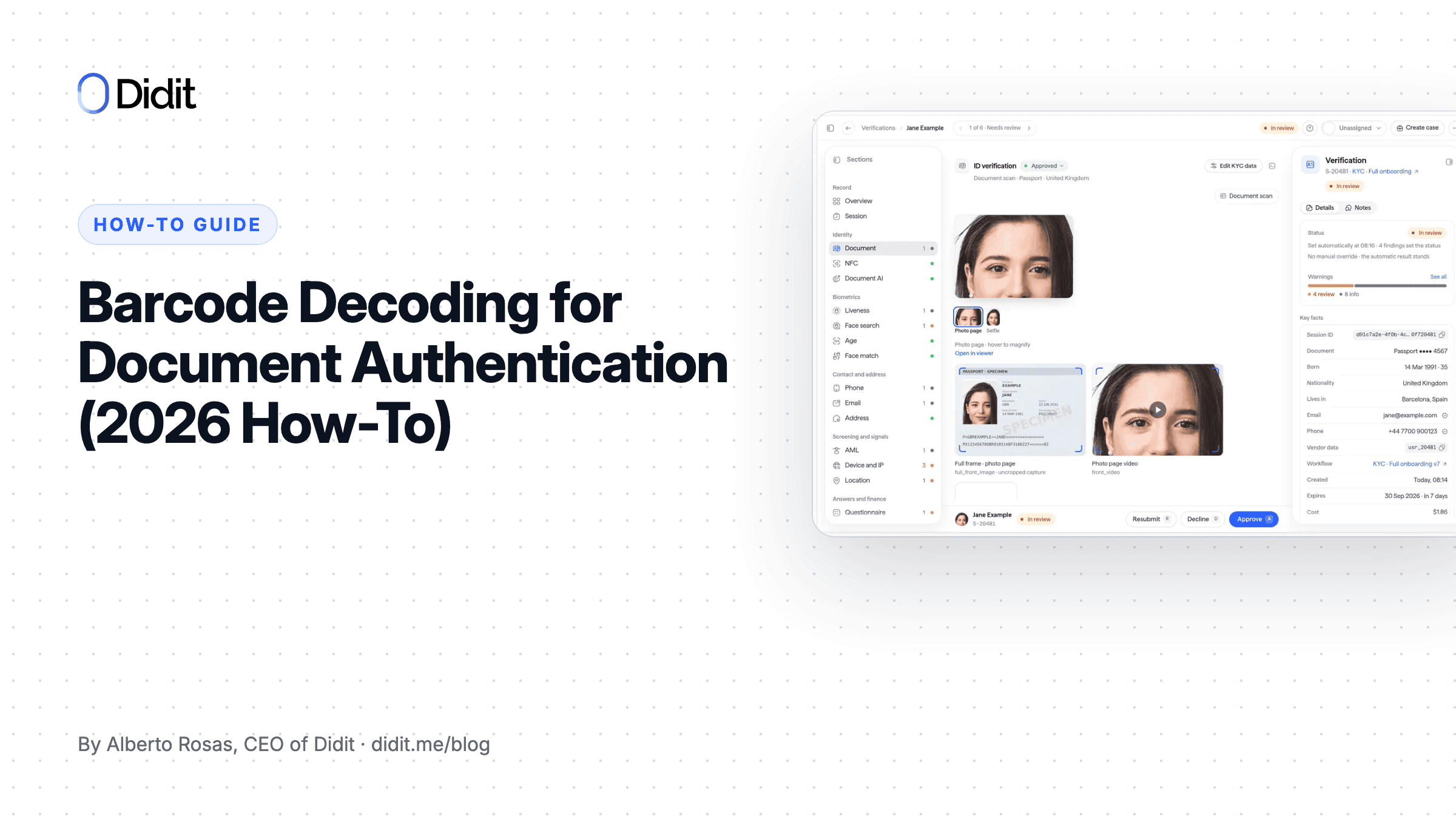
Send front and back images of an ID document to Didit's ID Verification API, read the decoded barcodes array, and compare it with the visual fields and the MRZ. $0.15 per check inside a workflow, $0.20 on the standalone API.
Alberto RosasMar 14, 2026eIDAS 2.0 Developer Guide: Building Compliant IDV Workflows
This comprehensive eIDAS 2.0 developer guide explores the technical considerations for implementing compliant identity verification (IDV) workflows.
Alejandro RosasMar 14, 2026Mastering Cross-Border Fraud Orchestration in MENA's Gig Economy
The MENA gig economy is booming, but so is cross-border fraud. This post explores the unique challenges and strategic solutions for fraud orchestration, emphasizing the critical role of identity signals and advanced prevention.
Alberto RosasMar 14, 2026Automated Data Harmonization for Cross-Border AML Compliance
Achieving seamless cross-border Anti-Money Laundering (AML) compliance, especially with regulations like the Travel Rule, demands robust data harmonization.
Alberto RosasMar 14, 2026iGaming SDK Integration: Mastering Player Lifecycle Verification
This deep dive explores iGaming SDK integration for robust player lifecycle management, focusing on identity verification, fraud prevention, and compliance.
Alejandro RosasMar 14, 2026Ethical AI in Geolocation Compliance: Navigating iGaming Challenges
Explore the critical role of ethical AI in geolocation compliance for iGaming, focusing on technical mechanisms, data privacy, and mitigating false positives.
Alejandro RosasMar 14, 2026Automated Fraud Remediation: Building Real-time Defenses
Explore how automated fraud remediation and real-time fraud response can transform your security posture. This guide for developers and CTOs covers the architecture, API design, and programmatic fraud workflows needed to build.
Alberto RosasMar 14, 2026Mastering Global IDV Coverage: A Strategic Guide for International Expansion
Expanding globally requires a robust global IDV coverage strategy. This guide explores how businesses can navigate the complexities of international identity verification, offering insights into balancing cost, compliance, and.
Alberto RosasMar 14, 2026Boost Cross-Border Onboarding: KYC Localization & APAC Conversion
Optimize your cross-border onboarding conversion rates, especially in APAC, by understanding the critical role of KYC localization and adapting identity verification to regional differences.
Alberto RosasMar 14, 2026Optimizing Document Coverage: Boosting ROI in Global Expansion
Expanding globally introduces unique identity verification challenges, especially regarding document coverage. This post explores the strategic importance of comprehensive document coverage, its impact on conversion rates and.
Alberto RosasMar 14, 2026Image Signal Processing: The Front Line of Document Forgery Detection
Explore how advanced image signal processing techniques are revolutionizing document forgery detection. This post delves into the technical mechanisms behind identifying altered ID documents, from spectral analysis to noise.
Alberto RosasMar 14, 2026Boosting Digital Operational Resilience with Identity Verification
Digital Operational Resilience Act (DORA) compliance is crucial for financial entities. This post explores how robust identity verification platforms are essential for DORA readiness, protecting against cyber threats, and.
Alberto RosasMar 14, 2026Distributed Consensus: The Future of Digital Identity Architecture
Explore how distributed consensus mechanisms are revolutionizing digital identity. This post delves into the technical underpinnings, benefits, and challenges of distributed identity, and how it fosters a more secure, private.
Alejandro RosasMar 14, 2026Wearable Biometrics: Invisible Identity Verification How-To 2026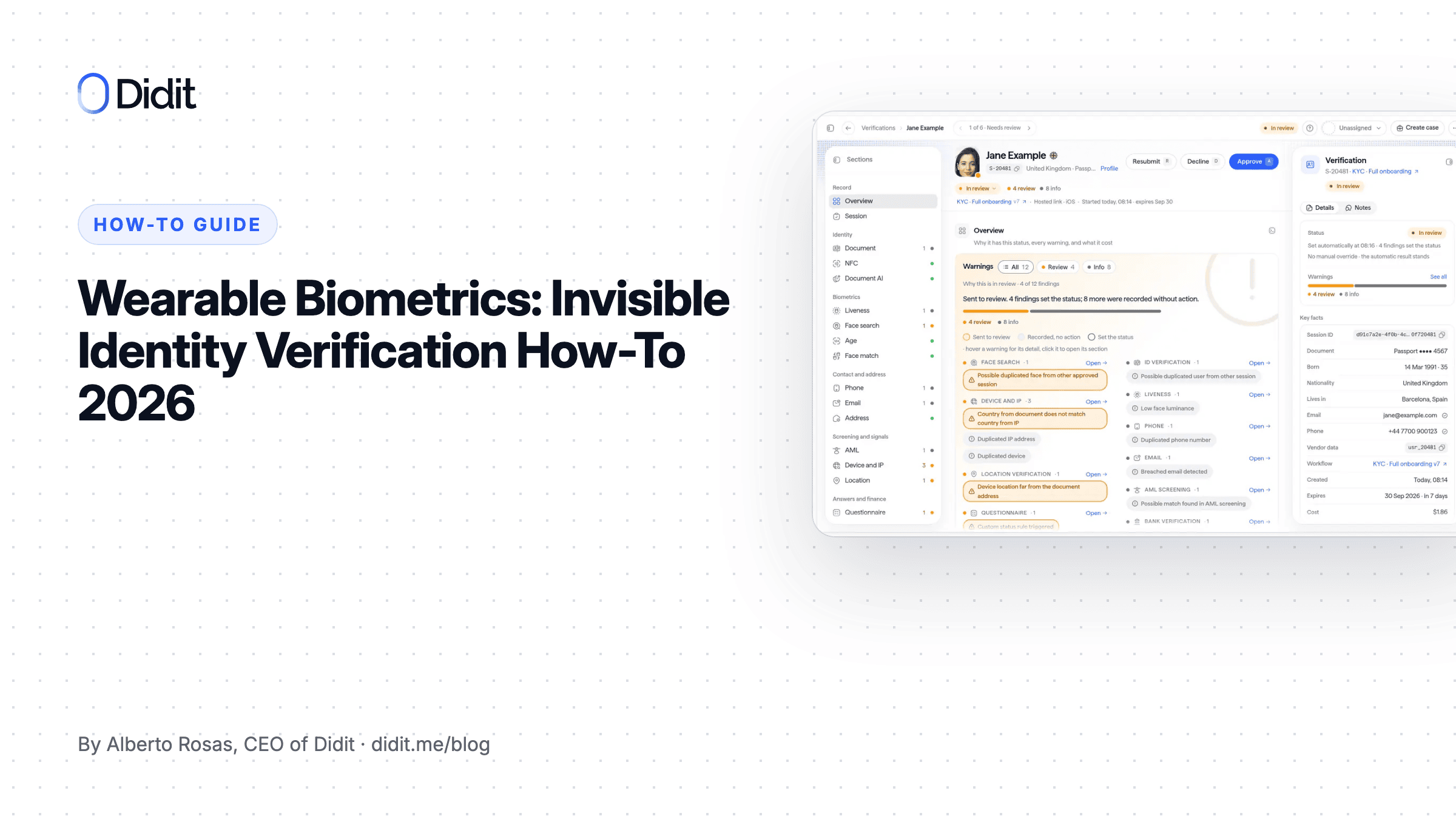
Use the wearable as the trigger, not the biometric: enrol once with a $0.33 full KYC, then run $0.10 biometric authentication step-ups on device events, and read each decision from the session or webhook.
Alberto RosasMar 14, 2026NFC Supply Chain Traceability and Product Authentication
NFC traceability needs two layers: a tag for the object and a verified identity for the person scanning. Didit reads e-passport and eID chips for a $0.15 add-on to a $0.33 full ID check.
Alejandro RosasMar 14, 2026KYC AML Fines: A Post-Mortem Analysis of Regulatory Breaches
Explore the critical lessons learned from significant KYC AML fines and financial institution penalties. This post-mortem analysis breaks down common compliance failures, regulatory expectations, and how businesses can.
Alberto RosasMar 14, 2026Data Residency & Biometric SDKs: A Critical Guide
Understanding data residency requirements is paramount for businesses deploying biometric SDKs. This guide explores the impact of data localization laws on biometric data, operational considerations, and how platforms like Didit.
Alejandro RosasMar 14, 2026Failure to Prevent: The Gaps in Your Fraud Prevention Stack
Many organizations struggle with fraud despite investing in various prevention tools. This article explores common pitfalls in fraud prevention technology stacks, from fragmented solutions to outdated methods, and highlights the.
Alberto RosasMar 14, 2026Federated AI: The Future of Deepfake Detection in Identity
Deepfakes pose a growing threat to digital identity verification. This post explores how Federated AI offers a robust, privacy-preserving solution for enhanced deepfake detection across multiple identity providers, ensuring.
Alejandro RosasMar 14, 2026Quantum-Safe IDV Procurement: A Compliance Officer's Guide
Compliance officers face a growing challenge with the advent of quantum computing: ensuring identity verification (IDV) systems remain secure against future threats.
Alberto RosasMar 14, 2026Dynamic DORA Reporting with Automated Identity Audit Trails
The Digital Operational Resilience Act (DORA) demands robust reporting and audit trails for financial entities. This post explores how automated identity platforms like Didit can streamline DORA compliance by providing dynamic.
Alberto RosasMar 14, 2026Dynamic Friction & PQC for Regulatory Sandboxes
Explore how dynamic friction orchestration ensures secure and compliant innovation within regulatory sandboxes, especially with the emerging threat of Post-Quantum Cryptography (PQC).
Alberto RosasMar 14, 2026GDPR-Compliant Identity Data Lakes: Rules, Retention, Costs 2026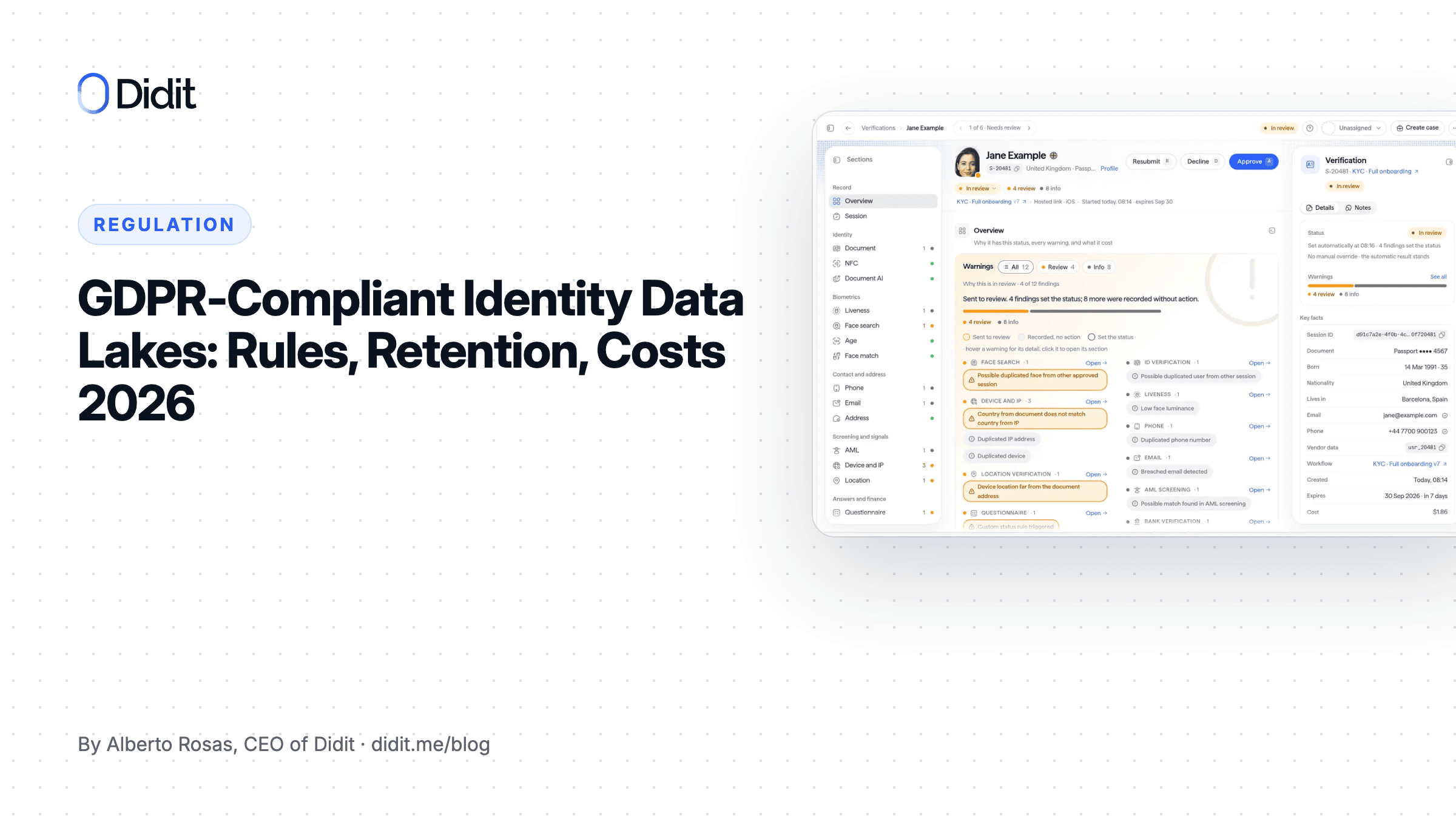
A GDPR identity data lake needs a lawful basis per purpose, a retention clock per record and an erasure call that works. Didit supplies the processor controls; you stay the controller.
Alberto RosasMar 14, 2026Real-time Responsible Gambling Controls: An Architectural Blueprint
Discover how robust architectural design, leveraging advanced identity verification and real-time data processing, can create effective responsible gambling controls.
Alejandro RosasMar 14, 2026Designing a Reusable KYC SDK for eIDAS2 & Verifiable Credentials
Explore the architectural considerations and implementation strategies for building a robust Reusable KYC SDK. This post delves into eIDAS2 compliance, verifiable credentials, and credential wallet APIs, offering developers.
Alberto RosasMar 14, 2026Unlock the ROI of a Custom KYC Workflow Builder
Discover how a custom KYC workflow builder can significantly reduce operational costs, accelerate customer onboarding, and optimize compliance processes.
Alberto RosasMar 14, 2026Integrating Reusable KYC with Traditional IAM Systems: A Developer's Blueprint
This post provides a developer's blueprint for integrating reusable KYC solutions with existing Identity and Access Management (IAM) systems.
Alejandro RosasMar 14, 2026The High Cost of Travel Rule Implementation Gaps
Travel Rule implementation gaps are costing VASPs dearly, leading to increased compliance costs, operational inefficiencies, and eroded trust in the crypto ecosystem.
Alberto RosasMar 14, 2026Optimizing Mobile SDK Performance for Deepfake Detection
Learn how to optimize mobile SDK performance for low-latency deepfake and liveness detection. This guide covers architectural choices, efficient data handling, hardware acceleration, and integration best practices for developers.
Alejandro RosasMar 14, 2026Navigating ICT Risk in AI-Powered Identity Systems
AI-powered identity systems offer immense benefits but introduce complex ICT risks. This post explores key challenges like data privacy, bias, and deepfake threats, providing strategies for robust risk management.
Alberto RosasMar 14, 2026Build vs. Buy: The True Cost of In-House Identity Data Harmonization
Building and maintaining an in-house identity data harmonization system can seem appealing, but it often carries hidden costs and significant risks.
Alberto RosasMar 14, 2026Flash Sales Face-Off: High-Throughput Identity Verification Links
Discover how high-throughput identity verification links are crucial for securing flash sales and preventing bot attacks. Learn practical strategies for optimizing conversion rates while maintaining robust security and.
Alberto RosasMar 14, 2026Continuous AML Monitoring: Optimize Costs & Boost Compliance
Discover how continuous AML monitoring can drastically reduce compliance costs while enhancing fraud detection and regulatory adherence. This guide provides actionable strategies, ROI insights, and a comparative analysis of.
Alberto RosasMar 14, 2026Blockchain Identity for Micro-Finance: Decentralized Trust
Blockchain identity solutions are revolutionizing micro-finance by enabling secure, verifiable identities for underserved populations, fostering trust in decentralized lending.
Alberto RosasMar 14, 2026Unlocking Financial Services for Informal Economies
Probabilistic identity offers a powerful solution for integrating individuals in informal economies into mainstream financial services. By leveraging diverse data points and AI, it creates reliable digital identities, fostering.
Alberto RosasMar 14, 2026API Gateways: Orchestrating DORA-Compliant Identity Services
This blog post explores the critical role API gateways play in building DORA-compliant identity services, especially in the context of advanced identity verification platforms like Didit.
Alejandro RosasMar 14, 2026Architecting Data Minimization in Alternative ID Verification
Data minimization is crucial for privacy and security in identity verification. This blog explores strategies for implementing data minimization in alternative ID verification methods, focusing on Didit's approach to secure.
Alberto RosasMar 14, 2026Bridging the Digital Divide: Regional Gaps in Mobile IDV Adoption
Mobile identity verification (IDV) is crucial for digital inclusion, yet its adoption varies significantly across regions. This post explores the factors contributing to these disparities, including infrastructure, regulation.
Alberto RosasMar 14, 2026Fortifying Multi-Cloud Identity: API Security Essentials
Securing APIs in a multi-cloud environment is critical for managing identity effectively. This post explores the challenges of multi-cloud identity, the fundamental principles of API security, and practical strategies to protect.
Alejandro RosasMar 14, 2026Mastering ICT Risk in Identity with Orchestration
The digital landscape is fraught with ICT risks, especially concerning identity. This blog post delves into how identity orchestration platforms like Didit are crucial for mitigating these risks, ensuring security, compliance.
Alberto RosasMar 14, 2026Mastering Hybrid Cloud Identity Orchestration with Didit
Hybrid cloud environments present unique challenges for identity management. This post explores the complexities of integrating on-premise and cloud identities, the pitfalls of fragmented systems, and how a unified identity.
Alberto RosasMar 14, 2026Securing Webhooks with Post-Quantum Cryptography (PQC)
Explore how to implement post-quantum secure webhooks to protect sensitive data transfers against future quantum attacks. This guide covers the architectural shifts, cryptographic primitives, and practical steps developers need.
Alejandro RosasMar 14, 2026Optimizing Device Intelligence for Low-Resource Environments
Discover how to implement effective device intelligence in emerging markets and low-bandwidth regions. This guide provides technical strategies for developers, focusing on data minimization, asynchronous processing, and edge.
Alberto RosasMar 14, 2026Modular Identity: The Future of Brand Safety in the AI Era
The rise of AI-generated content poses significant brand safety challenges. This post explores how modular identity verification, proof of humanity tools, and sophisticated content moderation strategies can protect brands from.
Alberto RosasMar 14, 2026Micro-Permissions & ZKP: Securing IoT with Zero-Trust Access Control
Explore how micro-permissions and Zero-Knowledge Proofs (ZKPs) are revolutionizing access control for IoT devices and supply chains. This post delves into the challenges of traditional access models, the benefits of granular.
Alberto RosasMar 14, 2026Age Estimation Accuracy vs Regulation: Compliance Guide 2026
Selfie age estimation costs $0.10 per check at Didit and reaches a 1.1-year mean absolute error at ages 16 to 17, but a model-predicted age is not legal proof. A full ID check fallback is $0.33.
Alberto RosasMar 14, 2026AI Agent Liveness Detection: Securing the Future of Human Verification
As AI agents become more sophisticated, the need for robust AI agent liveness detection has never been more critical. This post explores how advanced biometric technologies are evolving to distinguish real humans from.
Alejandro RosasMar 14, 2026The True Cost of Compliance Debt: Why Fragmented Identity Costs You More
Compliance debt, stemming from fragmented identity verification and manual KYC processes, significantly impacts a company's bottom line. This article explores the hidden costs, from operational inefficiencies to decreased.
Alberto RosasMar 14, 2026Mitigating Single-Vendor KYC Risk: A Strategic Imperative
Relying on a single vendor for your Know Your Customer (KYC) operations can expose your business to significant financial, operational, and reputational risks.
Alberto RosasMar 14, 2026Unlock the ROI of Multi-Vendor Identity Orchestration
Discover how a single integration identity platform like Didit optimizes the ROI of multi-vendor identity orchestration, reduces operational costs, and enhances user experience.
Alberto RosasMar 14, 2026API Design for Granular Identity Disclosure in EUDI Wallets
The EUDI Wallet promises a new era of digital identity, offering granular control over personal data. This post explores critical API design principles to ensure users can selectively disclose.
Alejandro RosasMar 14, 2026Open-Source DID Protocols for CASP Compliance: A Deep Dive
Explore how Open-Source Decentralized Identifier (DID) protocols can revolutionize CASP compliance. This post delves into the technical aspects, benefits, and challenges of using DIDs for enhanced security, privacy, and.
Alberto RosasMar 14, 2026NFC eID Verification with Serverless Architectures
Discover how to integrate NFC eID verification into serverless architectures for scalable, secure, and cost-effective identity checks. This guide covers the benefits, technical implementation, and practical considerations for.
Alejandro RosasMar 14, 2026FinTech CTO's Guide: Mastering Identity Orchestration
FinTech CTOs face unique challenges in identity management, balancing security, compliance, and user experience. This guide explores how identity orchestration platforms streamline complex identity verification processes.
Alberto RosasMar 14, 2026Unlock Instant Identity: NFC Verification with Edge Computing
Discover how Didit's low-latency NFC verification, powered by edge computing, revolutionizes identity checks. This blog explores the technology, benefits, and practical applications of combining NFC document reading with.
Alberto RosasMar 14, 2026Micro-Permissions: The Future of Federated Data Access
Discover how micro-permissions are revolutionizing federated data access, offering granular control, enhanced security, and streamlined compliance.
Alberto RosasMar 14, 2026Unlock ROI: Programmable Identity Orchestration for Compliance-as-Code
Discover how programmable identity orchestration transforms compliance from a cost center into a strategic asset. Learn about the significant ROI through reduced operational costs, faster onboarding, and enhanced fraud prevention.
Alberto RosasMar 14, 2026API Security for Sensitive Identity Data: 8 Steps for 2026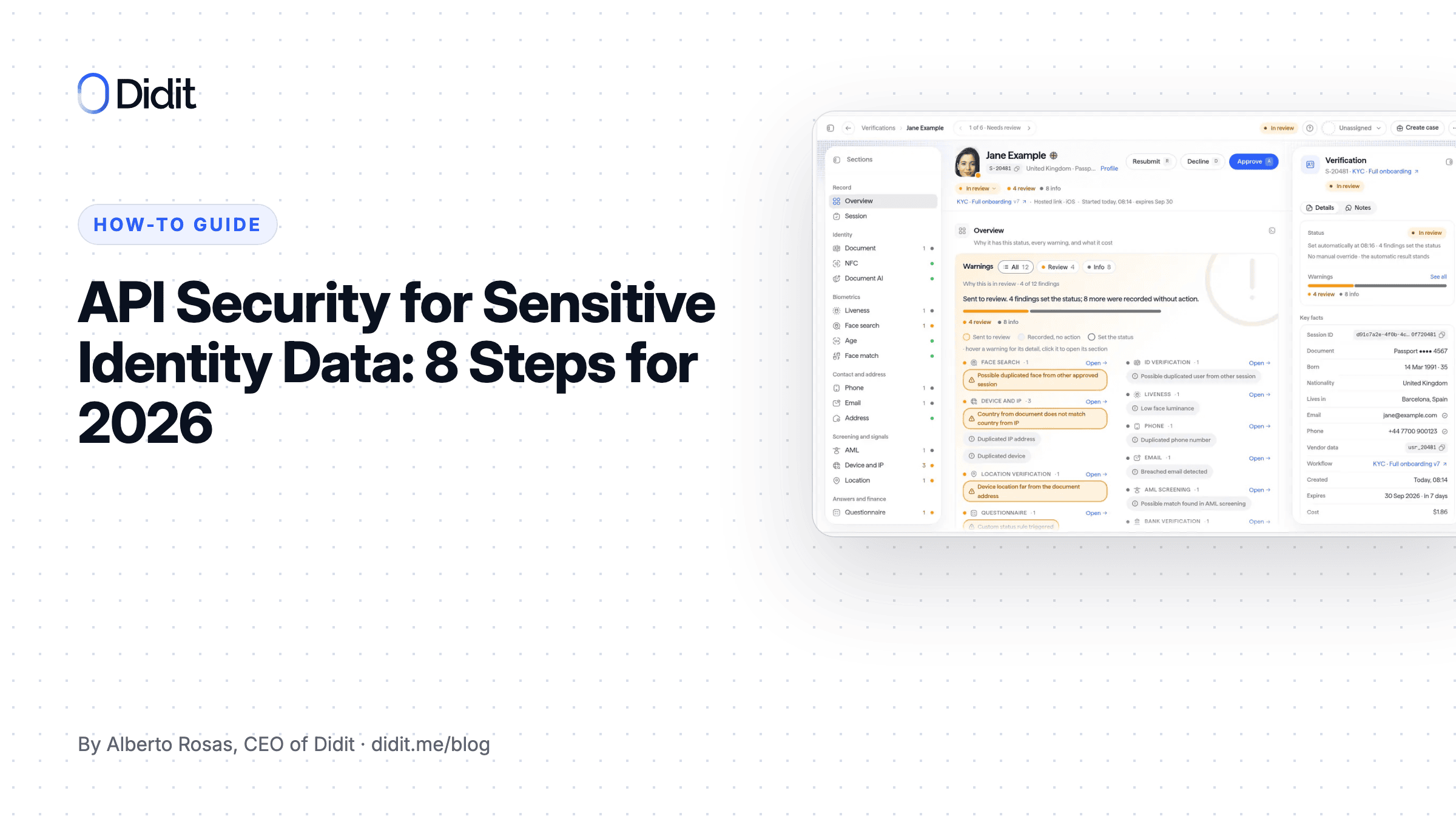
Secure identity APIs with server-side scoped keys, HMAC signed webhooks, retry-aware error handling and configurable retention. A full Didit KYC check is $0.33 and the sandbox is free.
Alejandro RosasMar 14, 2026Building Trust: The Core of Marketplace Safety Engineering
Marketplace trust and safety engineering is paramount for platform success, focusing on robust identity verification, fraud prevention, and compliance.
Alberto RosasMar 14, 2026Beyond PEP Screening: Advanced Adversarial Network Detection
Traditional PEP screening alone is no longer sufficient to combat sophisticated financial crime. This post explores the limitations of standard PEP checks and introduces advanced adversarial network detection techniques.
Alberto RosasMar 14, 2026Proof of Funds Verification in Emerging Markets: Challenges & Solutions
Verifying proof of funds (PoF) in emerging markets presents unique challenges due to diverse financial infrastructures, regulatory landscapes, and prevalence of informal economies.
Alberto RosasMar 14, 2026IP Telemetry & Identity: The Future of Dynamic Fraud Prevention
Integrating IP telemetry with identity verification creates a powerful synergy for dynamic fraud prevention. This approach allows businesses to detect and mitigate sophisticated attacks, enhance user experience, and ensure.
Alberto RosasMar 14, 2026Two-Sided Verification for Online Marketplaces: 2026 How-To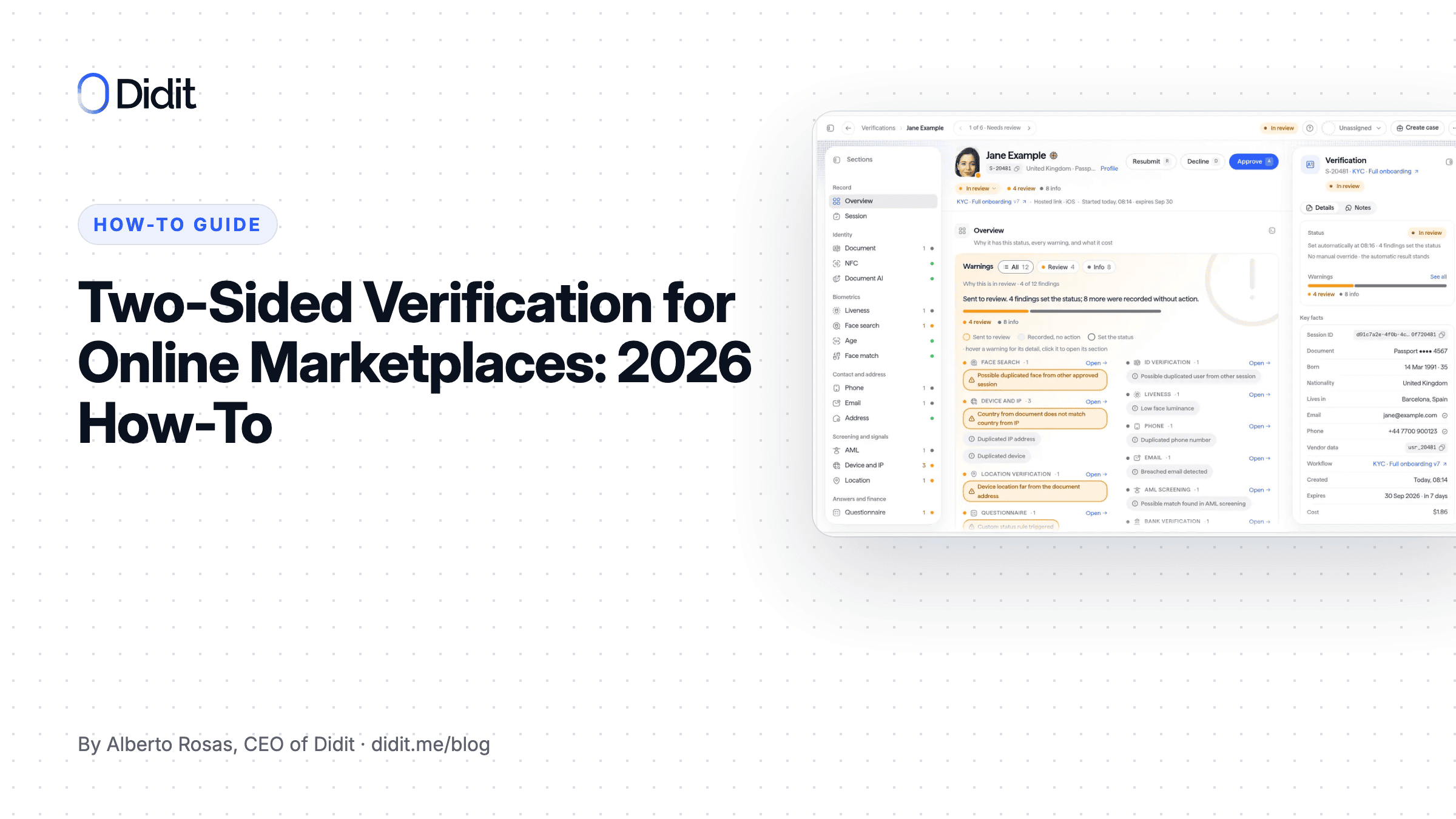
Verify buyers and sellers at the point of risk. A full Didit ID check costs $0.33. Add AML screening and proof of address for a $0.73 individual seller flow.
Alberto RosasMar 14, 2026Device vs Browser Fingerprinting: Key Differences (2026)
Browser fingerprinting recognizes a browser configuration. Device fingerprinting uses browser or app signals to find repeat device use. Didit adds device and IP analysis to its hosted flow at $0.03, part of a $0.33 full ID.
Alejandro RosasMar 14, 2026Injection Attacks: A Growing Threat to Biometric Security
Injection attacks pose a significant and evolving threat to biometric systems, exploiting vulnerabilities to bypass or manipulate authentication.
Alberto RosasMar 14, 2026Orchestrating Adaptive Friction in AI Agent Workflows
As AI agents become more sophisticated, integrating adaptive friction into their workflows is crucial for security, compliance, and user experience.
Alberto RosasMar 14, 2026Automated Policy Enforcement for AI Agent Permissions
The rise of AI agents necessitates robust, automated policy enforcement for their permissions. This blog post explores the challenges of managing AI agent access, the core principles of effective policy enforcement, and how a.
Alberto RosasMar 14, 2026Levels of Assurance in Digital Identity: How to Prove LoA in 2026
A level of assurance is the evidence behind an identity claim. Map the risk to a method, prove it with document, lookup or wallet checks, and read the assurance tier on the session.
Alberto RosasMar 14, 2026IP Anomaly Detection: Wire It Into a Verification Flow
Device and IP Analysis runs inside every Didit verification session for $0.03 per check. Create a session, read the per-session IP analysis report and its LOCATION warnings, then branch on the risk codes.
Alejandro RosasMar 14, 2026Navigating the Legal Landscape of Alternative Credentials
Alternative credentials like digital badges and micro-certifications are gaining traction, but their legal standing is complex. This article explores the essential legal frameworks, regulatory challenges, and best practices for.
Alberto RosasMar 14, 2026Data Resiliency for Global Identity Platforms
In an increasingly interconnected world, data resiliency is paramount for global identity platforms. This post explores the critical importance of robust data strategies, covering topics like distributed architecture, disaster.
Alberto RosasMar 14, 2026Optimizing SDK Performance for Edge AI: A Developer's Guide
Pick the native Didit SDK over WebView, pin 4.15.4, create sessions on your backend, respect rate limits and read decisions from webhooks. A full ID check is $0.33 per completed check.
Alejandro RosasMar 14, 2026Corporate Liability for AI-Generated Fraud: What You Need to Know
The rise of AI-generated fraud presents significant legal and financial risks for businesses. This post explores the evolving landscape of corporate liability, examining how companies can be held accountable for fraudulent.
Alberto RosasMar 14, 2026Questions
Blog questions
Who writes the Didit blog?
Which topics does the blog cover?
Is the blog available in my language?
Where do I find product updates?
Are these posts legal advice?
How do I find posts on one topic?
Are posts dated?
Do posts link to the docs?
Is the blog the same as the docs?
Compliance built in
Audited, certified and attested.
We hold the certifications and build each country's rules into your flows, so you can launch anywhere without worrying. Security and Compliance center
- Regulation encoded into your flows
Tell us what you do and where. Didit lists the rules that apply to you, with sources, and builds the checks each country needs into one workflow.
- Ready for AMLR
Every requirement of the new EU anti-money laundering rules, from checking customers to human review, is already covered by a Didit check.
- Tested in Spain's Treasury sandbox
Spain's Treasury published its supervised sandbox report on Didit's NFC plus active liveness onboarding; SEPBLAC took part and valued the added measures positively.
- Audited, not self-declared
iBeta Level 1 and Level 2. Liveness tested under ISO/IEC 30107-3.
Your obligations · 3 regions
 SOC 2 Type 2
 ISO 27001
 iBeta Level 1 and Level 2
 EU regulator attestation
 FSM youth protection
 GDPR
 EBA remote onboarding
 MiCA compatible
 FIDO Alliance member
- AMLREU AML Regulation ready
Integration · Didit MCP
Run Didit from your own AI agent
Connect Didit to Claude, Cursor, VS Code or ChatGPT and just ask in plain words. Your agent can do anything you can do in the console, with the same permissions you have.
 Add to Claude
 ChatGPT
 Cursor
- Build workflowsDescribe the checks you need. The agent creates and publishes the flow.
- Run investigationsAsk why a session was declined, review cases, search people and companies.
- Change rulesCreate payment rules, test them on past data and switch them on.
- Pull reportsAsk for numbers, exports or the audit log.
Didit Academy


